Indigenous-made rings of the American Southwest serve as historical signposts of significant growth and change in jewelry design history. How rings develop tells us a great deal about Indian aesthetics in terms of construction and personal vision. Lacking a real tradition for metalworking, Native American smiths—initially Navajos and Pueblos—devised an impressive array of jewelry forms in a very short time. In the 19th century, early silversmiths emphasized primal shapes in adornment. For finger rings, the focal point for surface decoration was the central plate. Makers experimented with a variety of pleasing shapes before determining that an oval was one of the most popular.
The first smiths were skilled at adopting and adapting jewelry forms from Native cultures inside and outside their region. They also observed Spanish, Mexican and incoming European American settlers’ rings; the first Native finger rings were made with oval, square and rectangular shapes. In the first three decades of Native silversmithing, a preference emerged for oval shapes derived from outsider cameo, seal and signet rings. It’s interesting to note that these last three categories of rings were perceived as representations of reflected power or identity.
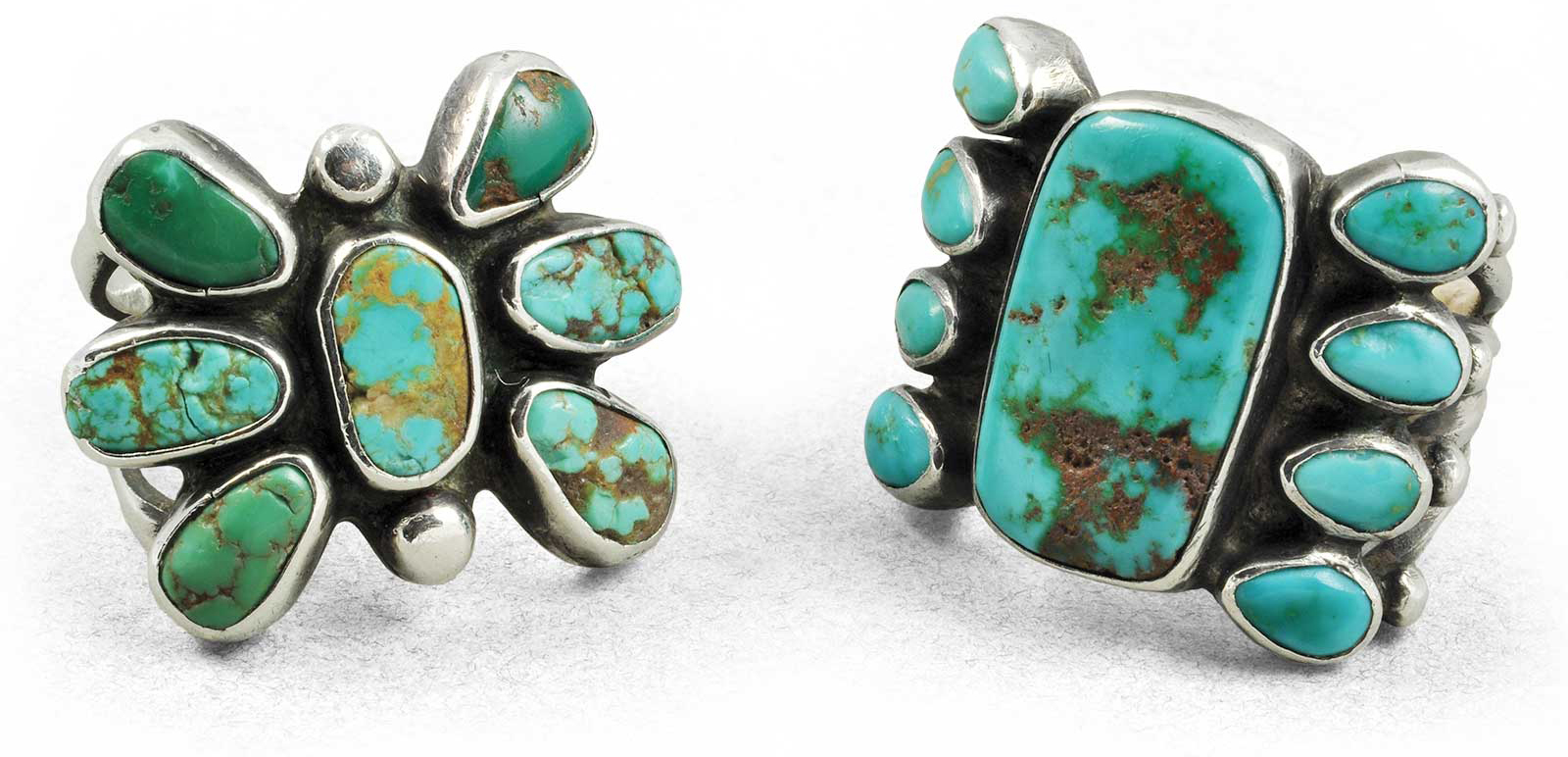 Two early “butterfly” style turquoise cluster rings, Navajo or Pueblo, 1920s. Courtesy of Karen Sires.
A Native “tradition” would be established within decades. Mastering technical construction became an ongoing process. In terms of personal vision, jewelry makers needed to reach inside themselves for an imaginative spark. Ring creation before 1900 tended to vary between plain silver rings and those with single or multiple stone settings. Indian smiths of the 1880s and 1890s rendered designs with turquoise cabochons in rough handmade bezel settings. By the later years of the 1890s, makers of hand-wrought jewelry understood they needed to enlarge their market for economic gain. This meant retaining and integrating Native design tastes with features possessing cross-cultural appeal.
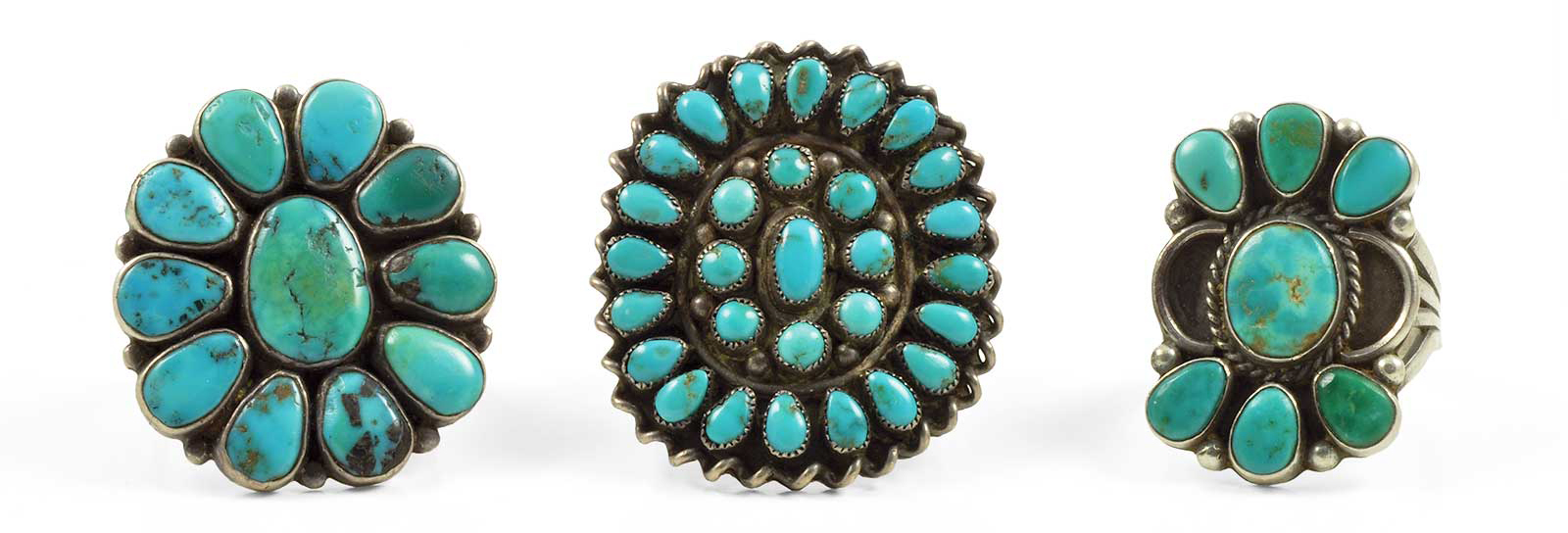
Three evolving Navajo cluster work design rings with oval centers, 1940s to 1960s.
By 1900, the oval-shaped central plate was well established. Specific design choices for oval rings made between the 1920s and 1970s show an active changeover in aesthetic appearance from wholly Native tastes to works with universal appeal. This period also marks the transition between historic era (1870s-1945) and vintage era (1946-1979) decorative elements. The examples illustrated here reveal how the oval shape of the ring’s center dictates the composition’s character.
The use of multiple-stone turquoise by Navajos and Pueblo smiths (especially Zuni, known for its lapidaries) often featured carving this material into small oval-shaped stones. This kind of stonework turned into a style, which initially resembled a butterfly-shape configuration by the 1920s. Over the next 40 years, the decorative cluster moved from its early broad shape with winglike oval stones to more rounded bands of concentric ovals on an oval or circular plate.
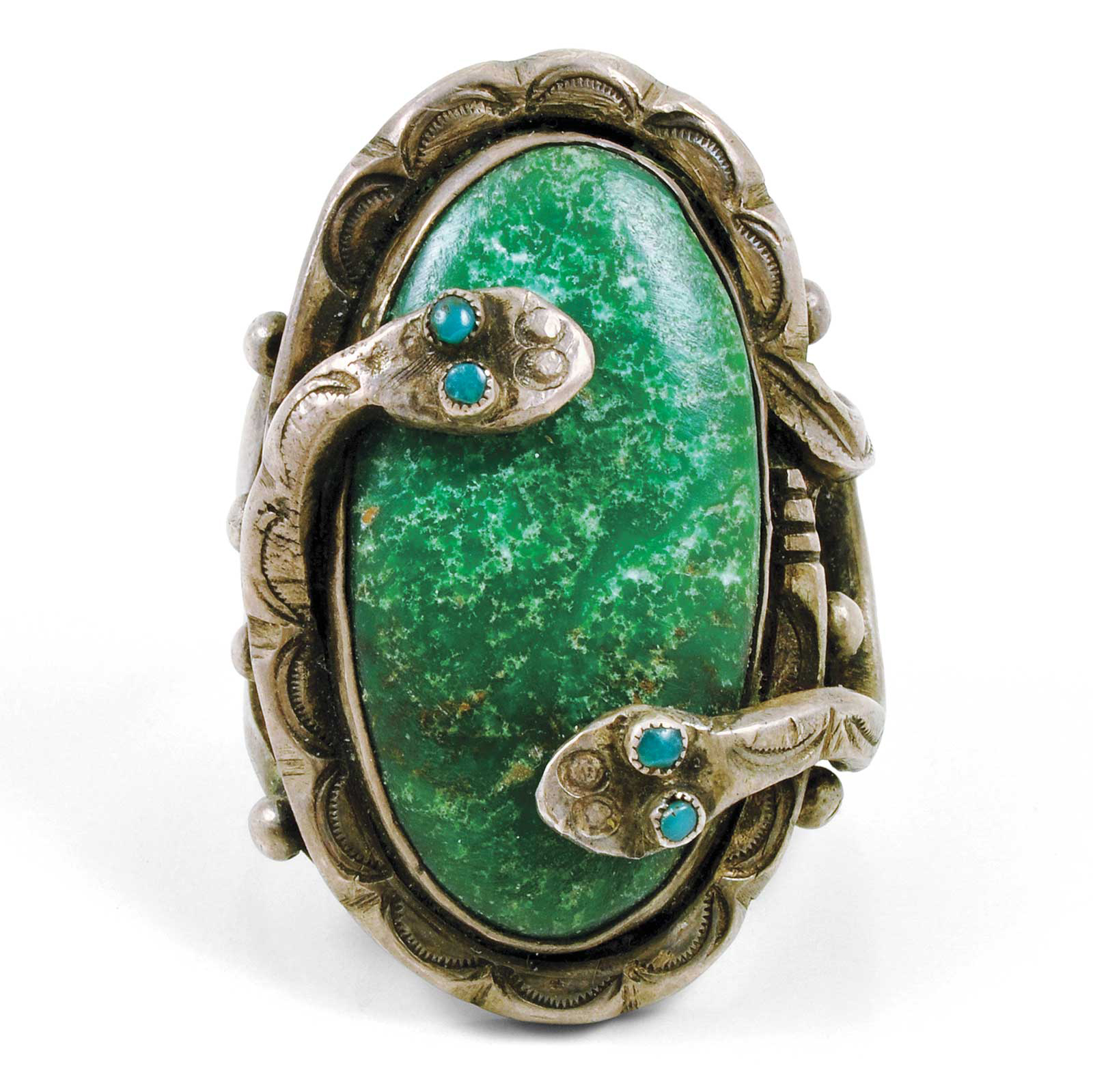
Oval Zuni ring with natural turquoise and framing snakes appliqué, 1930s.
Rounded oval stones became rather like petals on a flower in the 1940s and transferred well to bracelet, belt and brooch designs. Over the next 10 years, one specific arrangement of multiple stone clusters evolved into the petit point style: Native jewelry makers created petit point by carving turquoise cabs into a pear-like oval shape. Later on, a modified and more harmonious butterfly spacing design, not unlike the interval spacers on concha belts, appeared in 1960s ring design.
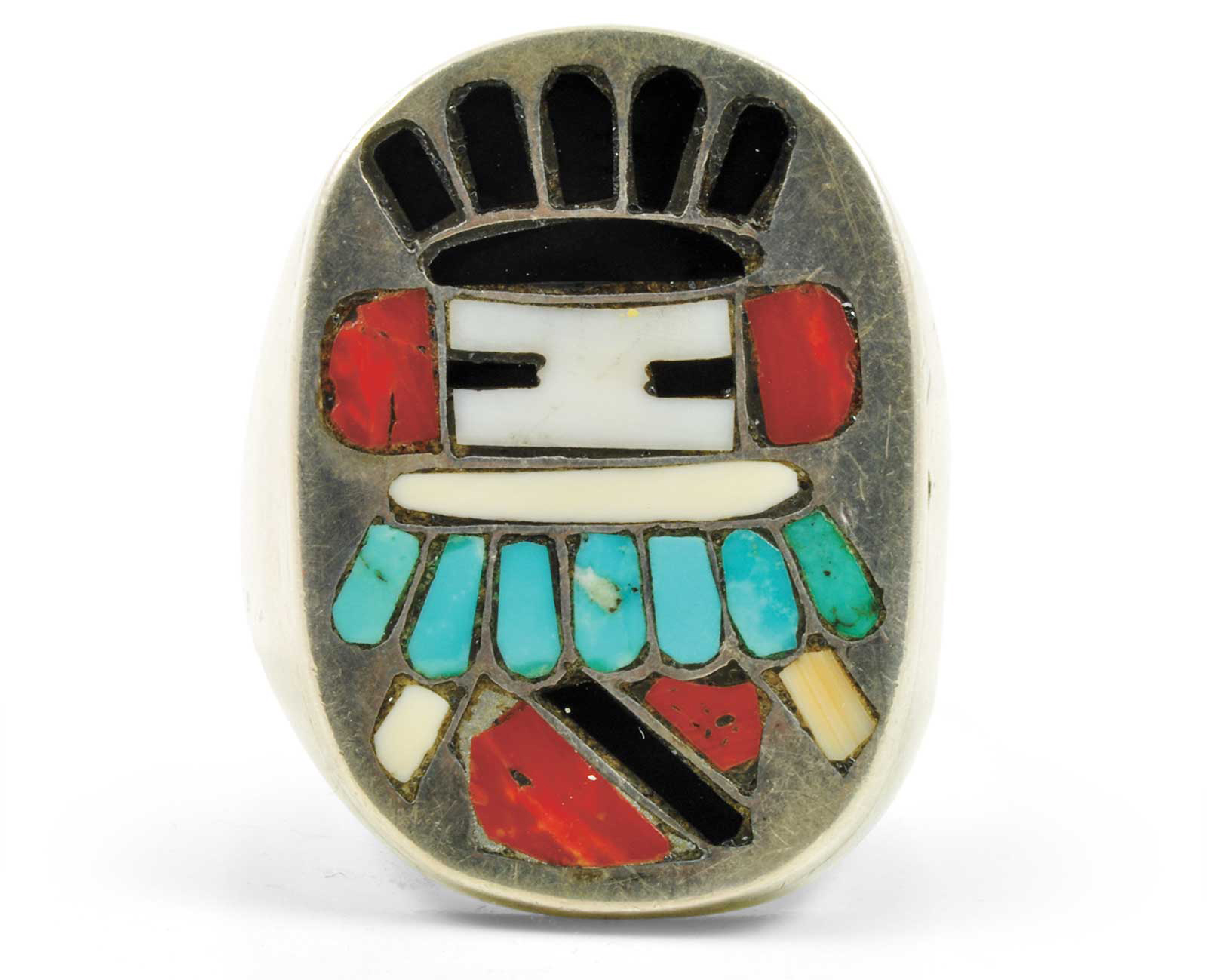
Multi-stone inlay of a masked “kachina” figure on silver ring by Frank Vacit (Zuni, 1915-1999), 1940s.
From the beginning of Indian silversmithing, abstract design on rings predominated with a variety of geometric and organic surface patterning. Realistic figures such as animals, birds and humans appeared in jewelry design more regularly after the late 1920s. This imagery was already prevalent on earlier commercial Indian jewelry designs and had proved popular with tourists and collectors. The Zunis were particularly good at developing this sort of depiction; in the 1930s, long oval natural turquoise rings were fashioned with stylized sinuous snakes coiled around the central stone. Appliqué work, added to Native rings fairly early on, provided texture and interest to the central plate; this was a process whereby a cut-out shape from sheet metal was soldered onto the plate or the shank.
Human figures had already been stylized representations in commercial Indian jewelry. Zuni silversmith Frank Vacit became noted in the 1940s for his kachina-like mosaic inlay figures, most likely drawn from the masked dancers who impersonated sacred spirits. Vacit’s figures tended to occupy the entire space within a ring’s oval- or rectangular-shaped center. His portrayals are attractive, albeit somewhat geometrically stiff.
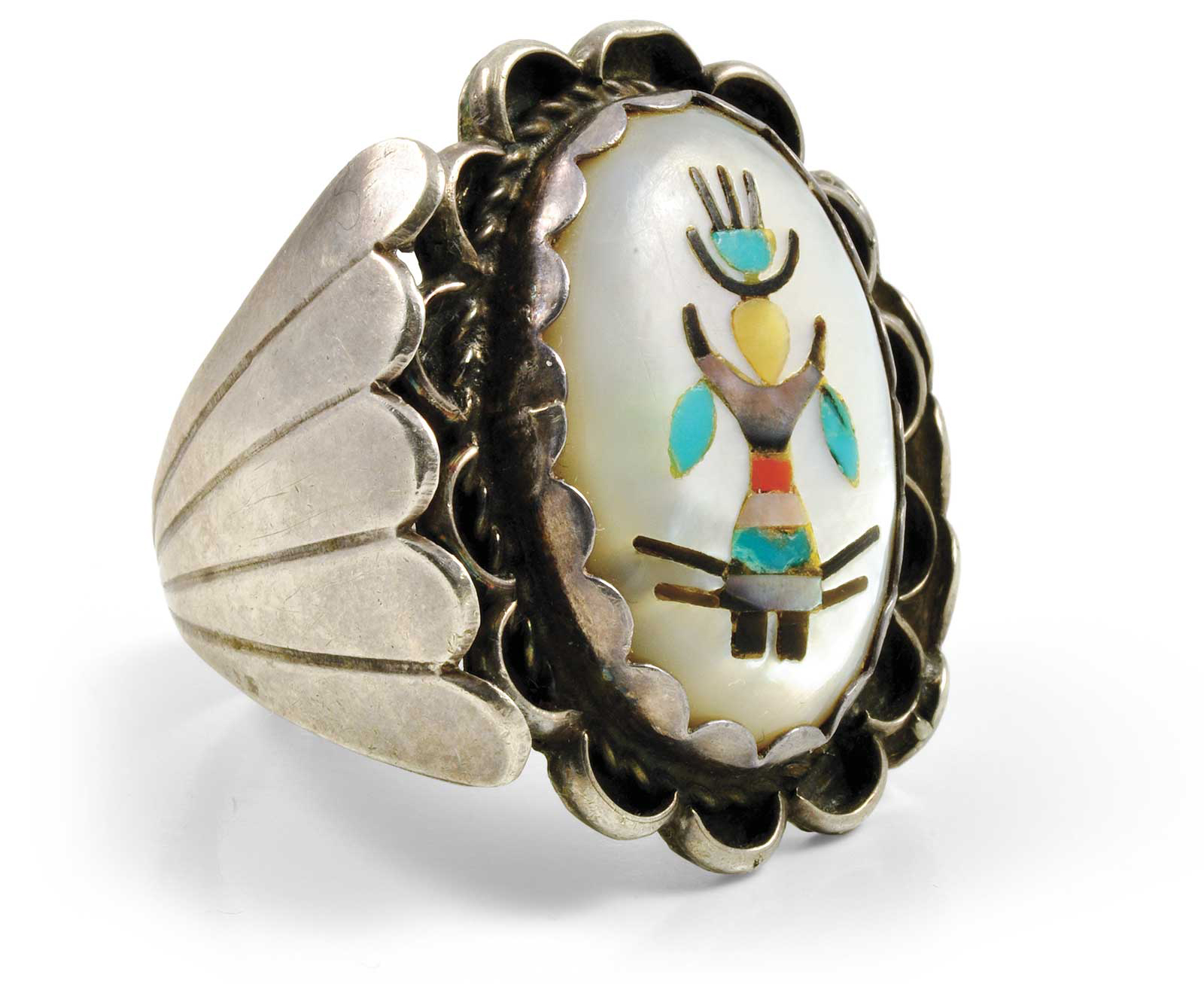 Turquoise, jet, and shell inlay design of a Pueblo woman on domed mother-of-pearl oval lapidary work, set in silver, 1950s-1960s.
Mid-20th-century ring makers, however, did not always get it right. Native jewelry making in the American Southwest had developed rapidly because the makers were constantly experimenting with their artistic intentions. On occasion, a delicate piece of lapidary work might be paired with silver not in balance with the design. We can see this discordant effect in a 1950s to 1960s ring with small inlay figural features that essentially are overpowered by the oversized and incompatible setting.
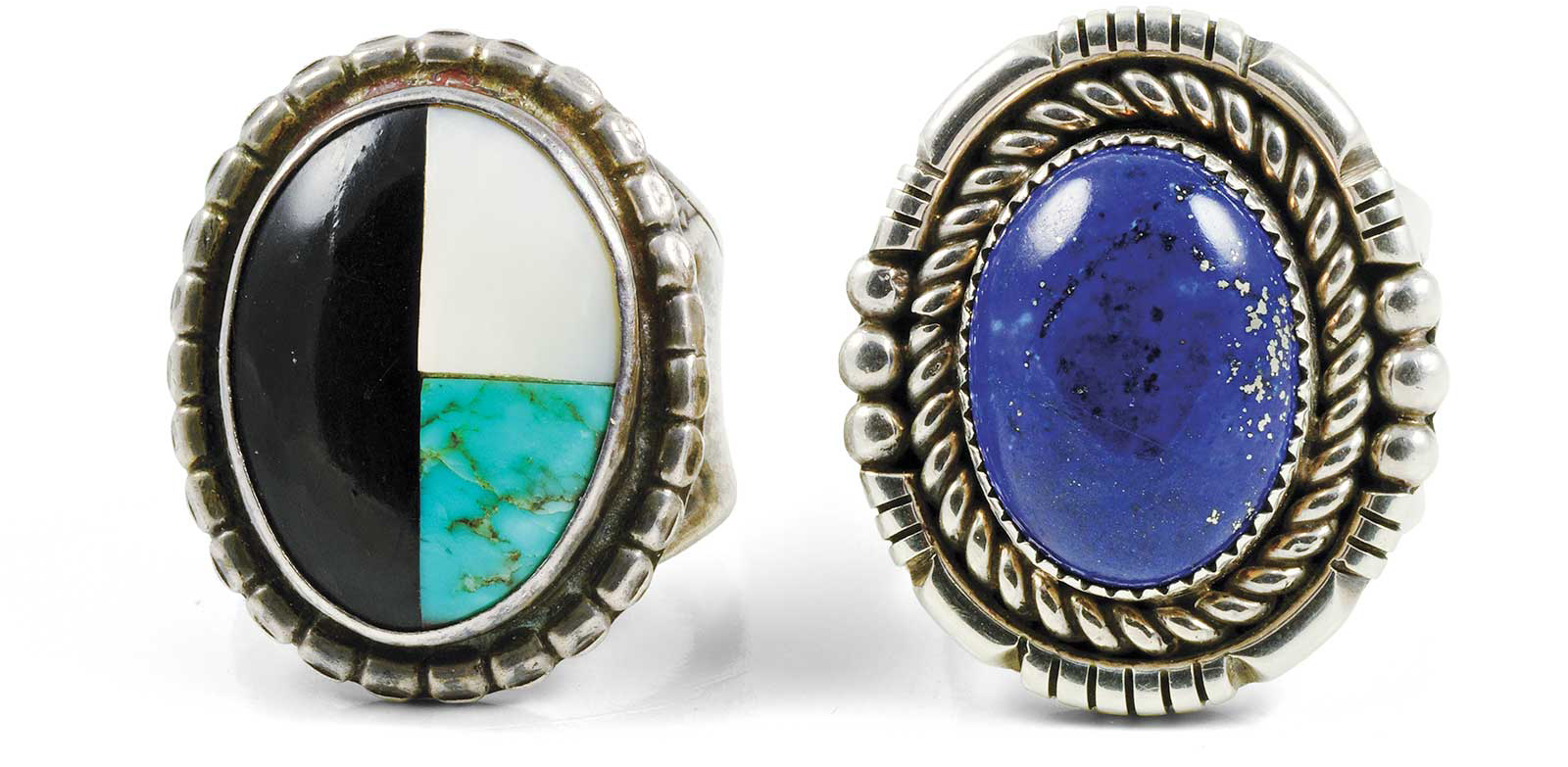
Two 1970s rings with silver frames that emphasize and enhance their oval stone setting: unknown maker on left and lapis stone design by Wilson Padilla (Navajo) on right.
By the 1970s, more Southwestern Indians either received training by Native silversmiths in the regional Indian schools or attended college arts programs. Better tools and training led to improved techniques. Native designers entered a period of more fruitful experimentation and personal creativity, and we can see the results in both abstract and figural designs. A new form of modernist aesthetics can be found in two single-stone oval rings, which are wholly abstract in design. These examples show a finer union of material and technique. The center plate as always is the focus but the silver setting melds beautifully with the stones. There is an enigmatic quality to the tricolor domed center of the ring on the left, while the other ring’s silver border enhances its lapis gemstone, a nontraditional material choice.
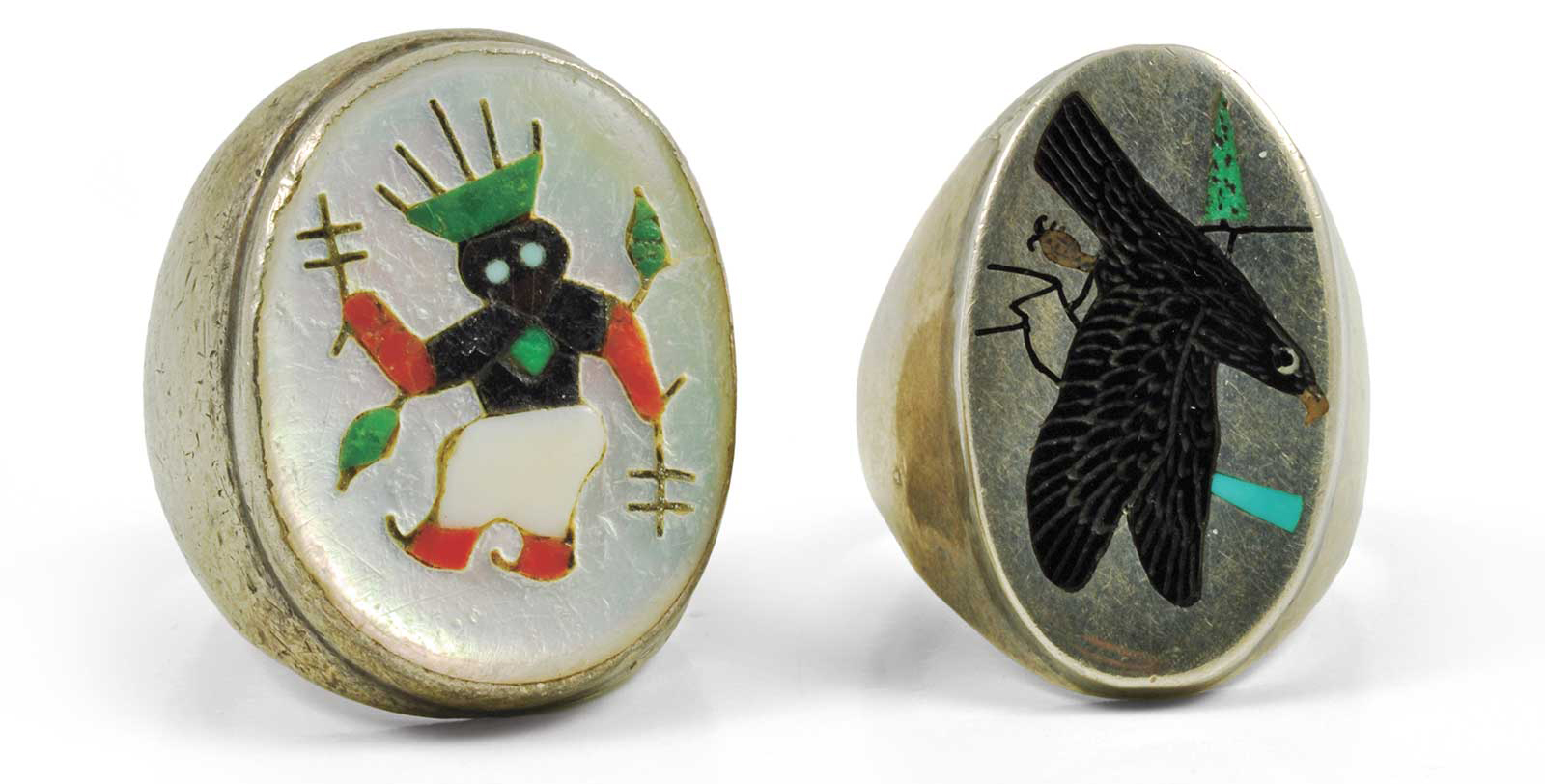 Two Zuni oval ring shapes minus silver frames: left, dancing Apache Gan figure, 1970s, maker unknown; right, swooping hawk inlay by Harlan Coonsis (Zuni), 1980s.
Designs grew more sophisticated and gained a sense of movement. This animation is apparent in two unframed oval rings, an Apache Gan dancer created in the 1970s and a hawk in flight from the late 1980s. Both rings are examples of a transformation in Zuni figural depiction. The dancer appears to be in mid-step.
Master silversmith Harlan Coonsis’ hawk swoops down against a beautifully delineated landscape background. The Coonsis ring perfectly illustrates how Indian jewelry making had evolved from constant experimentation into a well-developed awareness of fine artistry.
About the author
Paula A. Baxter is a design historian who has worked as an art librarian, curator and adjunct professor in New York before recently moving to Scottsdale, Arizona, a longtime dream realized. The author of The Encyclopedia of Native American Jewelry, she and photographer husband Barry Katzen have just published their fourth book together, Pueblo Bead Jewelry: Living Design. Their next project she claims is “the big one.”
Powered by Froala Editor