


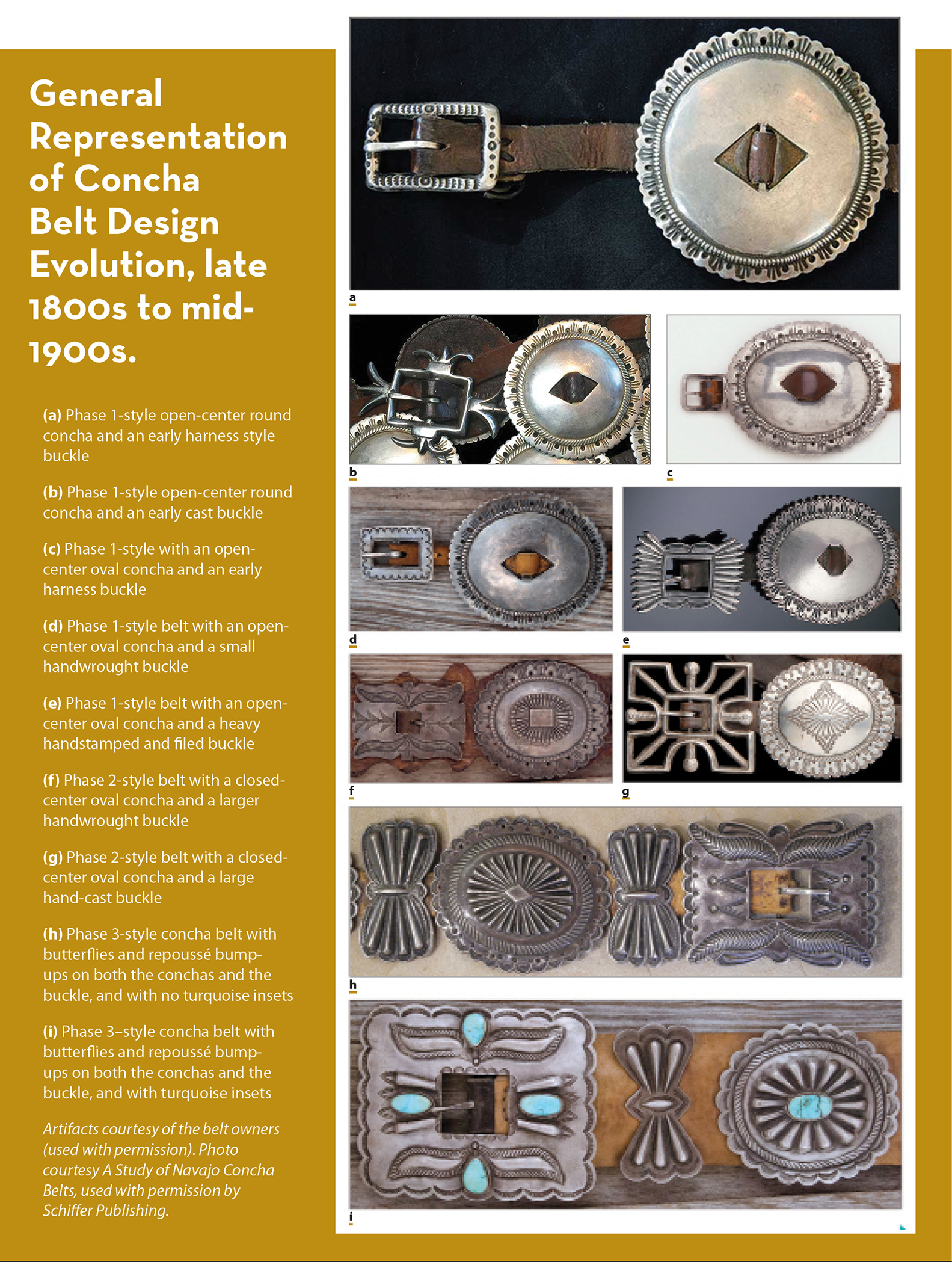
Precisely dating conchas by their “design” alone can be very difficult, since the design alone is not the only variable to be considered. The details of workmanship, combined with the design and how the design was created by the silversmith, must be considered together in order to try to date a piece even somewhat accurately. [The imagery of the general evolution of handwrought concha central design] illustrates some of the variables both in the evolution of the design and how the design might have been created.
The belts show the general evolution of the central design of silver conchas as they were originally used on concha belts. A general statement would be that the Phase 1 style (the earliest) has the central slot for attaching to a leather strap, since the Navajo silversmiths had not yet learned to solder in the early stages of Navajo silversmithing. The decorative stampwork on Phase 1 conchas was usually limited to a perimeter decoration but later often included some designs around the central slot. After the Navajo silversmiths learned to solder, the central slot was no longer required, since the belt attachment loops could be soldered to the back of the concha.
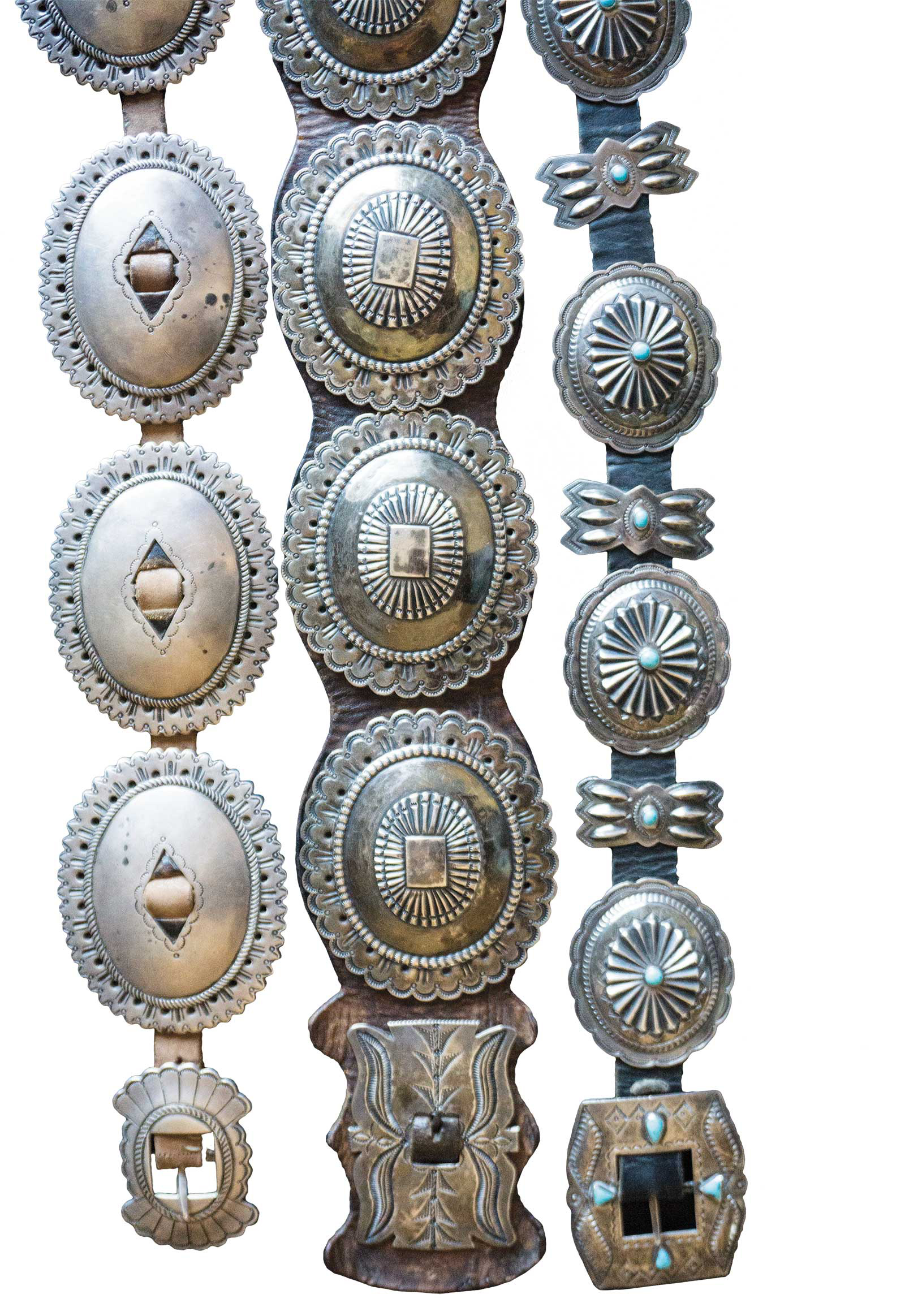 The evolution of Navajo concha belts, from left, Phase 1, Phase 2 and Phase 3. Artifacts and image courtesy of Donald P. Richards.
The earliest Phase 2 conchas generally added a central design of chisel work, which later evolved into simple repoussé bump-ups in the central dome. For Phase 3 belts, the basic concha elements remained the same but were supplemented by butterfly elements, alternately spaced with the conchas. The central repoussé design evolved into a more sophisticated application technique using a paired set of male and female dies. Later on, perhaps the 1920s or earlier, simple turquoise insets were added to the conchas, the butterflies and the buckles. As the design styles evolved, and the silversmithing tools and techniques improved, inset stones (usually turquoise) started to appear, first using a single inset in the center only, which gradually evolved into the design incorporating stones inset at other places on the concha, usually around the perimeter inside the “braided rope” design at the outside edge of the central dome. As the concha design evolved, Zuni silversmiths who were also great lapidaries expanded on the initial Navajo design layouts by using stone insets, and their exceptional creativity and lapidary skills are evident in some of the more modern conchas shown. Zuni lapidaries now often team up with Navajo silversmiths in the creation of an exceptional piece, with each executing their own specialized style and workmanship on the same piece. This is especially obvious and noteworthy in the imagery.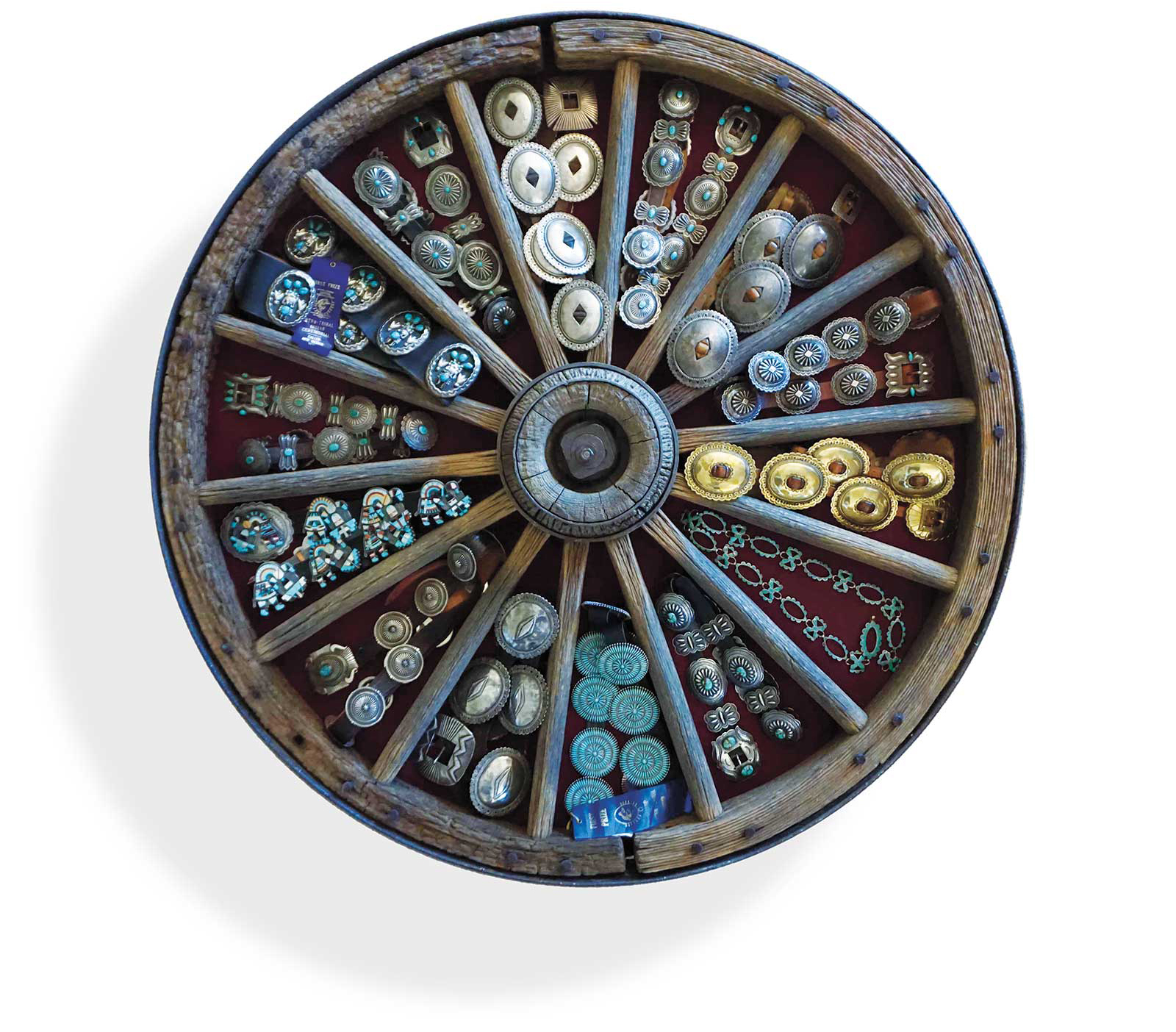 The wheel of belts—which came first? Artifacts and image courtesy of Donald P. Richards.
As conchas evolved, so did buckle design and fabrication [as shown in the imagery of general evolution of buckle design concepts]. Initial buckles were adapted from horse headstall buckles, and the later stamped buckles came into fashion as silversmithing tools and techniques improved. These were initially small but gradually evolved to be about the same size as the conchas. However, since buckles were often replaced or exchanged over time for older belts, the style or pattern of a buckle may not be an adequate indicator of the approximate age of the entire belt. If the buckle had been replaced, it is most likely that a newer buckle would have been added.
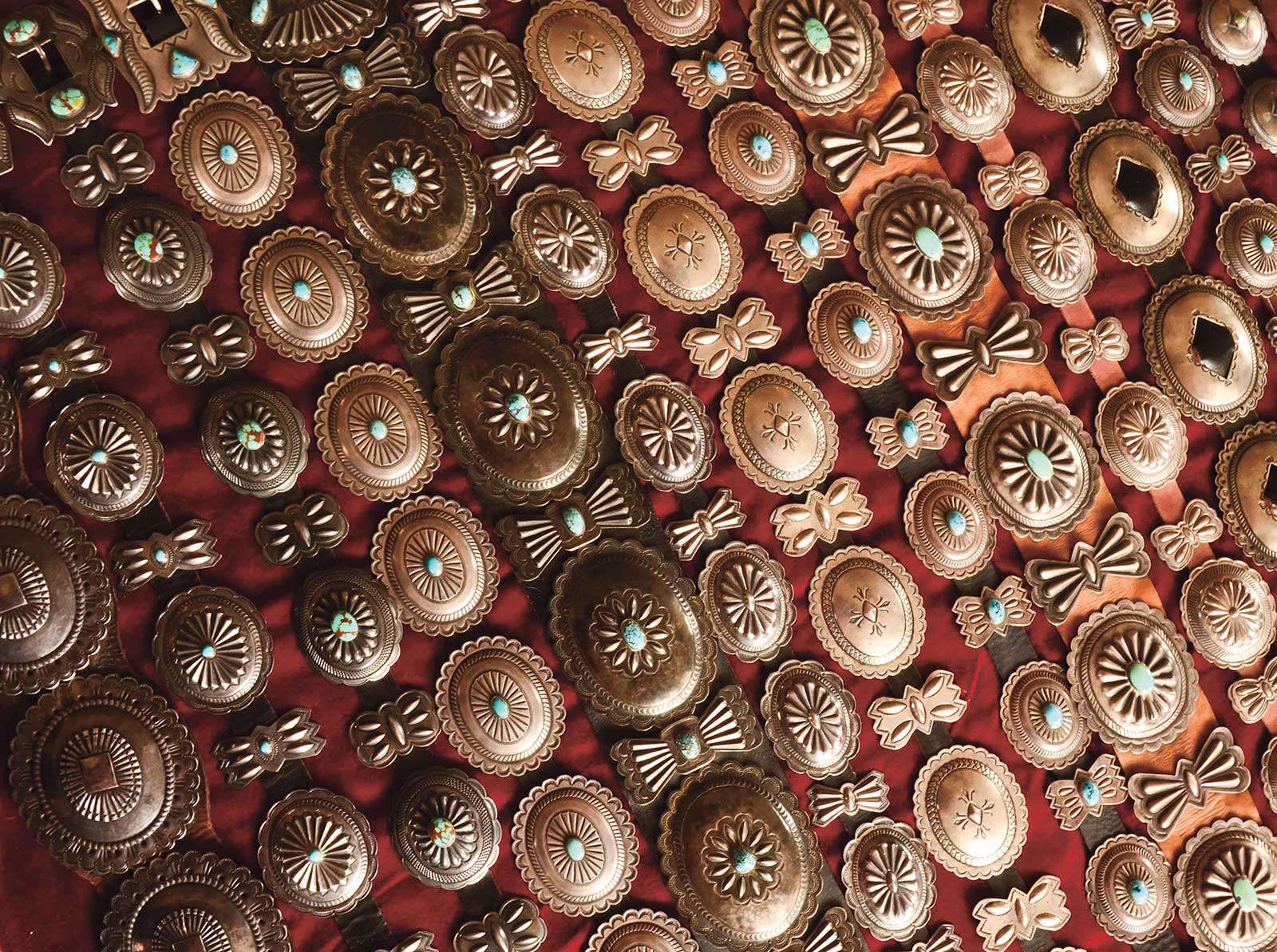 An array of Navajo concha belts. Artifacts and image courtesy of Donald P. Richards.
Other Consideration
Relatively recently, Pickering (2011) reported on the latest methods of evaluation age and authenticity of peace medals—that is, how can you tell the difference between a modern reproduction (fake) and an authentic original from the late 1700s? The technique is called energy-dispersive X-ray spectroscopy (EDS). For the peace medals, the analysis was performed by the University of Tulsa for the Gilcrease Museum in Tulsa. In the EDS test, the elements on the surface are detected and their relative abundance is measured by the magnitude of the spike in the response… The technology as applied for authentication purposes applies equally well to this discussion on age determination, since a piece that has been artificially “artifaked” may not be as old as the “artifaker” wanted you to believe that it was. The conscientious evaluation of authenticity and its implications for the actual age of a piece also affects the value of a piece; that is, whether or not it is actually worth less than the “artifaker” wanted you to believe.
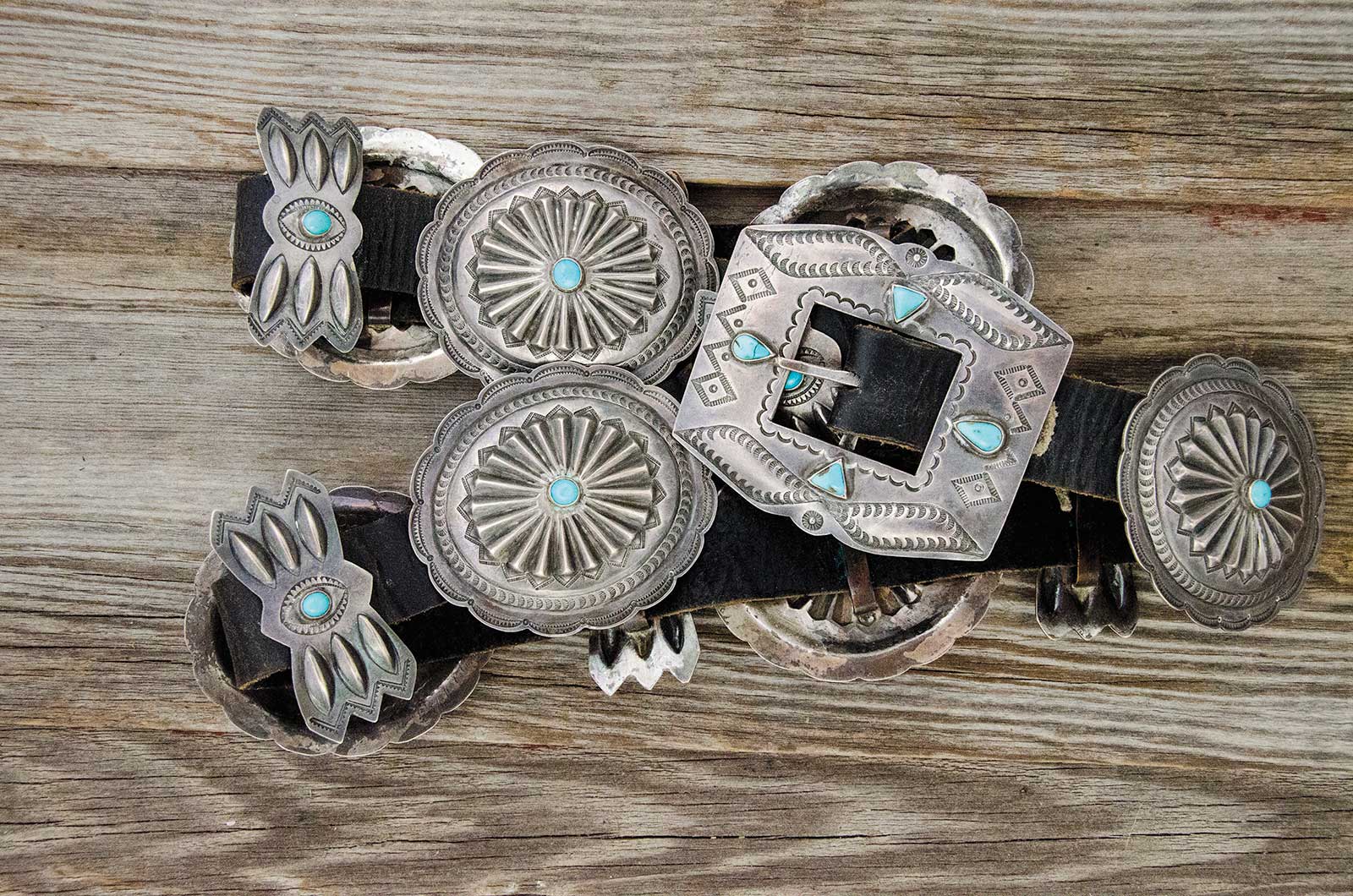 Typical Phase 3 concha belt by Hosteen Goodluck. Artifact and image courtesy of Donald P. Richards.
This same technique of EDS testing to detect artificial aging should be considered for older concha belts, for which the value may justify a more expensive analysis. Genuinely old concha belts have usually developed a natural patina, without the use of chemicals. However, if those older pieces were polished in the past (Navajos generally like shiny silver, compared to Anglos, who generally prefer a patina) by using any type of chemical compound, traces of that compound may be detected by the EDS test, but they may not be sulfur.
Another option is to look at the conchas by using a high-powered jeweler’s loupe (30× at least) and examine the tool-stamping marks. On old belts, when examined under a microscope, the deepest depressions of the stampwork usually show accumulated dirt and crud at the bottom of the depression, which is not evident with the naked eye. This assumes, though, that the belt has not been polished. If it has, there will likely be polishing compound at the bottom of the depressions, but it may be a lighter color than accumulated dirt.
General Evolution of Handwrought Concha Central Design
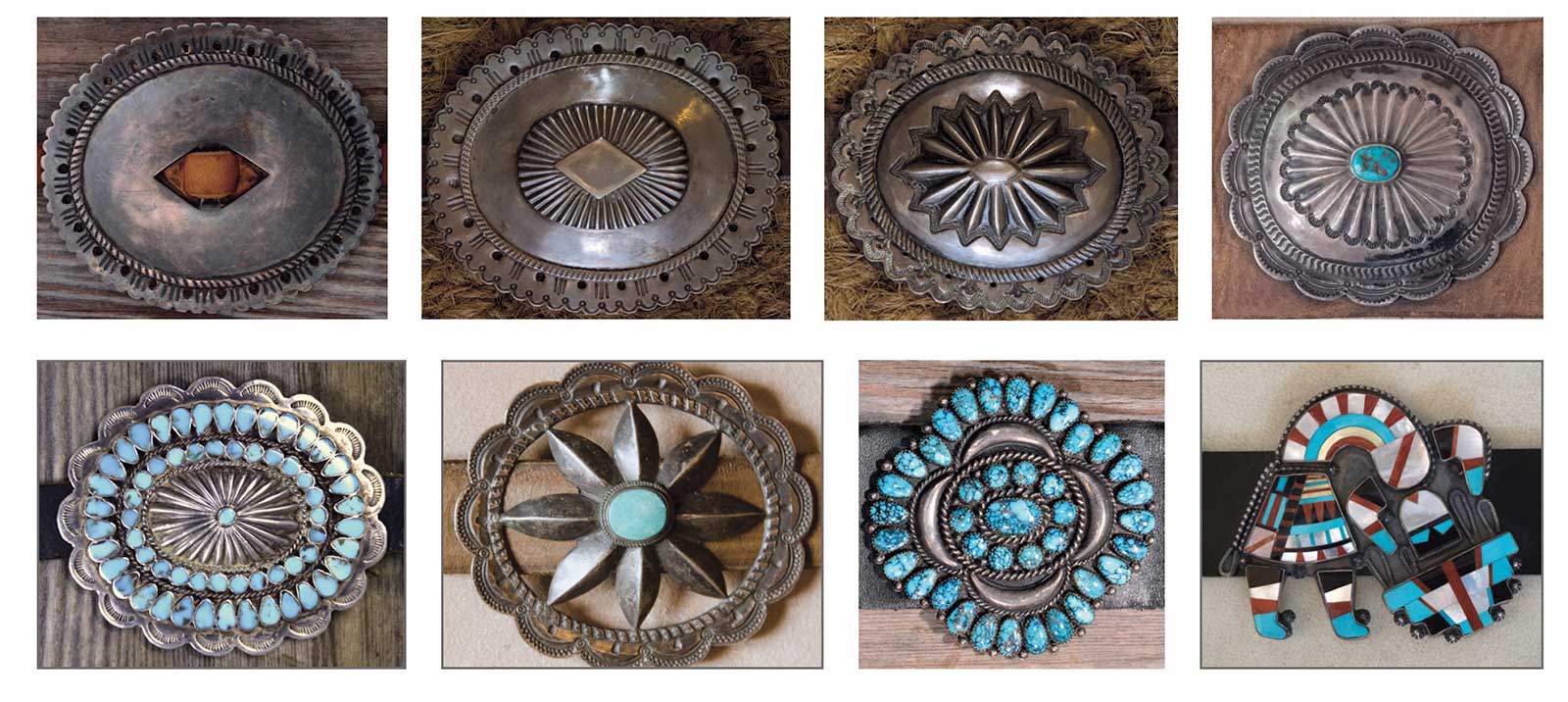
First row, from left: no central design; chiseled and filed design in center of dome; simple bump-up repoussé in center; die stamp repoussé with stone inset in center
Second row, from left: illustration of perimeter stone insets; flexibility introduced by cast conchas; innovations in concha shape and style by Zuni silversmiths and lapidaries
This article has been excerpted from the forthcoming A Study of Navajo Concha Belts: Origins • History • Catalog by Donald P. Richards with Karen M. Richards. The book is published by Schiffer Publishing.
About the Author
Donald Richards was born and raised in Arizona and has worked on and around the Navajo Reservation several times over the years. Having worked and traveled in more than 40 countries, he has developed an appreciation for the indigenous arts of North and South America, Africa, Oceania and Asia. He brings this interest, knowledge, and appreciation to his research work on Navajo concha belts.
Powered by Froala Editor