In 2015, I went to the opening of the Jim and Lauris Phillips Center for the Study of Southwestern Jewelry at the Wheelwright Museum of the American Indian in Santa Fe, New Mexico. I remember the initial impact of exquisite jewelry and everyday objects displayed in brightly lit cases with just the right amount of explanatory information to give the pieces a context. Recently I had the pleasure of returning for a tour of the collection with some members of the museum’s knowledgeable and enthusiastic staff.
When Boston philanthropist Mary Cabot Wheelwright (1887-1957) founded the museum in 1937, it was called the Museum of Navajo Ceremonial Art and was dedicated to the understanding of Navajo spirituality. The painter and architect William Penhallow Henderson designed the museum’s original structure as a modernist interpretation of a traditional Navajo hogan.
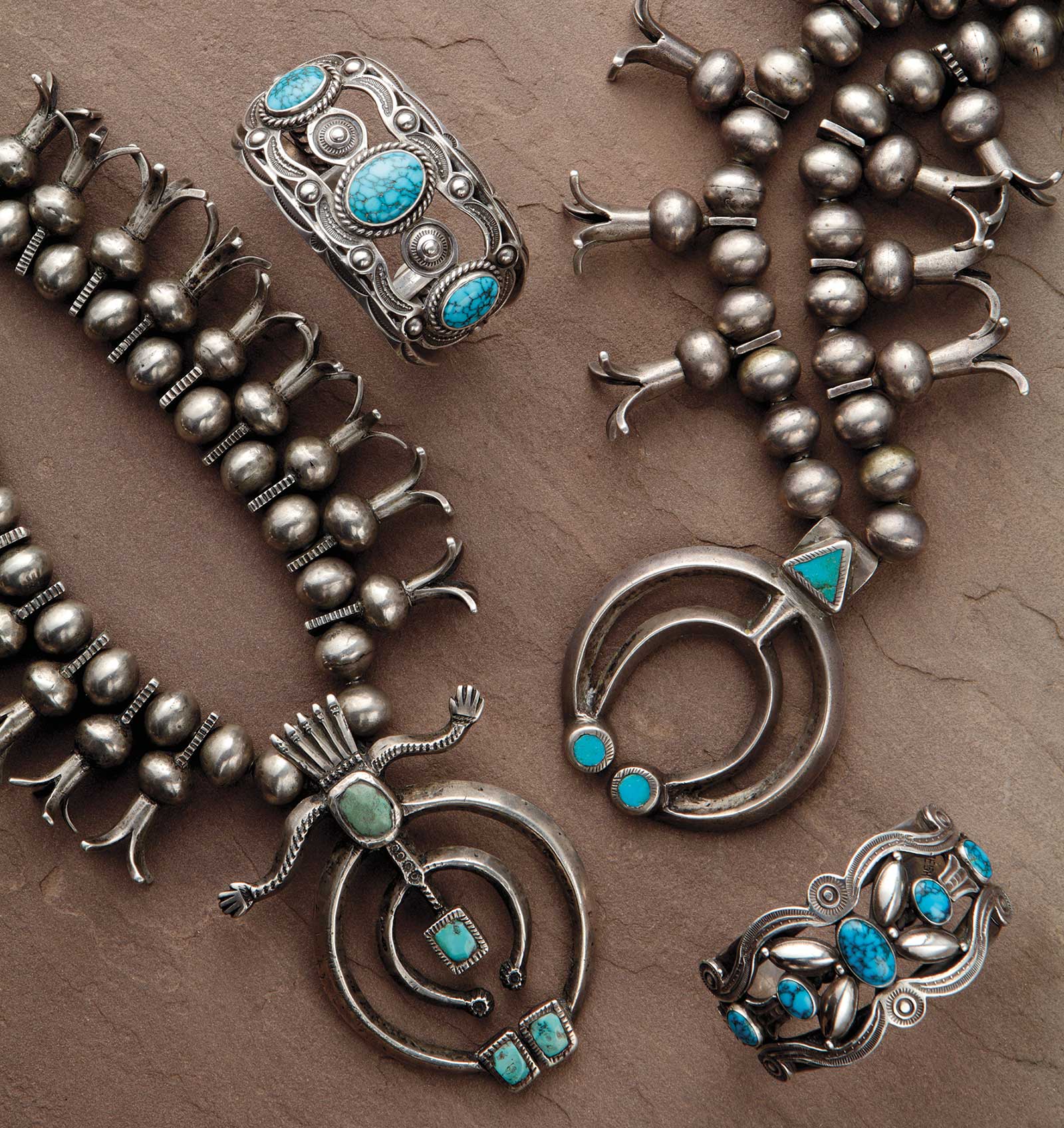 Two squash blossom necklaces by Slender Maker of Silver (Navajo, ca. 1830-1910) and two bracelets by his son, Fred Peshlakai (Navajo, 1896-1974). Photo by Addison Doty, Jim and Lauris Phillips Collection (2013.01.0606, 2013.01.0613, 2013.01.0018, 2013.01.0044), Wheelwright Museum of the American Indian, Santa Fe.Over the years, the museum began considering more space and a new purpose. Among the early donors of artifacts was Byron Harvey III, the
great-grandson of the tourism entrepreneur, Fred Harvey. He was a trained anthropologist and a friend of the then-museum director, Bertha P. Dutton. Dutton and Harvey recognized the gaps in the museum’s collection, and Harvey began collecting pieces, which he donated to fill those gaps.
The acquisition of the photographic and research archive of the anthropologist John Adair (1913-1997) in 1995 began a new era for the museum. His archives joined others at the museum but his emphasis on jewelry provided a new focus. He was the first to research the history of Native silversmithing and was the author of the landmark book The Navajo and Pueblo Silversmiths published in 1944.
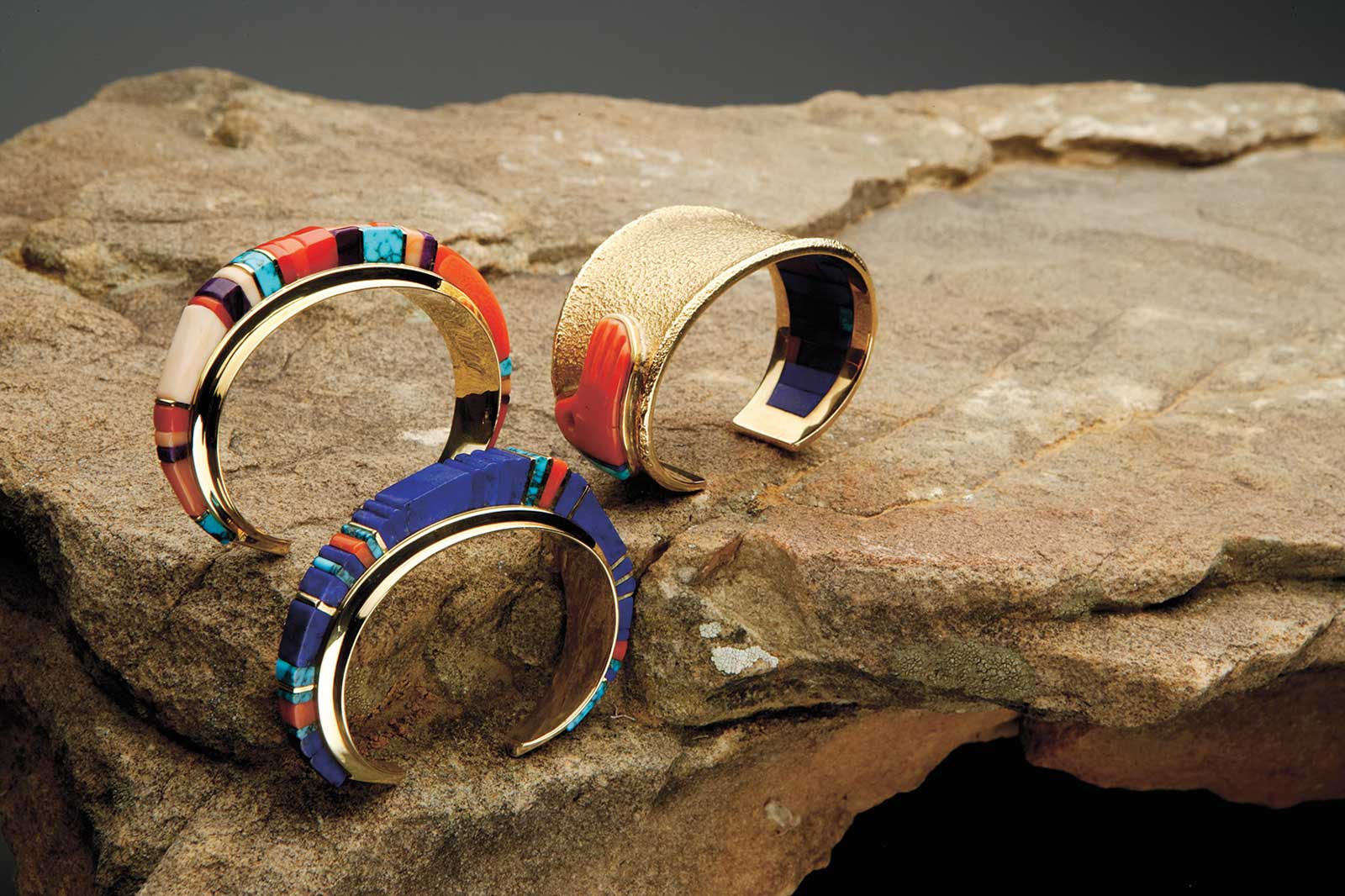 Three bracelets by Charles Loloma (Hopi, 1921-1991) with inlays of coral, turquoise and lapis. Photo by Addison Doty, John and Ann Stewman Collection and Anonymous Collection (2012.23.003, IL2012.01, 2012.23.002), Wheelwright Museum of the American Indian, Santa Fe.
In 2010, the Lauris Phillips collection was given to the museum, joining many important earlier gifts.
The exhibition cases in the new wing are arranged chronologically from early blacksmithing and shell, coral and stone jewelry through the introduction of silversmithing and into the present with recent acquisitions. The effect is a living story of the development of Southwestern jewelry and the people who made it. The museum’s interim director, Jean L. Higgins, comments, “This is a culture that is still alive. These pieces aren’t from a dead culture. This is a documentation of a beautiful history.”
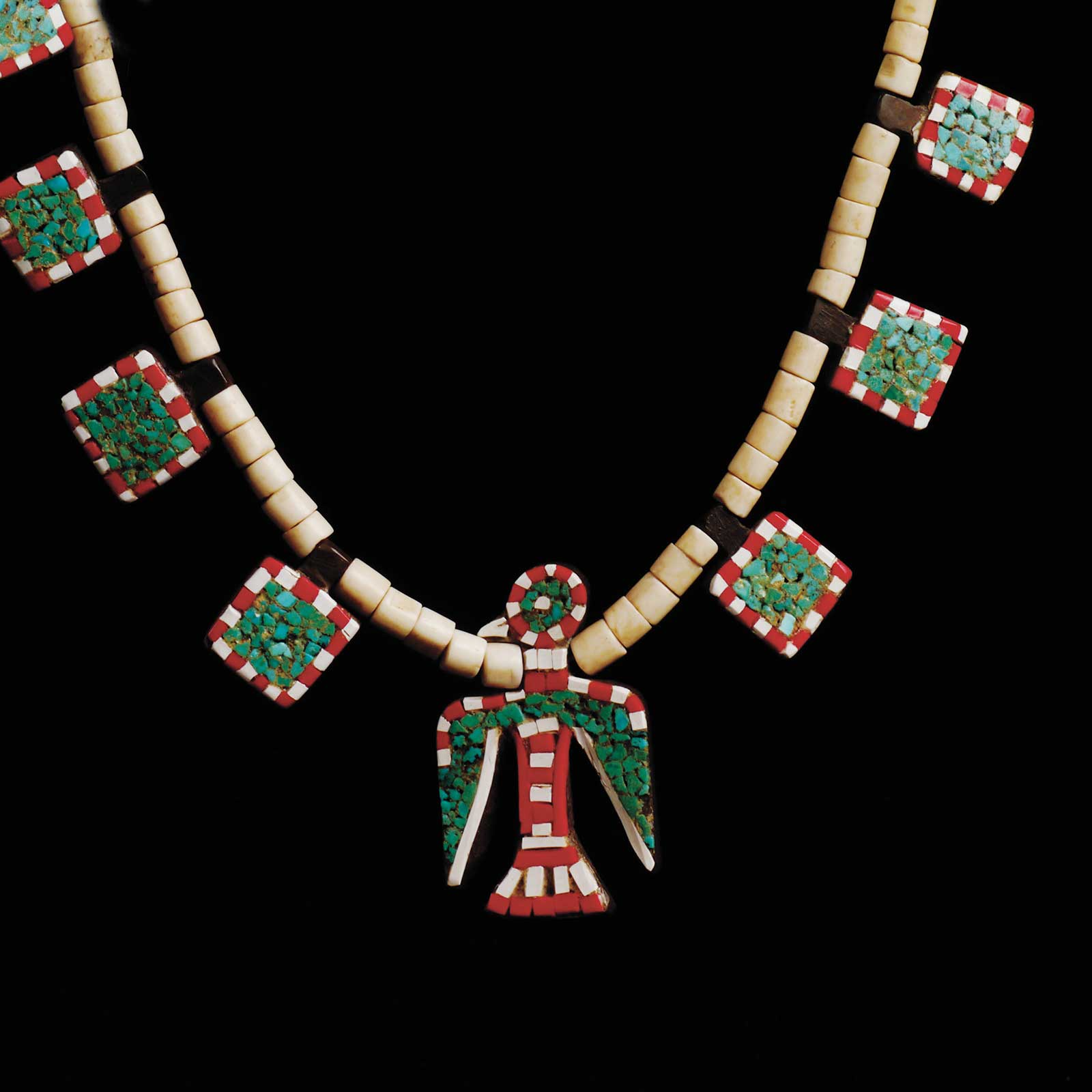 Santo Domingo thunderbird necklace, ca. 1950-60, gypsum, vulcanite and turquoise. Photo by Addison Doty. Wheelwright Museum of the American Indian Collectors’ Circle Collection (2012.25.002), Wheelwright Museum of the American Indian, Santa Fe.
Among the museum’s important early Navajo pieces are necklaces of hollow squash blossom beads by Slender Maker of Silver who was the first master silversmith of the Navajo, active in the late 1870s and early 1880s. The Navajo learned silversmithing in the mid-1800s from Mexican silversmiths. Across from the booth containing the masterpieces by Slender Maker of Silver is a booth of work by his son, Fred Peshlakai (1896-1974). Peshlakai had a shop in Los Angeles and his work is known for its innovative designs and his use of fine stones.
A discovery for me was the thunderbird jewelry from Kewa (Santo Domingo Pueblo). The Pueblo was known for its shell, turquoise and jet jewelry, but as the materials became scarce, the artists found materials such as battery casings, phonograph records and other manufactured products to incorporate in their whimsical folk art jewelry. The pieces contain tiny chips of turquoise salvaged from the cutting of stones for more important jewelry. Ben Calabaza (Kewa/Santo Domingo), the museum’s public relations manager, recalls how whole families were involved in making the jewelry—some cut the stone, others glued and the best talkers were sent out to sell the finished pieces.
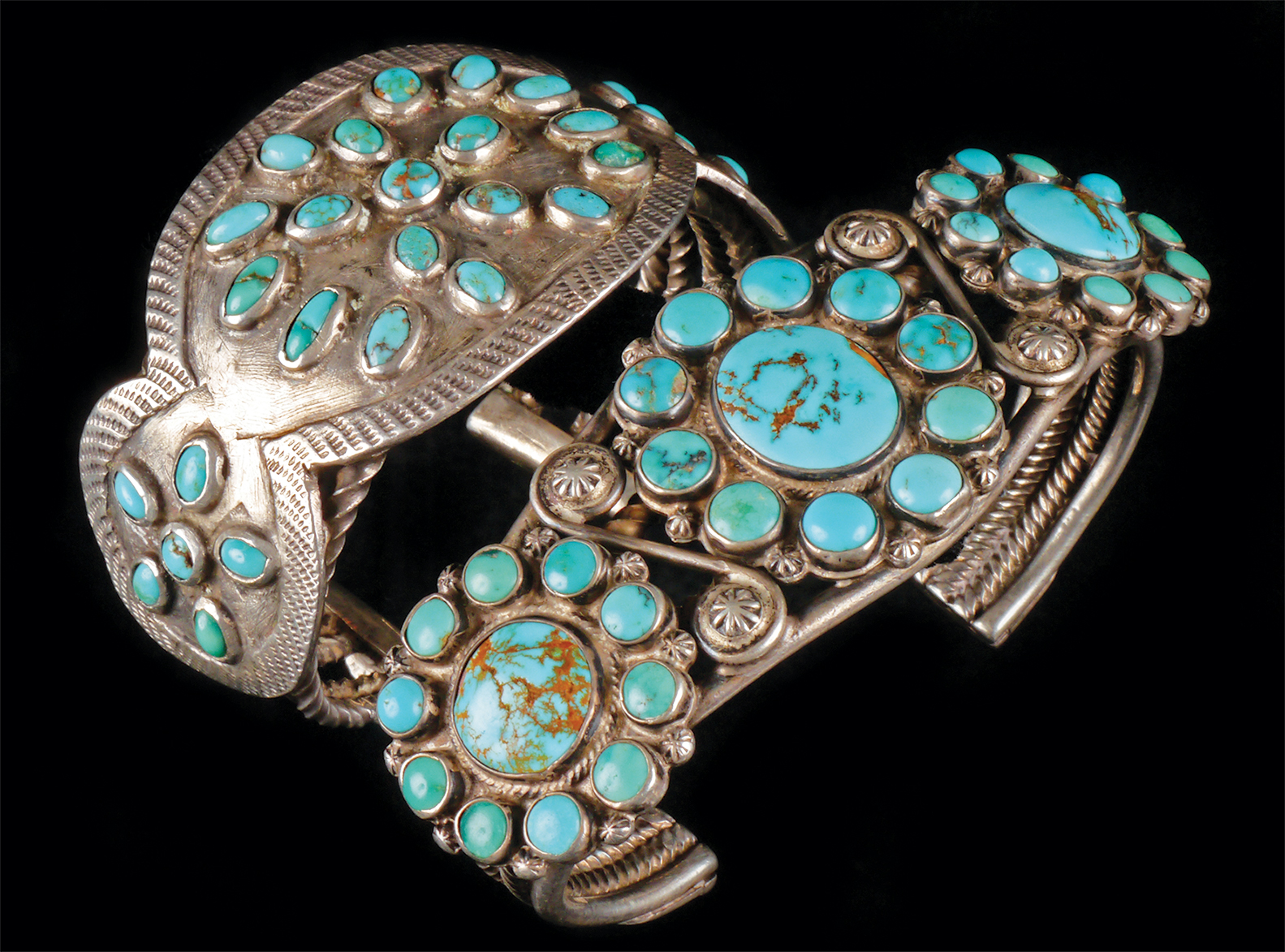 Zuni bracelets, ca. 1930-35, hand-wrought and commercial sheet silver, hand-twisted commercial wire, turquoise. Photo by Addison Doty, Byron Harvey III Collection (47/0219, 47/0064), Wheelwright Museum of the American Indian, Santa Fe.
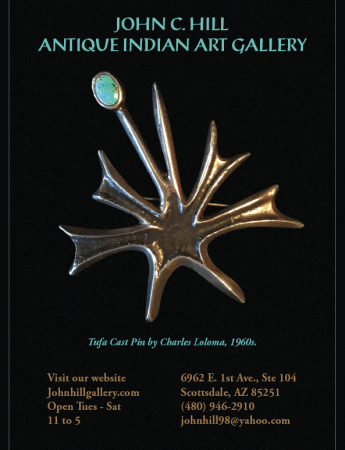
Charles Loloma (Hopi, 1921-1991) studied ceramics at Alfred University and had a shop in Scottsdale. In 1955, he began making increasingly innovative jewelry. He said, “I felt a strong kinship to stones, not just the precious and semiprecious stones I use in my jewelry, but the humble stones I pick up at random while on a hike through the hills or a walk along the beach. I feel the stone and think, not to conquer it, but to help it express itself”.
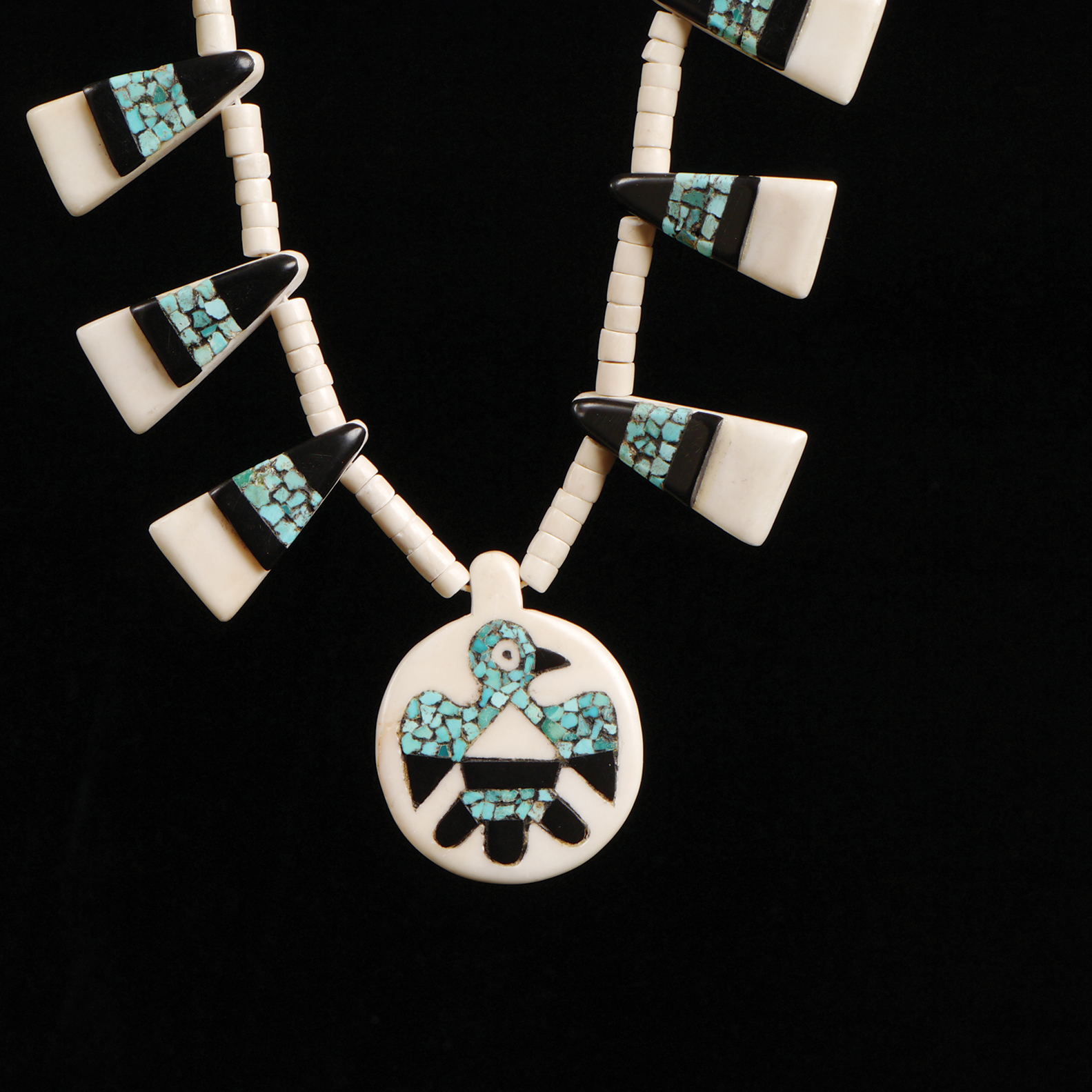 Santo Domingo thunderbird necklace, ca. 1950-60, gypsum, vulcanite, turquoise. Photo by Addison Doty. Wheelwright Museum of the American Indian Collectors’ Circle Collection (2012.25.021), Wheelwright Museum of the American Indian, Santa Fe.
Ken Williams (Arapaho/Seneca), the manager of the Case Trading Post at the museum and a renowned beadmaker, notes that Loloma “forged his own path” and became “the father of contemporary Indian jewelry.” He relates that when Loloma first entered competitions he was rejected because his work “didn’t look Indian at all.”
The objects and story of the past and the present are the foundation for future scholarship and creativity. The museum’s director emeritus, Jonathan Batkin, once explained, “We envision the center growing into a place where ideas are exchanged between artists and scholars, and where opportunities for mentorship and entrepreneurship are offered.”
Powered by Froala Editor