Many interesting advances took place in Native American jewelry making during the mid-20th century. The 1950s and 1960s were a period of renewed experimentation, boosted by the replacement of the gasoline blowtorch with a more precise and safer acetylene torch and more plentiful sheet silver and wire. By the 1970s, a would-be “boom” in Indian jewelry creation produced a wider market for both conventional and innovative designs. These three decades of social change offered new opportunities for stylistic variations.
One of the most significant developments between 1950 and 1980 was the adoption of figural (animal and human) design motifs. Pre-1945 Pueblo jewelry offered surface decoration that was essentially abstract or organic-themed. Steer heads on silverwork and carved leaves, birds and fetish animals appeared in the 1920s and 1930s. Commercial Indian jewelry of that time used derivative figural designs. When carvers and jewelry makers in Zuni Pueblo began shaping figural images in earnest after 1945, their work signaled a large shift in visual depiction from earlier decades. In many ways, however, Zuni was the obvious place for innovation and changing representations.
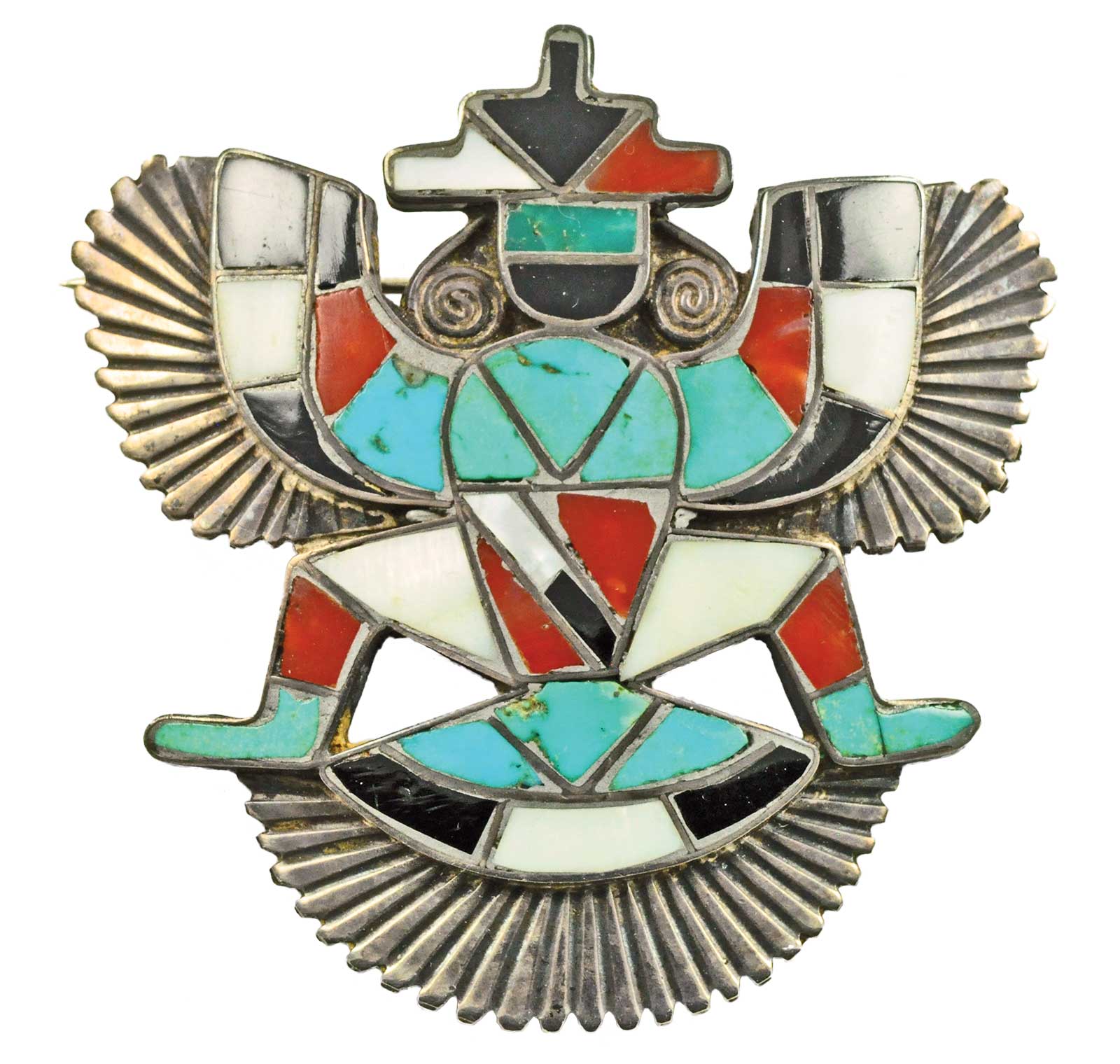 Knifewing pin attributed to Alonzo Hustito, 1940s-1950s. He was known for adding silver “feathers” to his inlaid Knifewing designs.
Zuni is the westernmost Pueblo in New Mexico, not far from the Arizona border. Historically, its inhabitants received a number of unwelcome visitors, from Spanish conquistadors making their entrada into the Southwest to prying anthropologists in the late 19th century. Matilda and James Stevenson arrived in 1879; Matilda was a prototype of the fictional Amelia Peabody complete with parasol. They were joined by fellow anthropologist Frank Hamilton Cushing (1857-1900) who famously “went Native” and upon returning East sold out his hosts’ private rituals. Cushing is loathed at Zuni to this day. Talented artist Phil Hughte created a pictorial cartoon series, A Zuni Artist Looks at Frank Hamilton Cushing (1994), marked by a wry sense of humor much like that of Ricardo Caté.
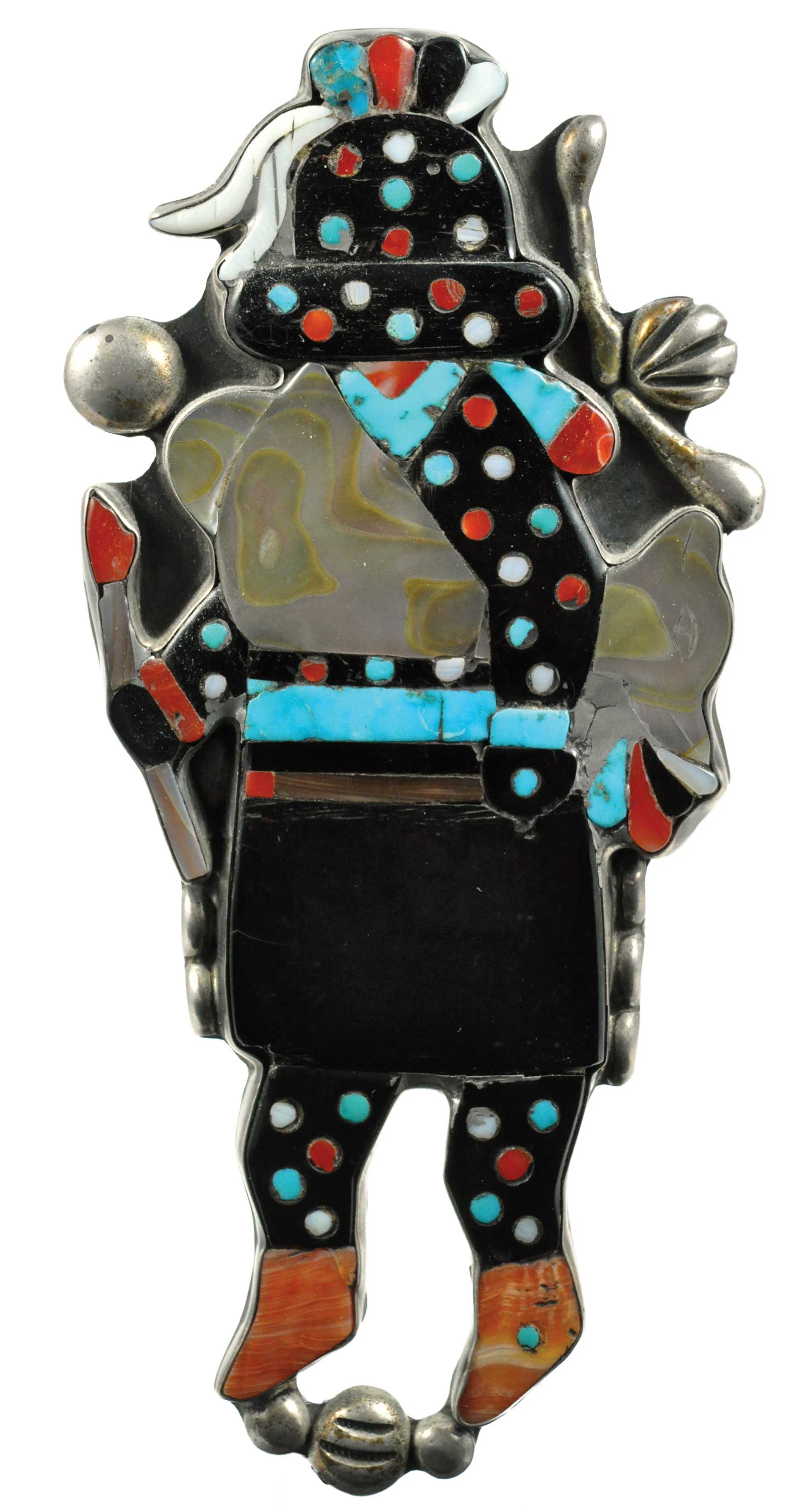 Shulawitsi, revered Little Fire God katsina of the Hopi and Zuni, 1960s.
One of Cushing’s most enduring contributions to the start of figural representation at Zuni was an illustration he made for a report to the Smithsonian’s Bureau of Ethnology. He drew a reproduction of a shrine of the Bow Priests. On the top area of the shrine was a depiction of the Zuni deity Atchialatopa, or Knifewing. Cushing labeled this sacred being a god of war, but this figure also possessed a more complicated role as a warrior in folk tales. Knifewing had both monstrous and beneficial attributes, and was associated with animal spirits. A number of Zuni smiths told John Adair that once a Knifewing design was rendered in silver, it lost all religious significance.
Zuni’s best-known and most industrious Indian trader, C.G. Wallace (1898-1993), was so taken with the figure that he reproduced it on his business stationery. Horace Iule (1901-1978) is credited with being the first smith to create a silver Knifewing for decorative purposes in the late 1920s. Fellow artist Juan Dedios (1882-1944) was also known for his renderings of the Knifewing in the 1930s. This image was a breakthrough of sorts in terms of figural designs. Nevertheless, other such representations remained scarce until after World War II.
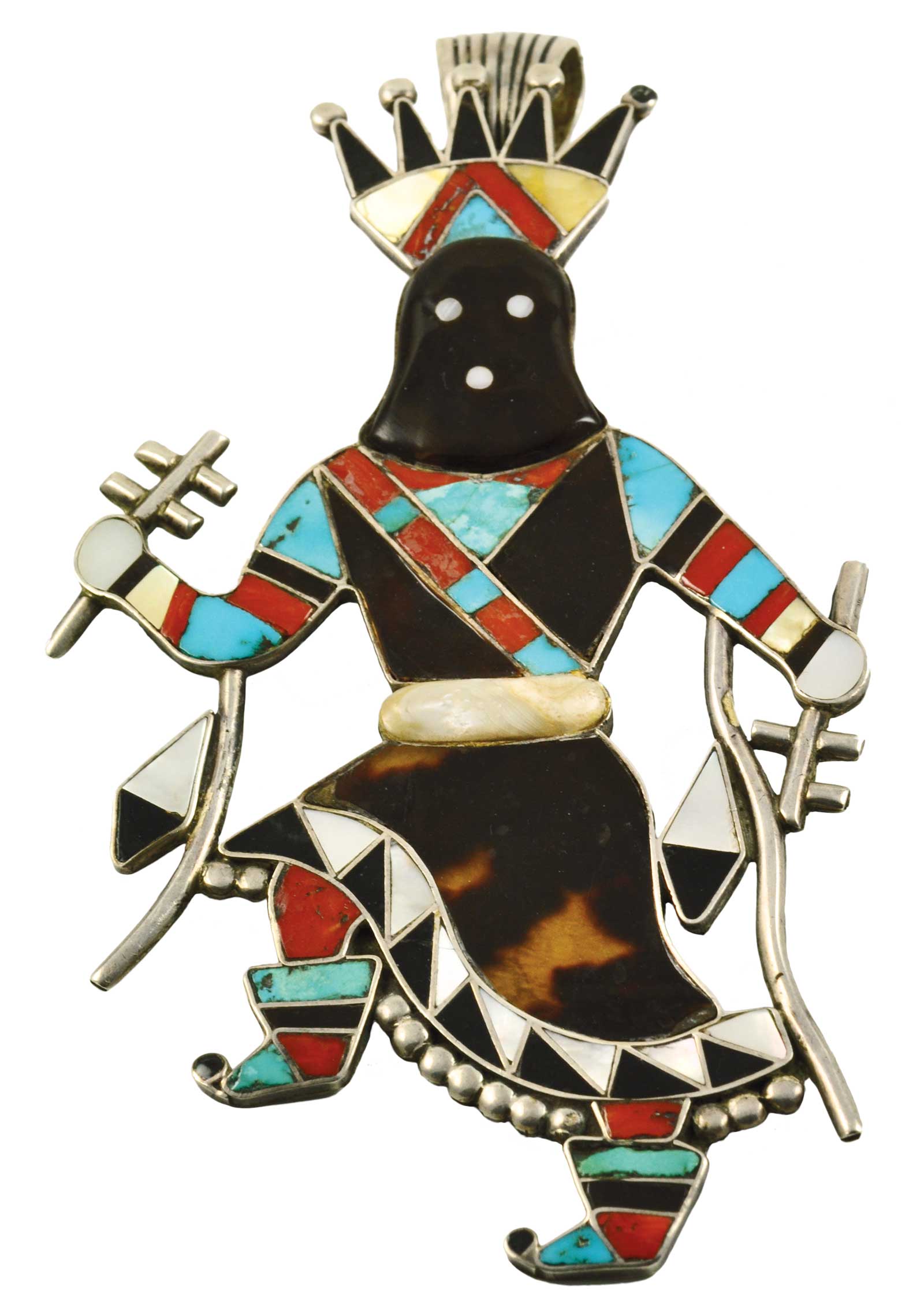 Apache Crown dancer with hallmark by Vera Luna, early 1970s.
By the 1950s, numerous Zuni silversmiths and lapidaries were creating the Knifewing in a “traditional” manner. Most of their inlay jewelry was fashioned as dual pin/pendants. In an unsigned design, probably the work of Alonzo Hustito, known for adding framing silverwork, we can see one interesting variation on the bird-human figure of a Knifewing. This piece is identifiable by its conventional flint-edged wings, terraced sky cap and squatting pose inlaid in jet, coral, turquoise and shell. The Knifewing and another mythological figure, Rainbow Man, are still the best known and most regularly formed Zuni figural designs in the marketplace.
Native design motifs changed to some extent when contemporary Southwestern Indian jewelry was relabeled “craft” rather than ethnographic work. This transformation came about through the combined efforts of the Indian Arts and Crafts Board (IACB), Indian traders brought together in 1947 as the United Indian Traders Association (UITA), and a move toward combating fakes and forgeries through the encouragement of hallmarks. Much Native silverwork was not hallmarked prior to 1945. The new craft identity especially seemed to fit Zuni with its many multigenerational families of artists. Local enterprises for the Navajos and Pueblos were deemed to be guilds. Between 1950 and 1980, the craft label persisted until Native jewelry finally earned its true designation as fine art.
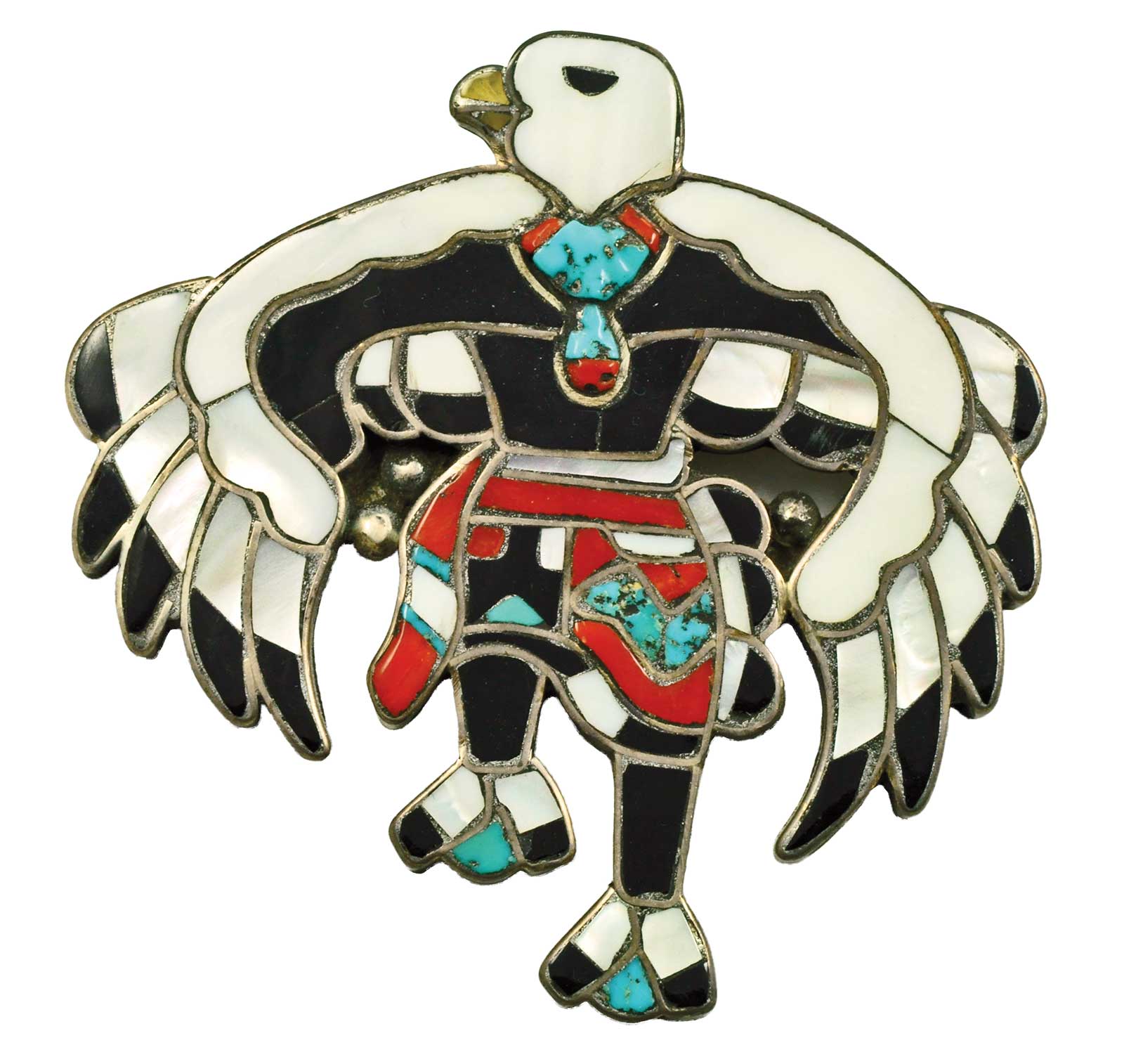 Eagle Dancer by Dixon Shebola, 1960s-1970s.
Non-Native craft workers, typically those in a guild, took ownership of designs they created. Wallace and other traders encouraged hallmarks whenever possible, but not all pieces received this identification. Between 1950 and 1980 some Zuni artists would sign their work with a personal hallmark or inscribe their names with an engraver’s pen. Yet, many others did not opt for this type of visual proprietorship. Design motifs were known locally to belong to a certain individual or family. Design ownership in Zuni was not as hard and fast as in non-Native guild settings; an artist’s piece might be reproduced by relatives.
This article examines some distinctive Zuni figural design motifs that flourished between 1950 and 1980 and continue to this day, and which have been translated into differing styles by other Southwestern Native artists as well. These are: kachinas (katsinam in Hopi), dancers, maidens, masks, and the vastly popular Sun Face design. In a parallel development, animal motifs blossomed at this time, especially birds, cows, and horses. Many of these animals illustrate how tradition, craft (construction), and—most of all—personal vision enlivened their creation.
Zuni and the other Pueblos are conservative in nature. They were historically oppressed by their Spanish rulers and missionaries and forced to take their religious practices underground. Many accepted Christianity but still revered their ancient gods. Taboos existed within Pueblos over depictions of sacred beings. What emerged in the mid-20th century was a visual compromise whereby selected spiritual beings could be recreated, albeit in altered, representative forms. Indian traders spoke prematurely about a “kachina style” emerging in the 1950s and 1960s, but this was actually an internal approval of human figures impersonating selected deities; the chosen figures were drawn from rituals and dances which outsiders were permitted to view, such as the Shalako ceremonial.
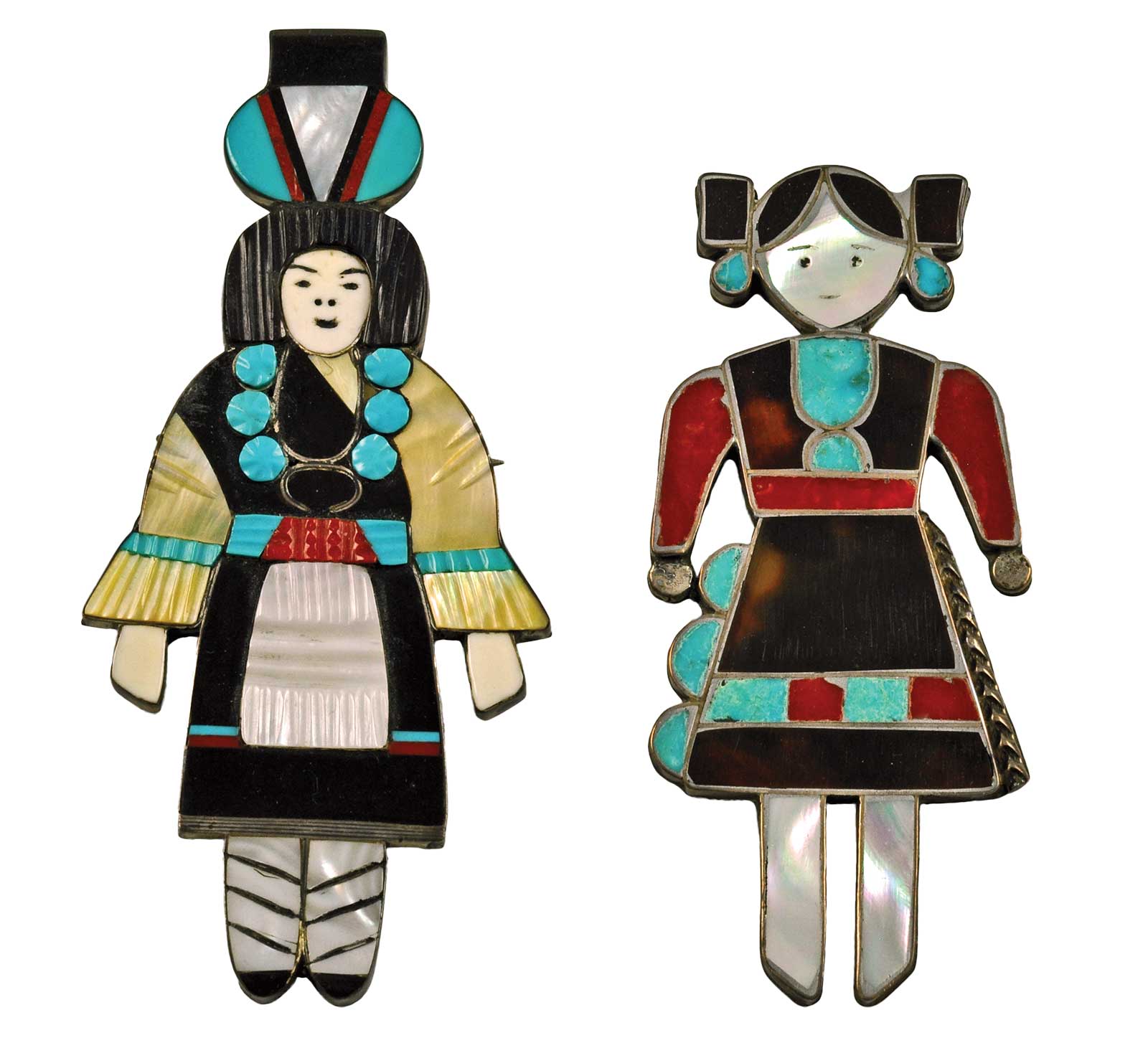 Olla Maiden by Madeline Beyuka, 1970s (left); Hopi Maiden by unknown artist (right), 1960s.
This was a breakthrough, indeed, but as always it was the Native peoples’ design decision. Some Pueblos would prove more restrictive. But Zuni had already gained a reputation for its appealing “folk art” pottery figures, stone and shell fetish carving, and colorful inlay on silver. Several kachinas became natural choices because of their expressiveness. One of these was the impersonation of Shulawitsi: the Little Fire God, known to both Zunis and Hopis. Distinguished by his black mask and body spotted with red and blue dots, this sacred spirit coordinates the Winter Solstice Shalako ritual. Those who depicted him in jewelry made sure to carefully substitute small details related to his head feathers, breechclout, and the offerings he carries. A Zuni-made silver and inlay Shulawitsi, originally purchased by the Fred Harvey Company, is now in the permanent collection of the Heard Museum in Phoenix, Arizona; it dates from the 1930s -1940s and the deity carries a dead fawn draped across his chest (Hopi katsinam versions often show a rabbit instead).
An example of a standup mosaic inlay on silver features a Little Fire God from the 1960s. The figural design resembles the earlier piece in the Heard for the most part, save for small divergences in the figure’s mask plumage, dead animal, garments, and overall stance. The piece is unsigned and has a pendant hook on the back. Shulawitsi has been reproduced by a number of Zuni lapidaries including Dexter Cellicion, Walter Nahktewa, and Leo Poblano.
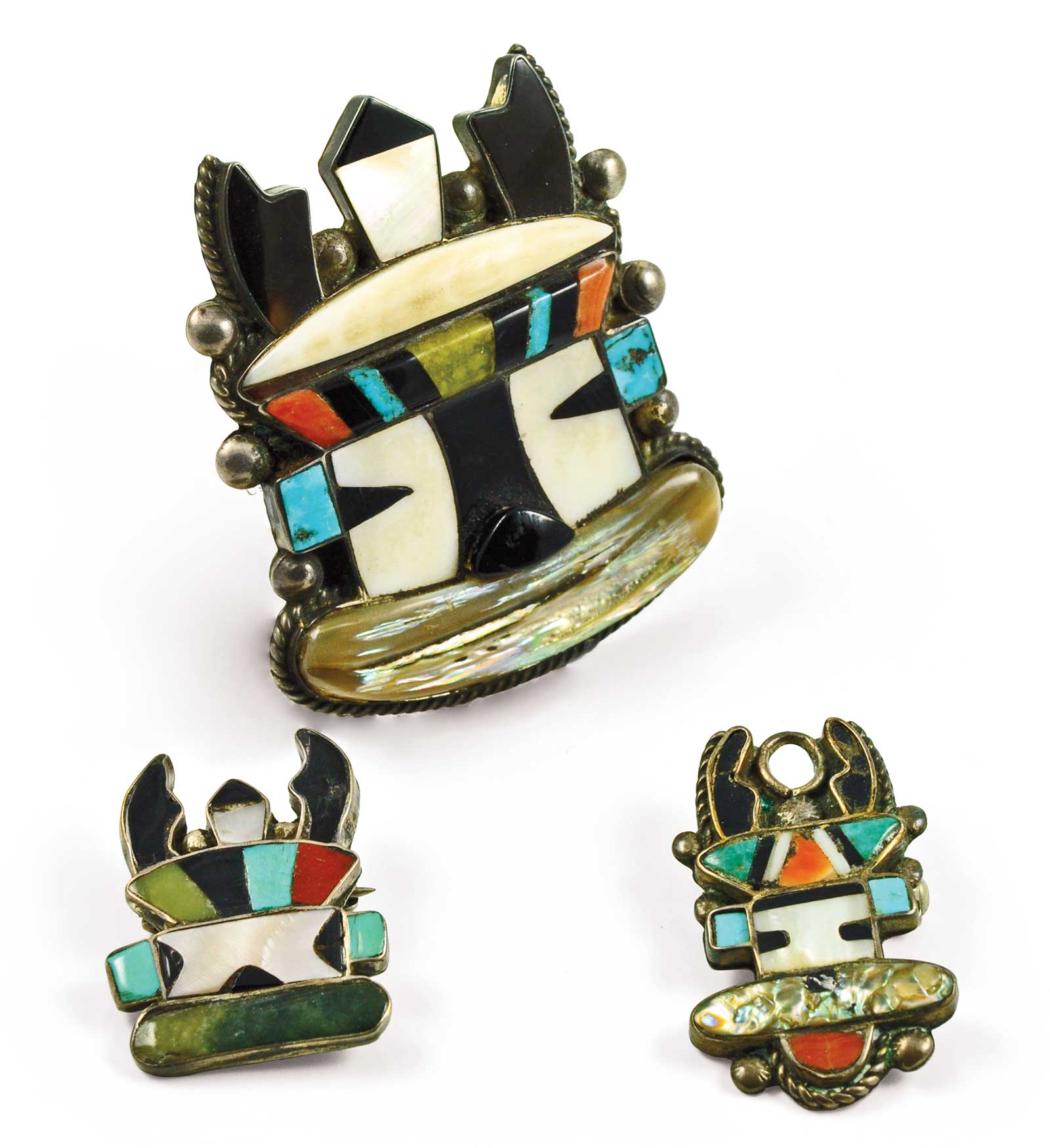 Three Zuni inlay masks, all unsigned. Smaller pieces likely 1950s, large mask 1970s.
Non-Natives have always been fascinated by Indian dances, so Zuni lapidaries and smiths fashioned a number of well-known dancer figures. One particularly colorful motif was made popular between 1950 and 1980: Apache Mountain Spirit (Gan) or Crown dancers. This dancer, conveniently not Zuni in origin, appears in the final day of Apache girls’ puberty rites, and is associated with healing. Depictions of these dancers range from a design by Frank Vacit from the 1950s, figures by Lambert Homer Jr. and Leonard and Edith Lonjose in the 1960s, and different versions by Tony Ohmsatte and Elliot Qualo in the 1970s.
One of the most memorable designs of that last decade, however, was an Apache Crown dancer conceived by Vera Luna (1930-1982). Her figure appears poised, caught in a moment of physical action, with distinctive crown-like headdress, masked head and beautifully made garments inlaid with jet, abalone, turquoise, opal and coral. Part of the dancer’s kilt is constructed from tortoise shell, which means it probably was made prior to 1973 (the year when this material was banned for use). Luna hallmarked her pieces with conjoined initials. Despite this precaution, her design has been flagrantly copied by imitators over the years. Buyer beware.
Another beautiful design rendered in mosaic inlay is the Eagle Dancer. John Lucio (1919-1984) and Dixon Shebola are best known for their dramatically posed figures made between 1950 and 1980. Lucio’s dancer has a bird-like aspect with its head extended while crouching with wings outspread in vigorous movement. Shebola’s unsigned eagle dancer is less exotic and more anthropomorphic in appearance; the muscular figure stands upright with one leg lifted in time to an invisible beat. Intricacy and focus appear in the dancer’s representation. Another uniquely Zuni detail can be seen in how the carved turquoise necklace contrasts against the flush inlay. This design is probably from the late 1960s or early 1970s.
The depiction of maidens is another popular mosaic inlay design motif. For the Zunis, this often took the form of a maiden effortlessly balancing an olla vessel on her head. Another widespread motif is that of a Hopi maiden wearing her uniquely whorled hair style. Leo Poblano (1905-1959) is considered the master of this type of figure. (Note: he is among the most over-attributed artists in the marketplace because of the beauty of his compositions.) An olla maiden signed by celebrated Zuni lapidary Madeline Beyuka from the 1970s is one example. The delicacy of her feminine features somewhat resembles Poblano’s style. This figure also has carved turquoise beads. Madeline and ex-husband Ed Beyuka (1920-2002) created a number of iconic midcentury mosaic inlay designs greatly in demand by collectors.
Beyuka’s olla maiden can be compared and contrasted with a pin pendant of a Hopi maiden in a much different style. It is an unsigned work that has been attributed variously to Zuni inlay artist Teresa Waatsa and a Navajo jeweler, Emma Bonney. In fact, there is a published example of this piece in identical garments but with a very differently delineated face (Bonney’s work?). The design shown here possesses delicately defined facial features and the inlay is neatly flat and well-ordered, with the dress made from tortoise shell. In terms of contrast, however, this figure is less detailed and much more geometric and fixed in pose than Beyuka’s work. While both pieces are aesthetically different, they are equally pleasing in their composition.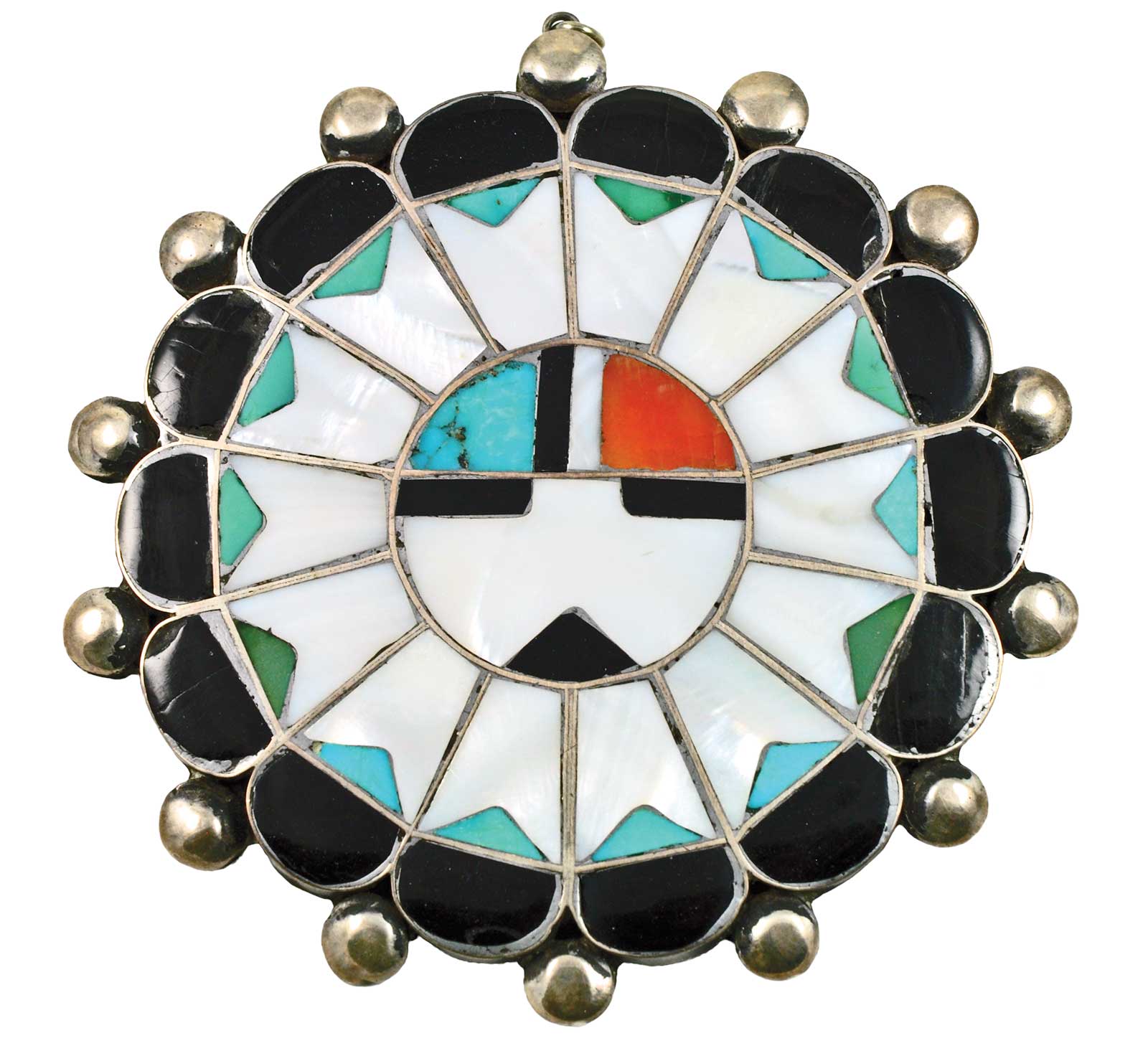 Inlay set in silver Sun Face by unknown artist, late 1960s-1970s.
Masks in Pueblo culture are sacred objects that make possible communication between the gods and their worshippers. They are a vital and dynamic part of Zuni life, cared for by those who revere their purpose. When mosaic inlay pins of masks began appearing in the period between 1950 and 1980, jewelry makers usually designed their features in forms that no way resembled the genuine article. The three pieces shown here, made without silver channels, are fanciful re-creations intended for the marketplace. The two small pins are older, possibly from the 1950s or early 1960s. The large 1970s mask pin possesses added three-dimensional features in the nose and rolled mask bottom, a reminder of the skillful fetish carving talent existing in Zuni.
The Sun Face design is likely Pueblo in origin but has been taken up by all Southwestern Native peoples. The Sun is revered as a deity in most Indian cultures, and depicted in a variety of ways. Zuni Sun Faces are appreciated for the charm with which geometric lines and shapes have been put together in inlay. Most Sun Faces are devised with either a round or triangular mouth. The pin/pendant shown here is arranged with appealing elements. Its radiating spokes consist of shell, turquoise and jet, and the turquoise is shaped into triangles that echo the design of the mouth. Interestingly, the Sun Face became a popular design motif during the 1960s and 1970s, the same time when graphic illustrators in the U.S. and Europe began devising the iconic yellow-and-black smiley (or happy) face symbol.
Viewed through the lens of design history, these vibrant examples of intricate inlay and graceful silverwork are yet another distinctive feature of mid-20th century modernism in American Indigenous design. Their conception draws upon traditional themes, their construction is clever—even playful—and they clearly speak of personal vision. The introduction of figural design motifs in Zuni between 1950 and 1980 was an opportunity that famously enriched decorative jewelry design. These “vintage” pieces uniquely blend craft, folk art and emerging fine art design.
Powered by Froala Editor