Souvenirs, keepsake reminders of travel, are made in many forms. In the American Southwest, a popular tourist choice was Indian jewelry. Navajo and pueblo silversmiths were constructing adornment in the last decades of the 19th century; soon Indian traders and curio store owners were buying and commissioning these goods for sale to interested non-Natives. As smiths became more experienced and their designs grew even more attractive, a trade developed in jewelry fashioned for discerning travelers.
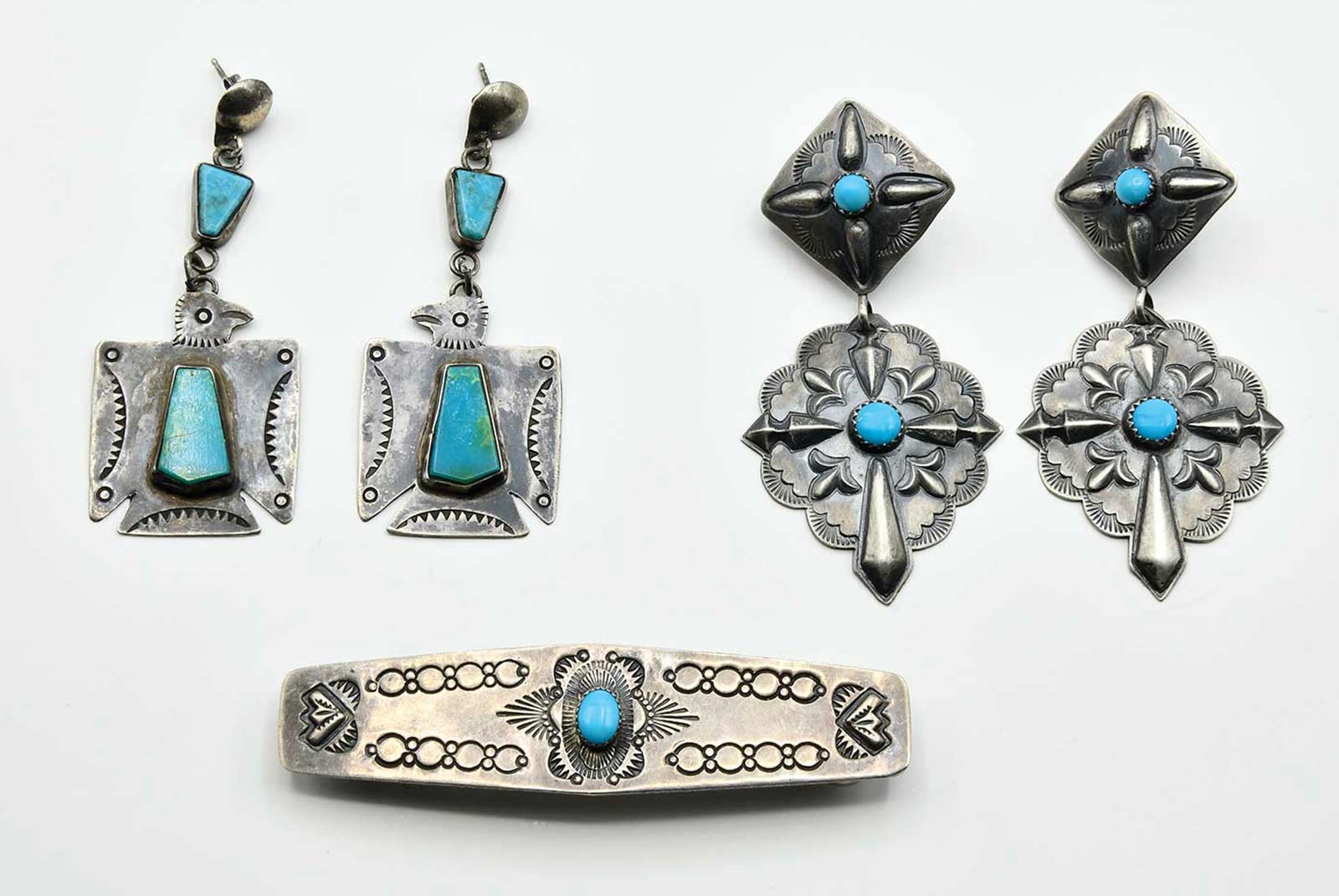
Two pairs of old-style earrings in silver and turquoise: left to right, abstract design with Kingman turquoise; tourist-style eagle designs with Blue Gem, both 1920s; and a hair barrette, likely repurposed a few decades later.
As early as the 1900s, non-Native manufacturers began cranking out mass-produced jewelry forms; trade catalogs for companies in New York, Chicago, and Los Angeles offered these generic wares for sale in stores inside and outside the Southwest. Inexpensive souvenirs were made in brass, copper and nickel silver. Handmade jewelry in silver, mostly sterling silver by the 1910s, soon surpassed the cheaper wares.
This adornment grew better in quality when the goal was to market jewelry with selective designs as even more desirable souvenirs. Pieces were scaled down and shaped for non-Native wear. These creations emphasized plain silver and silver set with stonework. During the 1920s through 1950s, talented jewelry makers produced souvenir adornment with durable appeal. Metalsmith and beadmaker motifs sold well when they embodied unique, unusual and intriguing aspects of the Southwestern landscape and its Indigenous inhabitants.
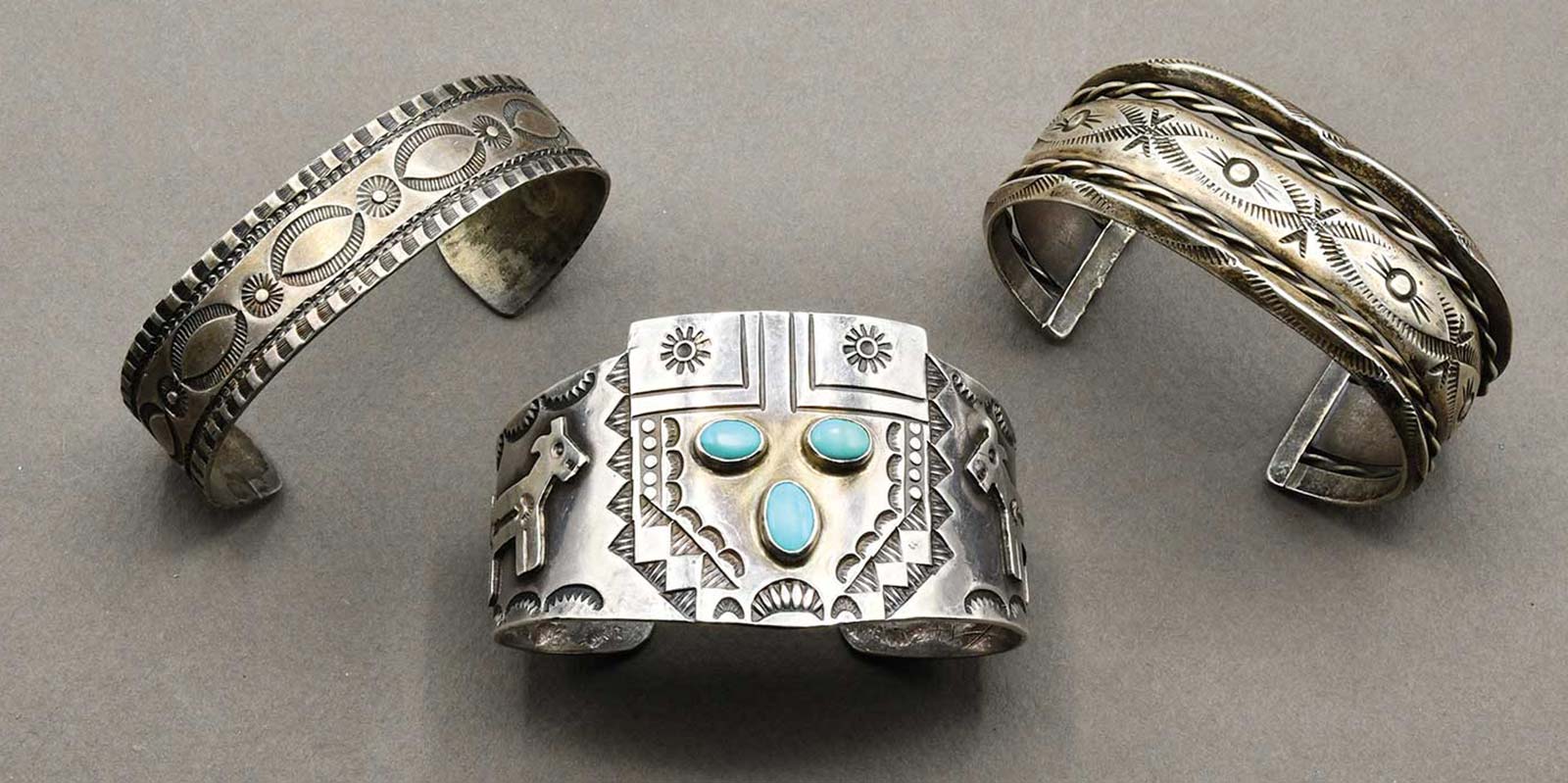
Three tourist styled bracelets. Left to right: all silver with abstract stamping; wide cuff with Fred Harvey-style “horses” on the sides and a central absurdist face made with turquoise cabs; silver bracelet with linear stamping, 1930s-1940s.
The early- to mid-20th-century taste for portable mementos advanced Native careers once their designs became collectible. Discerning tourists might turn into future collectors. Those hunting for high-quality American-mined turquoise also became interested in Indian jewelry. During these four decades, Indian-fabricated jewelry could also be considered craft, such as inlay work, made in multiples.
Intricately fabricated sterling silver tourist jewelry became more appealing in the 1930s and 1940s. By the 1950s, stylish designs emerged with minimalist surface decoration. Native-made silver and stone jewelry outstripped the cheaper souvenirs in design and construction quality. The examples shown in this article are objects owned by Elizabeth Stiers, who began collecting tourist and artist-designed jewelry in the 1980s.
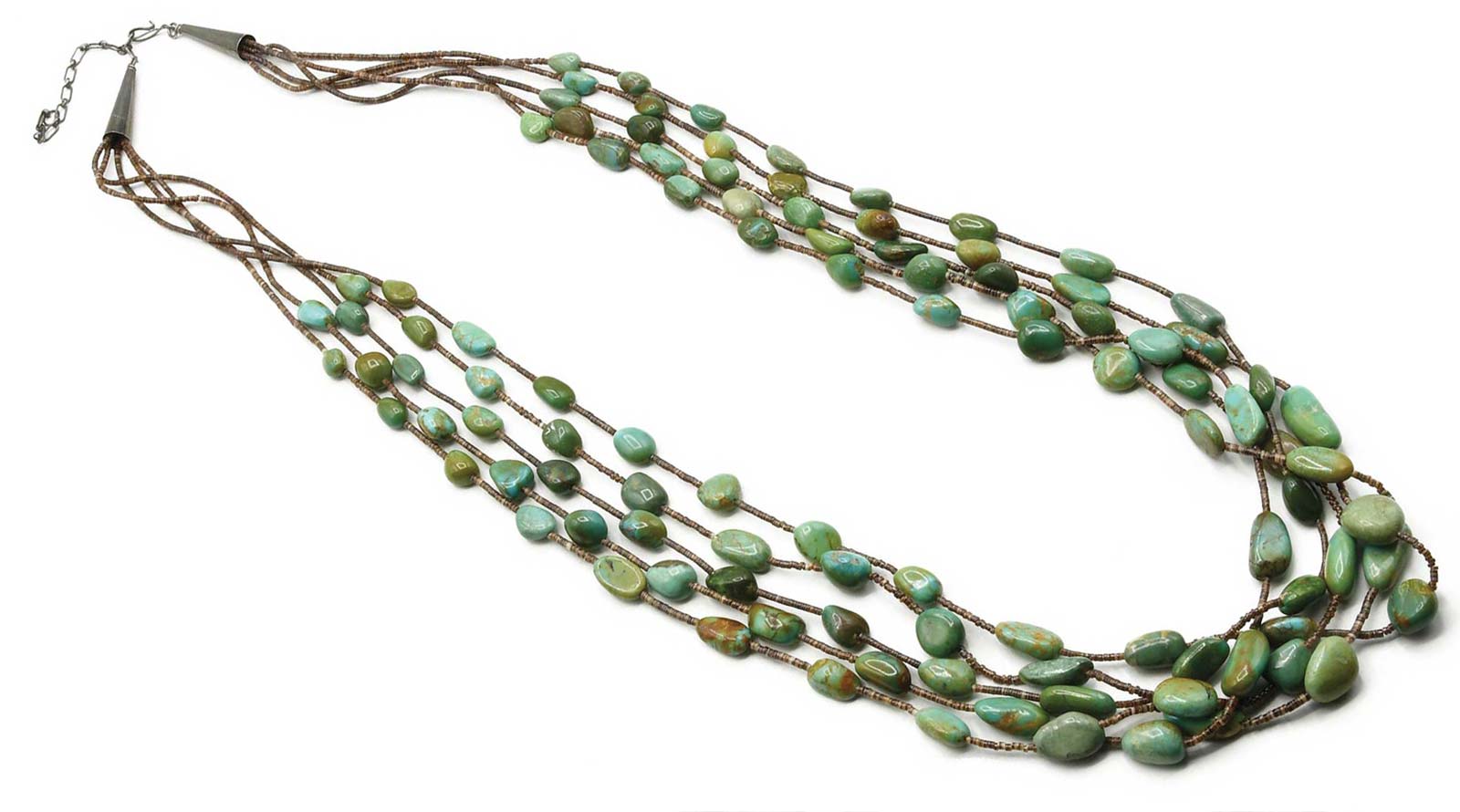
Five-strand necklace with brown clamshell and Fox turquoise bead, possibly Pueblo, 1920s-1930s.
Interesting historic souvenir jewelry often turns up in estate sales across the United States and abroad. The less expensive Fred Harvey-era designs can still show up at antique and flea markets. Characteristic pieces have such popular stamped motifs as fanciful animals, arrows, eagles and whirling logs. The last design was voluntarily retired by 1940 because it resembled the Nazi swastika; it has now been reprised as a legitimate retro motif.
Specific examples show that abstraction remained a favored choice for patterning, while figural compositions refer to the older Harvey-era motifs. The advent of sterling silver as material of choice for tourist jewelry creation helped Native makers hone their jewelry forms, designs and styles. Earrings, bracelets, rings, necklaces and distinctive concha belts were the most popular jewelry forms brought home by visitors.
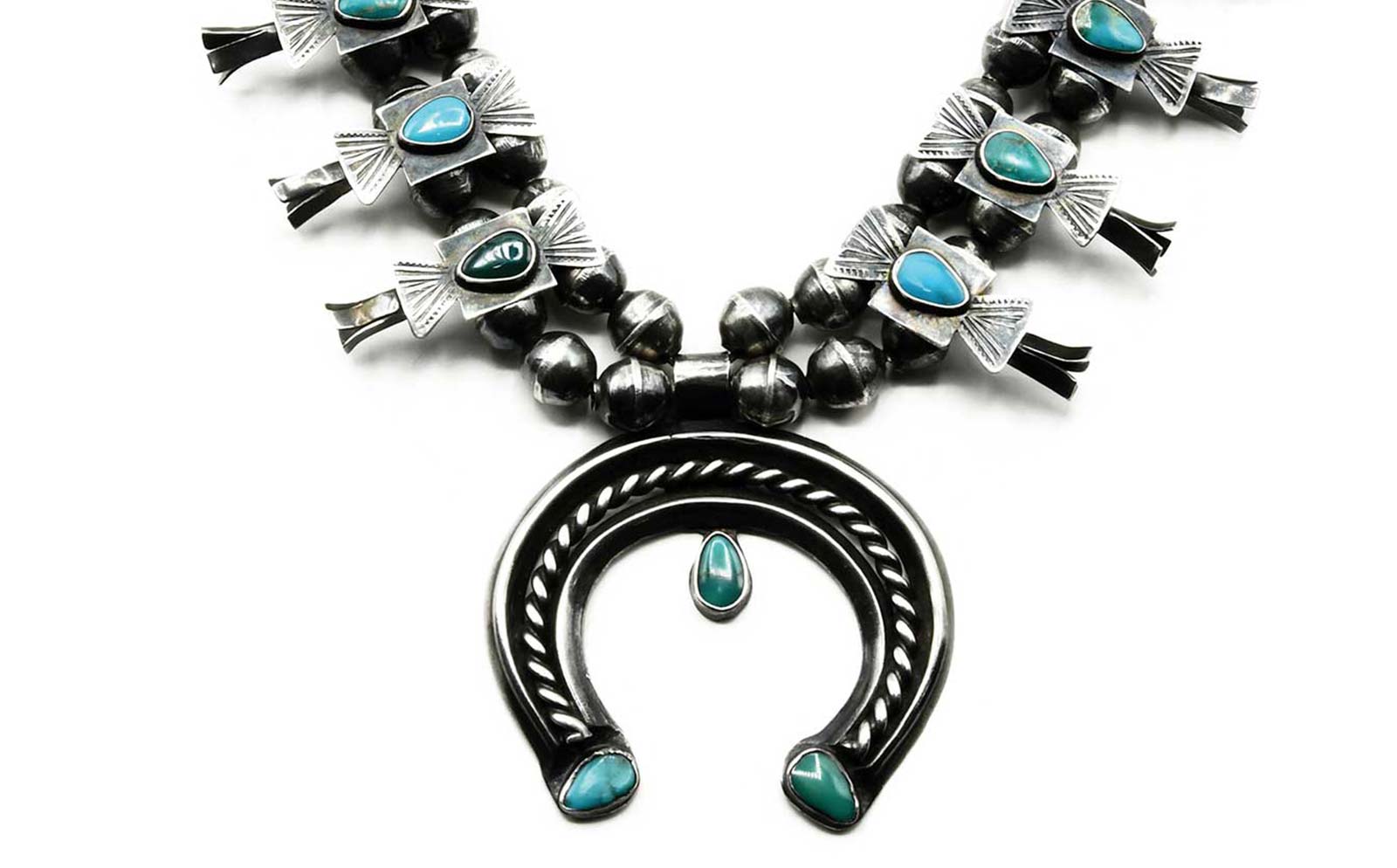
Silver squash blossom necklace with Blue Gem box bows and naja decoration, mid-20th century.
Early tourist earrings tended to split into two design categories: abstract and small figural vignettes. The Fred Harvey Company was known for encouraging Native artists to make precise motifs. Dangle shapes were characteristic pueblo earring forms, rather sophisticated designs that date back to at least the mid-19th century. Native makers knew how to style or repurpose these pieces to fit mainstream feminine tastes.
Navajo silver cuffs were fashioned to appeal to both women and men as souvenir choices. Indian bracelets were bestsellers, especially those with a pawn ticket added. Curio stores, like the Bell Trading Company, made multiples of such bracelets employing form, size and texture as vibrant physical characteristics. Small turquoise cabs could be added to shape a comical face, making the piece definitely out of the ordinary.
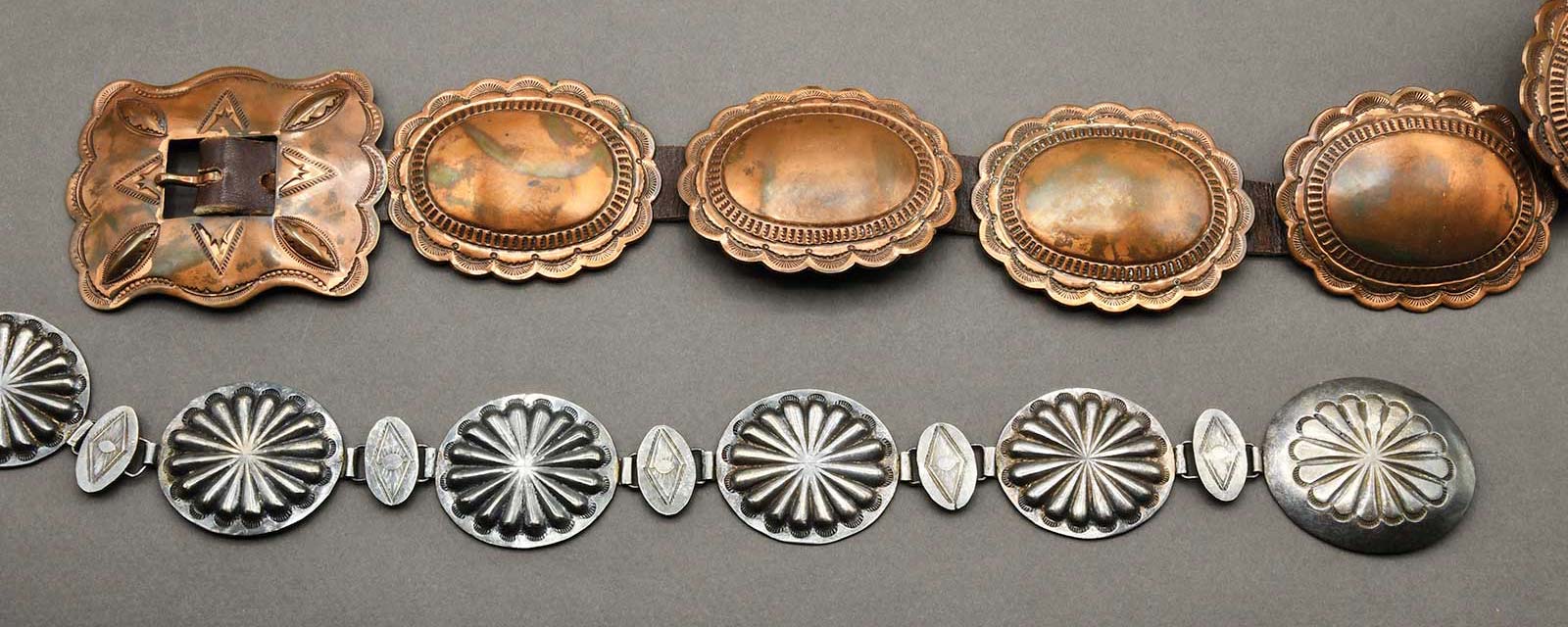
Two tourist concha belts: copper belt stamped “UITA 21” and silver belt stamped “UITA 15,” late 1930s-1940s.
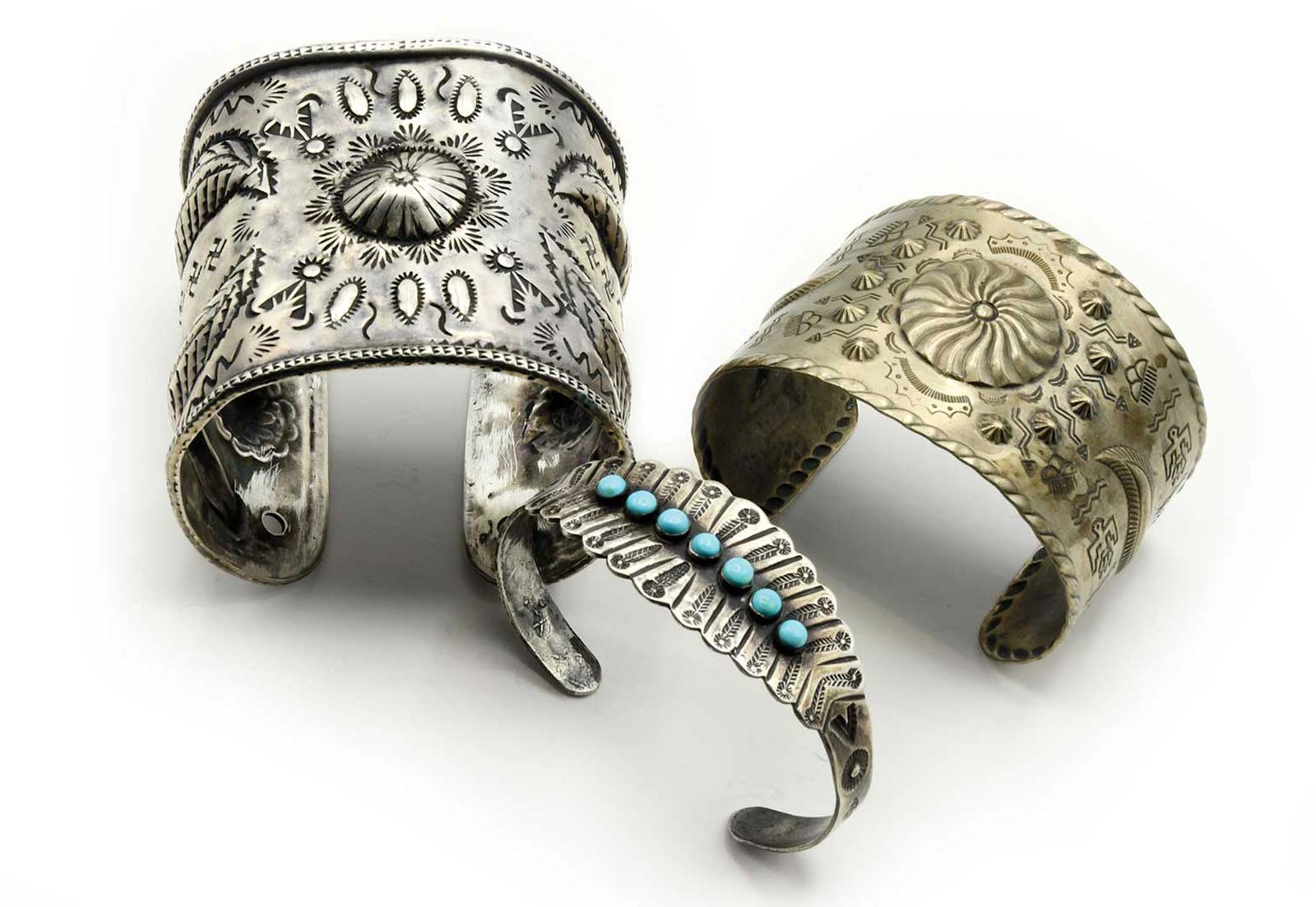
Two wide cuffs and a narrow tourist bracelet. Left to right, tall silver cuff with geometric and central dome decoration; a thin stamped bracelet with turquoise dots in a line; and a nickel silver cuff made by Bell Trading Post, all 1930s.
Turquoise became highly popular with collectors as mines around the West opened and closed frequently in the 20th century. Delicate necklaces, such as this example with brown clamshell and Fox turquoise cabochons (Page 49), fulfilled souvenir and curio expectations. Or a souvenir squash blossom necklace could be worn at home as a statement piece. The horseshoe-shaped naja and ornamental box bows give this silver necklace (Page 47) an exotic character; its beauty is enhanced by its Indigenous origins.
Silver concha belts were possessions prized by Indian men. Tourist belts, less grandiose and more scaled-down, became fashion accessories for unisex wear. The examples seen here (Page 48) are marked with the UITA (United Indian Traders Association) label which means they can be attributed to specific locales of construction. The UITA devised numbered stamps for specific pieces which had been fabricated for member posts and stores; eventually this practice fell out of favor. Collectors, however, value the UITA stamp because pieces can be dated to a specific mid-20th-century period.
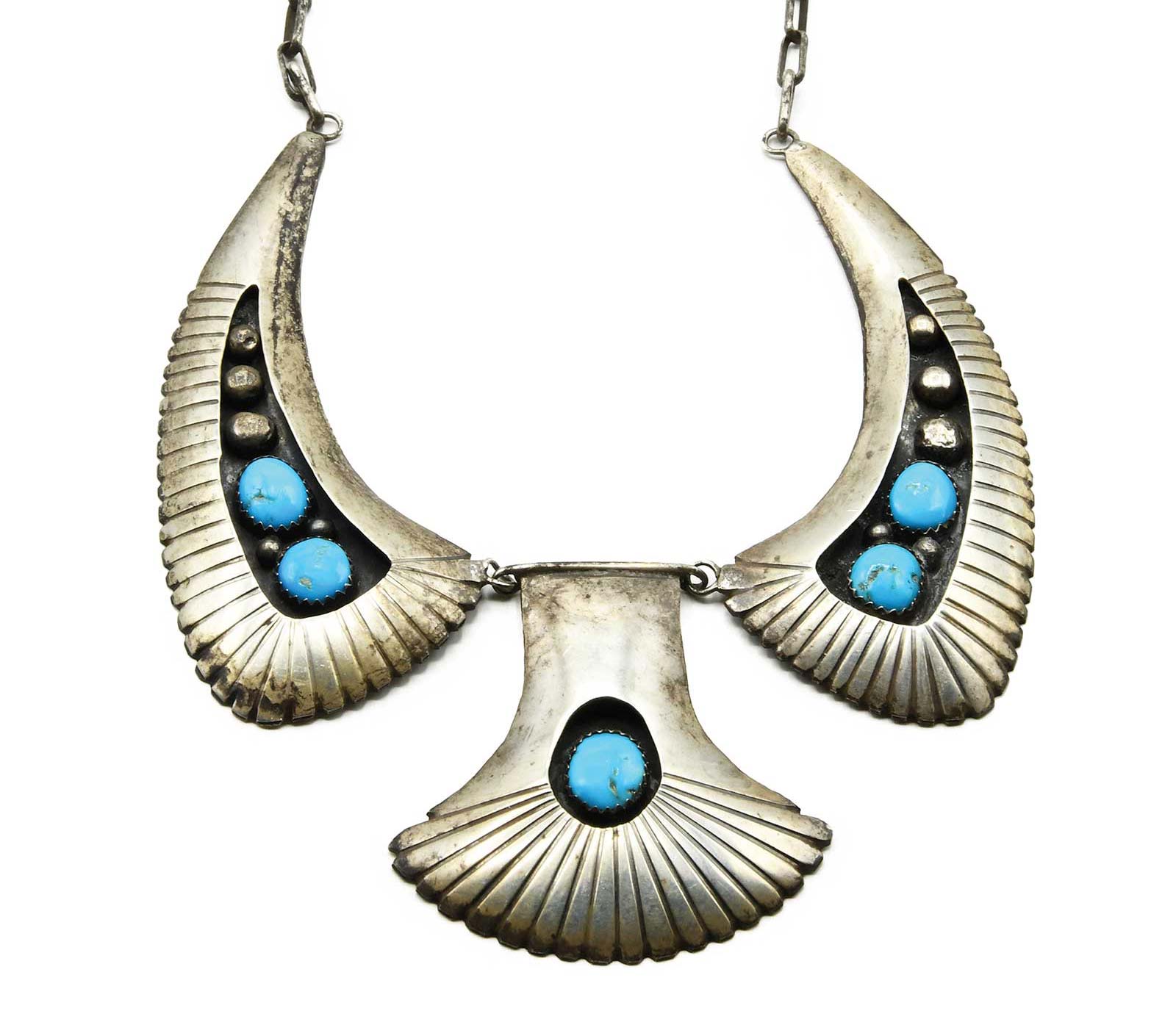
Three-piece silver necklace with grooved abstract design and inset turquoise by Cecil Sanders (Navajo), 1950s.
Tourist jewelry usually copied old-style compositions; many 1930s bracelets were designed with wide bands and ever-popular repoussé adornment, and pieces were sized for a feminine wrist. These effects could also be made in nickel silver for those who didn’t want to pay more for sterling silver. Curio bracelet bands could be designed to be thinner and more decorative by emphasizing a row of turquoise “dots.”
By the 1950s, aesthetic changes were underway. More artists working in an original mode now signed their pieces. The collar necklace shown here (Page 49)has grooved lines reminiscent of the work made by the White Hogan’s Native silversmiths. Strongly marked silver paired with good turquoise stones narrowed the gap between tourist and artistic designs. Postwar tastes ran to row bracelets and cuffs with a large central turquoise stone. These creations were pieces meant to be seen and appreciated.
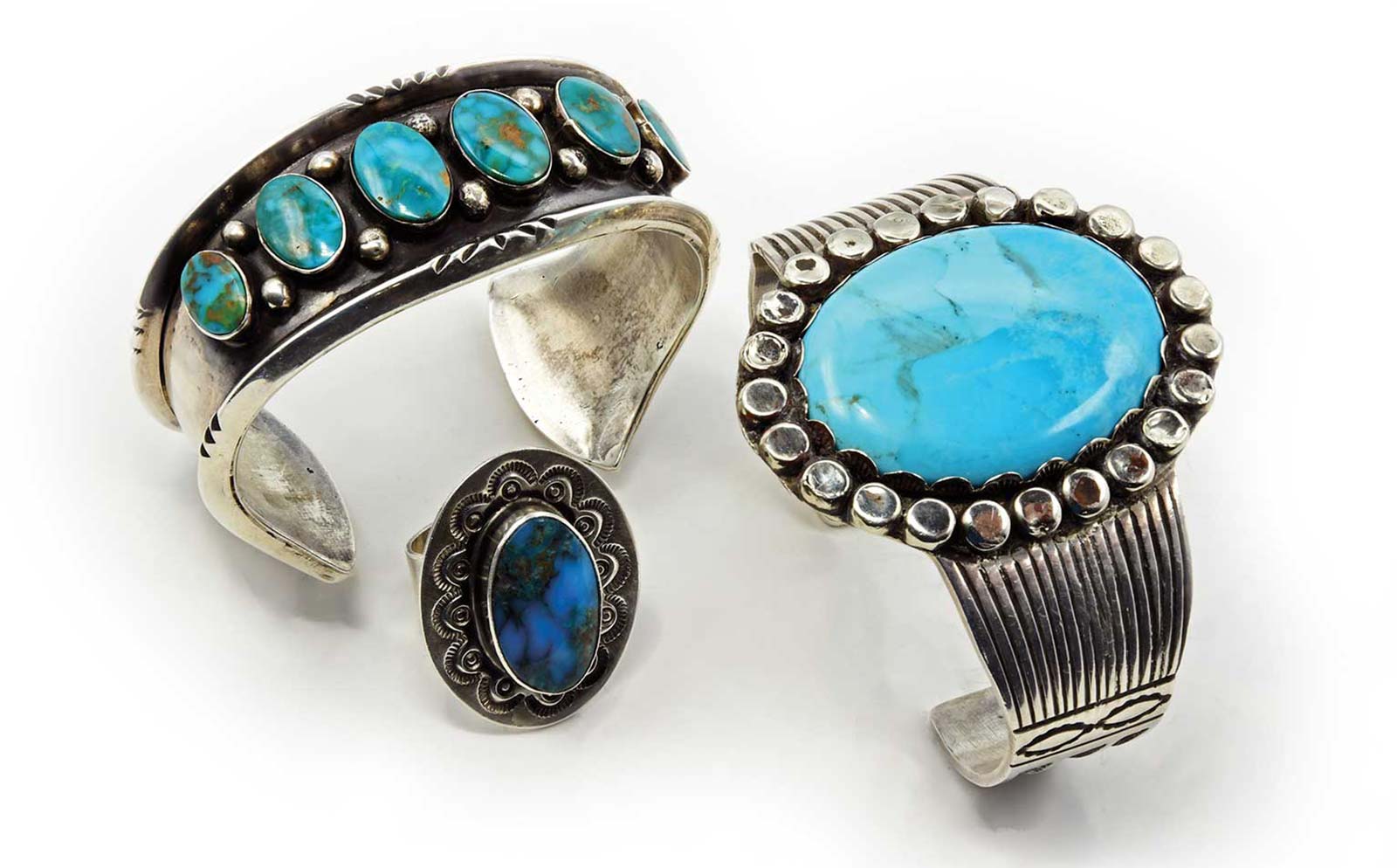
Two postwar bracelets and ring. Clockwise from top left: row bracelet with Blue Gem stones; silver cuff with large round stone set in Sleeping Beauty turquoise; silver ring with framing plate set with Blue Gem turquoise, 1950s.
Native-made silver jewelry has come a long way from its souvenir origins. These creations have their place as contemporary craft and artistry and are highly collectible in nature. Tourists today can still find tatty stuff but they have easier access to attractive pieces made by Southwestern Indians. The 1920s through 1950s can be seen as a period when Native jewelers were moving into craft design enroute to unique fabrications. The postwar rise of automobile tourism, Route 66 and souvenir kitsch never dampened travelers’ admiration for better-quality jewelry. Collecting such work can be habit-forming. —
Paula A. Baxter, a former curator and adjunct professor from New York, is an independent design historian living in Scottsdale, Arizona. Her photographer is longtime husband Barry Katzen. Her sixth book, Navajo and Pueblo Jewelry Design: 1870 to 1945, was published in fall 2022. She’s working on a sequel which will cover the years 1946 to 2025, and will include Indigenous jewelers who aren’t Navajo or Pueblo but live and work in the American Southwest.
Powered by Froala Editor


