In celebration of its 50th anniversary, and in recognition of America’s 250th, the Rockwell Museum, a Smithsonian affiliate, is presenting an exhibition that will highlight Indigenous identity, resilience and creativity through 40 works by more than 30 of today’s leading Native artists.
Native Now: Contemporary Indigenous Art at The Rockwell Museum runs January 24, 2026, through May 4, 2026, and features artworks by an impressive roster of renowned artists. On view will be pieces by Jaune Quick-to-See Smith (Citizen of the Confederated Salish and Kootenai Nation, 1940-2025), Virgil Ortiz (Cochiti Pueblo), Wendy Red Star (Apsáalooke (Crow)), Preston Singletary (Tlingit), Cannupa Hanska Luger (Three Affiliated Tribes of Fort Berthold Reservation), Jeffrey Gibson (Mississippi Choctaw/Cherokee), Raven Halfmoon (Caddo), Sarah Sense (Chitimacha/Choctaw), Hayden Haynes (Onödowa’ga:’ (Seneca Deer Clan)/Kiowa/Mvskoke), Edgar Heap of Birds (Cheyenne, Arapaho), and many others.
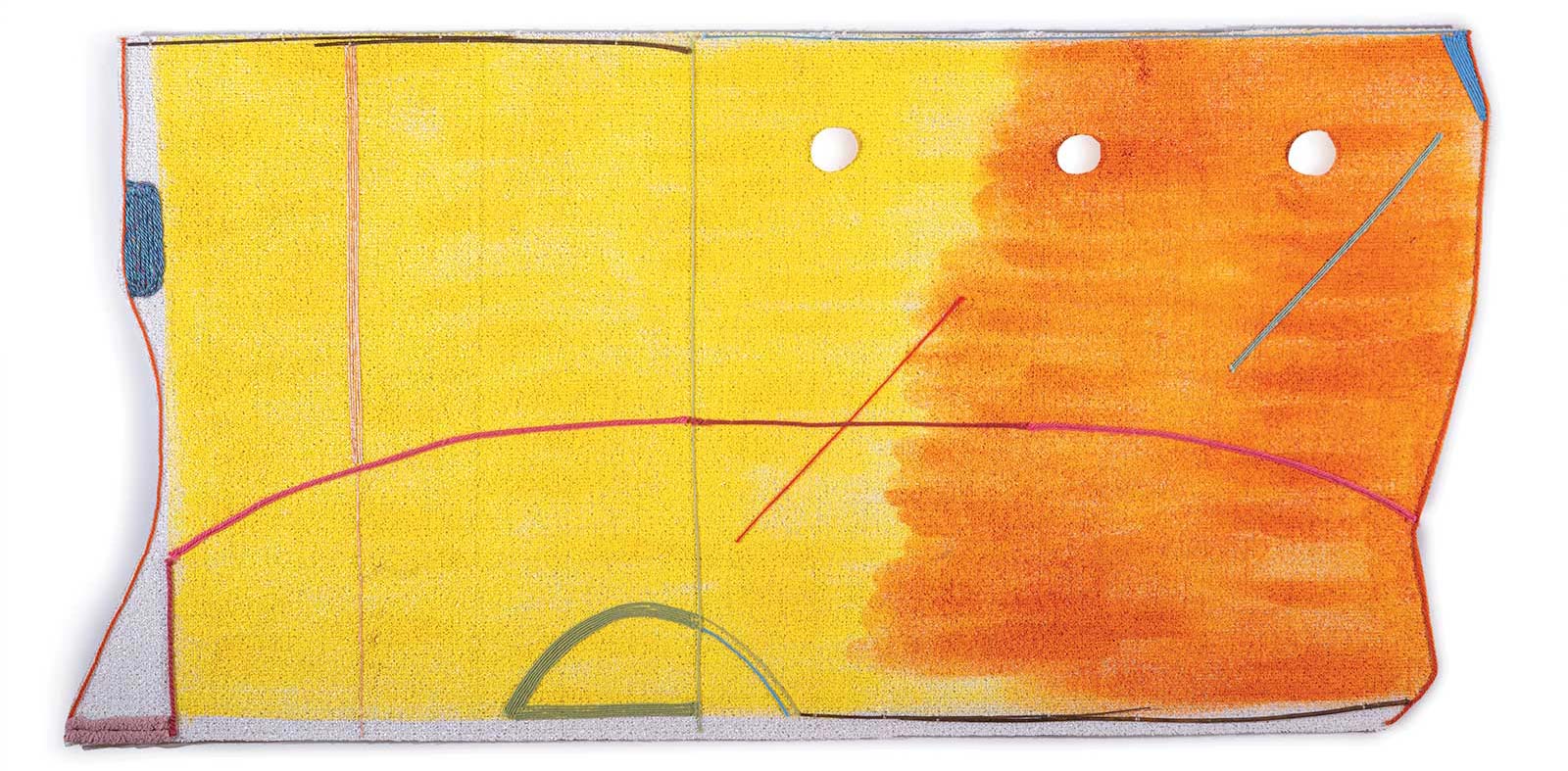
Teresa Baker (Mandan/Hidatsa), Yellow Prairie Grass, 2023, acrylic, yarn, willow and buckskin on artificial turf, 38 x 75 in. Museum Purchase with the Bob and Hertha Rockwell Deaccession Fund. 2024.3. The Rockwell Museum, Corning, NY.
“In planning for our anniversary year, we wanted to highlight areas of strength in the Rockwell’s collection that reflect the museum’s legacy, current goals and vision for the future,” says the museum’s executive director Erin M. Coe. “From its founding in 1976, Native American art has formed the cornerstone of the Rockwell’s identity, shaping its mission and informing its interpretation of American art and the American experience.”
By the late 1990s, the museum had started to expand its holdings from its foundation of historical material to incorporate works by living Native artists. They were guided in their efforts by Cherokee artist and professor Kay WalkingSitck (Cherokee/American) who, Coe says, “[urged] the museum to collect art by Native people who speak for themselves and their communities—especially important within an institution that had long represented Native subjects through the lens of others.
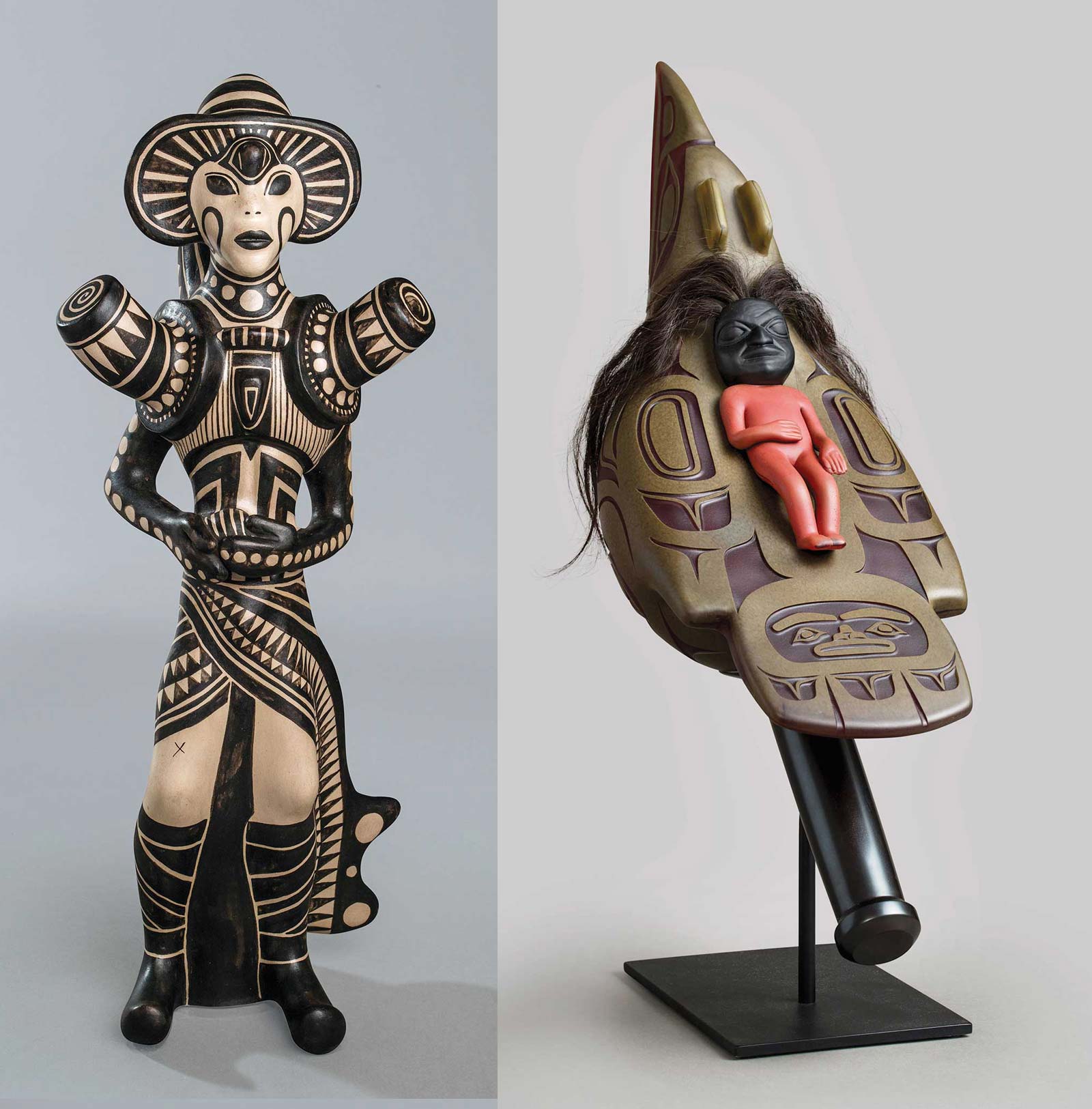
Left: Virgil Ortiz (Cochiti Pueblo), Ancient Elder Figure / Pueblo Revolt 1680 / 2180 Series, 2012, polychrome ceramic, 20 x 7½ x 2 in. Purchased with Funds from the Silver Dollar Society in memory of Bryan J. Lanahan. 2014.6.1 © Virgil Ortiz. The Rockwell Museum, Corning, NY. Right: Preston Singletary (Tlingit), Wakefulness, 2016, glass, hair, steel, 21½ x 21 x 6 in. Museum Purchase with Funds Donated by James B. Flaws and Marcia D. Weber. 2016.4a-b. © Preston Singletary.
“Nearly three decades later, the Rockwell Museum continues to build upon that vision…By organizing an exhibition focused on this area of strength, Native Now not only celebrates the vitality of Indigenous creativity but also positions the Rockwell within the national dialogue on the power and potency of contemporary Native art and its resonance in the present moment.”
Native Now is organized in three thematic sections: “Indigenous Landscapes,” “Past/Future” and “Thrivance.” Through works by artists such as Teresa Baker (Mandan/Hidatsa), Emmi Whitehorse (Diné (Navajo)) and Julie Buffalohead (Ponca), “Indigenous Landscapes” explores the spiritual and political relationship between Native identity and the land. Drawing inspiration from her home in the Northern Plains, Baker’s Yellow Prairie Grass is a multi-media piece consisting of layers artificial turf with buckskin, acrylic and yarn in hues evocative of a vibrant sunset and a grassy field. Amanda Lett, curator of collections and exhibitions, says, “One of the museum’s newest acquisitions, Yellow Prairie Grass, is a wonderful example of the new ways artists are interpreting the landscape. Grounded in the history of Winter Counts used by many Plains Nations to record the important events in a year, Baker transforms this older form of map and meaning-making into something bold and abstract…Her use of artificial turf asks the viewer to think about how humans change and shape the land. Baker, like many of the artists in this section, utilizes landscape to ask broader questions about who we are and where we are going.”
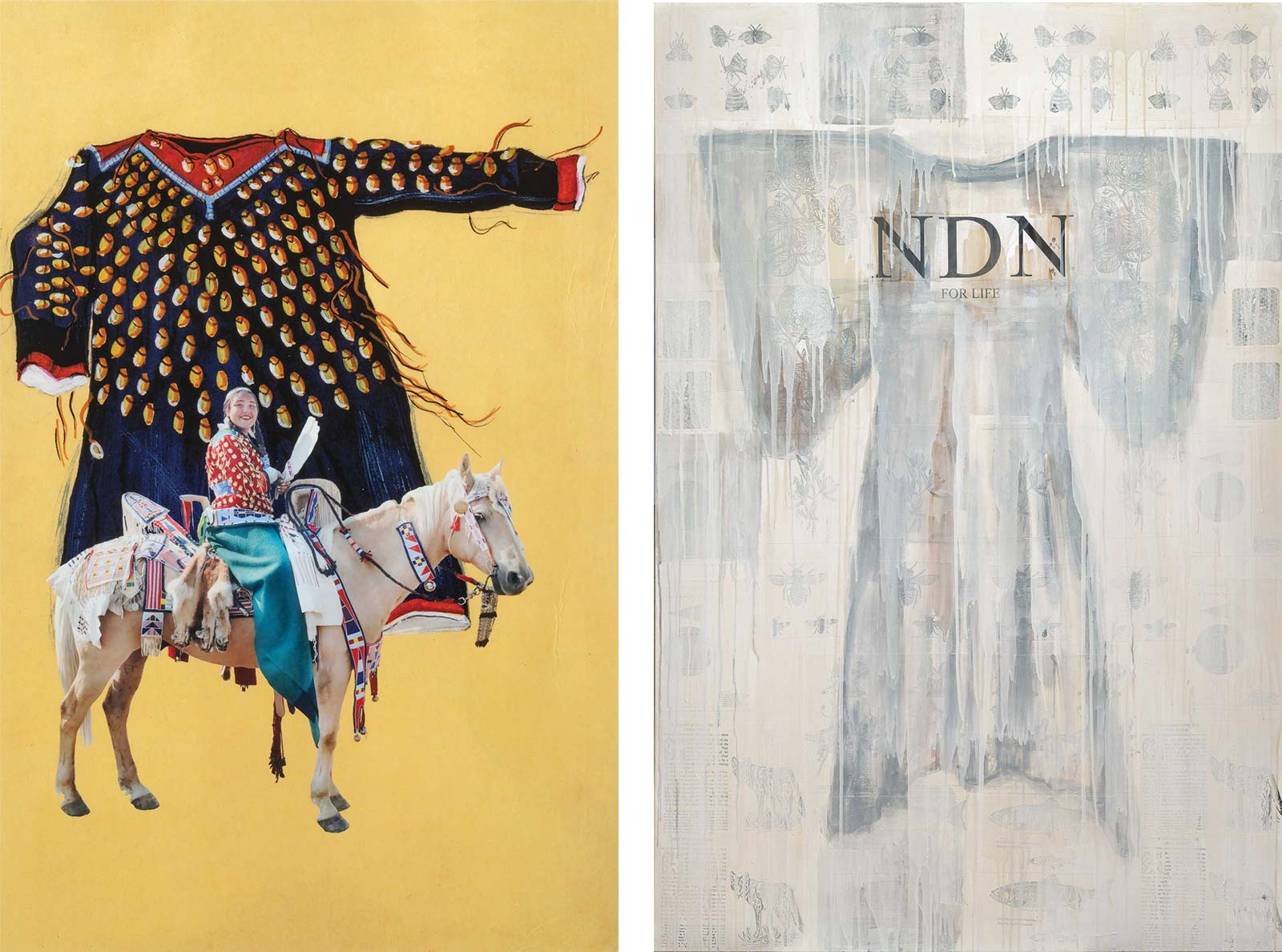
Left: Wendy Red Star (Apsáalooke (Crow)), Catalogue Number 1950.76 from “Accession” Series, 2019, pigment print on archival paper, 28 x 18 in. Clara S. Peck Fund. 2021.2.15. The Rockwell Museum, Corning, NY. Right: Jaune Quick-To-See Smith (Citizen of the Confederated Salish and Kootenai Nation, 1940-2025), NDN (for life), 2000, mixed media on canvas, 72 x 48 in. Gift of Joanna Wurtele. 2000.13. The Rockwell Museum, Corning, NY.
Works from Virgil Ortiz’s Ancient Elder Figure / Pueblo Revolt 1680 / 2180 Series are showcased in “Past/Future,” which explores Native Futurism, a concept that the museum explains, “fuses ancestral knowledge with visions of Indigenous sovereignty and transformation.” Lett continues, “One of the most exciting movements in contemporary Native American art is the rise of Native Futurism. Artists such as Virgil Ortiz and Cannupa Hanska Luger are on the cutting edge of this work, combining Native history and popular science fiction with forms that speak to the ongoing creativity of Indigenous people.
“Like all the work in the exhibition, their work specifically speaks about ‘thrivance’: a more recent framework scholars are using to move past the ideas that modern Indigenous people are simply survivors, but are productive, successful, artistic, and thriving in the contemporary world.”
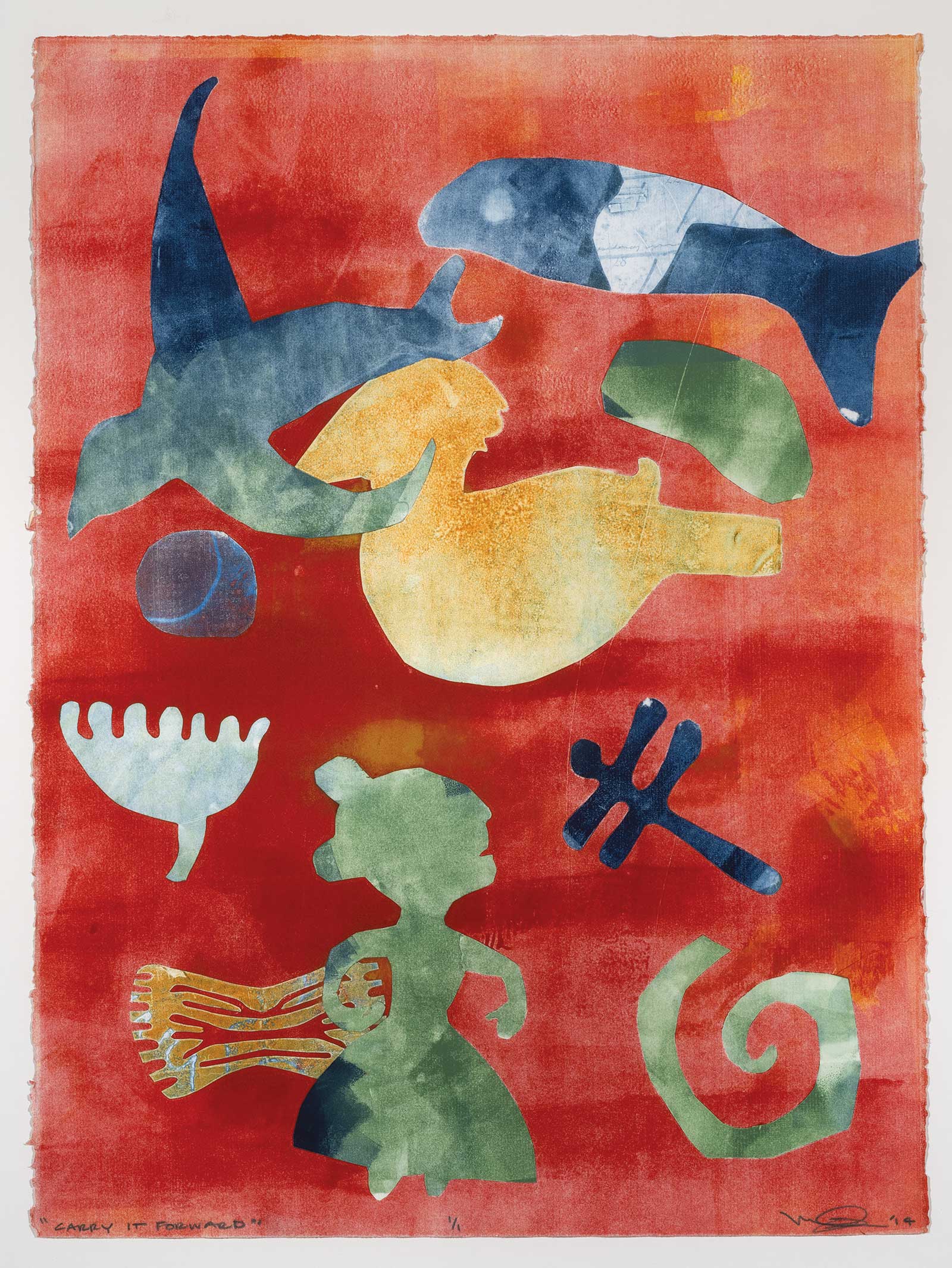
Melanie Yazzie (Navajo (Diné)), Carry It Forward, 2014, monotype on paper, 29¾ x 22 in. Clara S. Peck Fund. 2019.10.
Other artists highlighted in “Thrivance” include Red Star, Sense and Melanie Yazzie. Quick-to-See Smith’s NDN (For Life), a pointed commentary on the idea from popular culture that all Native people are the same, will be featured in a section on identity.
“I am working closely with co-curator Randee Spruce (Seneca Nation, Heron Clan),” says Lett, “and we hope that visitors come away with the idea that contemporary Native American art is fresh, experimental and speaks to everyone. Many of the works ask visitors to think of themselves as part of an interconnected community, and we hope visitors leave with a deeper connection to the art they experience and a greater appreciation for diverse perspectives, cultures and places.” —
January 24, 2026-May 4, 2026
Native Now: Contemporary Indigenous Art at the Rockwell Museum
The Rockwell Museum, 11 Cedar Street, Corning, NY 14830
(607) 937-5386, rockwellmuseum.org
Powered by Froala Editor


