

The San Ildefonso Pueblo ceramicist Maria Martinez (1887-1980) became a legend in her own lifetime. She attended four world’s fairs, was invited to the White House by presidents Hoover, Roosevelt, Eisenhower and Johnson, and her pottery was collected by luminaries around the world.
 Maria Martinez, 1976, with jar made in 1942. Photograph by Jerry Jacka, 1976.
The photographer Ansel Adams related that he and his wife Virginia “traveled all through Arizona and ended up in Santa Fe, where we originally bought eight Maria plates. My father lent me $48 to buy them, in 1929.”
John D. Rockefeller Jr. and later, his son David, met Maria and collected her work as did his other sons Nelson and Laurence. The elder Rockefeller held her in such high esteem that he invited her to participate in the laying of the cornerstone of Rockefeller Center in 1933.
In 1952, the potter Shoji Hamada, a Japanese national treasure, visited Maria at San Ildefonso and performed a demonstration during his stay. A photograph of the event shows Maria and, way in the back, Georgia O’Keeffe.
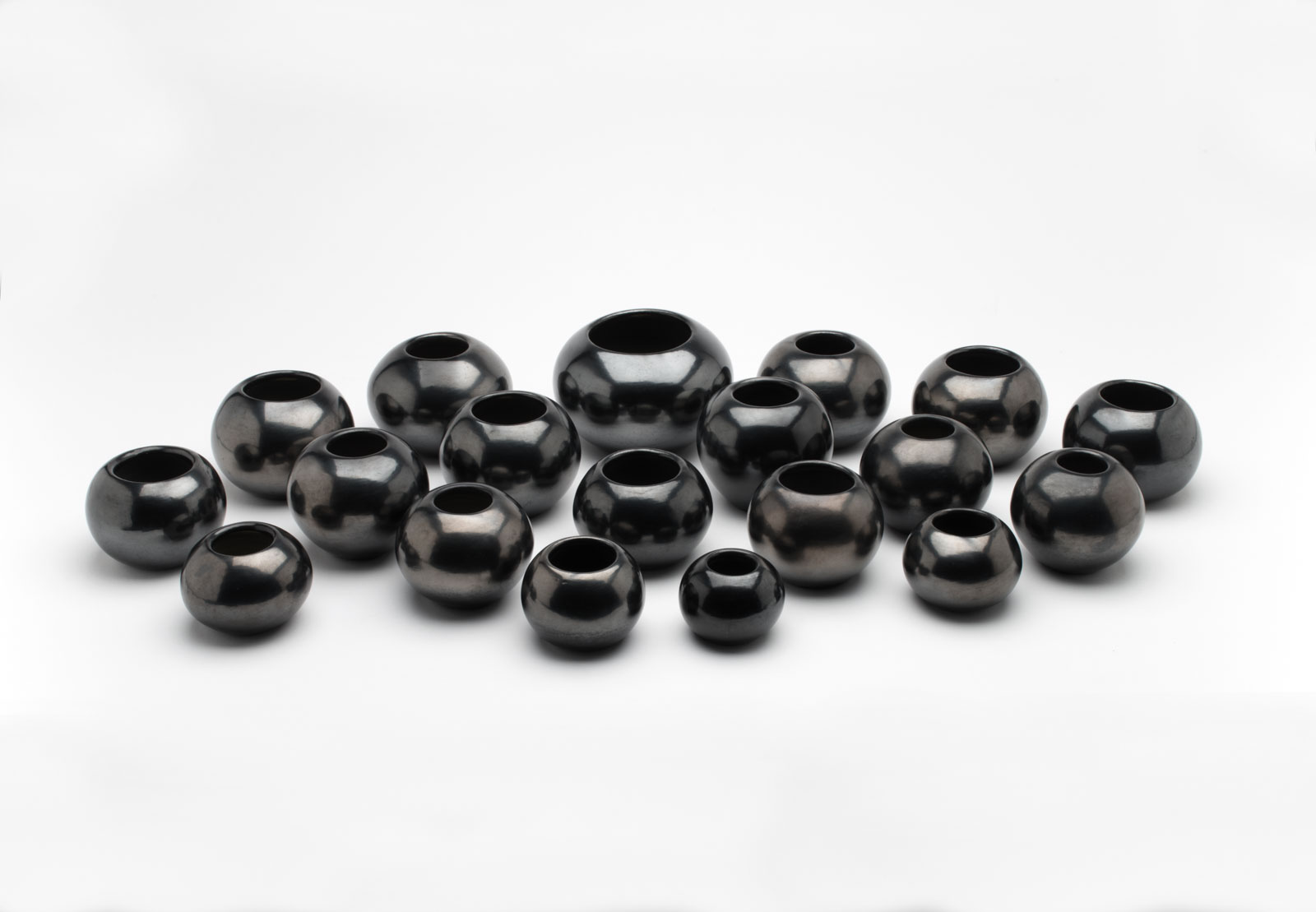 Maria Martinez (San Ildefonso, 1887-1980) and Popovi Da (San Ildefonso, 1922-1971), Gunmetal finished jars, July 1963-December 1970, smallest: 2 x 2¾”, largest: 4 x 6”. Collection of Nadine Basha.
Despite her innovations in pottery realized with her husband, Julian, and their international fame, she hasn’t been included in the scholarship of American modernism. The Heard Museum in Phoenix will unveil the exhibition Maria & Modernism, beginning February 24. The museum explains that the exhibition “will present examples of her pottery that substantiate the aesthetic and conceptual affinities of her work with major artistic and creative movements of her time, including decorative and industrial design, and examine her ongoing influence on 21st-century artists.”
The museum’s chief curator, Diana Pardue, notes that “in terms of innovation—the sleekness, shine, shape and perfection of her pottery—it perfectly fit American modernism. It could go into any home or contemporary office. It fit the streamlined architecture of the ’30s and ’40s. The Rockefellers were collecting her work as early as 1926.”
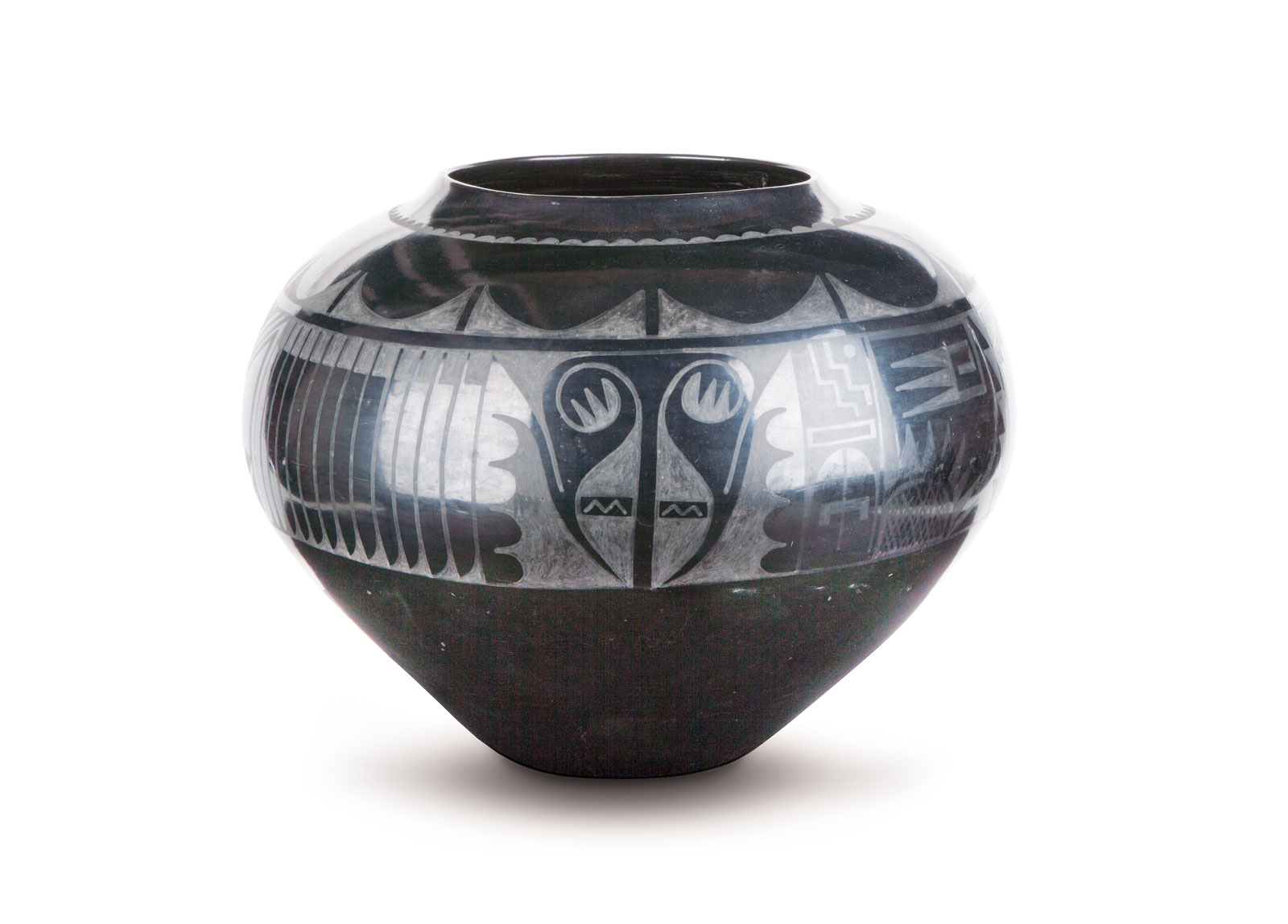 Maria Martinez (San Ildefonso, 1887-1980) and Julian Martinez (San Ildefonso, 1879-1943), Black-on-black jar, ca. 1940, 17 x 22”. Philbrook Museum of Art, Tulsa, Oklahoma. Gift of Clark Field. 1946.46.1.
The exhibition will include work from Maria’s decades-long career as well as associated ephemera. It will also be accompanied by a scholarly catalog.
Maria Poveka Montoya (1887-1980) and Julian Martinez (1879-1943) were born at San Ildefonso Pueblo and were instrumental in the revival of the pueblo’s pottery-making tradition, revitalizing the economies of their own and other pueblos.
Maria had learned pottery making from her aunt, Nicolasa Peña Montoya (1880-1904), mastering the art of making polychrome storage jars. She was about 17 when she married Julian in 1904. Since she had been invited to demonstrate pottery making at the St. Louis World’s Fair, she and Julian boarded a train to Missouri on the afternoon of their wedding. Maria demonstrated her skills and Julian performed pueblo dances with older men from San Ildefonso. In 1909, the archaeologist and anthropologist Edgar Lee Hewett found a shard of highly polished black pottery in a nearby dig in what is now Bandelier National Monument. Julian was assisting in the dig. Hewett sought out Maria to see if she could produce a similar pot. She and Julian experimented with different clays and different ways of firing until one day they decided to smother the fire with manure to keep the smoke in. The result was a shiny dense black pot. Hewett had hoped they could reproduce the ancient pot but they had come upon a new art form. Maria hand-built the pots with coils of clay and Julian painted matte black designs on their polished surface.
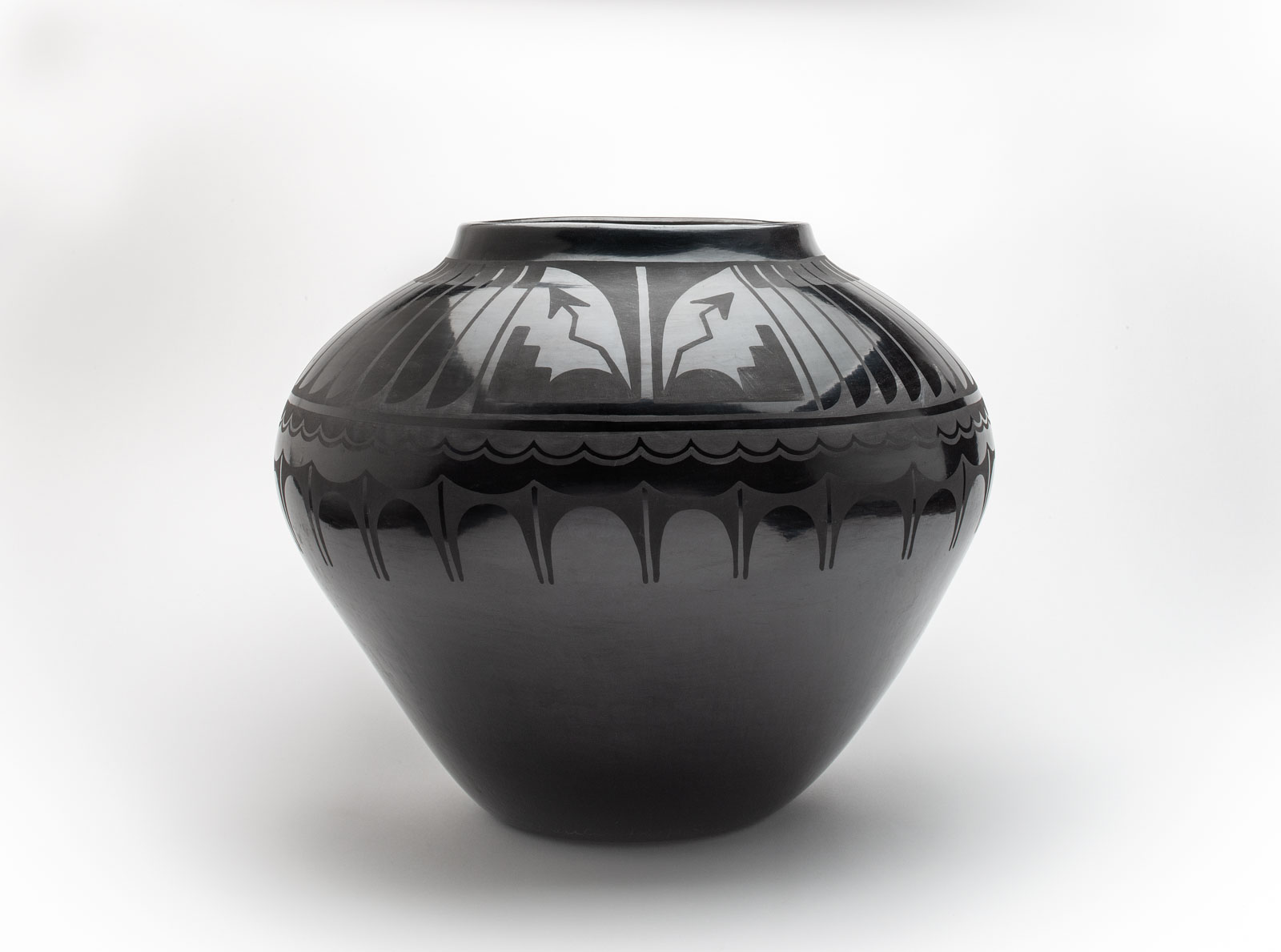 Maria Martinez (San Ildefonso, 1887-1980) and Popovi Da (San Ildefonso, 1922-1971), Black-on-black jar, 1964, 15¾ x 19½”. Private collection.
Traditional firing of San Ildefonso pots that allows oxygen into the process produces a red result. Smothering the fire, as Maria and Julian discovered, depleted the oxygen and allowed the same clay to turn black. Control of the firing is crucial in the production of San Ildefonso blackware. Over-firing sometimes resulted in a glossy gunmetal gray patina that Maria and Julian’s son Popovi Da (1922-1971) later deliberately perfected. A spectacular group of gunmetal-finished jars made by Maria and Popovi Da between 1963 and 1970 is on loan to the exhibition from the Nadine Basha collection. Maria’s great granddaughter, Barbara Gonzales, who worked with Maria and Maria’s daughter-in-law Santana Martinez (1909-2002), recalls that originally the gunmetal patina was “a chance happening due to the firing. It might be just one pot out of 20. Maria didn’t care for the gunmetal effect. She liked the shiny black on black.”
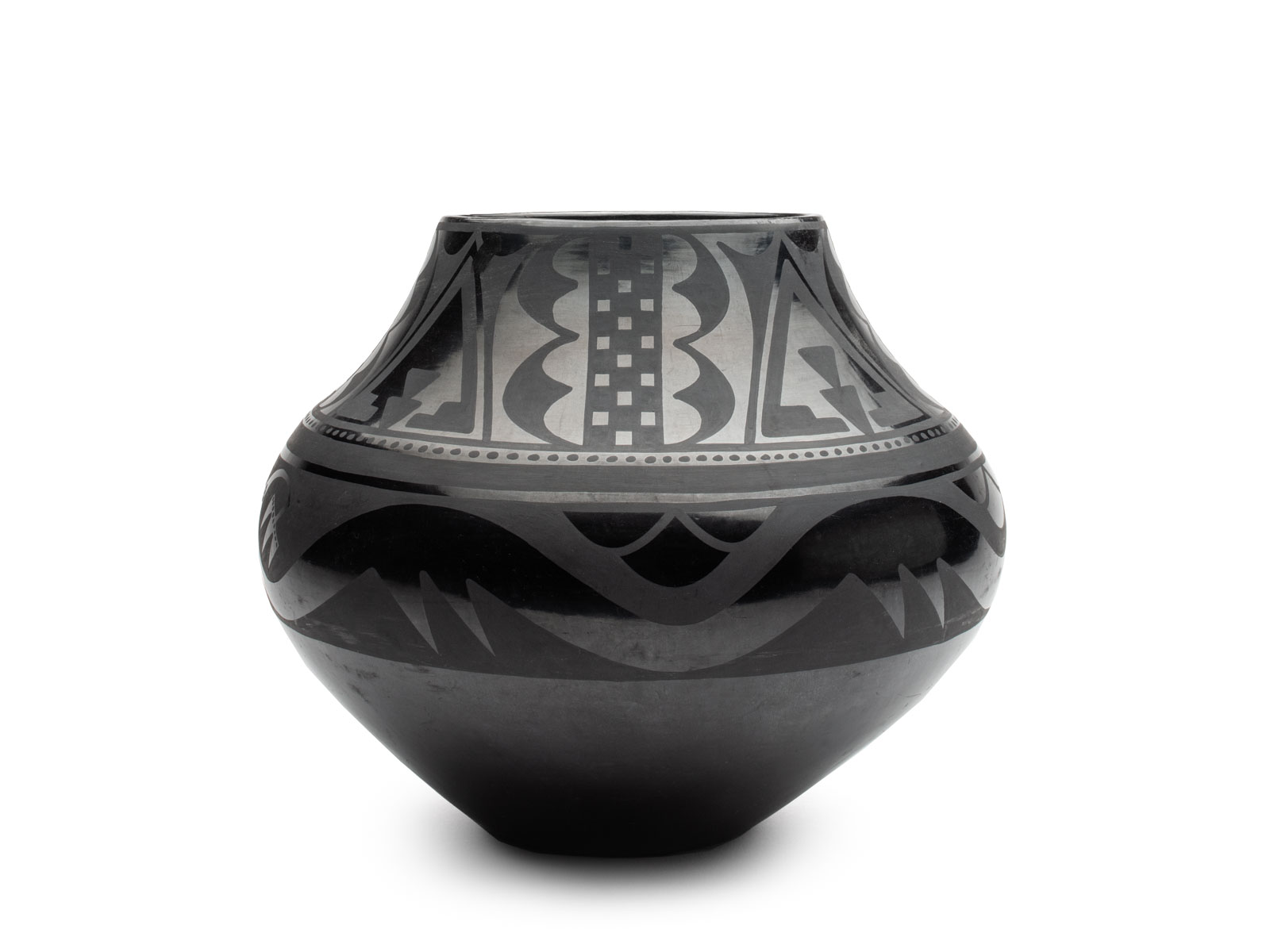 Maria Martinez (San Ildefonso, 1887-1980) and Julian Martinez (San Ildefonso, 1879-1943), Black-on-black jar, ca. 1930, 9 x 10½”. Private collection.
The exquisite perfection of the work Maria made over the years with Julian, Popovi Da and Santana began with her making an offering of corn meal to the Great Spirit before she gathered only the amount the clay and sand she needed for her work. She cleaned, sifted and blended the raw materials, adding the right amount of water to allow it to bind and to be pliable and not crumble or run. She then kneaded the air out of the mixture. She built the pots using coils of clay formed by hand into her elegant shapes. After the vessel had air dried, she applied a slip of watered down clay which she burnished with a smooth stone from the creek bed. The designs were applied with brushes made from the fibers of a yucca leaf. In a 1972 documentary produced by the National Park Service, Popovi Da remarked that his designs needed “to be in keeping with the form of the pot.”
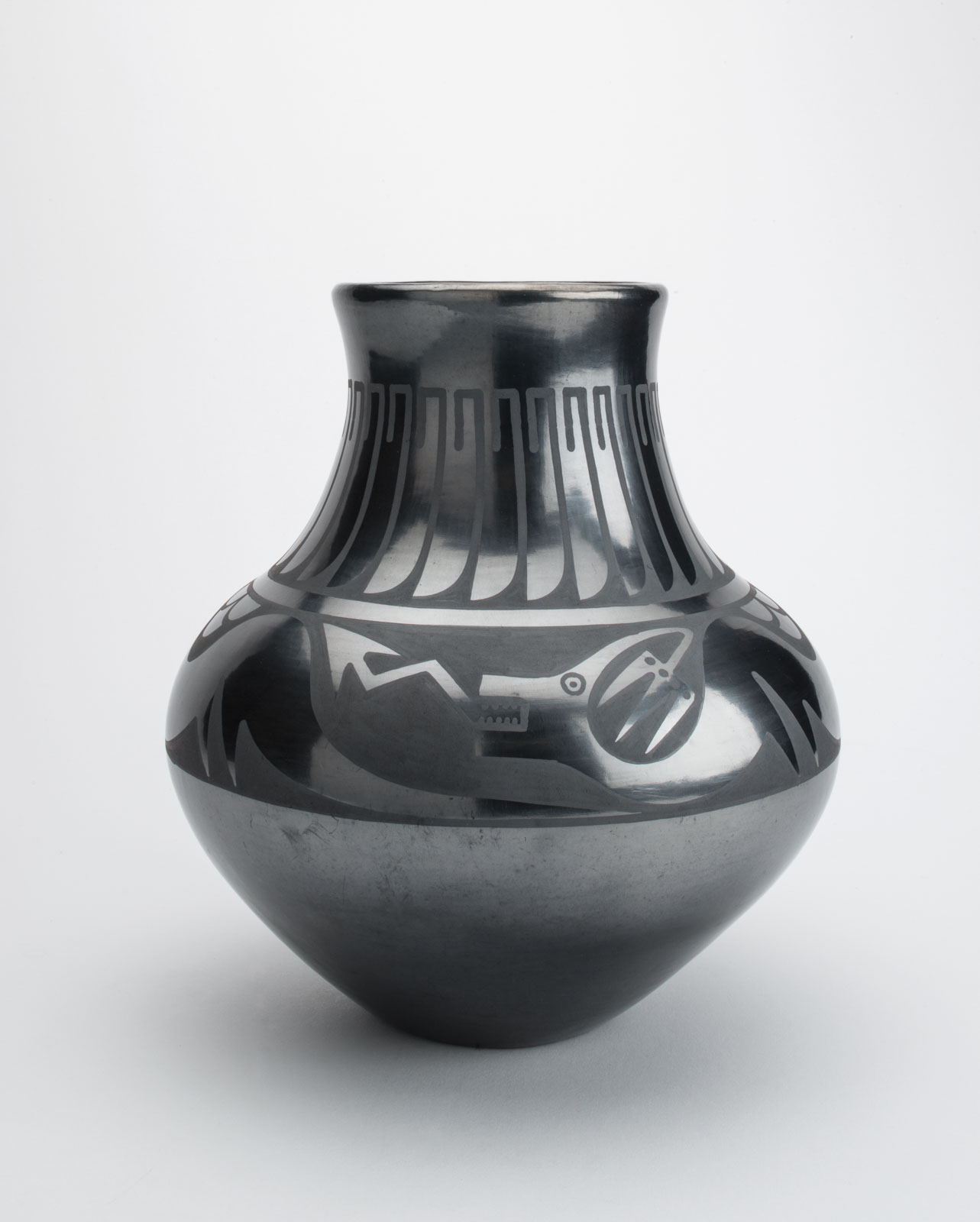 Maria Martinez (San Ildefonso, 1887-1980) and Popovi Da (San Ildefonso, 1922-1971), Black-on-black jar with gunmetal finish, 1968, 10½ x 9¾”. D. H. Waite Collection.
In 1934, the Illinois firm, Haeger Potteries, set up a manufacturing facility at the Chicago World’s Fair, Century of Progress. The firm invited Maria and Julian to juxtapose their traditional methods with their own modern manufacturing methods. Haeger Potteries closed up shop in 2016. The ancient methods of hand manufacture perfected by Maria and Julian continue today.
Opens February 24, 2024
Maria & Modernism
Heard Museum
2301 N. Central Avenue, Phoenix, AZ 85004
(602) 252-8840, www.heard.org
Powered by Froala Editor