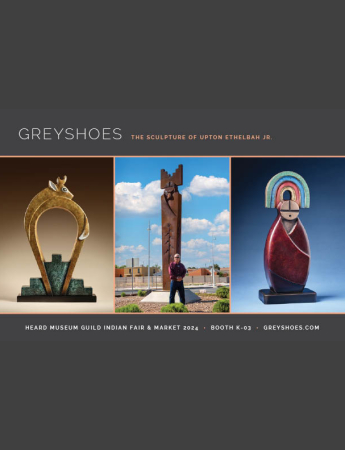
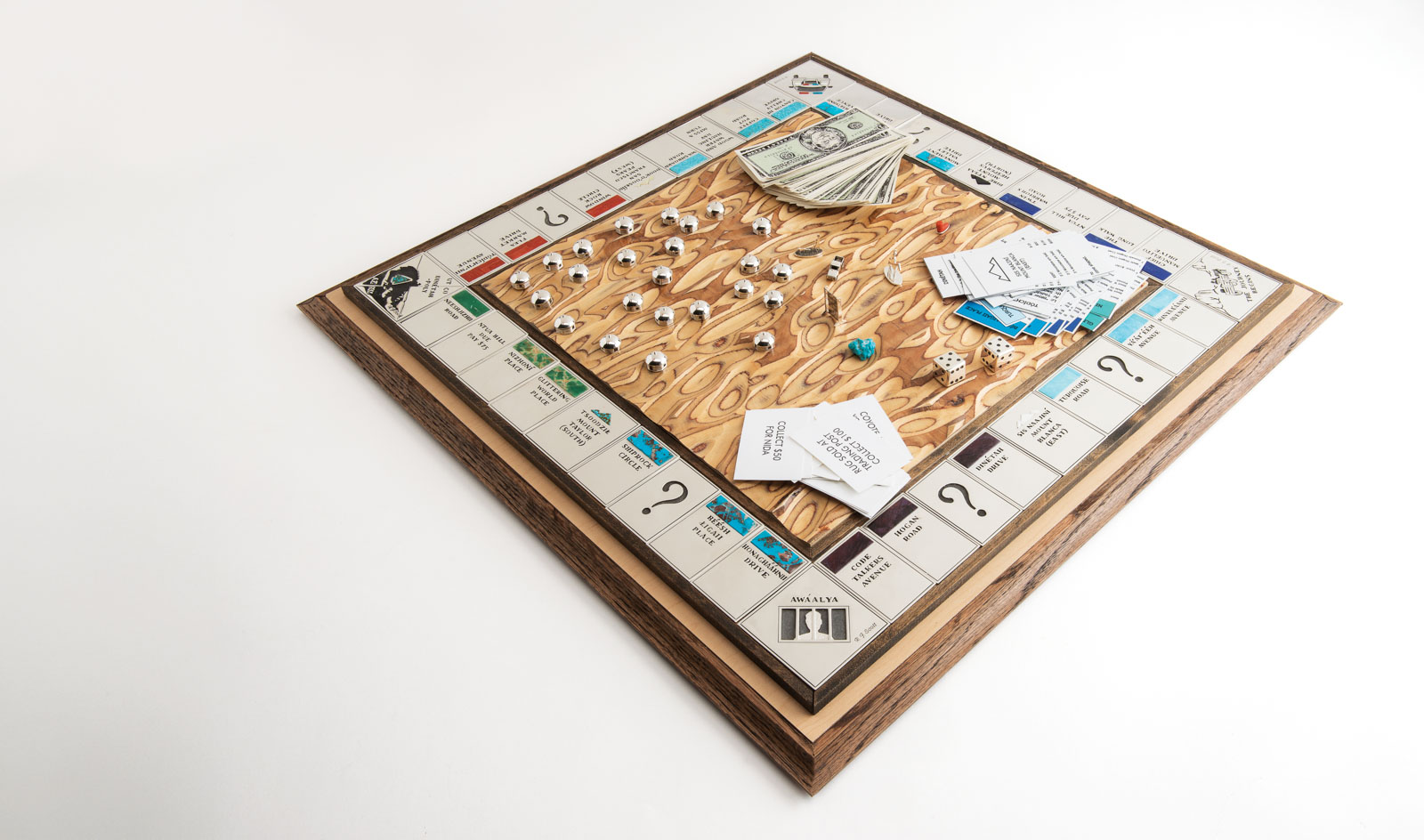
 Dinetah-poly, the 2023 Best of Show at the Heard Museum Guild Indian Fair & Market.
Raynard J. Scott was born September 3, 1965, in Los Angeles while his father attended business school. His father and mother, Raymond and Louise Elson, are jewelry makers. They lived in Fort Defiance, Arizona, when they started making jewelry. Scott’s father pioneered the very popular overlay/chip inlay with turquoise and coral in 1969 and 1970. In 1971, Scott was introduced to making jewelry at the age of 6 years old while he was in the first grade when he and his family lived on the reservation.
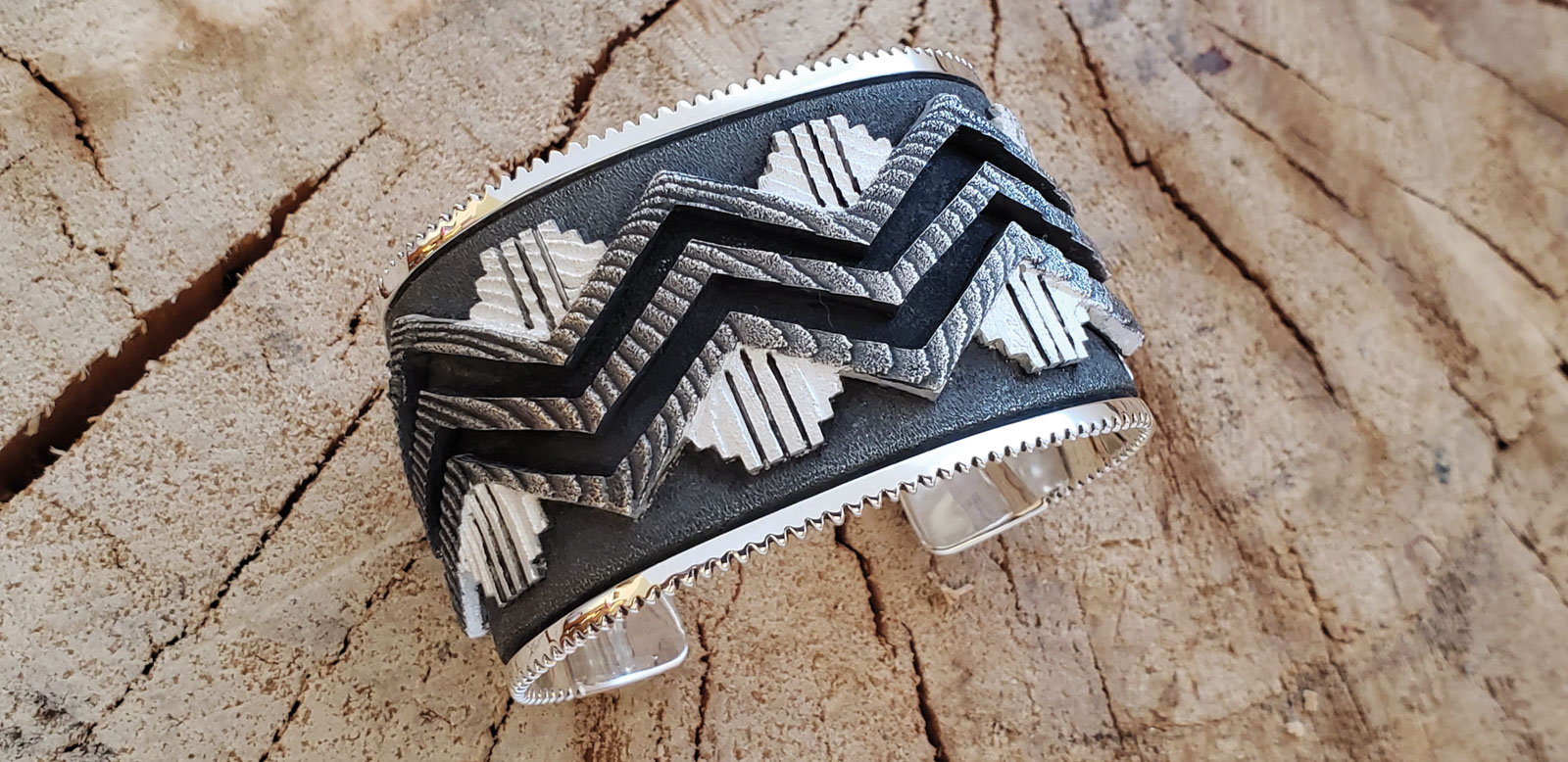 The Healing Bracelet, sterling silver with cuttlebone cast overlay, and coin-edge texture on sides
Being the oldest, Scott was expected to work in the family business and his first task was stamp work and lots of filing. He filed until his fingers hurt so much he could hardly work any longer. Soon after, the jeweler’s saw became part of his arsenal. This tool is used to saw out the shapes the family used in their designs. It can be a dangerous tool as it will slice right through anything in its way. Larry Jay was one of the makers the family hired to help them reproduce their line of jewelry. “Larry was FAST! As fast as anyone I have ever seen,” Scott says. “I tried to emulate his speed, but I soon found that speed meant nothing if the quality suffered, so I concentrated on quality.” In a 1970s Arizona Highways magazine, the young artist saw an article on jewelry made by Charles Loloma and he immediately knew he wanted to do unique works of art like those shown in that issue. His work evolved over the years to what we now know as Raynard J. Scott’s artwork. (He was not the only one whose desire was sparked into jewelry making by that issue. I confess that I, too, became a jewelry maker after reading that Arizona Highways article on Loloma 54 years ago. I cannot say it strongly enough, Loloma’s work is off-the-charts amazing and Scott has certainly lived up to his own aspirations.)
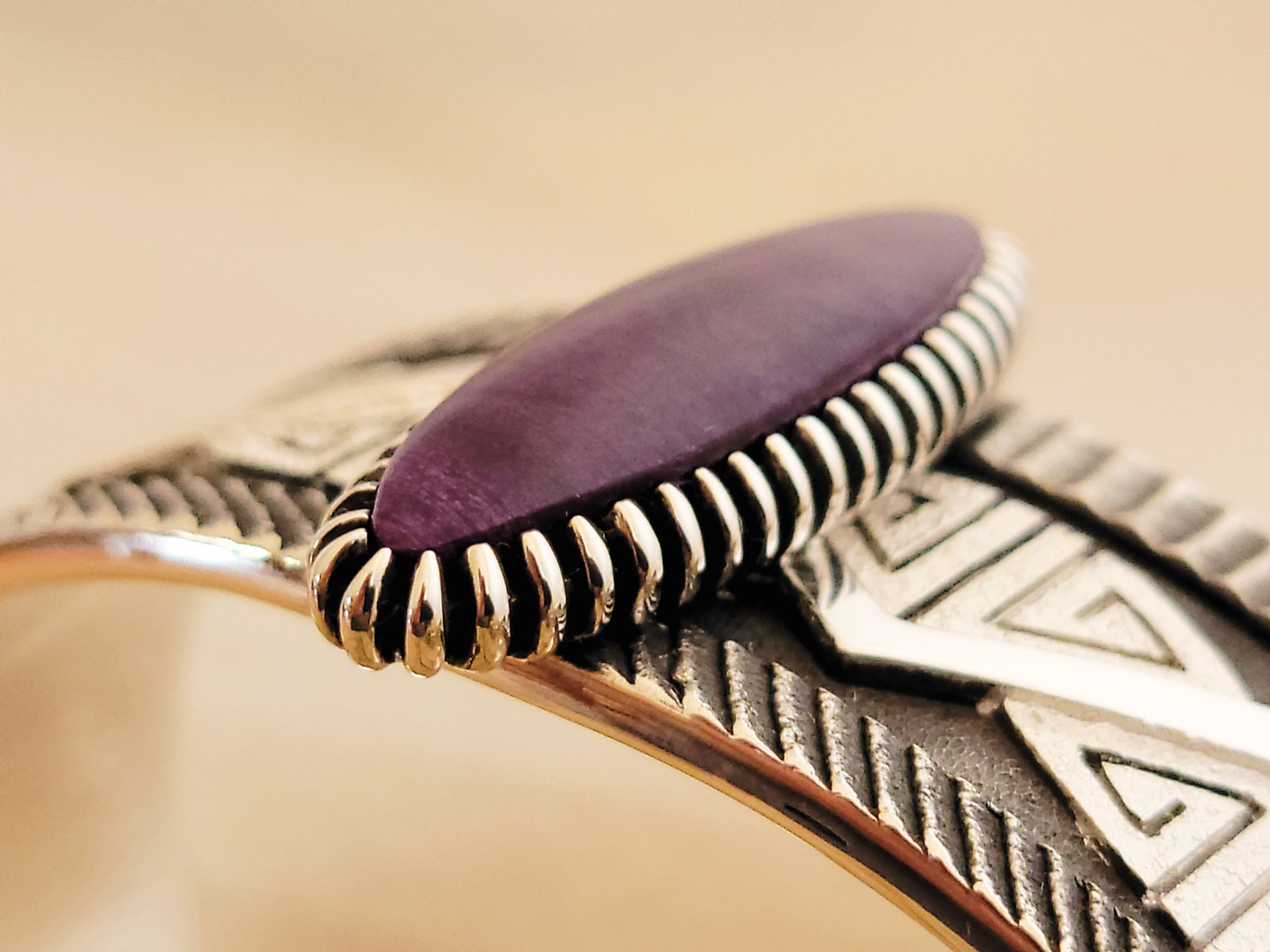 Close-up image showing Raynard Scott’s 12-gauge bezels.
Precision was paramount to Scott and, after years of practice, it’s the level of quality that is immediately recognized in his art. Today, his forte is sawing, piercing and stamping. His stamp work is unmatched. “Bezels are my specialty,” he adds.
The first piece of jewelry he completed on his own was at the age of 12 years old. It was a belt buckle, a commission piece he sold for $150—quite a sum back then for a new artist. “Sadly, I do not have any of my first works at all,” Scott says. “Everything needed to be sold just to stay alive. I have no regrets.”
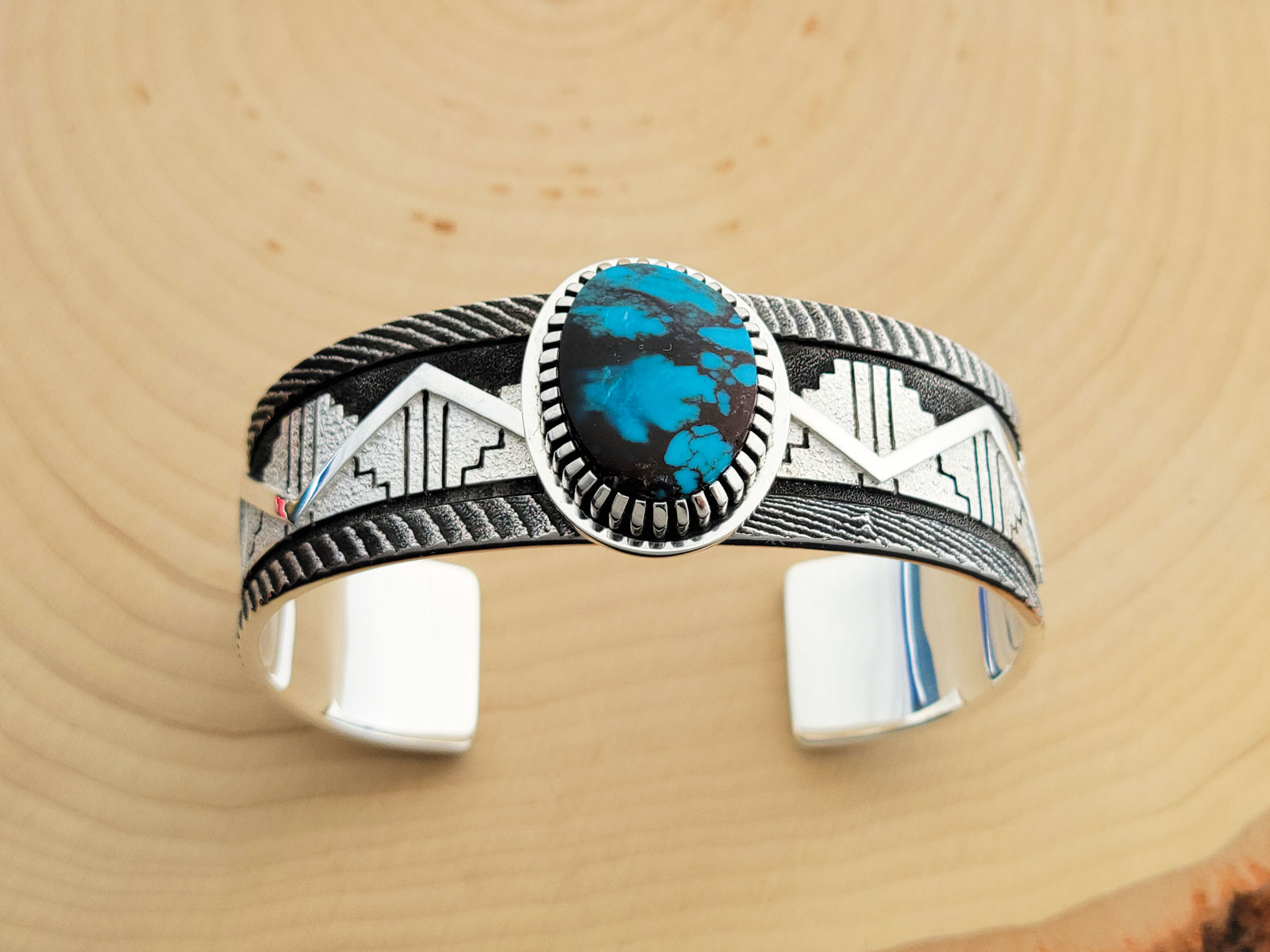 Bracelet, sterling silver with cuttlebone cast overlay and turquoise
Scott’s contemporary works are rooted in his love of art and art history. Patterned off ancient Egyptian art, his work has brought a certain flair into the jewelry arena. What amazes him about the Egyptians is how old their work dates back—4,000 years—and how advanced their jewelry was. He has studied that style closely and incorporated gemstones such as lapis lazuli, jet, Mediterranean coral and ironwood, just to name a few. All the gemstones used are cut with his own hands. Stamping the designs with a tool similar to and no wider than a sharpened screwdriver used like a chisel. He then pounds away with a heavy ball-peen hammer fashioning lines up to 8 inches long that are uninterrupted. Each impression is exactly the same depth, so precise that you would swear it is machine cut. Masterful, gifted hands turn his jewelry into one-of-a-kind works of art.
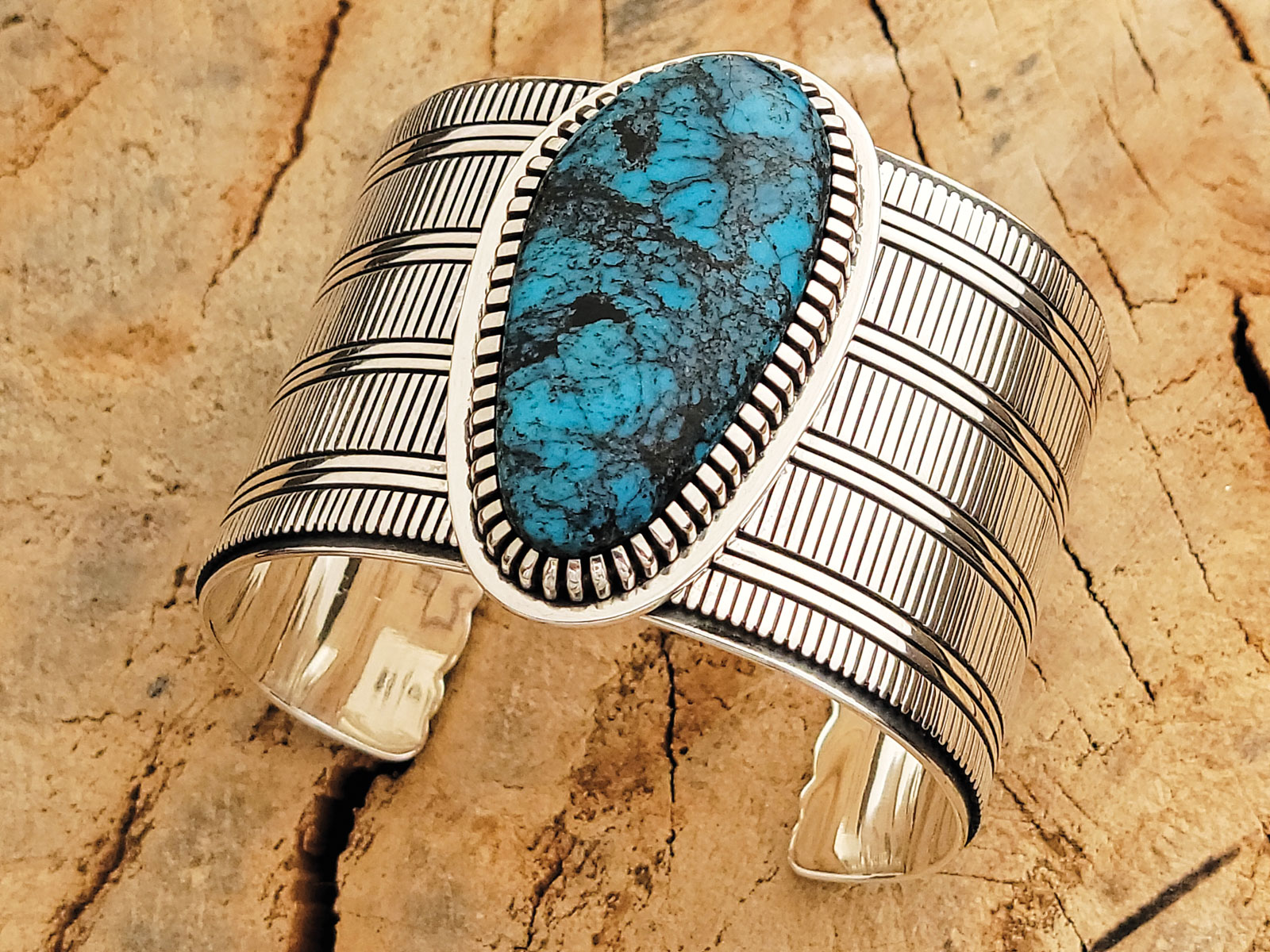 Cuff bracelet, sterling silver and large turquoise stoneWhile he used to build 12 or more pieces a month, today Scott’s focus is on quality. Completing about two pieces a month is not uncommon. “I just want to make the very best pieces of jewelry as I can,” he says. As I watch him work, you can see his dedication to building the finest pieces of art that his hands can deliver. Each piece is crafted directly from his heart. His artistry flows from his hands onto the canvas of metals and stones like the gentleness of a butterfly, yet with the precise blows of Thor’s thundering hammer.
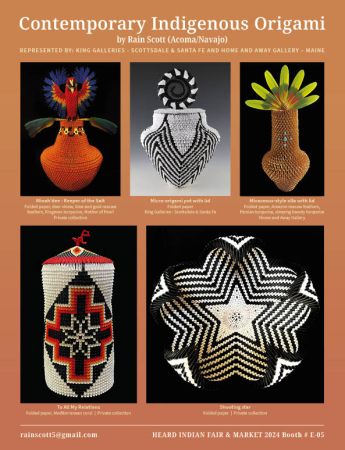
When asked if he has children, he beams with delight. “Four children in all, and all were or are artists today,” Scott says. His son Rain Scott is an absolute master paper sculpture artist and uses his own unique take on origami. Scott worked hard to provide for his children so they would not have to do without necessities throughout their lives. He pushed education so if art did not work out, they had something to fall back on. Rain is making quite a name for himself with his own achievements by winning top honors in some of the most prestigious fine art shows in the country. The other children are not making art as much, but “my door is always open in my studio,” the father says.
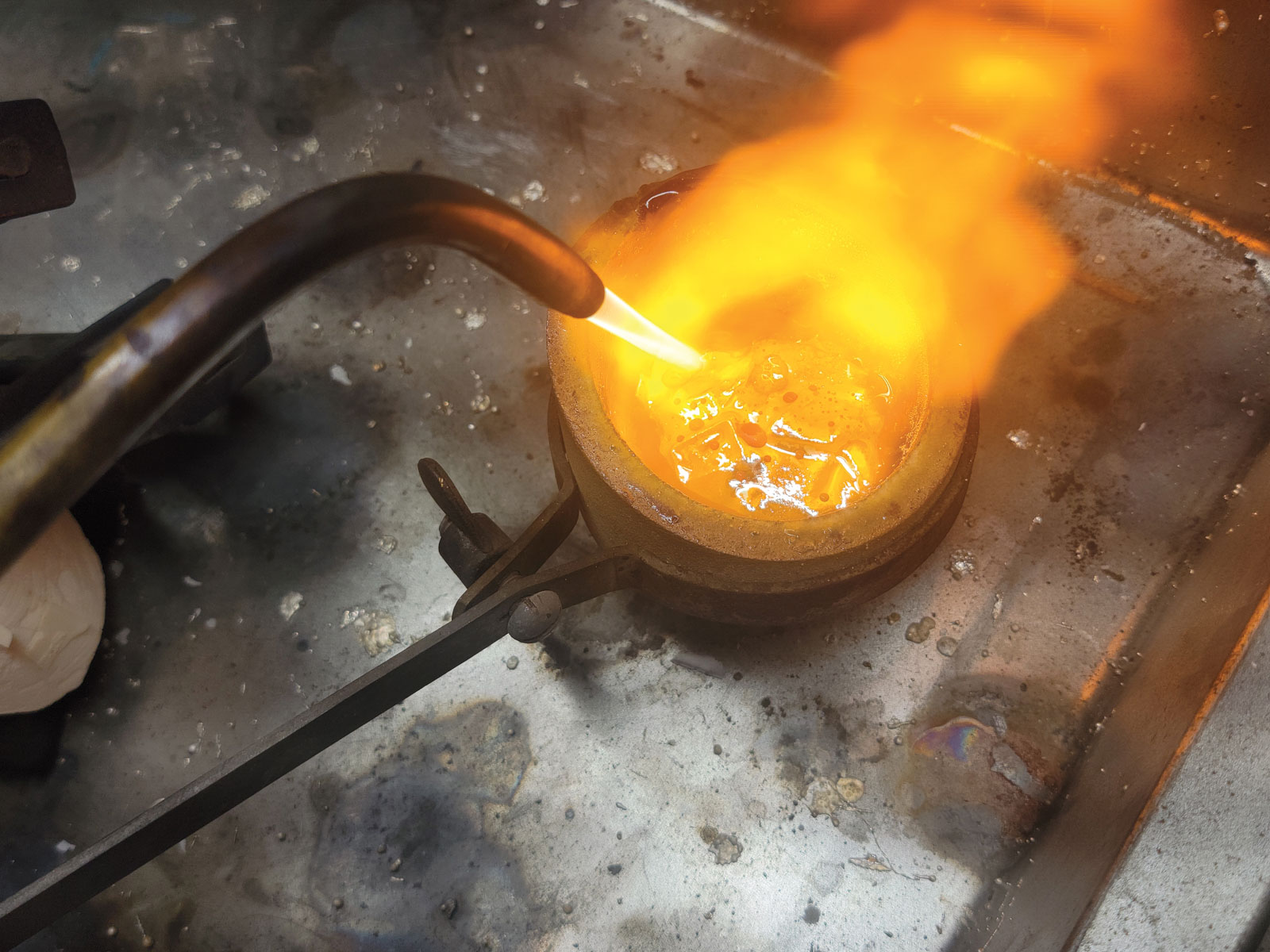 Raynard Scott heats up silver until it’s a liquid prior to the casting process.
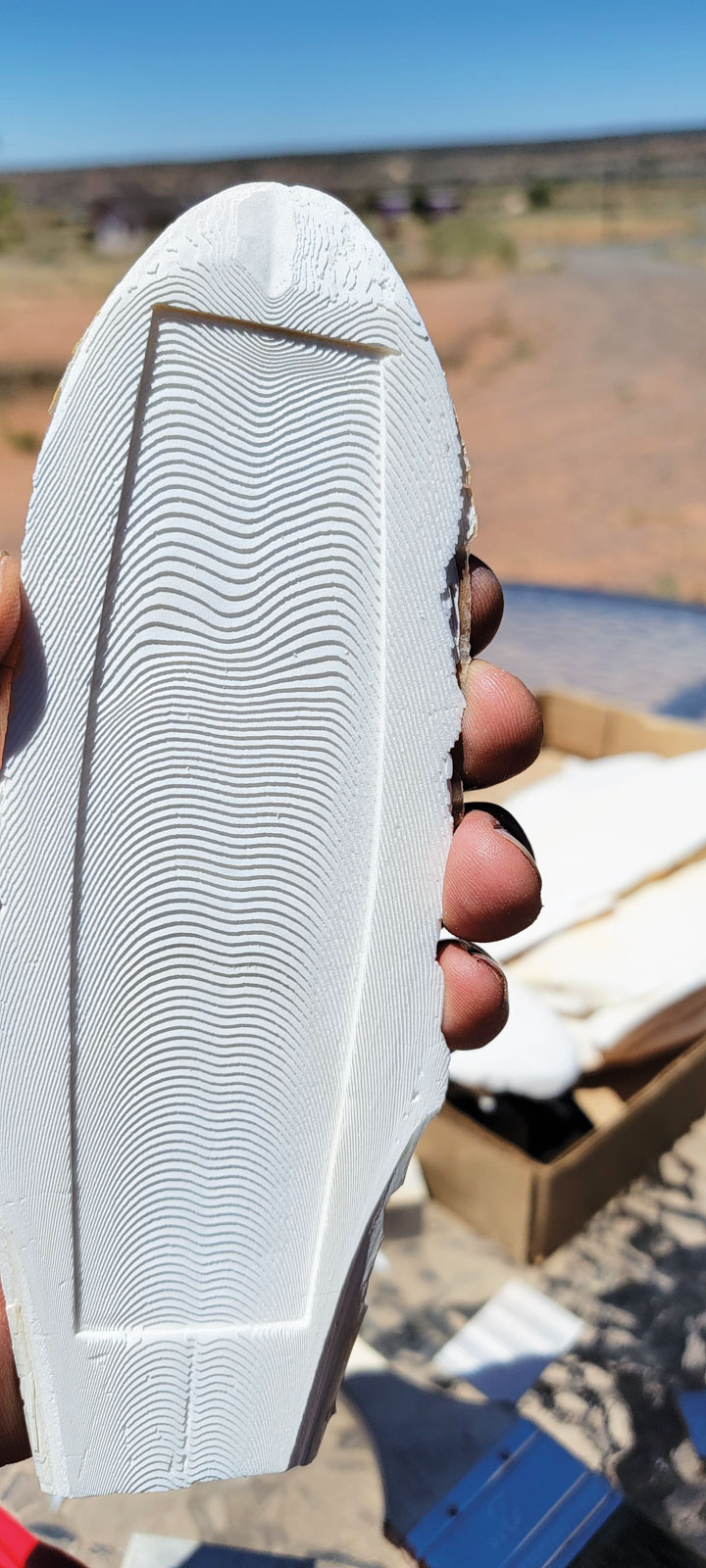 Carved cuttlebone ready for casting.“What is my crowning achievement? Best of Show at the 2023 Heard Museum Guild Show with my board game Dinétah-opoly. The Heard is the premier Native American art show in the country,” he says. “Well, maybe this was not my crowning achievement. Maybe the crowning achievement was putting my kids through school. No regrets about the decisions I have made. I take more pride in helping my children become who they are.” Dinétah-opoly was huge hit with collectors and museum patrons, with its desert windblown look of the actual board and hand-made game pieces. Everyone was abuzz after it was announced that he had won. When asked how Scott feels about thinking so far out of the box, he replies, “What box?”
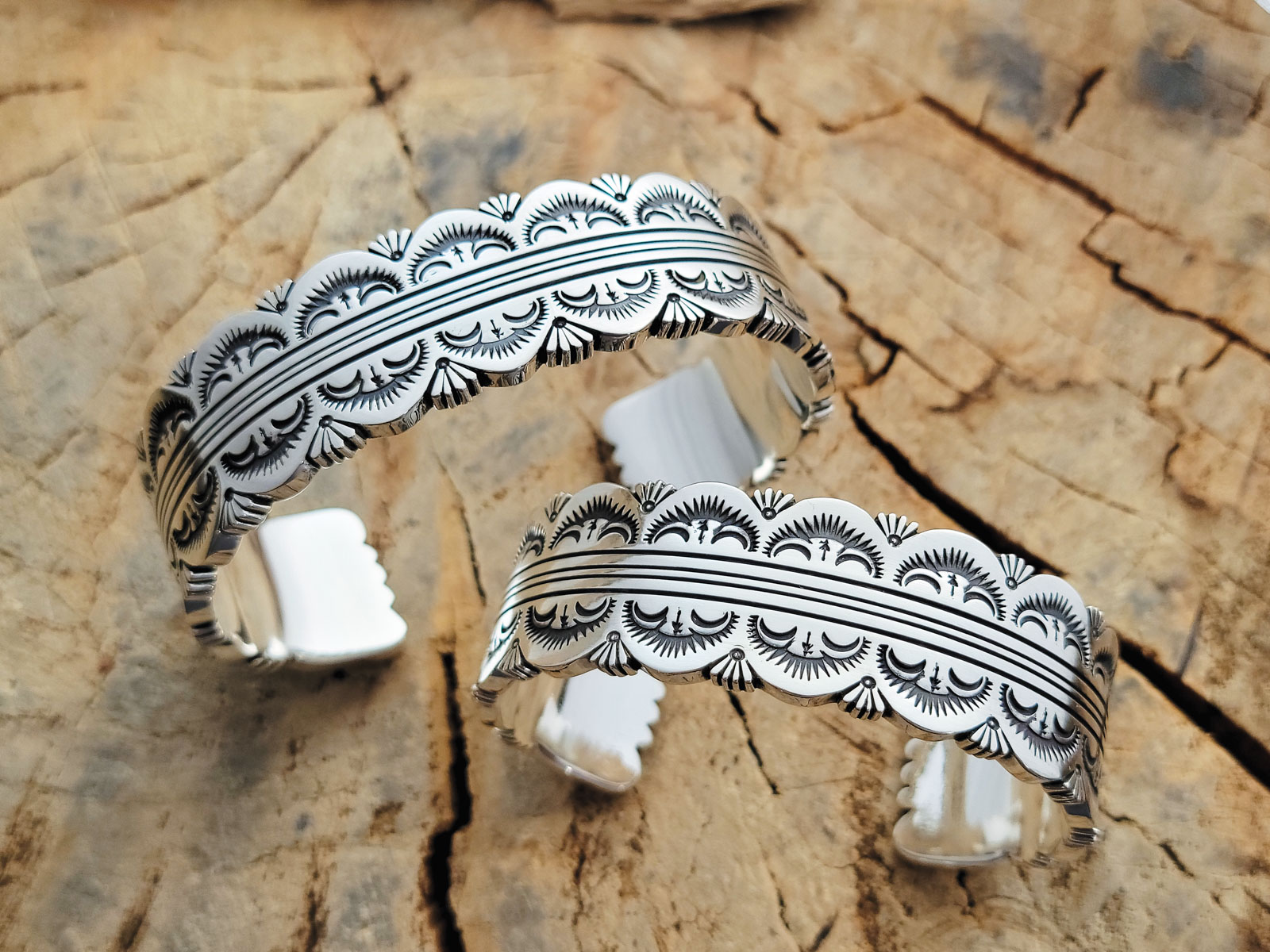 Two sterling silver bracelets, stamped design on 7-gauge rolled silver ingot
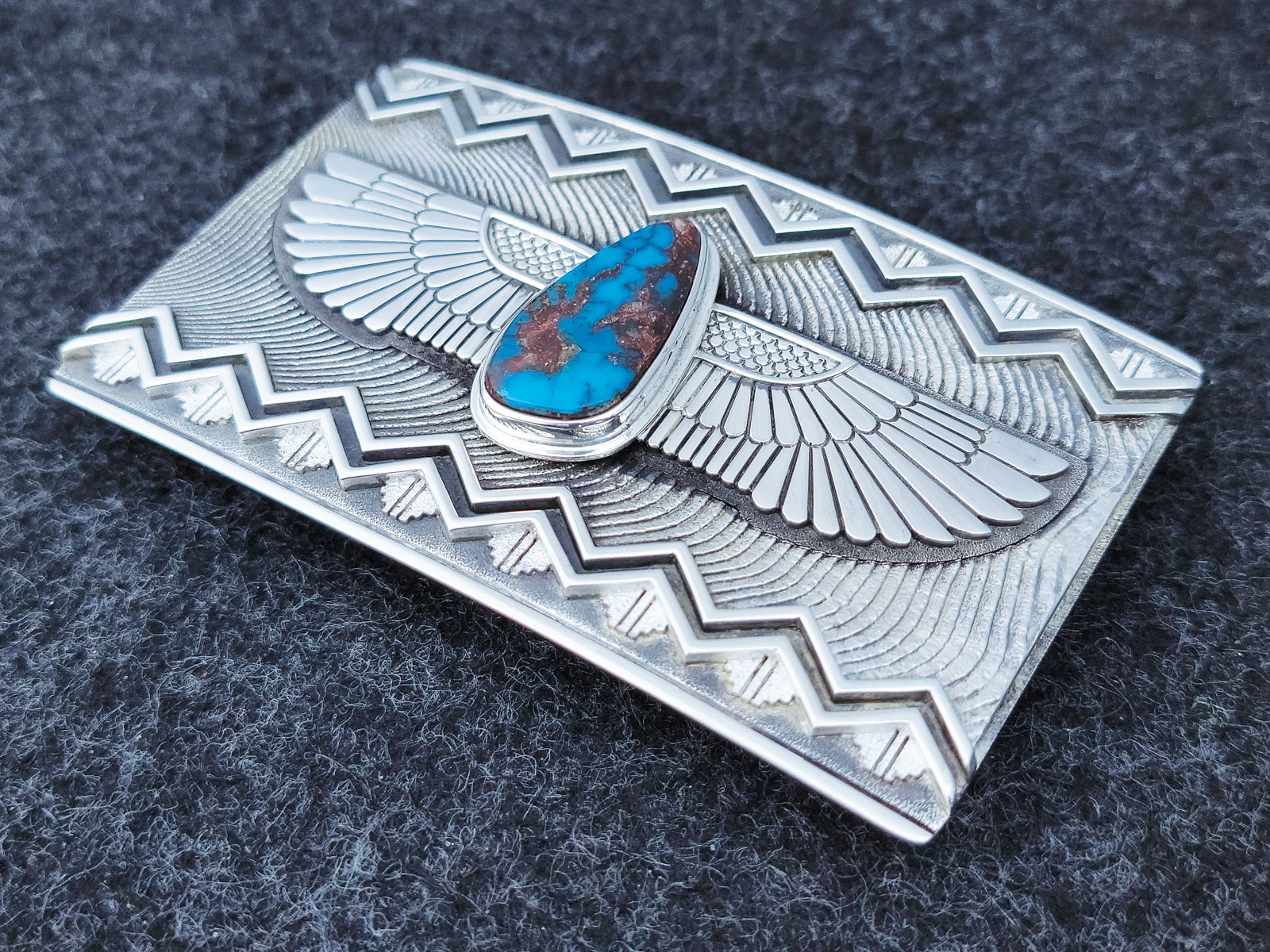 Silver buckle with turquoise over wings designOutside of being one of the top artists working today, Scott is also a kind person and a compassionate teacher. He is always willing to share his art with anyone who asks. His pieces are also highly desirable among top collectors. “My work can be found through personal social media outlets, the Heard Indian Market, Santa Fe Indian Market, Eiteljorg Museum Native Art Market and wherever else I can make a sale. I have sold bolos right off my own neck at the airport before,” he says. “Just in passing, people bump into me on the streets asking what’s in the works.” He encourages guests to stop in and see him at this year's Heard Museum Guild Indian Fair & Market. You will make his day, but I assure you it will make yours as well.
John F. Heusler has been making jewelry for more than 54 years and sells his original designs as well as gemstones at all the major gem and mineral shows. He travels to teach classes and offers instruction at his studio in Southern California. He has a Facebook group called Heusler’s Lapidary and Jewelry. Follow him on Instagram (@GemologistJohn).
Powered by Froala Editor