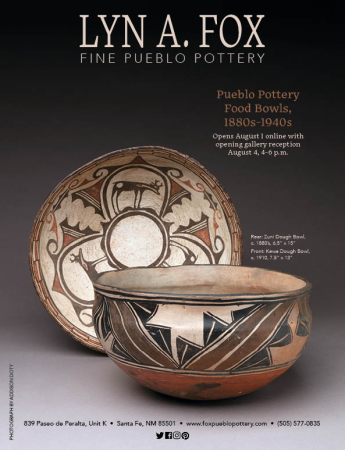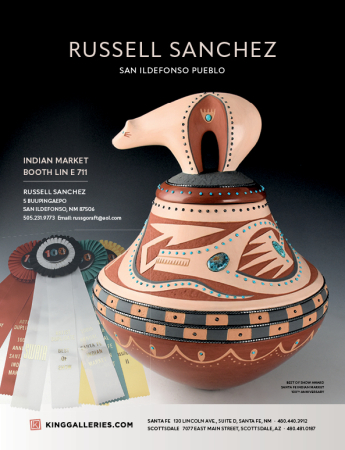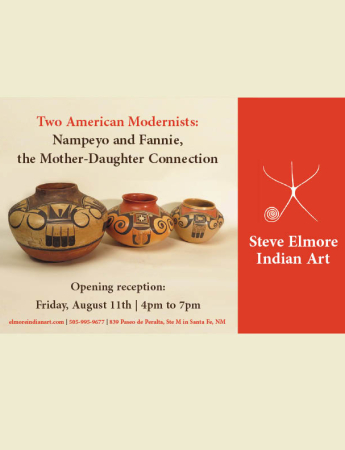
Nampeyo (1859-1942), the matriarch of the Hopi Corn Clan, ground corn meal for the people in her village which they used for ceremonial purposes. She is renowned for her innovative pottery in which she adapted designs she found on sherds of Sikyátki pottery produced from about 1375 to 1625 and excavated in 1895. She copied the designs in pencil on scraps of paper and worked to duplicate the creamy yellow color of the ancient pots.
Our collectors in Santa Fe have amassed a large collection of work by Nampeyo as well as examples of pottery by ancestral Puebloans and Nampeyo’s contemporary descendants.
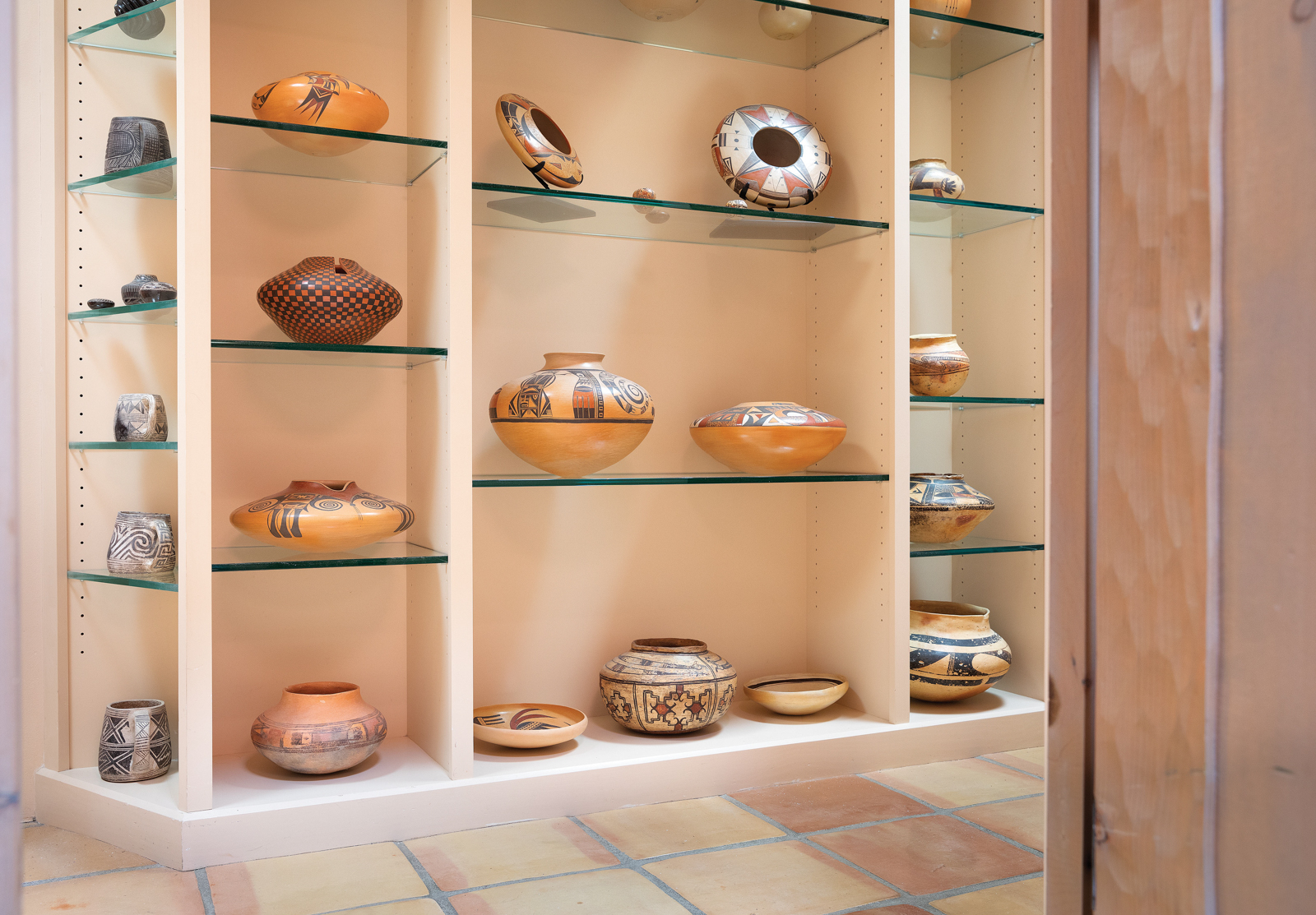 On the shelves are pieces primarily by Dextra Quotskuyva (Hopi, 1928-2019). On the left-hand shelves is a collection of Mesa Verde Mugs, ca. 1050, and on the right are pre-historic Hopi works.
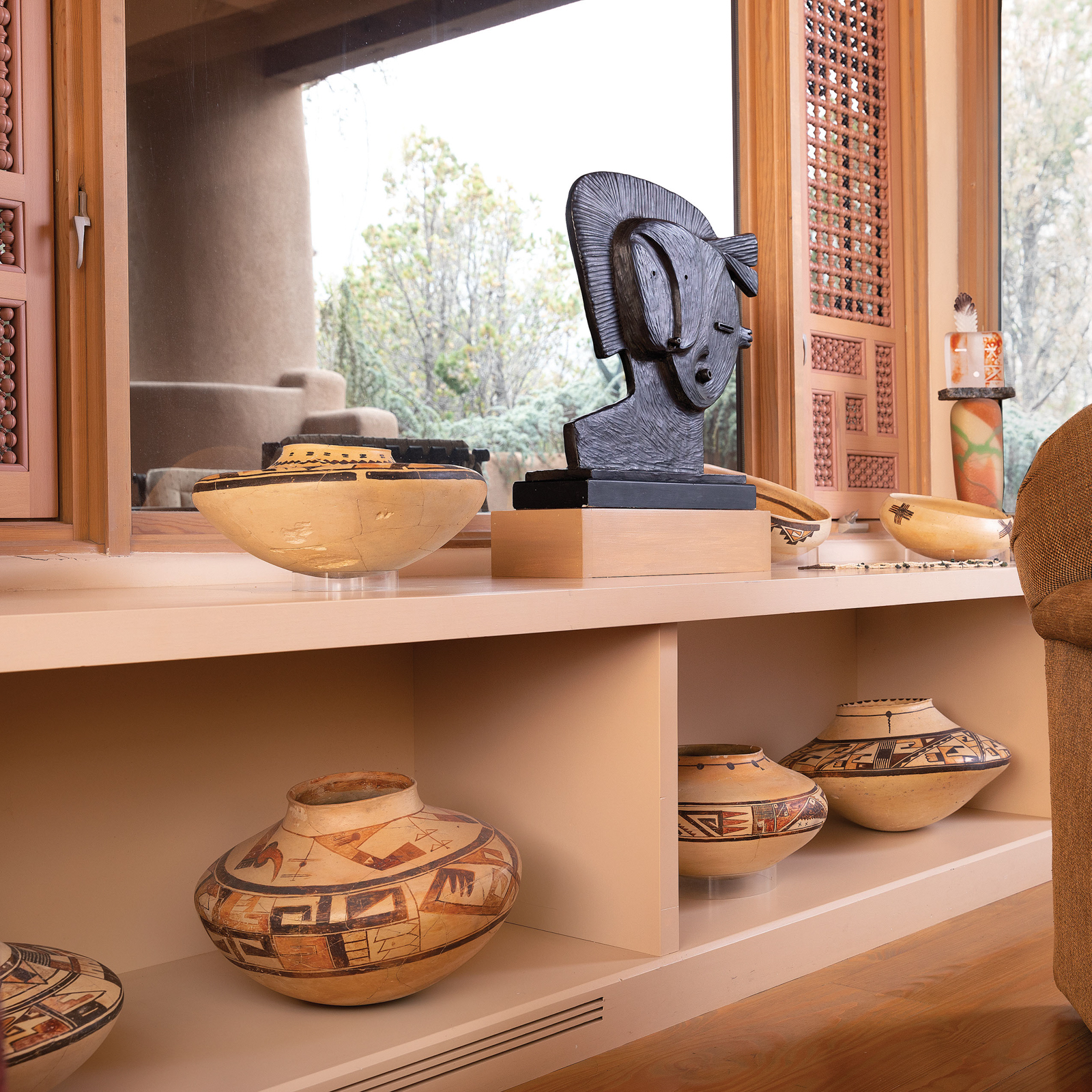 The bronze sculpture is Mask Assemblage, 1984, by Dan Namingha. On the right is a glass sculpture, 2008, by Spooner Marcus (Ohkay Owingeh). The pottery is pre-historic Hopi.
The husband’s fascination with archaeology and the wife’s interest in history, as well as the descent of artistry through generations of Native families, have developed into a broad and deep collection satisfying both their interests.
The late scholar Marti Struever and her husband, Stuart, ran archaeological art tours of the Southwest. On one of those trips, she introduced our collectors to Dextra Quotskuyva (Hopi, 1928-2019), the great-granddaughter of Nampeyo, and one of the great potters of the 20th century. She is the mother of painter Dan Namingha and potter Hisi Quotskuyva, the grandmother of sculptor Arlo Namingha and the aunt of potters Steve Lucas and Les Namingha, who she taught how to make pottery. All are represented in the collection. “We just like the continuation of that family line. They’re all marvelous artists,” he says. “I find it interesting that they work in different media,” she adds. “Marti and Stuart used to live within a mile of us and my husband would go over and chat with them. They would gossip about what was going on and a lot of pottery made its way from Marti’s house to our house as a result of those gossip sessions.”
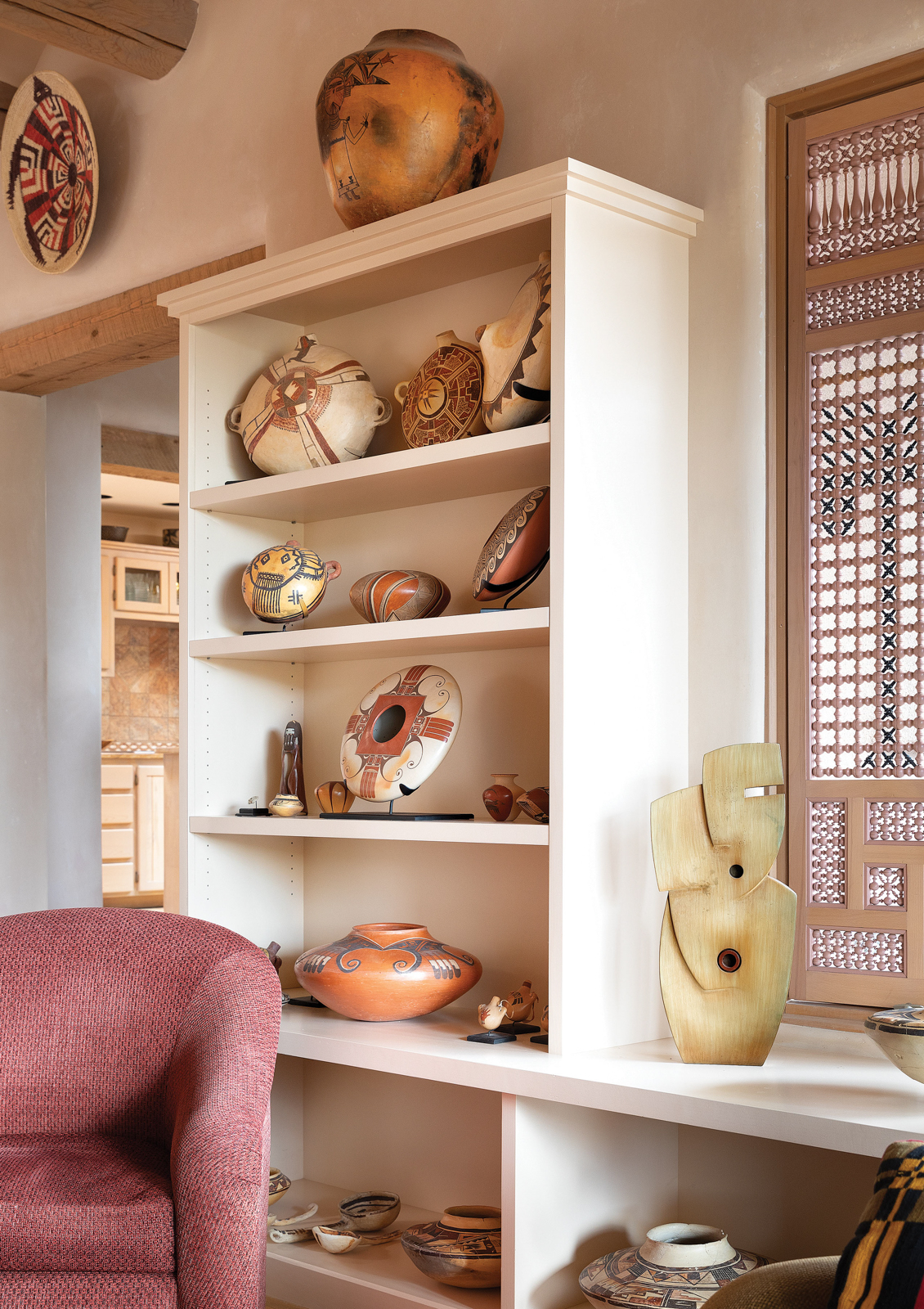 Above the doorway is a basket, Turtle, 2006 by Elsie Holiday (Navajo/Diné). On the shelves are a Red Eagle Tail Olla, ca. 1900, by Nampeyo (1859-1942, Hopi-Tewa) and, above it an Eagle Tail Olla, 1993, by Dextra Quotskuyva (Hopi, 1928-2019), as well as other examples of her pottery. On top is a large jar by Nampeyo. On the right is Cultural Images #3, 2004, bronze, by Arlo Namingha (Tewa-Hopi).
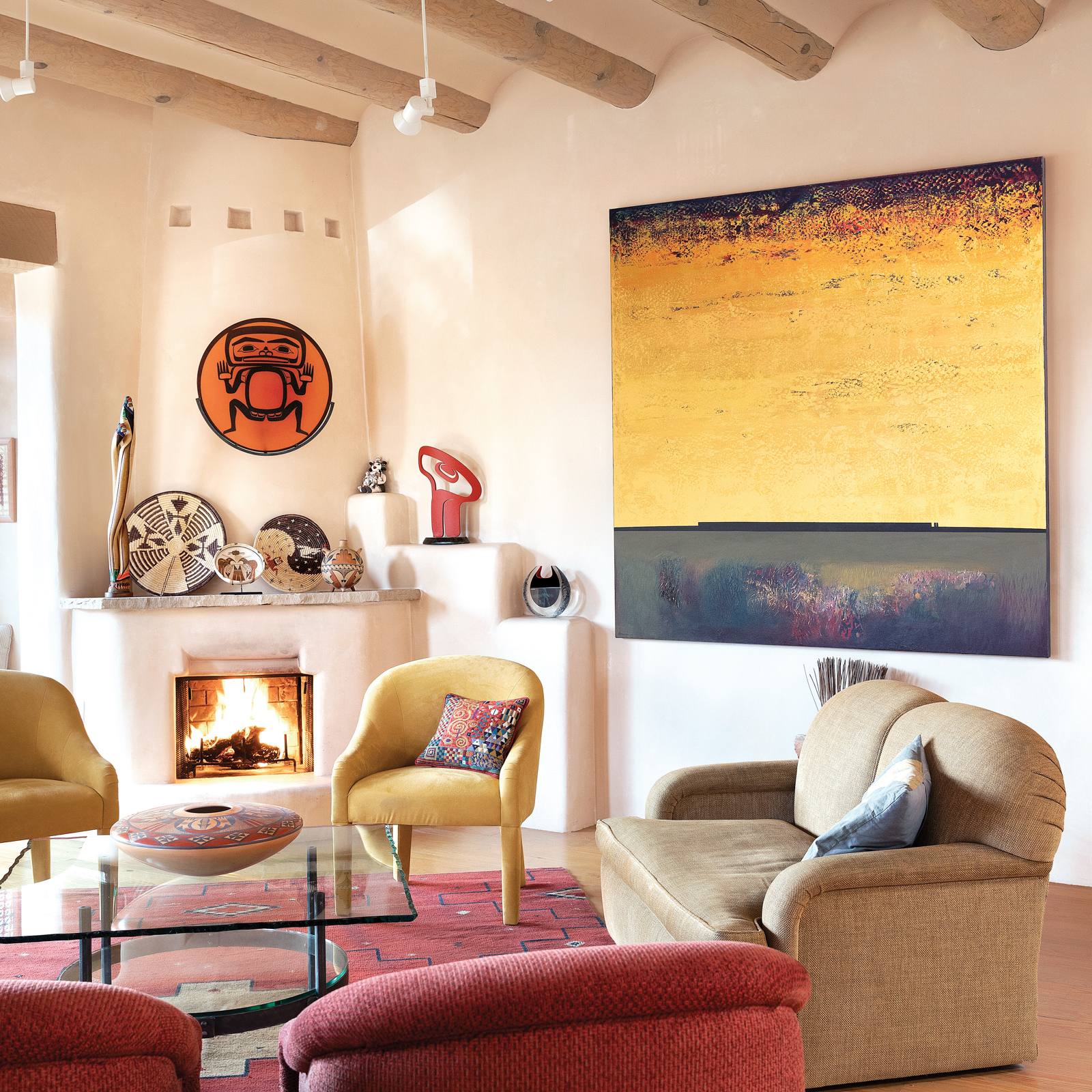 On the right is Dusk #1, 2001, by Dan Namingha (Tewa-Hopi). On the coffee table is Potters Prayer, 1998, by Steve Lucas (Hopi-Tewa), winner of Best of Show at Santa Fe Indian Market. Above the fireplace is Welcome Figure, 2005, glass, by Preston Singletary (Tlingit).
The original intention had been to collect the best pottery from each of the pueblos. “That became too much of a mixture,” he explains, “and I thought they clashed. I started focusing on Hopi pottery because I like the earth tones and the symbolic connection to the past. We met a lot of Hopi people and, in the 1980s, got to be a friend of Dextra and began to concentrate on the Nampeyo family.
“Hopi pottery had pretty much died down and Nampeyo revitalized it. Some of our Hopi pots date from the 1300s, 1400s and 1500s. Her Red Eagle Tail Olla from around 1900 and Dextra’s Eagle Tail Olla from 1993 were inspired by designs on the early Sikyátki designs you can see on some of our early Hopi pots.
“I bought Dextra’s eagle tail pot at an auction to benefit the Crow Canyon Archaeological Center in Cortez, Colorado. Stuart Struever was a co-founder of the center.
“Because Dextra was so famous, her work was in demand. She made a lot of pieces and met the demand. I never saw a piece by Dextra that I didn’t like.”
As I have learned talking to collectors who knew Dextra Quotskuyva, she had a great sense of humor. When the couple married, she explains, “The woman who made our wedding cake came to the house, saw our collection and said, ‘I can make your wedding cake look like Hopi pottery.’ Dextra made a small wedding vase decorated with a hummingbird and kokopelli design, both of which are fertility symbols to the Hopi. I was 50 and my husband was in his 60s. When she told us, she laughed so hard she just dissolved into giggles.”
On one group of shelves there are pieces primarily by Dextra with a collection of Mesa Verde Mugs, circa 1050, and pre-historic Hopi works.
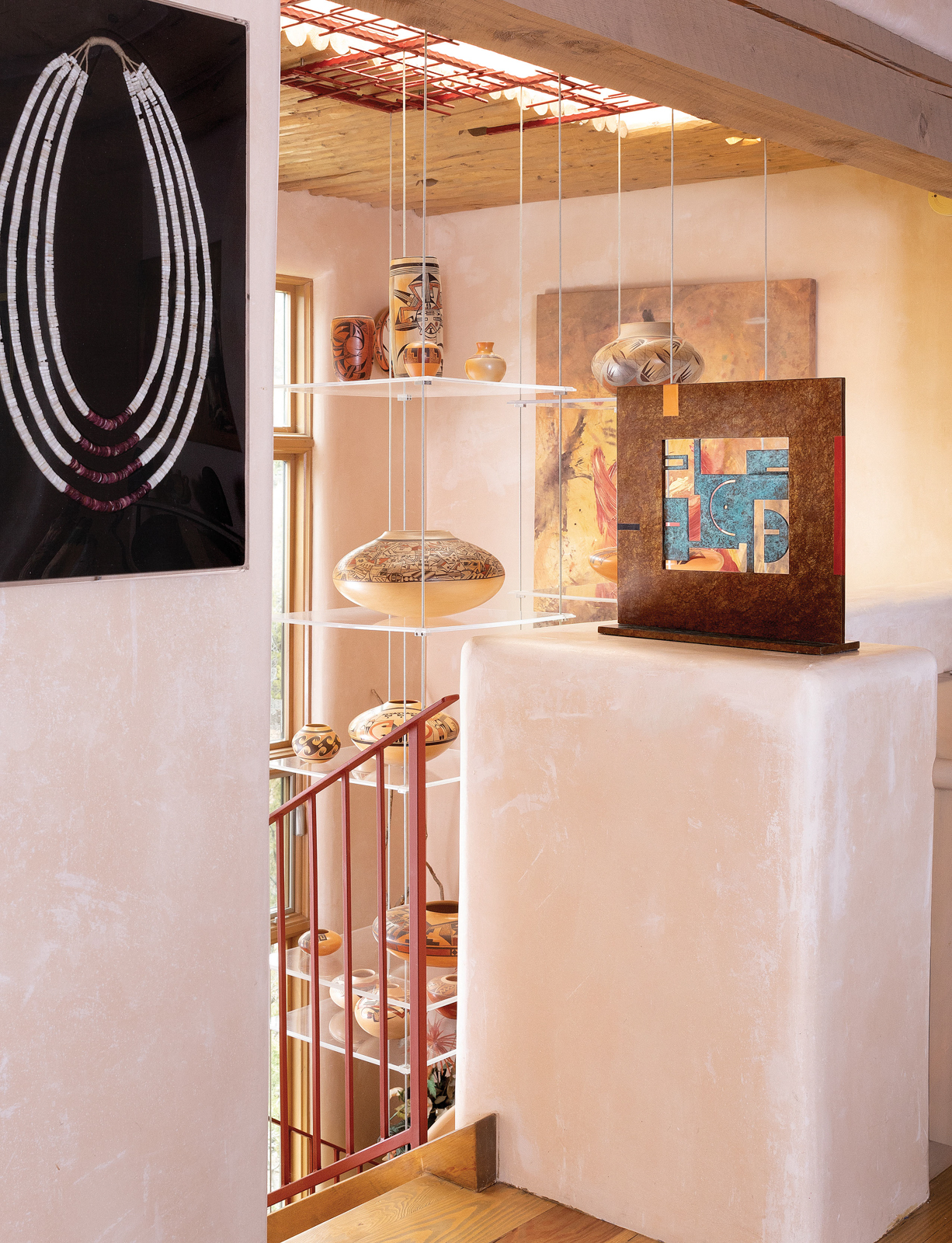 On the left is a Mesa Verde Shell Necklace, ca. 1050. On the hanging shelves are pottery pieces by Dextra Quotskuyva (Hopi, 1928-2019), Steve Lucas (Hopi-Tewa) and Les Namingha (Tewa-Zuni). The bronze sculpture is Kachina Symbolism I, 1996 by Dan Namingha (Tewa-Hopi).
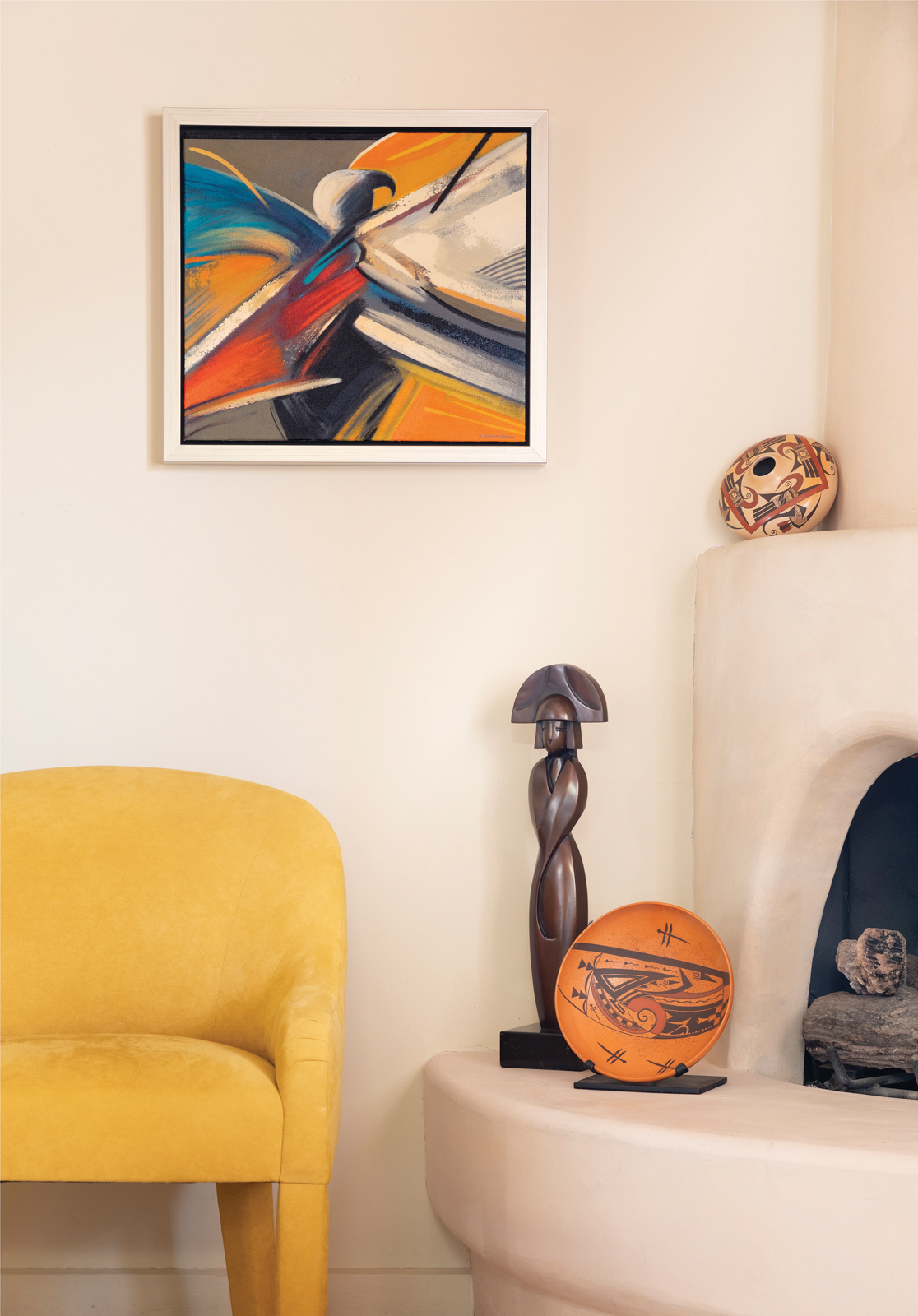 The painting is Eagle Dancer, 2010 by Dan Namingha (Tewa-Hopi). The bronze sculpture is Palhik Mana (Butterfly Maiden), 2003, by Arlo Namingha (Tewa-Hopi). The two pots are by Les Namingha (Tewa-Zuni) from ca. 1994.
Commenting on the prehistoric works in their collection he says, “In more recent times, collecting of prehistoric material has become controversial. I don’t have any problem with having prehistoric pieces as long as I know the provenance of when and where they came from and how long it has been in non-Native hands. I know where they came from and that they were not ceremonial pieces and they were not on BLM or Native land.”
Intent on purchasing a piece by Allan Houser, whom they did not have in their collection, they visited a gallery and saw Dan Namingha’s bronze sculpture Mask Assemblage, “We just instantly said that we’ll take that instead of a Houser,” he recounts. “We just love it. There are two pieces in the edition and the other is owned by Dan and his wife, Frances.”
She explains: “My taste goes more toward contemporary art, so the fact that so much of the Naminghas’ painting and sculpture work has a contemporary look is really what appeals to me. We like the contemporary feel but also the Hopi symbolism in Dan’s work such as his bronzes Kachina Symbolism I and Vertical Forms.”
The couple also own several of Dan Namingha’s paintings. At the time of an exhibition of his and his sons’ work, he talked to me about the long history of his family’s artistic tradition in paintings. He began as a realistic landscape painter. “Today, I break them down into very minimalist forms,” he explains. “If I’m looking out at a landscape, nature has a lot to provide…It all exists in the landscape. I break that down to simple forms. A horizontal contour line indicates possibly a butte, a mountain or hill.”
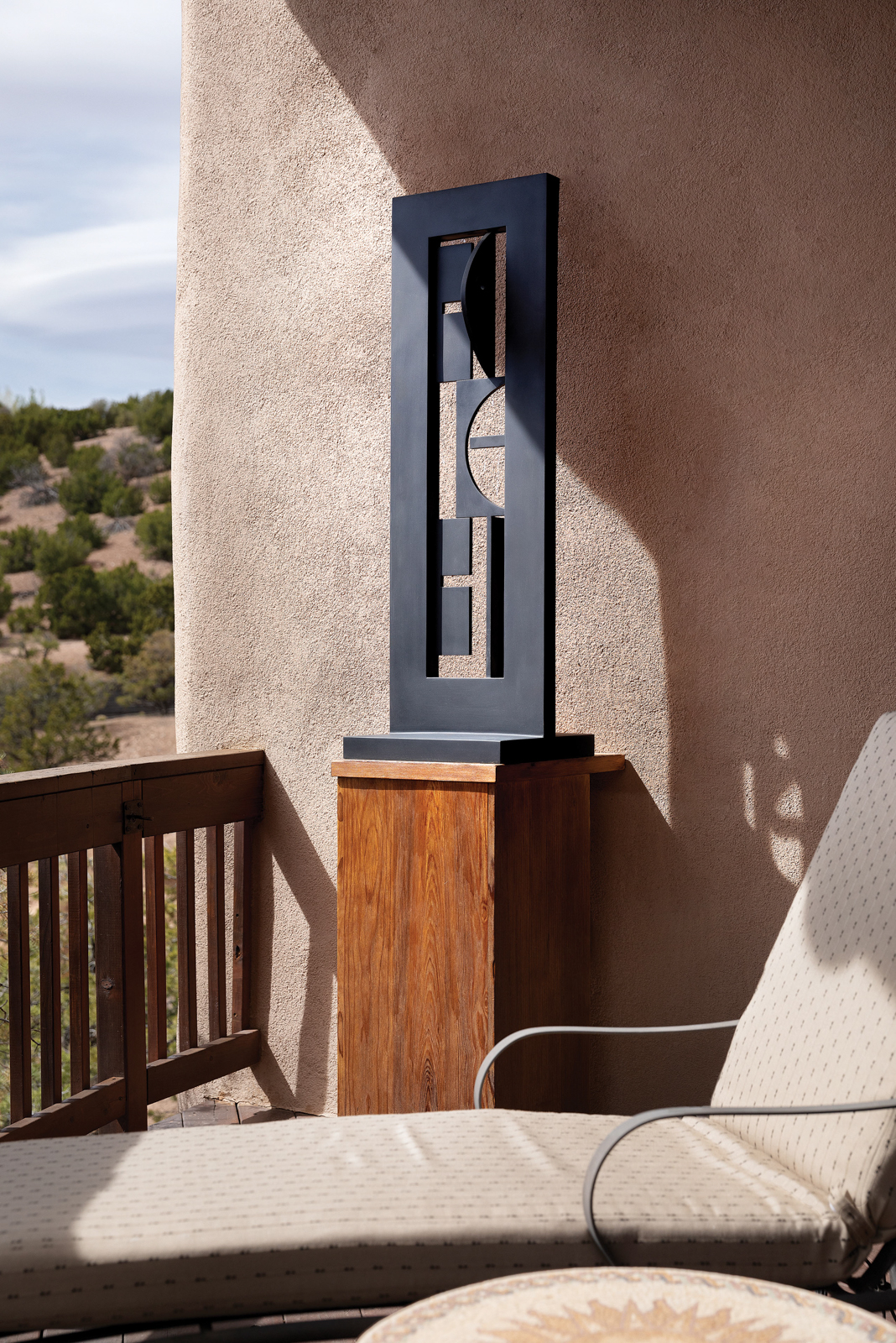 On the balcony is Vertical Forms, 2003, bronze, by Dan Namingha (Tewa-Hopi).
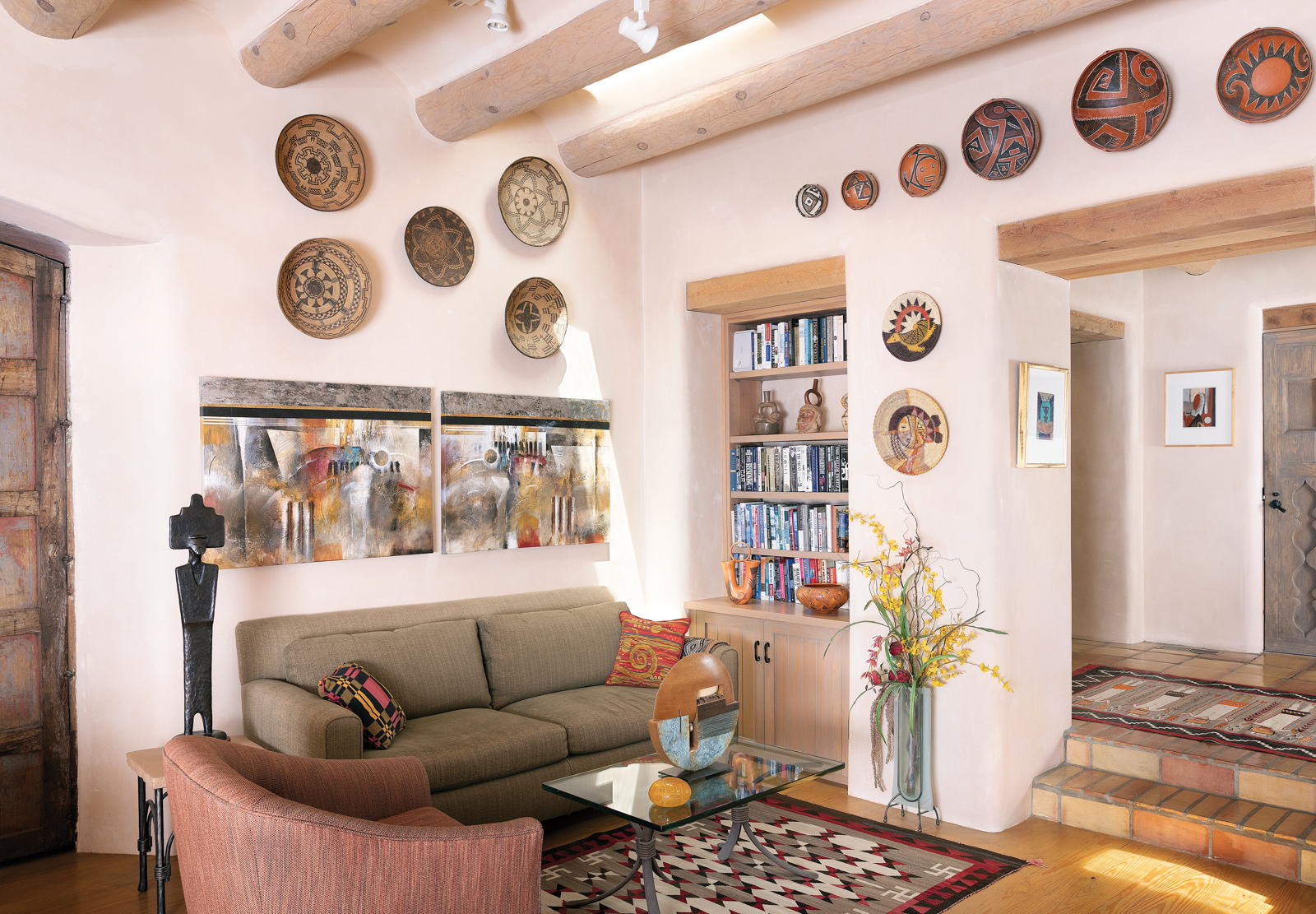 A collection of Apache baskets, ca. 1900, hangs above the sofa. The two baskets next to the bookshelves are, top to bottom, Turtle with Sun, 2003, and Helen Hardin Face, 2003 by Elsie Holiday (Navajo, Diné). Above the door are Four Mile Pueblo bowls, ca. 1050. The standing sculpture is Hesot Kachina Mana, 1982, bronze, by Dan Namingha (Tewa-Hopi).
Next to Dan Namingha’s Mask Assemblage is Arlo Namingha’s bronze, Cultural Images #3, which contains an abstracted katsina face. He comments, “I started out carving katsinam. It became repetitive and I began fragmenting the images.” His sense and mastery of building forms comes from watching and working with his grandmother, Dextra Quotskuyva.
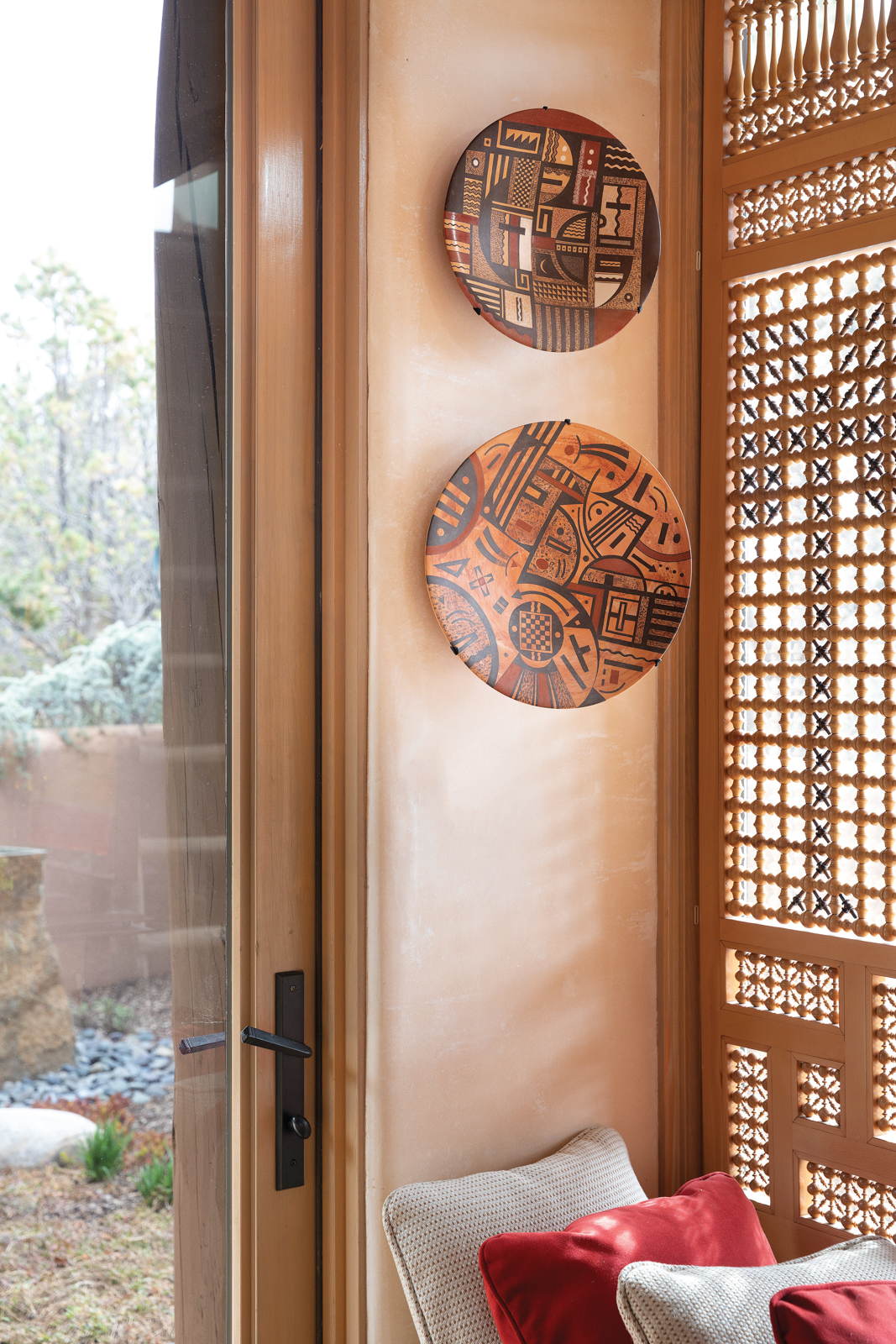 The plates by Steve Lucas (Hopi-Tewa) are, top to bottom, Kachina Faces, 1998, and Kachina Faces, 2000.
“We love Arlo’s stone pieces,” the collector recounts. “And the wood,” she comments. “But we’ve just run out of space, places to put more of them,” he continues.
“We don’t store anything. If it can’t be out, we don’t want it. You’ve got to live with it. You have to be able to see it. We enjoy showing it to friends and talking about it.”
Each piece has a story and a history. “It’s nice to talk about it,” she says, because it does make us sit down and think about it again.”
Powered by Froala Editor