In 1959, Lloyd Kiva New (Cherokee, 1916-2002) wrote “A Proposal for An Exploratory Workshop in Art for Talented Younger Indians” to the Rockefeller Foundation which then supported a conference on Indian art at the University of Arizona and a series of Southwest Indian Art Project workshops between 1960 and 1962. In his proposal for the Rockefeller grant, New wrote, “Let’s see that the young Indian realizes the values of his great and wonderful traditions as the springboard to his own personal creative ideas. Indian art of the future will be in new forms, produced in new media and with new technological methods. The end result will be as Indian as the Indian.” Therein lies the roots of the Institute of American Indian Arts, more commonly known today as IAIA.
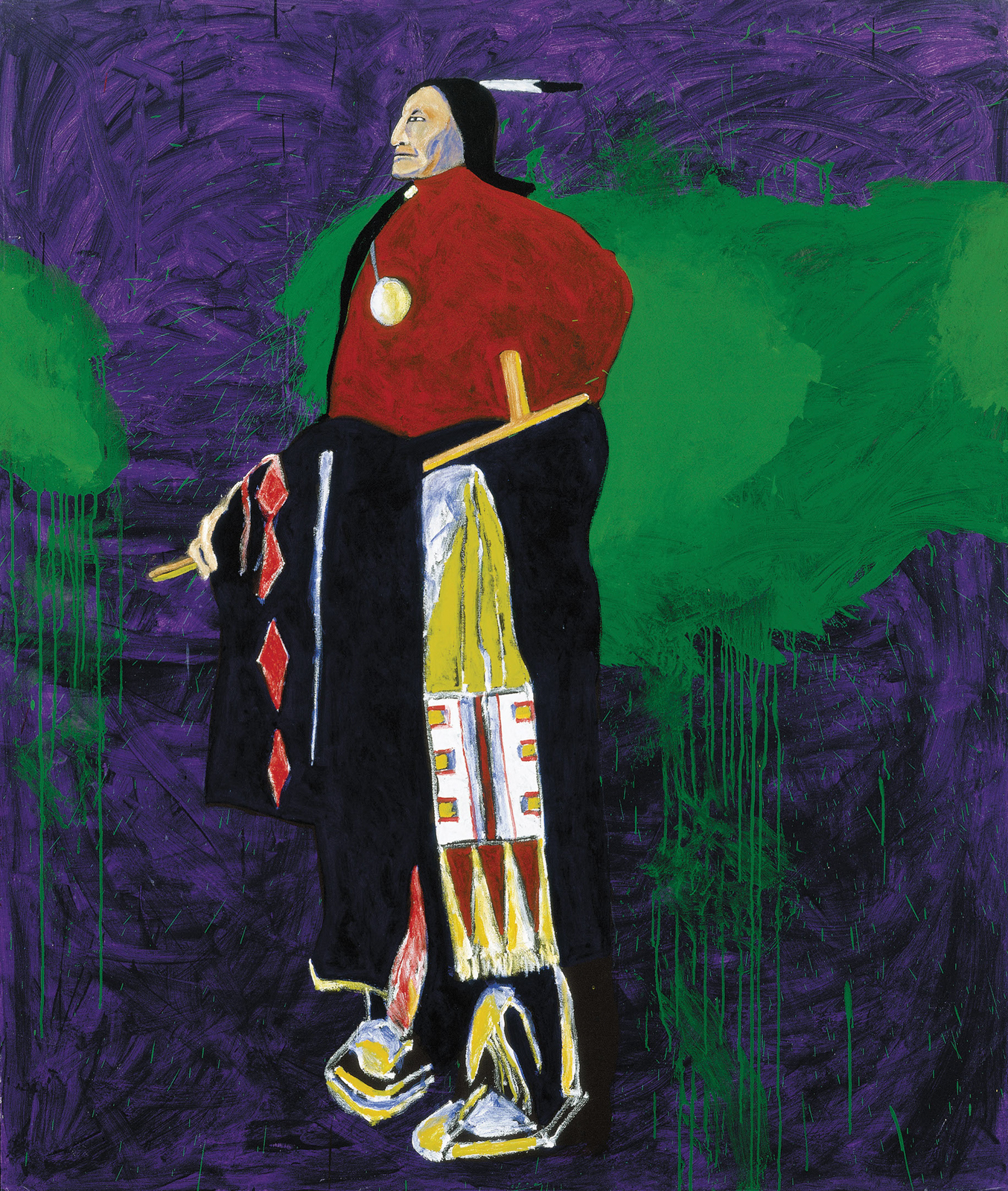 Fritz Scholder (Luiseño, 1937-2005), Portrait with Pipe, 1995, acrylic, 80 x 68”
Dr. Robert Martin (Cherokee Nation), president of IAIA, recounts the school’s history: “We have come a long way from our early days as a high school funded by the Bureau of Indian Affairs to where we are now—a world-class institution devoted to creating, interpreting, and preserving ground-breaking contemporary Indigenous arts,” Martin says. “From the start of the Institute of American Indian Arts, students were encouraged to experiment. The boundaries were limitless. Our students were taught to develop their artistic style without being bound by tradition or history. What I’ve admired most during my tenure here is observing the evolution of our students’ creativity and the ways in which they learn to take risks and manifest other leadership qualities while advancing their artistic expression.”
When we profiled the collection of Letitia Chambers in this magazine, she commented, “Prior to the founding of IAIA, artists were often criticized if they did anything that was not traditional. With the coming of IAIA in 1962, Indian artists were encouraged to learn about their traditions but to create whatever they wanted to create. I love that freeing of creativity, so I’ve focused on the artists of that time period.” Chambers was a board member of IAIA for 10 years and is the former president and CEO of the Heard Museum in Phoenix.
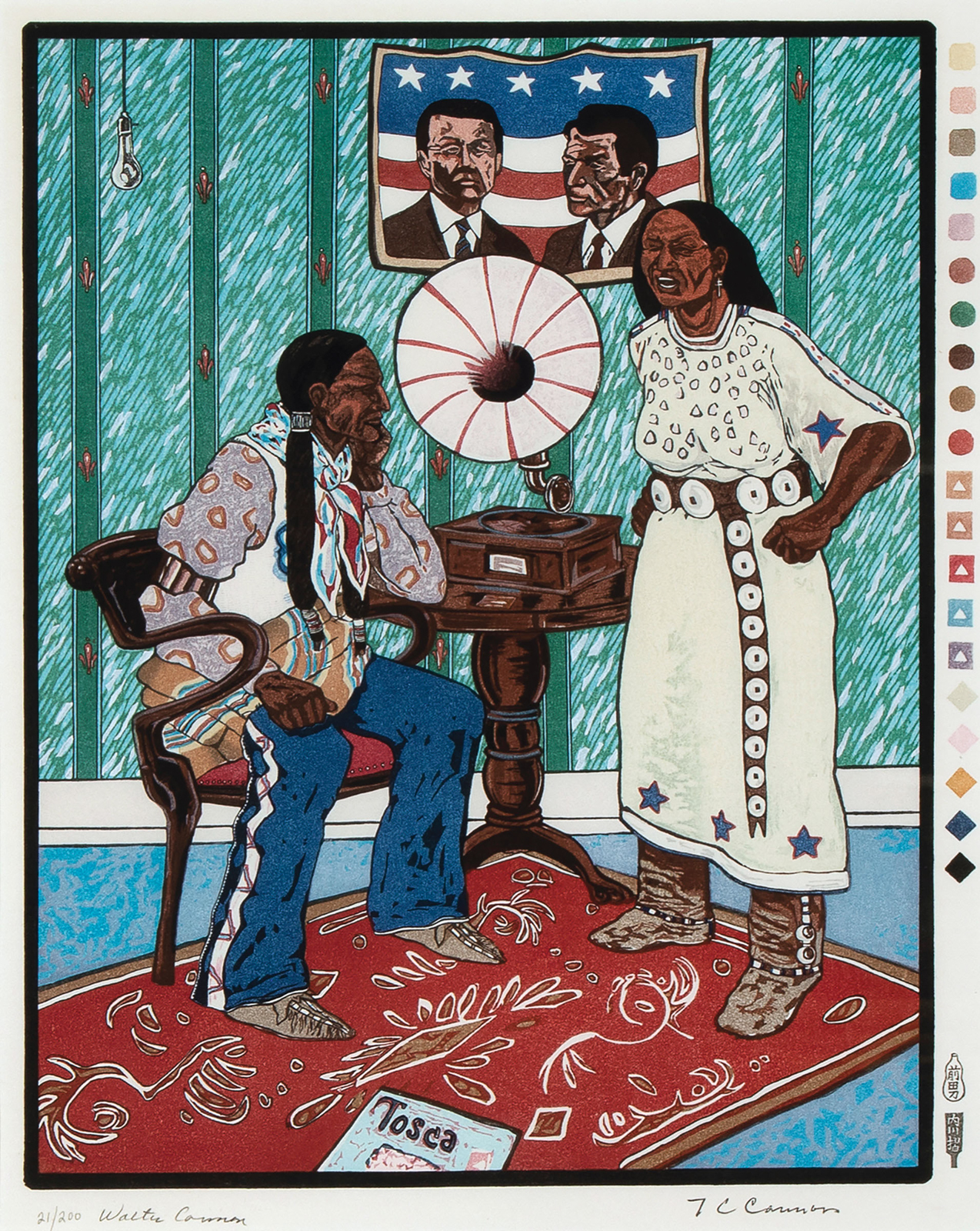 T.C. Cannon (Caddo/Kiowa, 1946-1978), A Remembered Muse (Waiting for Tosca), woodblock print, ed. of 200, 25¼ x 20”. Courtesy Nedra Matteucci Galleries, Santa Fe, NM.
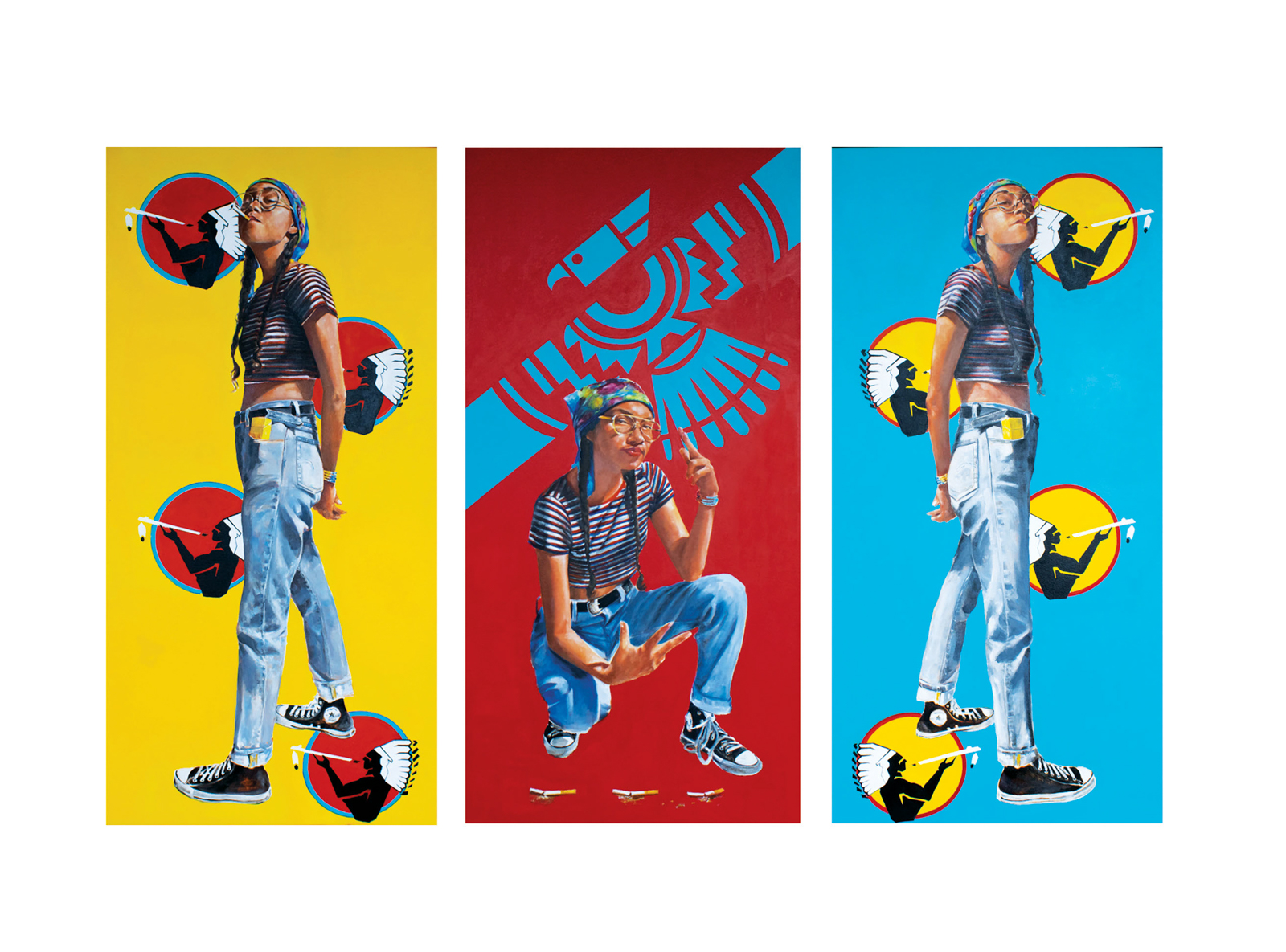 Del Curfman (Apsáalooke), Tobacco Ceremony, 2022, oil on canvas, 62 x 92”. Courtesy the artist.
Students at IAIA—including notable alumni such as T.C. Cannon, Roxanne Swentzell, Marie Watt, Kelly Church, Jody Naranjo and the late Benjamin Harjo Jr.—were introduced to the art of other tribes and, often for the first time, the history of the art of their own. They were also introduced to art history in general, a context in which Native art had never been considered to be part.
Fritz Scholder (1937-2005) was one-quarter Luiseño and was conflicted about his Native heritage. In 1961, he received a full Rockefeller Foundation scholarship as part of the Southwest Indian Art Project and met Lloyd Kiva New. He joined the IAIA faculty in 1964. In a 1996 interview for the Academy of Achievement, he said, “I was mislabeled an Indian artist because I had done a series on the American Indian when I came to Santa Fe. It was a very natural thing, because all painters who go to Santa Fe become immediately seduced by this very strange and foreign little town. Who still thinks about how much Indian blood someone has? Well, I never thought about it, because I grew up in public schools and I’m not an Indian. I’m very proud of being one-quarter Luiseño, which is California Mission, but you can’t be anything if you’re a quarter. Plus, I just never had that background. But I found out what Indians think in Santa Fe. For the first time I met real Indians, and they have a whole different mind-set.”
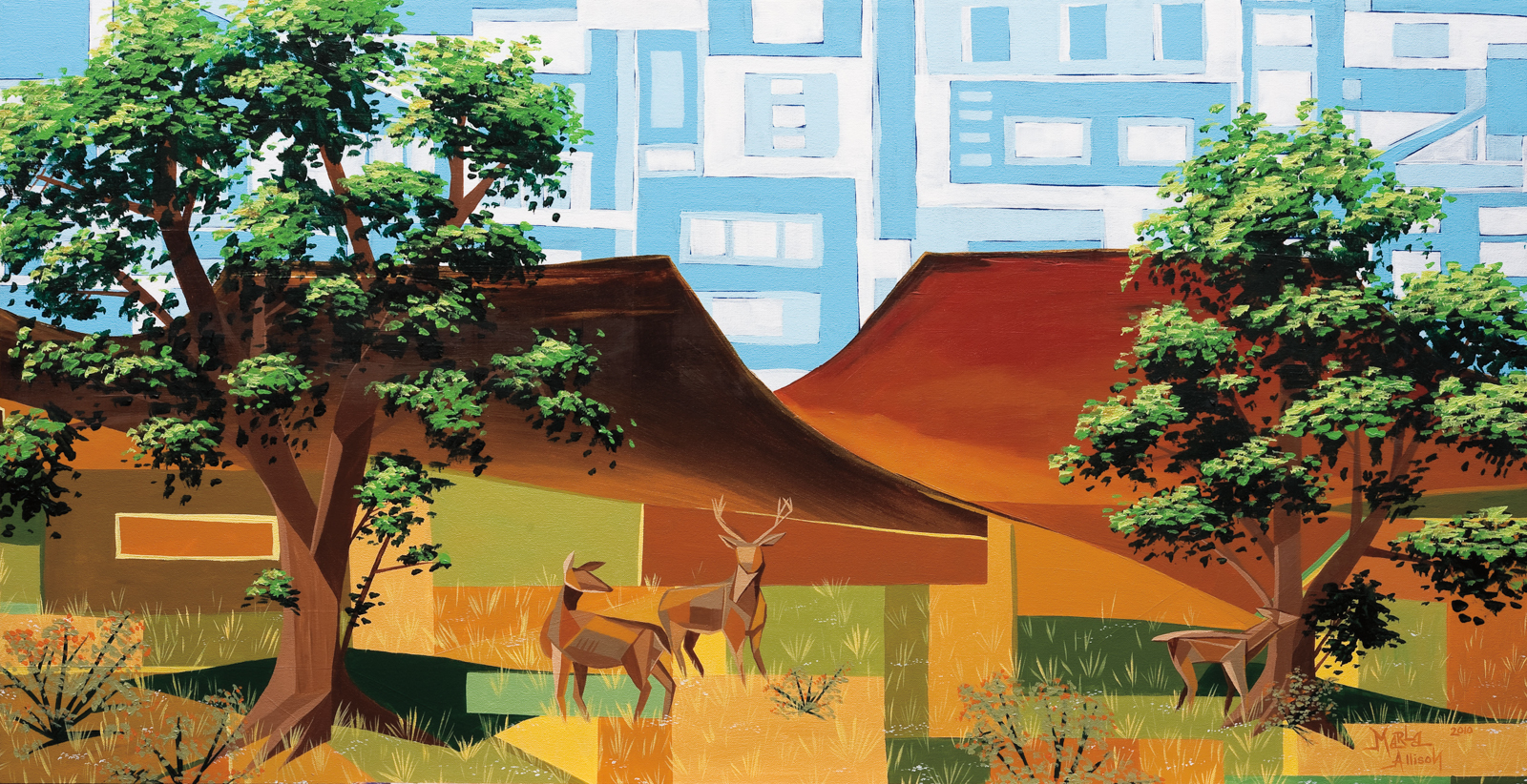 Marla Allison (Laguna Pueblo), Cottonwood and Deer, 2010, acrylic on canvas. Collection of La Fonda on the Plaza, Santa Fe, NM.
The spirit of freedom that permeated the early years of IAIA inspired students whose parents may have endured the trauma of the federal government’s attempts to rid them of their tribal heritage, language, customs, clothing and names. It was also a period when, if the worth of Native art was recognized at all, it was thought to be something frozen in time that needed to be sheltered from the influence of the modern world.
Nocona Burgess (Comanche), who graduated from IAIA in 1991, grew up in a family that excelled in a number of forms of art and is the great-great-grandson of one of the most revered Native American leaders, Chief Quanah Parker. At IAIA he met students from reservations and urban environments where they hadn’t been exposed to either their tribal heritage or the excitement of the contemporary art world. The school’s presence in a welcoming city and one with other young people wanting to be artists fostered camaraderie and the beginnings of networks that would influence the rest of their lives. He also cites the alumni who have returned to the school to teach and to impart their knowledge of the traditional and contemporary.
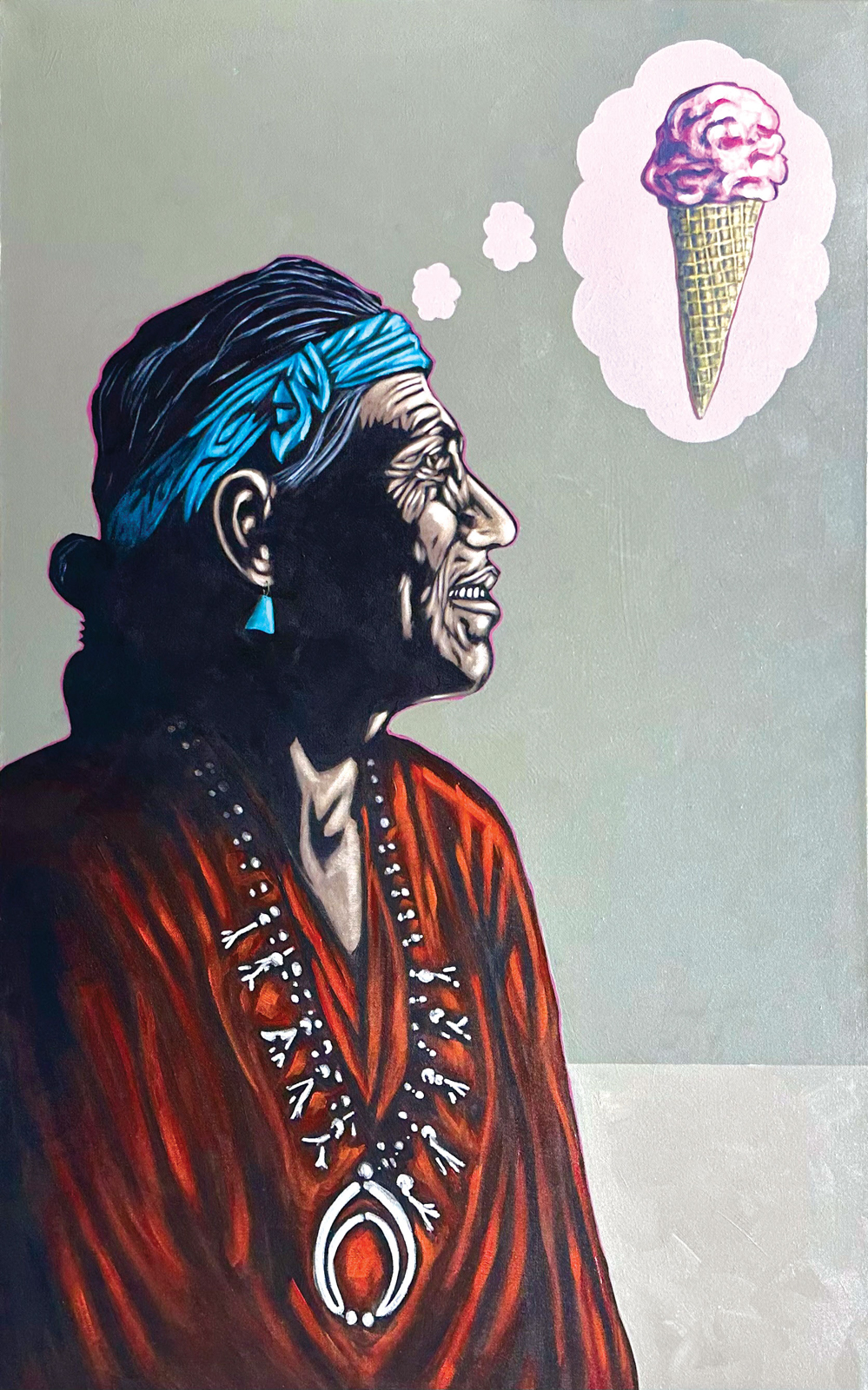 Nocona Burgess (Comanche), Diné abe’ yistini ayóo bil daalkan/Mequecito 1904, acrylic on canvas, 48 x 30”. Courtesy the artist.
Marla Allison (Laguna Pueblo) carries on the artistic traditions of her pueblo. “This great world is an amazing network of bridges once the roads are discovered, found and learned. Coming from the lands of Laguna Pueblo with deep red mesas and native tradition, I was encouraged at a young age to make art and keep questioning the creative process and how to make it continuous throughout life. Taking the career of an artist is a challenge, but I love the work and journey it offers to be doing what I’m doing.”
She graduated from IAIA in 2000 and comments, “Thanks to my beginnings under the guidance of IAIA and the structure it gave me as an artist, I continue to thrive as an artist making paintings and learning new techniques everywhere I go. I am able to tell the story of my past, present and future using my tradition of native pottery design—originally painted as ceramic vessels—now applied to canvas in a manner that evolves with every step of my journey forward.”
Her journey this year, alone, has included attending an opening of a solo exhibition at Rainmaker Gallery in Bristol, England, and a trip to Budapest, Hungary. She relates, “I was in Budapest for the 2023 American Indian Workshop conference as a panelist and as an exhibitor at the Museum of Ethnography for an opening of Ancestral Shadows: Ethnocultural Encounters Carried in Body and Mind, which I helped curate. Working with the museum as a curator in concert with a Hungarian art historian, a bridge has been forged to bring Native art to Budapest. The show included pieces by fellow artist Roxanne Swentzell and other works by Mateo Romero, Will Wilson, Tammy Garcia and Autumn Borts-Medlock.”
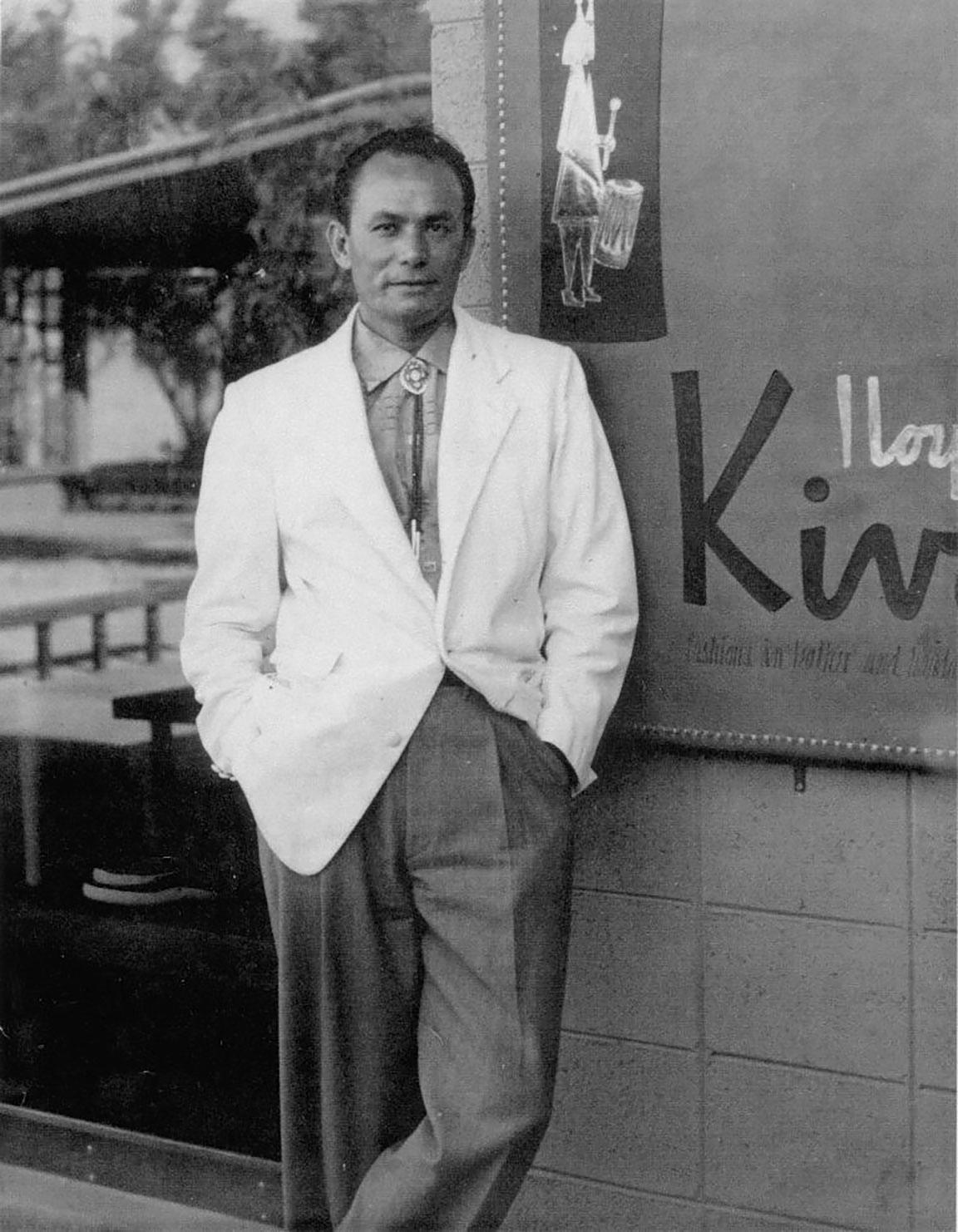 Lloyd Kiva New (Cherokee). Image courtesy IAIA.
She continues: “Thanks to my start of going to school at IAIA, I was able to focus my craft and test the creativity of my body and mind while learning who I can be. I found my people (and was prepared) to take on the world.
“From childhood and graduating, my journey was not as short as it would seem. It took me over eight years to find my way as an artist. A job doesn’t come easy when you are selling your dreams—a language of the inner soul floating in mid-air brushed on to a tangible surface. For me, creating art comes from the pit of my existence, that ethereal sense transformed into a treasured article of the artist (positioned) in the past, present and future.”
Del Curfman (Apsáalooke) graduated from IAIA in 2017. He comments on its role locally and internationally: “IAIA has had a profound impact on contemporary Native art, both within the United States and internationally. Since its establishment, it has played a crucial role in nurturing and promoting Native artists, fostering creative expression, and elevating the visibility of Native art forms. Through its education, support, and advocacy, IAIA has empowered Native artists, revitalized indigenous art forms, challenged stereotypes, and elevated the visibility and appreciation of Native art globally.
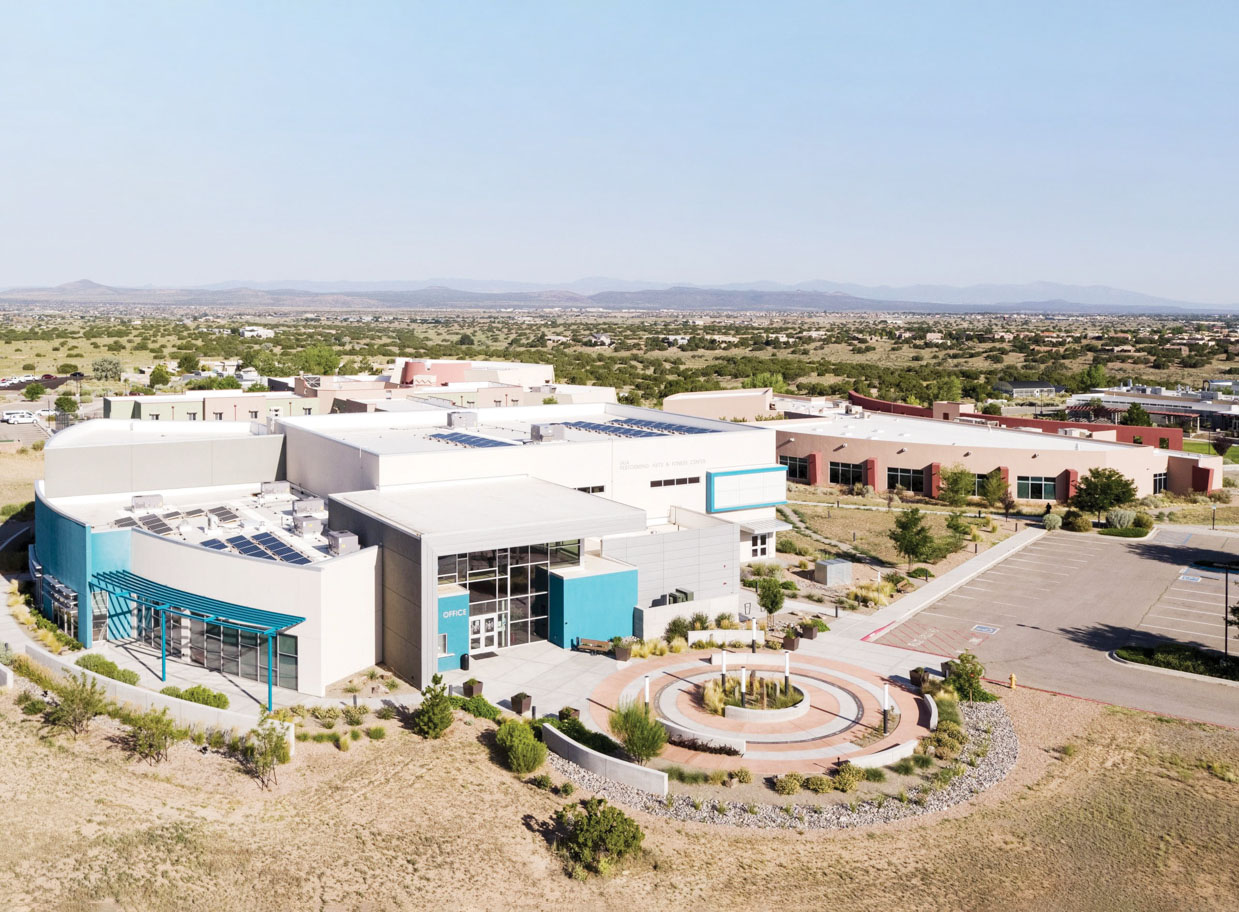 The IAIA campus in Santa Fe, New Mexico.
“IAIA has been instrumental in breaking down barriers and challenging stereotypes associated with Native art. By providing education and training programs in various artistic disciplines, IAIA has helped Native artists develop their skills, experiment with new mediums, and engage with diverse artistic practices.
He delves into his Crow heritage and comments, “IAIA has served as a platform for me to explore my creativity, exhibit my artworks, collaborate with peers, and connect with the wider art community. Through its on-campus gallery, engaging exhibitions, and events, IAIA facilitated exposure to a newfangled understanding of contemporary Native art, its history and it’s standing in the greater art canon. This exposure lead to the inspiration for me to create artwork and, later on, generated commercial opportunities for me, enabling me to sustain my artistic practice.
“The impact of IAIA extends beyond individual artists and has influenced the perception and appreciation of Native art on a broader scale. By highlighting the richness, complexity, and contemporary relevance of Native art, IAIA has challenged preconceived notions and fostered a deeper understanding of Native cultures. This has led to increased recognition and inclusion of Native art in major art institutions, galleries and collections worldwide.”
Lloyd Kiva New’s dream for IAIA continues to thrive. In 1984, he wrote, “To the extent that art is usually a reliable barometer of social movement and harbinger of change we should look carefully at the expressions of the Indian painter, sculptor, writer for insight to the present, and perhaps, as a glimpse of the future.”
Powered by Froala Editor