Arapaho/Cheyenne artist Brent Learned’s art has been in surprising places: in the updated music for video for Redbone’s “Come and Get Your Love,” currently sitting at 12 million views on YouTube; in the closing credits of the Predator prequel, Prey; and on the Santa Fe Indian Market official T-shirt from 2022. His artwork has been widely seen, a trend that will continue at this year’s market.
Taking traditional Native imagery into new Pop Art and space-age territory, Learned excels as a colorist and riffs on classic paintings, giving them an Indigenous twist. Born in Oklahoma City to the Cheyenne Arapaho Tribes of Oklahoma, he has been painting his culture since his university days, inspired by his mother’s wish. Learned is the eighth of 10 children born to John W. and Juanita Learned. His father was an artist of German, French and English ancestry. His mother was the first female chairperson of the Cheyenne and Arapaho tribes. On his mother’s side, he is related to Chief Black Kettle; on his father’s, to The Waltons actor Michael Learned.
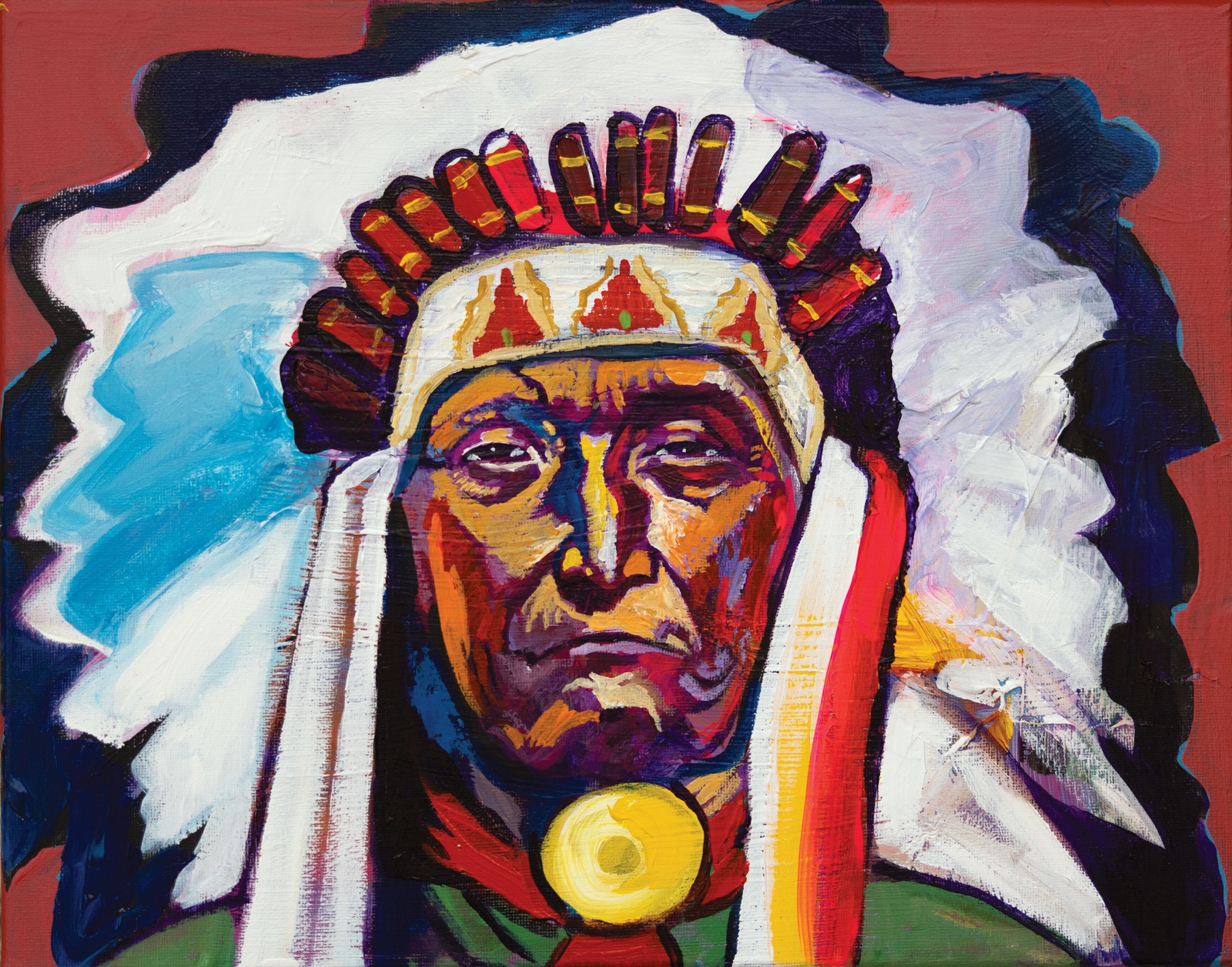 Arapaho Chief, oil, 11 x 14"
“Brent creates art with the purpose of capturing the essence, accuracy and historic authenticity of Oklahoma’s indigenous peoples. His work reflects an important nexus of historic references and current influences in contemporary art,” said Oklahoma State Arts Council executive director Amber Sharples in a recent interview with The Oklahoman. “He contributes an important voice to the Oklahoma State Art Collection, in conversation with other luminaries such as T.C. Cannon and Allan Houser, who continue to influence artists both in and beyond our state.”
Last year his colorful painting of a buffalo adorned the official SWAIA T-shirt, which sold out by Sunday. “What I’m bringing out to Indian Market this year is new. I always try to push the envelope on some of the scenes and imagery that I bring. One of the things that I’m going to bring is more compositions of family and friends telling stories of daily life on the plains, but also show more women and kids, because that’s one of the things you typically don’t see a male artist paint at art shows,” Learned says. “Men mostly paint chiefs, a lot of guys on horseback and hunting the buffalo, more violent and I guess manly imagery, where I want to soften up and show the other side and give a voice to women and children.”
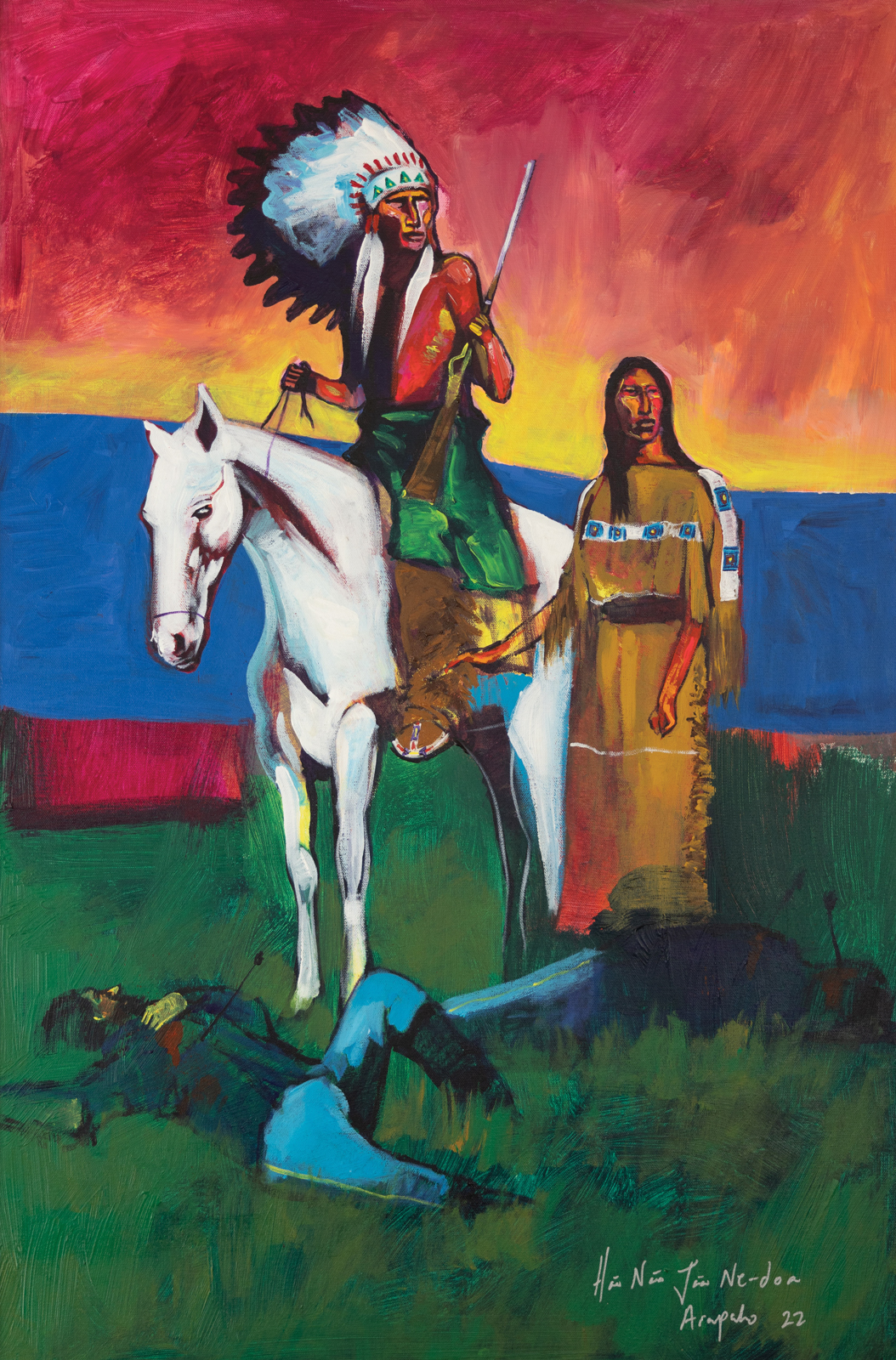 Fight for the Ones You Love, 36 x 24"
He continues, “I want to depict how the life would have been for the backbone of the family—putting up a teepee, making the home inside, then having to tear it down and move it all over again. They are the nurturer of the next generation of kids, and I even want to go further by showing how they prepare food and what it would be like to be a woman at that time. Because that’s something when I go to these art shows, I don’t see any of that type of imagery.”
Learned feels a larger responsibility at this point, as both an artist and educator. “I always tell young artists that you’re an ambassador of your tribe. You’re educating dominant society through your work, giving your ancestors a voice, and telling your story of your people and who they really were. Try to tear down these boundaries of being the noble savage or the savage that we’re always seeing in movies and books, but times are changing into where people are coming out with a new narrative on how we are seen. I want to be a part of that, depicting scenes that you typically would not see at an Indian art show.”
The artist questions some of the subjects he views, and wonders if there are other paths through history and culture. “You can only see so many chief portraits before you’re inundated with them. What’s new in this? What can I take from this?”
Learned’s art received major visibility when he was asked to create an animated video for Indigenous supergroup Redbone, formed in 1969. In 2020, he collaborated with the band and Legacy Recordings, the catalog division of Sony Music Entertainment, to create an official new music video for “Come and Get Your Love,” the infectious, bouncy song with a message of earthy and universal love, a pop-rock classic by the groundbreaking Native American band. The song was recorded in 1973, but it was still finding new fans 50 years later. The song had never had an official video, but the live 1974 performance of the song by the band that featured powwow dancers on the Midnight Special TV show has been viewed more than 25 million times.
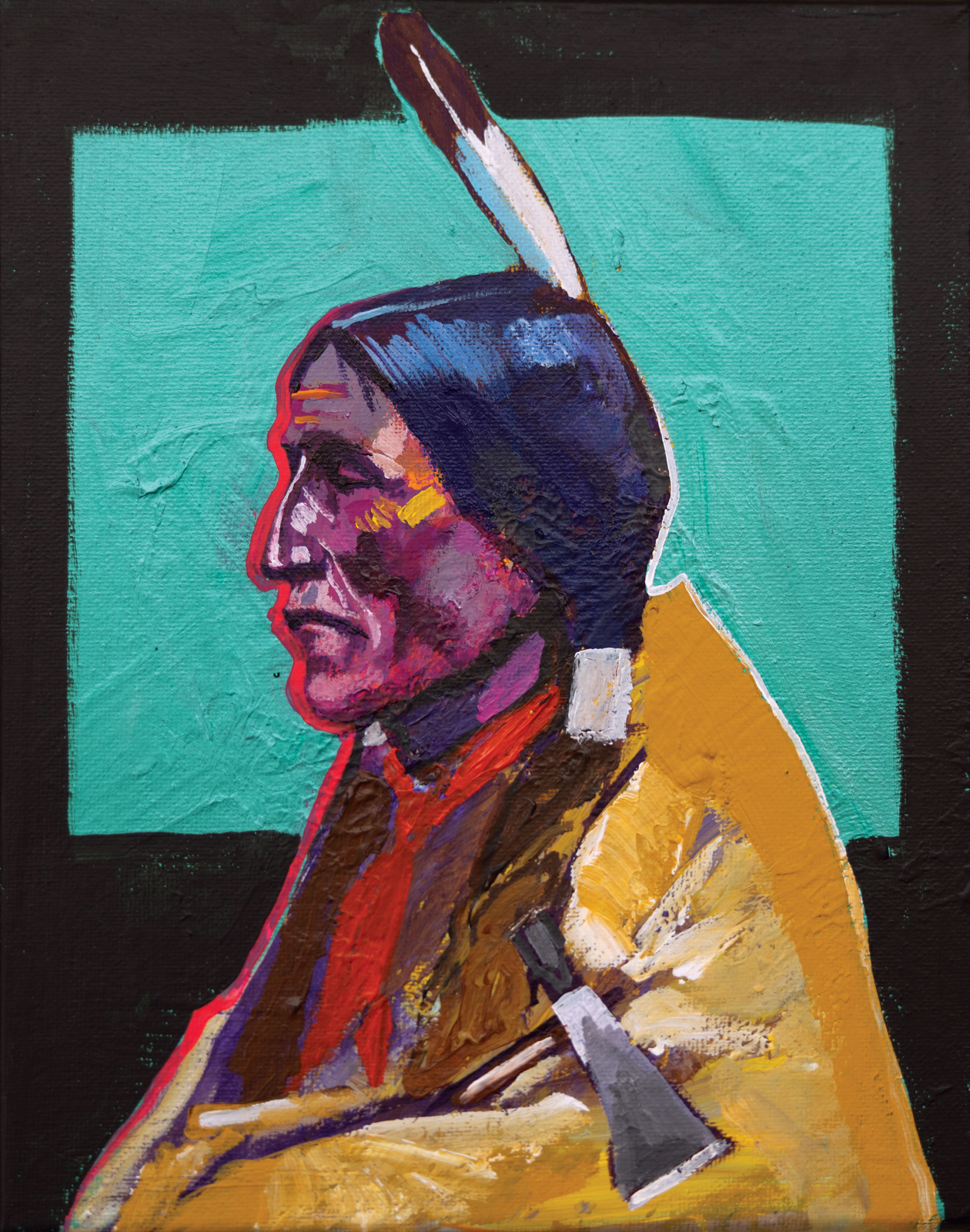 Arapaho Indian, oil, 10 x 8”
The song has been popularized again in recent years in the soundtrack for the movie Guardians of the Galaxy, the first entry of a three-film franchise within the Marvel universe that has earned more than half a billion dollars at the box office. Legacy Recordings pulled in an Emmy-nominated director, Juan Bedolla, and Learned to create the visuals.
Approaching the storyline of the Redbone video, Mexican producer and director Bedolla, who has two Emmy nominations and multiple Telly and Addy awards, found Learned through Instagram and asked him to help. They planned to shoot footage, but the pandemic hit, and they had to shift production gears and go with animation. The resulting video was inspired by “graffiti, traditional images, the future and reexamining pop-culture imagery in the context of contemporary events,” Bedolla says. “The film’s mythic Indigenous traveler moves from his reservation eventually to outer space. There’s a lot going on in each frame, with multiple scenarios. Pat Vegas from the band had some input, and the band appears in several places throughout the film.”
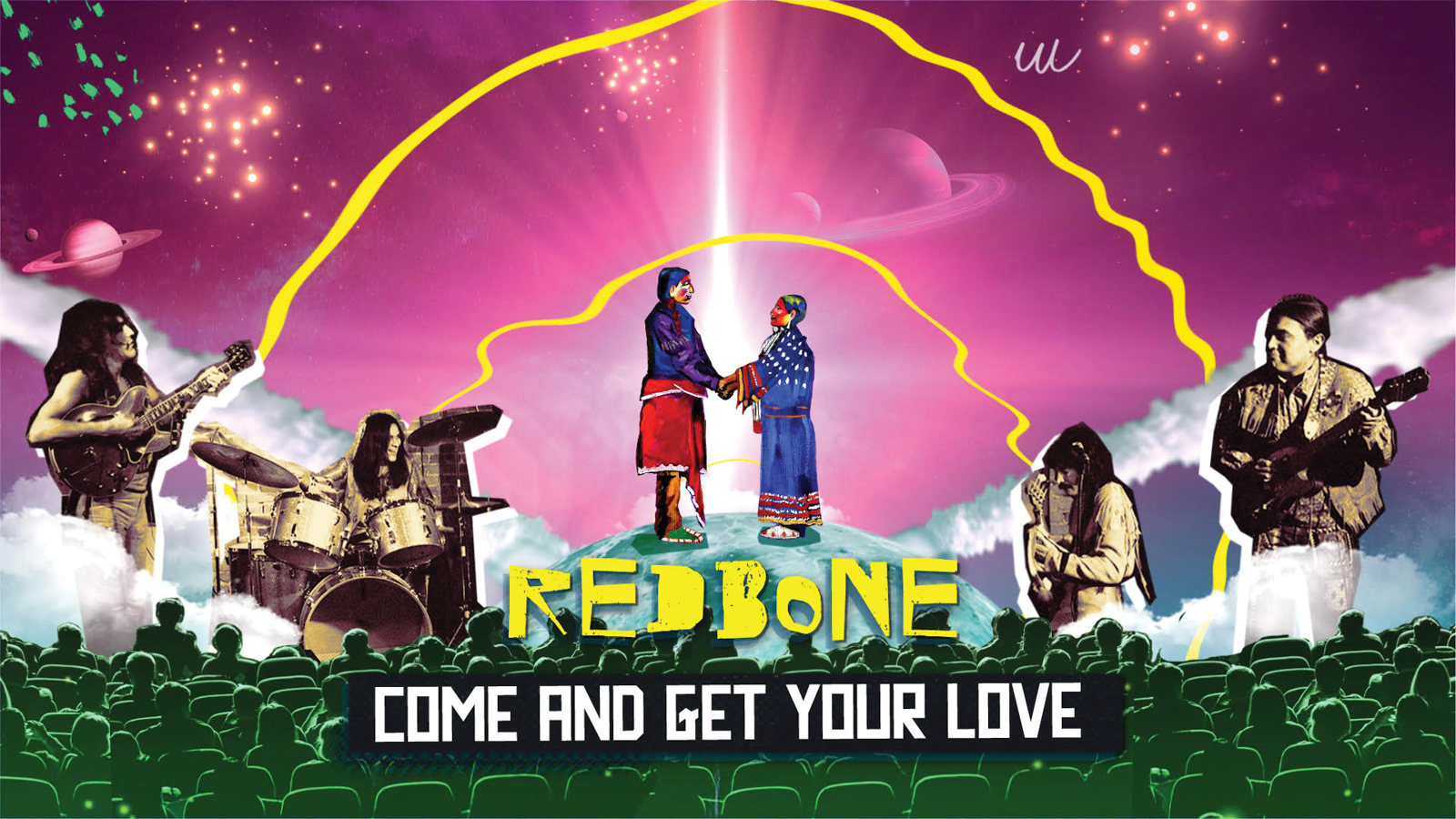 A still from Redbone’s music video for “Come and Get Your Love,” featuring the art of Brent Learned.
Bedolla says the time-traveling central figure in the project is an “expression of universality.”
“This is a commentary on an overarching idea repeated throughout the video, that of seeking our love/interests in all the wrong places, when oftentimes they are right in front of us; if only we’re willing to look,” Learned says. “It was important to us to include contemporary images such as protest signs, the #MMIW (Missing and Murdered Indigenous Women) hashtag on the horses’ haunches, and ledger books that come to life. When the traveler becomes an astronaut, there are tribal patterns painted on his rocket ship.”
From that visibility, Learned was contacted by producer Jhane Myers, who was working on a new installment of the Predator film series, this time set on set in the Northern Great Plains in 1719 with the Comanche tribe. “They reached out to me and to several other artists,” Learned says. “We had to provide a portfolio of different types of ledger drawings that we’ve done. And then once we were chosen, they sent us a package of what kind of look they were going for. Then, from there, we had to come up with the characters.”
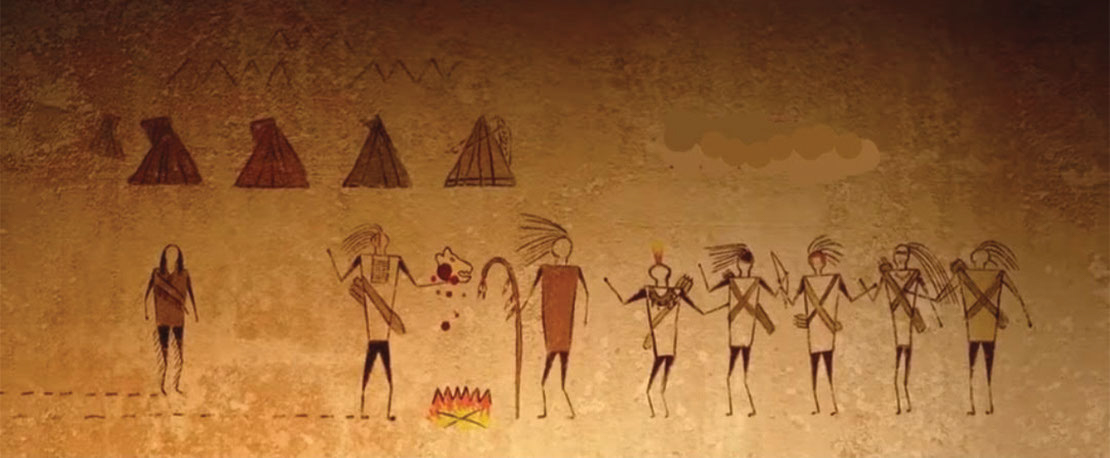 Still image from the film Prey, showing Learned’s ledger-inspired art.
The producers wanted it updated—a mix of ledger art and rock art—very simple lines that were strong and told a story.
“That was nice because if you look at the rock art the Comanches did it was real primitive, real stylized—nothing was really well defined. [Director Dan Trachtenberg] thought that they should have it where at the very end, they wanted to do a recap of the movie in credit form. They looked at early ledger artwork and they liked the way I did my characters that they have. Myers went ahead and made me the lead artist for developing the characters. So, I literally came up with a design for each one of the movie characters.”
This was an ongoing process as the movie was being made, so the artists got to see early rough-cut scenes from the film. “They outlined it, they sent us a scene we watched ahead of time,” Learned says. “They would go back, and they said, ‘You need to watch this scene, which is at 29 minutes to 32 minutes, and to come up with a drawing from that.’ We would do a drawing and then send it in and then they would turn that into animation.”
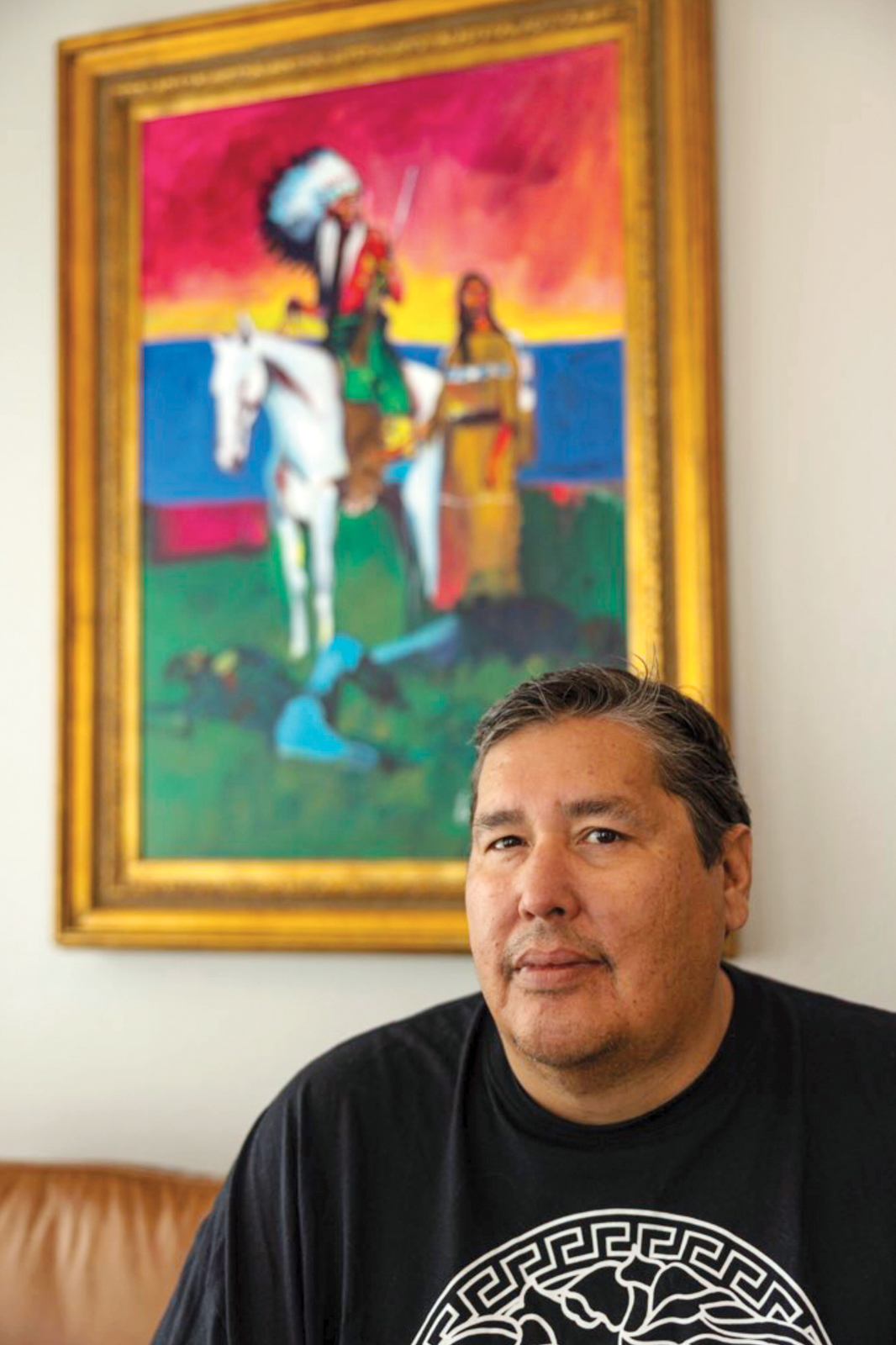 Brent Learned
Some of the process was done digitally on an iPad. “So, for example I just drew Naru (Amber Midthunders’ character) just standing there. And they would draw her standing there, but they would put a tomahawk in her hand or her holding a bag or something. Just little small details,” Learned elaborates. “From there they were able to send that to the animator and then the animator would actually make her move and run and everything else. It was beautiful, not to mention that’s the first time ever to have a ledger-style illustration at the end of a movie.”
The movie debuted last summer on Hulu and was a monster hit, pun intended, with millions of views. It was so popular with sci-fi fans and Indigenous viewers, a second film is in pre-production now. The film studio even commissioned Learned to paint a Prey alien creature portrait, which now hangs in their main offices. Indigenous worlds overlapped further with Myers, who was a producer on the film and jewelry designer. She was offering Prey posters at her booth at the Heard Museum Guild Indian Fair & Market in March.
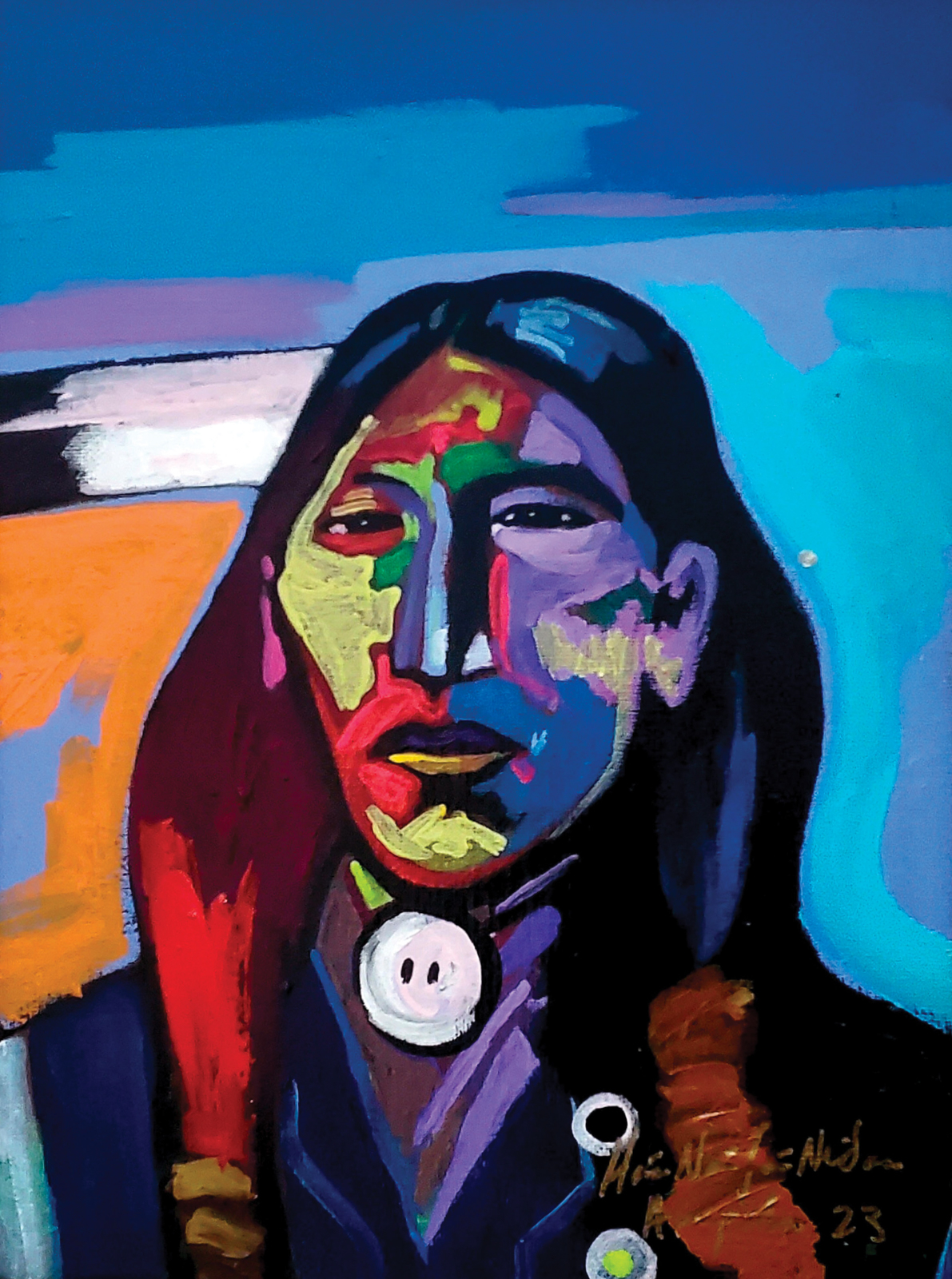 Arapaho Brave, oil, 14 x 11"
With music, art and film worlds colliding, Learned will be at his booth in Santa Fe with retro Pop Art of Arapaho life, greeting the thousands who will stop by to see the new work and meet the artist. “Going to Market is like going back to the family reunion,” he says. “You always run into people you haven’t seen in a long time and I like that. But to hear the stories about where my paintings have traveled, that is really cool because I don’t have any kids, but my art is my kids. So, when I’m gone from this world, it’s kind of nice to know that I’ll have a mark and have these pieces that will bring joy to others.”
Powered by Froala Editor