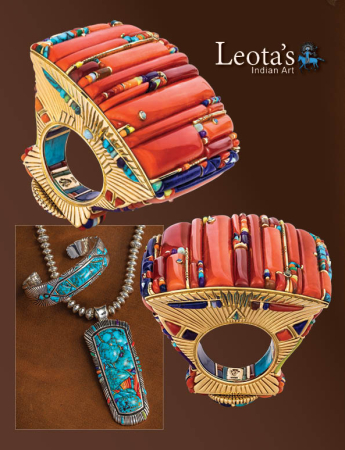
While Ric Charlie is skilled in constructing fine silver jewelry, his gold creations display unparalleled design elements of unity and harmony. Charlie has been making high-end adornment since 1983. He’s won awards galore at all the important Indian art showcases, and his work seen in numerous exhibitions and publications. In recent years, however, Charlie’s pieces in gold place him at the apex of his profession.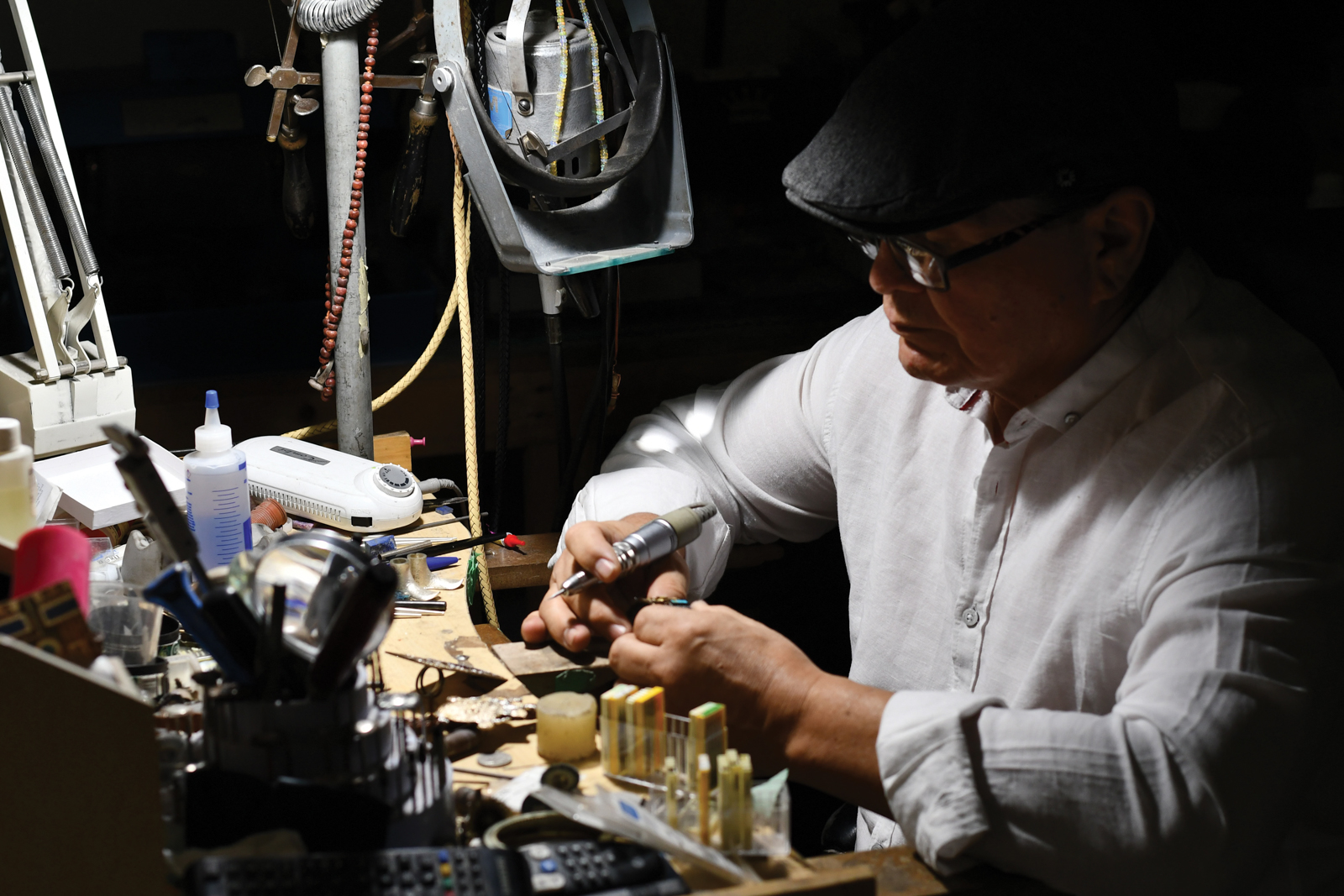 Ric Charlie in his jewelry studio.
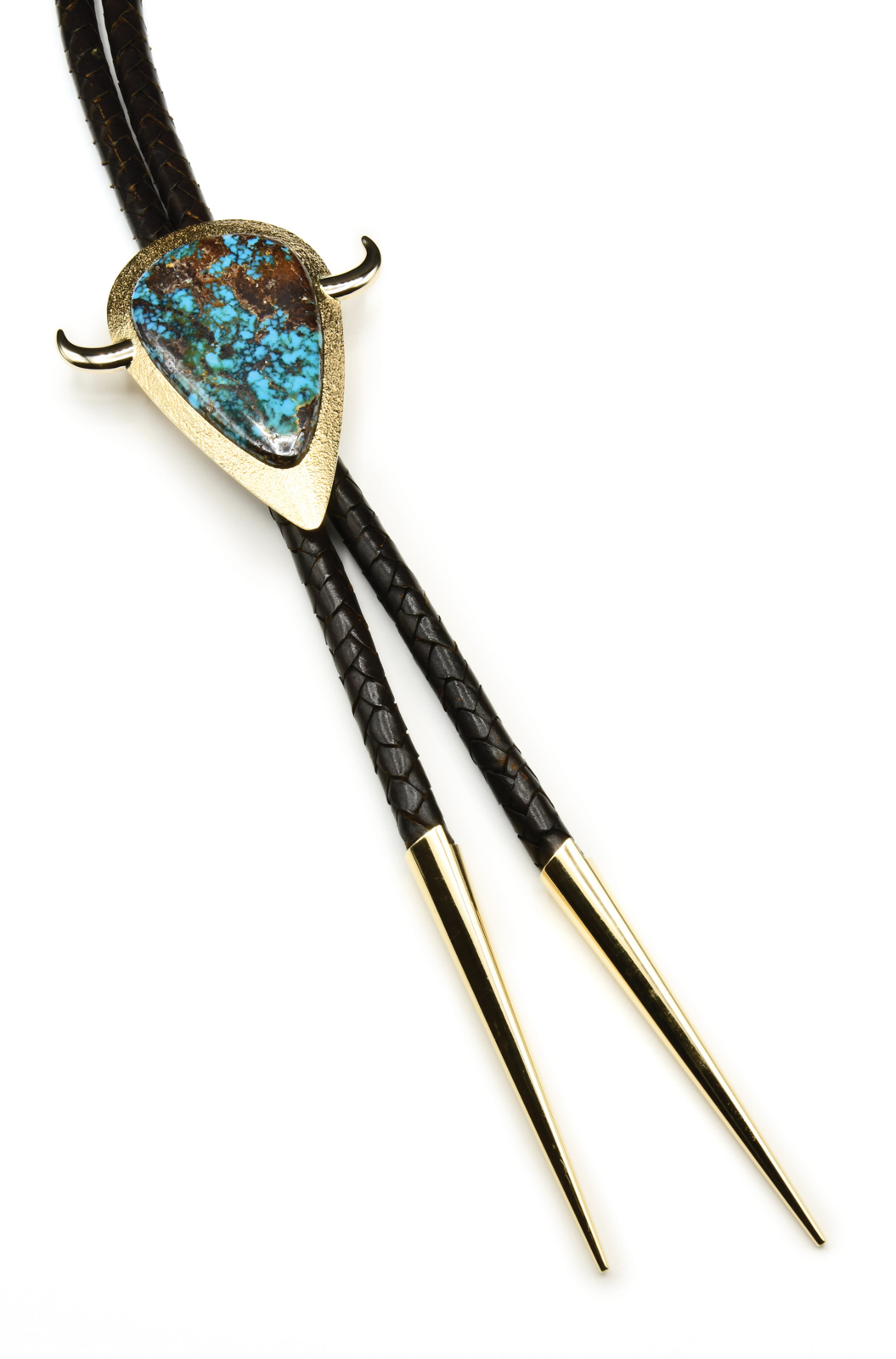
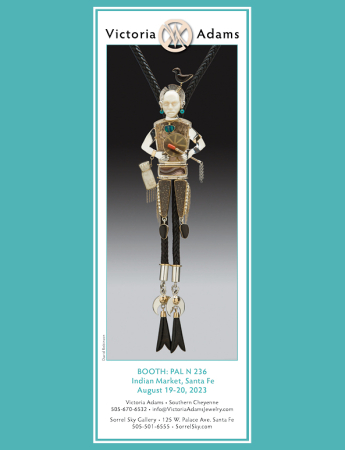
Bolo tie made with 14k gold and Candelaria turquoise, ca. 2001-2.
He started making jewelry in 1976 while in high school to get some extra income. Unlike many Native artists, nobody in his family was doing this kind of work. Charlie’s grandfather, an engineer, inspired him to take matters into his hands and make it work. Most of all, he wanted to master tufa casting since he believed the source of his designs was “all in the tufa stone.”
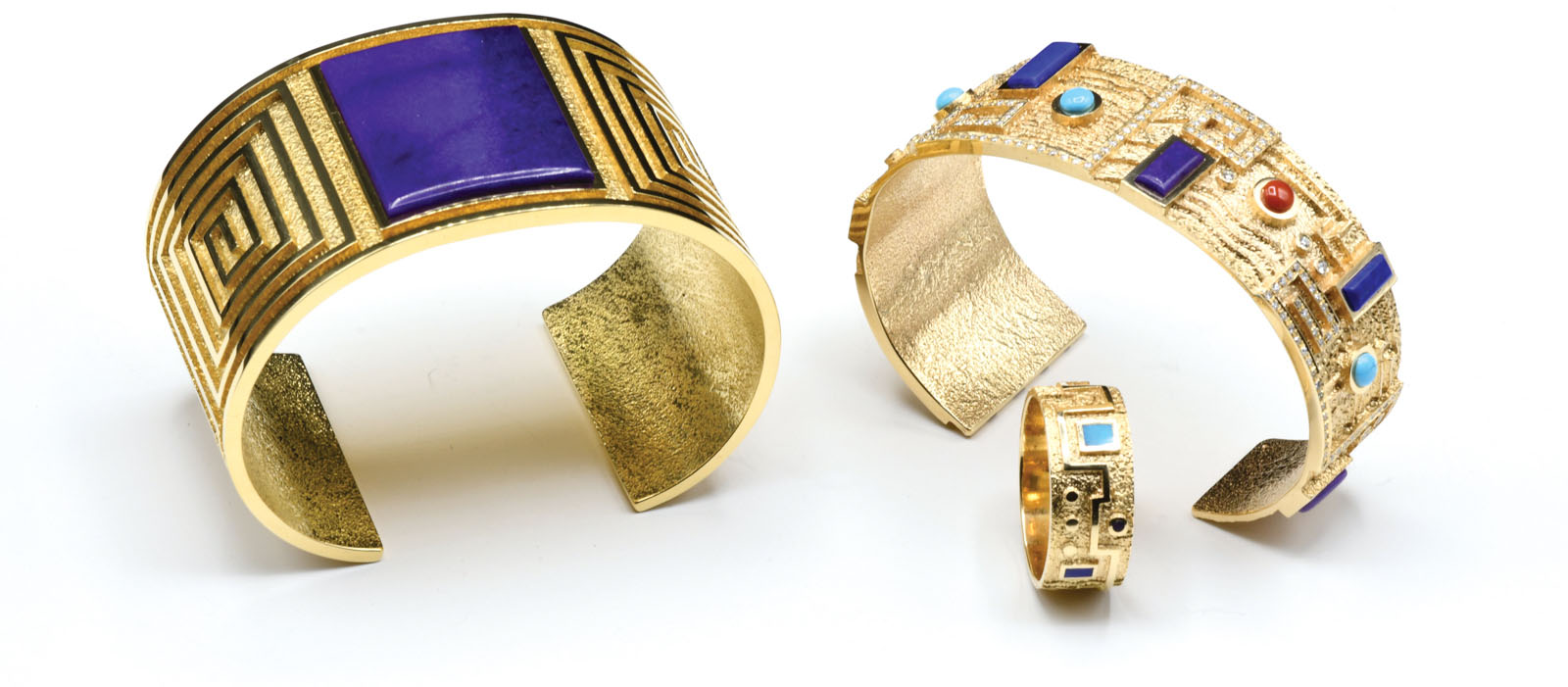
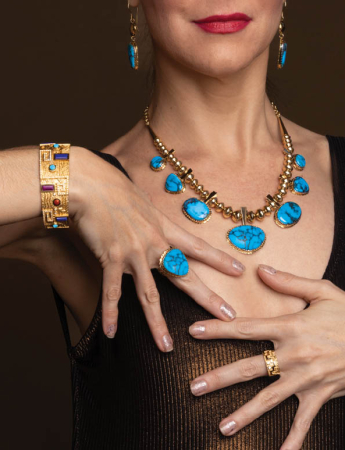
Two bracelets: (left) 18k gold with gel sugilite, 2000; (right) 14k gold with small stones in turquoise, sugilite, lapis, coral, and diamonds, 2022, and matching 14k gold ring, 2021.
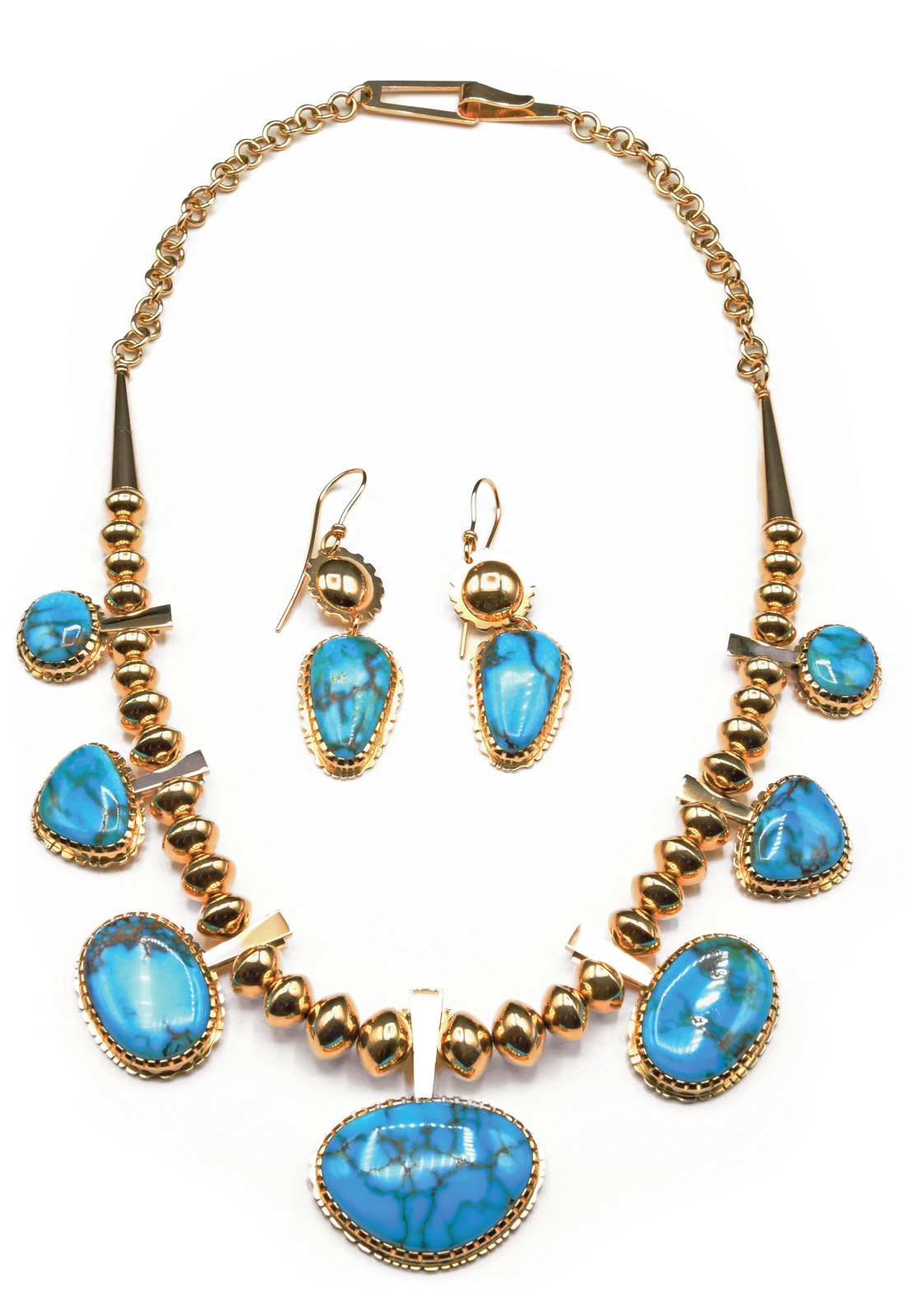
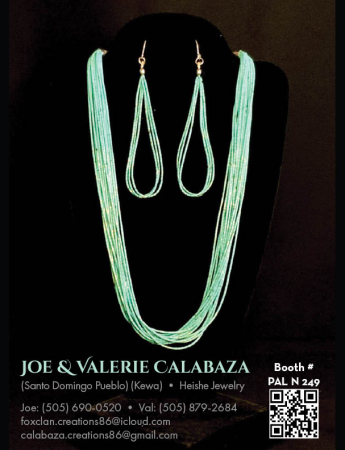
18k gold necklace with matching earrings; stones are Candeleria turquoise with central stone of Lone Mountain turquoise, 2022.
The artist’s designs are mostly abstract but can also have figural shapes. Reviewing the design elements he employs, Charlie acknowledges the importance of texture and proportion, which show to great advantage in his work. But his thoughts on design come from the first line of inspiration. “Basic fundamentals are probably the best way to express yourself in art—contrast, line, depth.”
Charlie names his inspirations: Navajo landscapes, Yei Bi’ Ci’ spirits and sandpainting patterns based on ceremonial designs. He believes his designs can evolve as he works on them but also feels that “I try not to design around a stone. So I end up cutting the stone to fit the design. Every piece has a story. If you look deep enough, there’s a story.” Charlie doesn’t make or follow drawn designs because he looks for everything to happen in the moment. He says that to create a bracelet, it can take anywhere from three days to a month and a half. And he feels that “the better you are, the longer it takes to make a piece.”
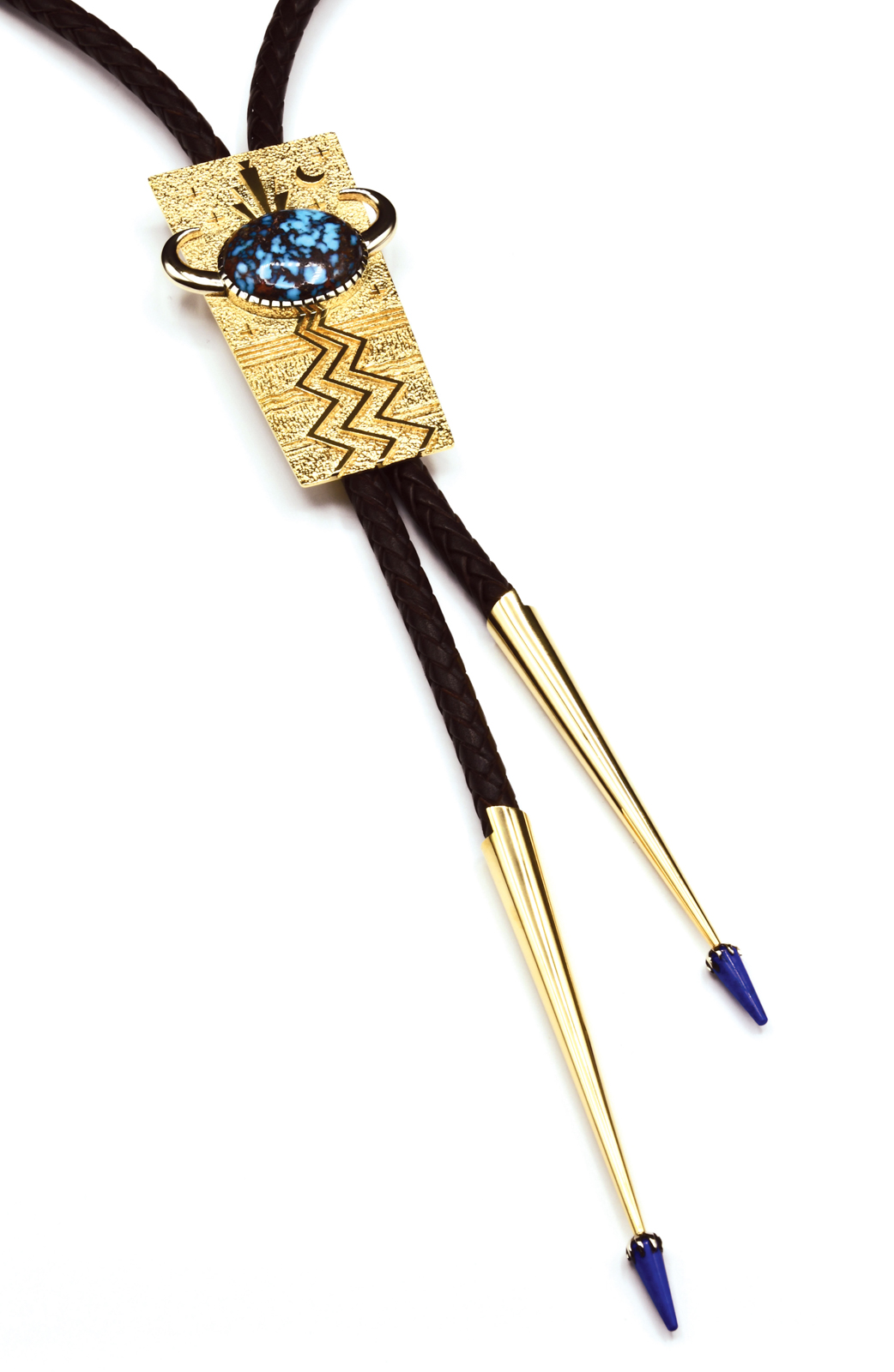
18k gold bolo tie with Godber turquoise ornamentation, 2023.
The artist values his relationships with other jewelers, especially when showing them how to technically construct designs. He taught his own son Aaron Charlie and brother Edward Charlie, along with Mark Crawford and Carlos Dougi. He and Boyd Tsosie exchanged technical skills; Tsosie showed him how to roll beads and Charlie taught Tsosie how to tufa cast. Charlie taught the fundamentals of tufa casting to celebrated goldsmith Harvey Begay and, also, to father and son jewelers Richard and Jared Chavez. He gave technical advice along the way to Jesse Monongye. When younger, Charlie was close to Isleta artist Ted Charvese (1936–1980) and admired his work with diamonds.
Charlie’s affinity for training goes beyond the ordinary. His core belief is that every would-be artist must learn how to express themselves. Their designs must come from within. He attributes his ideas about education to Charles Loloma. In fact, Charlie’s advice to young Native people echoes Loloma’s own straightforward counsel: “Be yourself. Create your way.”
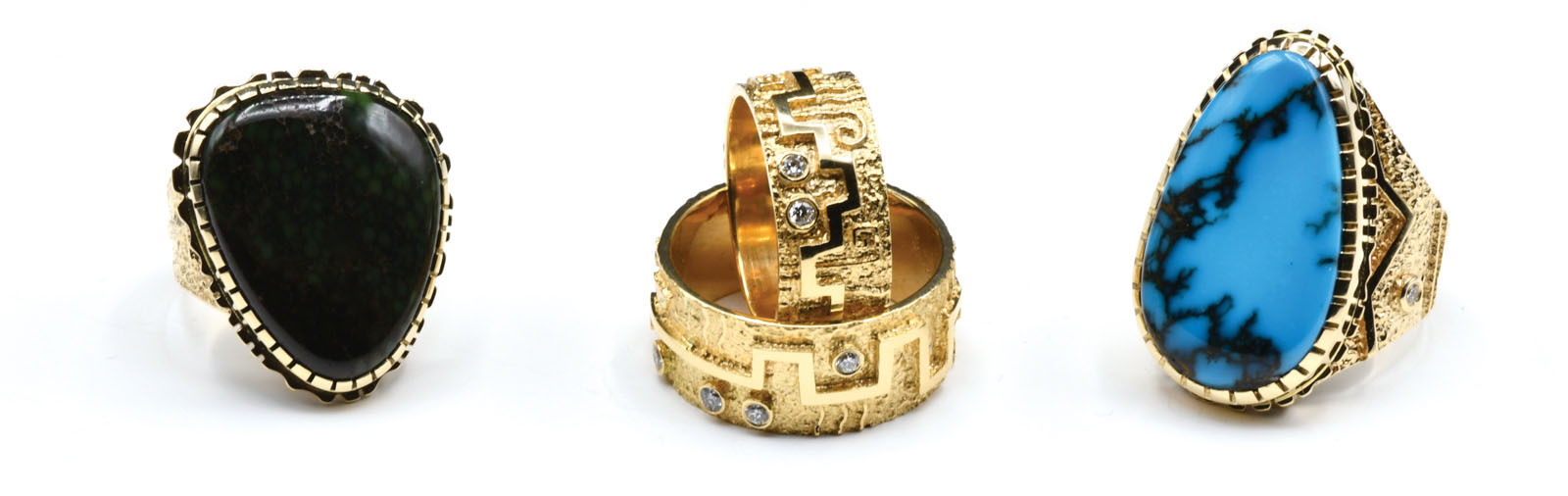
Four rings, from left to right: 14k gold and white gold with gel Damele stone, two 18k gold wedding bands with diamonds, and 14k gold ring set with Candeleria turquoise, 2022.
His gold work is characterized by its alloy’s vivid colors. In addition to tufa casting, he employs mosaic and channel inlay, sets semiprecious stones and uses fabrication and appliqué. All these techniques are color enhanced by means of patinas on silver. His fine lines and rich texture come from cutting tufa and surfaces with dental tools. “I can get deep into the corners I need to cut.”
Charlie, like some of the best jewelers today, is an experienced collector, with the soul of a gallerist. He started collecting in 1978 by purchasing a kachina doll. Charlie acquires paintings and sculptures from Native talent. He also paints and sculpts for himself. He believes that working in different media aids his collective design process. In the 1990s, he learned how to carve in stone from two Italian immigrants, with a studio in Scottsdale, Arizona; they showed him how to work with Carrera white marble.
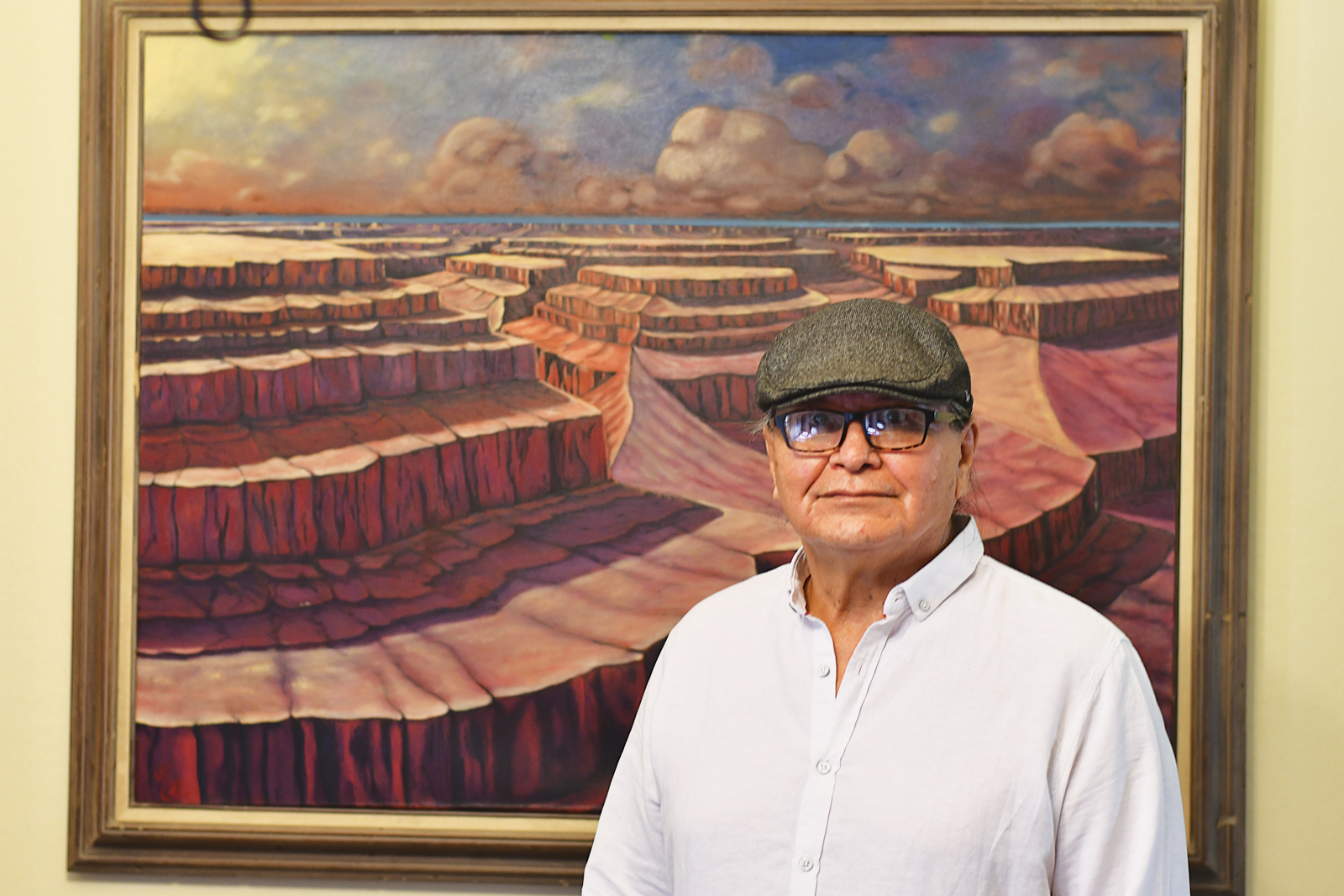
Jeweler Ric Charlie in his home.
The artist’s favorite setting figures in his creative work. He feels a close emotional and spiritual tie to Monument Valley, which he visited from Tuba City and Chilchinbito, Arizona, where his father’s side of the family lived. He particularly loves rendering, with paint or metal, artistic visions of the deep canyon and jutting mesas and the play of light and shadow on them. Charlie often dreams about the sacred nature of this spectacular Four Corners landscape. This fascination goes into his gold jewelry in terms of its design integrity and appeal.
Charlie began winning awards early in his career. At the SWAIA Indian Market, he won the Raymond Dewey Memorial Award for Best of Tufa Stone Casting for multiple years in a row during the 1980s into the mid-1990s. He has also captured various SWAIA awards for Best of Category, Best of Class, Best of Division and Most Creative Design in Any Classification over the years. In addition, he has won many awards at the Heard Museum Guild Indian Fair & Market in its Jewelry and Lapidary and Personal Adornment class categories. Recently, Charlie was awarded Best of Show at the 2017 Cherokee Indian Market. The list of show awards and publications featuring his jewelry stretches from 1982 to the present.
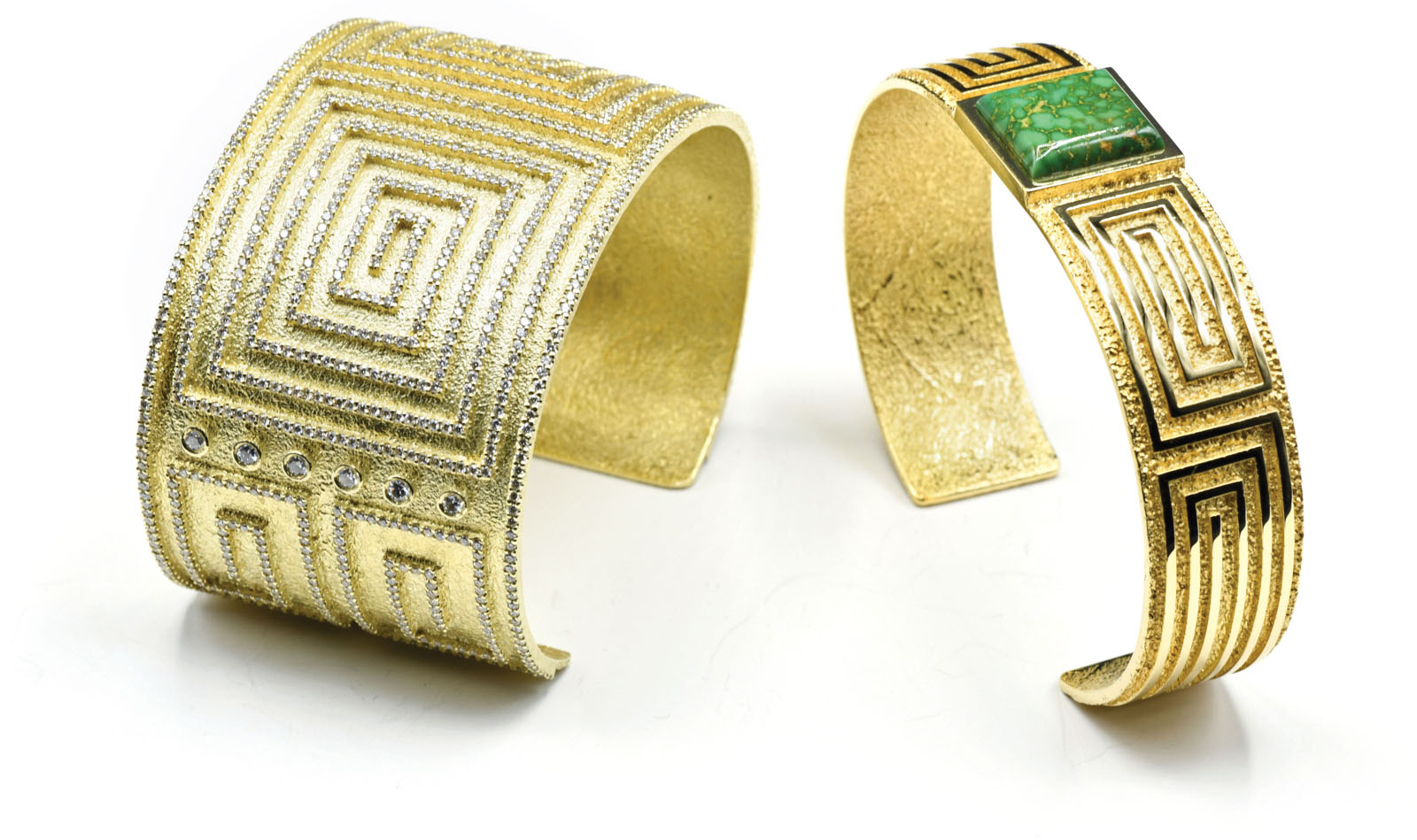
Two bracelets with the artist’s “lifeline” design: (left) 14k gold wide cuff; (right) 18k gold with central stone. Both 2001.
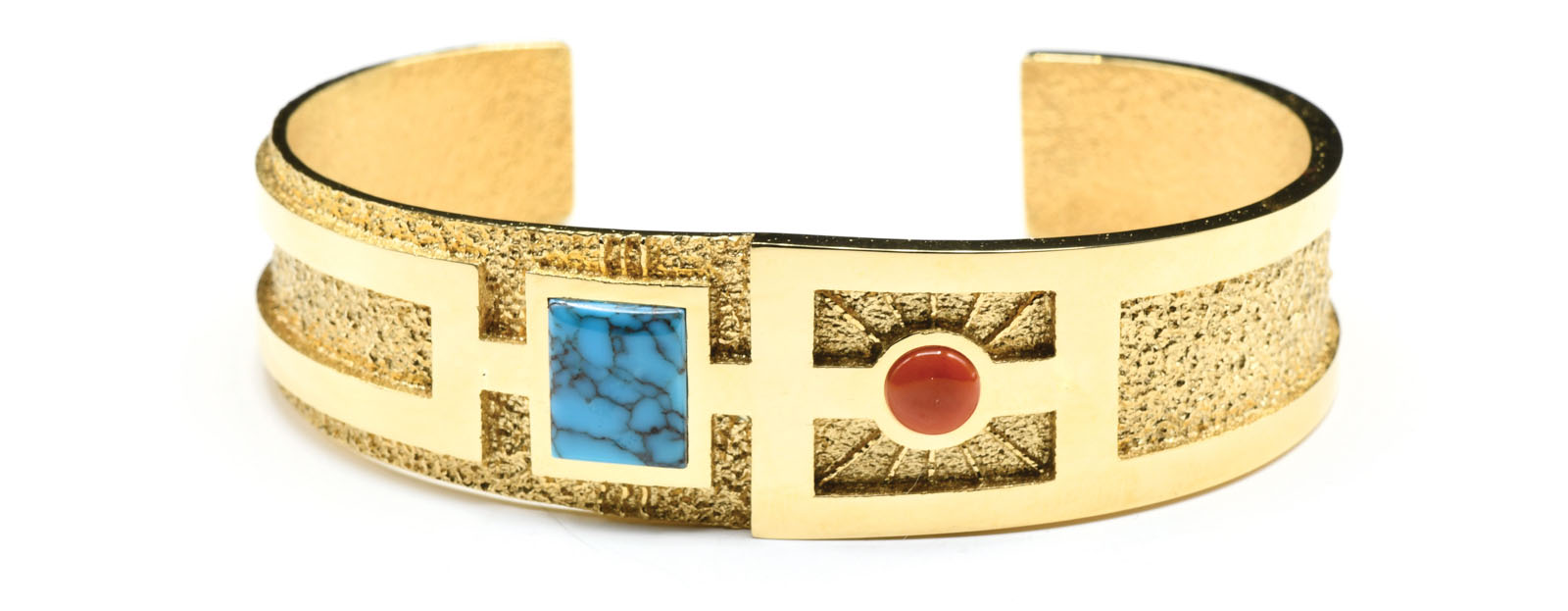
18k gold cuff with single Bisbee and coral stones, 2022.
But Ric Charlie reserves a special spot in his heart for the SWAIA Indian Market in Santa Fe as a space that has nurtured his marketability. “The SWAIA show on the Plaza is the place where you are judged by your skill, by how people react to your art. Santa Fe can make you or break you.” And then, he smiles almost shyly as he says, “I’d like to thank those who supported me over the years. Without that support I would not be where I am today.”
Powered by Froala Editor