Everton Tsosie’s work is bold, graphic and gestural. The artist, who lives and works between Albuquerque, New Mexico, and New York City, paints large canvases, thick with impasto, and layered with geometric imagery and angularly depicted faces. The works have a dichotomy of anguish and exuberance—a dichotomy that is resultant from the artist’s lived experience, moments of precarity in his childhood, and an interpretation of historical and current events affecting and effecting Indigenous communities and bodies, as well as issues facing the global community.
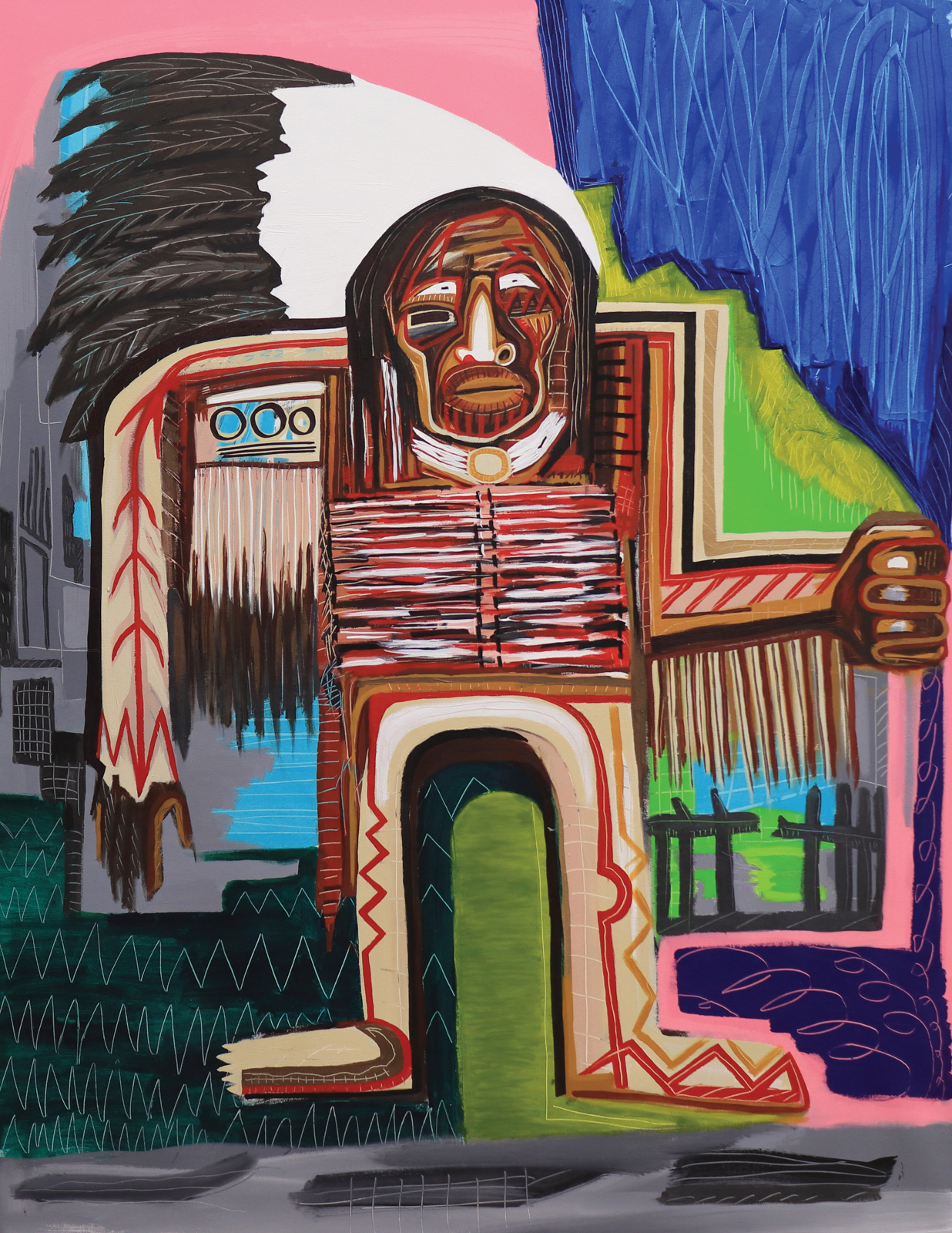 The New Territory, acrylic and mixed media on canvas, 66½ x 52½"
Growing up in Albuquerque, the artist turned to art as a means of processing and interpreting the world around him. “I would [draw] in my sketchbook growing up as a kid in the war zone,” he says, referencing what is now known as the city’s International District in the southeast. “I came across a lot of crazy-looking people and a lot of people who [use] drugs and people who are in gangs, people on the bus. I would see these characters, and I would draw them because it was something of interest to me.”
These drawings were, and still are, an important and foundational part of the artist’s evolution and journey in their practice, setting the stage for the work the artist is doing now. Tsosie received his bachelor’s in fine arts at the University of New Mexico, where his paintings received mixed reactions from professors. “When I got into school, that is when I started to do those faces [on canvas],” shares the artist. “There were instructors that liked them, and there were also other art instructors that [were] kind of hesitant to let me continue [working] that way. They would say ‘OK, we like that your [work] is like that, but we want you to be more proportional or submit to symmetry.’” Essentially, they wanted Tsosie to create paintings that were more realistic and in tune with the natural world. “I had to work on my blending, and I had to work on those [art] terms and aspects that the school foundations have required.”
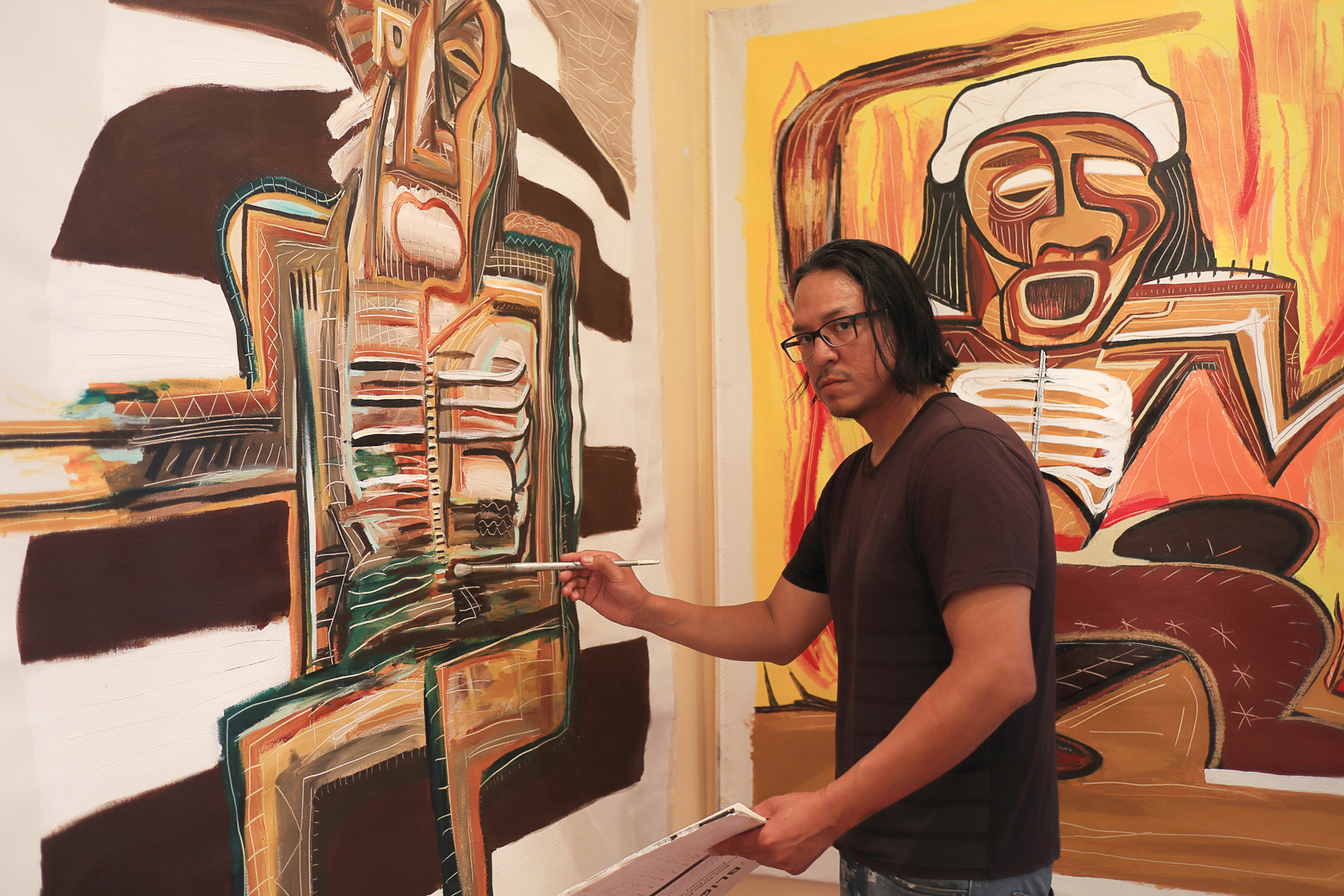 Everton Tsosie in his New Mexico studio.
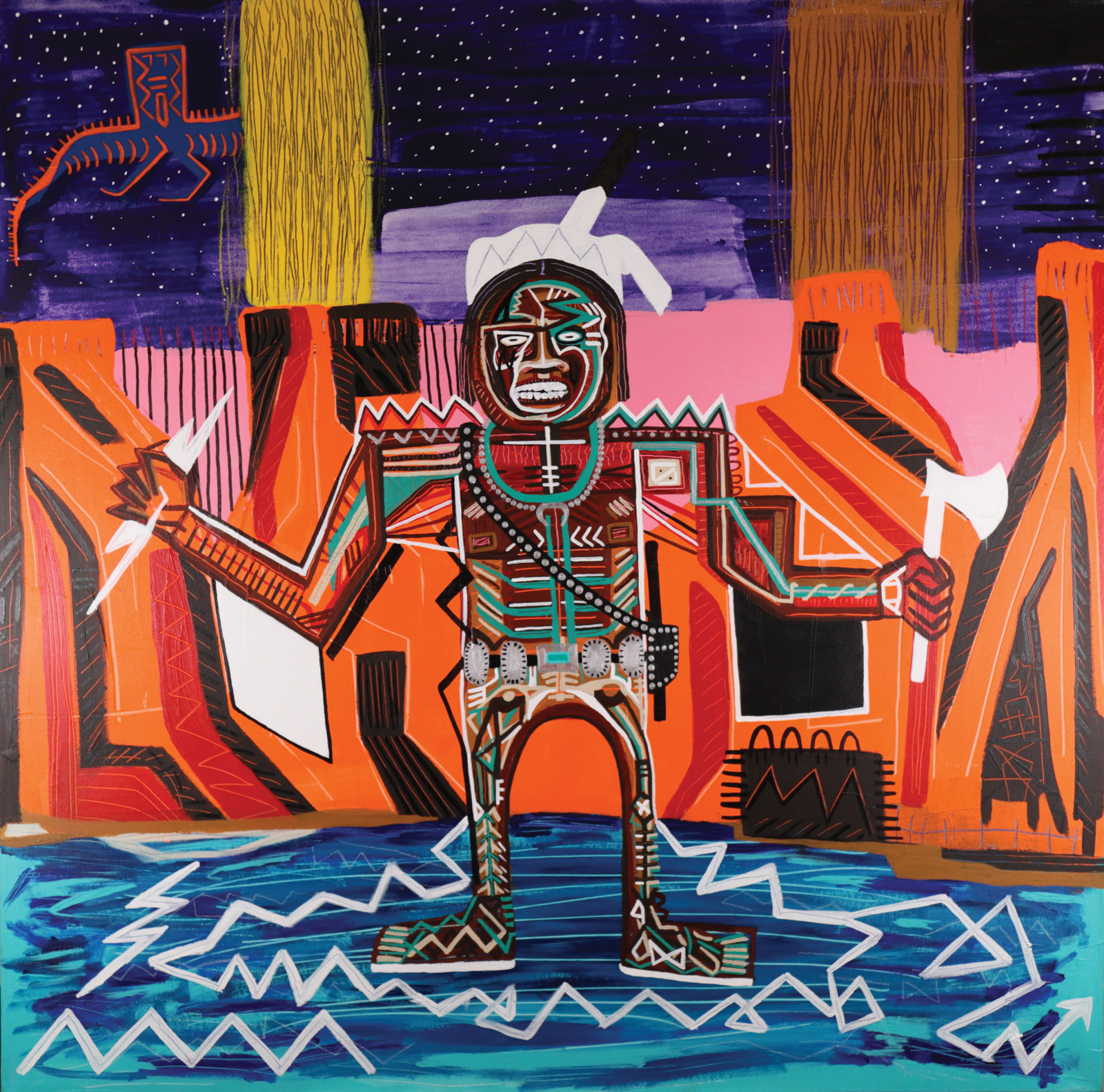 Father Sun Where Are You, acrylic and mixed media on canvas, 48 x 48"
The paintings themselves convey what Tsosie refers to as “absurdity,” possessing a wildness and explosivity that pushes emotions toward the viewer through thick applications of paint and abstracted visages. The work brings to mind the psychological portraiture of Fritz Scholder, or the pastiche of street art and studio work of an artist like Jean-Michel Basquiat—but to the artist himself, it feels generated from within. “I had never left New Mexico, you know, so I hadn’t seen this kind of work here,” he says. “There were a lot of people [in the Southwest] that, you know, would be more interested in realistic art. My mom would always tell me, ‘I want you to draw grandma or draw a horse herding sheep’—you know, that was more acceptable to her.’”
It was not until the artist moved to New York City in 2018, after graduating from UNM, that all the ingredients he had been developing in his practice finally had the right environment to thrive. “I went out to New York, and that is when I just let go of a lot of things,” says Tsosie. “The city [had] no rules, you know what I mean?” Tsosie remarks on the freedom he felt upon arriving the New York—the dynamic, chaotic and frenetic environment “really woke up my mind, it was revolutionary.” The artist established a small studio on the Lower East Side and began experimenting with different mediums and modes of production. It was during this time Tsosie shifted away from oil painting and into acrylic. “In my mind I [thought] this is awesome because I draw fast, and it dries really fast,” he says. “I started to use my palette knife to build some type of texture and use new mediums [and] materials on the canvas, [like] pencils, crayons or even colored pencils and markers.”
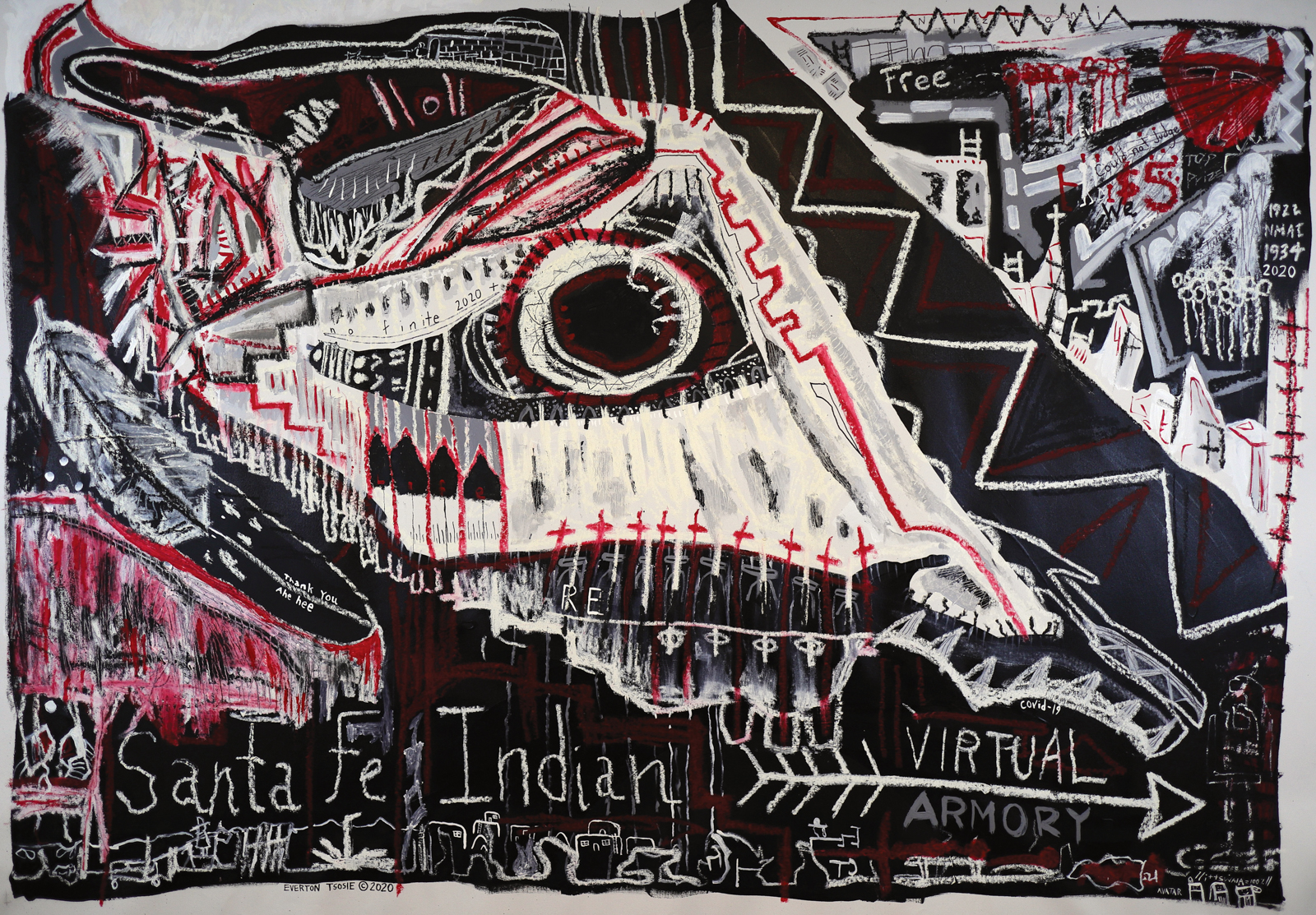 Market, acrylic and mixed media on canvas, 56 x 80”
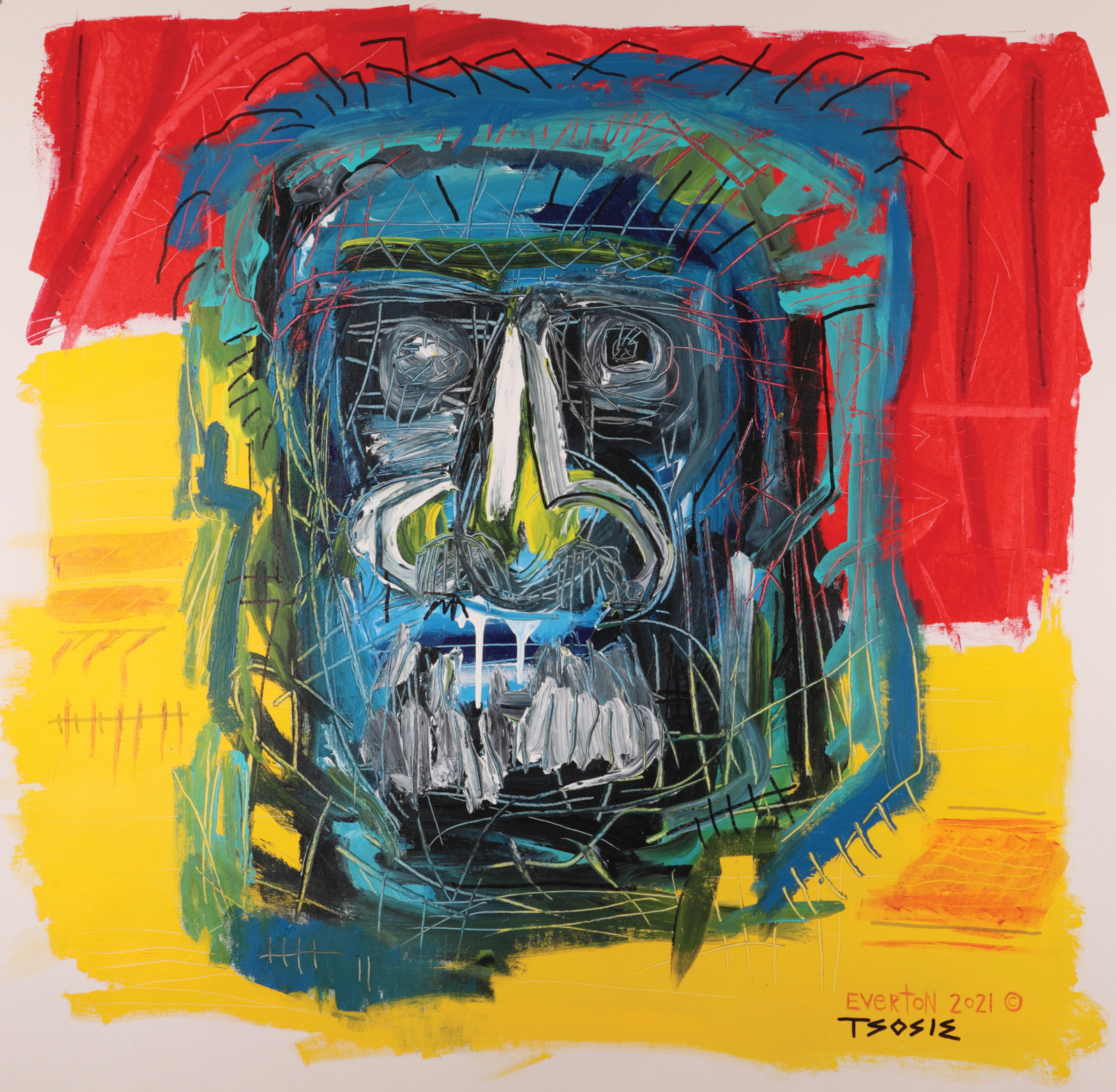 Primary Innocence, acrylic and mixed media on canvas, 40 x 40”
With this newly found freedom to experiment, Tsosie began digging deeper into his work, playing with larger canvases, pushing paint in new ways and getting it out into the community to be seen. “I started to paint those images I had in my sketchbooks, all those intense drawings,” he adds. “That is when I would actually take that chance and put it out on a bigger canvas. I love to draw big, and I want to work on big canvases so I would stretch bigger canvases and draw bigger faces and bigger images. It was freedom.”
Emboldened with freedom and a departure from the structure of the academy, Tsosie started taking his art out into the world. “I [would] take it to Union Square Park, and I got a lot of attention. People would talk to me about my work, and I started feeling that New York energy.”
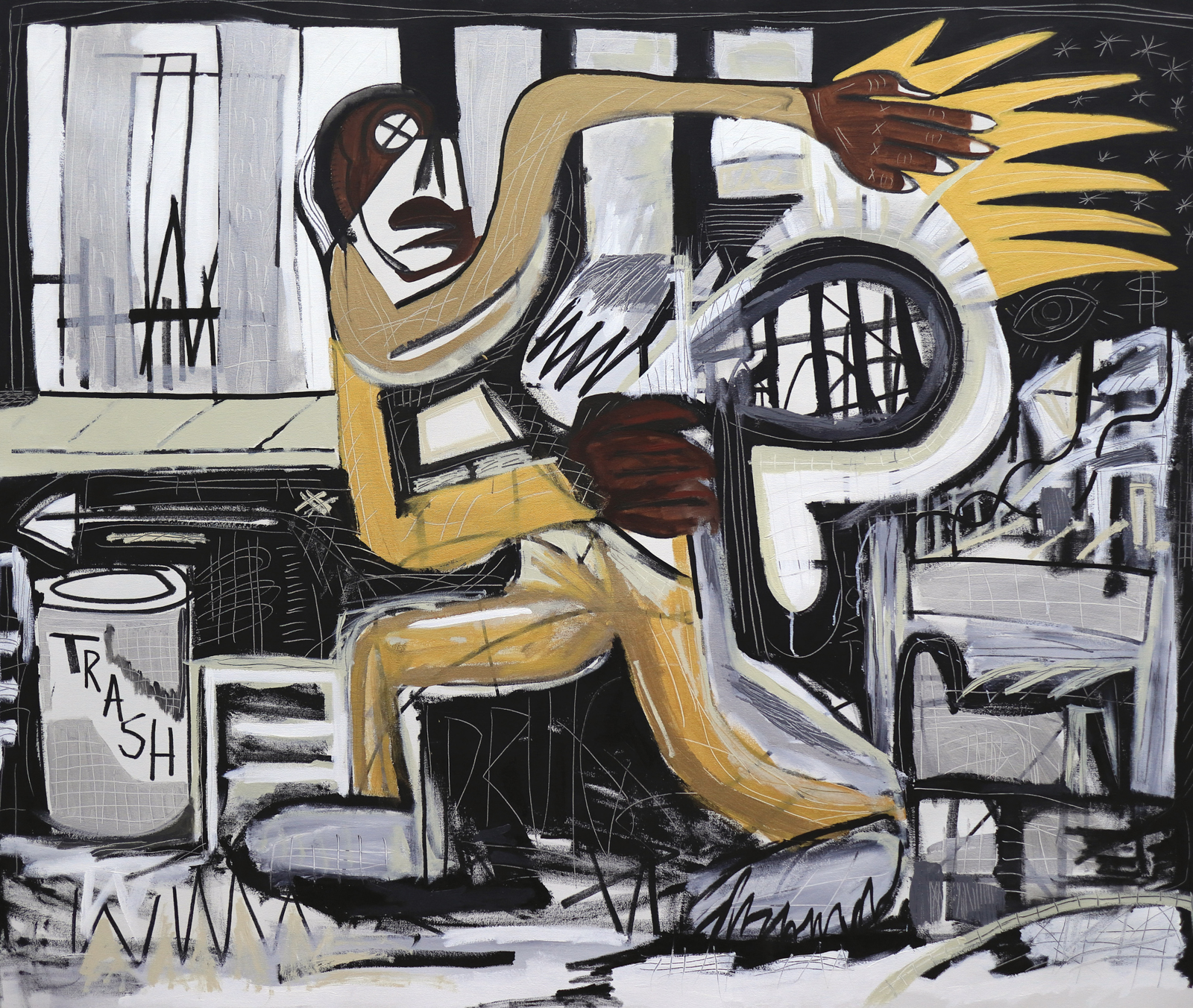 They Don’t Know, acrylic and mixed media on canvas, 55 x 66”
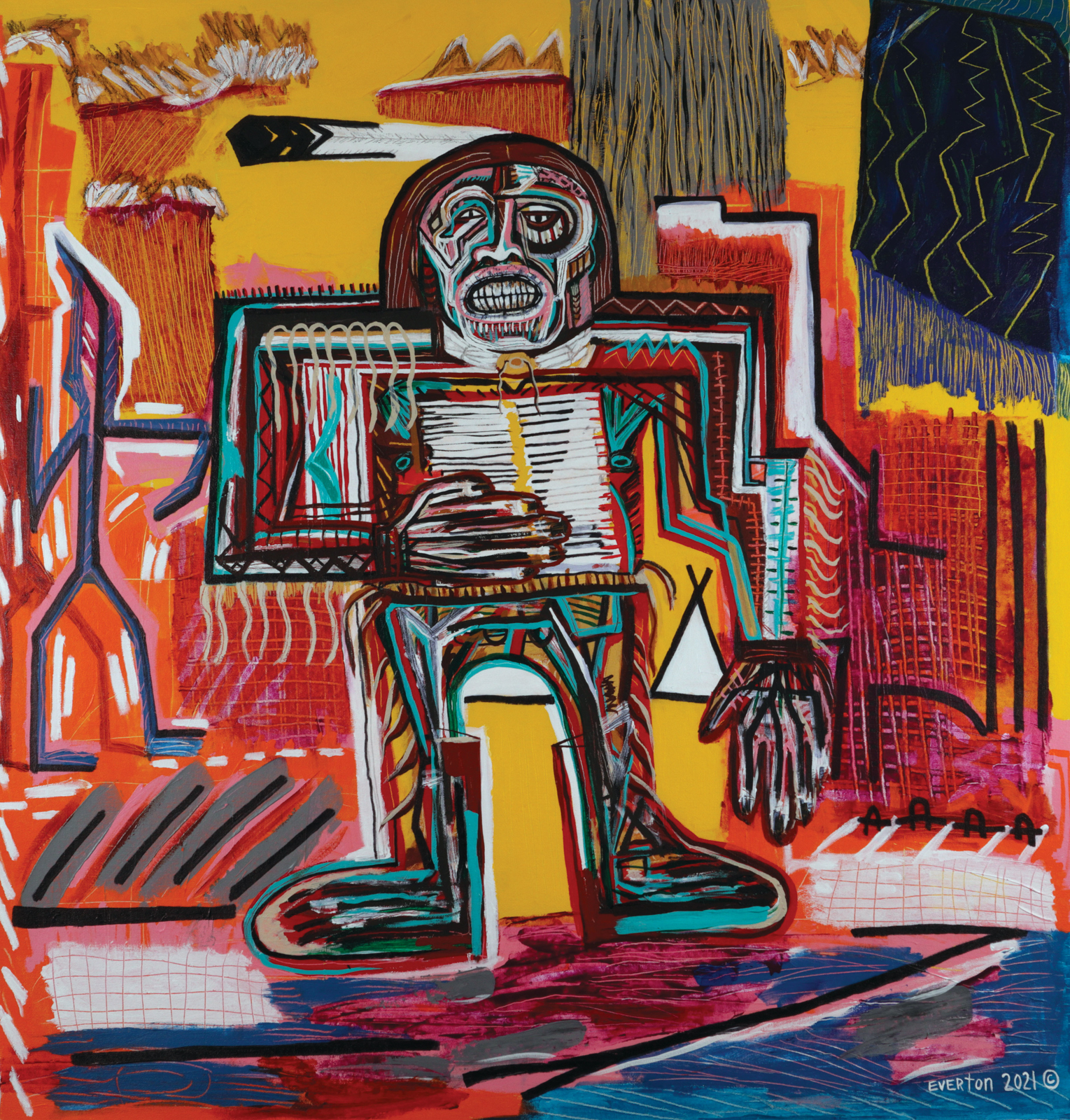 The Breath-Taking Voyage to the Unknown, acrylic and mixed media on canvas, 39½ x 40½”
In New York, the artist was seen and experienced a level of acceptance that he had not felt before, not only an acceptance of the modalities and visualities of his work, but in subject matter—noting that oftentimes within his own community, some of his work can be met with skepticism. “The faces [I paint] kind of look a little scary,” he says. “Because I am Navajo and we have a taboo society, which is very superstitious, and I have an image that emulates a path to death or something, some Navajos, some Native Americans really get held up [by] that.” The artist adds that even at other markets, including his experience at the Heard Museum in Phoenix, he received some critical feedback. “I did get some negative feedback at the Heard; other Natives walked by and talked about the dark side of [my work] and the culture, because of the way my faces look. I felt bad, you know, just awful. I did not know how to deal with negative comments from my own people.”
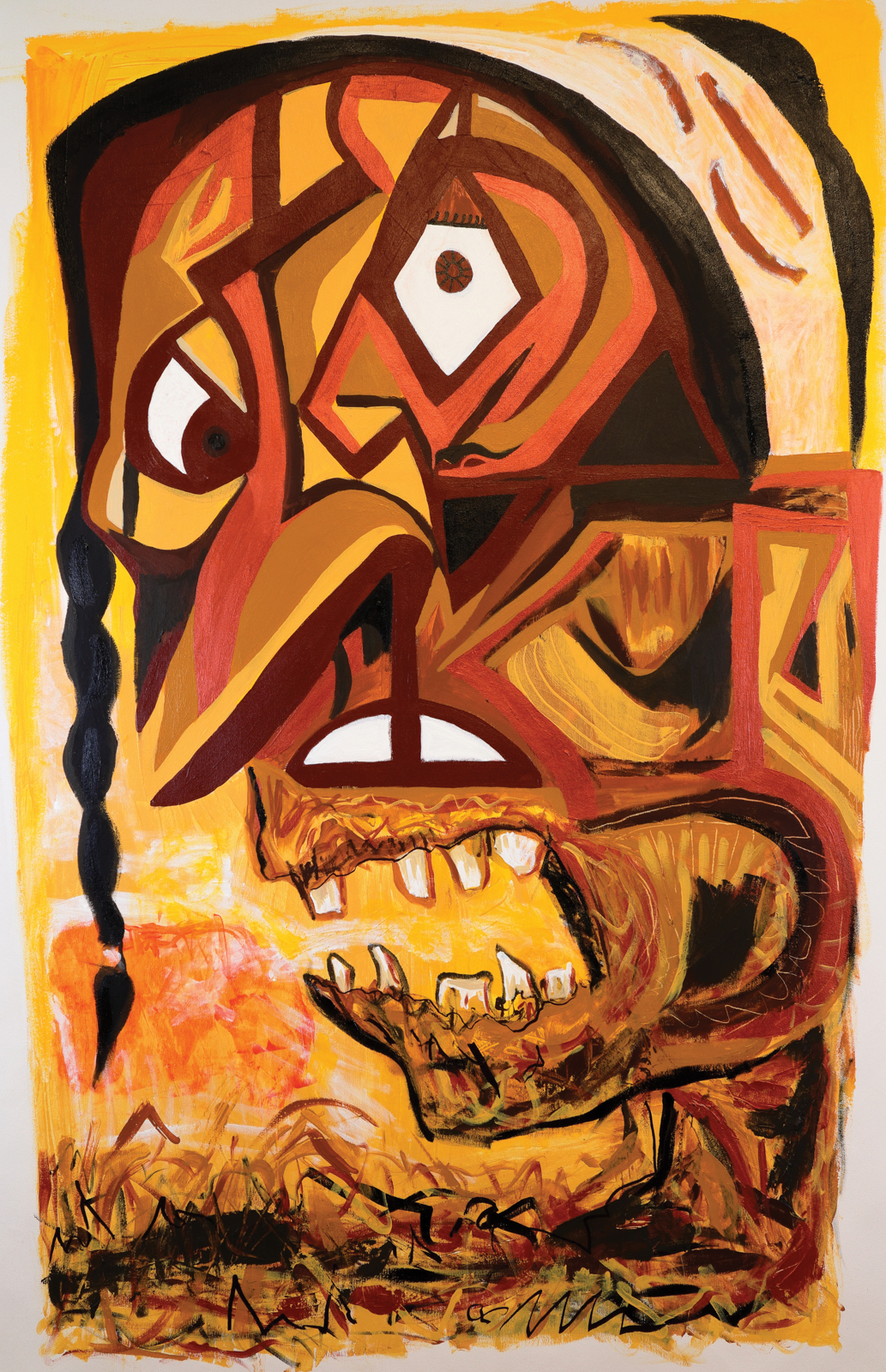 Call Rising, acrylic and mixed media on canvas, 53 x 34 x 1½”
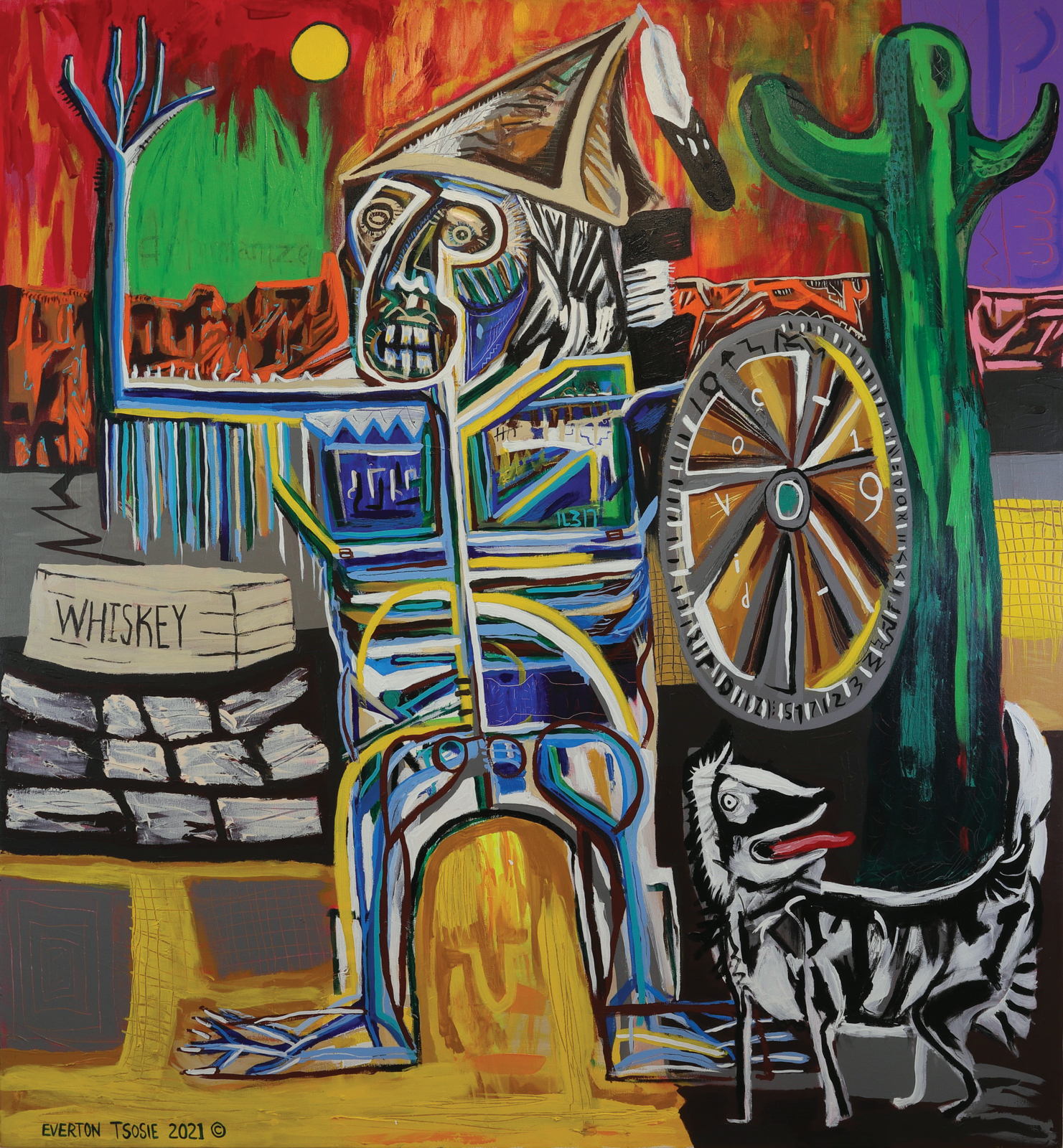 The Miracle in the Sun, acrylic on canvas, 71 x 66 x 1½"
Even though he had unenthusiastic reactions from some marketgoers, Tsosie also had a wealth of young people and collectors flock to his booth praising his techniques and subject matter. “Young people were coming up to me, younger Native Americans, and saying, ‘You know, I really like that you do this because my cousin, my son, my brother, my daughters, my sisters, they like drawing like this too!” Tsosie’s work, though it may not be for all, is an important contribution to the landscape of contemporary Indigenous art in the western hemisphere. It gives space to historic trauma, current events and is in dialogue with histories of painting and production—all of which are things the artist is excited to bring to this year’s market.
Powered by Froala Editor