Landscape paintings are rarely just that—trees and mountains. Consciously or subconsciously, they’re imbued with meaning, subtext.
Such is the case for Kay WalkingStick (Cherokee) as it was for the Hudson River School painters of the 19th century. The two come together this fall at the New-York Historical Society for Kay WalkingStick / Hudson River School, an exhibition placing landscape paintings by WalkingStick in conversation with highlights from NYHS’ esteemed collection of Hudson River School paintings.
Landscapes, yes, but more than that.
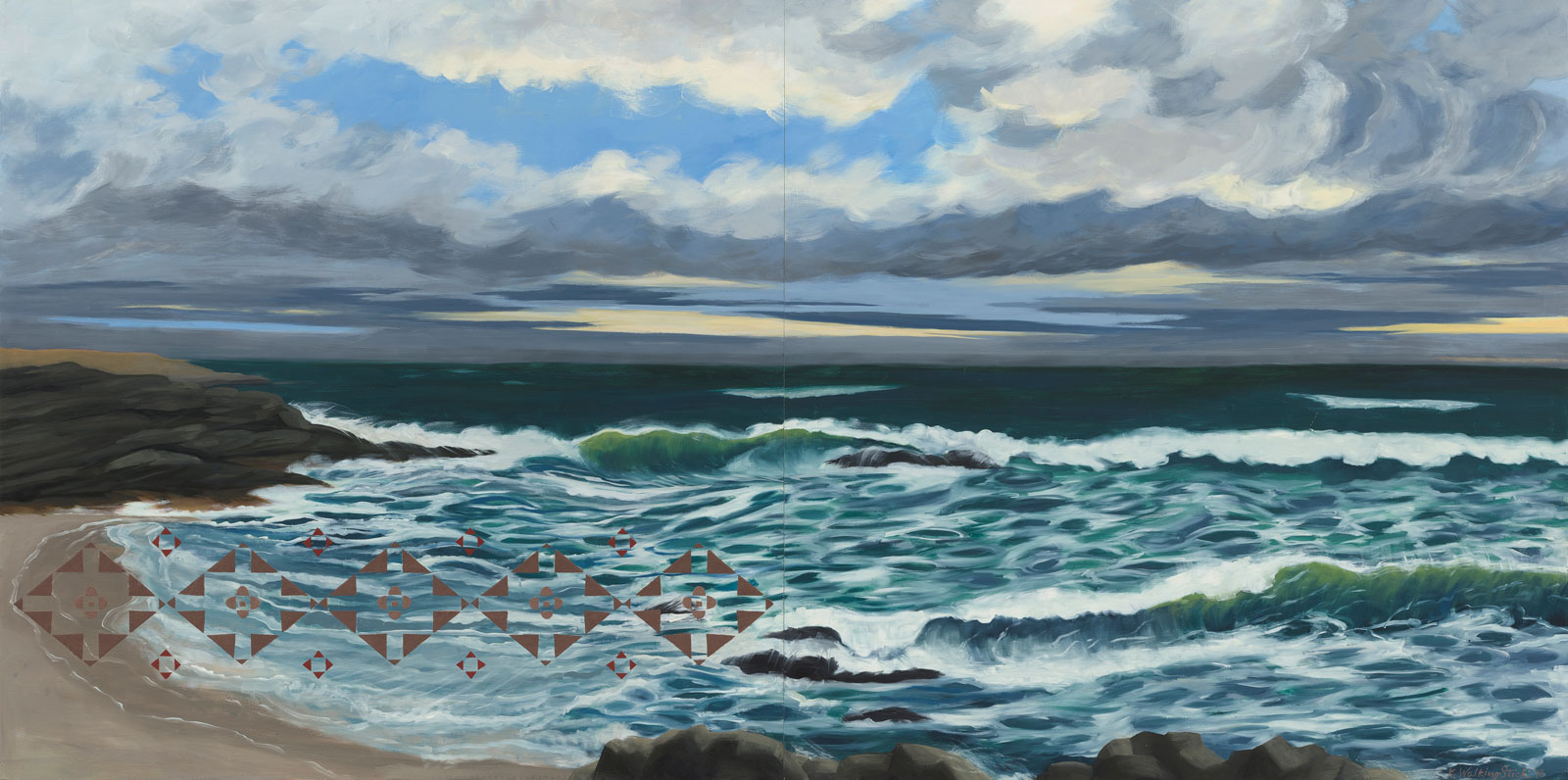 Kay WalkingStick (Cherokee), Wampanoag Coast, Variation II, 2018, oil on panel in two parts. Collection of Agnes Hsu-Tang, Ph.D., and Oscar Tang.
Founded in the mid-19th century along the Hudson River in New York by Thomas Cole, the Hudson River School was a loose community of landscape painters exalting America’s natural beauty. Frederic Edwin Church, Albert Bierstadt and George Inness are also associated with the group. Asher B. Durand is WalkingStick’s favorite Hudson River School painter due to his loose brushwork and vivid, fresh colors by 19th-century standards.
In portraying the American landscape as a paradise, an Eden, the Hudson River School painters were making a then-progressive statement in the face of the nation’s rapid development and industrialization that these wonderfully scenic places should be protected and revered. In a way, they were early environmentalists.
In another way, they were in the long line promoting Manifest Destiny and colonization.
The dramatic waterfalls and sweeping vistas of the Hudson River School painters were mostly unpopulated. The Indigenous people who had called these lands home for millennia were erased by the artists. Hudson River School paintings promoted the fallacy of America beyond its East Coast cities as an unpopulated wilderness, wide open, free for the taking.
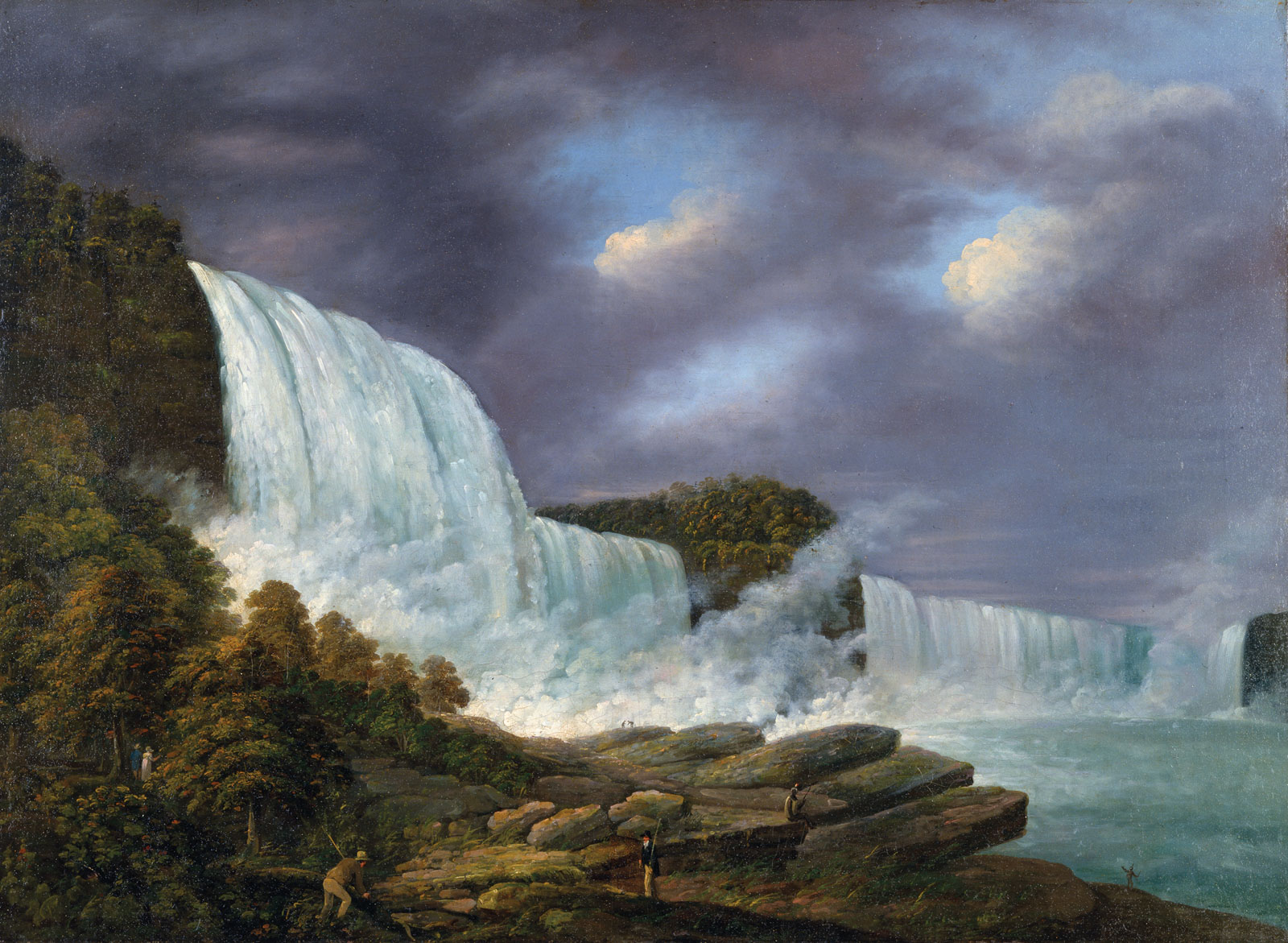 Louisa Davis Minot (1788-1858), Niagara Falls, 1818, oil on linen. New-York Historical Society. Gift of Mrs. Waldron Phoenix Belknap Sr. to the Waldron Phoenix Belknap Jr. Collection, 1956.4.
Determine for yourself why America looked at these paintings and chose to see the settler message while ignoring the conservation message, but understand, there’s more at work here than picturesque topography.
WalkingStick’s contemporary message is simple.
“I hope viewers will leave the museum with a renewed sense of how beautiful and precious our planet is,” she says. “Also, that they leave with the realization that those of us living in the western hemisphere are all living on Indian Territory. These are certainly straightforward, even obvious, thoughts, but I believe they are concepts easily forgotten.”
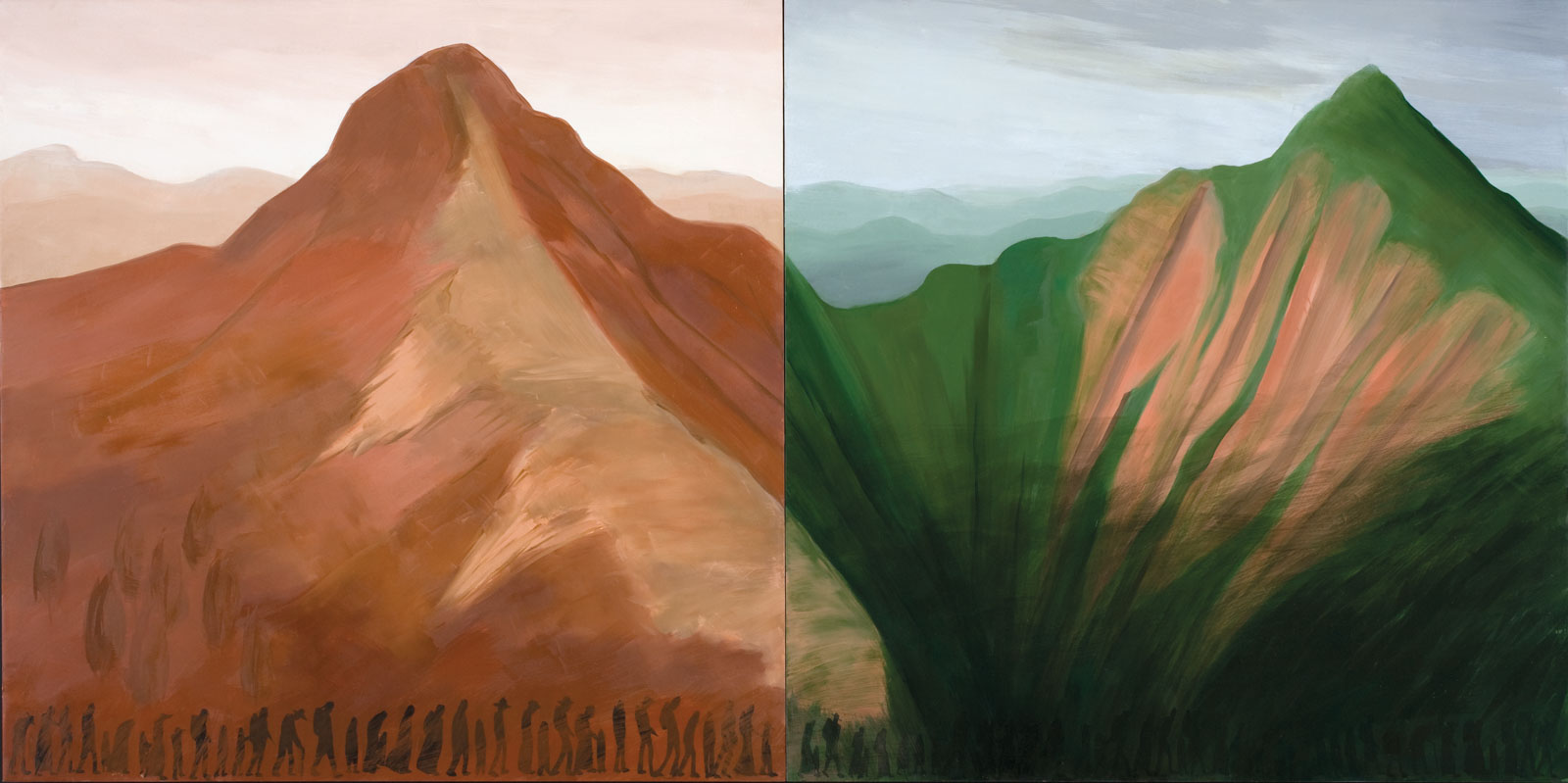 Kay WalkingStick (Cherokee), Farewell to the Smokies (Trail of Tears), 2007, oil on wood panel. Denver Art Museum. William Sr. and Dorothy Harmsen Collection at the Denver Art Museum, by exchange, 2008.14A-B.
In several of her most recent paintings, WalkingStick overlays geographically specific abstract Indigenous patterns onto representational landscapes as a device, re-asserting the Indigenous presence long removed by European settlers’ depictions of North America. WalkingStick puts an Indigenous stamp on the “unpopulated wilderness” reminding viewers these landscapes were populated; not wilderness, rather homelands.
Why does she forgo placing Native figures in her landscapes to reinforce this message?
“Because we’re humans,” she explains. “If we see a human in a painting, they become the focal point of the painting. That’s what you see first. That’s what you focus on. I don’t want that. I want these to be about the landscape, the land itself. To get people to focus on the land itself, you can’t put people in it.”
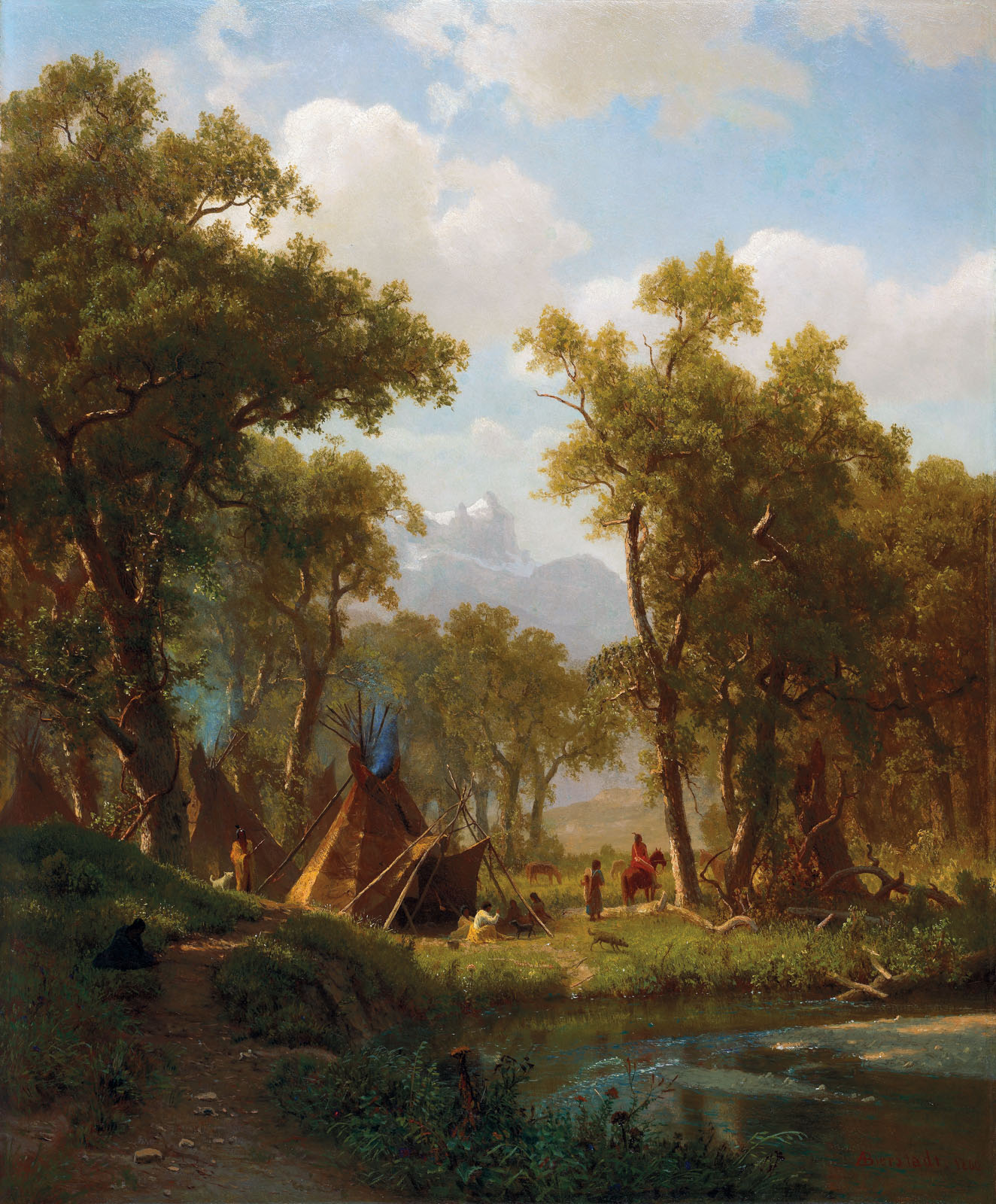 Albert Bierstadt (1830-1902), Indian Encampment, Shoshone Village, 1860, oil on millboard. New-York Historical Society. The Robert L. Stuart Collection, the gift of his widow Mrs. Mary Stuart, S-52.
Highlights of the exhibition’s more than 40 works include two of WalkingStick’s paintings directly inspired by Hudson River School artists. One of these, Niagara (2022), was recently purchased by the New-York Historical Society. The acquisition stirred senior curator of American art Wendy Nālani E. Ikemoto’s (Native Hawaiian) desire to showcase WalkingStick.
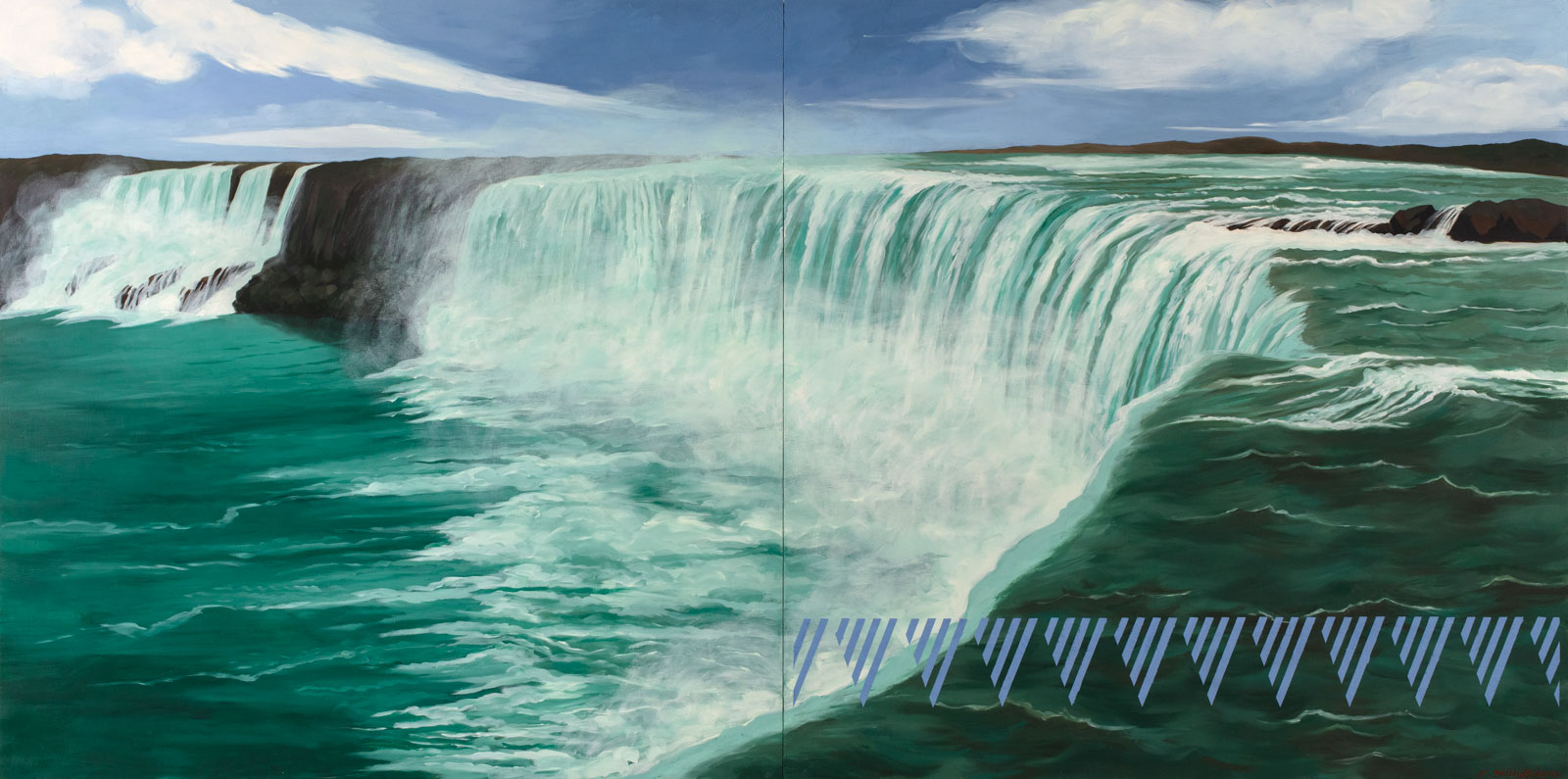 Kay WalkingStick (Cherokee), Niagara, 2022, oil on panel in two parts. New-York Historical Society. Purchased through the generosity of Agnes Hsu-Tang and Oscar Tang; Nancy Newcomb; Anonymous; Barry Barnett; Helen Appel; Belinda and Charles Bralver; Dorothy Tapper Goldman; Margi and Andrew Hofer; Louise Mirrer; Jennifer and John Monsky; Suzanne Peck and Brian Friedman; Pam and Scott Schafler; Barbara and Elliott Wagner; and Linda Ferber, 2023.2ab.
Niagara is grouped with two paintings of the iconic waterfalls by Louisa Davis Minot, which are among the few known works by her hand and rare examples of early 19th-century landscape paintings by a Euro-American woman. These works position WalkingStick within a lineage of women landscape painters in the Hudson River region (WalkingStick is from Syracuse, New York), while also considering the critical differences between the two artists: Minot’s work includes generic Indigenous figures to distinguish the site as North American; WalkingStick uses a culturally specific Haudenosaunee pattern to mark the land as Indigenous.
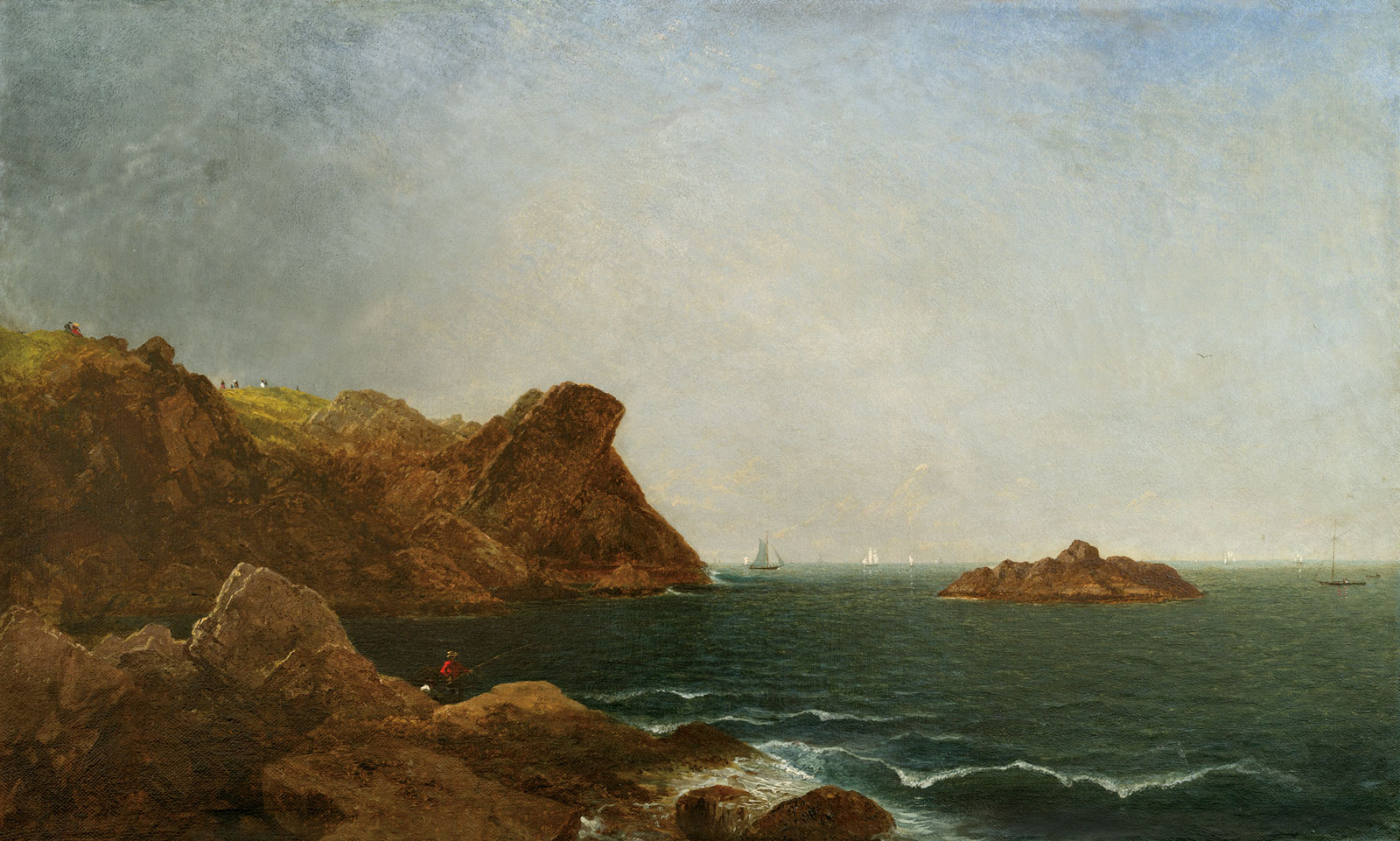 John Frederick Kensett (1816-1872), Pulpit Rock, Nahant (Nahant Rock and Seashore), 1859, oil on canvas. New-York Historical Society. The Robert L. Stuart Collection, the gift of his widow Mrs. Mary Stuart, S-84.
“I’m so pleased that we’re integrating the two bodies of work together,” Ikemoto says. “Instead of separating Kay’s work into one room and Hudson River School work into the other, it’s about this conversation. It’s about seeing the Hudson River School through Kay’s paintings, through her eyes, and looking at what’s missing, or who is missing, looking at what is untold. This juxtaposition is able to shift the way American art and American history are typically told.”
Kay WalkingStick / Hudson River School is on view from October 20, 2023, through April 14, 2024.
October 20, 2023- April 14, 2024
Kay WalkingStick / Hudson River School
New-York Historical Society, 170 Central Park West, New York, NY 10024 (212) 873-3400, www.nyhistory.org
Powered by Froala Editor