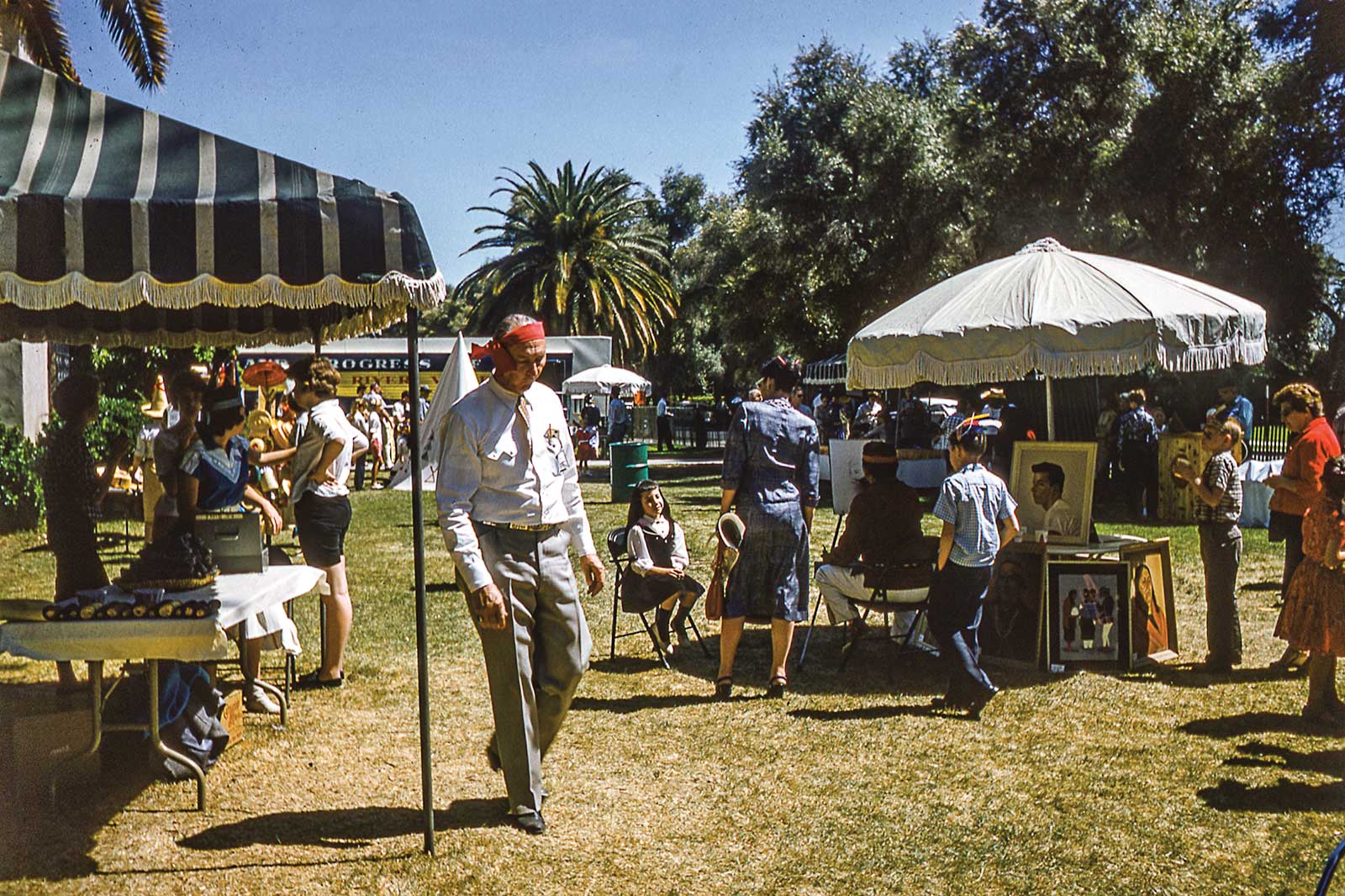
 An archive photo from a past market at the Heard Museum.
This year’s judges for the Heard Museum Guild Indian Fair & Market are experts and leaders in a number of fields. They come together to honor and award the artists for this year’s 64th annual market, which opens with the Best of Show Awards on March 4 at the Phoenix museum. The artists who will receive ribbons will represent a stunning array of people, places, cultures and styles. They will be some of the most revered art veterans and some of the hottest up-and-comers, and lots of tremendous artists in between.
Classification I Jewelry and Lapidary Work
Dexter Cirillo A noted authority on Native American jewelry, she is author of Southwestern Indian Jewelry and Southwestern Indian Jewelry – Crafting New Traditions, as well as multiple articles on jewelry in American Indian Art and Native peoples. She has lectured widely on jewelry at museums across the country and judged at both the Heard Museum Guild Indian Fair & Market and the Santa Fe Indian Market. She holds a Ph.D. from the City University of New York.
Larry Golsh (Pala Mission/Cherokee) Larry Golsh has achieved international fame as a jeweler and sculptor. After growing up on the Pala Mission reservation near San Diego, California, he studied architecture and art at Arizona State University. In 1969, he began to work with Paolo Soleri’s Arcosanti project, touring major art museums in the United States and Canada. Shortly after that, he met Hopi jeweler Charles Loloma, whom he credits as his inspiration for beginning his world-renowned jewelry designs. He has been the recipient of numerous awards and the subject of many articles. One in Forbes magazine titled, “American Fabergé,” highlighted both his and Loloma’s work. Additionally, he has received two NEA grants and was featured in the PBS documentary film, Larry Golsh-American Indian Artist.
Norman Sandfield Norman L. Sandfield is an internationally known collector and antique dealer in Chicago. His American Indian collections have been featured in three books and exhibitions in collaboration with the Heard Museum. The first, Old Traditions in New Pots: Silver Seed Pots from the Norman L. Sandfield Collection, written by Tricia Loscher (2007), featured the work of over 70 artists. This led to an exhibition and an award-winning book with curator Diana F. Pardue, Native American Bolo Ties; Vintage and Contemporary Artistry (2011), updating the history and art of the bolo tie. The third was, AwaTsireh: Pueblo Painter and Metalsmith (2017), also written with Diana F. Pardue. That exhibition brought together more of Awa Tsireh’s metalwork than had ever been shown in one setting.
Classification II Pottery
Max Early (Laguna Pueblo) Max Early is an established potter from Laguna Pueblo. His clans are (Tsina Haanu) Turkey People and (Kwiya Washchi) a child of the Bear. He is well known for his revival of classic Laguna shapes and designs as well as more innovative figurines and motifs. Max is also a published poet and incorporates some of his poems onto his pottery. He recently received an MFA in creative writing (poetry) from the Institute of American Indian Arts. Max has been an award-winning potter since 1994 at Santa Fe Indian Market and he continues to push the boundaries of both traditional and non-traditional pottery at Laguna Pueblo.
Peter Held Retired Curator of Ceramics, Arizona State University Art Museum, Ceramics Research Center. In the course of Peter Held’s impressive three-decade career as a museum director and contemporary art curator, he has organized more than 200 exhibitions and is the editor and essayist for 10 books. He has received three of the highest accolades possible within the field from the Friends of Contemporary Ceramics, the Smithsonian’s James Renwick Alliance and the National Council for Education on the Ceramic Arts. He is the principal owner of an art appraisal and consulting business based in Phoenix.
Andrew Hamilton Associate Curator for Art of the Americas, Art Institute of Chicago Lecturer, Art History, University of Chicago. Andrew Hamilton holds a Ph.D. from Harvard University and is a scholar of the art and architecture of the ancient and colonial Americas, specializing in the Andes. He is a practicing artist and frequently illustrates his own publications. Hamilton’s first book, Scale & the Incas, presents a groundbreaking theoretical framework for analyzing scale, and then applies this approach to Inca art, architecture and belief systems. He is presently writing his second book, The Emperor’s New Clothes: The Biography of a Royal Inca Tunic, which examines the most famous object of ancient Andean art, an intricately patterned tunic conserved at Dumbarton Oaks in Washington, D.C.
Classifications III and XI Two-Dimensional Art and Open Standards
Cynthia Chavez Lamar (San Felipe Pueblo/Hopi/Tewa/Navajo) Acting Director for Collections and Operations at the National Museum of the American Indian, Smithsonian Institution. Cynthia Chavez Lamar grew up at San Felipe Pueblo, New Mexico, and holds a Ph.D. in American studies from the University of New Mexico, Albuquerque, and an Honorary Doctorate, Doctor of Humane Letters, Honoris Causa from the Colorado College. She was a U.S. presidential nominee and appointee to the Board of Trustees for the Institute of American Indian Arts and was a Governor’s appointee as commissioner to the New Mexico Arts Commission. She has also served as director for the Indian Arts Research Center at the School for Advanced Research (2007-2014), and museum director of the Indian Pueblo Cultural Center (2006-2007).
America Meredith (Cherokee Nation) America Meredith is the publishing editor of First American Art Magazine and is an art critic, writer, visual artist and independent curator whose curatorial practice spans 28 years. She earned her MFA degree from San Francisco Art Institute and taught Native art history at the Institute of American Indian Arts, Santa Fe Community College, and the Cherokee Humanities Course. Northeastern State University named Meredith its 2018 Sequoyah Fellow. Based in Norman, Oklahoma, Meredith serves on the Cherokee Arts and Humanities Council board and the collections and acquisitions committee of the First Americans Museum Foundation.
Olga Viso Olga Viso is a curator, writer and contemporary art historian based at Arizona State University’s Herberger Institute for Design and the Arts in Tempe, Arizona, where she serves as Senior Advisor for Global Partnerships in the Arts. She was executive director of the Walker Art Center in Minneapolis from 2008 to 2017 and director/curator at the Hirshhorn Museum and Sculpture Garden in Washington, D.C., from 1995 to 2007. She is a scholar of contemporary and Latin American art, with a focus on the contemporary art of Cuba. She has organized major survey exhibitions on artists Ana Mendieta, Jim Hodges and Juan Francisco Elso. Her writing has appeared in the New York Times, ArtNews, Museum and Arts Asia Pacific.
Classifications IV and V Pueblo Carvings and Sculpture
Tony Astorga Heard Museum Trustee and collector of American Indian Art. Because of his self-described “passion for the arts,” Tony Astorga has a long history of supporting Phoenix cultural institutions. Prior to joining the Heard board, he served as a trustee at the Desert Botanical Garden and at the Phoenix Art Museum, where his wife is an emeritus Master Docent. He gained his extensive knowledge of American Indian Art from his life-long friend and mentor, Gilbert Ortega, who was instrumental in helping identify and acquire his art collection. In addition to his board involvement with the Heard, he also serves on various business and community boards and currently serves in a community leadership capacity as the Chairman of the Arizona Hispanic Chamber of Commerce Foundation.
John Blessington John has been collecting katsina dolls since 1973, shortly after moving from New Hampshire to Arizona at the age of 11. Upon arrival in Phoenix, he quickly discovered the Heard Museum and has been a frequent visitor ever since. He is a dedicated member of the Heard Museum & Guild, shop volunteer, and two-time president of the Heard Council. John’s appreciation and knowledge of katsinas has been deepened by long discussions with local expert James Barajas of the Heard Shop, the writings of Barton and Margaret Wright, and best of all, by meeting many katsina carvers over the years.
Joe Cajero Jr. (Pueblo of Jemez) Joe Cajero Jr. is a sculptor, painter and designer of jewelry. He is a descendant of a long line of Pueblo artists, including his father, a painter, and his mother, Esther, a potter. He holds an Associates of Fine Arts degree from the Institute of American Indian Arts and has won numerous awards for both his clay and bronze sculptures from the Santa Fe Indian Market and the Heard Museum Guild Indian Fair & Market. He is internationally known for his smiling koshare figures and has created several monumental commission pieces, including the Grandfather Storyteller for the Mesa Verde National Park Visitors Center, the Oneness sculpture for the Hotel Chaco in Albuquerque, New Mexico and two works for the Presbyterian Healthcare Foundation in Santa Fe, New Mexico.
Classifications VI and VIII Weavings, Textiles and Baskets
Julie Dalrymple Julie and Mark Dalrymple, longtime Heard Museum members and supporters, generously donated their collection of Navajo textiles to the Museum in 2019. This collection was featured in the exhibition, All at Once: The Gift of Navajo Weaving, which showcased 46 exquisite textiles from contemporary Navajo weavers. These textiles, plus dozens more, now reside in the Heard Museum’s permanent collection. Julie and Mark Dalrymple began traveling regularly to the Southwest in 1989. Steadily buying pieces on each of these trips, they eventually amassed a collection of more than 500 pieces. Fortunately, for future research purposes, they kept meticulous records about the purchases, documenting when and where they bought them, along with information about the artists. In addition to her knowledge of weavings, Julie has been a volunteer docent at the San Jose Museum of Quilts and Textiles near her home.
Florence Manygoats (Navajo) Florence Manygoats has won numerous awards for her outstanding weaving from both the Santa Fe Indian Market and the Heard Museum Guild Indian Fair & Market. Additionally, her work was featured in the Heard Museum’s exhibition, Color Riot. Having learned weaving from her mother and grandmother, she has been making and selling her work since childhood. As her style developed, she started using lots of bright, bold colors while mixing and matching aniline and vegetable dyed wool. She only uses two techniques in weaving; the raised outline and the single solid weave styles, and seldom works in traditional patterns. She finds that the more difficult the design, the more enjoyable it is for her.
Elaine Peters (Tohono O’odham & Akimel O’odham) Elaine F. Peters is an enrolled member of the Ak-Chin Indian Community and serves as the director of the Ak-Chin Him-Dak Department, which comprises of the Ak-Chin Him-Dak Eco Museum, Records & Archives Center, Community Art Program, Historic Properties and the Cultural Resources Program for the Community and has worked in the museum program for more than 33 years.
Classification VII Diverse Arts
Heather Ahtone (Choctaw/Chickasaw) Senior Curator, First Americans Museum, Oklahoma City, Oklahoma. Heather Ahtone holds degrees from the Institute of American Indian Arts (IAIA) and the University of Oklahoma (OU), including an interdisciplinary doctoral degree (art history/anthropology/Native American studies). Prior to becoming Senior Curator at First Americans Museum, she was an independent curator and writer while working at the University of Oklahoma, IAIA and the Southwestern Association for Indian Arts (SWAIA). She has curated many exhibitions, speaks internationally and publishes regularly. Recently, she led an all-Native curatorial team to build the inaugural exhibitions for First Americans Museum, representing the 39 tribal nations in Oklahoma. She is currently president of the Native American Art Studies Association and actively supports Native arts on several boards and committees.
Twig Johnson Retired Senior Curator, Native American Art, Montclair Art Museum, New Jersey. Twig Johnson served as senior curator at the Montclair Art Museum for more than 20 years. In addition to her curatorial duties, she also taught Native American art history and museum curation methods at Montclair State University, and served on the New Jersey Council on the Humanities Horizon Speakers Bureau. Currently she serves on the Board of Directors at Pueblo Grande Museum, where she also trains docents and other museum volunteers.
Patricia Marroquin Norby (Purépecha) Associate Curator for Native American Art, the Metropolitan Museum of Art, New York. Dr. Norby is the first full-time curator of Native American art at the Met in the museum’s 150-year history. Previously, she served as senior executive and assistant director of the Smithsonian’s National Museum of the American Indian-New York, and as Director of the D’Arcy McNickle Center for American Indian and Indigenous Studies at the Newberry, in Chicago. Her curatorial vision and exhibition strategies at the Met have been celebrated by the New York Times, PBS and Forbes magazine’s “50 Over 50 2021: Vision.” Her forthcoming book, Water, Bones, and Bombs, examines 20th-century American Indian and American art in context with environmental conflicts in Northern New Mexico (University of Nebraska Press). She earned her Ph.D. at the University of Minnesota-Twin Cities and her MFA at the University of Wisconsin-Madison.
Classification IX Personal Attire
Amber-Dawn Bear Robe (Siksika Nation, Canada) Assistant Faculty of Art History in the Museum Studies department at the Institute of American Indian Arts (IAIA), Santa Fe, NM. Amber-Dawn Bear Robe achieved an MA in American Indian studies and a second MA in art history, both from the University of Arizona. Current projects include producing the annual Indigenous fashion show for the Southwestern Association for Indian Arts (SWAIA) and curating a fashion exhibition for the Museum of Contemporary Native Arts opening August 2022. Bear Robe has received two regional Emmys as the executive producer for two short documentaries on Indigenous fashion. She is an acting trustee for the Western States Arts Federation (WESTAF) board, Colorado, and the Wheelwright Museum board, New Mexico, and sits on the curatorial committee for Vital Spaces, New Mexico.
Susan Kennedy-Zeller Retired Curator of Native American art, Brooklyn Museum (1998-2016). Susan Kennedy-Zeller holds a Ph.D. from Columbia University in art history. The recipient of numerous internships and fellowships, Dr. Zeller taught at Columbia University, Long Island University and the New School for Social Research. She was the co-curator of Tipi of the Great Plains (2011). Prior to joining the Brooklyn Museum, she spent 16 years in retail management in the New York City fashion industry. She continues to consult with museums and collectors about Native American and Australian Aboriginal art.
Jessica Metcalfe (Turtle Mountain Chippewa) Jessica R. Metcalfe is the owner of Beyond Buckskin, a website and business dedicated to promoting Native American-made fashion. A graduate of Dartmouth College, she holds a Ph.D. from the University of Arizona in American Indian studies. She has co-curated exhibitions and taught college courses in Native American studies, studio art, art history and literature. Her current work focuses on American Indian art, clothing and design from all time periods, with an emphasis on contemporary artists. —
Powered by Froala Editor