In 1958, a painting by Oscar Howe (Yanktonai Dakota, 1915-1983), who had studied with Dorothy Dunn at the Santa Fe Indian School, was rejected by the Philbrook Art Center (PAC) for its exhibition of Native American art done in the “traditional style.”
Howe wrote to the PAC, “Who ever said, that my paintings are not in the traditional Indian style, has poor knowledge of Indian Art indeed. There is much more to Indian Art, than pretty, stylized pictures. There was also power and strength and individualism (emotional and intellectual insight) in the old Indian paintings. Every bit in my paintings is a true and studied fact of Indian paintings. Are we to be held back forever with one phase of Indian painting, that is the most common way?”
Well-known and revered in his native South Dakota, Howe was relatively unknown beyond its borders.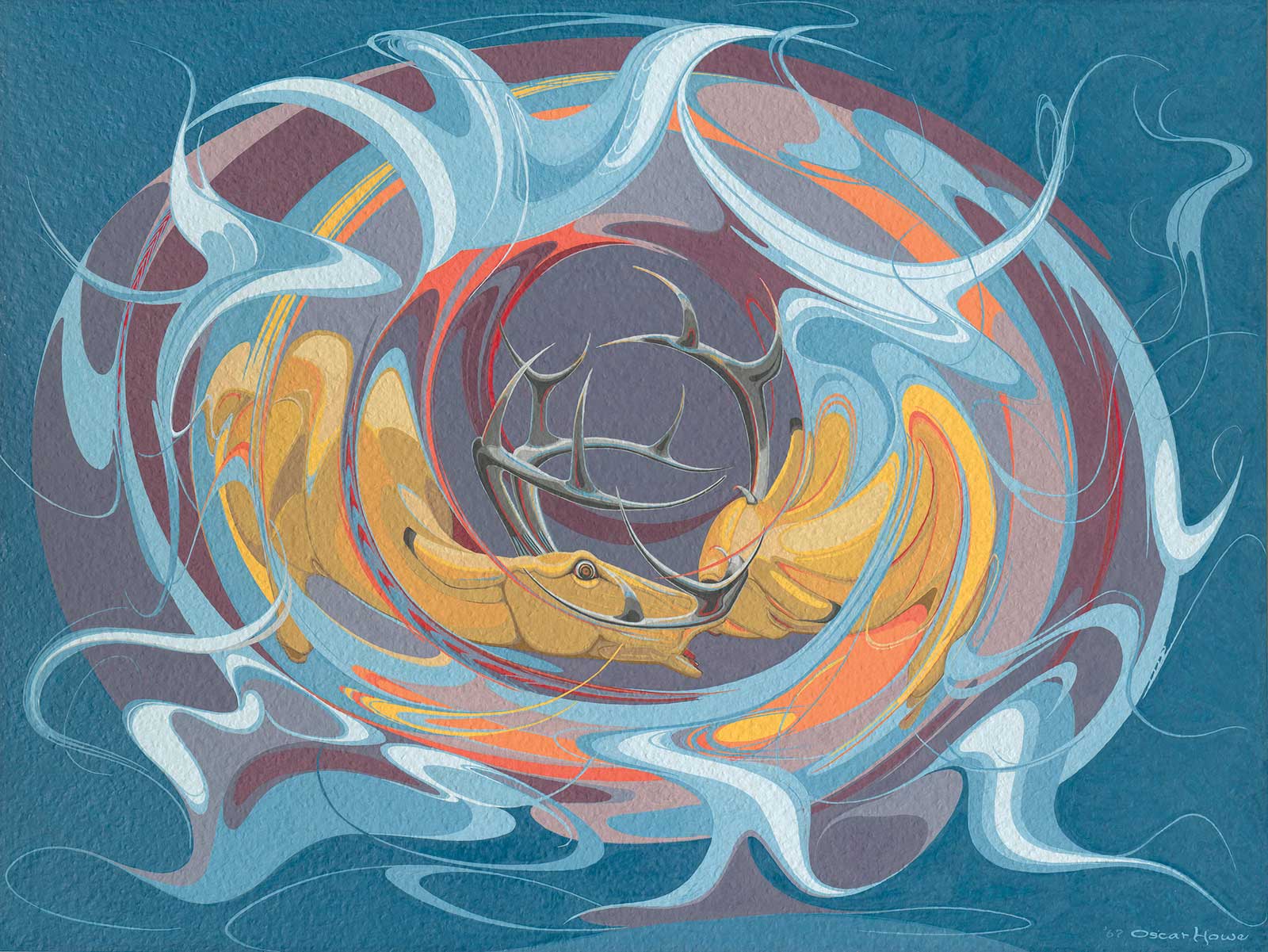 Oscar Howe (Yanktonai Dakota, 1915-1983), Fighting Bucks, 1967, casein on paper, 20¼ x 2615⁄16”. NMAI 27/0217.
The Smithsonian National Museum of the American Indian in New York brings him into the national spotlight with its major retrospective exhibition, Dakota Modern: The Art of Oscar Howe, opening March 11 and running through September 11. Following its showing in New York it travels to the Portland Art Museum (PAM) in Portland, Oregon, November 5 through May 14, 2023, and the South Dakota Art Museum at South Dakota State University in Brookings, from June 10, 2023, through September 17, 2023.
The NMAI states, “One of the 20th century’s most innovative Native American painters, Howe challenged stereotypes and created pathways for Native painters.”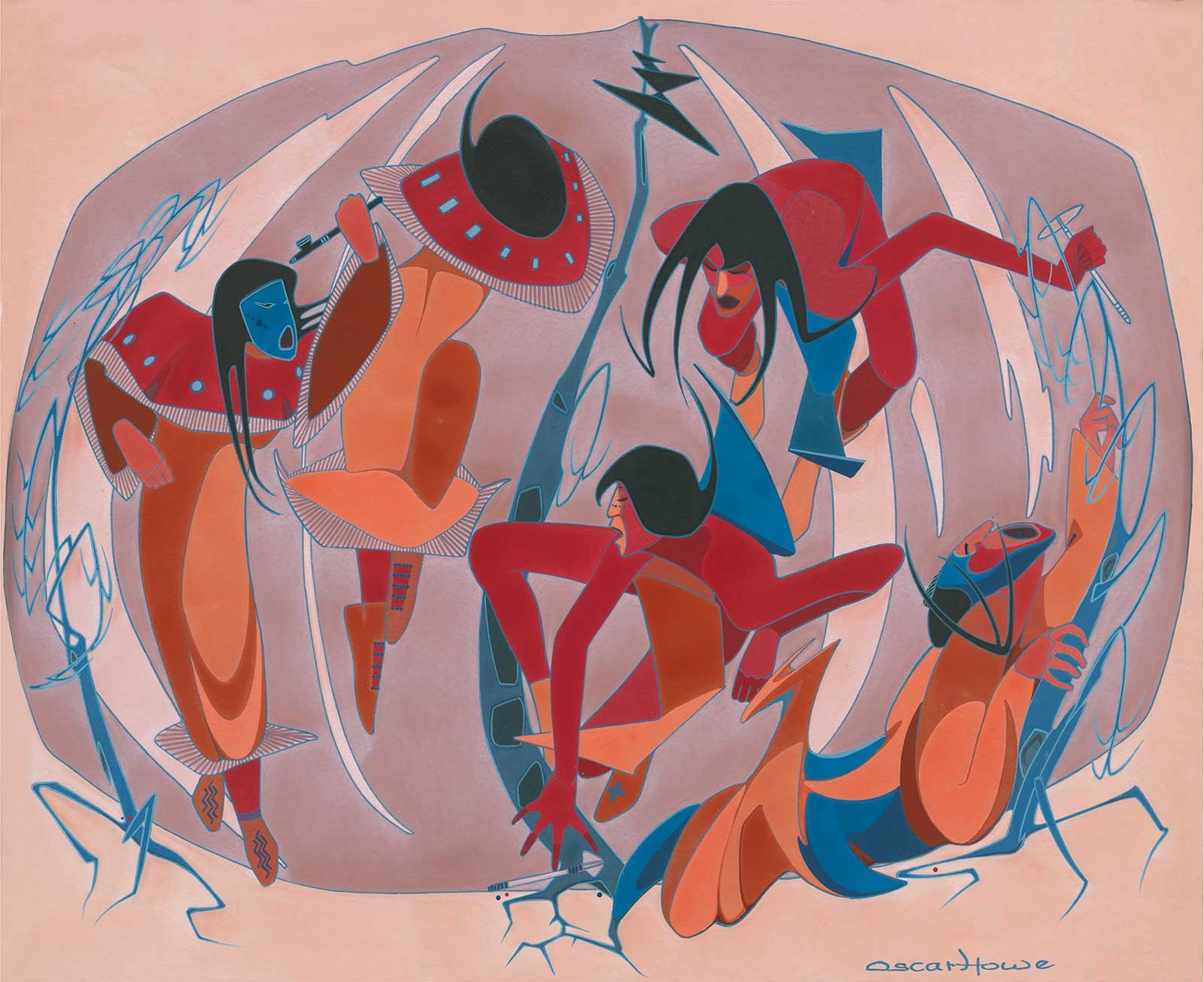 Oscar Howe (Yanktonai Dakota, 1915-1983), Umine Dance, 1958, casein and gouache on paper, mounted to board, 18 x 22”. Garth Greenan Gallery, New York.
The exhibition was curated by Kathleen Ash-Milby (Navajo), PAM’s curator of Native American art. She was formerly the associate curator at NMAI in New York.
“Tradition,” Ash-Milby says, “is not static. Everything is built on the ancestors but is constantly adapting. Howe was drawing from the traditions to do something new but embedded within the foundation of traditional knowledge and philosophy. During his lifetime, people were still having difficulty seeing Native people as part of modern life. From the art historical perspective of the ’80s, Native art was seen as traditional or not traditional. He didn’t fit into those boxes and was dismissed as a derivative of cubism. 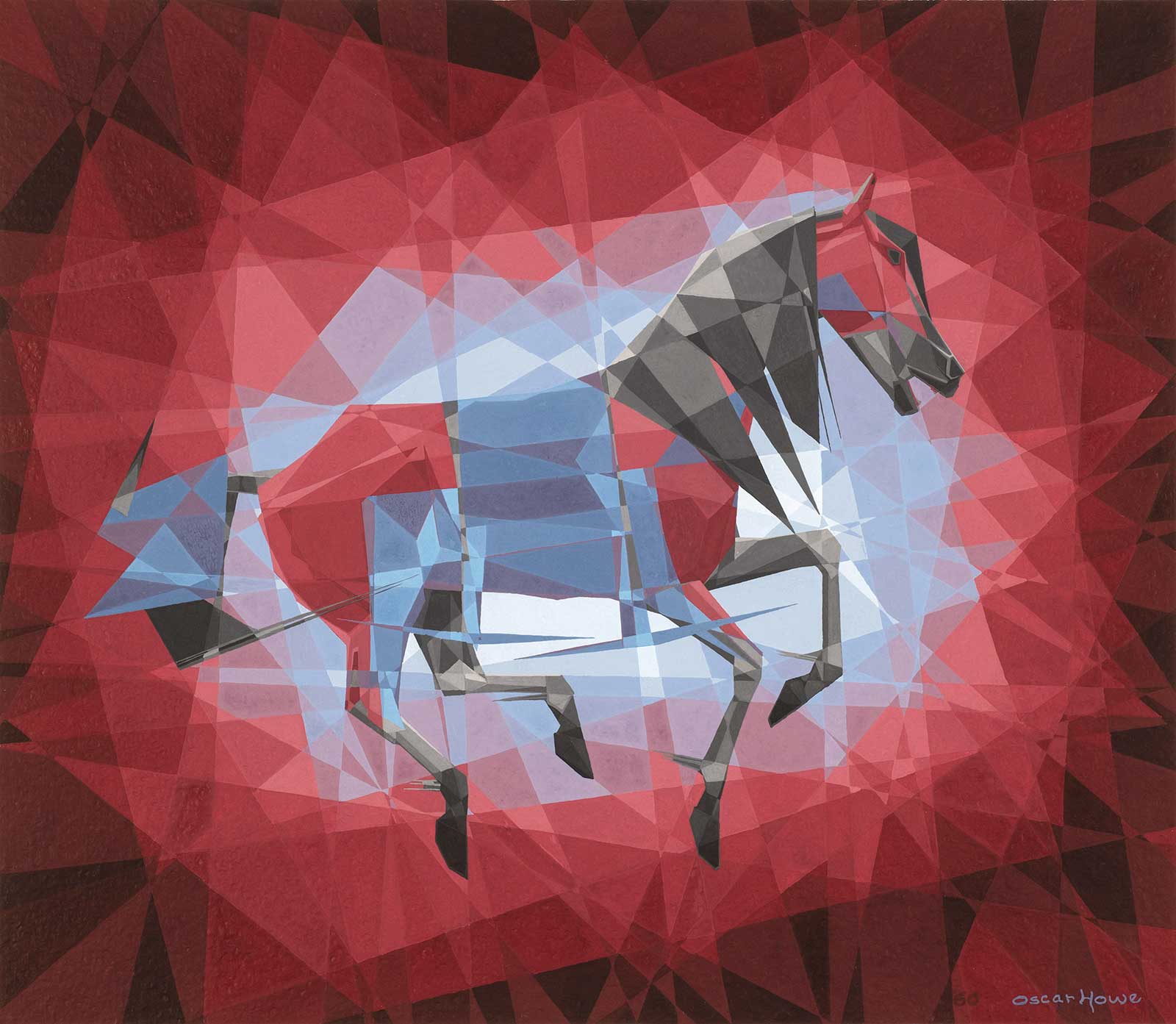 Oscar Howe (Yanktonai Dakota, 1915-1983), Cunka Wakan (Dakota Horse), 1966, casein on paper, 19¾ x 225⁄8”. University Art Galleries, University of South Dakota, Vermillion, PC OH 8 (O.H. 76.004).
“Our team on the project has looked at him with a more critical and wider lens. We are finally at a point in the 21st century where we can recognize the impact and complexity of Oscar Howe’s incredible work as both Native American and modern American art,” she continues. “This project is a long overdue recognition of his contribution to the field that we hope will establish Howe’s place as a 20th-century modernist.” —
March 11-September 11, 2022
Dakota Modern: The Art of Oscar Howe
National Museum of the American Indian
1 Bowling Green, New York, NY 10004
(212) 514-3700, americanindian.si.edu
Powered by Froala Editor