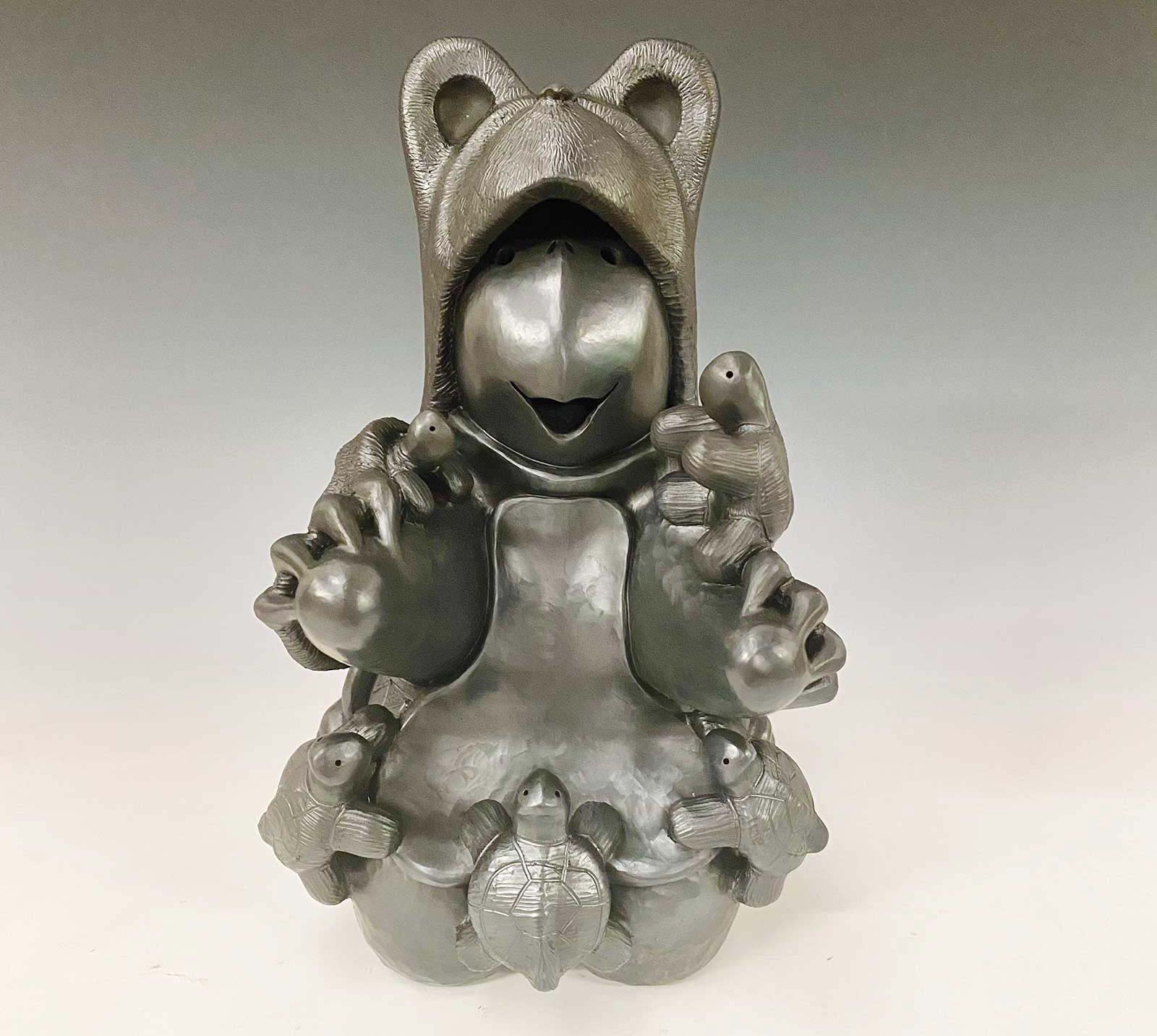
Look around your home. What was it that drew you to certain items you own? What was the spark that said “take me home with you?” For collectors of pieces designed and created by clay artist Randy Chitto, it comes down to this: a smile. It’s the single element above all others which sets his work apart as you look at his turtles, bears and Koshares. They’re all different, but all have a wonderful smile that just makes you want to smile right back.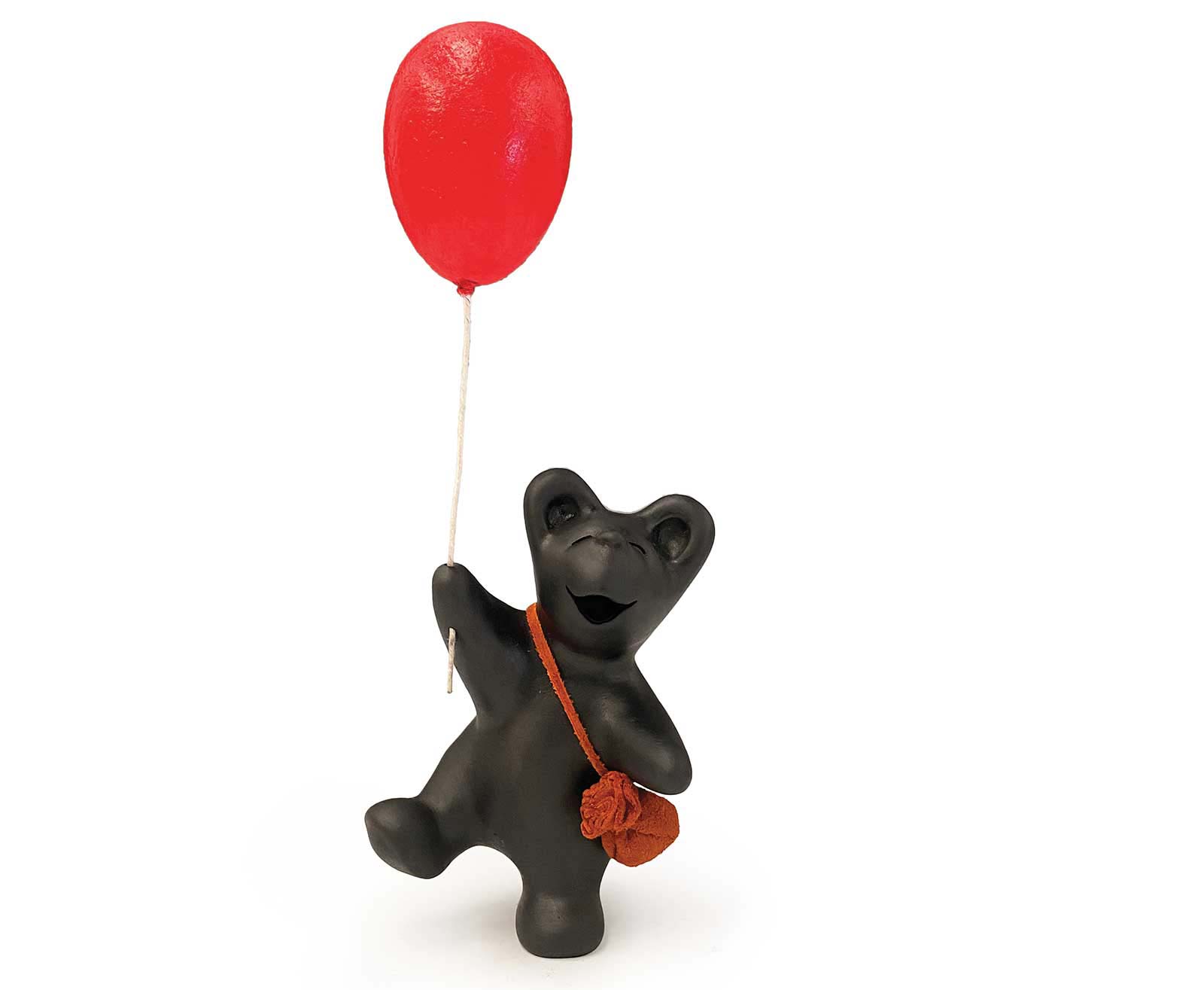 Bear with Balloon, red clay
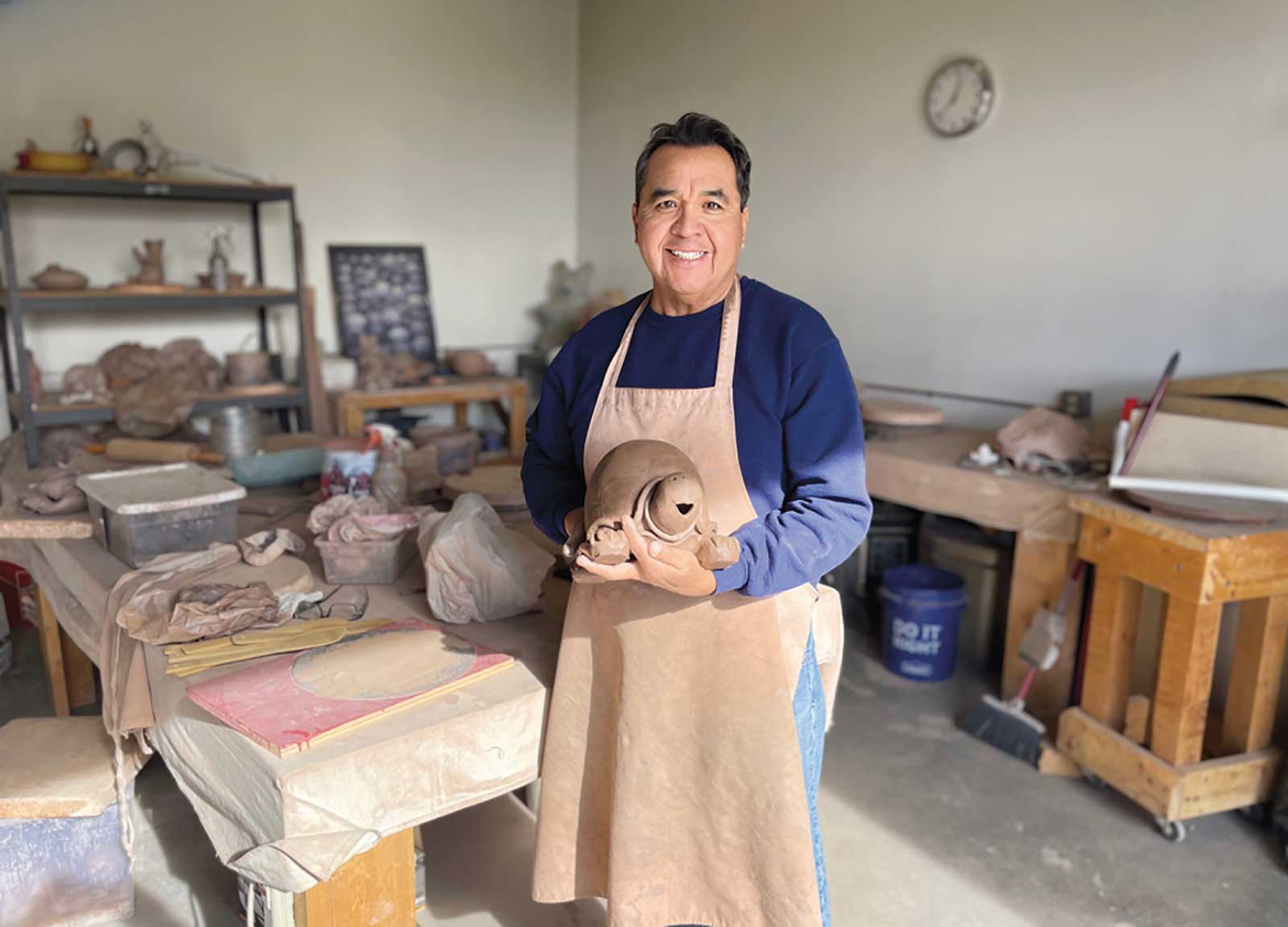 Randy Chitto (Mississippi Band of Choctaw Indians) in his clay studio.
Bruce McGee, director of retail sales at the Heard Museum Shop in Phoenix, knows very well the work of Chitto, and loves the reactions when people see these smiling sculptures. “Actually, his figures are very whimsical,” he says. “They kind of give people a break from the day-to-day struggles that they have. They’re just a lot of fun.”
“I’ve always been a positive person,” Chitto says, “and I’ve always been a happy person. It’s not a bad word to call my stuff ‘whimsical.’ I’ve heard people say ‘I’m sorry if I said whimsical. I didn’t mean it that way.’ No! That’s what they are, they’re happy…because I’m a happy person, they’re happy too! There’s nothing wrong with that.”
This artist has a very happy life. Married for nearly 40 years to his “bride” Jackie, with two very artistic sons, Hollis Chitto (beadwork artist) and Dylan Chitto (playwright). Plus, Chitto will happily tell you how he loves his job creating smiles inside his Red Clay Studio in Santa Fe, New Mexico.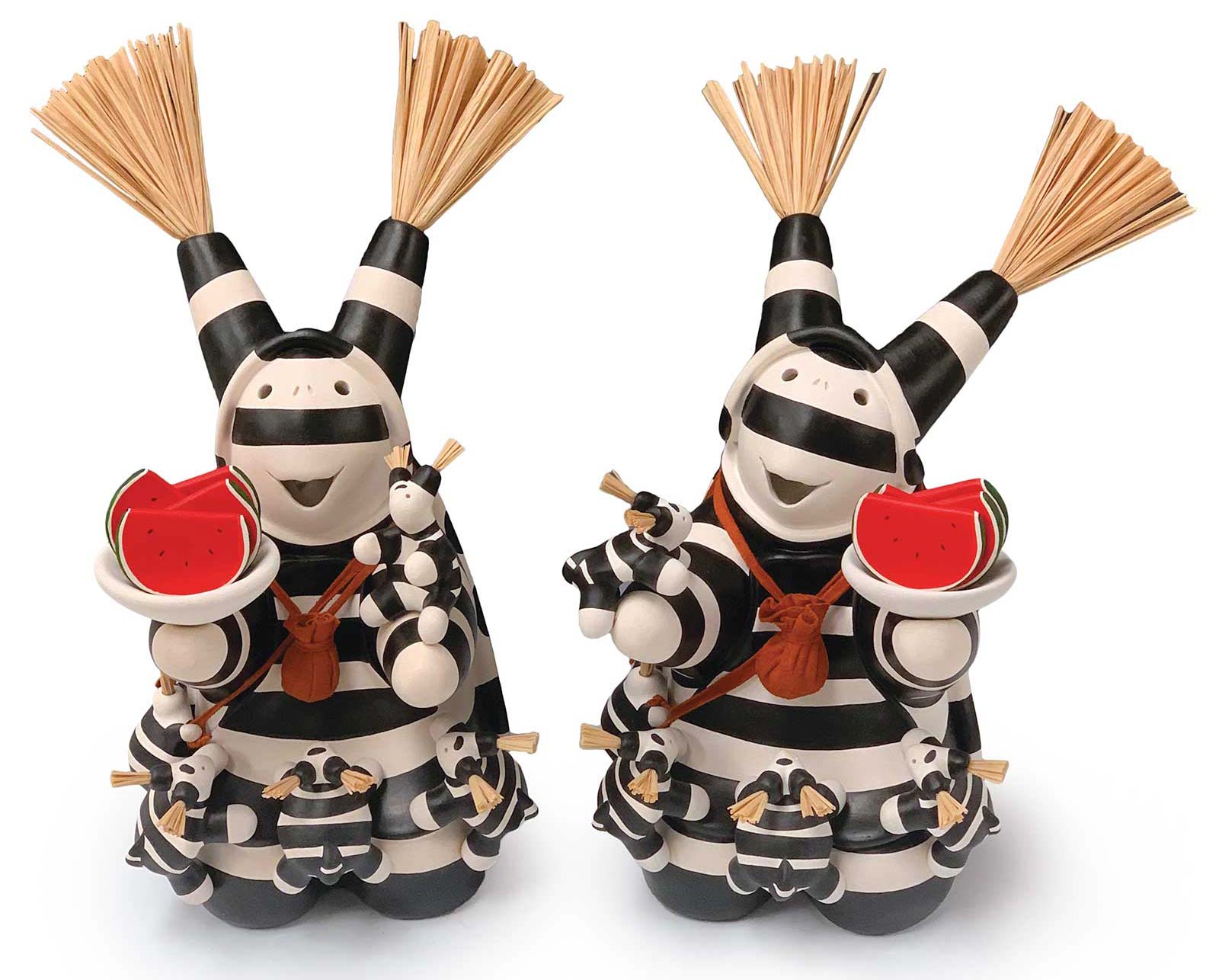 Turtle Koshare Storytellers, white clay
It’s almost by accident, a happy accident, of how he got here. He was born on the Choctaw reservation in Mississippi, but his family soon moved to Chicago. Chitto dreamed of being an artist with a paintbrush, and hoped to pursue that at the Institute of American Indian Arts in Santa Fe. His freshman year, all the painting classes were full, but pottery classes were still open, so he could do that for a semester or two, couldn’t he? However, once he immersed his hands and creative brain in clay, his career path and his artistic direction changed mediums. He graduated in 1983 with a two- and three-dimensional studio art degree and never looked back.
“Clay to me is just another medium, but in its own right, each medium…painting, sculpture and jewelry making, they’re all different…but they’re the same,” he says. “And like any other artist, we all want our stuff to be accepted. We do things to hopefully make a living and to have people look at it and enjoy what we put into it.”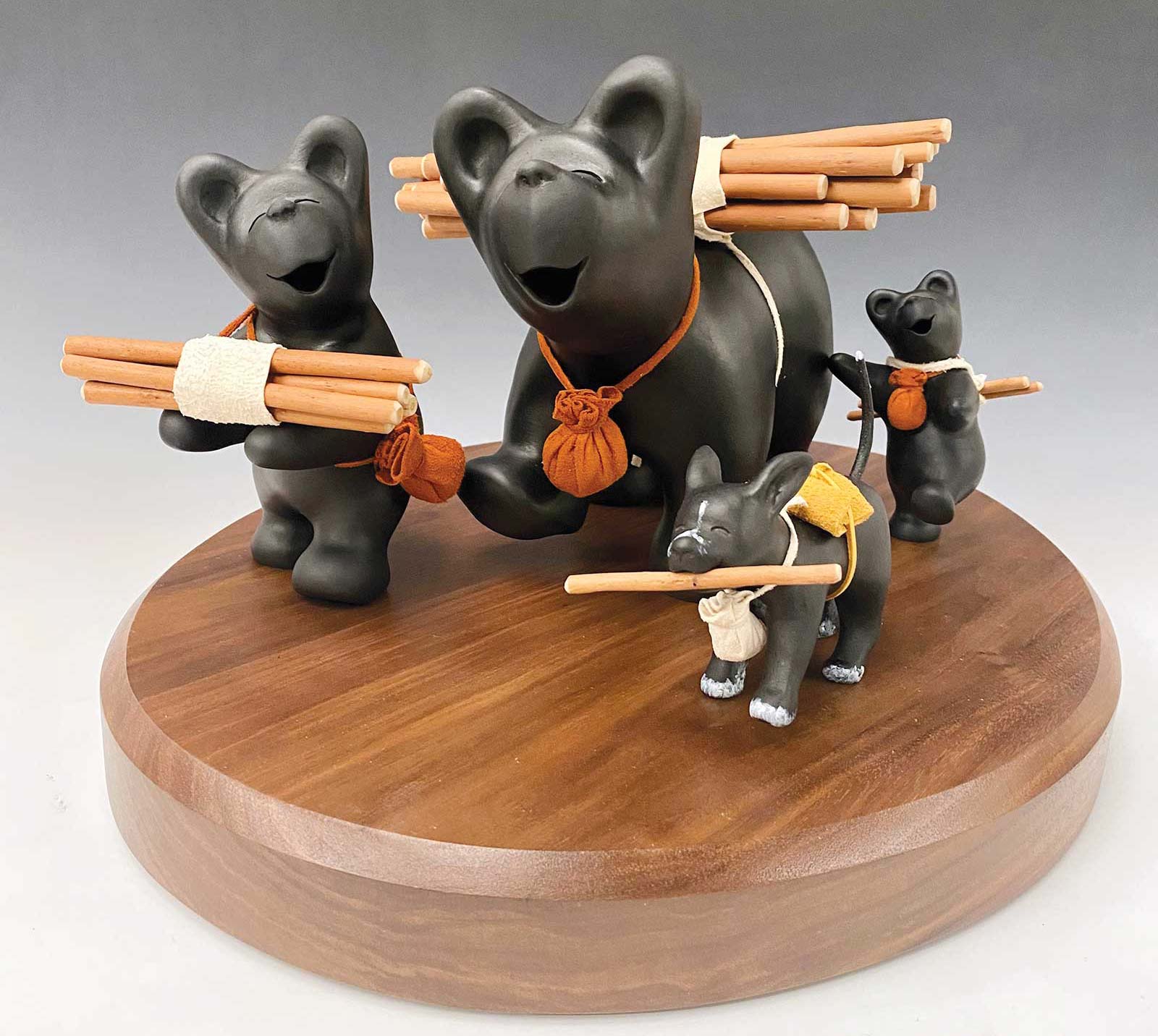 The Wood Gatherers - Mom & Kids, red clay
“That’s the one thing about clay,” he says enthusiastically. “It’s still alive…Unlike painting with oil…it tends to move around, has to have little microbes in it that keep it moving, it shrinks, all these things that keeps it more interesting…There’s no way you can master a process because sometimes the clay will say, ‘No, I don’t think so.’ So instead of me being in charge, it’s a group effort!”
He used to make pots and bowls, but “the first months I wasn’t the greatest potter,” he remembers. Then he tried making it more “turtle-headed,” as he calls it. “I started making turtles first. The pieces I used to do were more realistic. They weren’t exactly happy. But then, I thought, let’s give this guy a little more smile, and then they became happier and happier! And it’s so funny! They started being happier and I noticed my pieces were getting better!”
The smiling turtles were later joined by smiling bears and eventually, the smiling figures in black-and-white stripes known as Koshares, or clowns, tricksters as the artist calls them. While the turtles and bears are happy, they can’t do the things Koshares can.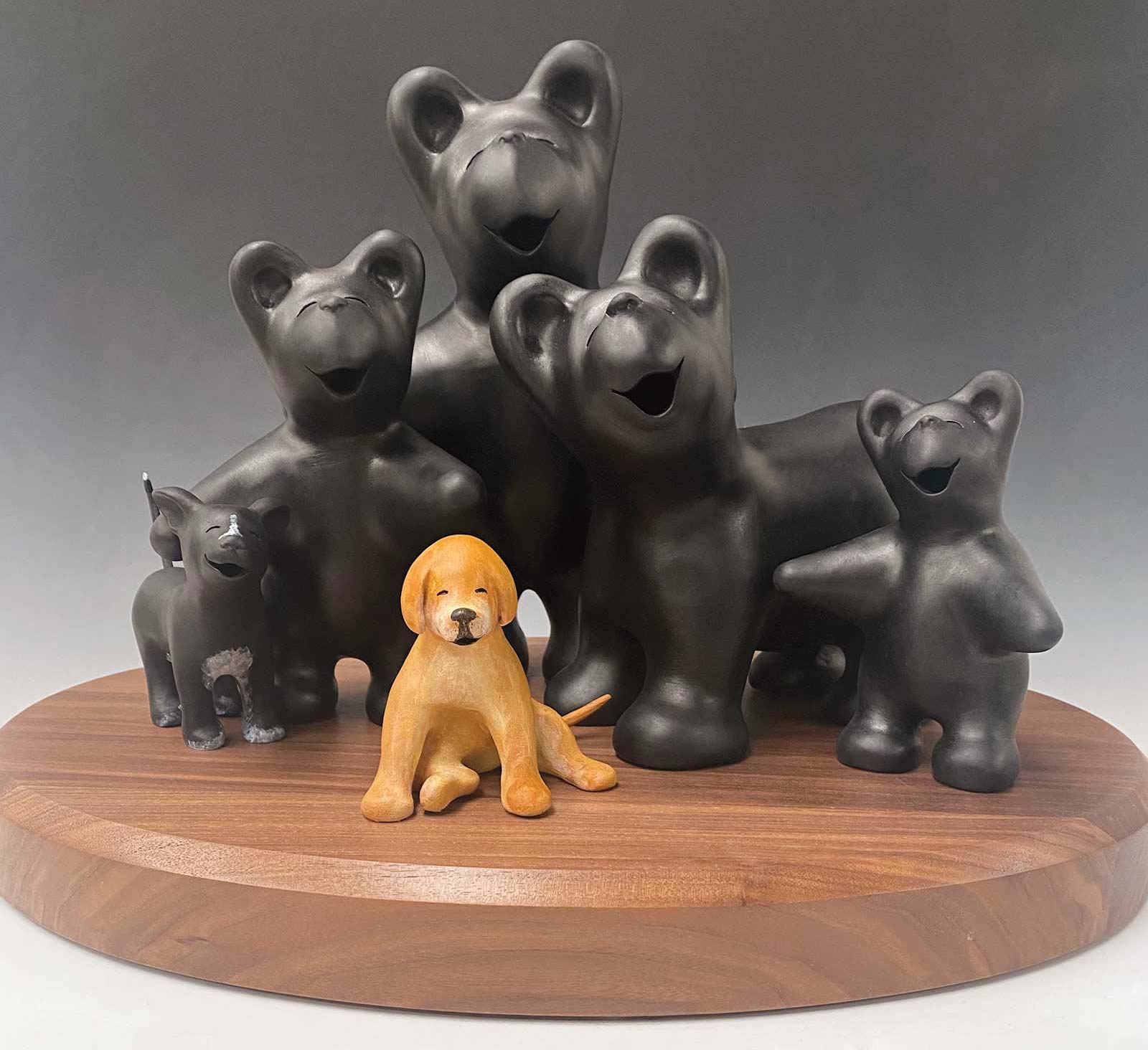 Bear Family - Addison’s Debut, red clay
“I needed something, an outlet that allowed me to say, ‘OK, these are having fun. We’re having fun!’ I want them to do other things than just be a dancer or a drummer…and those Koshares allow me to do that.”
The Koshares are also a nod to his wife’s Pueblo heritage.
Lisa Sheridan, a co-owner of True West Gallery with Craig Allen in Santa Fe, has known the artist for years. “I think the Koshares are probably one of the best sellers,” she says. “But if you look closely at the Koshare, not only is it a Hopi clown, it is the turtle, sacred to the Choctaw, but it’s also a storyteller figure, which comes from the Pueblos. So he’s combined different cultures into a single little figure, which
I find very cool.”
“All my pieces are storytellers,” Chitto says. “Turtles have always been storytellers in our tribe…so they’re always storytellers.”
And oh, what stories these pieces could tell, like the traveling over the years, not only into private collections but exhibits in the Heard Museum in Phoenix, the Denver Art Museum and the National Museum of the American Indian in Washington, D.C., to name a few. Then there’s the workshops and presentations he’s given, some at universities. “One of the times,” he recalls, “they introduced me as a ‘master sculptor.’ Surprised me! I looked all around to see who they were talking about, first of all, because a lot of these sculptures are hit or miss!”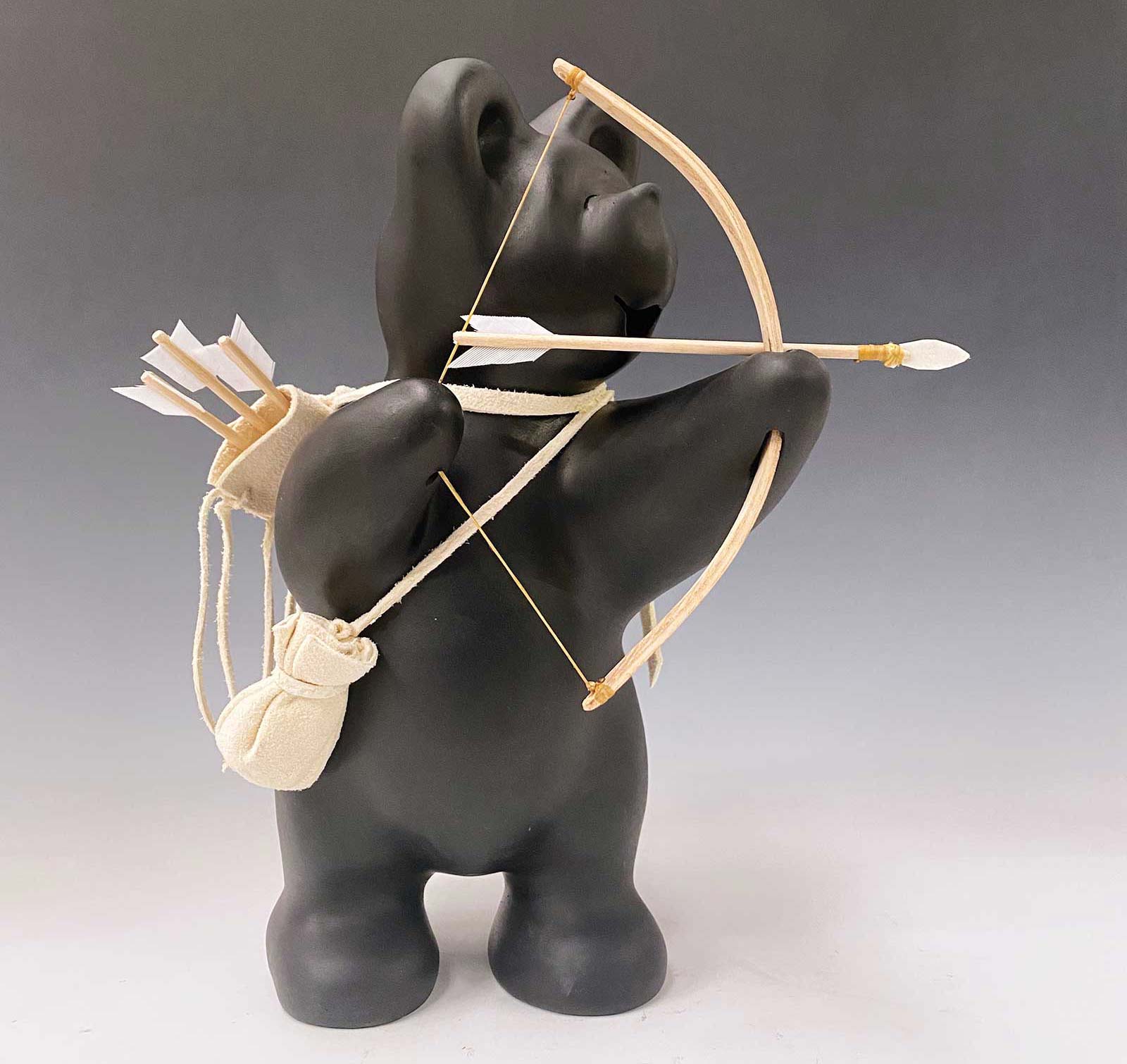 Bear Hunter, red clay
Looking back at the nearly 40 years of Chitto’s work, it’s not just hits, but plenty of home runs. For decades, his sculptures captured the attention of anyone walking past the windows of Packard’s Gallery (now closed) in Santa Fe. Lisa Sheridan worked at Packard’s during its last years and noted the reactions to these smiling figurines. So it was only natural for her to include Chitto’s work in her own gallery now. The reaction from people passing by remain the same.
“We have all of his work facing the sidewalk in our window and so people stop in their tracks, and I see them have conversations and they point out which ones they like, and nine times out of 10, they come in,” she says. “They want to see and touch it, and see how cute they are, and charming and cheerful. They just seem to strike everybody the same way.”
“People are spending their hard-earned money to buy something that they’re going to take to their home,” says Chitto. “What they’re doing is they’re buying a piece of you, and whatever piece of you that you are in reality, that’s what shows.”
McGee sees this as well at the Heard Museum Shop, and at the annual fair and market where they seek Chitto out. “People just come in and many times that’s the first booth they’ll go to,” McGee says. “Because they love his work. I think they love what it represents…I think that’s why most people pick them up. They know there’s two sides to the story. The one side is very relevant to this day and age. And they smile…they can’t help it.”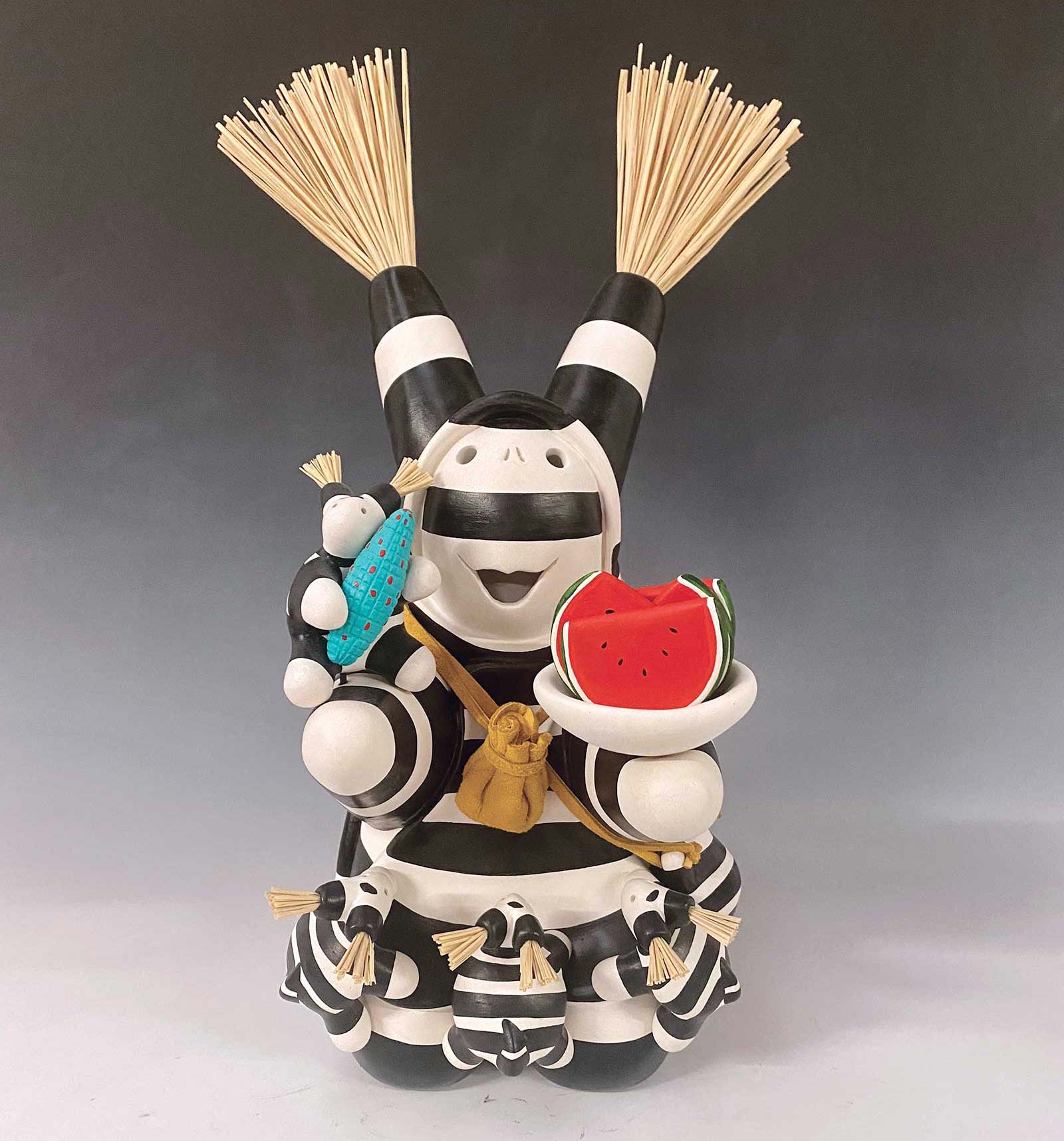 Turtle Koshare Storyteller, Turquoise Corn, white clay
 Turtle Bowl, red clay
“Don’t you just love that?” Chitto asks. “What I love…doing a market or a show, somebody will come up and say, ‘I bought a piece off of you.’ Or‘I bought a piece 20 years ago.’ ‘For 20 years I’ve had a piece because I could have a bad day at work, I come back and your piece makes me smile’…That’s a great compliment to me. I think the best thing in the world is to have somebody say their feeling changed. They have that opportunity with my pieces, and we’re working together to get this person happy. I love that!”
He also tries to find the best match for clients if he gets a call that someone is looking for that special something. “I look at my work and say, ‘Who does it fit?’ I’ll call them and say, ‘I’ve got this piece here, I’ll send you a photograph.’ And then they say they’ll take it…And then I get that 10 or 15 minutes of ‘my piece.’ I get to touch it, I get to look at it. It’s almost like I pet’em on the head and say, ‘have a good life, you can go.’”
So with the 64th Heard Museum Guild Indian Fair & Market rapidly approaching, Chitto will be saying that to a lot more pieces, as he has for 27 years at the Heard, but he doesn’t know just yet who in his smiling menagerie he’s bringing along. “Whoever wants to go with me,” he says. It may sound funny, but it’s true! Who wants to dry? Who wants to go through firing? So it’s ‘Me! Me! Me!’ when I’m working on a piece.” You can bet he’ll be there with smiling turtles, bears and whoever else decides to come along.
“It adds to the fun of coming to the market,” says McGee, when asked about Chitto and his creations at the Heard’s annual event. “You get to see an artist, he relates to people, he’s inviting and he’s got all the tools. We appreciate him…we love the guy!”
And apparently, so do collectors. —
Powered by Froala Editor