Our collector’s father was a school principal who is also a sculptor and her mother is a quilter. Museums were always part of family road trips and she became fascinated by the Native American objects on display.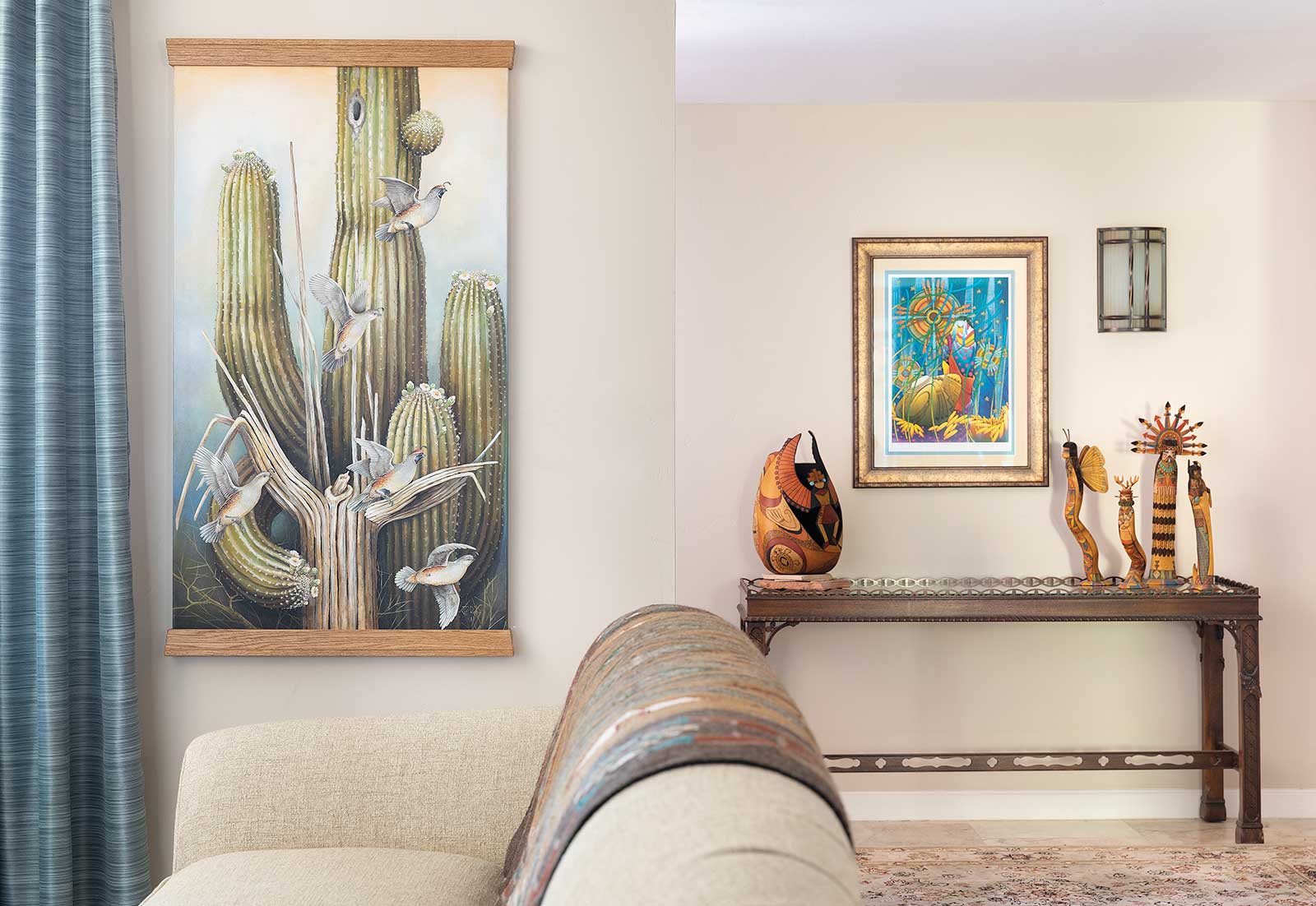 Susan Hemm Zivic’s acrylic on canvas, Quail and Cacti, hangs off the foyer. Midnight Skies, a print by David Dawangyumptewa (Hopi) is in the foyer. Beneath it, on the table, are, left to right, a gourd by Judy Moody and four katsinem by Randy David (Tewa Hopi): Butterfly, Deer, Pahlikmana and Warrior Maiden. In the foreground, on the sofa, is a Teec Nos Pos rug by Vangeline Thomas (Navajo (Diné)).
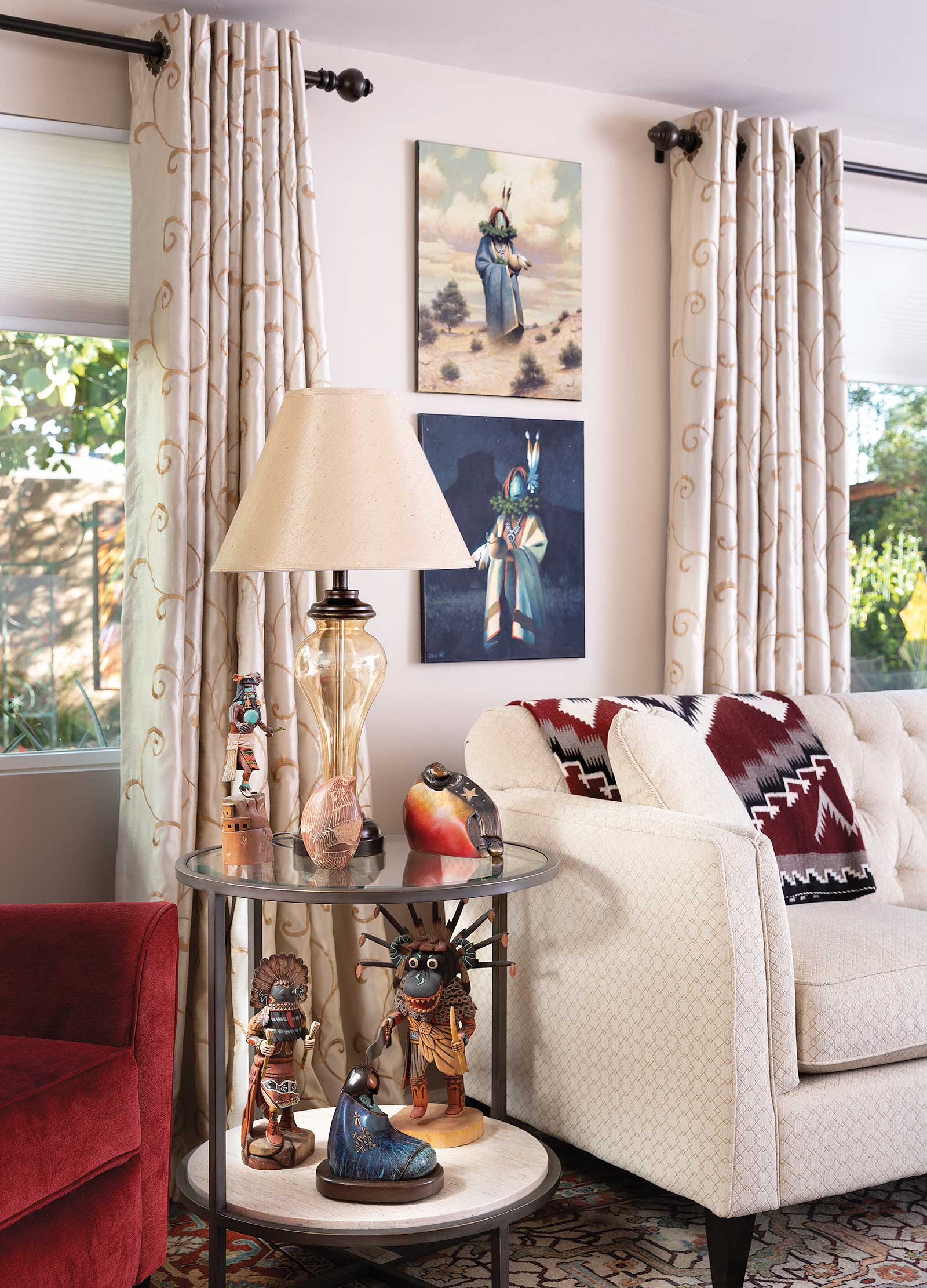 The paintings in the family room are by Allen Bahe (Navajo (Diné)), Sacred Ground and Ceremonial Glow. On the top of the end table are, left to right, Turtle, a katsina by Buddy Tubinaghtewa (Hopi); a Hawk pot by Bernice Naranjo (Santa Clara Pueblo); and Star Chaser, a bronze by Doug Hyde (Assiniboine/Nez Perce/Chippewa). On the bottom Tubinaghtewa’s katsina Broad Head, Blue Dragonfly; a bronze by Kim Seyesnem Obrzut (Hopi); and Ogre, a katsina by Donald Lomawunu Sockyma (Hopi).
She learned from her parents the amount of love, passion and meticulous work that goes into the act of creating and now looks for that in the pieces she collects. “I see a piece and I know what it takes to make it,” she says. “I did beadwork on a loom at one time. It was a regimented process, and I had a pattern to follow. I admire weavers who seem to come up with the patterns out of their heads and are talking to their friends as they weave the intricate designs.”
As a medical intern in Phoenix, she bought a few pieces that are now in a room in her home she calls the Room of Firsts—her first rug, her first bronze and her first katsina. In 2012, having completed her residency, she bought a house and “really began collecting!”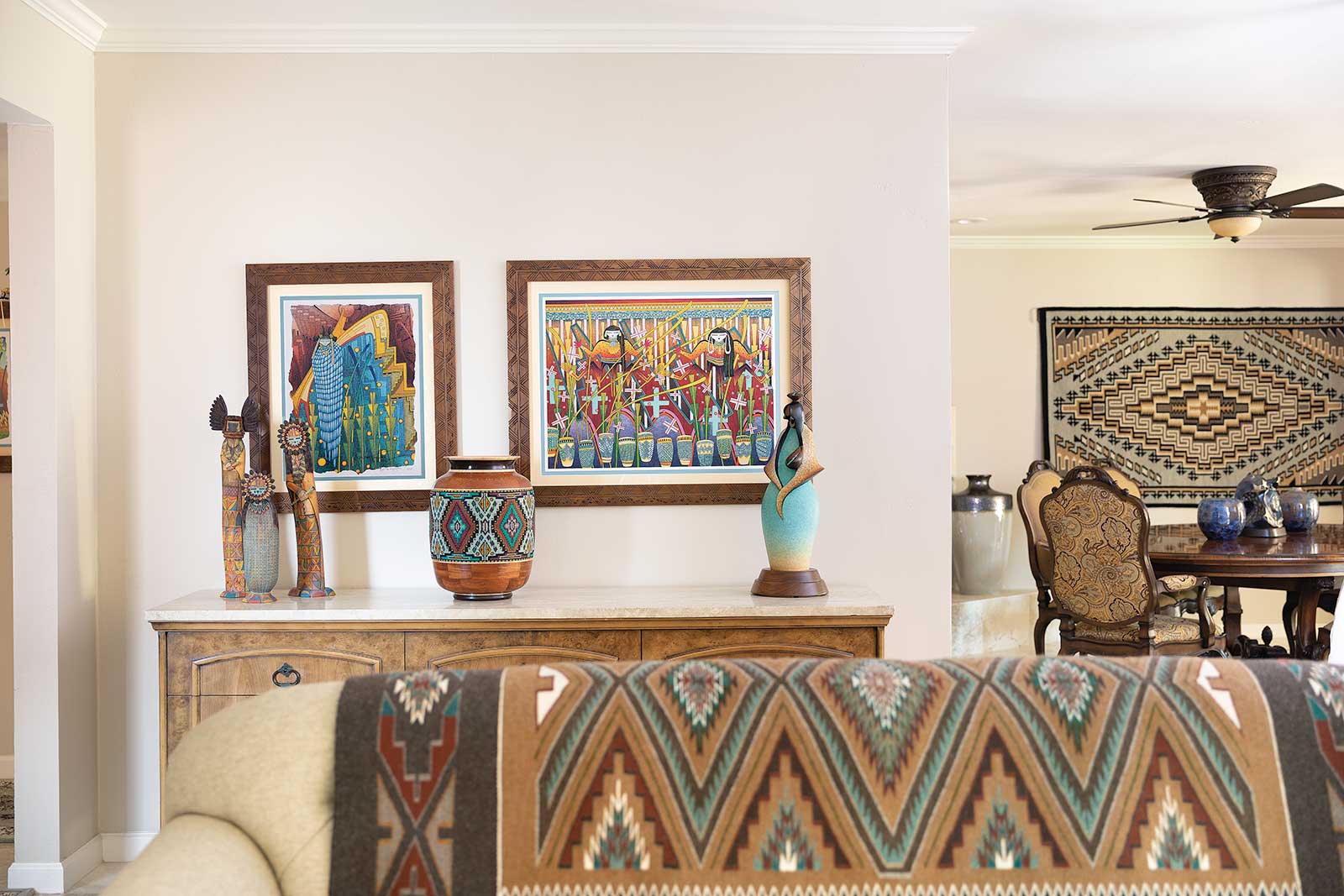 Above the sideboard in the living room are two prints by David Dawangyumptewa (Hopi), Corn Maiden on the left and Underwater People. On the counter are, left to right, Crow Maiden and 2 Suns, katsinem by Randy David (Tewa Hopi); a wood and bead vessel by Eucled Moore and Marilyn Endres; and To the Springs, a bronze by Kim Seyesnem Obrzut (Hopi). In the foreground is a Teec Nos Pos rug by Vangeline Thomas (Navajo/Diné), Beyond, and in the dining room is a Two Gray Hills rug by May Bedah (Navajo/Diné), ca. 1983.
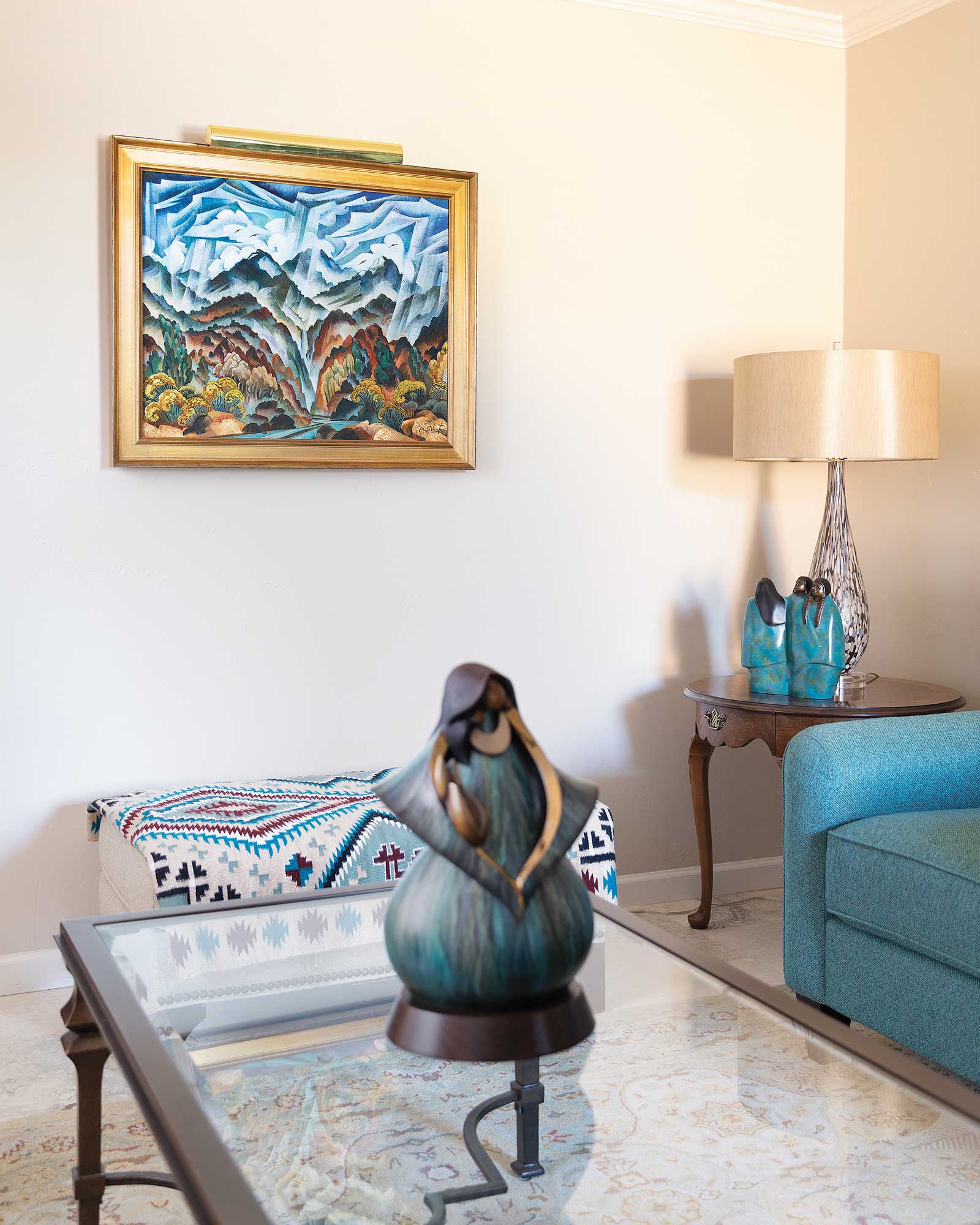 Mountain Falls, an oil on canvas by Tony Abeyta (Navajo (Diné)) hangs above a Burntwater rug by Rose Marie Avery (Navajo (Diné)). On the end table is The New Girl, a bronze by Doug Hyde (Assiniboine/Nez Perce/Chippewa). In the foreground is a Mother’s Gift, a bronze by Kim Seyesnem Obrzut (Hopi).
In addition to her pursuit of fine craftsmanship, she seeks the soft colors of the Southwest and works that focus on women. “A lot of Western art is very masculine,” she observes. “I don’t have any of that. Most of the bronzes are women. I like the way they portray the new woman and tell the story of the relationships between women. I had seen Billy Schenck’s paintings but they were too big for my house. I commissioned him to paint something smaller and asked him to do something with two women whom I think of as my twin sister and me. Billy is fascinating and gave me a tour of his studio and his home in Santa Fe with its wonderful collection.”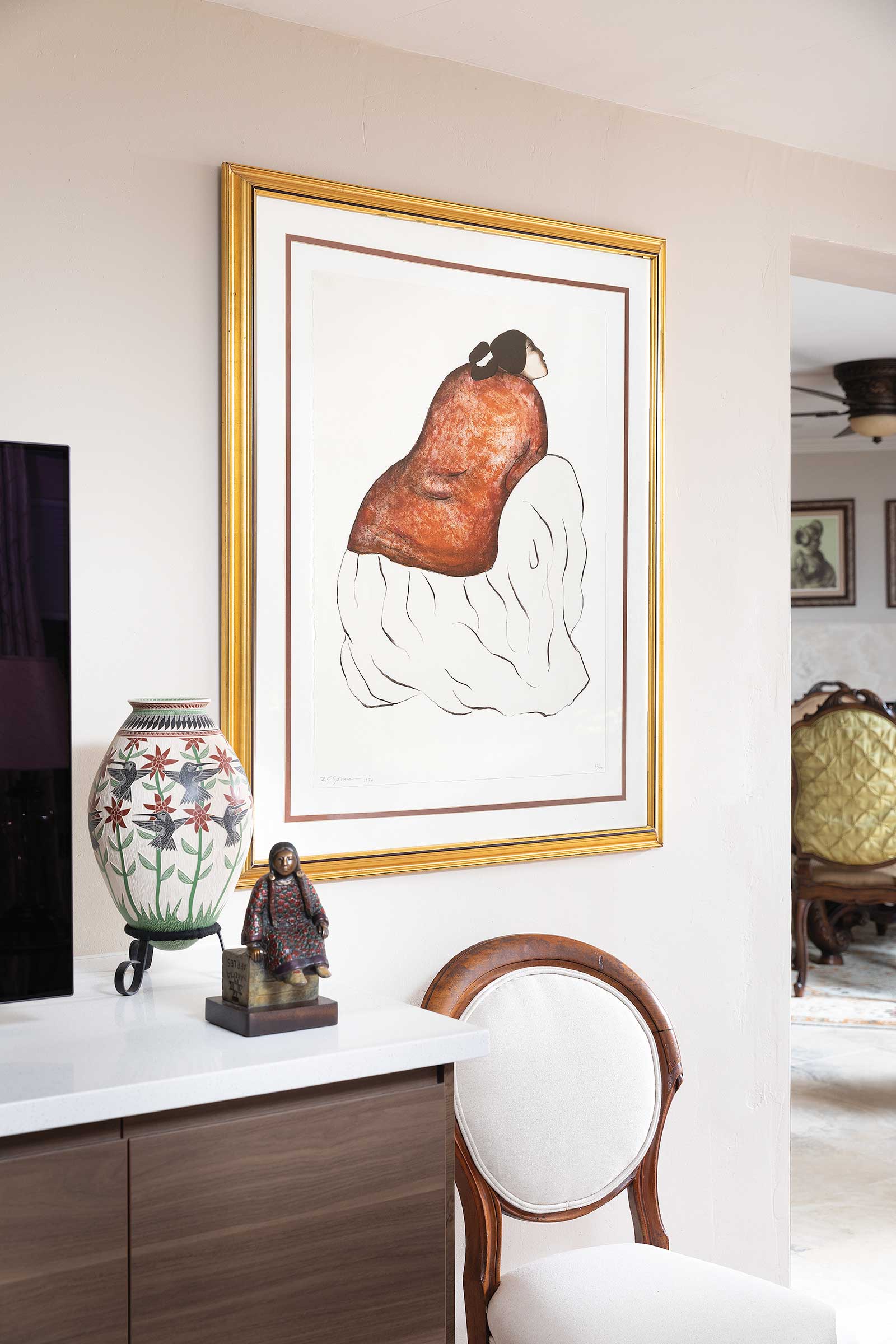 A lithograph, Woman from Pine Springs, State 1, by R.C. Gorman (Navajo (Diné), 1931-2005) hangs next to a Hummingbird pot by Martin Olivas Quintana (Mata Ortiz) and a bronze, Girl with Yakama Apples, by Doug Hyde (Assiniboine/Nez Perce/Chippewa).
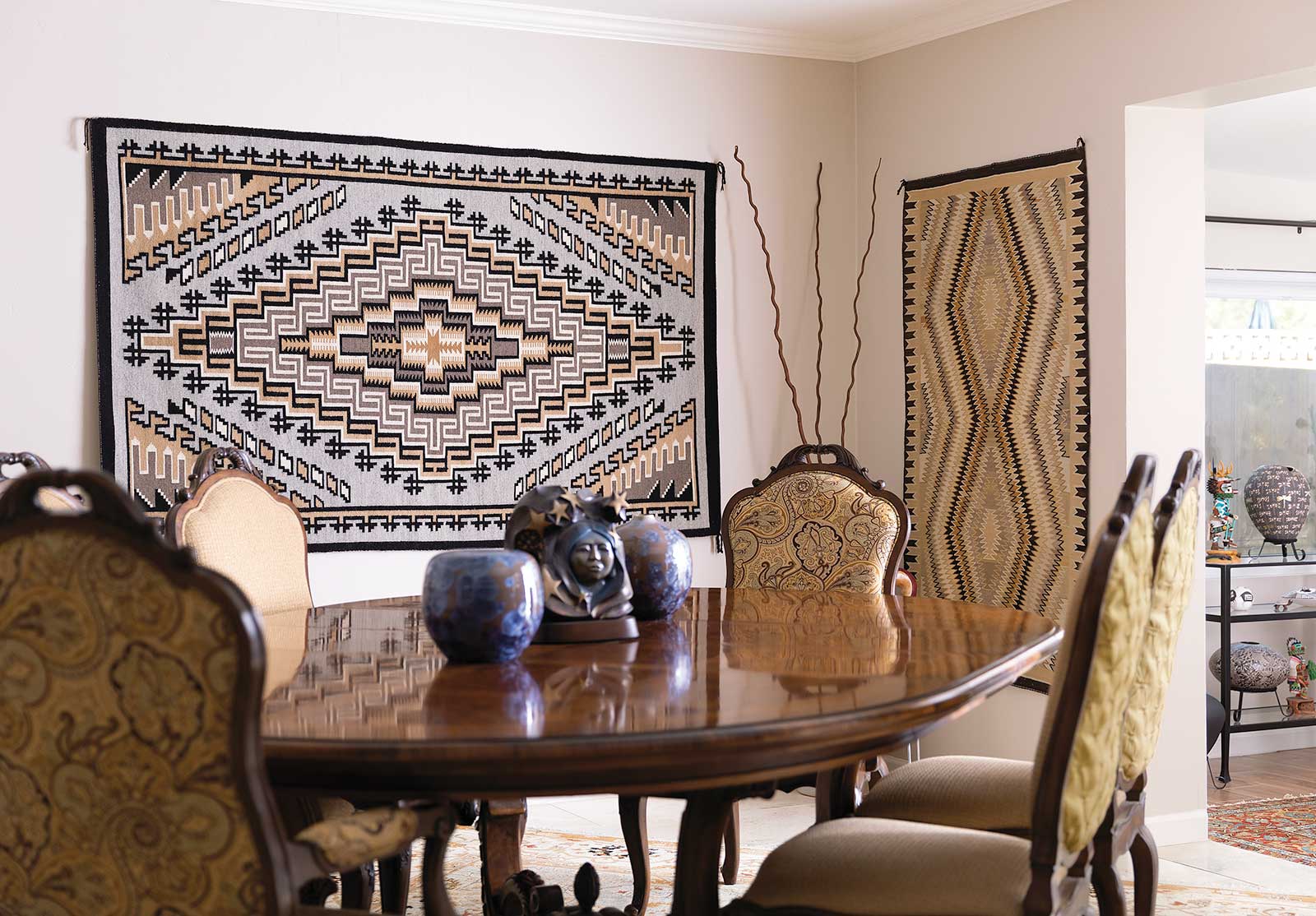 On the back wall of the dining room is a Two Gray Hills rug by May Bedah (Navajo (Diné)), ca. 1983. Adjacent to it is an Eye Dazzler rug from the 1920s by an unknown artist. The bronze on the dining table is Coyote Moon, a bronze by Doug Hyde (Assiniboine/Nez Perce/Chippewa). In the adjoining room are—left to right, top to bottom—Deer, a katsina by Irwin Poleahla (Hopi); a Dragonfly Pot by Elicena Cota and Jerardo Tena (Mata Ortiz); Poleahla’s katsina Ram; a Turtle Seed Bowl by Carolyn Concho (Acoma Pueblo); Morning, a katsina by Buddy Tubinaghtewa (Hopi); and Morning, a katsina by Randy David (Tewa Hopi).
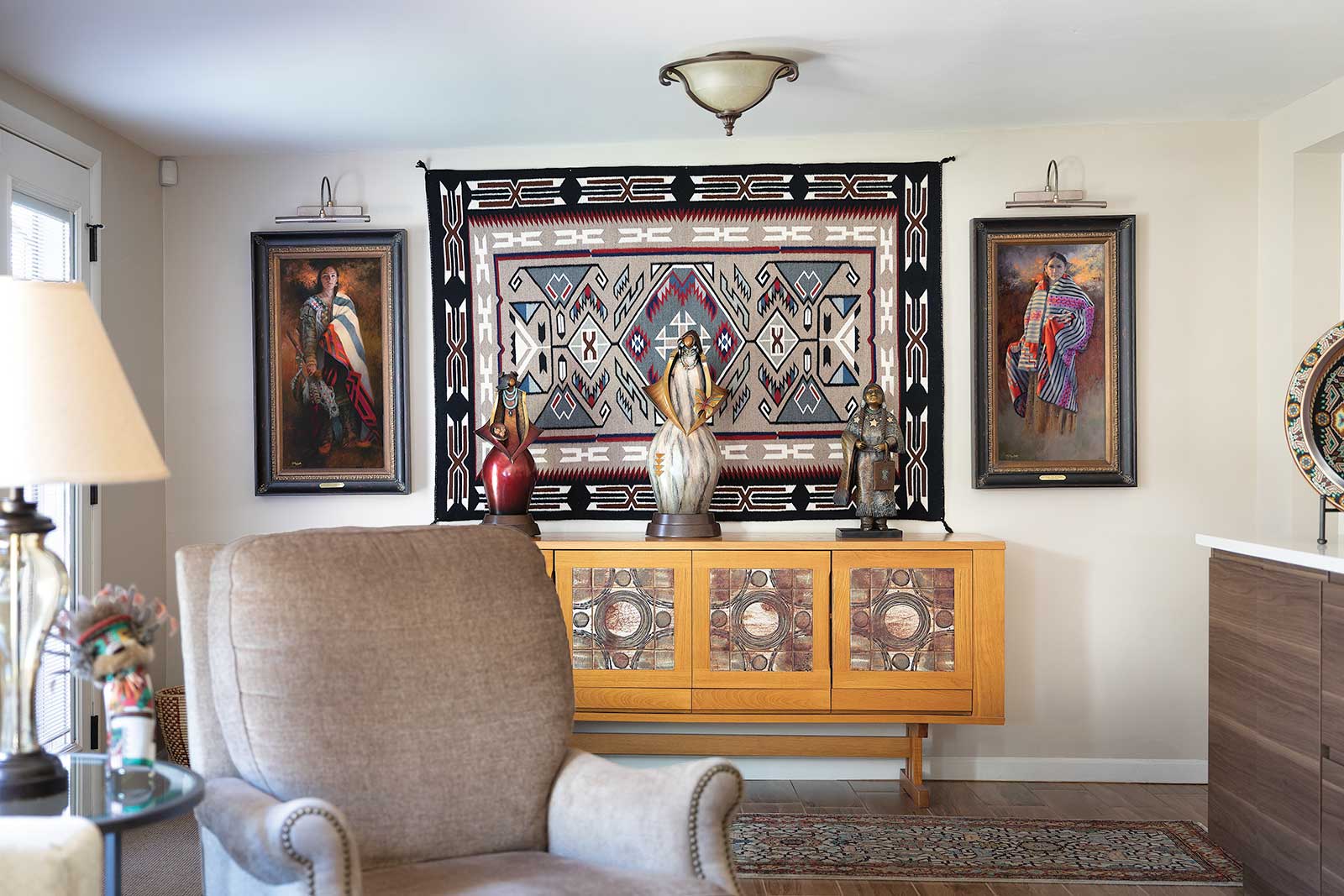 On the wall of the family room are, left to right, The Power of the Bear, a giclée by Brent Flory; a Teec Nos Pos rug by Pauline Wagner (Navajo/Diné); and Of Wind, Fire and Smoke, a giclée by Brent Flory. On the counter are, left to right, Peaches and Morning Song, bronzes by Kim Seyesnem Obrzut (Hopi), and Daybreak Star, a bronze by Doug Hyde (Assiniboine/Nez Perce/Chippewa). Next to the chair is a katsina, Cradle Doll (Badger) by Austin Coochyamptewa (Hopi).
Meeting and getting to know the artists is a vital part of her collecting activity. “I love learning about the stories the pieces are telling,” she says.
Complementing her collection of Native art is a large painting, Quail and Cacti, by Susan Hemm Zivic. She lives in the Arizona desert and has become intimately acquainted with its flora and fauna. Our collector explains that the artist outlines her paintings on the canvas and paints from memory without the use of photographs.
“The Heard Museum used to have a weaving workshop,” she explains. “When I walked in the first time, I saw a Navajo rug by Nellie Jo and immediately fell in love with it. Her daughters were there to help her sell it. Her daughters are weavers and are teaching their own daughters to weave. The rug is in a Yei design. I learned about the life and spirituality of Yei, and the Yei Bei Chei in Navajo ceremonial dances. Nellie’s colors inspired the color scheme of my home.” The Yei theme is picked up again in her collection of paintings by Allen Bahe. In 2002, he won Best of Division and Judges’ Choice Award at the Heard Museum Guild Indian Fair & Market.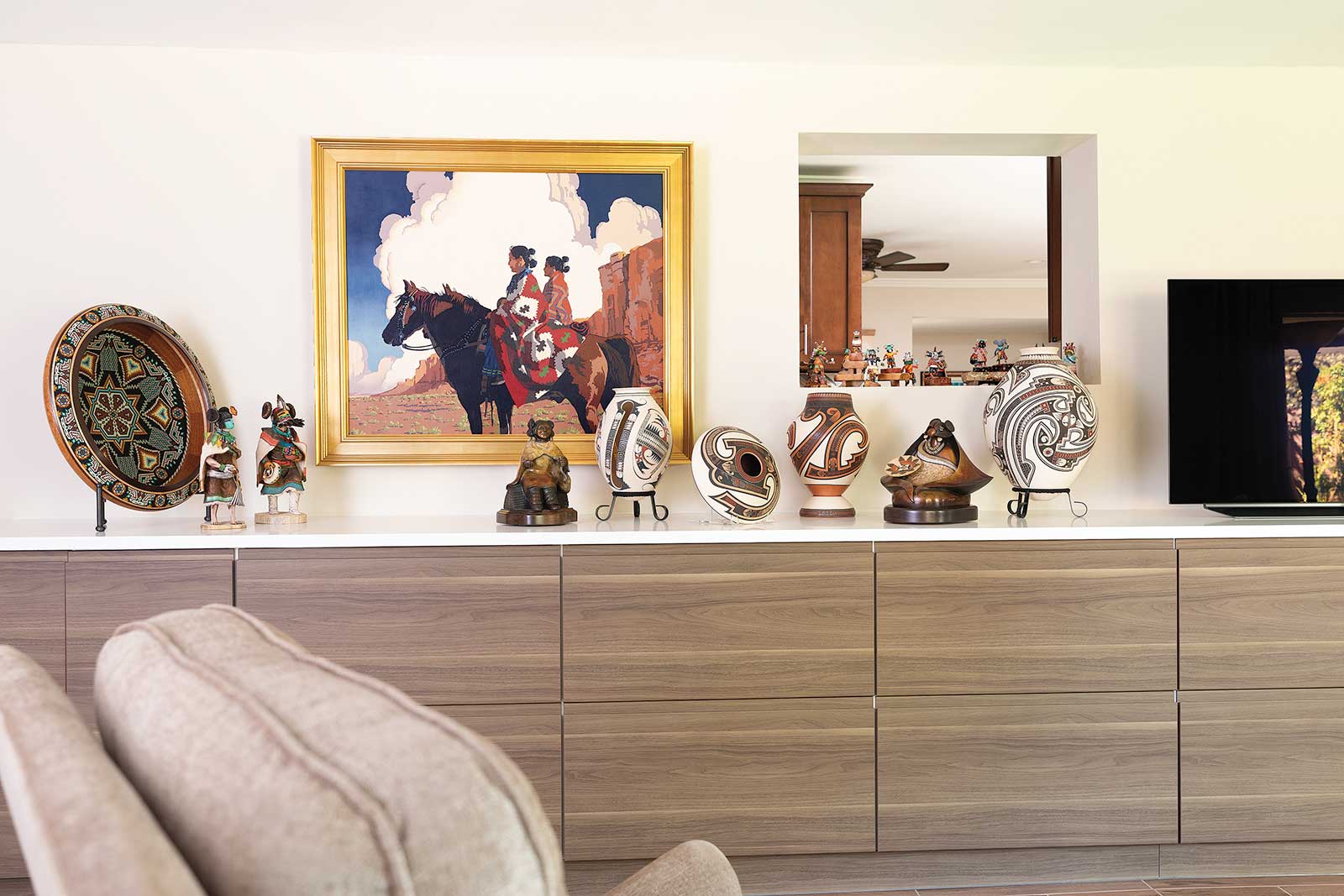 Hanging is Across from Cedar Mesa by Billy Schenck. Along the counter are, from left, a wood and bead Cylindrical Basket by Eucled Moore and Marilyn Endres; two katsinem, Maswik Mana and Katchin Mana, by Arthur Holmes Jr. (Hopi); Hopi Butterfly, a bronze by Doug Hyde (Assiniboine/Nez Perce/Chippewa); three Mata Ortiz pots by Antonio Sandoval, Octavio Silveiro and Jesus Octavio Silveiro; Beginnings, a bronze by Kim Seyesnem Obrzut (Hopi), and a pot by Lazaro Ozuna Silveira. On the passthrough to the kitchen is a collection of miniature katsinem by Buddy Tubinaghtewa (Hopi).
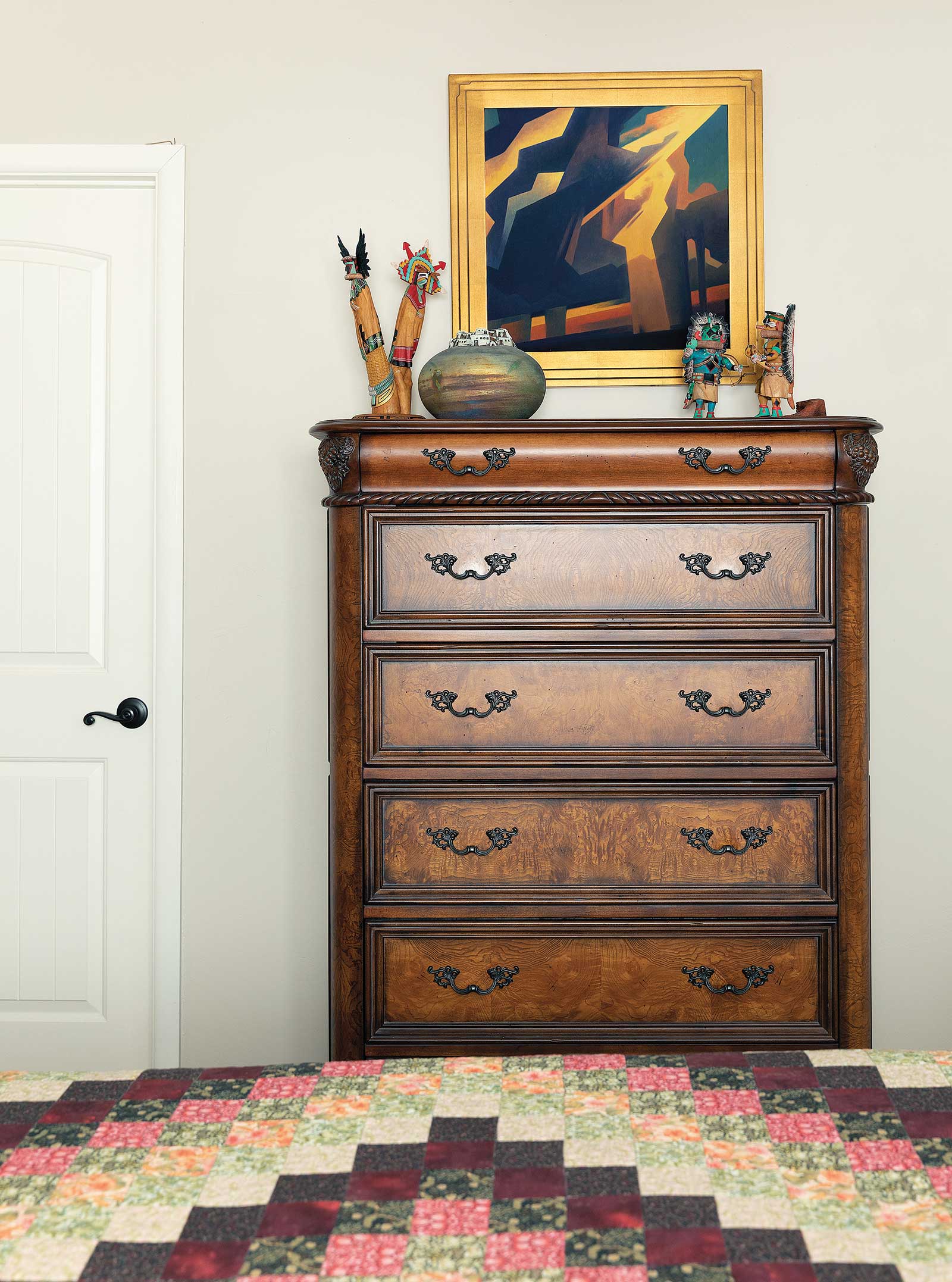
Hanging above the dresser is Prairie Storm, oil on canvas, by Ed Mell. On the left are katsinem Salako Taka and Salako Mana by Jarvis Cook (Hopi). The raku Pueblo Jar is by Jeremy Diller. The two katsinem on the right are Blue and Yellow Ahotes by Buddy Tubinaghtewa (Hopi). The quilt is by the collector’s mother.
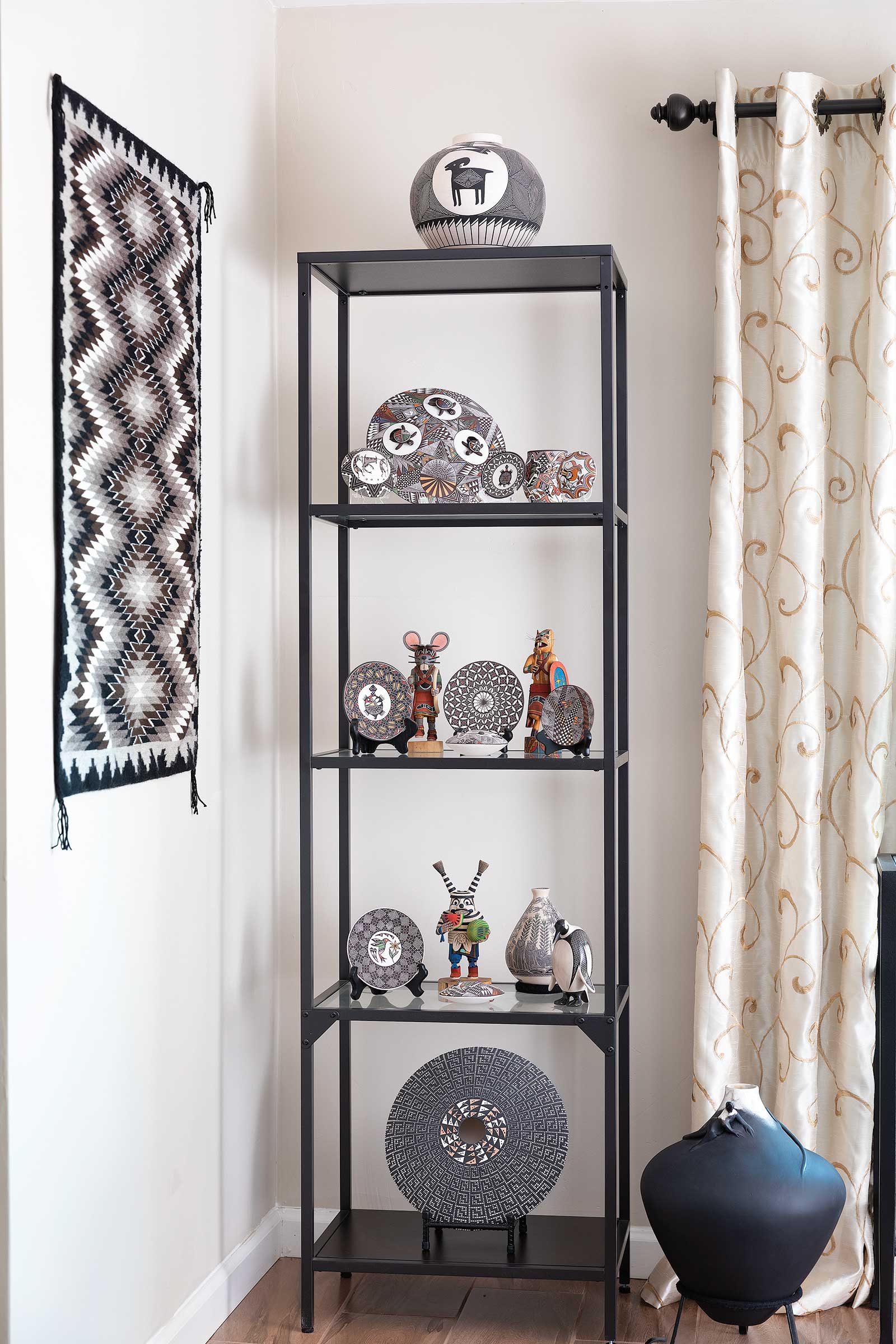 On top of the étagère is a Goat Pot by Harrison Poncho (Acoma). On the top shelf is a Turtle seed pot by Carolyn Concho and works by Rebecca, Amanda and D. Lucario, Marilyn Ray and D. Lewis Garcia. On the middle shelf are two katsinem, Warrior Mouse by Donald Lomawunu Sockyma (Hopi) and Warrior Mouse by Randy David (Hopi). On the next shelf is a katsina, Sockyma’s Koshari Clown, a Bear pot by Hector Gallegos (Mata Ortiz) and Penguin by Jerardo Tena (Mata Ortiz). On the bottom shelf is a large Acoma seed pot by Melissa Antonio (Acoma). The standing black vase is by D. Andrew Rodriguez (Laguna Pueblo). Hanging on the left is an Eye Dazzler rug by Verna Begay (Navajo/Diné).
“Sometimes it’s the colors and sometimes it’s the intricacy that attracts me,” she explains. Eucled Moore learned wood turning in Africa where his father was a missionary. Marilyn Endres learned woodworking when she helped design and build her home when she was 19. She then turned to and perfected her own woodturning skills. They have worked together for 26 years. They assemble different natural color woods, which they then turn on a lathe into platters and vessels. Some are inlaid with thousands of European glass beads in intricate patterns. Our collector has several excellent examples in her collection.
As she collects and gets to know the artists, she sometimes collects their work in depth. They also become friends. In fact, her father enjoys exchanging details about carving with Hopi carver Buddy Tubinaghtewa. Kim Seyesnem Obrzut has been willing to work with her to select the patina for her bronzes.
“I love the art,” she says, “and love meeting the artists.”—
Powered by Froala Editor