Editor’s Note: This is an excerpt from Western painter William Mathews’s new book, Bolo, published by Rizzoli.
The bolo is a Native American creation. It consists of an ornament or medallion, attached to a leather braided cord with silver or fancy tips, to keep the leather from unravelling. The back has a slide and tension clasp to adjust the length and keep it snug.
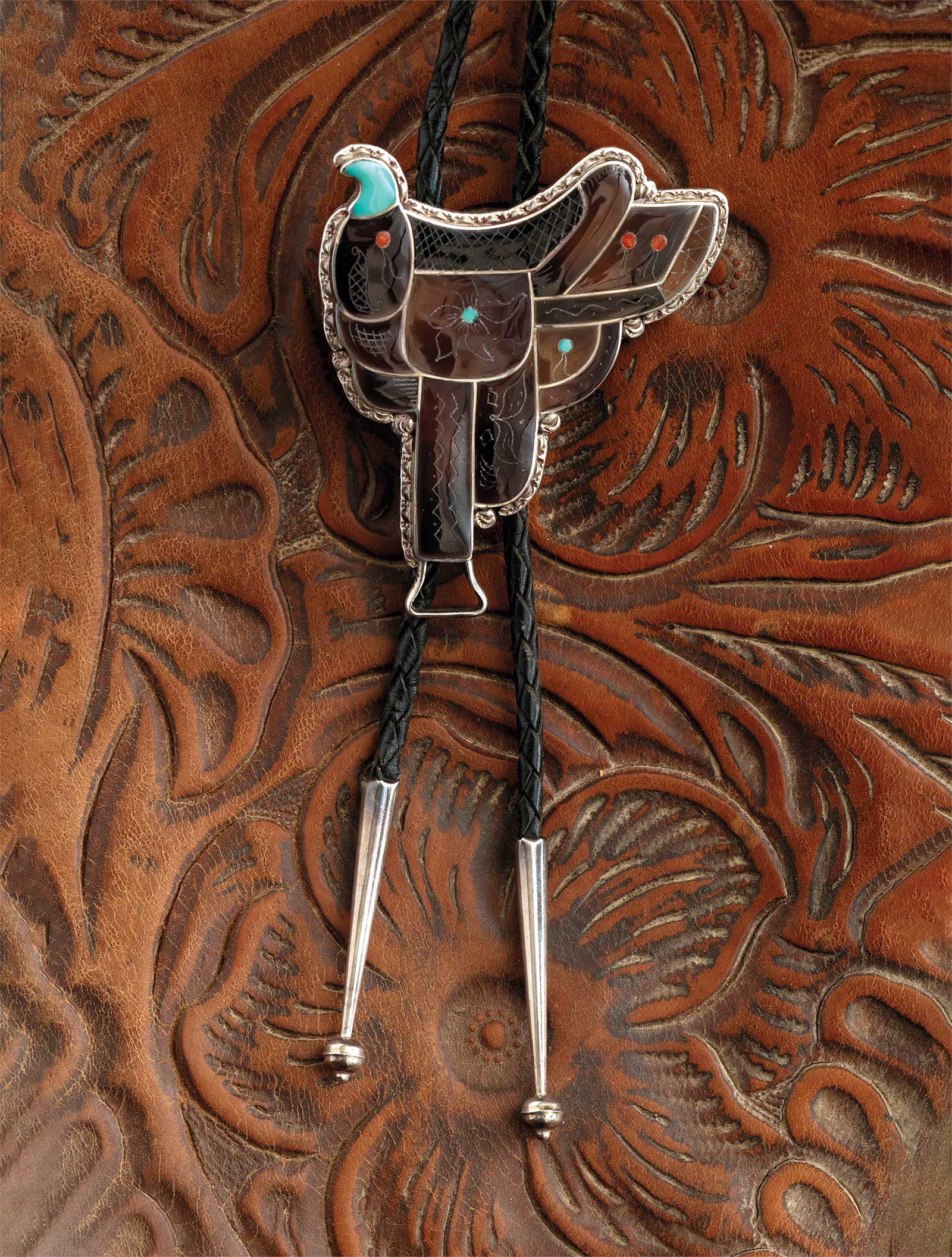
Porfilio Sheyka (Zuni, 1938-1982), Western Saddle Bolo, 1950s-60s, turquoise, coral and shell set into sterling silver. Private Collection.
The first bolos officially appeared in the 1920s, but they may have been worn even earlier. They were developed by Native American artists, which is clear from historical records. Native men had been wearing scarf slides, shells and ornamental turquoise around their necks for generations, and most historians agree that the bolo probably evolved from the scarf slide. However, their specific origin is still a conundrum.
The scarf is one of the most useful articles of clothing in the West. A scarf slide was used to adjust the tension, and most men wore them. Originally, slides were made of bone, like the one to the left. But later they became more ornamental, as when Navajo craftsmen rendered silver dollars and Mexican pesos into hammered ring slides. Another form of neckwear—leather strings, tied under the chin—were worn by riders to keep their hats from flying away. The Mexican vaqueros called them stampede strings; these leather strings bear a strong resemblance to the bolo strings.
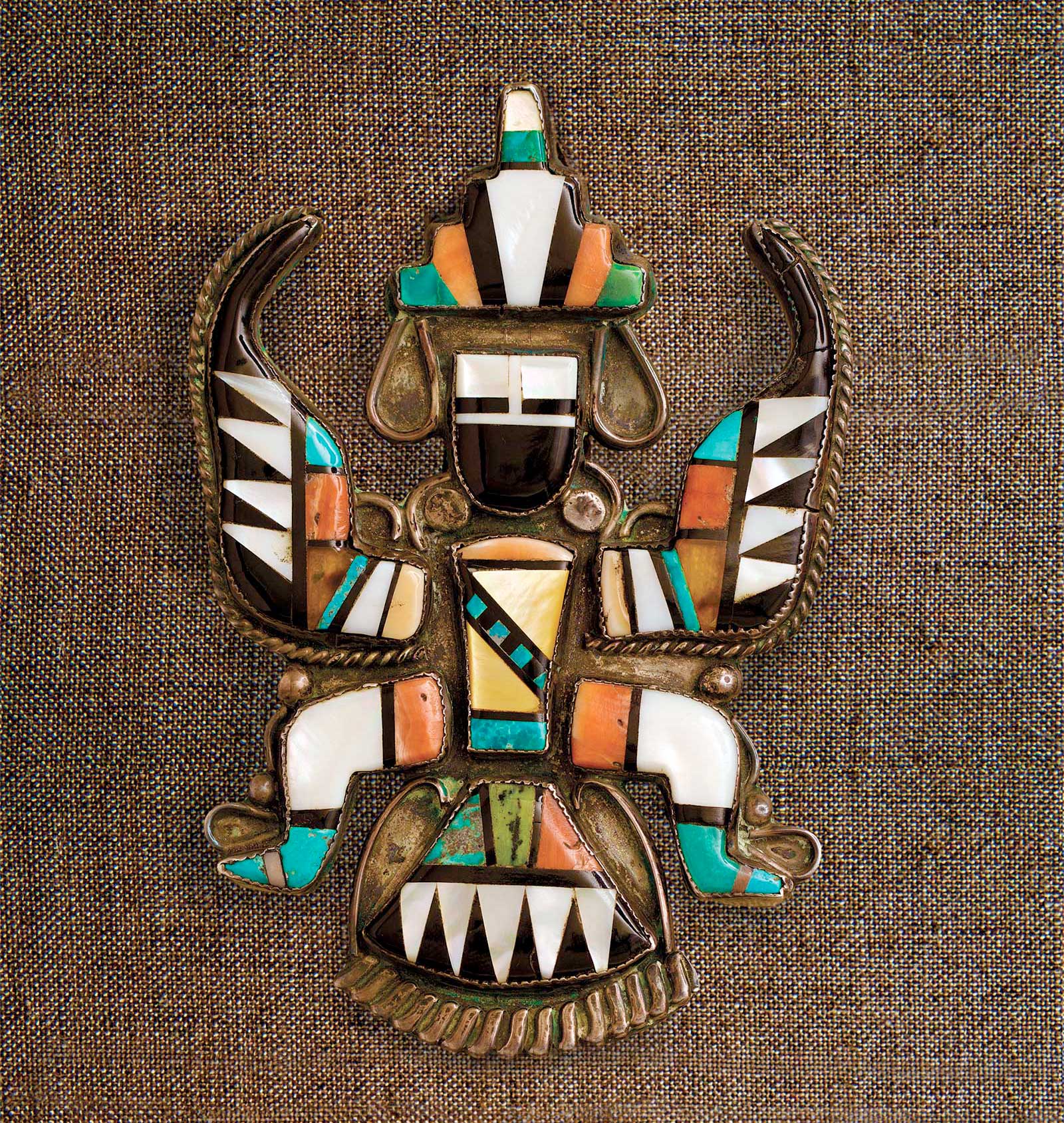
Large Knifewing Bolo, 1950s, large inlay knifewing shell, turquoise, coral and jet. Lapidary by Arnold Cellecion, Zuni silverwork by Artist Once Known (Navajo). Private Collection.
Most of the bolos in this book were made in the Southwest, around Gallup, New Mexico. They are primarily Navajo, Hopi and Zuni in origin, as those communities are where most of the great Native American jewelry-making has taken place in the 20th century. Zuni Pueblo and Hopi Pueblo are ancient villages, and both tribes trace their lineage back thousands of years. They are descended from the ancestral pueblo people and the Anasazi, who have long inhabited the Colorado Plateau.
Through extremely challenging circumstances, these pueblo cultures have survived. They continue to maintain their religious and cultural ceremonies, and their complex ritual dances are still performed regularly. Men take on the roles of supernatural spirits in the form of Katsinas, as they pray for rain, fertility and prosperity for all peoples. The importance of the religious life at the pueblos is the foundation of the imagery in their jewelry, including their bolos.
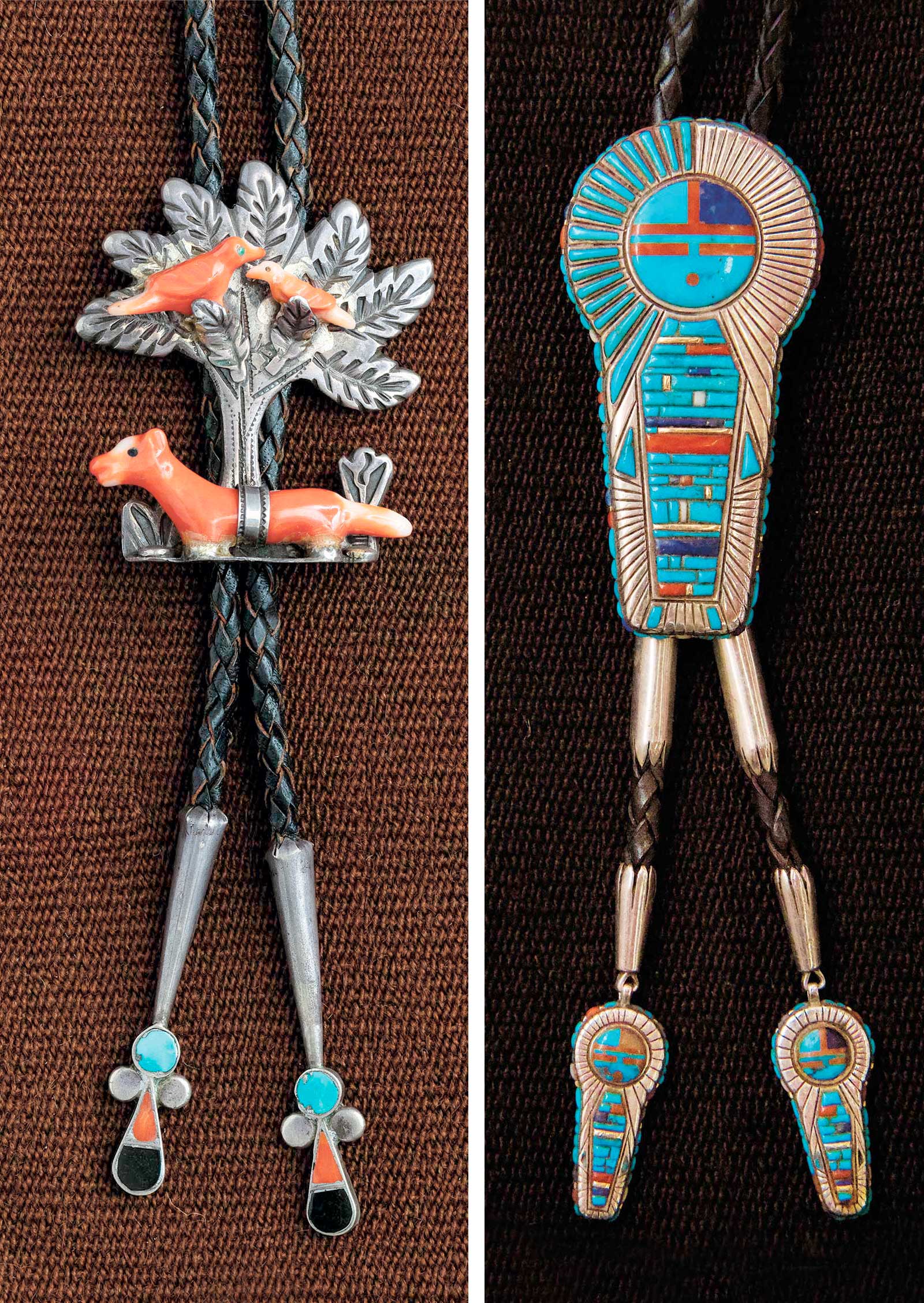
Left: Fox and Birds Bolo, 1930s, carving by Leekya Deyuse (Zuni, 1889-1966), silverwork by Artist Once Known. David & Carol Walters Collection / Hoel’s Indian Shop. Right: Raymond Yazzie (Navajo (Diné)), Stylized Sunface Figure Bolo with fancy tips, silver with inlaid turquoise, lapis, coral and gold. Joe & Cynthia Tanner Collection.
Traditional crafts, such as pottery and woven baskets and blankets are still being made today. Likewise, jewelry-making remains an extremely important and vital occupation. Navajo craftsmen first learned silversmithing techniques from Mexican blacksmiths and ironworkers in the 1850s. They melted American and Mexican coinage into plates and ingots, and used die stamps in the form of crescents, rosettes and radiating patterns to embellish their work. Initially they made bracelets, rings, necklaces, concha, buttons, and bridle ornaments. By 1880, they were adding inlaid turquoise. Eventually those same techniques were used to make bolos.
The Hopi people began using silver in the late 19th century, but it is hard to distinguish their work from that of their Navajo and Zuni neighbors. In the late 1930s, Mary Russell Ferrell Colton encouraged the Hopi to develop their own recognizable style. Artists including Paul Saufkie and Fred Kabotie helped develop the silver overlay technique, whereby a design is cut into one silver sheet, and placed over another, then soldered together. After World War II, a group of returning Hopi veterans enrolled in classes, eventually forming a guild in 1949. This program fostered many important Hopi silversmiths, who eventually made some of the most distinctive bolos.
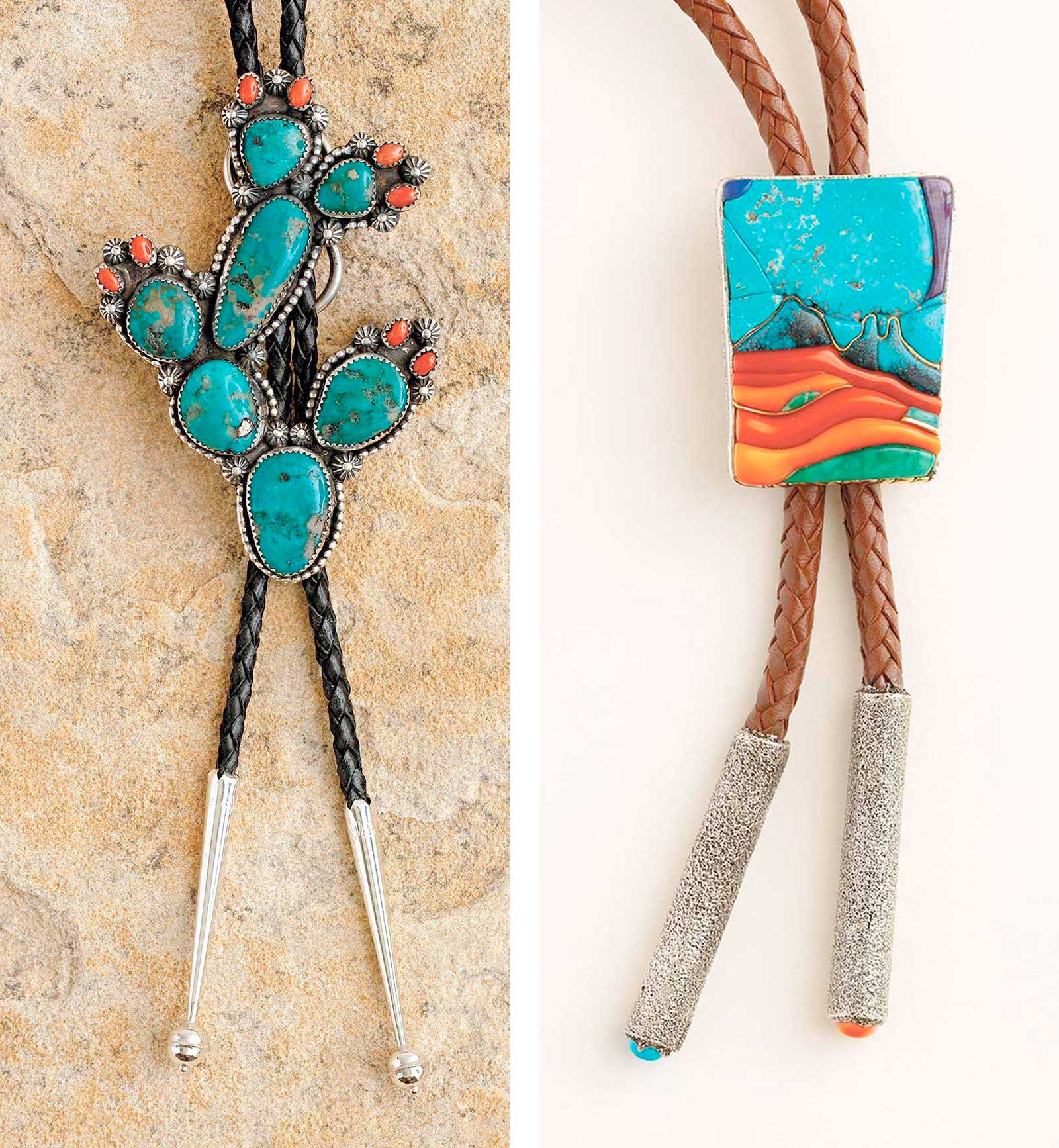
Left: Richard Yazza (Navajo (Diné)), Prickly Pear Cactus, silver with coral and turquoise cabs. Private Collection. Right: Christopher Yazzie (Navajo (Diné)), Navajo Landscape Bolo, silver with inlaid stones. William Matthews Collection
Zuni Pueblo developed its own distinctive style. For centuries, various stones and shells had been drilled and carved, and used for adornment. By the 1890s Zuni artisans were combining their lapidary skills with silver, and creating channel inlay work: Stones are set into silver channels. These artists also used complex stone-setting techniques like needlepoint and petit point.
A number of the young lapidary artists, including Leekya Deyuse, worked at the Hawikku archeological site in the early 20th century. There, they discovered beautiful stone mosaic and fetish carving which was a huge influence on the work that they would develop, under the guidance and encouragement of traders such as C. G. Wallace.
Zuni Pueblo is a matrilineal society. All property is passed down through the female line. When a man marries a Zuni woman, he moves into her house. The workbench is usually set up in front of a window, where the wife will often work side by side with the husband. I have heard from many family members, that their mothers were intricately involved with their husband’s work. Ida Vacit Poblano was a gifted lapidary who worked side by side with her husband Leo. After Leo died prematurely, Ida completed many of his projects. Frank Vacit’s daughter Bessie said, “My mother worked at the same bench as my father, and she did a lot of the stone work.” It’s a story I heard repeatedly, and always with an element of indignation. The wives of these famous artists seldom received the credit they deserved.
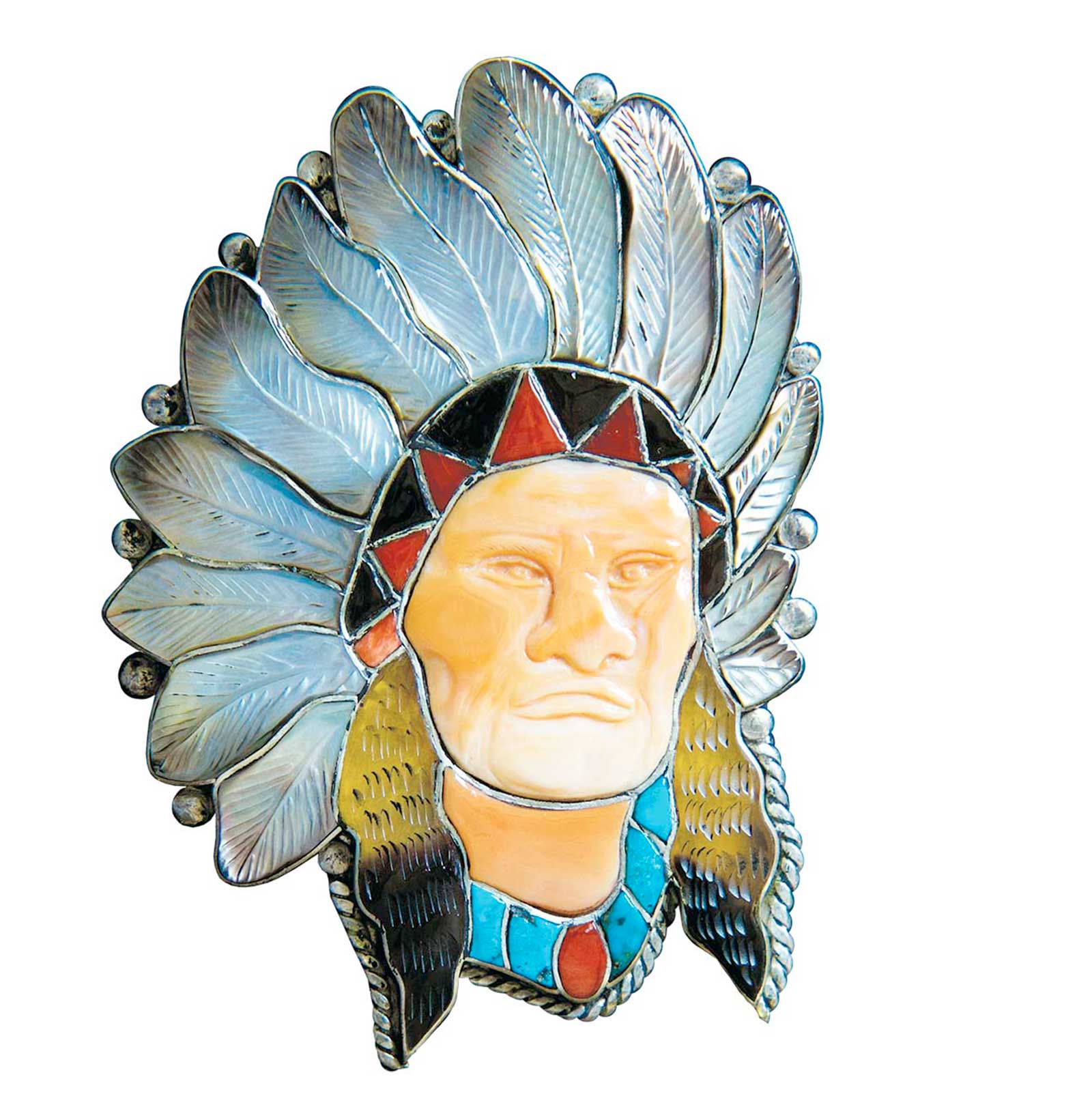
Virgil & Shirley Benn (Zuni/Hopi-Tewa), Indian Chief Bolo, 1970s. Amerind Foundation Collection.
As an artist myself, I have highlighted many of my favorite artists and craftsmen. I’ve also tried to draw attention to the fact that women have been under-represented in the history of Native jewelry making, particularly with bolos. Early on, there were female lapidary artists who did amazing inlay work. Famously, in the late 1920s, Della Casa Appa would sneak over to C. G. Wallace’s shop after hours with her silverwork. She assumed that the other villagers would disapprove. But the women took notice, and during the Depression, by 1940, there were more than two dozen women doing silver and lapidary work at Zuni.
Jewelry-making in the pueblos and on the Navajo reservation has become a very important part of the economies of these communities. There is a great incentive to find the best turquoise and shells, coral and stones—the materials are where the jewelry work begins. Many bolos start with a beautiful piece of turquoise, either as a nugget or a cabochon, already shaped, polished and ready to be set. Then the silverwork is created around the stone. Early work was often smoothed to a flat surface. Modern tools and grinding wheels now allow for much more dimensional work, resulting in more texture to the inlay.
Much of the early Zuni lapidary work was done with crude and primitive tools, and yet the refinement of craftsmanship is extraordinary. Styles and techniques have certainly progressed, and the work today is magnificent, but the early lapidary work has a magic all its own. Just handling these masterpieces is thrilling.
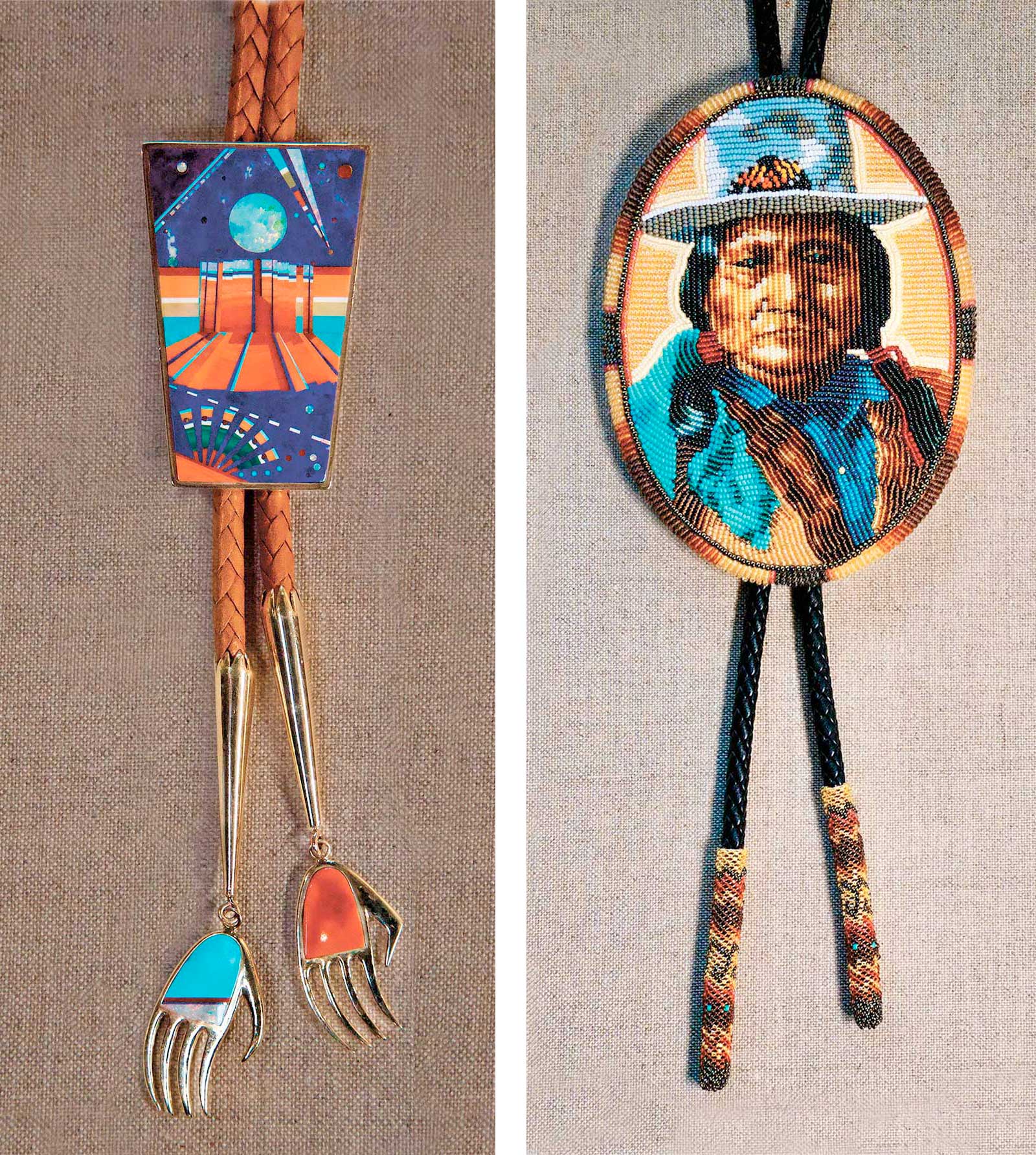
Left: Jesse Monongya (Hopi/Navajo (Diné), 1952-2024), Monument Landscape Bolo, gold with lapis, turquoise and coral inlays. Richard A. Gates Collection. Right: Jackie Larson Bread (Blackfoot), Sitting Bull Bolo, 2019. Larry Meeker Collection.
Bolos became very popular in the 1940s and ’50s, and a lot of the best work was developed during that time. It was the renaissance of Native American jewelry making, particularly for bolos. As fashion comes and goes, the bolo cycled back into fashion in the 1970s. Lots of movie stars and well-known musicians were wearing them, and that sparked a resurgence of interest. But beautiful bolos have always been created by young imaginative artists, and they continue to be made today. There are a number of buying and selling opportunities that take place each year. The Santa Fe Indian Market is held each August, and the Heard Museum in Phoenix has a number of events, particularly in March.
Although we know approximate dates, none of the early bolo work was signed or dated. Apart from the sparse provenance available, we have to speculate about who did what work and when. The back of the bolo is the only real source for that information, and we have included a couple of pages with examples of how the bolo backs developed. Family members of the artists and their neighbors have also been a great help in establishing who did the work.
A number of people before me have done extensive research. Toshio Sei has published important books on early Zuni work. Diana Pardue and Norman Sandfield published Native American Bolo Ties, through the Heard Museum in 2011, which is well-researched and great source of background information…Still, it’s surprising how many questions remain about the bolos and their history, as nobody knows exactly when the first bolos appeared.
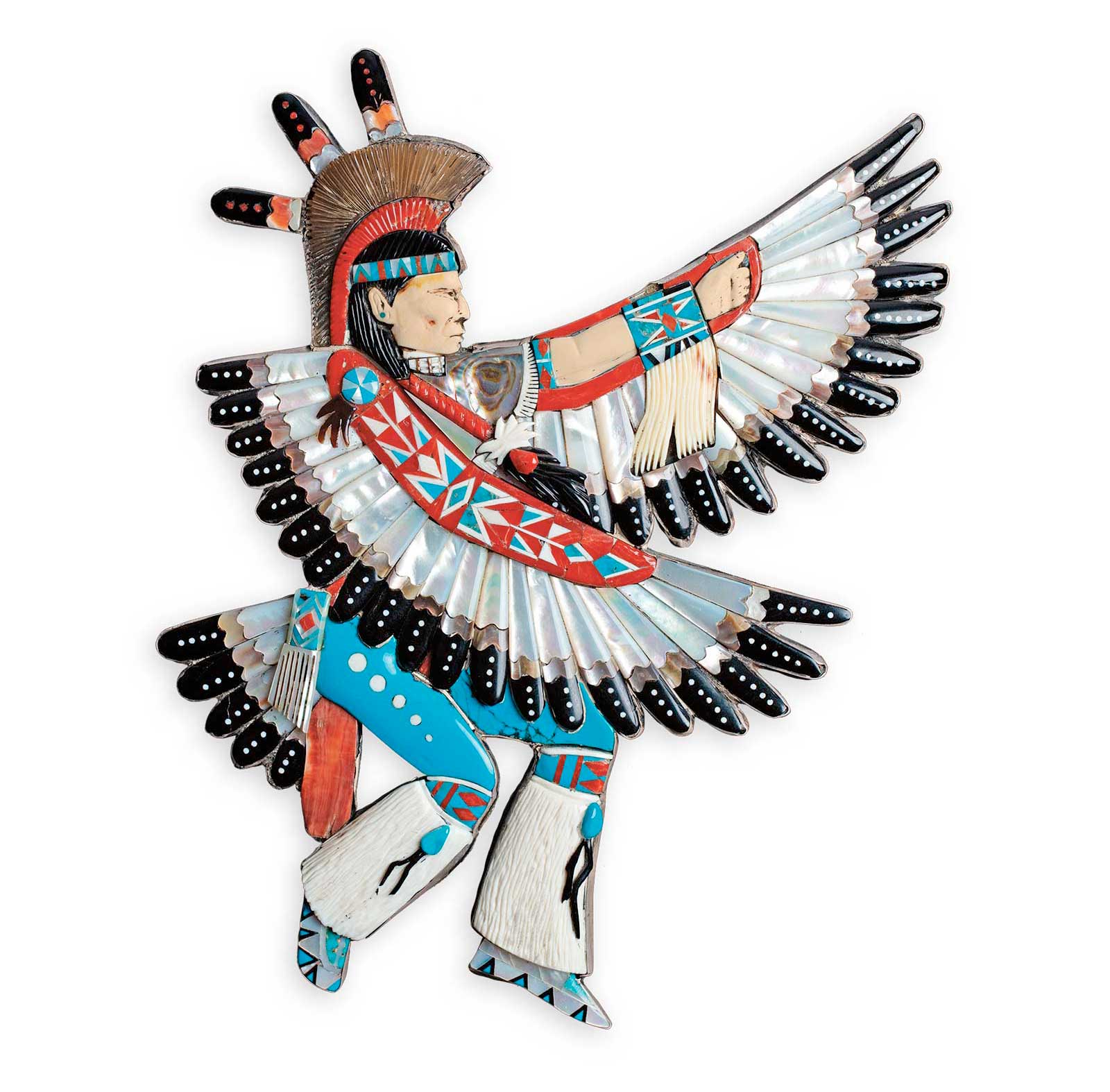
Carlos White Eagle (Mescalero Apache, 1937-2013), Eagle Dancer Bolo, silver with various materials inlaid and carved stones and shells. Private Collection.
The goal of this book is to show how beautiful and thoroughly imaginative the craftsmanship of these bolos are. The work spans almost a hundred years, with the early, more rustic pieces showing a beautiful worn patina. The contemporary work, by contrast, is brighter and more experimental. This is not a comprehensive study of the bolo, but rather a view of the bolos that I find the most interesting. I have arranged the book somewhat chronologically, but the subject matter also drives the page sequence. The photographs really tell the story.
Many of us grew up watching TV Westerns with the Lone Ranger, Gene Autry, Roy Rogers and Hopalong Cassidy, wearing his trusty steer-head scarf slide. If we were Boy Scouts or Girl Scouts we wore a bolo with our uniforms. Somewhere deep within us all, the bolo has had a hold, and the combination of sterling silver with the mysteries of turquoise never ceases to seduce our aesthetic selves. That’s where this fascination really stems from and where this book originates.
Bolos have certainly found an audience, and they have been worn by Westerners for a hundred years. They are now the official neckwear of Arizona, New Mexico and Texas, and they are even allowed on the floor of the United States Congress. But bolos are still considered somewhat unconventional and bohemian, even avant-garde. Artists and musicians adopted the bolo many years ago, and now businessmen wear them as an alternative to the necktie. Perhaps this book might spark a bolo renaissance. —
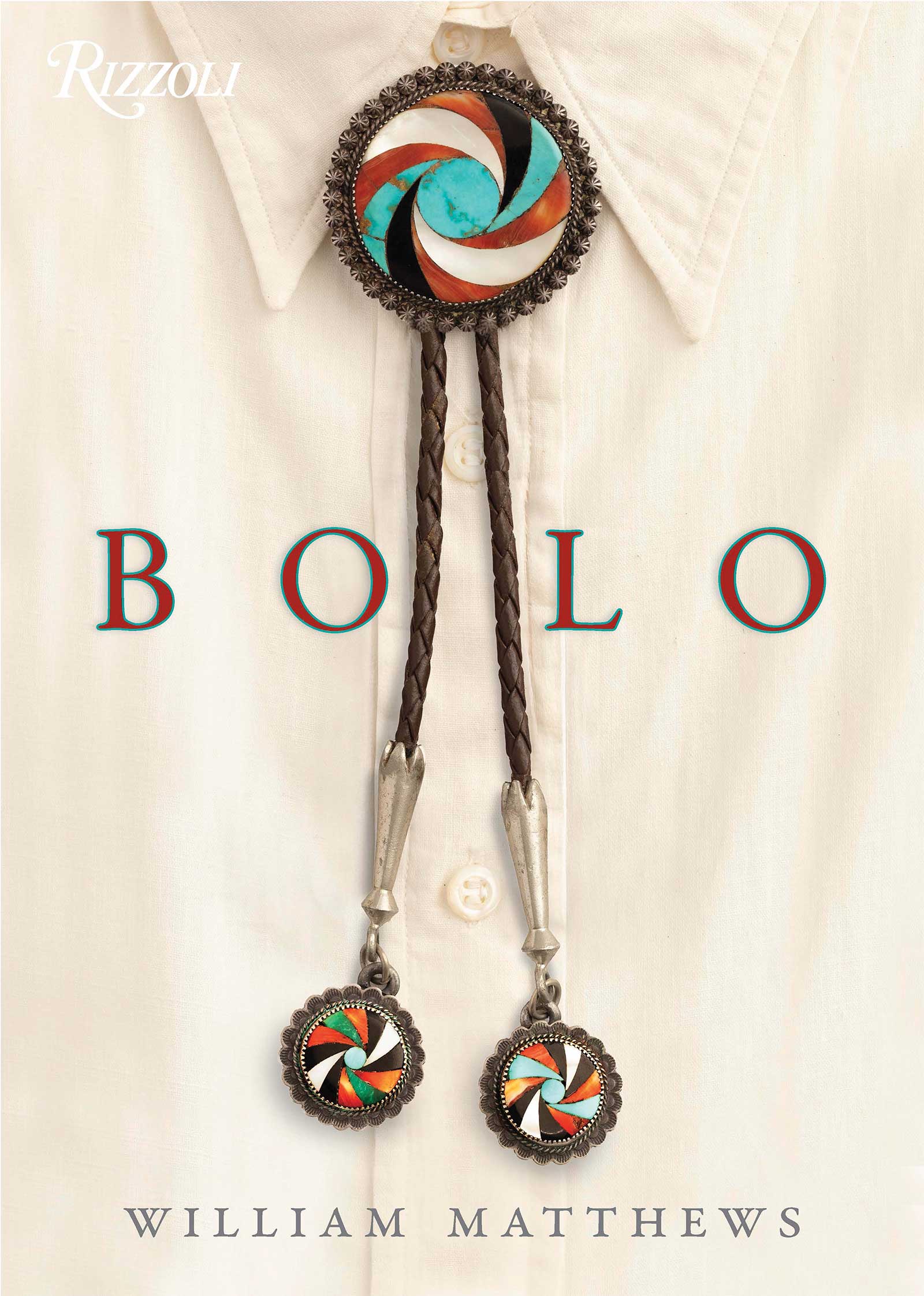
Bolo
By William Matthews
Foreword by Lyle Lovett
Published by Rizzoli, New York, NY
September 29, 2026
400 pages, hardcover
www.rizzoliusa.com
Powered by Froala Editor


