Vintage Zuni-made jewelry continues to appeal. Its popularity persists in the marketplace. Collectors now vie for pieces that were consistently undervalued in the last quarter of the twentieth century. Zuni stone shaping and inlay on silver was deemed craft work because designs could be made in multiples by several generations of family members. Nowadays, this adornment’s abstract and pictorial motifs deserve reappraisal as artistry.
When bolo ties appeared in the 1960s, they gave Native smiths and jewelers a new form of ornamentation to create. Bolos soon became a sought-after highlight for Western wear. While usually devised for masculine attire, makers also shaped bolos to suit feminine tastes. The most imaginative designs animate the central plate of the bolo, drawing visual attention to the wearer’s chest.
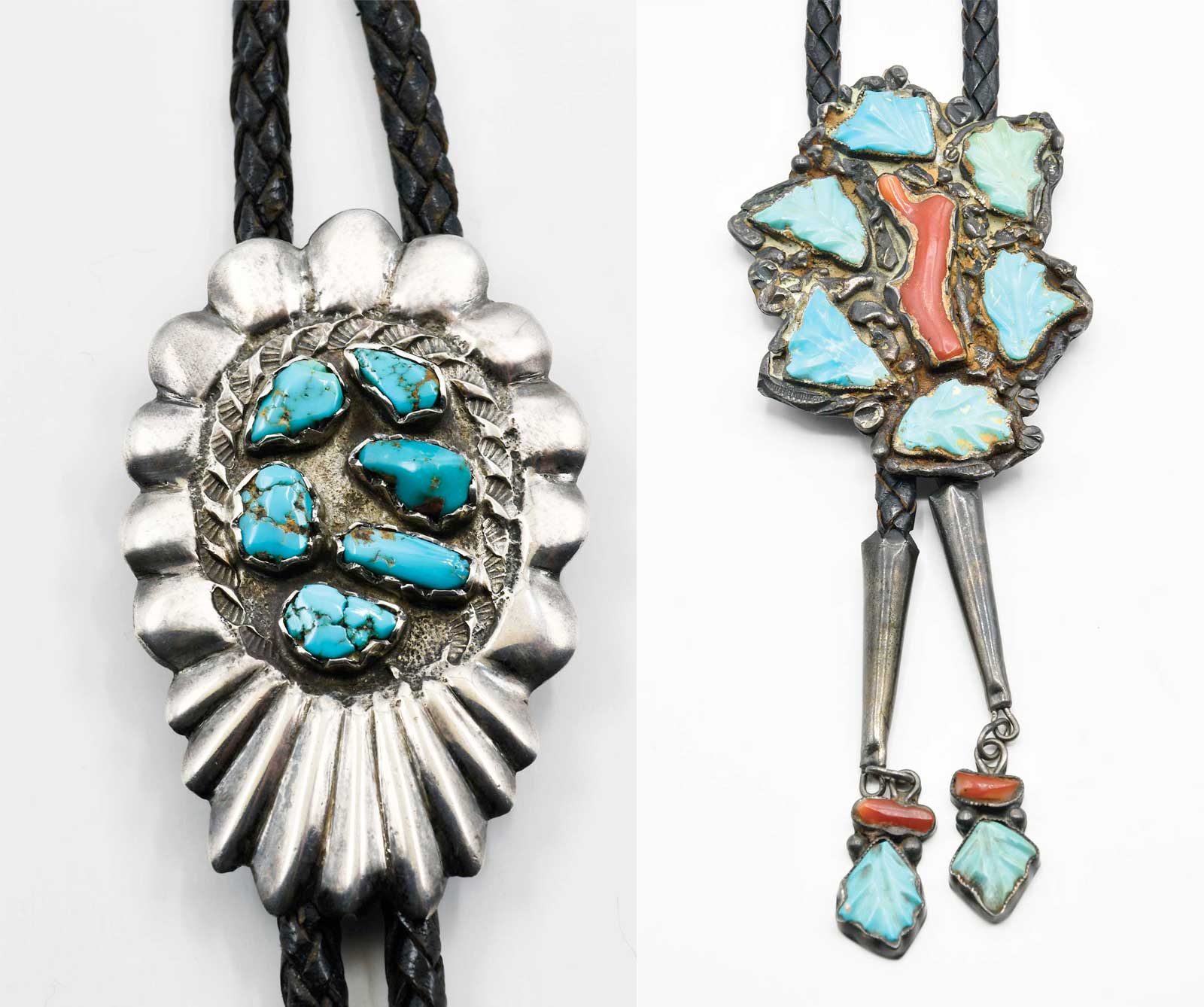
Left: 1930s cast ornament by Juan de Dios (Zuni, 1882-ca. 1940s) translated onto a 1960s bolo slide. Right: A typical abstract design—using carved turquoise, shaped coral, and matching bolo tips by Leekya Deyuse (Zuni, 1889-1966)—likely assembled later in the 1960s or 1970s.
The bolo arrived at a time when craft and fashion forces joined together, causing Indian traders and curio store owners to promptly endorse this new adornment. Zuni silversmiths and lapidaries were encouraged to make the bolo plate a new palette for artistic expression. The pueblo’s jewelry families devised identifiable designs that displayed the styles they were known for. Makers known best for stone and metal work constructed abstract imagery. Lapidaries chose realistic visual motifs of birds, animals, and figural compositions.
These aesthetic special effects can be seen in bolos by seven of Zuni’s finest jewelers: individuals whose works are highly prized by collectors and experts. Each design demonstrates the best features of what is wearable art. These pieces were gathered over a number of years by a private collector in Arizona. When examined as a group, their unique qualities illustrate how Zuni makers dominated bolo design in the mid-20th century.
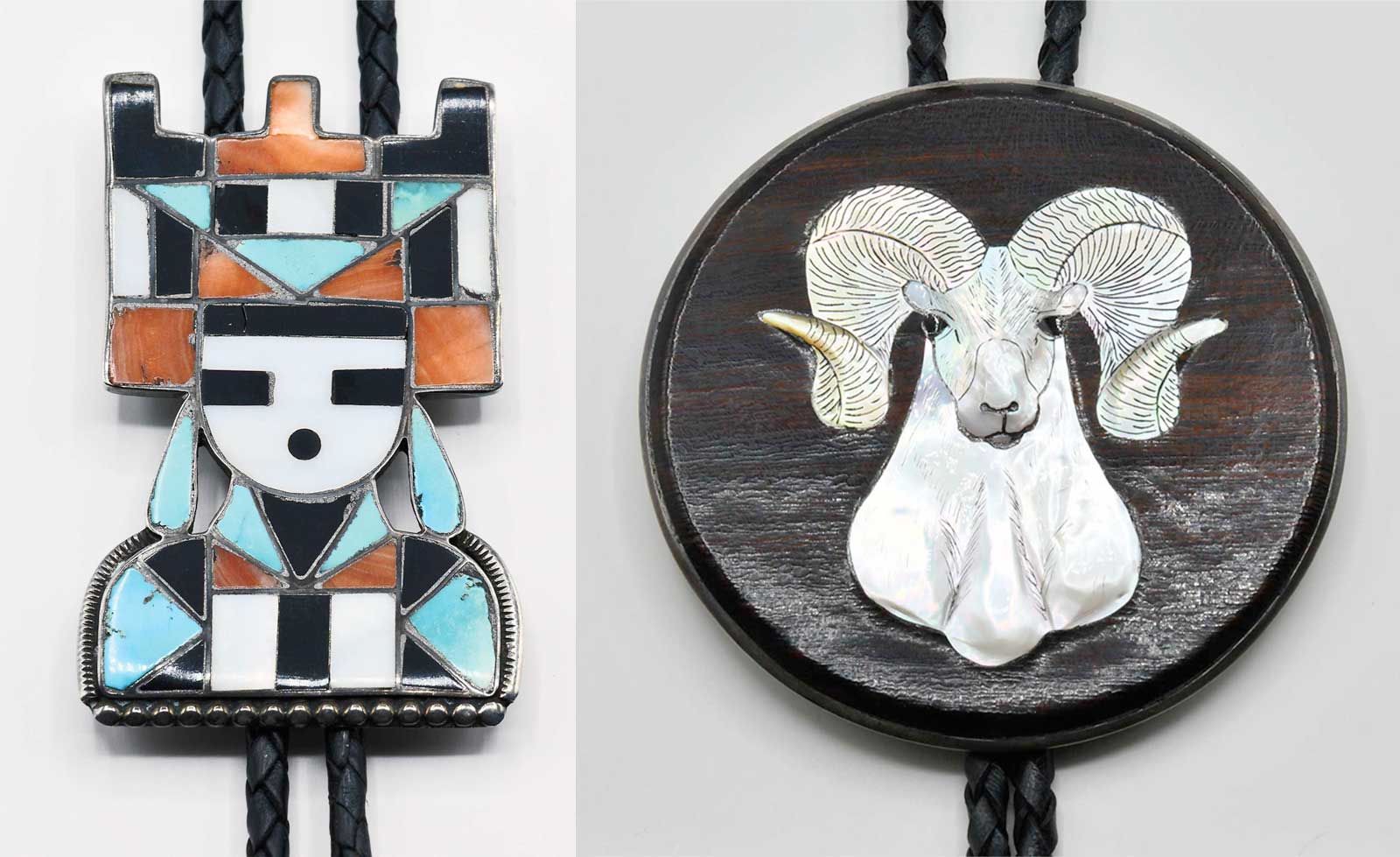
Left: A mid-20th century inlay female figure with tablita by Leo Poblano (Zuni, 1905-1959). Right: Inlaid bighorn sheep mounted on ironwood circle by Elliot Qualo (Zuni, 1930-1974), 1960s or early 1970s.
Sometimes lapidary pendants made before the 1960s could be affixed later to a bolo slide. This was done with an abstract silver and stone ornament originally created by Juan Dedios or de Dios (1882-ca. 1940s) in 1930. The visual effect of nugget turquoise stones resting in a cast silver nest is appealing. This effect can also be seen in a central ornament originally made by carver Leekya Deyuse (1889-1966); his trademark turquoise leaves around a coral center with matching stone and shell tips translate well onto a bolo setting.
Among Zuni jewelers admired for their skill with shell and stone inlay, Leo Poblano (1905-1959) ranks as one of the finest. His flawless mosaic inlay technique enhanced his artistic representations. This delightfully stylized woman wearing a tablita headdress is constructed from precise silver channels. Poblano’s innovative fine relief carving gave depth to his pieces. Because his passing was so untimely, Poblano’s exquisite lapidary work would be added posthumously to bolo ties, a practice we’ve already seen done with other Zuni masters.
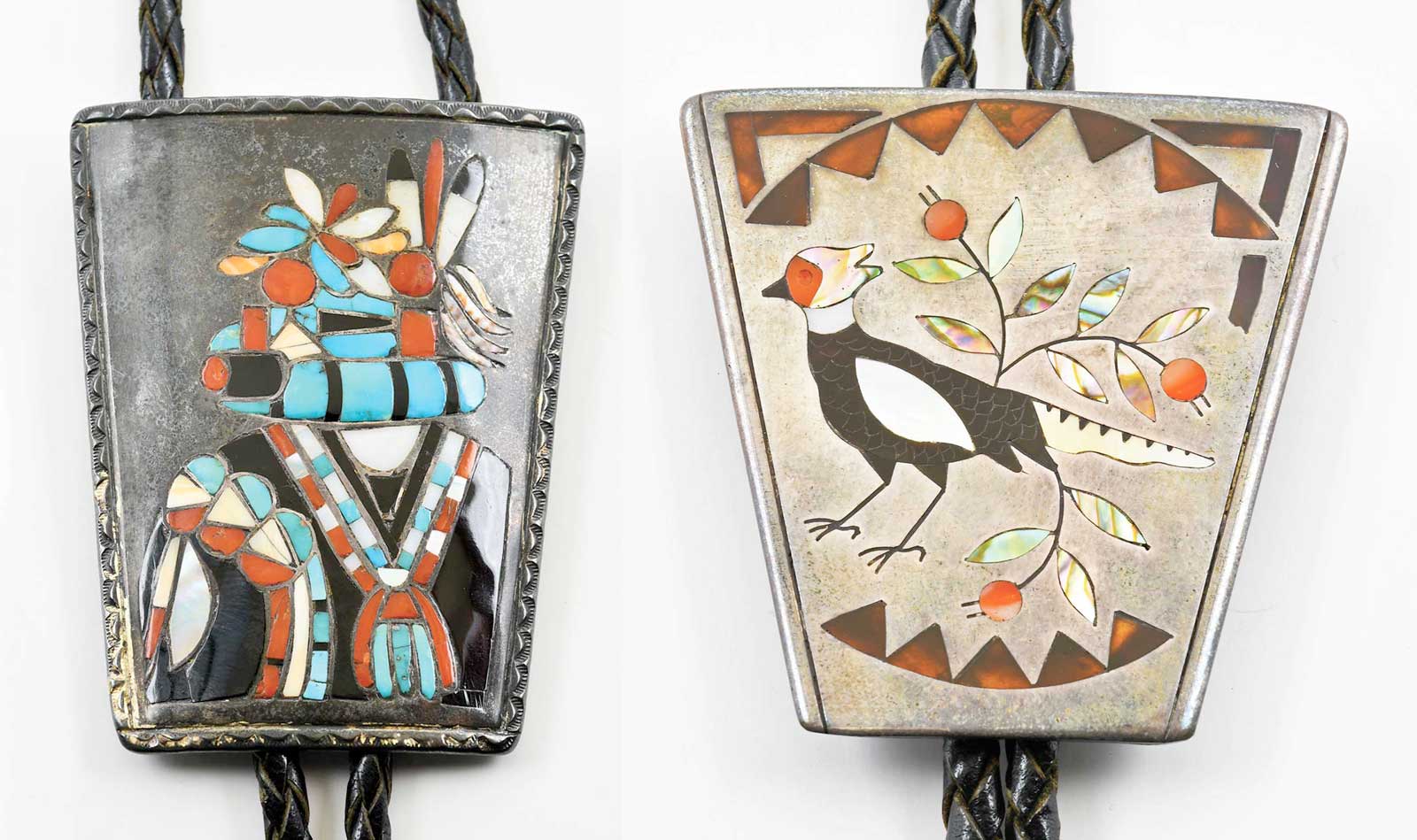
Left: Inlaid katsina figure on trapezoidal silver mount by Frank Vacit (Zuni, 1915-1999), 1960s or 1970s. Right: Dennis Edaakie (Zuni, 1931-2008) inlaid roadrunner also on trapezoidal silver mount, 1970s-1980s.
Simplicity is a design strength in Zuni portrayals. Elliot Qualo worked in inlay from 1960 to the late 1970s; he excelled at rendering dancers and spiritual figures in movement. In this bolo, however, his bighorn sheep stands front and center, as proudly as any human model. Qualo’s superb use of shell is evident, especially in the animal’s horns. This inlay portrait is backed with ironwood, a material brought into prominence by Kenneth Begay and Charles Loloma, two of Qualo’s contemporaries.
Silver trapezoidal slides were often adopted for early bolo construction in the 1960s and 1970s. This shape, offering the security of a plate on which an inlay design could be arranged, would lose favor by the 1980s. Frank Vacit, known for his early channel inlay, used this form for his unique composition of a kachina poised at an angle. Vacit was also one of the first Zuni artists to adopt a hallmark, in his case a fleur-de-lis. Zuni jewelers were adept at creating sacred spirits using cubistic and other abstract forms to enhance their otherworldliness. The trapezoidal slide used by Dennis Edaakie permits his bird to occupy its space in a modernistic mode. His designs are noted for their lightheartedness.
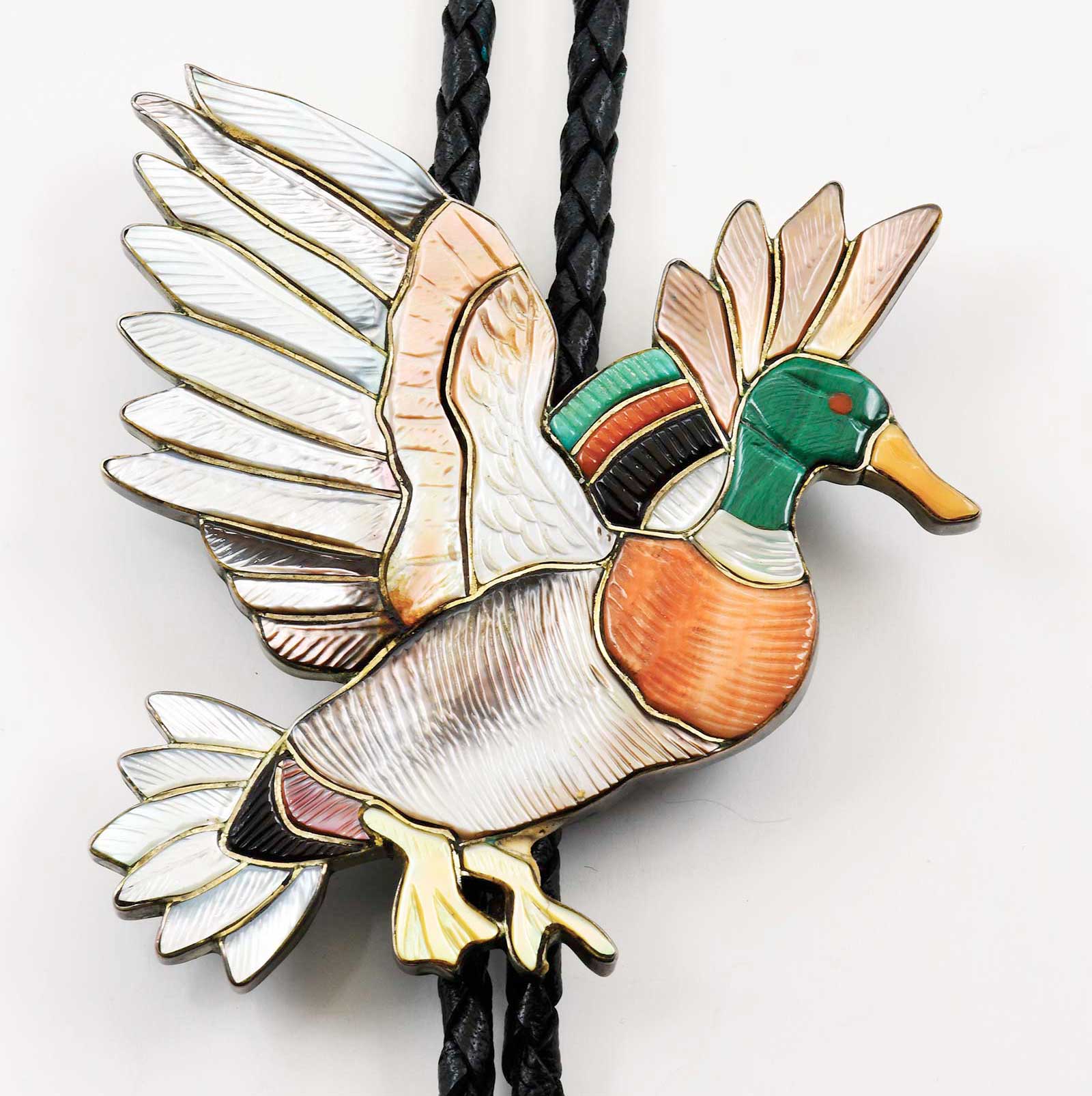
This 1970s inlay bolo by Virgil and Shirley Benn (Zuni) has fine detailing and a realistic silhouette; the word “mallard” is etched on the bolo’s back.
The highly popular mosaic inlay creations of Virgil and Shirley Benn started gaining notice in the late 1950s. Their work stands out in terms of refined execution and animated subjects, especially for birds and animals. This bolo featuring a mallard is notable for its pronounced relief carving for detail and realistically outspread wings ready to take flight. The Benns have gathered a wide following over the years for their vibrant designs.
When Native artists started using the bolo slide as a palette, they began the process of merging craft, fashion, and fine art. These seven bolo designs are also compatible with mid-century modern and folk art expression. They’re seen today as uniquely rendered period pieces. Through these works we better understand why Zuni jewelry retains visual and artistic power in the marketplace. —
Paula A. Baxter, a former curator and adjunct professor from New York, is an independent design historian living in Scottsdale, Arizona. Her photographer is longtime husband Barry Katzen. Her seventh book, Navajo and Pueblo Jewelry Design: 1946 to 2026, was published in November 2026. This is the sequel to her 2022 title, Navajo and Pueblo Jewelry Design: 1870 to 1946. The new book includes Indigenous jewelers who aren’t Navajo or Pueblo but live and work in the American Southwest. This book, Baxter says, has “lots of contemporary Native voices.”
Powered by Froala Editor


