Mentored by his pottery-making grandmothers, and later jewelry artist Kenneth Johnson, Emmett Navakuku was exposed to a wide variety of influences, but none quite like his own Hopi culture and heritage, which is reflected in his stunning silver jewelry.
The renowned artist lives in Flagstaff and Tuba City, both in Northern Arizona, and is the son of Eileen and Garland Navakuku. He grew up in Polacca, Arizona, on the Hopi Reservation on First Mesa. “Both of my grandmothers mentored me. They were doing Hopi-style pottery,” he says, adding that jewelry entered his life when he was 21 years old. Although he has siblings, and they are creative, Navakuku is the only one in his family who has entered art as a profession. He and his wife, Teri Navakuku, have three children, and already art-making is wearing off onto them.
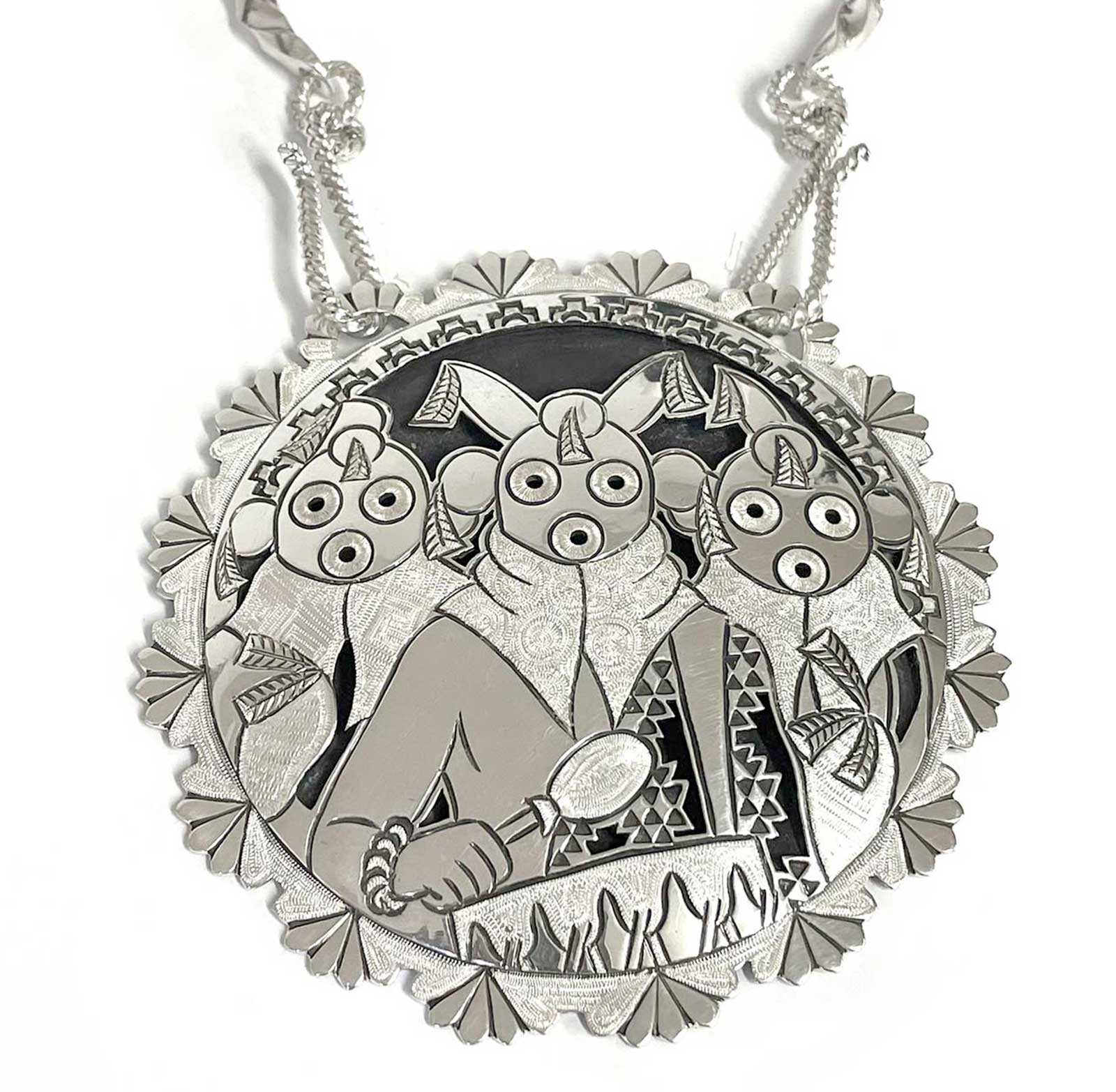
Mudhead Necklace, silver
“I started my early education in the arts in the first grade doing drawing and painting. My mom pretty much has all my early years’ artwork in scrapbooks,” he says, a smile growing on his face. “I got my professional start creating fine art 22 years ago while attending the Institute of American Indian Arts (IAIA). My first class was an elective in jewelry making with Kenneth Johnson in Santa Fe, New Mexico. I schooled with him as a jewelry apprentice for 10 years. I learned so much from that man and I owe him all my gratitude, for sure. Things like engraving, polishing, stamping, sawing, casting and stone setting, prong setting plus bezels...and pavé and flush setting. These are my bread-and-butter techniques to build my jewelry.”
Stamping is especially important in his work. “Stamping is taking steel tools with designs on them…and hammering them into the metal to create shape, design and textures,” he says. “[I make my own stamps] if I need a certain shape or certain line stamp. I will file it by hand and tweak it to fit my designs. I have been in my own studio for the last 10 years. My studio in Tuba City is 12 by 30 feet.”
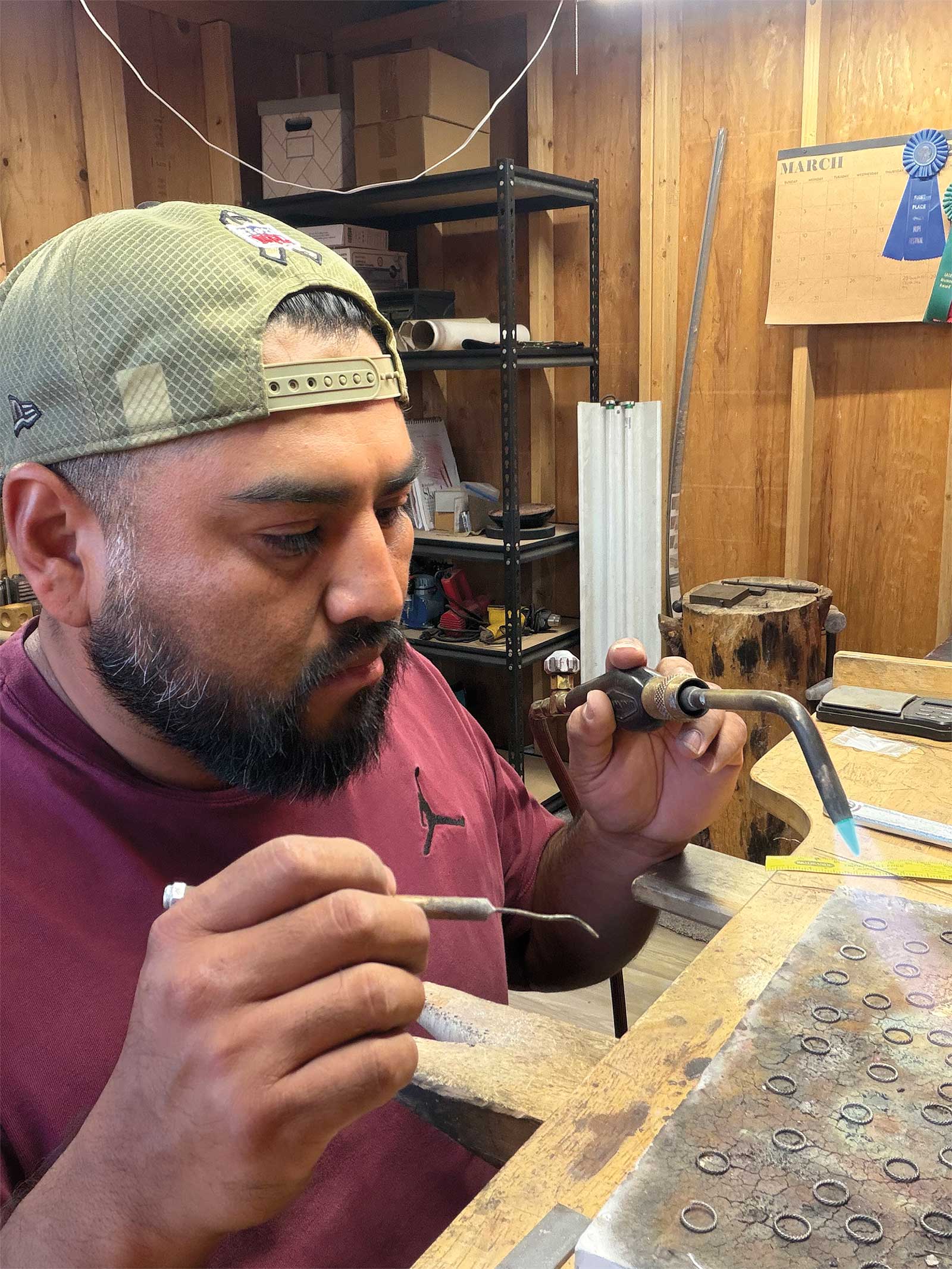
Emmett Navakuku in his Arizona studio.
In recent years, Navakuku has explored painting, although jewelry is still the primary method of creativity in his studio. “I like jewelry and give it a slight edge. I can build and fabricate, plus implement sculpting techniques in metal by using my line work in jewelry pieces. If I were to describe my work and processes to build jewelry, I would say overlay technique which is a more contemporary style than what is typically used today. I do not like simple flat designs,” he says. “I like to give them depth by using dapping tools to create some broader dimensions. I use steel mandrels to shape and form metal. I also like hand-push engravers, plus power-assist engraving tools. I especially love my chasing tools…I put the metal in a heated pitch bowl and place it on top and let it harden just enough to hold the piece, but still warm inside, then chase it to the desired shape…[Chasing is] the art of moving metal to a desired shape with steel hand tools and a chasing hammer.”
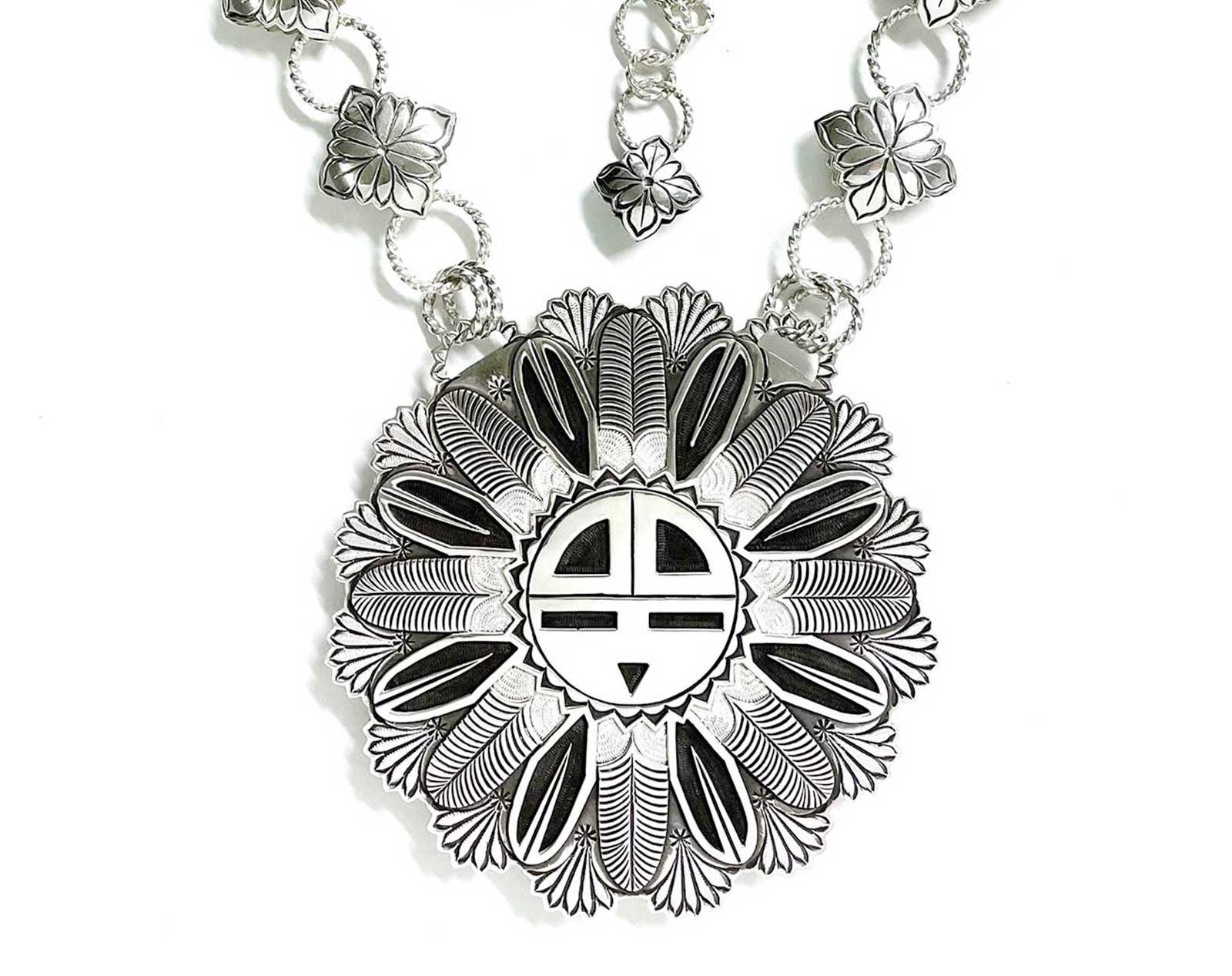
Sun Necklace, silver
When it comes to his designs, the artist makes sketches prior to starting the metalwork. “Contour and flow are very strong in my vocabulary and sketching helps a lot. I want to make sure the design in my head fits the metal, then I carefully lay it out to conserve as much metal as possible. The designs will usually change along with the building process. Also, with today’s prices of precious metals, it is very important to conserve and reuse. That is a form of profitable recycling,” he says. “I think that, for me, there are two different approaches [to design]. First, there is two dimensional, giving an object its form. Then our culture is applied to metal. My ability to draw and paint really helps my jewelry come together.”
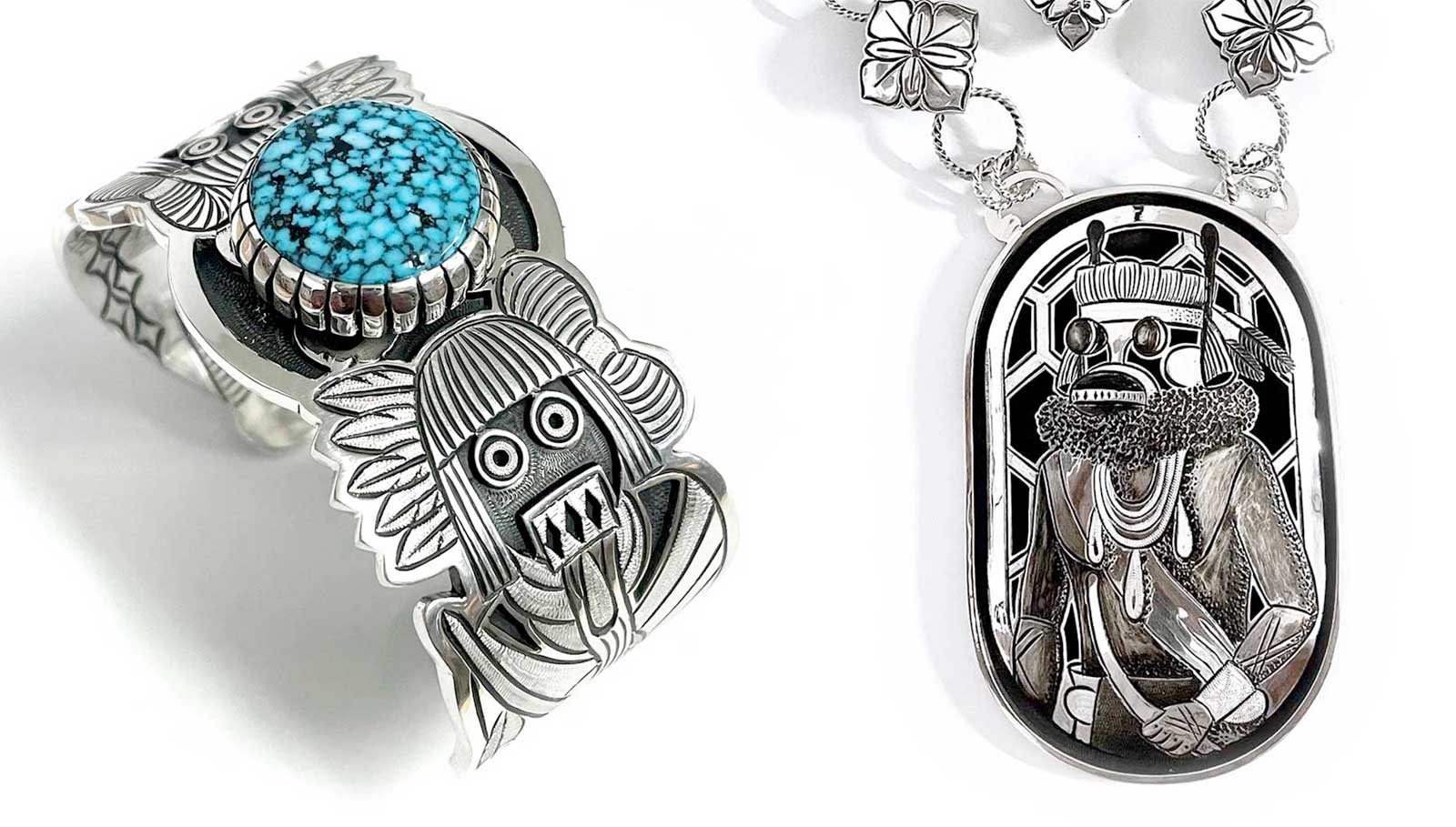
Left: Warrior Maiden Cuff, silver with turquoise Right: Bee Katsina Necklace, silver
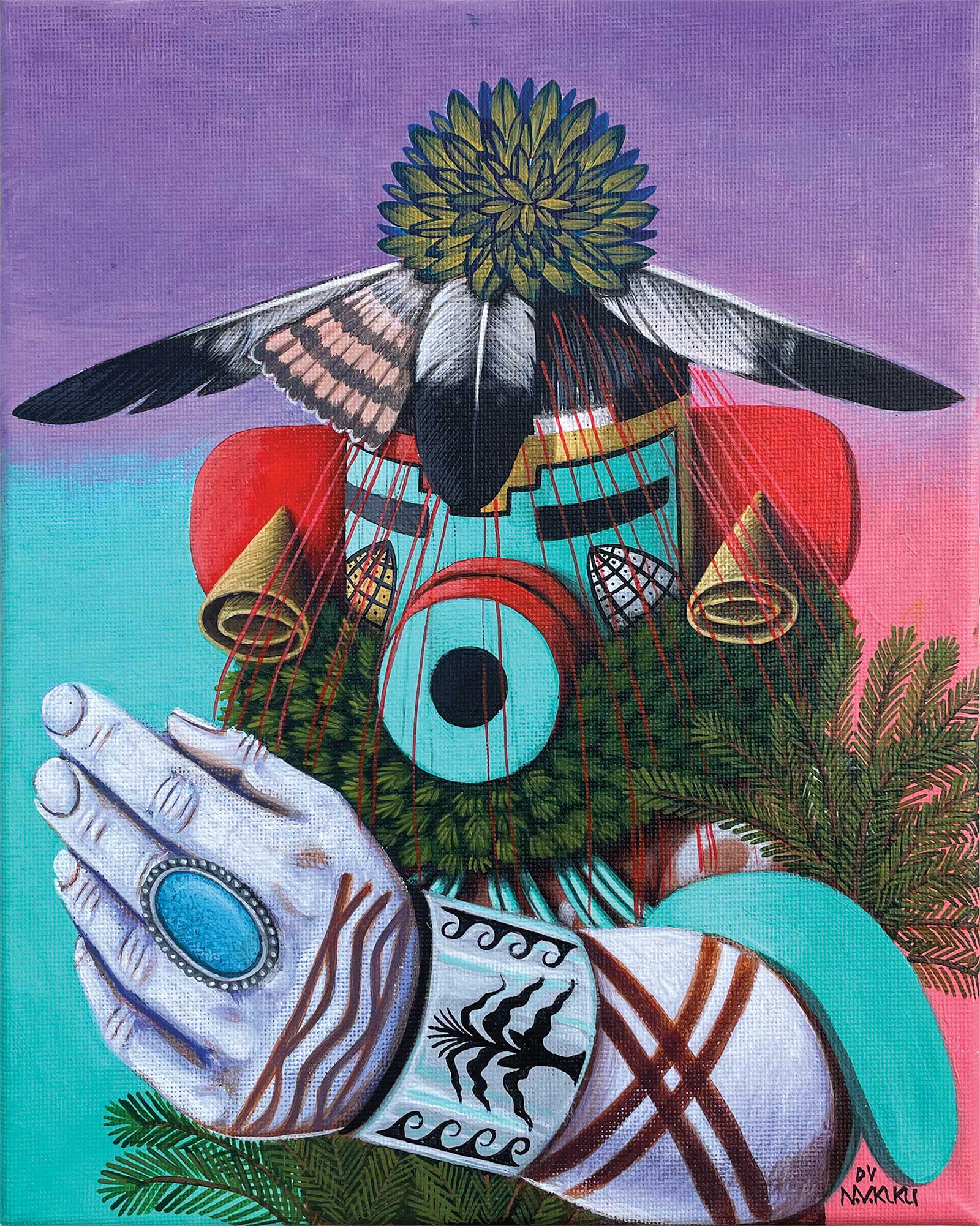
Avatshoya (Spotted Corn Katsina), acrylic, 8 x 10 in.
The artist says his name, Navakuku, means Snow Feet. “What it means to me is it has been a name that holds a long lineage, and it’s like everybody that has that name has been known to work hard, and we have all been educated. I carry on that last name, and I have been blessed with the talent that I have through that lineage.”
Lineage, heritage, culture and family—these are elements of Hopi life that mean a great deal to the artist. Sometimes they are manifest through Hopi figures. “I think my favorite is the Longhair Katsina which represents rain. I think that is a favorite katsina design of most of the collectors that love our art as well. We need rain so desperately, and it sells well, so I make that design often in bolos, pendants and bracelets,” he says. “The Mud Head is also very popular, then a Dawa, which represents the Sun.”
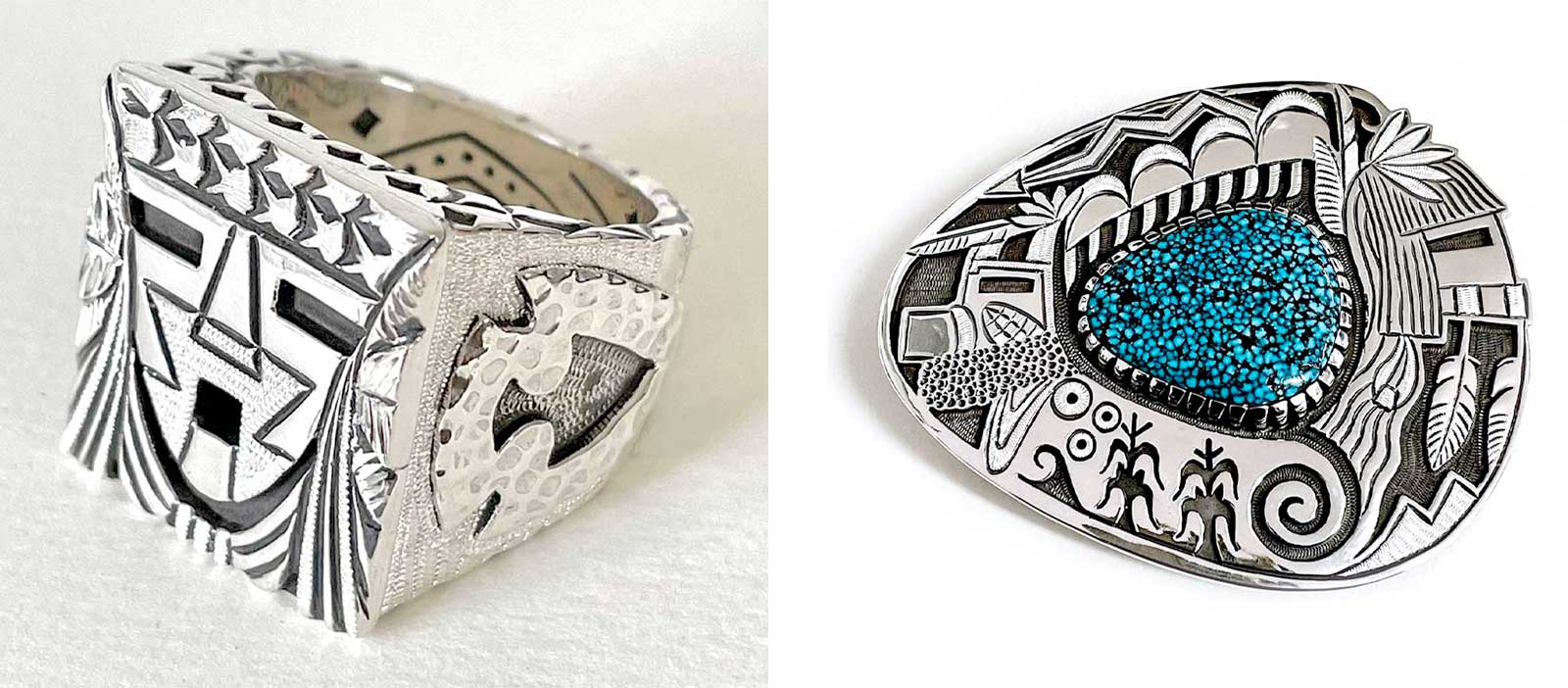
Left: Comanche Ring, silver Right: Corn Dancer Buckle, silver with Kingman Turquoise
As collectors have come to recognize Navakuku’s work, so have judges, curators and experts within the jewelry-making genre. He’s won top awards at events all around the Southwest, including at IAIA, the Autry Museum’s American Indian Arts Marketplace, the Museum of Northern Arizona and the Heard Museum’s Indian Fair & Market. “I won first place at the Heard in 2023 for my jewelry, a Hilili silver cuff. Hilili is a katsina design [for which] there is no real English translation, but they dance really fast, and they are known to guard the ceremonies we have,” he adds.
Navakuku and his wife are encouraging of their children when they show interests in art, something that was gifted to the artist when he was growing up. “My 16-year-old son, Tahlon, went through a small period where he did stamp work on copper. He finished bracelets, rings and earrings all in copper. Kaitlyn is 13 years old and wants to learn jewelry making like me. She just today told me that. She favors drawing and painting now,” Navakuku says. “Andrinna is our youngest child at 11 years old and at this time is not interested in art—she is into modeling.”
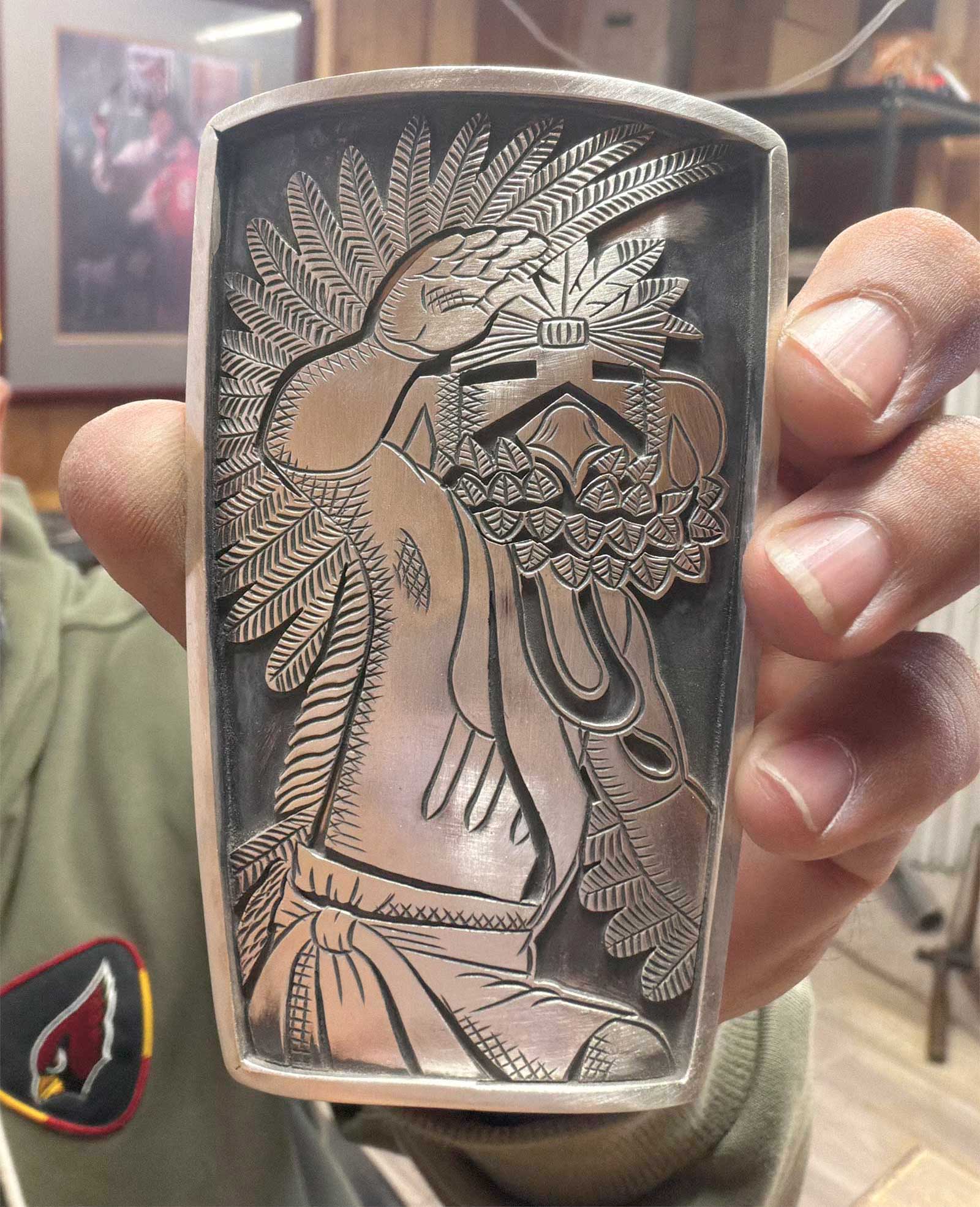
Eagle Dancer Necklace nearing completion in the studio.
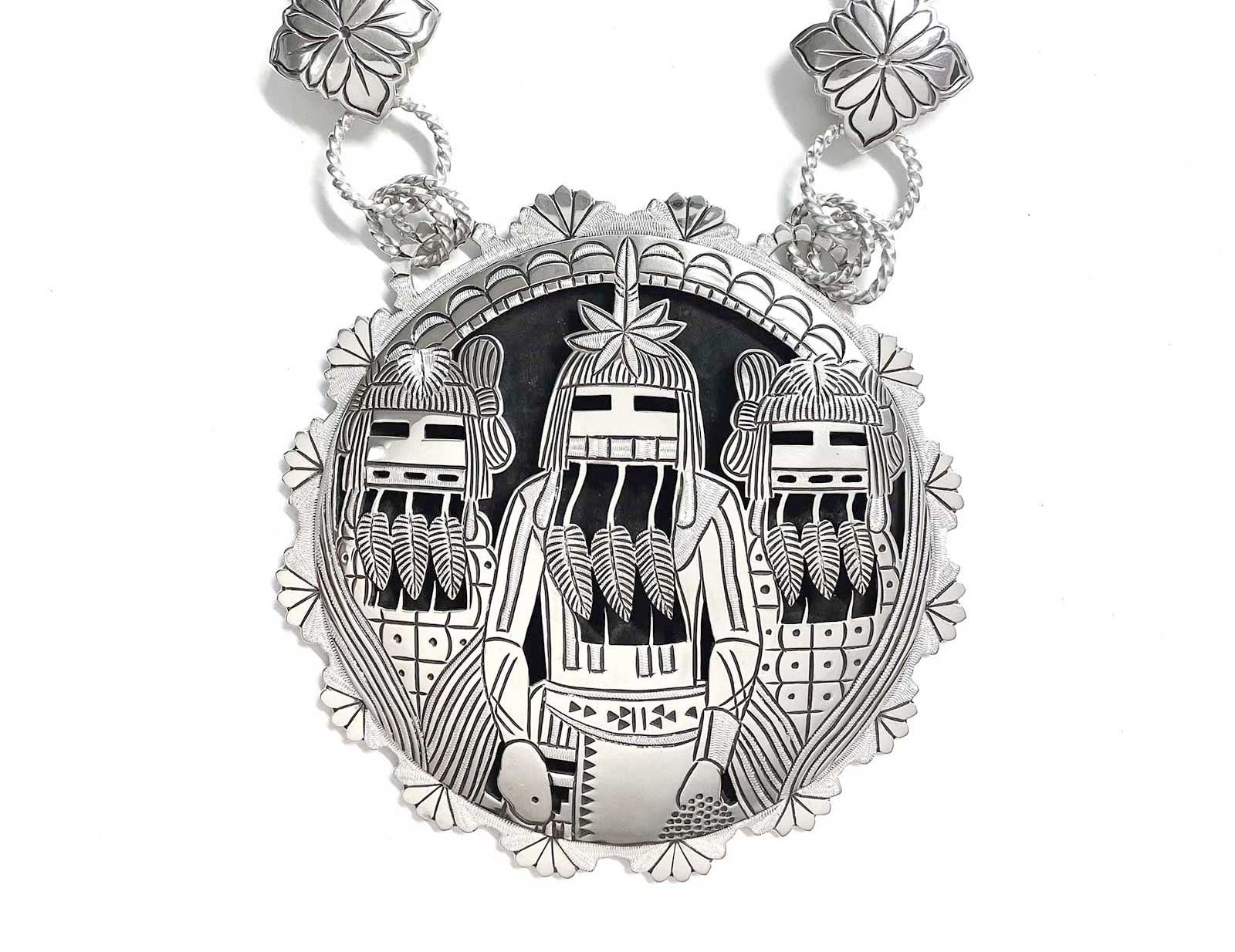
Longhair Katsina Necklace, silver
He continues, “We teach our Hopi ways [to our children]. Definitely. We talk to our kids about Hopi values and beliefs and all the things we must do as Hopi people. We always talk to them about language, farming, ceremonies and we make sure we live that lifestyle to the best of our ability. It is our responsibility to adhere to those values. It is our children that will carry on and teach these values to others, but most of all to their own children.”
The jeweler has been busy in the studio, where he works up to 10 hours a day, more as he gets closer to each market or show. He recently completed an Eagle Dancer Katsina bolo that was a commission. His work sells anywhere from $200 to $10,000, although he has completed an $18,000 piece made in gold and set with coral. Another recent work was a Deer Dancer bolo. “This katsina is very spiritual to Hopi. Animals give medicine and strength. If you take the animal while hunting, obviously you pray to that animal to give us the strength that they have for our entire family,” he says. “They are very powerful beings. We do not hunt just to hunt. We do not benefit other than the spiritual aspect and food to keep us alive.”
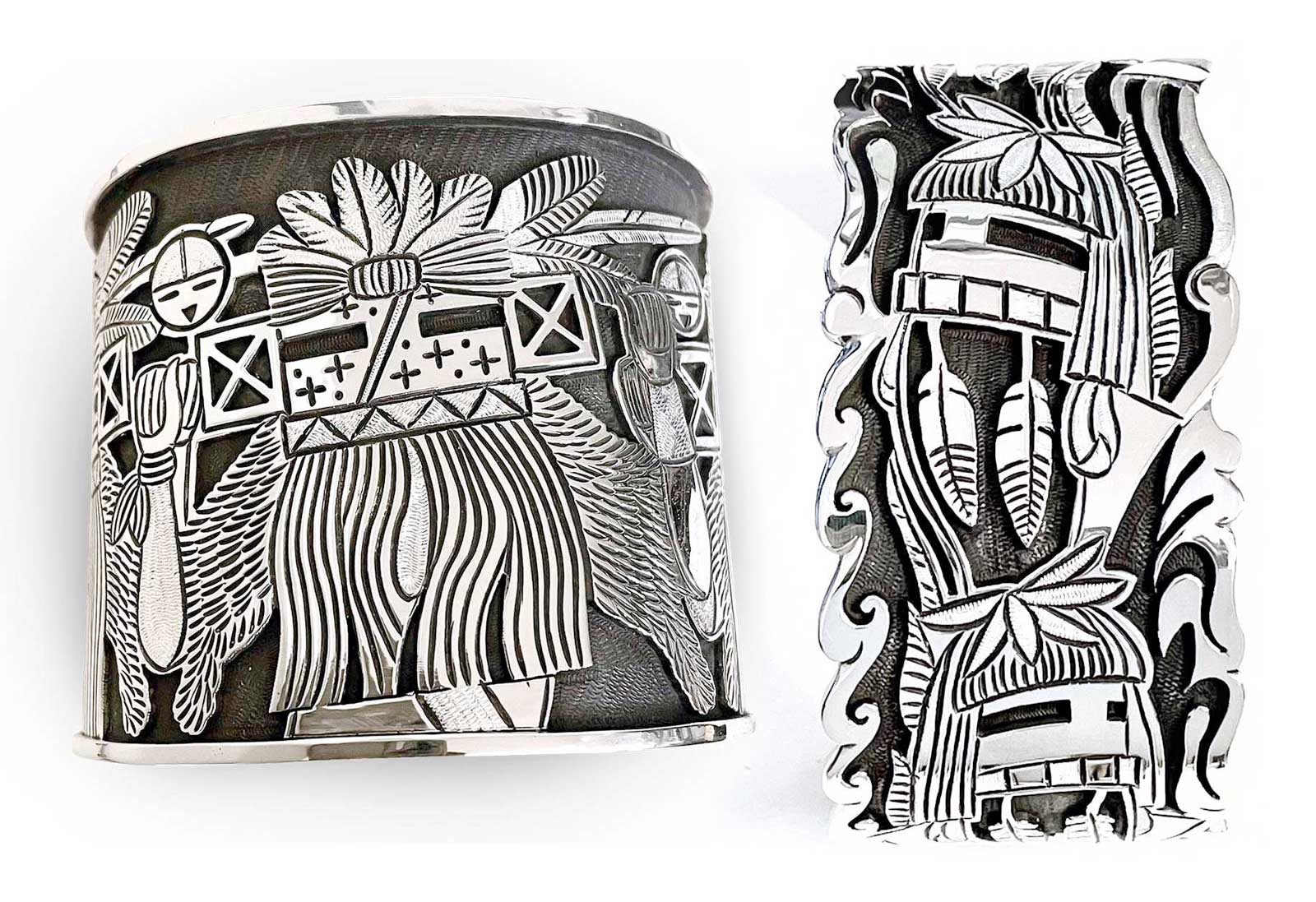
left: Hilili Cuff, silver Right: Longhair Katsina Cuff, silver Photos courtesy the artist
These sacred beings, coupled with Navakuku’s fascinating technique, have created remarkable work during an exciting period of Native American jewelry. For the artist, it’s all rather simple—“I love my job!” —
See More
Browse his art on Facebook (/emmett.navakuku), Instagram @enavakuku and TikTok (@enavakuku).
John F. Heusler has been a jewelry maker and gemstone cutter for 57 years. He teaches classes in both lapidary and jewelry design. He can be found on Facebook under the name John F. Heusler, and Instagram (@gemologistjohn2). His website is www.baldymesastudios.com.
Powered by Froala Editor


