There is a story that most museums have chosen to begin at the wrong place. Walk into nearly any major American institution’s Native American or contemporary art galleries and the narrative typically opens somewhere around 1970, with the founding generation of the Institute of American Indian Arts, and moves forward from there into the vivid, market-savvy contemporary moment we now recognize in the work of artists like Jeffrey Gibson, Dyani White Hawk and Rose B. Simpson. It is a true story. It is also an incomplete one. Tony Abeyta is a painter, independent curator and son of the Navajo painter Narciso Abeyta, known as Ha So De. For him, the real story begins 70 years earlier, in a period American art history has largely declined to claim as its own.
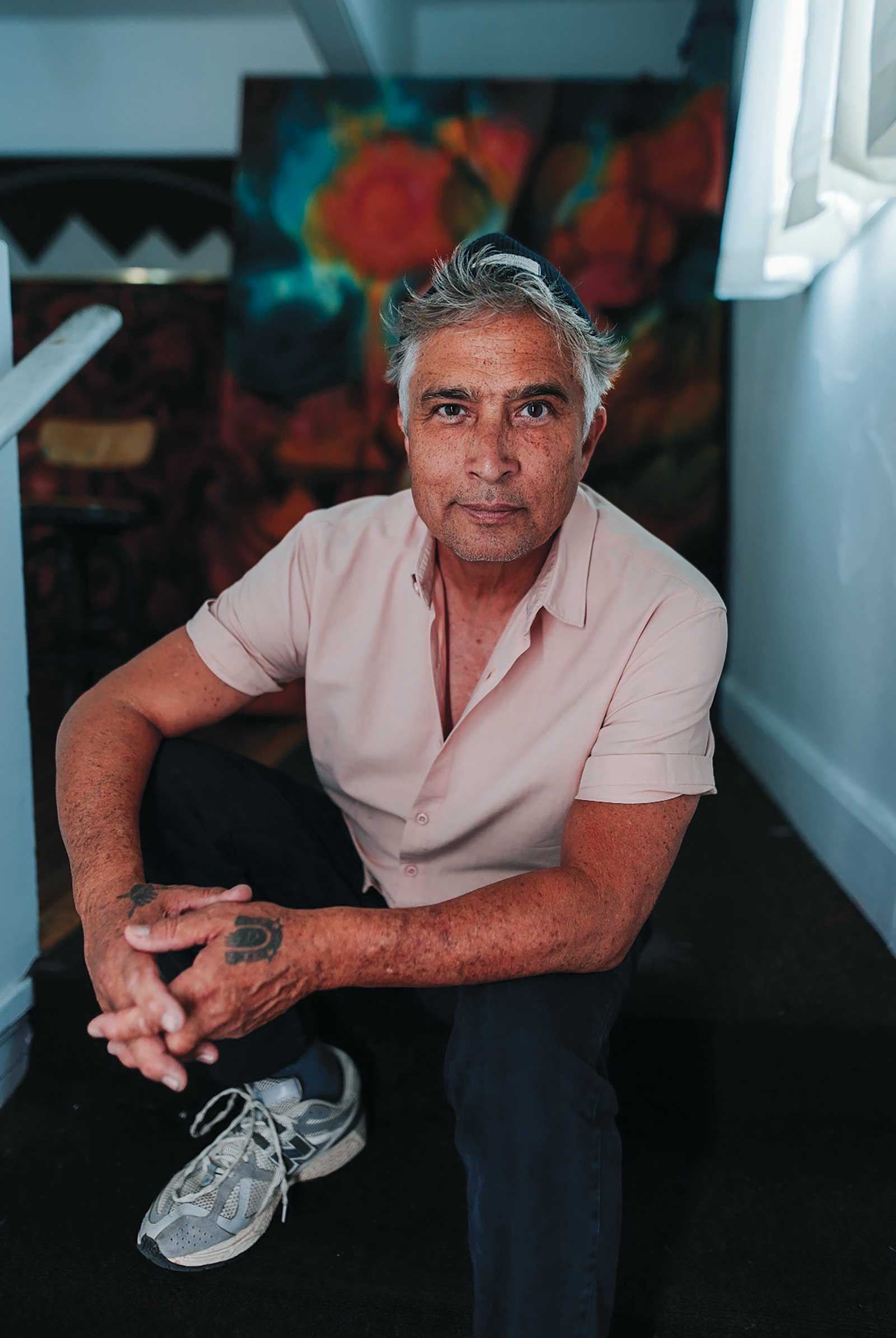
Tony Abeyta in his Santa Fe studio. Courtesy the Agua Caliente Cultural Museum
This year, Abeyta is mounting three exhibitions that, taken together, argue for a different starting point. Spanning venues in Palm Springs, California; Cartersville, Georgia; and Phoenix, Arizona, the shows reconstruct the first half of the 20th century, roughly 1900 to 1970, as the essential, unglamorous groundwork beneath everything that followed. It is a period defined by boarding schools and forced assimilation, but also, in Abeyta’s telling, by extraordinary artistic exchange, entrepreneurial resolve and the quiet construction of an American art movement that has never fully received its due.
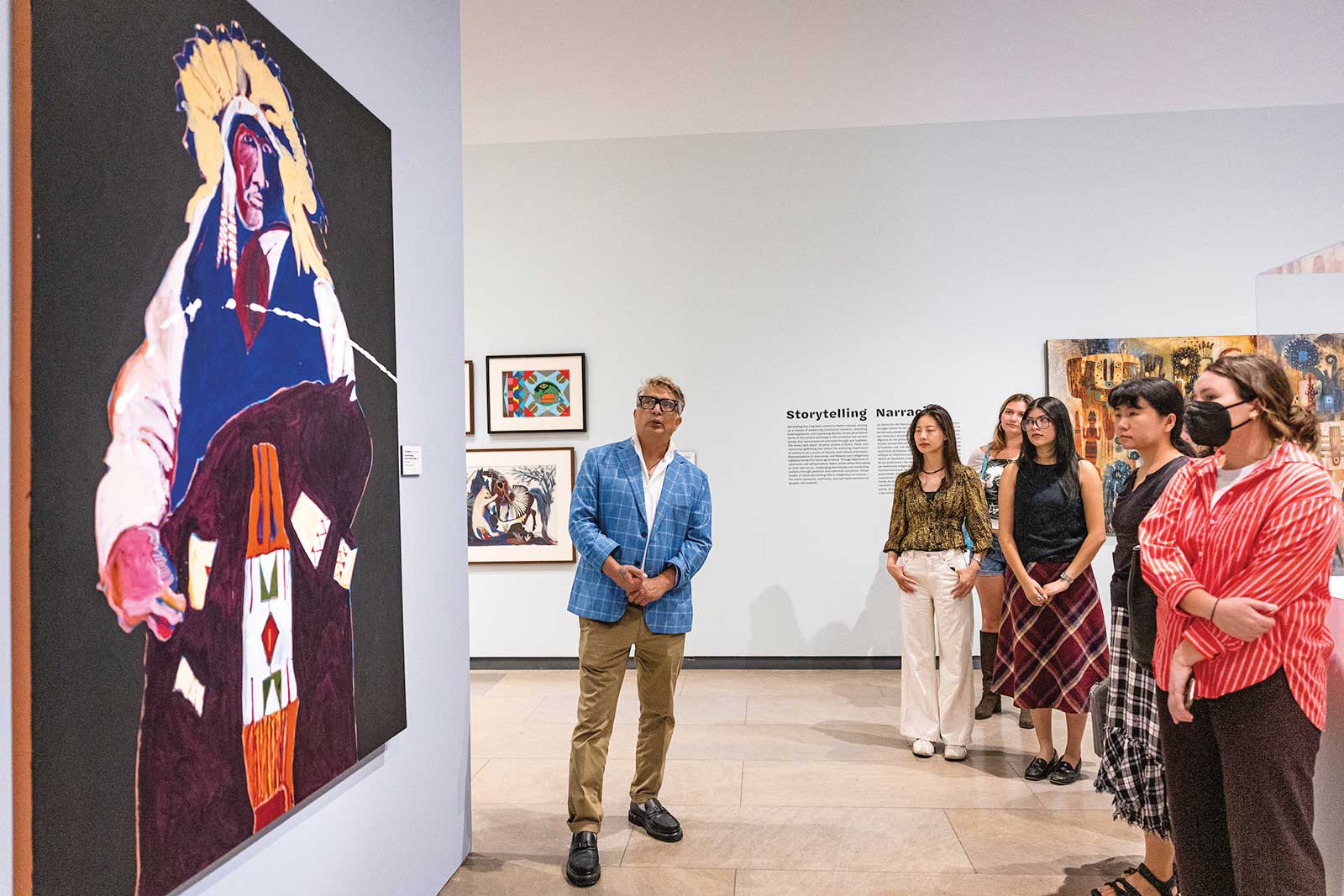
Phoenix Art Museum guest curator and Navajo artist Tony Abeyta discusses Fritz Scholder’s Indian with Pipebag from the exhibition The Way We Came: A Century of Indigenous Art, with Arizona State University graduate students in August 2026. The exhibition runs through July 11, 2027. Photo by Charlie Leight/ASU News.
Before the Institute, a Studio
To understand what Abeyta is building, it helps to understand what came before the Institute of American Indian Arts (IAIA). In the 1930s, under the direction of teacher Dorothy Dunn, students at the Santa Fe Indian School worked side by side in a shared studio space, developing what became known simply as “the Studio style,” a collective visual language built through daily proximity and, as Abeyta describes it, a healthy competitiveness among peers. Painters were, in his words, working “in tandem with one another,” refining a shared vocabulary that eventually splintered into distinct individual voices.
That splintering is central to Abeyta’s thesis. He points to painters like Fred Kabotie and Waldo Mootzka, whose early work is, by his own admission, difficult to tell apart. “I can’t tell if that’s a Waldo Mootzka or that’s Fred Kabotie,” he says, before each artist’s mature style pulled decisively away from the other’s. The same pattern holds across the pueblo world, where the ceramic-to-painting lineage that runs through Julian and Maria Martinez, Awa Tsireh and Abel Sanchez at San Ildefonso produced artists who were, in many cases, literally related to one another. And it holds in Oklahoma, where a parallel movement grew out of Bacone College, producing painters like Stephen Mopope, Lois Smoky, Jack Hokeah, James Auchiah and Ernest Spybuck, a cohort Abeyta considers just as foundational and just as underrecognized as their New Mexico counterparts.
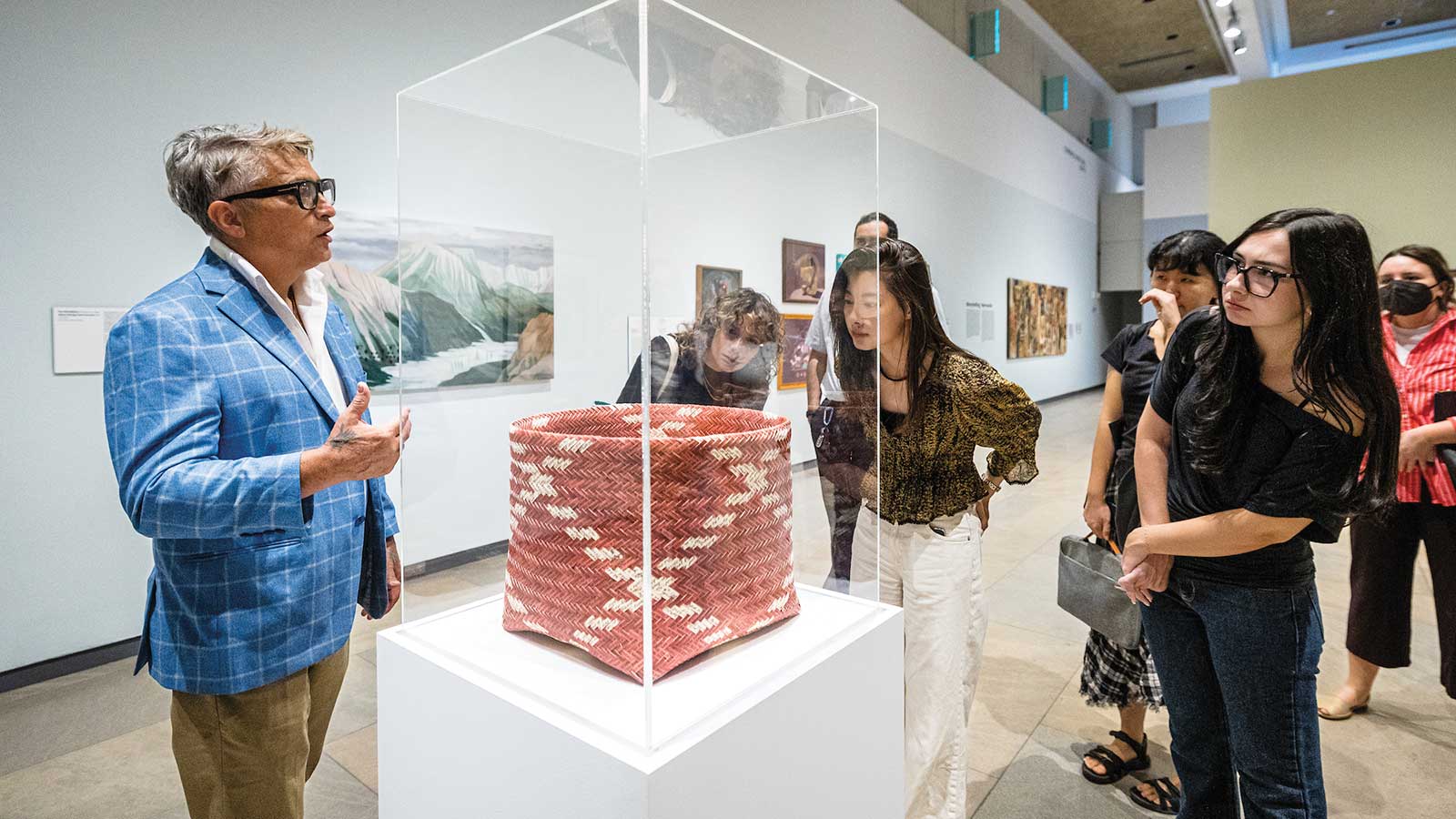
Tony Abeyta discusses Eastern Band Cherokee Shan Goshorn’s traditional double-weave basket designed to address the lasting impacts of U.S. Indian boarding schools, from the new exhibit The Way We Came: A Century of Indigenous Art at the Phoenix Art Museum. Abeyta toured the new exhibition with assistant professor JoAnna Reyes. Photo by Charlie Leight/ASU News.
World War II interrupted this first flowering, pulling a generation of young men, Allan Houser among them, and Abeyta’s own father, into a conflict most had barely enlisted for by choice. Those who returned came back changed, and their work changed with them. Houser and Harrison Begay, together with Narciso Abeyta, went on to found a screen-printing enterprise that gave the postwar generation a new commercial foothold: proof that survival, for this cohort, was inseparable from invention. It is a detail Abeyta returns to with evident pride: these were not artists waiting for validation from the outside world. They were building an art market of their own, on their own terms, years before most American institutions were paying attention.
That inattention is, in part, the point. Abeyta notes that Native painters exhibited at Grand Central Art Galleries in New York as early as 1931, and that Indigenous American work appeared at the Venice Biennale not in the 21st century but in 1932—a fact he suspects few people, inside or outside the field, know at all. The absence of that history from the standard telling of American modernism is, for Abeyta, the gap his three exhibitions are meant to close.
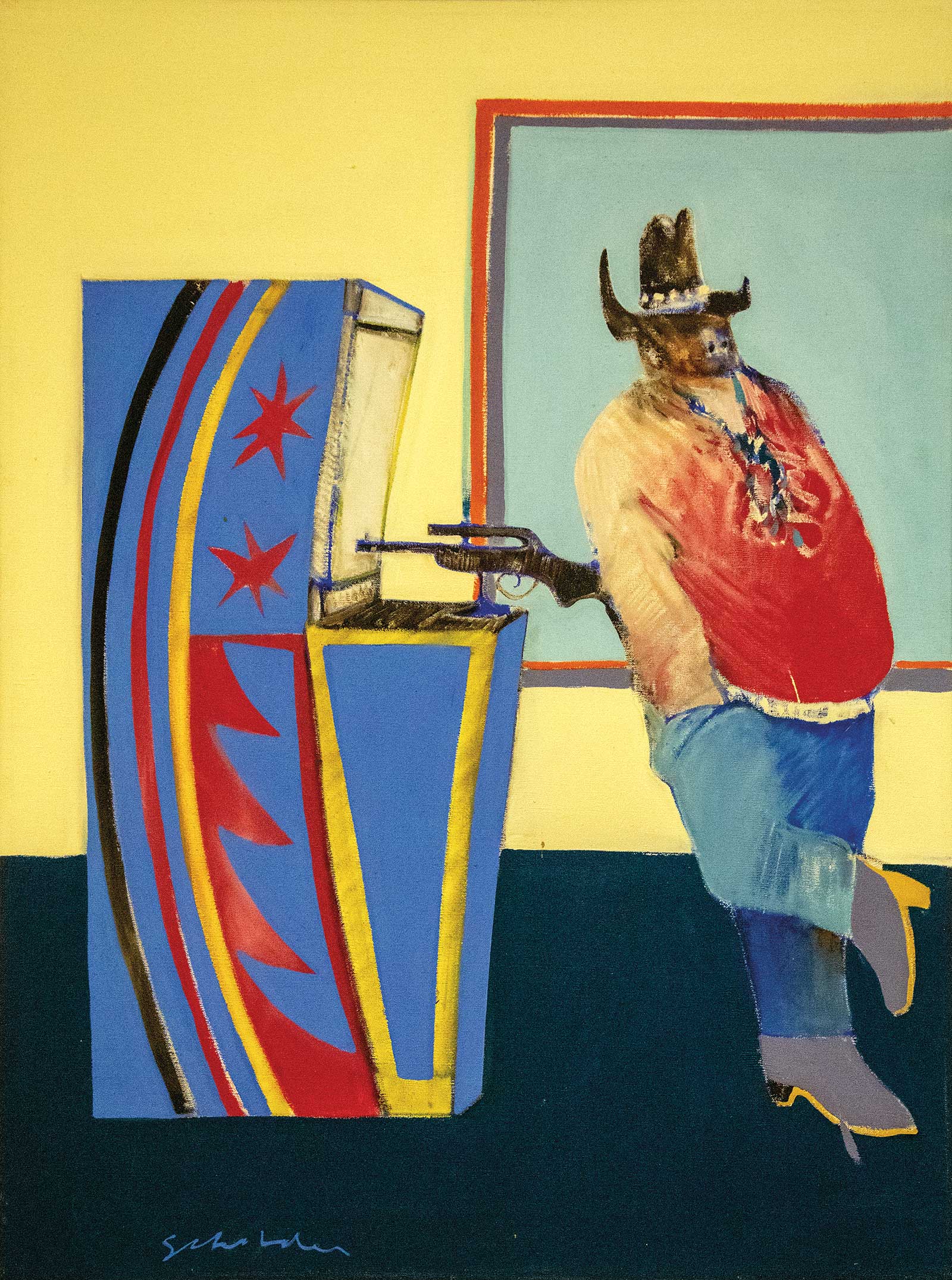
Fritz Scholder (La Jolla Band of Luiseño Indians, 1937-2005), Indian at Gallup Bus Depot, 1969, oil on canvas, 40 x 30 in. Booth Western Art Museum permanent collection, Cartersville, GA. On view at 30 @ 30: 30 Native Artists, 30 Artworks, Made in Their 30s, Booth Western Art Museum.
Three Exhibitions, One Argument
The Agua Caliente Cultural Museum exhibition, A Beauty That Endures: Native Painting, Ritual, and Resilience in the 20th Century, opens in Palm Springs this October and is perhaps the most direct expression of Abeyta’s argument. Drawing some 52 works primarily from the Fred Jones Jr. Museum of Art at the University of Oklahoma, many of them pulled from storage after two decades unseen, the show includes paintings by Oscar Howe, Dick West, Allan Houser, Quincy Tahoma and Frank Day. Abeyta describes the exhibition’s structure as more linear than his other projects, organized around regional schools and carrying a pronounced focus on the psychological aftermath of World War II: young men who left as boys and returned carrying trauma the art world had little language for at the time. Consultation with tribal communities and some artists’ families shaped both the checklist and the wall text, a process Abeyta treats as inseparable from the exhibition’s integrity rather than a procedural afterthought.
That throughline surfaced for Abeyta not as an abstract argument but in a specific gallery encounter with the museum’s executive director, Steven Karr, an ethnohistorian by training who has spent his career working with and for tribal communities. Standing in front of a Tahoma painting at the Fred Jones one afternoon, Karr noticed something in the figures that did not fit the usual reading of the artist’s work. “I’m seeing some really strong Japanese influences here,” he recalls telling Abeyta, who had never made that connection himself. The two decided to test the theory before it went any further. “I bet 20 bucks this guy, Quincy Tahoma, served in the Pacific Theater,” Karr says. A cursory search confirmed it: Tahoma had likely served in the Pacific, perhaps as part of the occupying forces in Japan at the war’s end, close enough to the visual language he encountered there to leave a mark on the work that followed. For Karr, the moment crystallized what part of the exhibition is ultimately arguing: that World War II, not the Great Depression, was the true rupture point for this generation of Native artists. It was a war that scattered tribal communities off the reservation for the first time and sent so many of their young men, Narciso Abeyta among them, into combat and back again, changed.
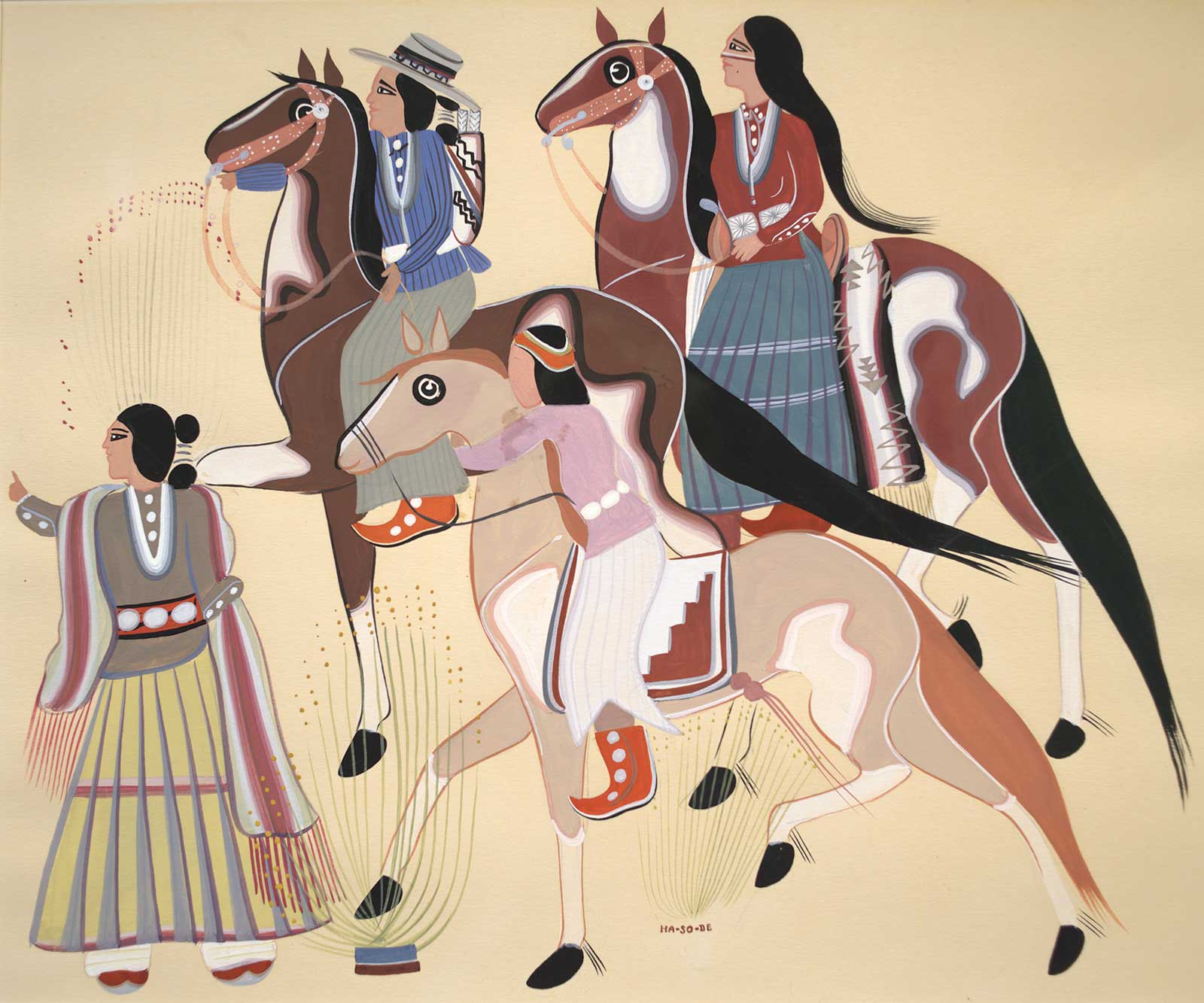
Narciso Abeyta (Ha-So-De) (Navajo (Diné), 1918-1998), Directing Guests, 1940, tempera on paper. Courtesy of the Fred Jones Jr. Museum of Art, The University of Oklahoma, Norman; Museum purchase, 1940. On view at A Beauty That Endures: Native Painting, Ritual, and Resilience in the 20th Century, Agua Caliente Cultural Museum, Palm Springs.
In Phoenix, Abeyta is co-curating The Way We Came: A Century of Indigenous Art—the Bill Healey collection’s culminating gift to the Phoenix Art Museum, opening in August—alongside Dr. JoAnna Reyes, the museum’s adjunct curator of Art of the Americas. Healey’s collecting life began conventionally enough, built on Russell, Remington and the Taos founders—the romantic vocabulary of the American West. But Healey came to feel that vocabulary was incomplete, even dishonest, in its silence about what was actually happening to Native communities during the period it depicted. Abeyta, already a friend and an artist in Healey’s collection, became an informal advisor, steering him toward painters connected to his own father’s circle (Gerald Nailor among them) and pushing him to build a collection that included women painters and a genuine range of tribal perspectives. The result, split between an earlier gift to the Saint Louis Art Museum and this culminating Phoenix installation, which spans roughly 185 works, opening with Ernest Spybuck and closing with contemporary painters including Emmi Whitehorse, Jaune Quick-to-See Smith and George Morrison—an abstract expressionist whose market value, Abeyta notes, has shifted so dramatically in recent years that a major canvas once available for under $20,000 is now the object of active museum pursuit. The Phoenix show also traces direct generational lineage, following Pablita Velarde’s line down to her granddaughter’s own practice today, a living demonstration of Abeyta’s larger point that this is not history in the past tense.
Reyes, who inherited much of her own sense of the collection from walking through it at Healey’s side with Abeyta as guide, says the depth the paintings carry only becomes visible up close. She points to Navajo Country, a Quincy Tahoma canvas of a young Navajo boy and girl on a burro before Monument Valley, surrounded by more than 100 individually rendered sheep. “We found out that this painting was created within about a decade of the government’s campaign to eradicate the Navajo-Churro sheep, a breed they’d been raising for over 400 years and that was central to their livelihood,” Reyes says. “During the ’40s, Navajo people were hiding the herds in canyons deep in Navajo country to keep them alive. That’s a piece of history that hadn’t been told about this object before, and it’s exactly the kind of thread this collection lets us pull on.”
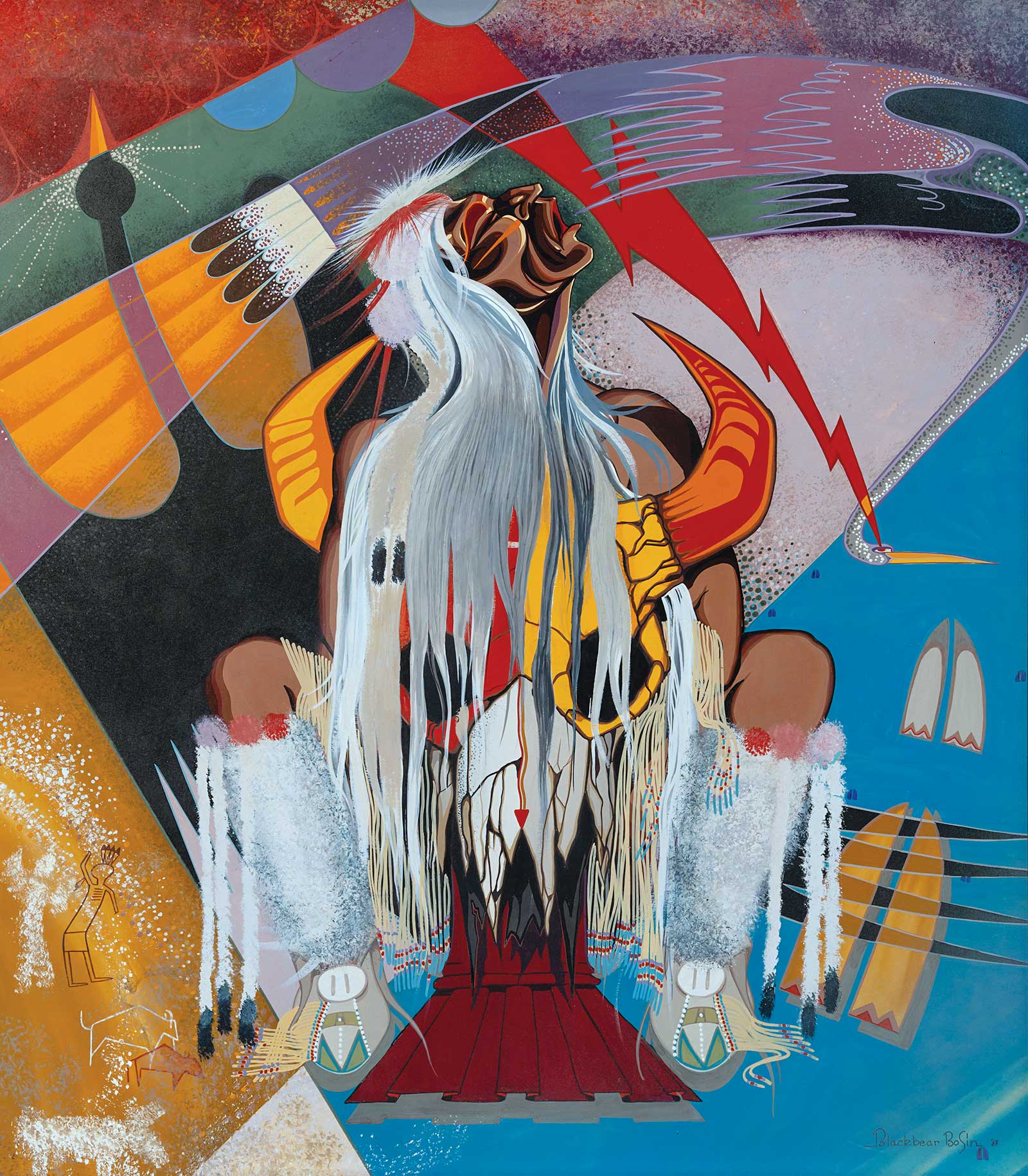
Blackbear Bosin (Kiowa/Comanche, 1921-1980), Sing Back the Buffalo (Singer with Buffalo Skull), 1963, gouache on board, 32 x 28 in. William P. Healey Collection of Native American Art at Phoenix Art Museum, Gift of William P. Healey. Photo: Davin Lavikka. On view at The Way We Came: A Century of Indigenous Art, Phoenix Art Museum.
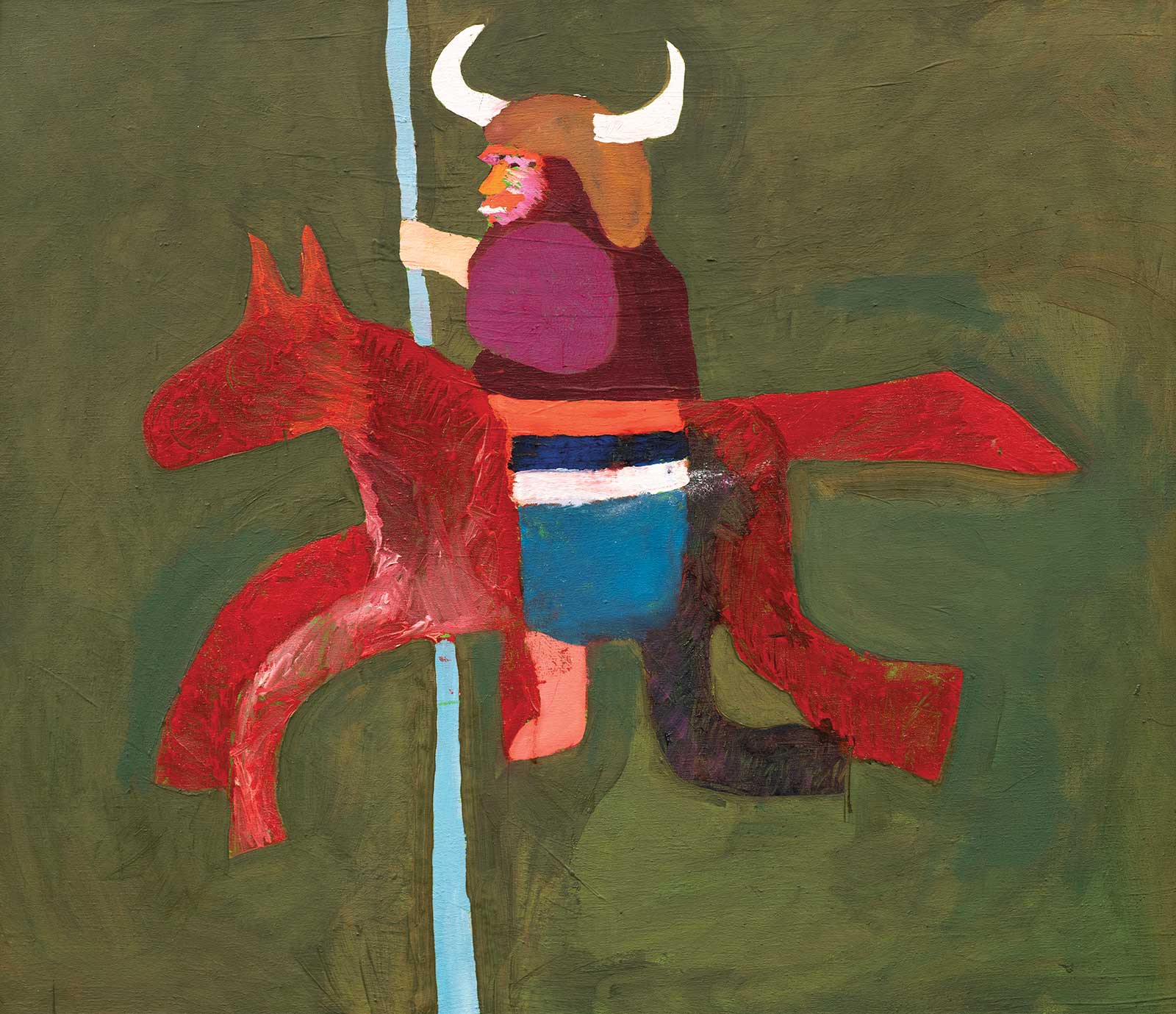
Billy “War Soldier” Soza (Cahuilla/Apache), Indian on a Merry-Go-Round, ca. 1965. Tia Collection. © Estate of Billy “War Soldier” Soza. On view at 30 @ 30: 30 Native Artists, 30 Artworks, Made in Their 30s, Booth Western Art Museum.
The third exhibition, 30 @ 30: 30 Native Artists, 30 Artworks, Made in Their 30s, at the Booth Western Art Museum in Cartersville, inverts the historical frame entirely by turning to the present. The idea has roots in the Booth’s own exhibition history. “In 2019 we had an exhibition titled Six Navajo Masters: Abeyta, Begay, Johns, Whitehorse, Whitethorne & Larry Yazzie. It was extremely well received, and we knew that we wanted to have another exhibition featuring a younger generation of Indigenous artists,” says Lisa Wheeler, the Booth’s director of curatorial services. “In 2024, artist and curator Tony Abeyta presented the idea of an exhibition featuring Indigenous artists in their 30s to Seth Hopkins, former director of the Booth Western Art Museum, and we readily agreed to the idea. I think this is the perfect time to show Indigenous art as a vital part of contemporary art because there seems to be a shift in the art world as this generation of artists has matured artistically. Their work is especially powerful because they work with both inherited cultural knowledge and the rapidly changing realities of Indigenous life today.”
The premise: 30 paintings by 30 Indigenous artists in their 30s, a decade Abeyta regards as a genuine inflection point in an artistic career: early academic training absorbed, individual voice beginning to sharpen, but nothing yet fully settled. To anchor the living artists to the historical arc of his other two shows, Abeyta has folded in a handful of works by artists no longer living, each painted during their own 30s: a Fritz Scholder canvas made when the artist was 36, a T.C. Cannon painting from around age 34, and a work by Billy “War Soldier” Soza, whose activism with the American Indian Movement runs through his art as much as his biography. Read together with the contemporary selections, the show becomes Abeyta’s argument in miniature: proof that the throughline from 1900 to today has never actually broken.
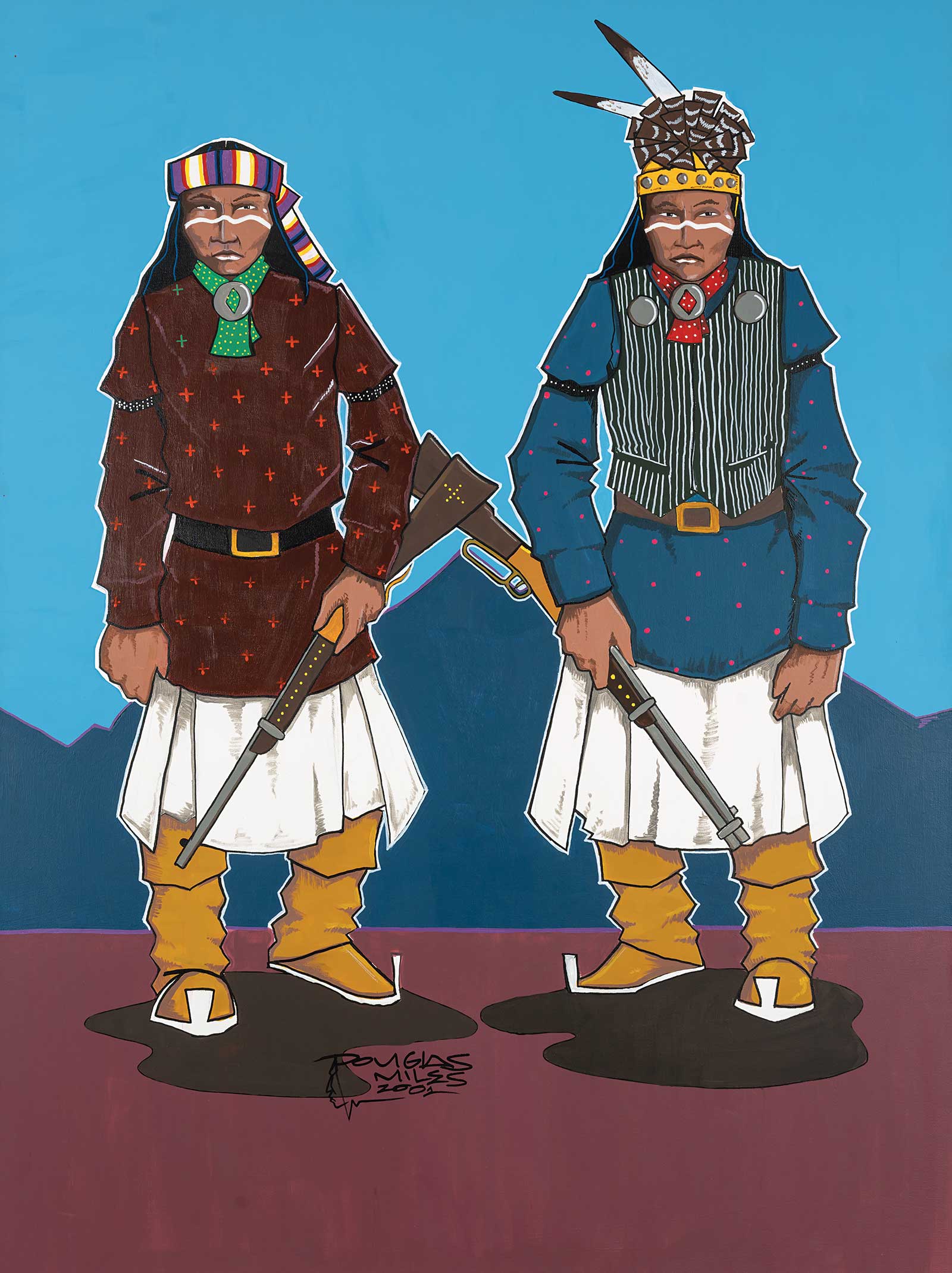
Douglas Miles (Apache), Untitled, 2001, acrylic on canvas, 49¼ x 37 x 2 in. William P. Healey Collection of Native American Art at Phoenix Art Museum, Gift of William P. Healey. Photo: Davin Lavikka. On view at The Way We Came: A Century of Indigenous Art, Phoenix Art Museum.
What distinguishes Abeyta’s curatorial voice from that of a conventional museum professional is that he is, first and foremost, a working painter, and he is unambiguous that this is not incidental to how he curates. He does not take on projects outside his direct knowledge, and he resists the idea that an artist’s involvement in the market he curates is a conflict to be apologized for. It is, in his framing, simply honesty: he collects the work of his father’s contemporaries because those relationships shaped him, he advises collectors like Healey because he has spent a lifetime looking at these paintings with an artist’s eye rather than an archivist’s, and he sees no contradiction in occupying multiple roles within the same small, interconnected world. That world is one he was born into rather than one he studied his way toward: he knew the regional painters of the Santa Fe Indian School generation, he has said, before he knew Picasso. It is a rare kind of authority, built less on institutional credentialing than on inherited memory, and it gives these three exhibitions a texture that a purely academic curatorial hand would be hard-pressed to replicate.
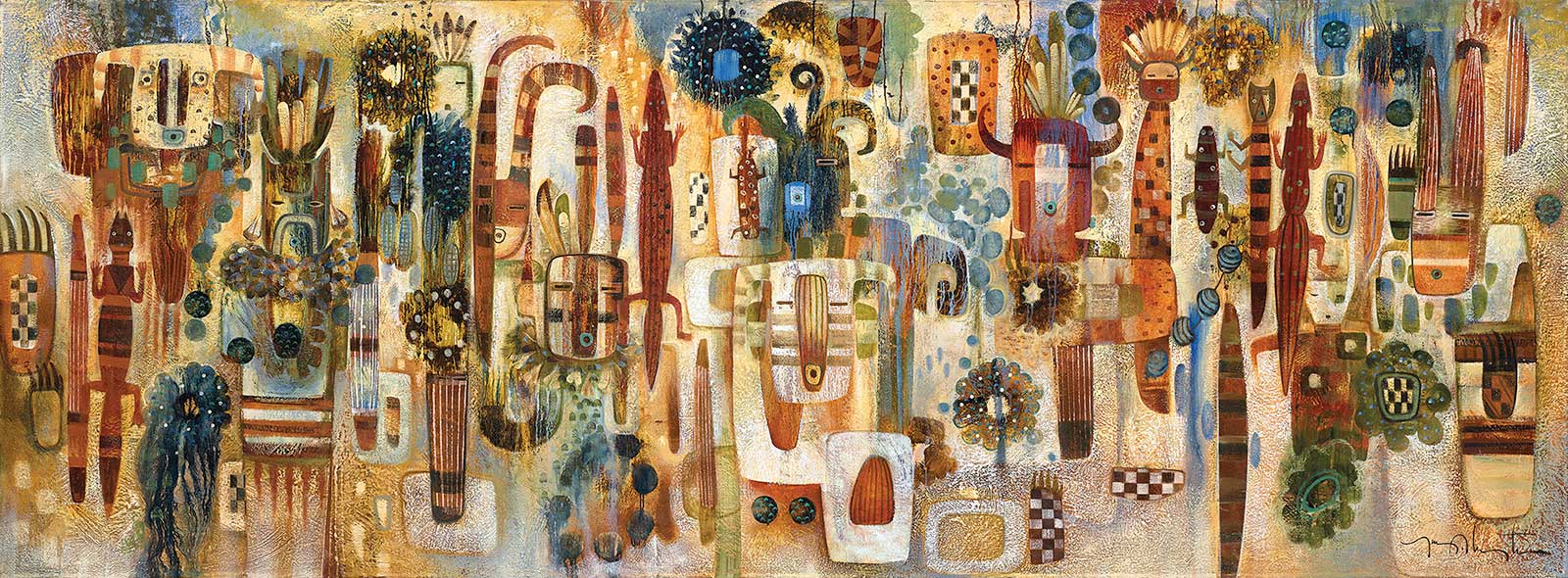
Tony Abeyta (Navajo (Diné)), Celebration from the Underworld, 1998-1999, oil on canvas, 50 x 135 in. William P. Healey Collection of Native American Art at Phoenix Art Museum, Gift of William P. Healey. Photo: Davin Lavikka. On view at The Way We Came: A Century of Indigenous Art, Phoenix Art Museum.
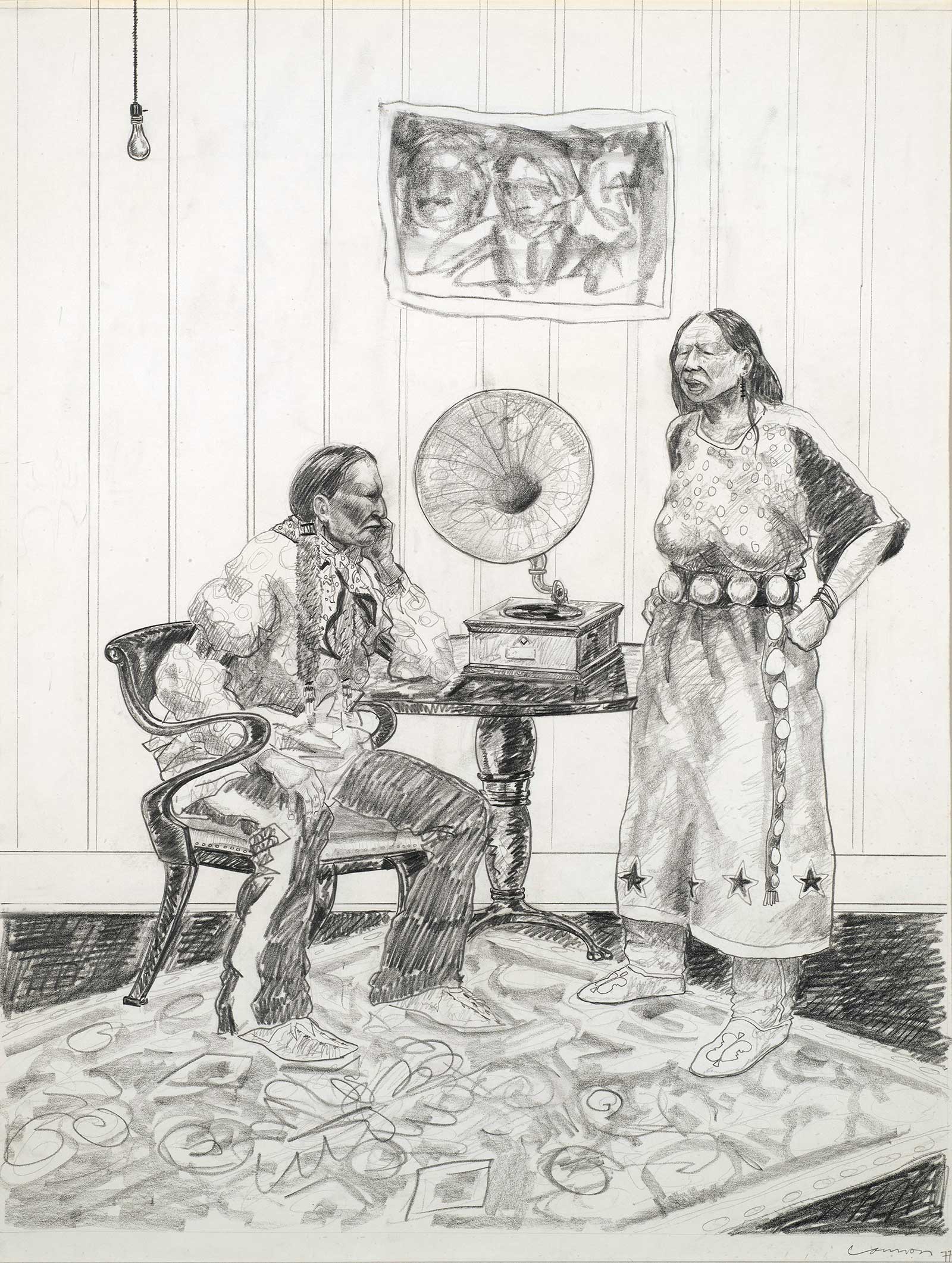
T.C. Cannon (Kiowa/Caddo, 1946-1978), Sketch for A Remembered Muse (Tosca), 1977. © Estate of T.C. Cannon. Tia Collection. Photo: James Hart Photography. On view at 30 @ 30: 30 Native Artists, 30 Artworks, Made in Their 30s, Booth Western Art Museum.
Why Now?
Abeyta is careful to resist a purely elegiac reading of this material. He speaks pointedly about refusing to let trauma become the organizing lens of the story, not because the history of boarding schools, forced relocation, and assimilation policy is untrue, but because dwelling there risks reproducing exactly the kind of us-and-them narrative he believes Native art has already moved beyond. His preferred term is survivance: the idea that culture was never taken from Native communities so much as it adapted, sometimes painfully, to a changed world. That adaptation is, in his view, the real story: one told not by outsiders looking in, but by the artists themselves, many of whom Abeyta counts among his own teachers, mentors, and friends.
The stakes of that argument feel especially immediate this year. Abeyta notes that Native American boarding schools have recently burned or been demolished (one in Santa Fe, another destroyed by fire at Fort Wingate), erasing physical sites that carried, in his words, both fond memories and deep trauma in equal measure. With those structures gone, the paintings themselves become one of the few remaining records of what happened inside them, and of what came after. Three exhibitions, three cities, one continuous argument: this is not a footnote to American art history. It is the foundation most of the field has yet to properly build on. —
Andrew J. Walker is the former executive director of the Amon Carter Museum of American Art, where he served for 14 years. Under his leadership, the Carter’s collections and endowment expanded significantly, and the museum’s internal galleries have been renovated and reimagined to improve visitor experience and to emphasize a thematic presentation that connects artists and works through time. Prior to joining the Carter, he served as curator of American art at the Saint Louis Art Museum. In his 21-year museum career, Walker has also held curatorial positions at the Missouri History Museum and the Art Institute of Chicago. His teaching experience includes instructor positions at the University of Chicago’s Department of Art History and the University of Pennsylvania’s Department of the History of Art, and he has been published in scholarly journals across the country. Currently, he is the founder of Walker Art Consulting and represents the American master sculptor James Surls.
Powered by Froala Editor


