A quiet resurgence is underway.
By introducing a deeper sense of humanity and shared lived experiences into their work, three award-winning Hopi katsina carvers—Mark Ron Taho, Arthur Holmes Jr. and Robert Albert—are extending the boundaries of contemporary ultra-realistic katsina carving beyond the aesthetic interpretations that once defined the movement.
Walking past a katsina carver’s booth at the Santa Fe Indian Market during the 1980s, a visitor might have felt as though the katsinam themselves had stepped from the spirit world into concrete motion. No longer simplified ceremonial figures carved from cottonwood root and painted with natural pigments, these works had become sophisticated sculptural art—arms outstretched, feathers in flight, eyes alive with emotion, and more vividly painted using stains and acrylics.
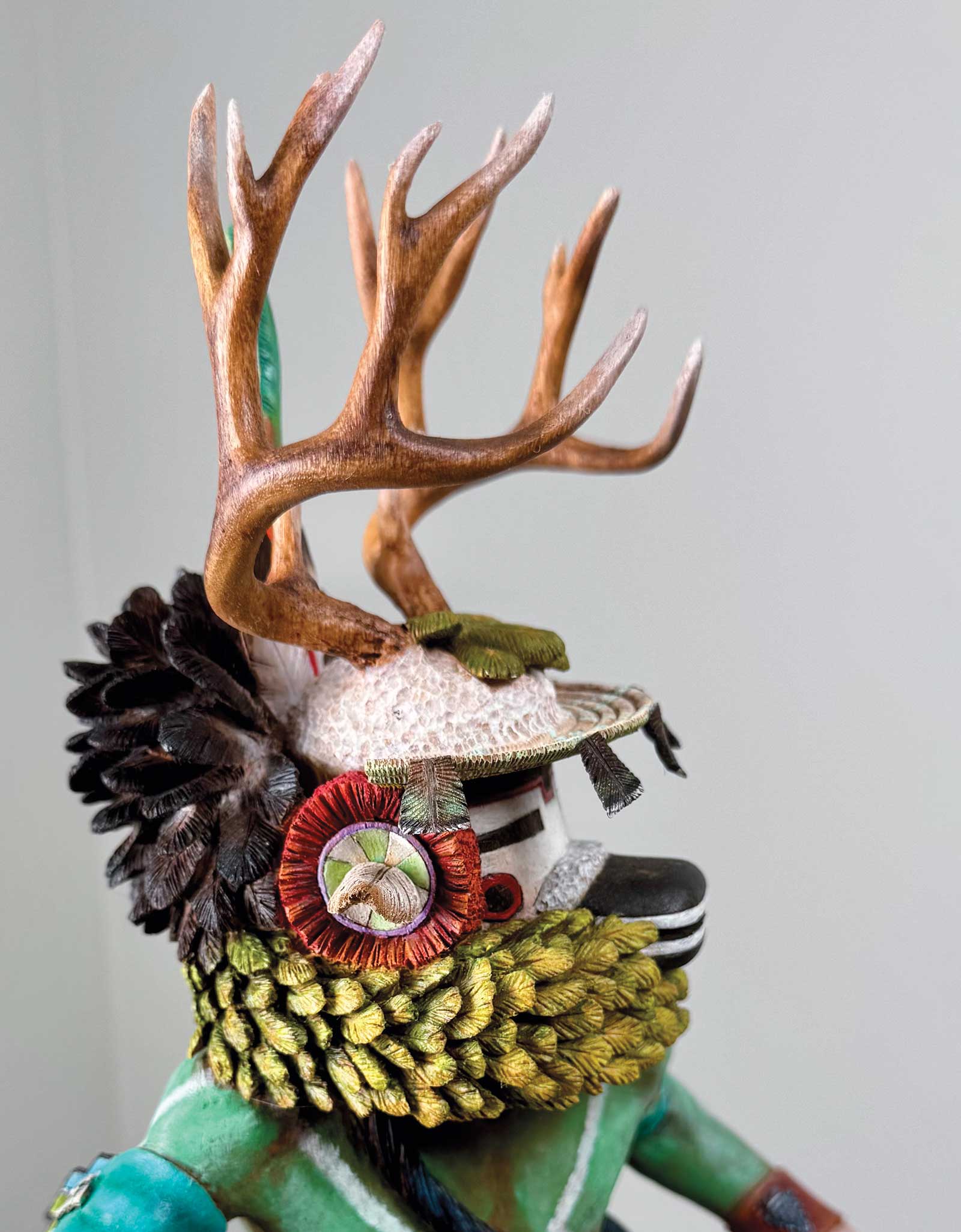
Mark Ron Taho (Hopi/Navajo (Diné)), First Hunt (detail), cottonwood
This was the height of the contemporary katsina carving movement, when artists such as Alvin James Makya, brothers Brian and Ron Honyouti, Dennis Tewa and many more reinvented the form for modern audiences.
With the 2008 economic crisis, however, the momentum had slowed. Collectors gradually turned back toward less-expensive traditional forms, and the ultra-realistic carvings lost momentum in the marketplace.
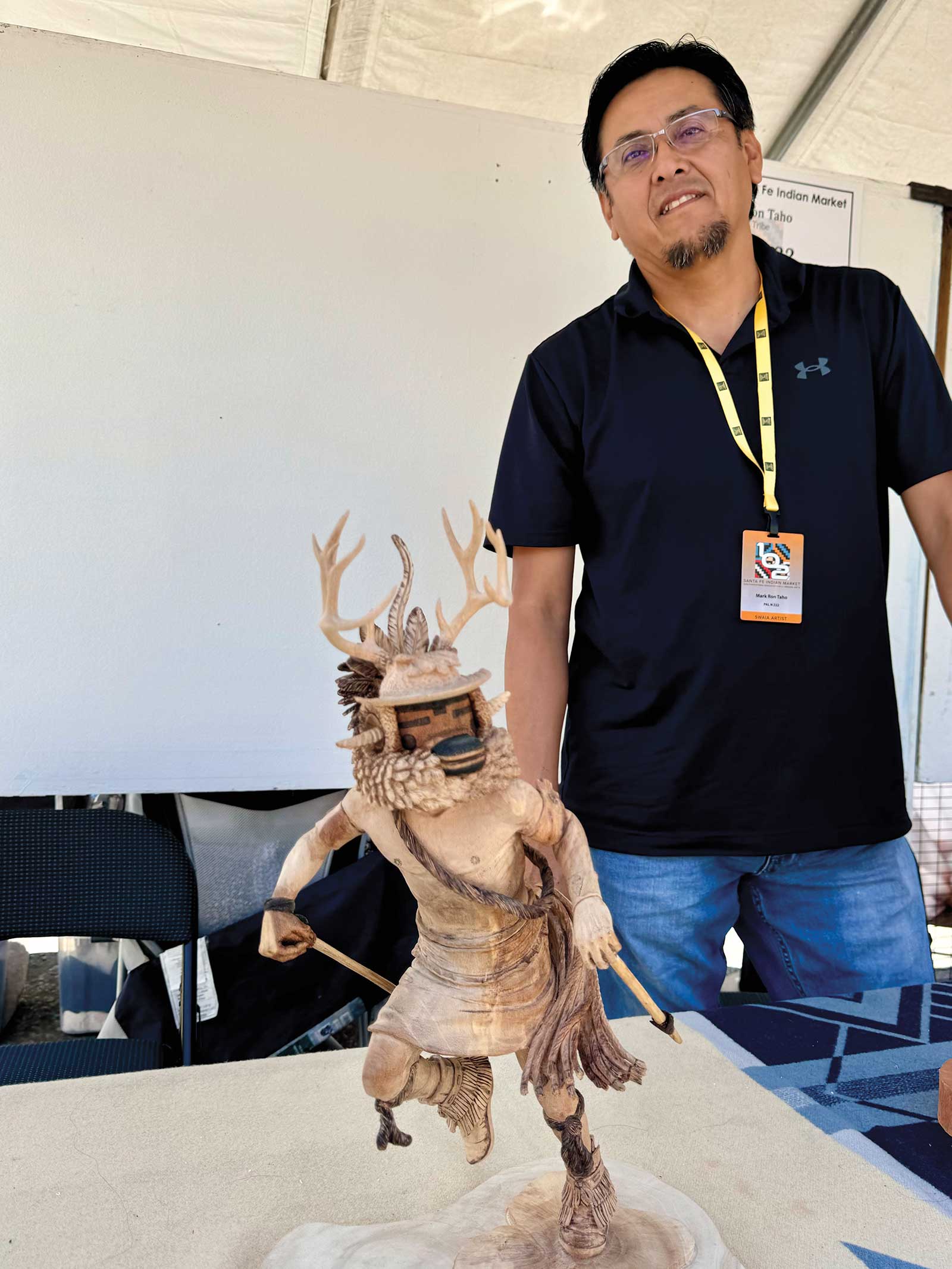
Mark Ron Taho with an in-progress version of First Hunt.
Today, a small group of carvers is revitalizing the sculptural approach. By fusing traditional Hopi teachings with deeply human emotions, they remind us that katsinam still speak in both the ancestral language of ceremony and the universal language of humanity. And a new generation of collectors is beginning to take notice.
Known to the art world as Mark—and to family and friends as Ron—Mark Ron Taho is the son of cattle-ranching parents from Moenkopi, Arizona. An engineering degree from Arizona State University led him to a career servicing medical equipment throughout the Hopi and Navajo reservations. When he’s not at work or helping on the ranch, Taho creates award-winning katsina carvings.
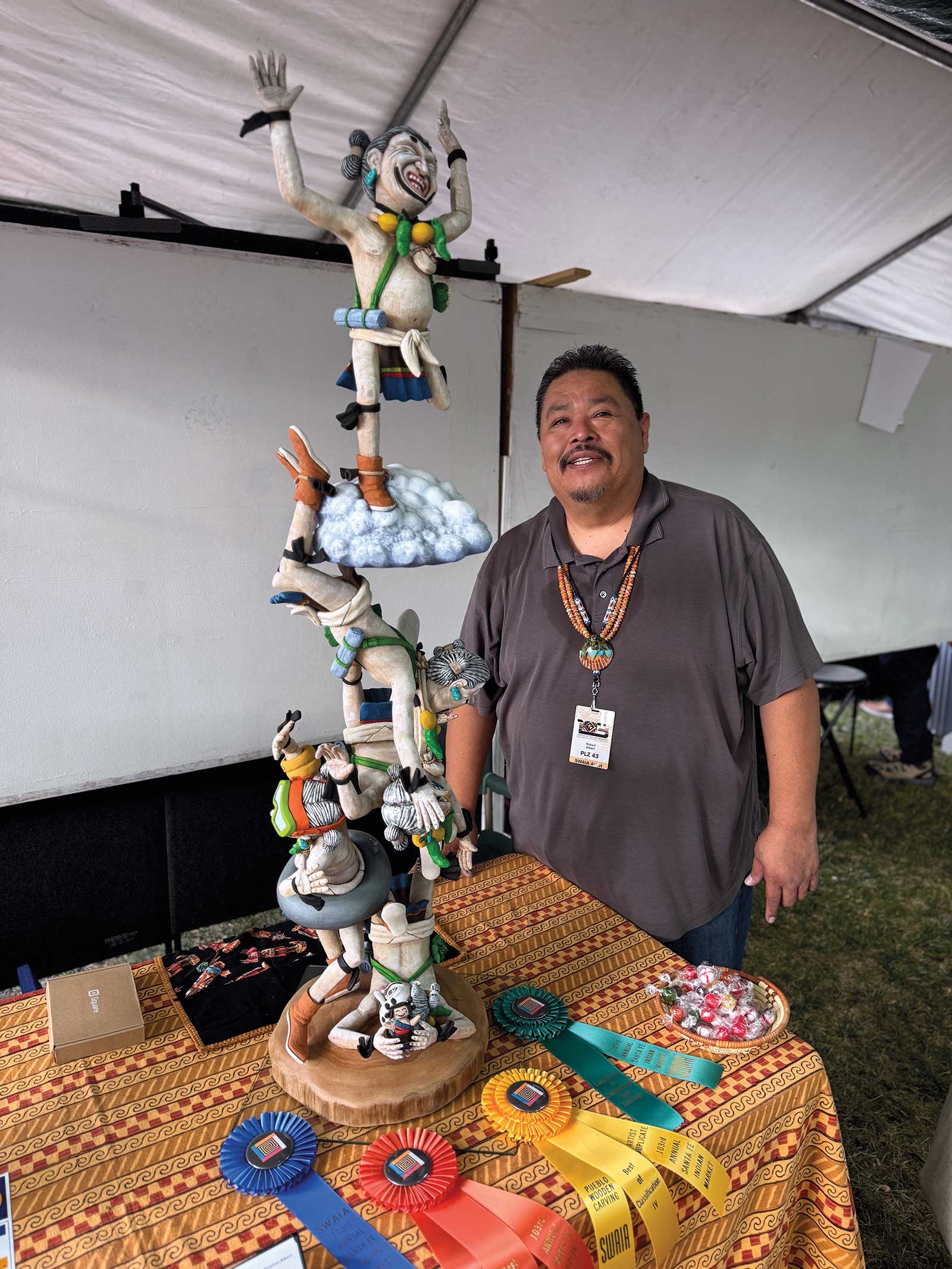
Robert Albert with White Cloud Clowns Jumping Off Clouds, his award-winning work from the 2025 Santa Fe Indian Market.
“I don’t so much try to put the Katsina spirit in my carvings,” Taho says. “I put a piece of myself in them. That piece of me that holds respect for a real Katsina.”
“What stories do they tell?” he asks himself while carving. “What songs do they sing?”
In searching for those answers, Taho has carved out a singular artistic identity. “It takes me a long time to create a piece—both in the design phase and the actual carving,” he says. “My engineering background takes over and I get totally focused about the details. I’m really serious about getting things right.”
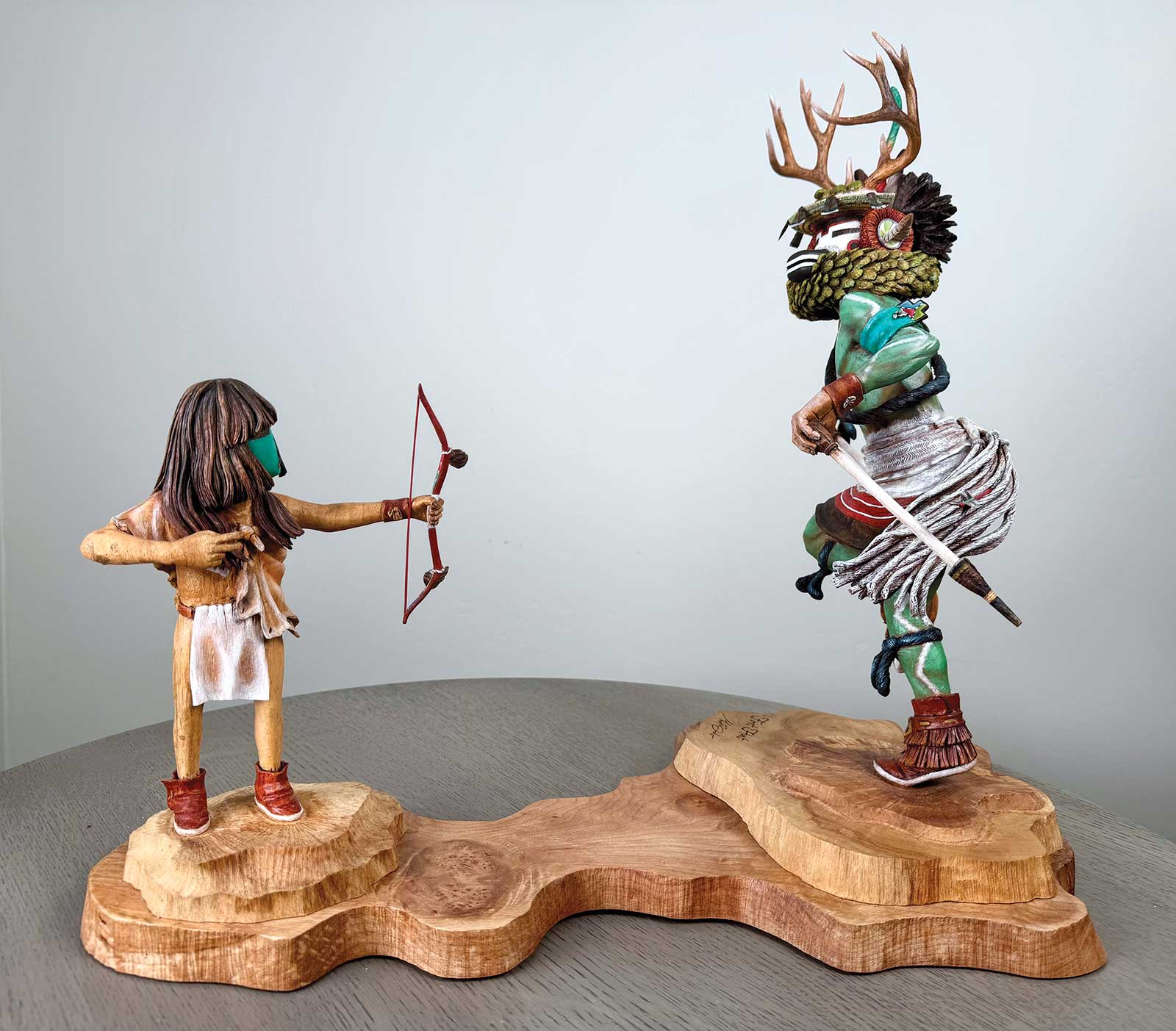
Mark Ron Taho (Hopi/Navajo (Diné)), First Hunt, cottonwood
In First Hunt, the piece that earned him first place in the contemporary katsina carving category at the 2025 Santa Fe Indian Market, Taho draws from a memory of his son Jaylen as a young boy who had briefly “gone missing.”
“In Hopi culture boys are given their first bow and arrow by a katsina during one of our ceremonies,” he explains. “Jaylen was adventurous as a little boy and one day decided to be a grown-up and, without telling us, wandered out of the house to go hunting. He didn’t kill anything, but I’m pretty sure he terrorized a lot of rabbits.”
In the carving, a young boy carrying the bow given to him by a katsina dancing on the plaza has struck a Deer Katsina with an arrow. The katsina, holding its walking sticks representing the deer’s forelegs as it bends in dance, turns toward the boy with an expression that seems almost compassionate—as if to say: “Not this time, young child, but soon. You will grow to become a great hunter and support your family with the meat I give to you and the Hopi people.”
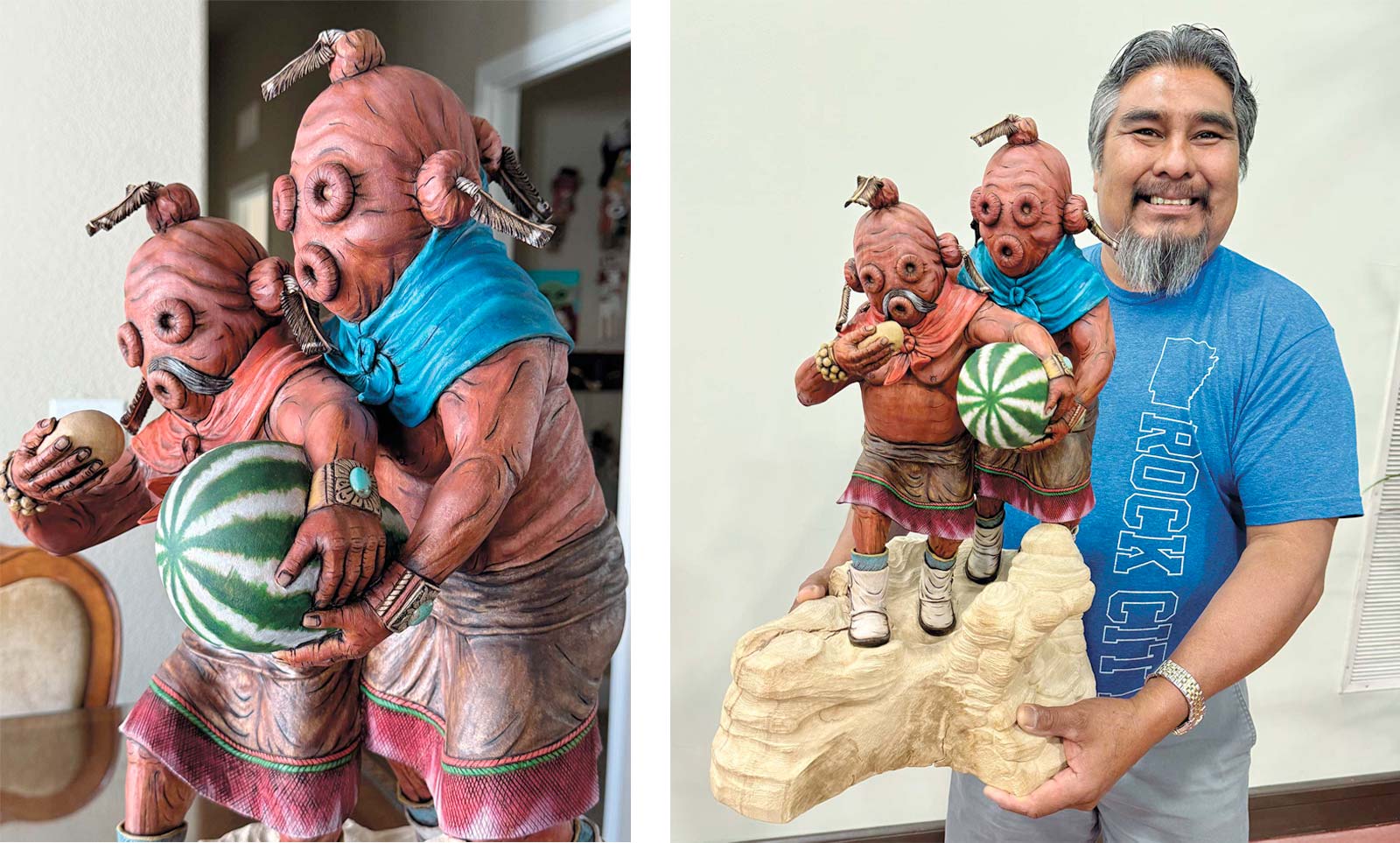
Left: Arthur Holmes Jr. (Hopi), Father and Son (detail), cottonwood, 23 in.
Right: Arthur Holmes Jr. holds up Father and Son, carved from a single piece of cottonwood.
The piece succeeds not only through technical mastery, but through emotional honesty, where memory, humor, love and cultural teaching coexist naturally.
Like Taho, Arthur Holmes Jr. is exploring the deeply personal dimensions of katsina carving. He is the son of one of the pioneers of the contemporary katsina movement and the winner of Santa Fe Indian Market’s pueblo wood carving category five of the last 10 years, Holmes carries both inheritance and responsibility into his work.
In his piece Father and Son, Arthur explores relationships between generations, tradition and obligation. “I made this to represent two different relationships between a father and a son,” Holmes explains. “It is a mirror that reflects my respect for family—all those who came before me, all those who come after me.”
Both interpretations center on multiple generations. In the first, an elder Koyemsi, or Mudhead Katsina, has spent his life carrying the burden of supporting the family. Now old and weary, he still feels obligated to continue carrying the load. “I carved a younger Koyemsi coming up beside the elder whispering, ‘I am here, father,’ [and] helping him carry the load together,” Holmes says.
Within the sculpture exists a tender tension—a mixture of gratitude, responsibility and quiet pride. The roles have begun to shift. The son is becoming a protector and caretaker while still honoring the elder katsina who shaped him into the man he has become.
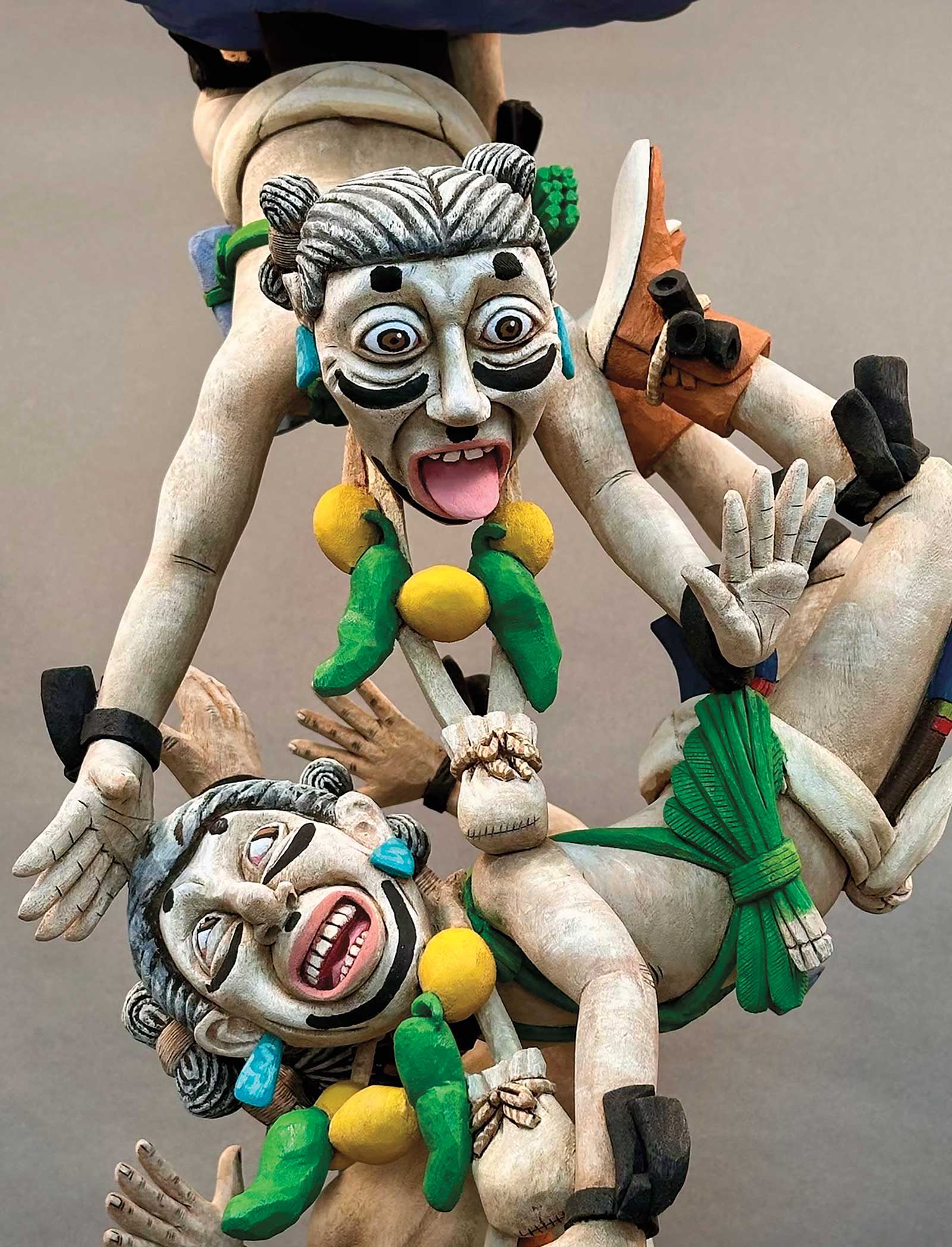
Robert Albert (Hopi), White Cloud Clowns Jumping Off Clouds (detail), cottonwood root and acrylic paint, 48 x 15 x 12 in.
The second interpretation reverses the perspective. Holmes now carves the elder Koyemsi, passing corn seeds and a watermelon to his son, symbolizing the transmission of cultural knowledge and responsibility from one generation to the next. In both readings, tradition becomes less about preservation than about continuity—a living relationship between the katsinam, people, memory and responsibility.
“I was inspired by the people in my life,” Holmes says. “It is planting season here at Hopi. Where and how we plant things like melons is different than squash. Blue corn is different from white corn. After years you get to know how and where to plant them so they grow best. My son, Hunter, has been down in Tucson at the university for school. He came back up to Moenkopi to help me plant. It was no different than when I helped my father and grandfather with the planting. I miss Hunter while he’s been away. When he came back to help and I could pass on my knowledge I felt whole again.”
Robert Albert’s contribution to this resurgence arrives with both technical ambition and unmistakable humor. Like Taho and Holmes, Albert is well known for the exceptional level of excellence he brings to the details in his carvings.
At the 2025 Santa Fe Indian Market, Albert earned best of classification for pueblo figurative carvings and sculpture with an extraordinary work titled White Cloud Clowns Jumping Off Clouds. Towering at nearly 4 feet tall, the sculpture features five cascading clown figures carved from a single cottonwood log and required nearly two years to conceptualize, carve and paint.
Albert imagined a group of Koyaalas, or White Clowns, falling headfirst from the heavens, each figure carrying its own expression and comic personality. He believes his greatest strength as a carver lies in facial expression. In White Cloud Clowns Jumping Off Clouds, the exaggerated faces become the emotional center of the work—wide-eyed, colorful, theatrical and deeply alive.
Humor, however, remains the soul of the sculpture. “What’s the joke?” Albert asks with a smile. “Only clowns would leap from heaven.”
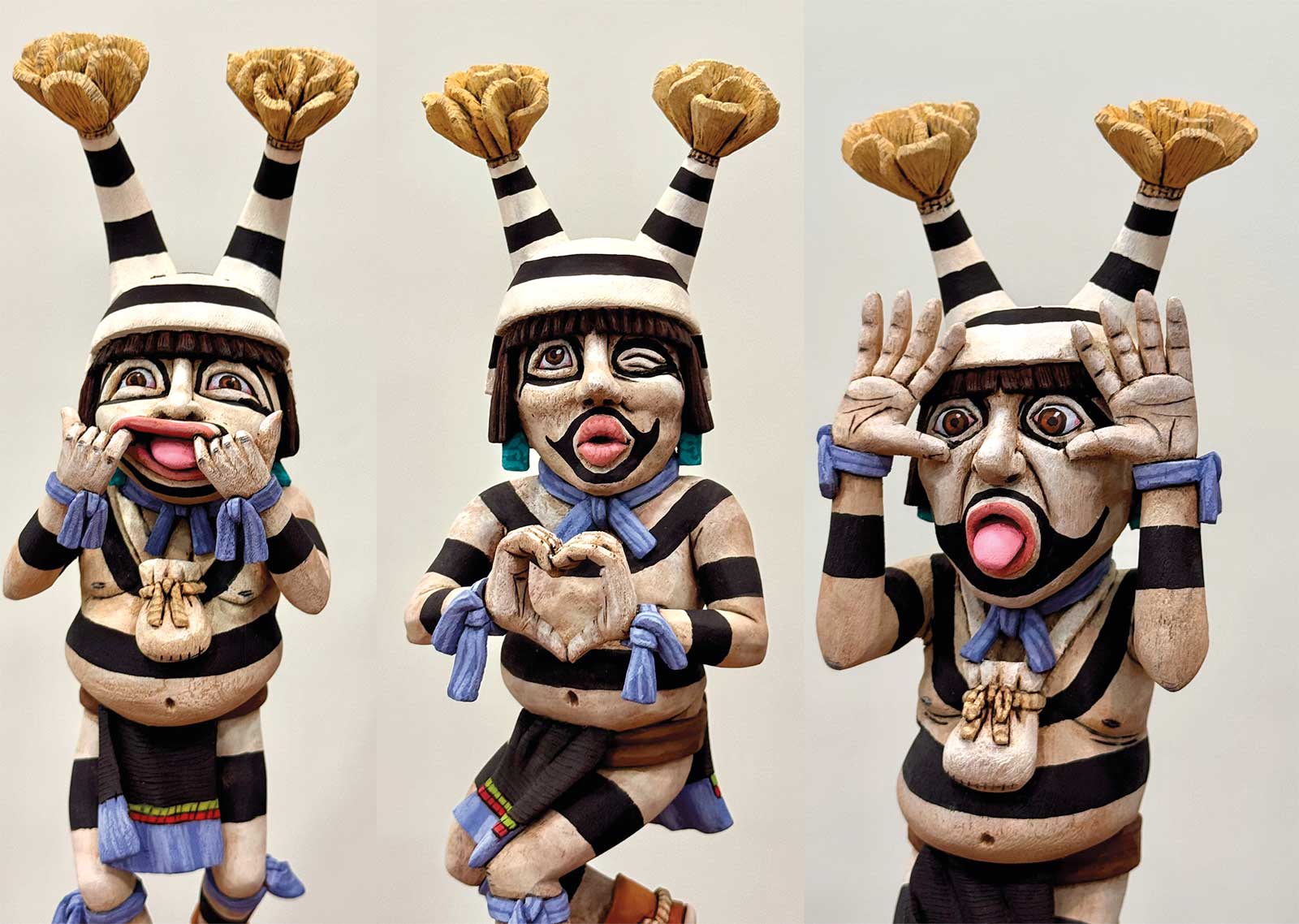
Robert Albert (Hopi), Koyaalas (detail), cottonwood root and acrylic paint
The figures tumble toward the dusty earth of a Hopi plaza with questionable preparation yet absolute commitment. One clown in particular embodies absurdity. Wearing swimming goggles and an inner tube around his waist, he has convinced himself he is fully equipped for the journey. As the artist explains, “In every group of clowns, there’s always one who thinks he’s smarter than the others.”
The punchline, of course, is unmistakably Hopi: there is no water waiting for him below. “His gear is idiotic,” Albert laughs.
Mark Taho, Arthur Holmes Jr. and Robert Albert are transforming what we’ve come to expect from contemporary-style katsina carvings. By utilizing personal reflections that reveal powerful stories of inspiration, challenge and growth, they are not abandoning tradition—they are allowing it to rise again. —
Indian Market booths: Robert Albert, PLZ 43; Mark Ron Taho, PAL N 222; and Arhtur Holmes Jr. (PAL N 219).
Powered by Froala Editor


