There is a word in Cree for metal: pewapisk. It means, literally, from molten to solid form. It is the kind of word that carries an entire philosophy inside it; the transformation of raw material into something new, the discipline of heat and pressure, the intimacy required to work something until it yields. When Erik Lee explains this to me, it is not a linguistic curiosity, it is the key to understanding everything he makes.
Lee is a Plains Cree silversmith and leather artist from Maskwacis (“Hills of the Bear”) in Alberta, Canada. He is also one of the most quietly formidable makers working in Native fine arts today. His work spans sterling silver fabrication and casting, hand-engraved jewelry, tooled and sewn leather, hide tanning, and what he calls, with both precision and pride, Plains Indian Formal. Spend any time looking at his work—the silver belt buckles, the luxury handbags crafted from tooled leather, the jewelry that walks the line between wearable and dangerous—and you begin to understand that Lee is not simply making objects. He is participating in a living inheritance.
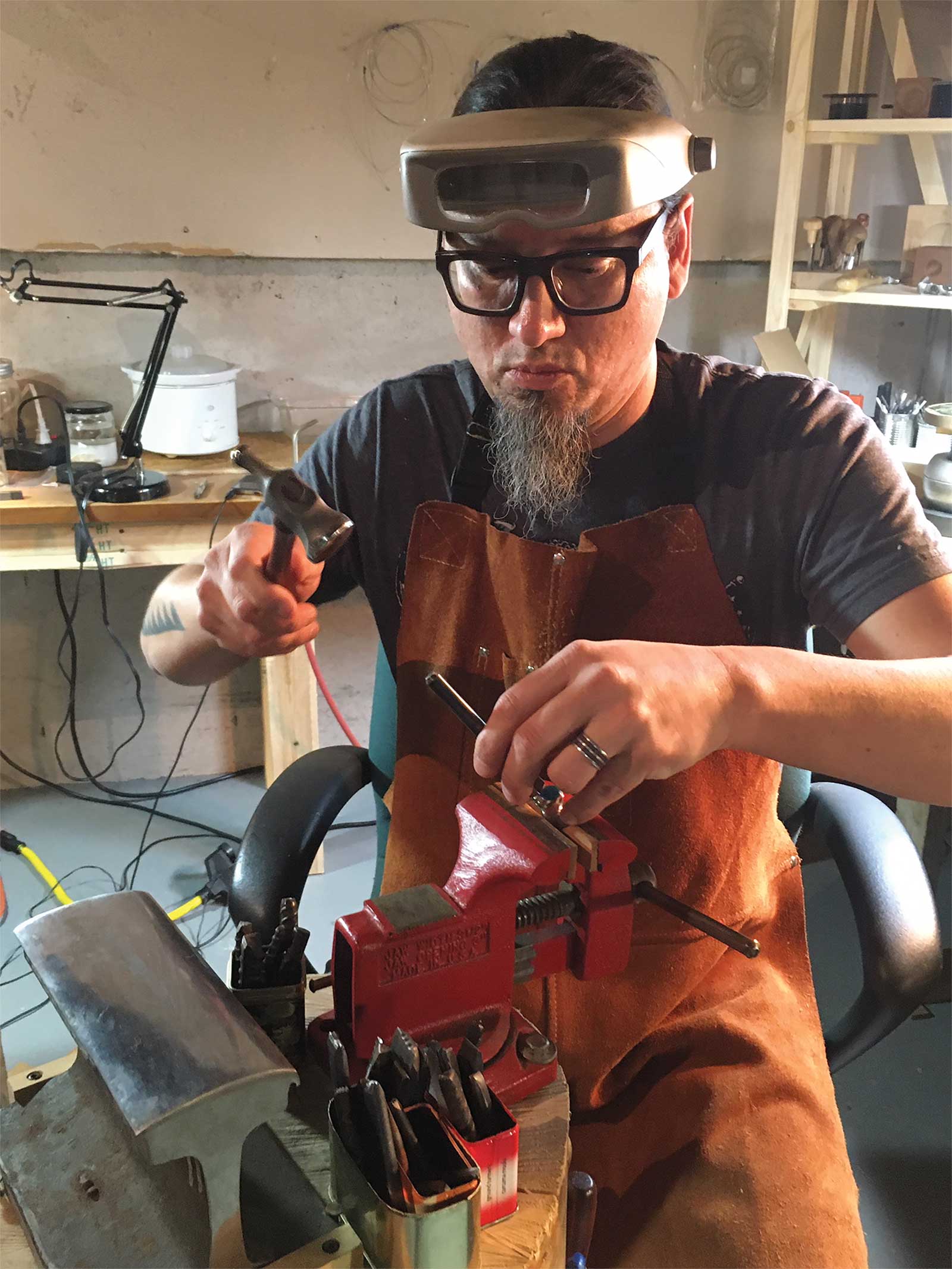
Erik Lee in his studio.
He will tell you he never intended to become a silversmith. “It’s kind of something that just happened,” he says, with the modesty of a person who has found their exact place in the world and chooses to not make too much of it. But the story that follows is not one of accident, it is one of accumulation, of a life spent paying attention.
Lee has been an artist since childhood, with crayons and Play-Doh giving way, eventually, to sterling silver and engraving tools. His first jewelry, though, was made with his mother. Virginia Lee was a prolific beadwork artist known for geometric designs so vivid and precise that she would dream them in the night, wake up, draw them before they vanished, and then sew them bead by bead. Lee grew up beside her, stringing beads, learning color theory, watching how patterns hold meaning. “You spend a lot of time with your mother as a child,” he says, “that’s where you get your first parts of your being.”
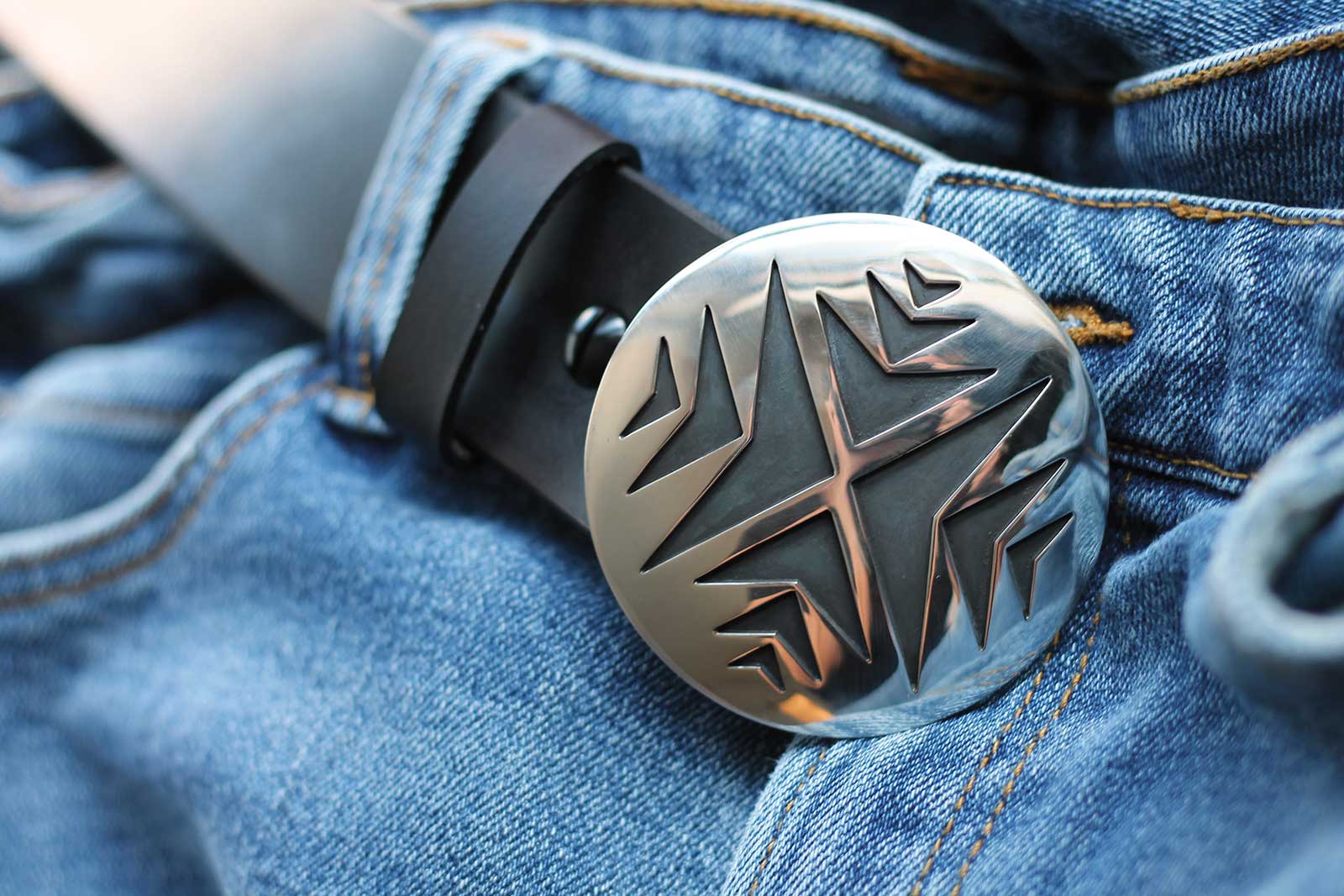
Sterling buckle, silver, 2½ x ½ in.
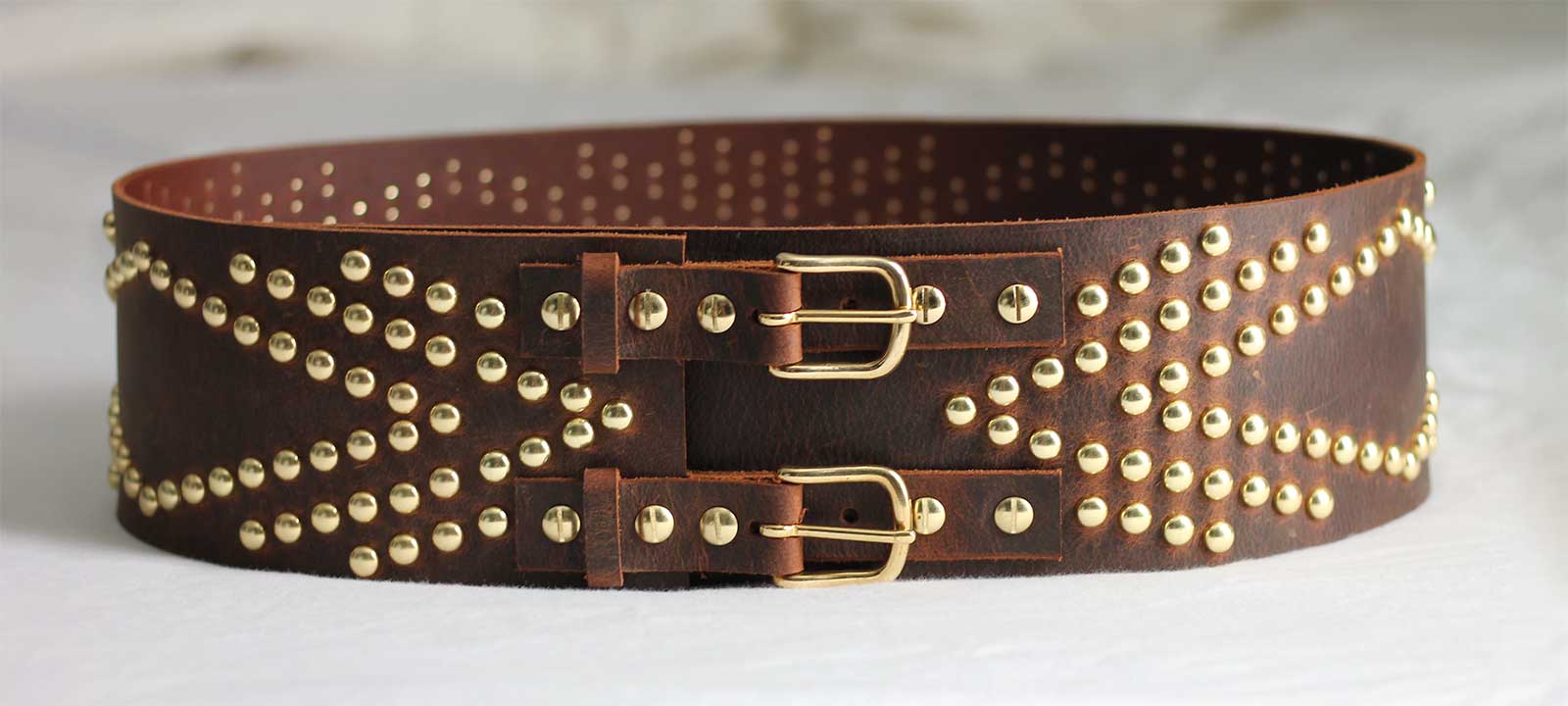
Formal belt, water buffalo hide, brass tacks and hardware, 4 x 34 in.
Virginia Lee has since passed on, but her influence is structural in her son’s work. The geometric sensibility, the bold contrast, the commitment to pattern as a form of cultural transmission. These are not borrowed aesthetics, they are inherited ones. And the practice of dreaming designs, of waking in the middle of the night with geometric flashes that must be drawn before they disappear, is something Erik has carried forward. “I don’t know where that’s coming from,” he says, but anyone who knows him will tell you it’s his gift.
About 12 to 15 years ago, Lee began spending time with artists on Vancouver Island, where silver engraving and copper work has deep living roots in the Northwest Coast traditions. He was captivated; not to replicate, but to be ignited. “I stay away from their designs,” he says clearly, “that’s cultural property. But I have my own inheritance, my own cultural lineage. Figuring out how to use those materials and techniques and sort of indigenizing that in a very Plains Cree or Plains Indian way, that was the fun part. And also the challenge.”
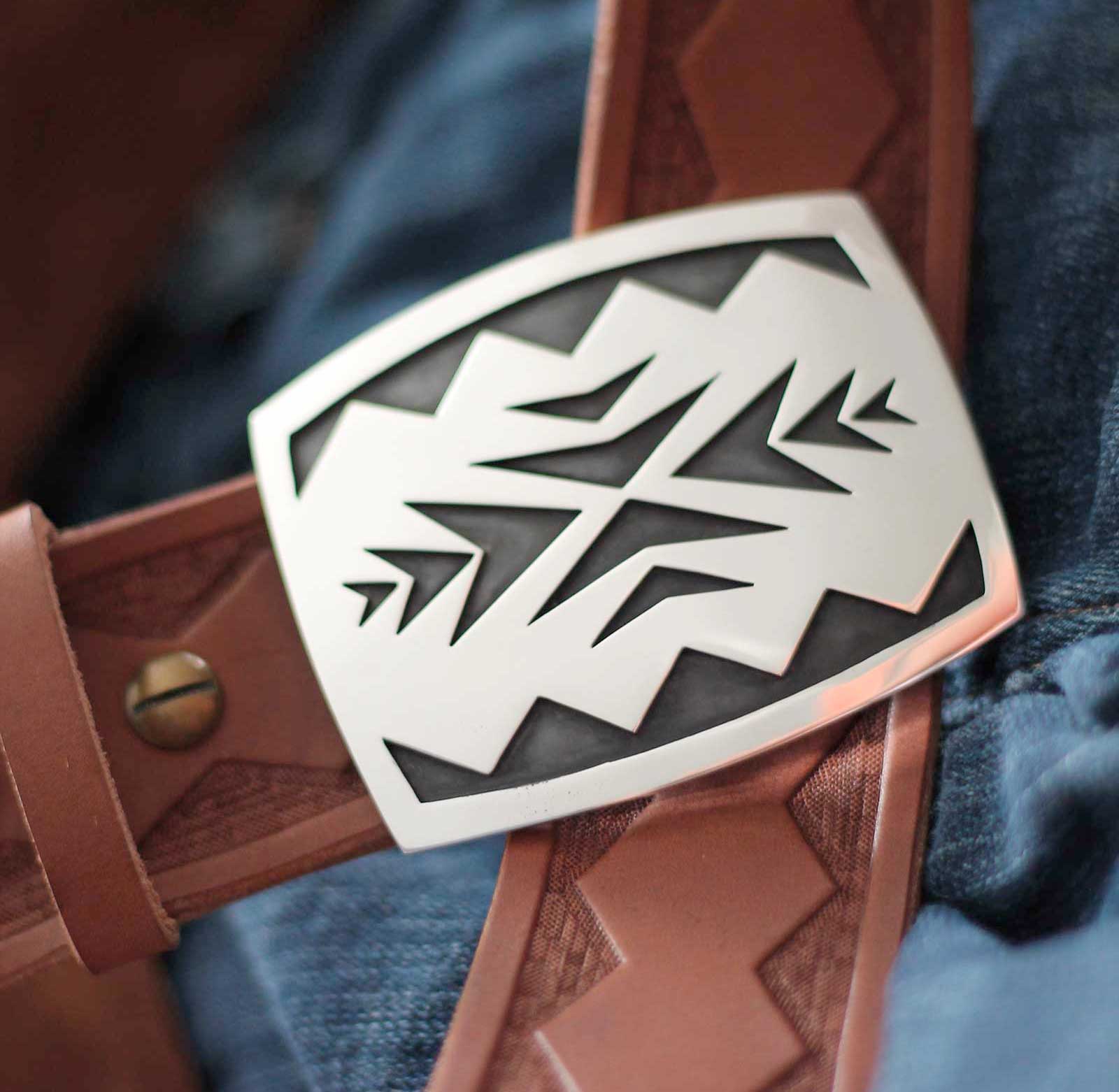
Symmetry belt and buckle set, sterling silver, leather, 3 x 48 in.
He started with hand engraving on flat sheet silver, a two-dimensional medium that satisfied him for a few years before he wanted to deepen his skills. He then began learning fabrication and casting, the techniques that allow a silversmith to build forms in three dimensions. This is where the Plains Cree sensibility took over. The bold geometrics, the high contrast, the sense of formal adornment that Lee had grown up watching in his community, all of it began to move through the medium of metal. He found a way to contribute to the evolving Plains Indian culture. “We’ve always had jewelry,” Lee says simply. “We were always very flashy and luxurious looking, especially in formal settings.”
In an era of Indigenous fashion, Lee’s framing of his own work as Plains Indian Formal carries both affection and precision. He knows that what he is making connects directly to the formal dress traditions he grew up watching, the bold patterns, the geometric and floral beadwork, the luxurious use of material characterized powwow regalia and ceremonial attire on the Northern Plains. This was, and continues to be, the aesthetic expression of cultures with sophisticated design philosophies and exacting standards.
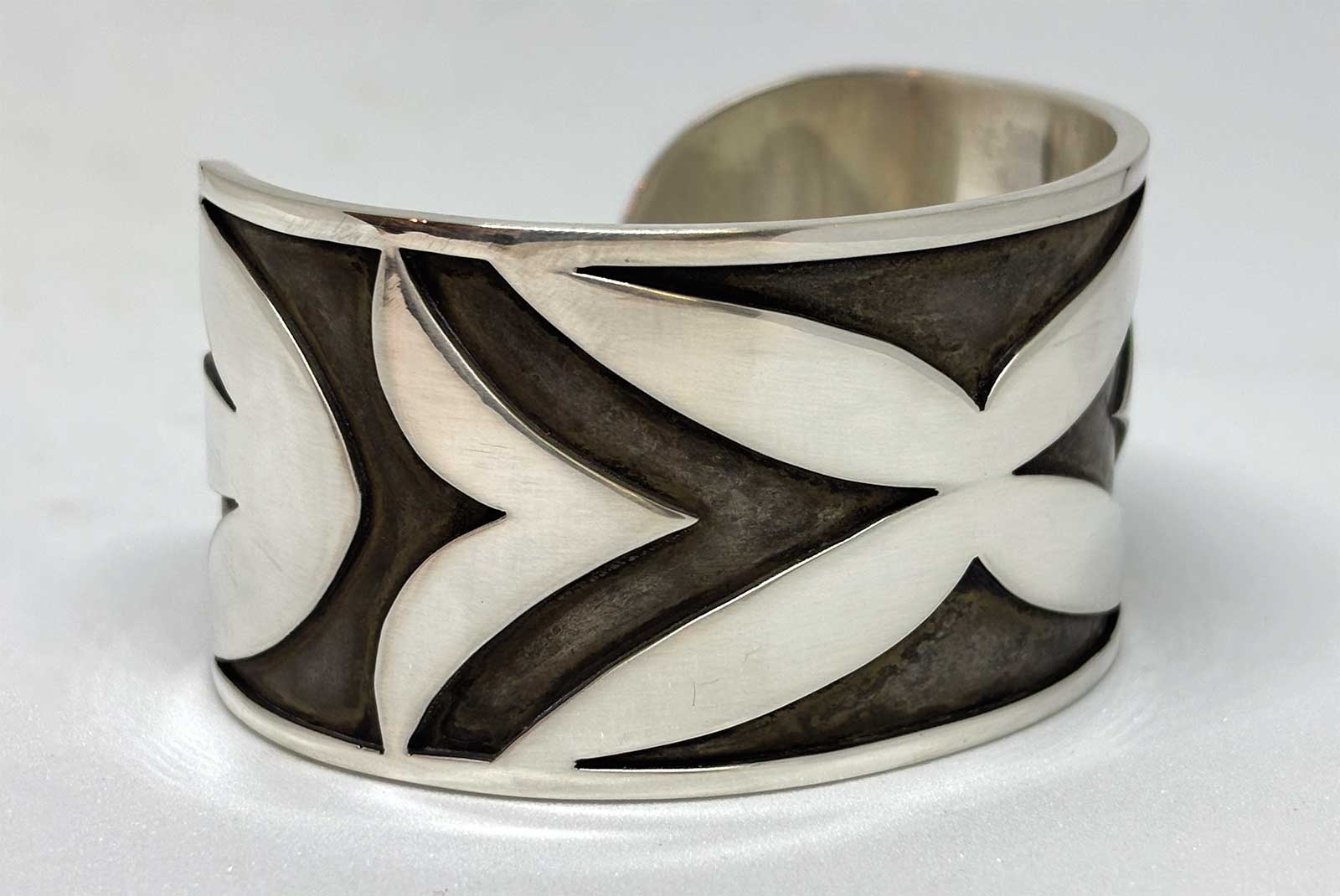
Floral cuff, sterling silver, 6 in. (round)
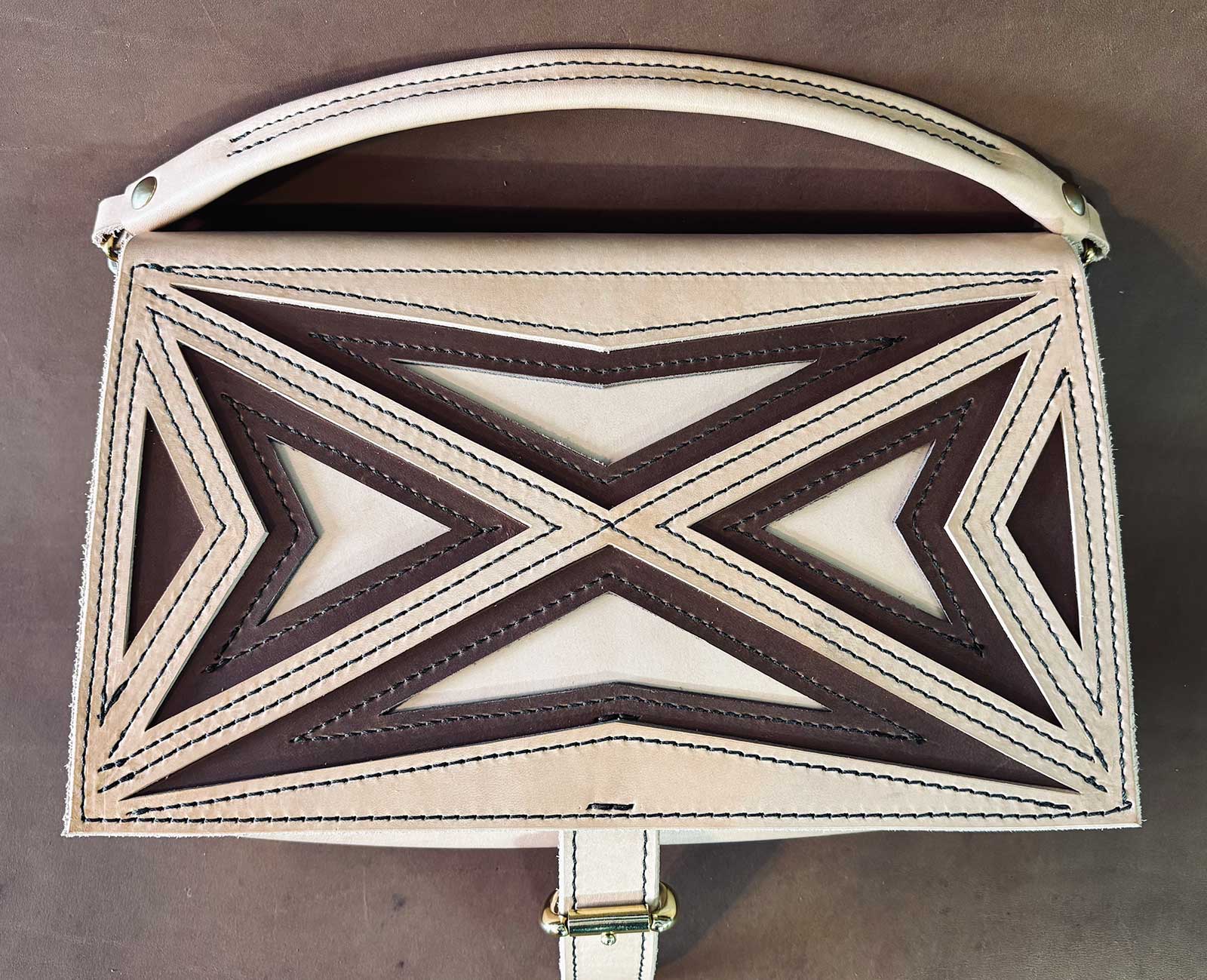
Northern Plains baguette, leather, 11 x 6 in.
“This is not something new that we have,” he says, of the current wave of attention to Indigenous fashion. “Just because it’s on a runway now doesn’t mean it’s new. We always had a very intimate relationship with the materials. Shell, bone, quills and color. We’ve always been flashy.”
Lee’s leather practice grew directly from his silver work, which is itself a testimony of the logic behind how he thinks. He was making sterling silver belt buckles and realized they needed belts worthy of them. So, he started making his own. That led to tooled leather, then sewn leather, then powwow belts with brass tacks, then matching bags, then more elaborate leather overlay, then handbags he describes as rugged luxury. He laughs at the phrase, knowing the two English words seem contradictory but insisting they are not. He calls them “luxury Indigenous formal handbags. Plains Indian Formal.”
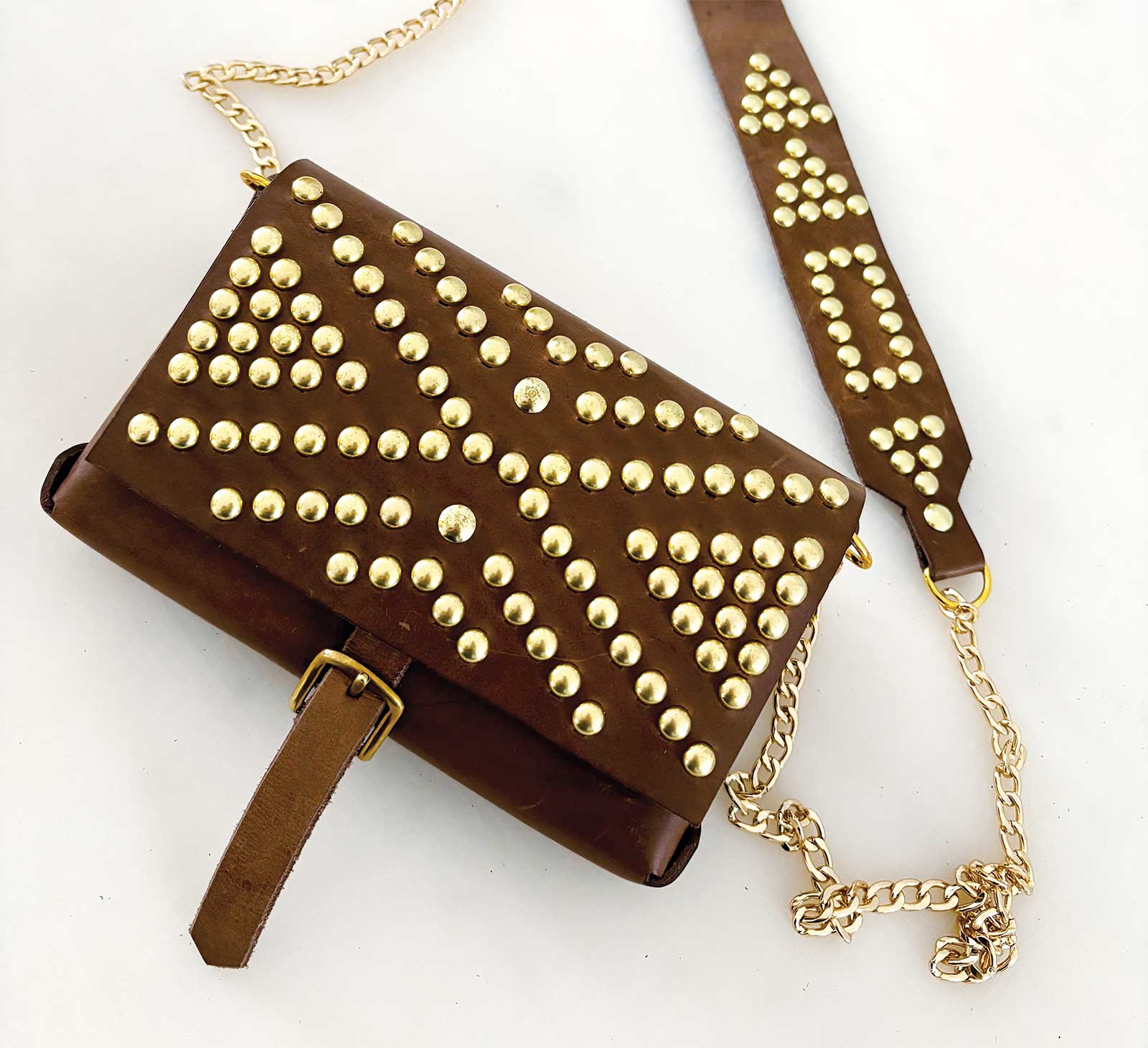
Crossbody clutch, leather, brass tacks and hardware, 8 x 5 x 2 in.
When you look at his leatherwork alongside his silverwork, the cross-pollination is unmistakable. The geometric sensibility, the sense of weight and proportion, the use of negative space. These are not separate design vocabularies across mediums; they are the same mind, moving through different materials.
There is something Lee wants people who are new to his work to understand, and he is direct about it: nothing he makes is AI-generated. In an art world increasingly contending with artificial intelligence’s extraction of imagery, including cultural property, Lee’s position is both principled and grounded in worldview.
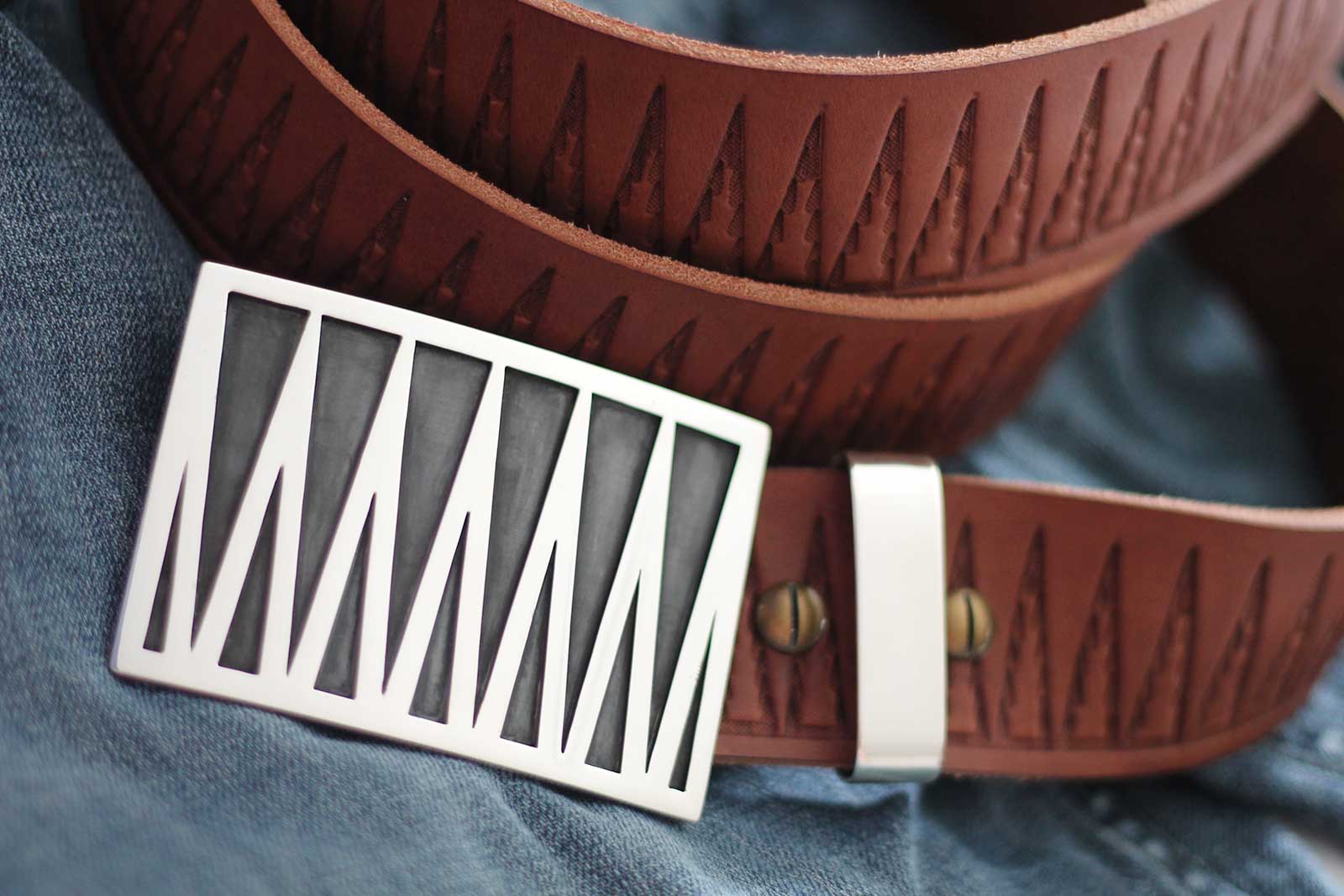
A Study in Balance, sterling silver, leather, 3 x 48 in.
“I want to feel a definite connection to the materials that I’m working with,” he says. “We’ve always had a connection to the materials whether its antler, horn, bone, stone. We’re almost related to the materials, in the way that we’re connected to things we’ve harvested from the earth. For me, that’s important. That connection.”
This is what he means by slow fashion, and it is the opposite of what AI offers. His work is intentional because each piece requires hours of his devotion. “With cultural artwork, we have a responsibility to ensure that our art is done well and in line with good cultural continuity,” he says. “I’m participating in a living art form. Our art forms are evolving, just like our culture is evolving. I’m a part of it. My artwork is a part of it. I’ve inherited a cultural legacy of imagery and connection to place and materials.”
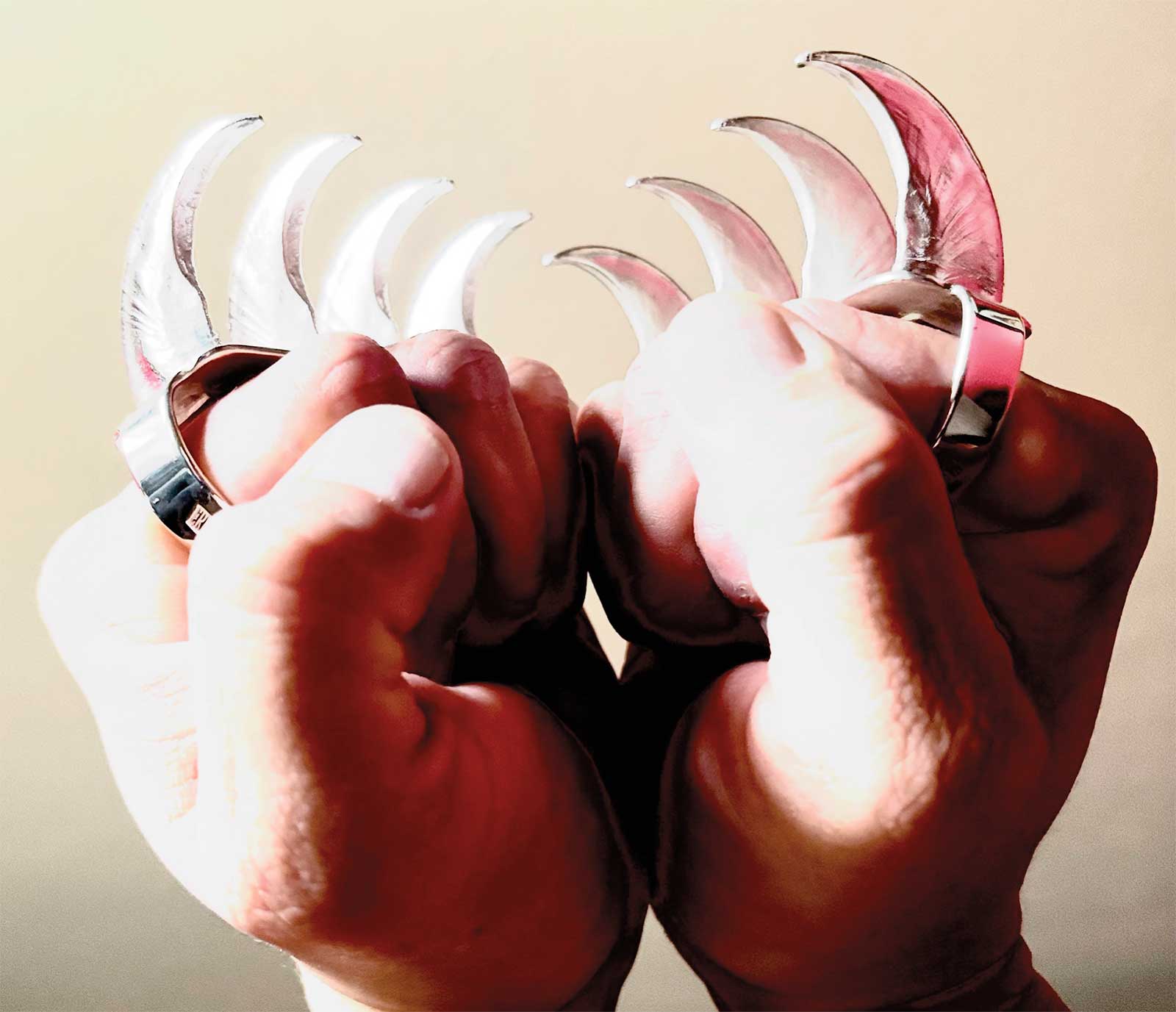
Accoutrement-Ursa, sterling silver, 3½ x 1½ x 1 in.
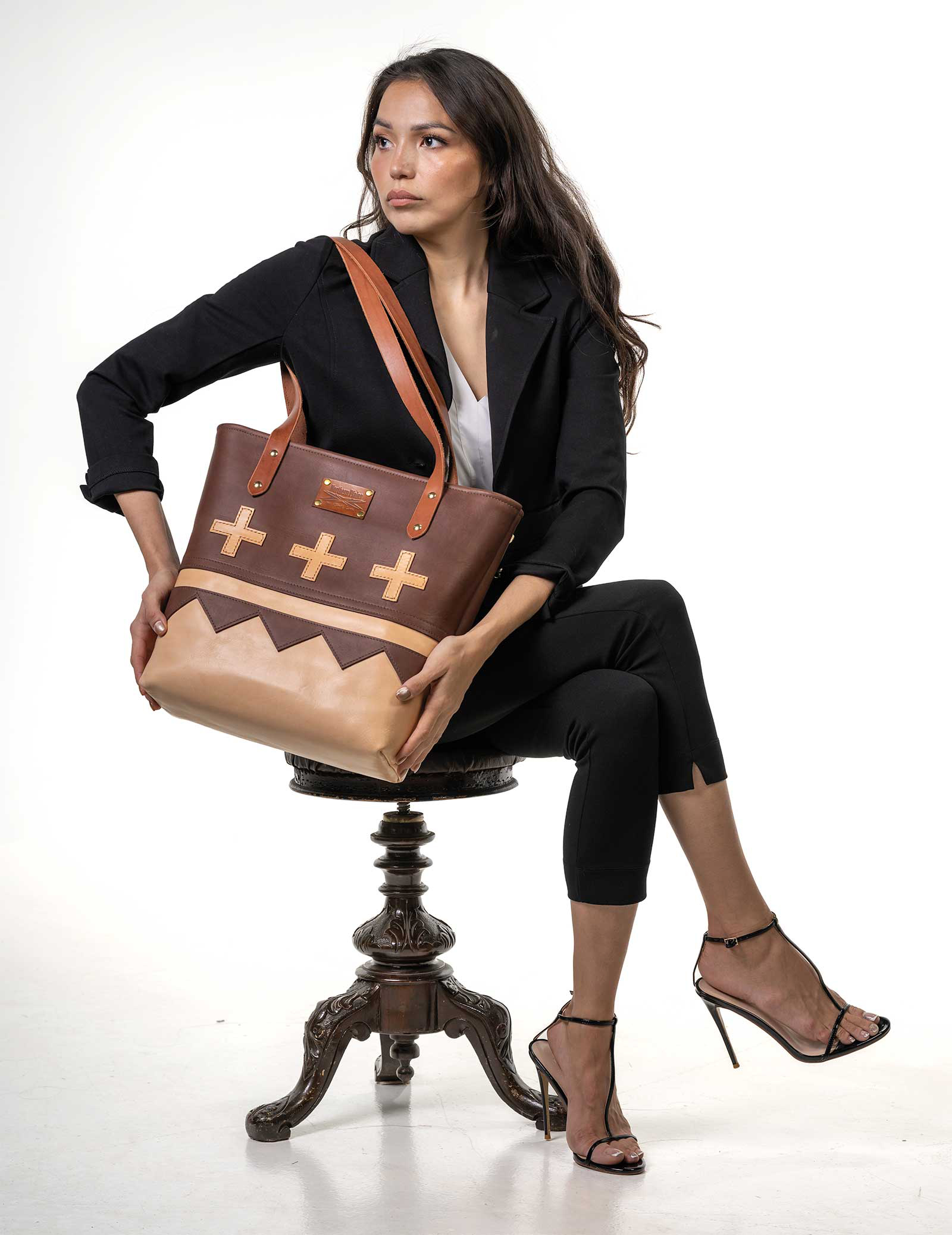
{Achakhos} Star Tote, leather, brass hardware, 14 x 15 x 6 in.
He sees Native artwork, broadly, as a form of resistance to the disposable culture of the fast fashion economy of trend-chasing and planned obsolescence. His buckles will outlast the person who wears them. His rugged luxury handbags are built to last decades. This is not an accident of craftsmanship, it is a philosophical position.
Lee has been showing at Santa Fe Indian Market for six or seven years now, consistently receiving placement in both jewelry and diverse arts. He travels from Alberta carrying as much as he can fit in his bags, including new leather compositions and silver pieces—whatever he has been able to complete between fashion events and art shows. He has participated in New York Indigenous Fashion Week and appeared at Indigenous fashion events in Toronto, Vancouver and Edmonton. The fashion world is finding him, or perhaps he was already there before it arrived.
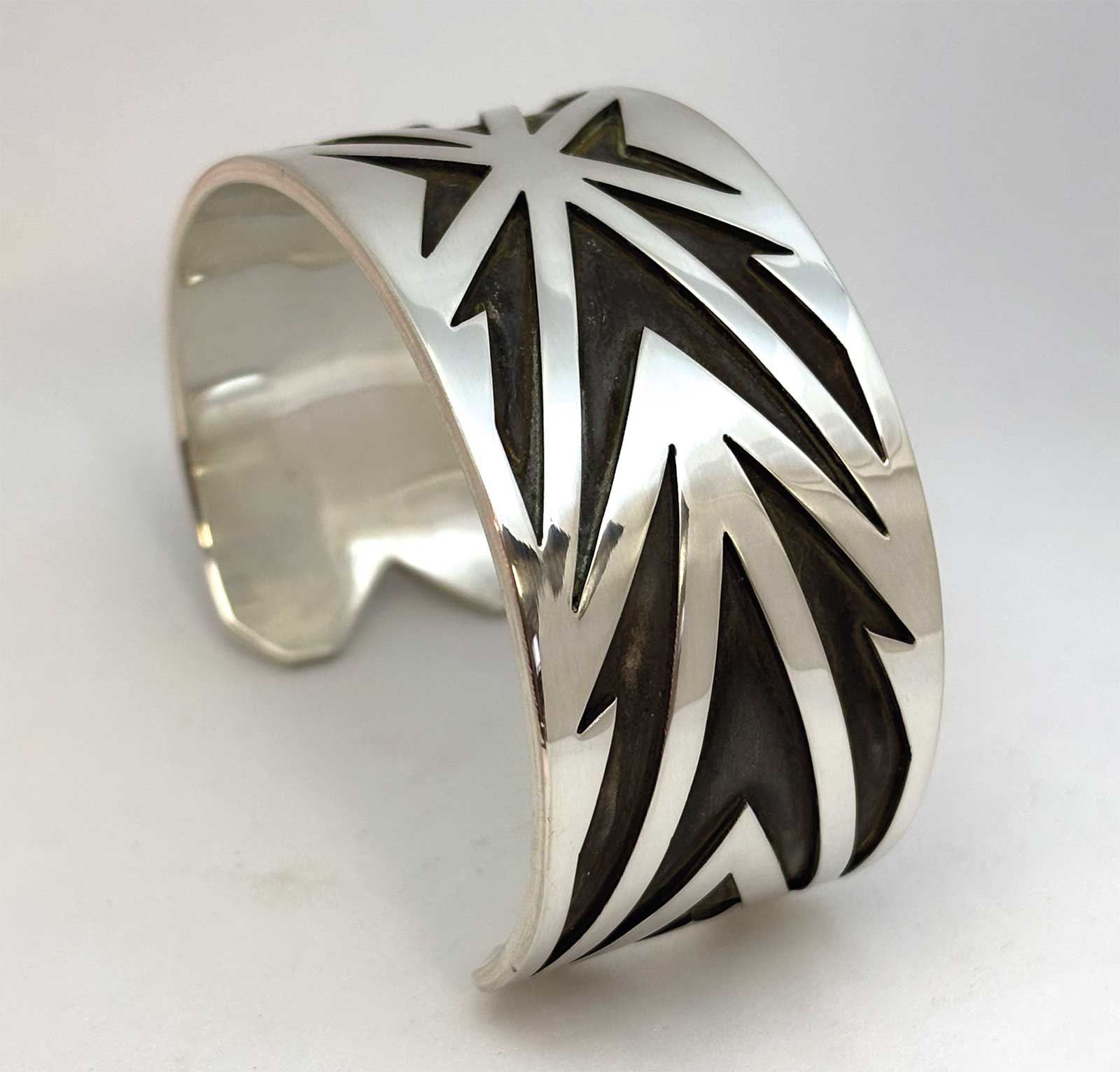
Quill bracelet in silver, sterling silver, 6 in. (round)
For collectors and those encountering Lee’s work for the first time, the visual experience is immediate because his work has presence. The silver has weight and specificity. The leather has depth of design that rewards sustained looking. But what makes the work matter, in the longer sense, is what it carries: a mother’s geometric dreams, a vivid language that connects him with process, a tradition of Plains Indian Formal that was never not sophisticated, and the quiet discipline of an artist who shows up every day to participate in a living culture. —
Erik Lee’s booth is WA E 414 at Indian Market.
Powered by Froala Editor


