Lily Hope (Tlingit, Raven moiety) is the recipient of a 2026 United States Artists Fellowship as a Cultural Continuity Artist. Her Tlingit name is Wooshinkindein Da.aat, which means “walking together one behind another.”
USAF notes, “Hope’s art honors Indigenous resilience and creative sovereignty—each weaving a living thread between ancestors, contemporary communities and generations yet to come.”
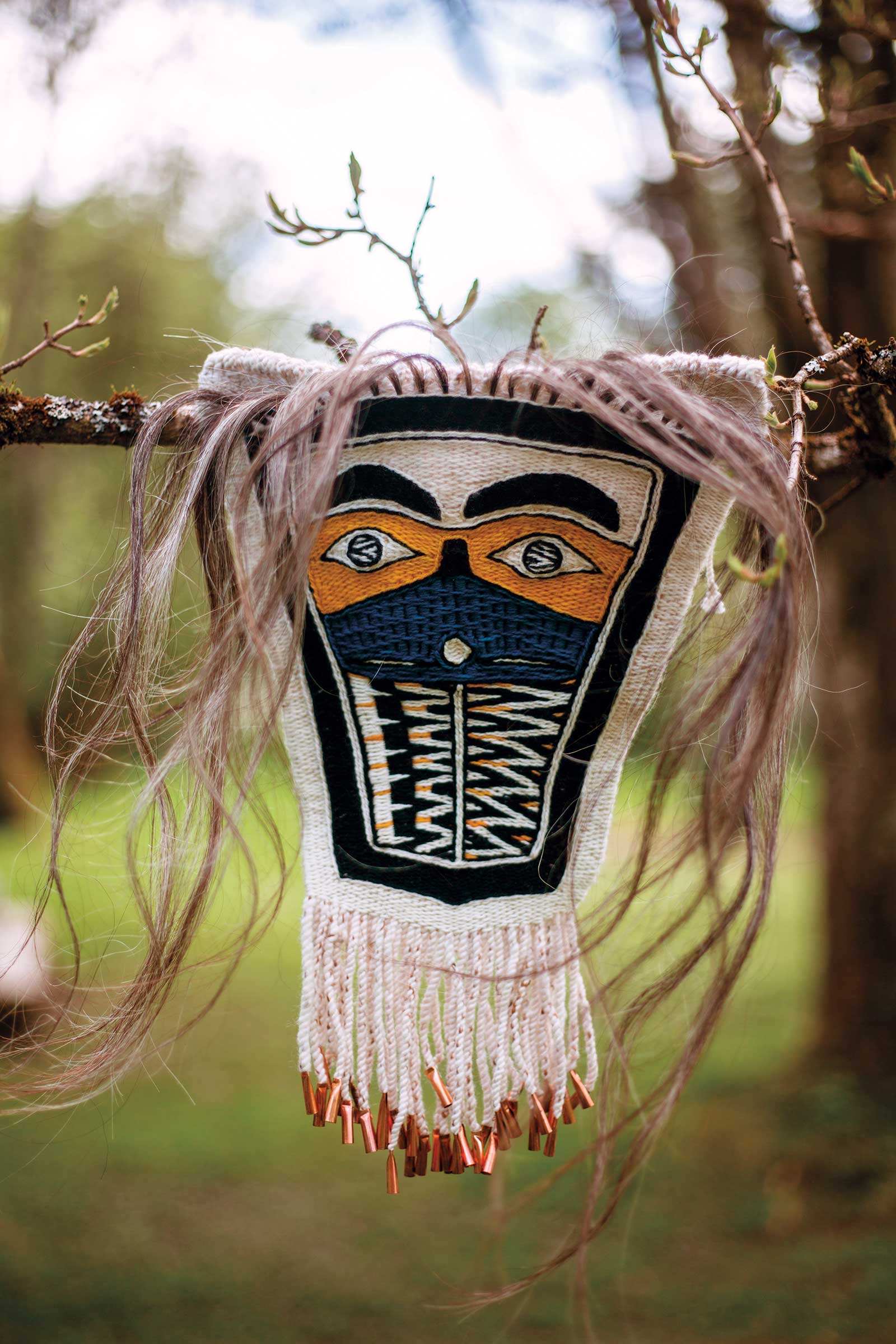
Grandmother’s Wealth, Chilkat weaving, thigh-spun merino and cedar warp, hand-dyed merino weft yarns, copper cones and human hair. Sold through Stonington Gallery, Seattle, and later donated to the Burke Museum of Natural History and Culture, Seattle, by Bob and Rita Moore.
The renowned weaver of Chilkat dancing blankets learned finger-twined Ravenstail and Chilkat weaving from her late mother, Clarissa Rizal (1956-2016), who studied with the master Chilkat weaver Jennie Thlunaut (1891-1986).
She lives up to her name, weaving traditional histories as well as exploring ways to express contemporary culture. She not only collaborates with other artists but perpetuates the traditions in both lecturing and teaching.
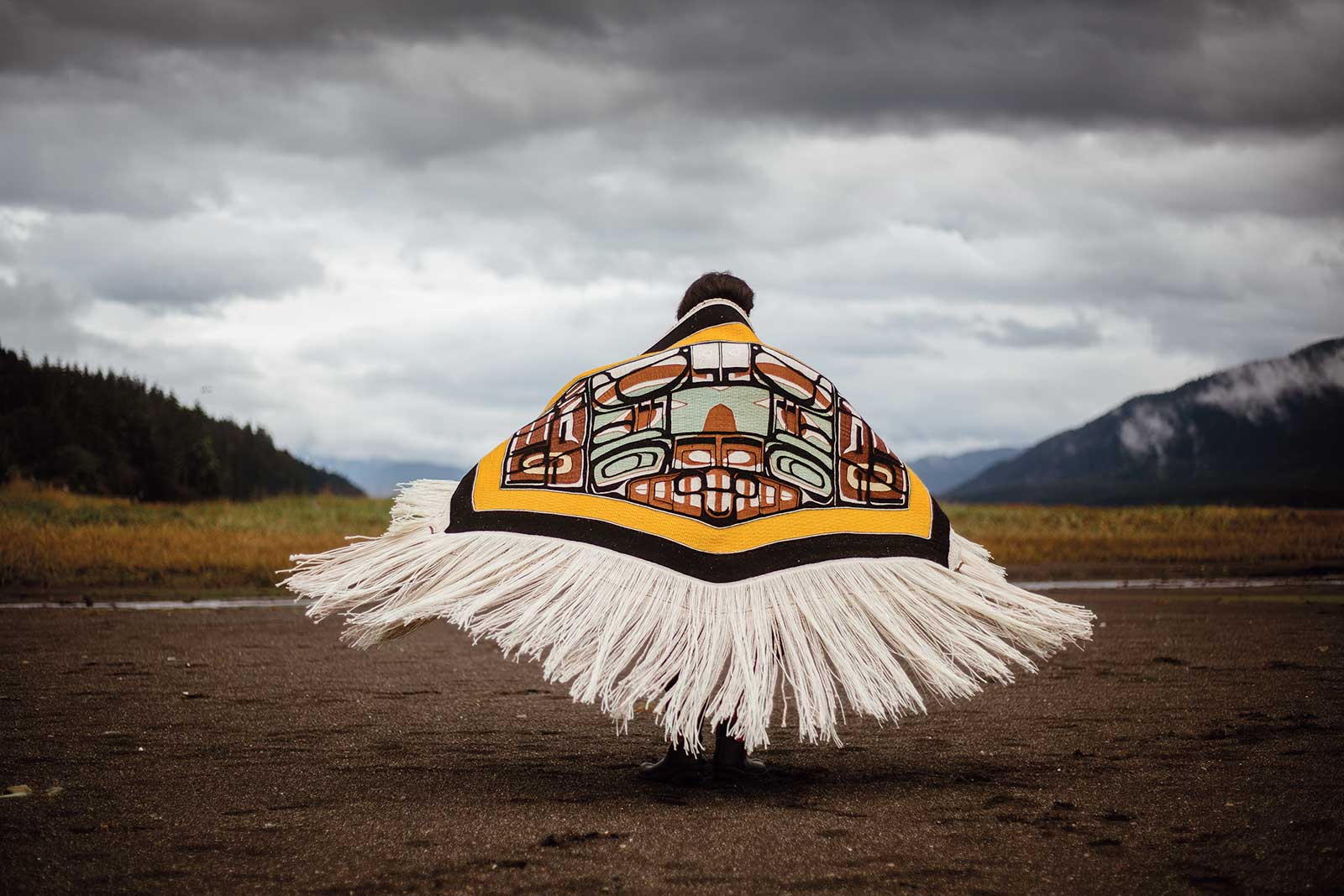
Between Worlds, Chilkat weaving, thigh-spun merino and cedar warps, merino weft yarns, 63 x 35 in. Commissioned by the Houston Museum of Natural Science for its Great Hall of the Americas, where it is on permanent display.
Her wall hanging Grandmother’s Wealth, “is the curvature of the copper tináa [copper shield], symbolizing the wealth of Tlingit, Haida and Tsimshian Native people of Southeast Alaska,” she explains. “Grandmother’s face has eyes of lightning, an open mouth to share her oral stories, and the mouth doubles as the opening to the clan house, where she holds her children and grandchildren. The bottom geometric pattern is a historic design titled All Our Ancestors. Her head is adorned in silver cascading human hair, as some of the most sought-after carved wooden formline masks also embody. The copper cones jingle like rain, symbolizing the cycle of water and life.”
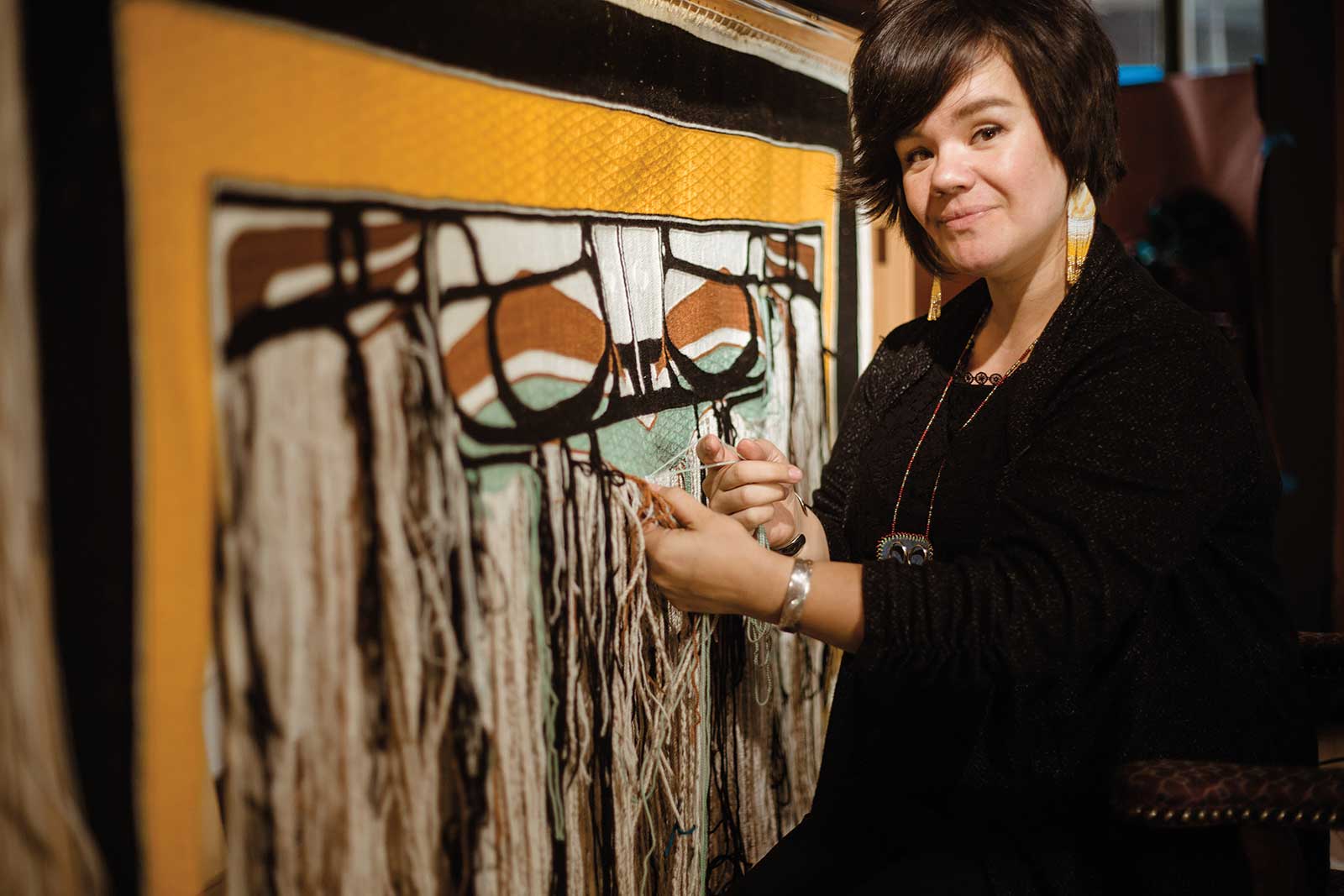
Artist Lily Hope with an in-progress weaving.
In March, she unveiled two ceremonial pride robes woven by young people in her community of Juneau, Alaska. She says, “The Weaving Our Pride Ravenstail and Chilkat youth pride robes [were] created together by Native, non-Native, queer, straight, cis-gender, transgender, allies and all identities [that sat] side by side to finish one Ravenstail robe and one Chilkat robe. The robes will live at the Zach Gordon Youth Center [in Juneau] as a permanent wearable art piece, to only be worn by youth, during Sealaska Heritage Institute’s biennial celebration, graduations, new-names parties, coming-out parties, and significant Native and non-Native pride events.”
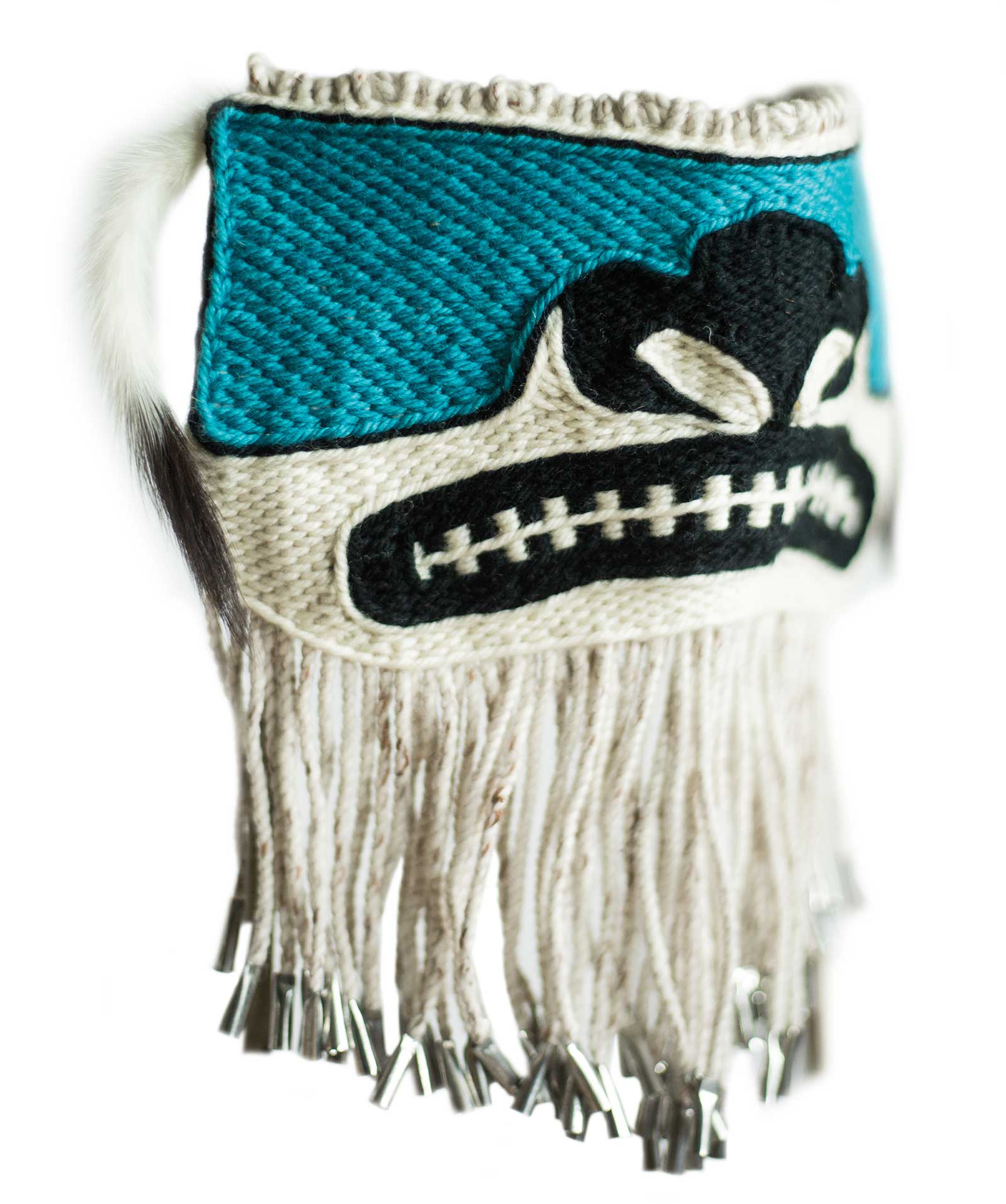
Chilkat Protector Mask, thigh-spun merino and cedar bark, merino weft yarns and tin cones. The mask was created as part of a series of Covid masks in 2020. It was featured on the cover of First American Art in spring 2021. The artist wove 37 of these masks, housed in dozens of museums across the globe. She also taught more than 75 artists to weave them. More than a dozen of the masks from her and her students toured the country in the exhibition Protection: Adaptation and Resistance. This original mask was acquired by the Burke Museum of Natural History and Culture in Seattle.
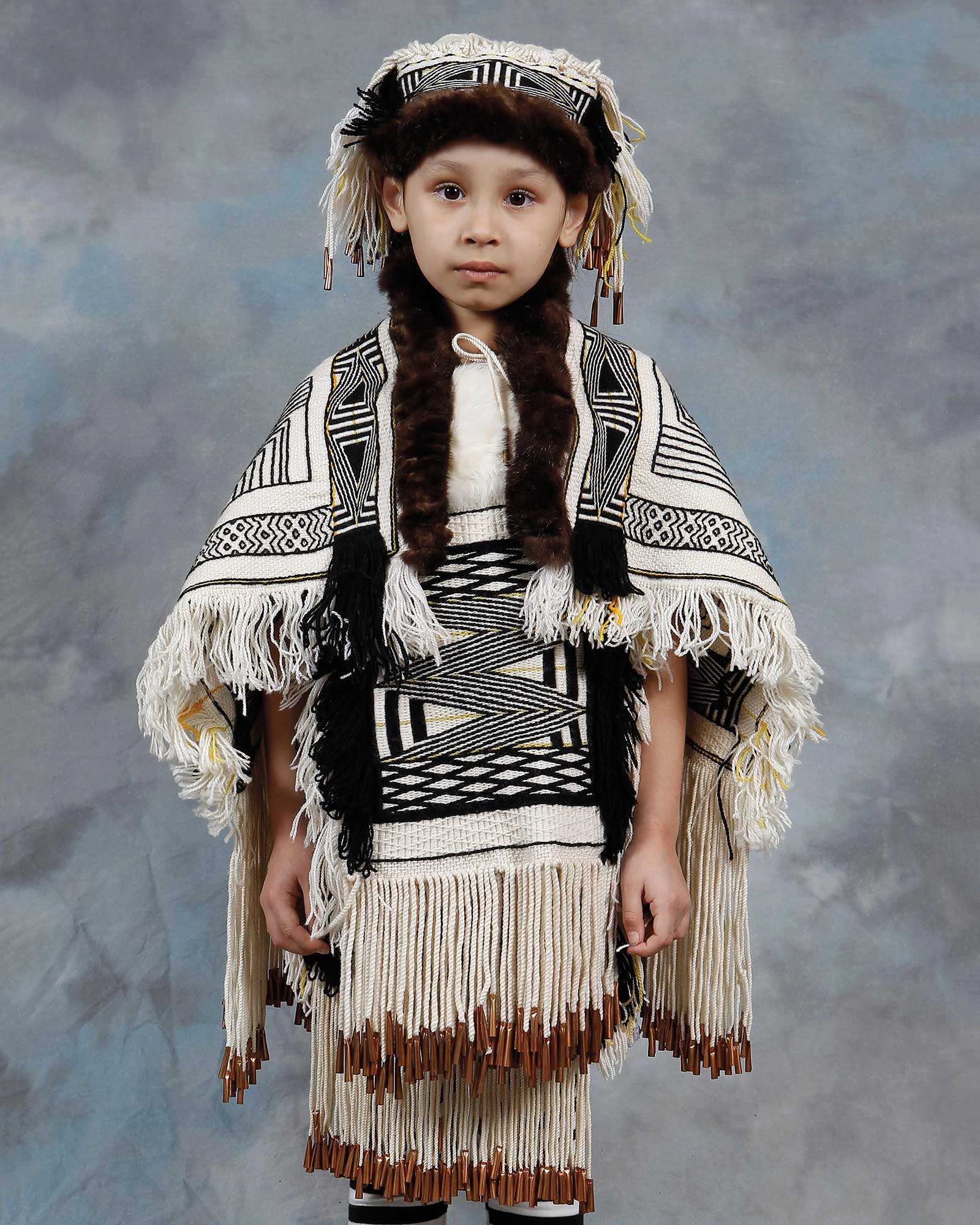
This Copper Child Ensemble was woven in 2010, and is one of the first works Lily Hope completed and sold. It was placed in the permanent collection of Alaska’s Sealaska Heritage Institute after it won best of show in the Juried Art Show in 2012. Ravenstail techniques include thigh-spun merino warps, original designs of Shaman Eyes and adaptations of Standing on Top of the Mountain. The bunny-fur top as woven by the artist’s mother, Clarissa Rizal. “This work speaks to the mountainous elevation we seek to gain perspective on how to see more clearly and heal ourselves and our communities.” —LH
Hope is currently working on a commission for a Chilkat robe woven of mountain goat wool for the Crystal Bridges Museum of American Art in Bentonville, Arkansas. She comments, “When I’m weaving for a museum, I’m not weaving an object. I’m weaving an educational tool. I’m weaving an ancestor that is going to become an ambassador in that space for artists, scholars and future visitors—hopefully some of them weavers who will study my work long after I am gone.”
She and Jordan Poorman Cocker (Kiowa Tribe and Kingdom of Tonga), Crystal Bridges’ curator of Indigenous art, discussed the future of the completed robe. “We talked about the life of this work,” she explains. “Is it going to live in a drawer or on a mannequin on display? We asked, ‘what can we do differently?’” The museum has agreed to send the Chilkat dancing blanket back to Juneau to be danced at least biennially.
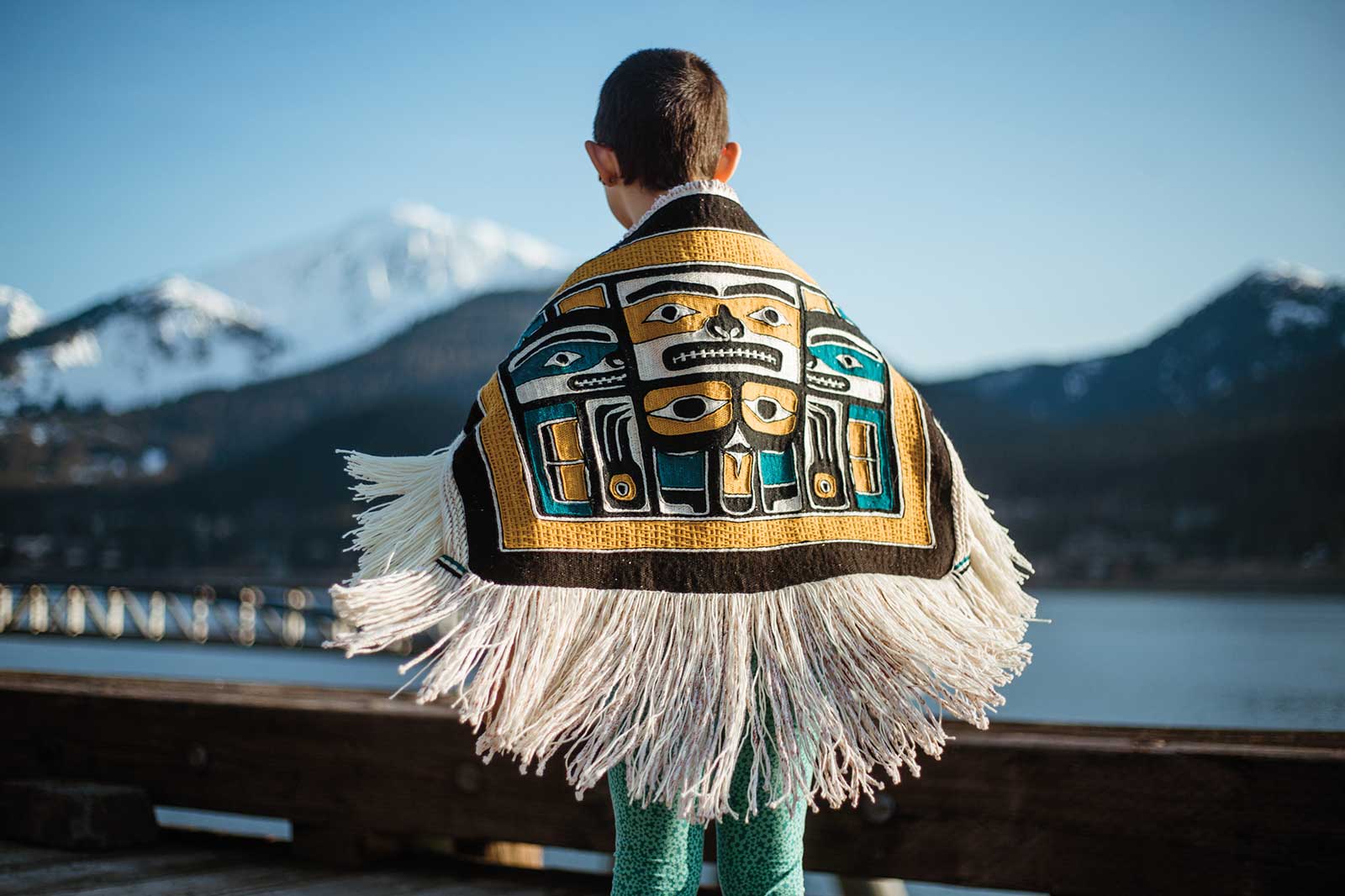
This robe, Seven Generations Chilkat Robe, was woven across more than 680 video tutorials created for students to follow along and weave their own robes during the pandemic. More than two dozen artists benefited from the videos and now retain the spiritual and technical knowledge to weave adult-sized Chilkat dancing blankets. This robe and 22 more were danced for the first time in February 2023, the largest gathering of recently completed Chilkats in history. After the dance, all robes were on display in the exhibition For Our Children: Chilkat Regalia Woven in the Lineage of Jennie Thlunaut & Clarissa Rizal in 2023 at Alaska’s Juneau Douglas City Museum. This Seven Generations robe is in the permanent collection of the Goldbelt Heritage Foundation in Juneau, Alaska. Its creation and placement was supported in large part by a SHIFT Grant through the Native Arts and Cultures Foundation.
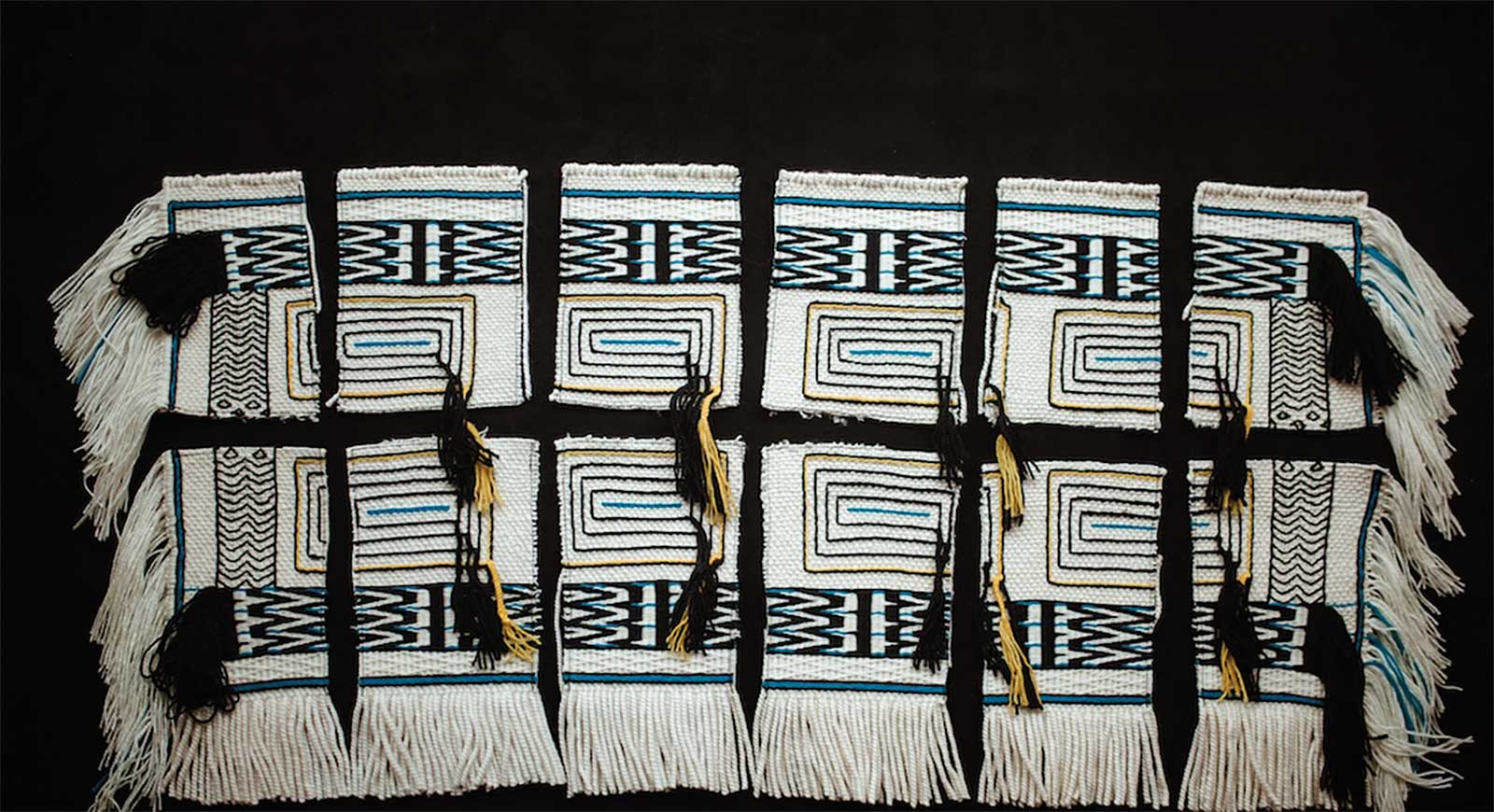
Governors Award for Arts and Humanities, thigh-spun 100-percent merino wool warps, hand-dyed merino weft yarns, mounted in 8 x 10 frames with name plaques, 34 x 24 in. “This work was woven for 12 awardees for Alaska’s Governor’s Awards. In Chilkat tradition, when a clan leader or chief cuts up and gives away fragments of woven regalia, it is not only an assertion of his wealth, it is an acknowledgement of the rich relationships with dignitaries in his community. Cutting up this Ravenstail robe affirms the same for these 12 governor’s awardees: that our State of Alaska is more rich because of their creative and humanitarian contributions.” —LH
In 2024, one of her ensembles in both Ravenstail and Chilkat techniques, Reimagining Alaska Native History or Valuable Since Birth, won best of division at Santa Fe Indian Market. She plans on taking her Crystal Bridges robe, an innovative work-in-progress, to this year’s market.
She explains that the prize-winning ensemble “was created for a baby girl. Preverbal, 6 months old. Historic photos and ethnographic writings record that ceremonial Ravenstail and Chilkat dancing blankets were woven primarily by women to be worn primarily by men. Every time a totem pole is raised, every time a person dies, the woven, woolen, beaded and cedar/spruce regalia drape the shoulders and heads of men. The men speak for the clans, as leaders of the community. What are we communicating to our girls when they turn 40 before they have regalia for themselves? How do we tell them that they’re allowed to speak up, and that their voices will be heard? We start by weaving our girls their own prestigious woolen regalia. From birth. We shroud them in laborious and meaningful patterns from their ancestors. We tell them, before they can speak, but with photos of their babyhood later, that they’ve been just as valuable as their brothers since the beginning.”
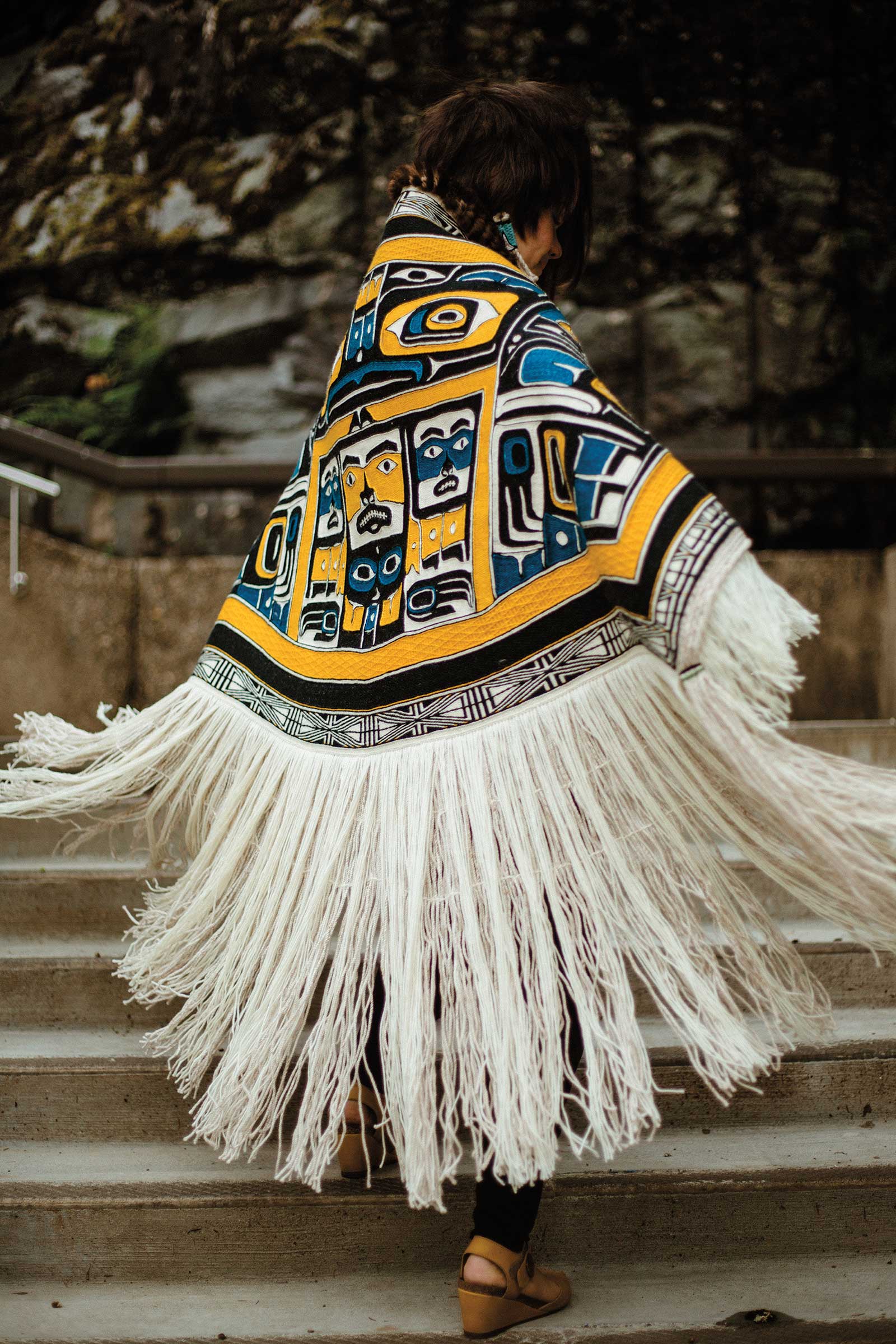
Double Raven Chilkat, thigh-spun merino weft yarns, hand-dyed and commercially dyed merino weft yarns, 58 x 34 in. Commissioned by an art collector in Los Angeles. Woven in tandem with Ricky Tagaban.
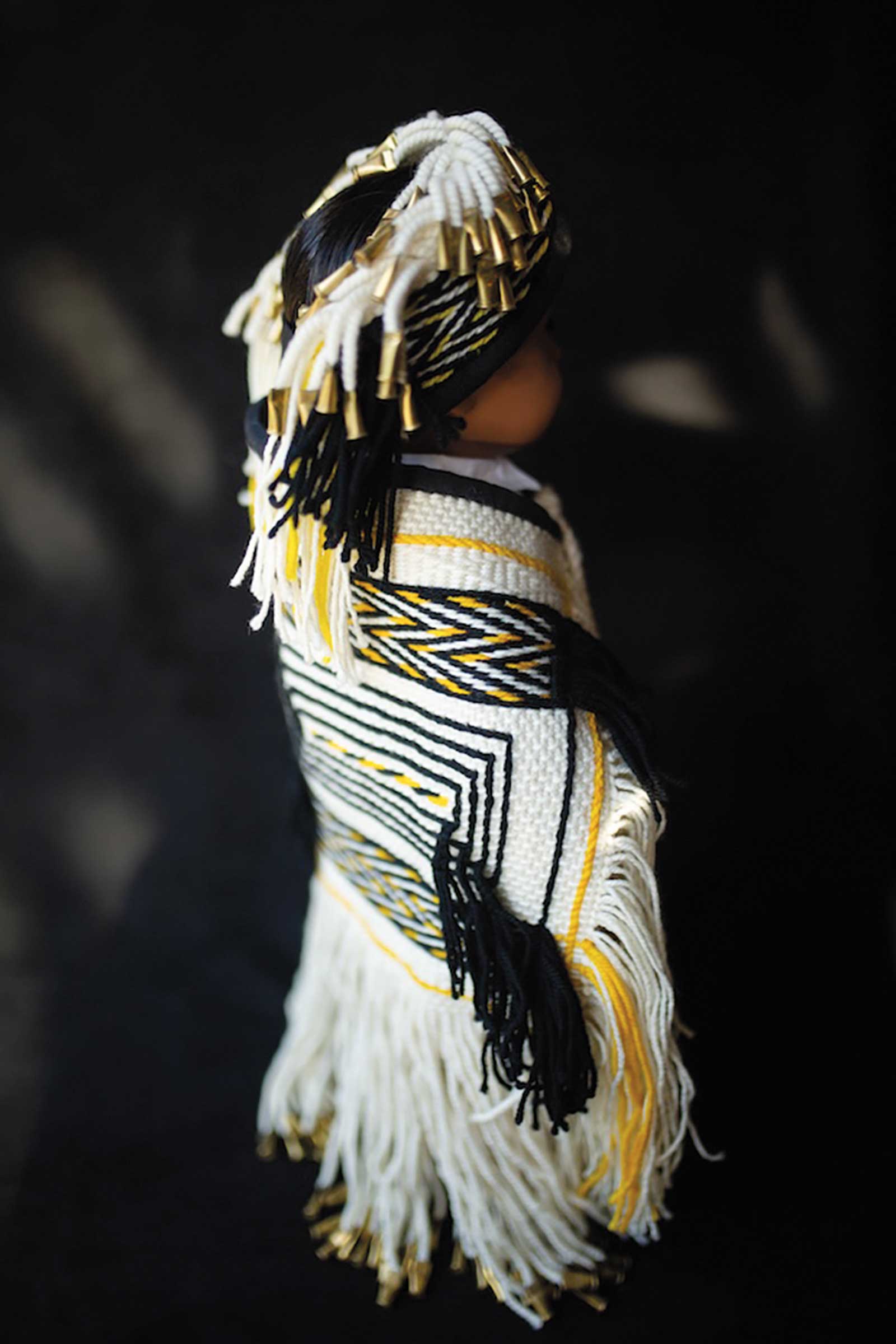
Reimagining Alaska Native History or Valuable Since Birth, Merino thigh-spun warps, merino weft yarns, .22 magnum bullet shells on every fringe. Created for a 6-month-old baby girl. The weaving won best of division (finger weaving) in the textiles classification at the 2024 Santa Fe Indian Market. It is in the permanent collection of the Aaywa Storytelling Institute, Alaska.
Her Double Raven Chilkat was commissioned by an art collector in Los Angeles, who asked for a clan robe. “We discussed that clan items do not usually leave the village they were made for, and settled on a double raven Chilkat original design, to highlight two raven weavers and their respective descendants alive at the time. It was woven in tandem with Ricky Tagaban, the second raven on the team.”
Hope’s Crystal Bridges robe will be twined in the traditional way with the warp made of mountain goat wool and cedar bark. Merino wool has taken the place of mountain goat wool in most contemporary robes. During the weaving process—which takes 54 weeks, or 2,500 hours, of finger-twining and braiding of a full-size ceremonial blanket, in addition to six to 12 weeks of material preparation—the weaver exists “in the veil between the spirit world and our physical realm.” Hope believes her mother still guides her from the other side of the veil.
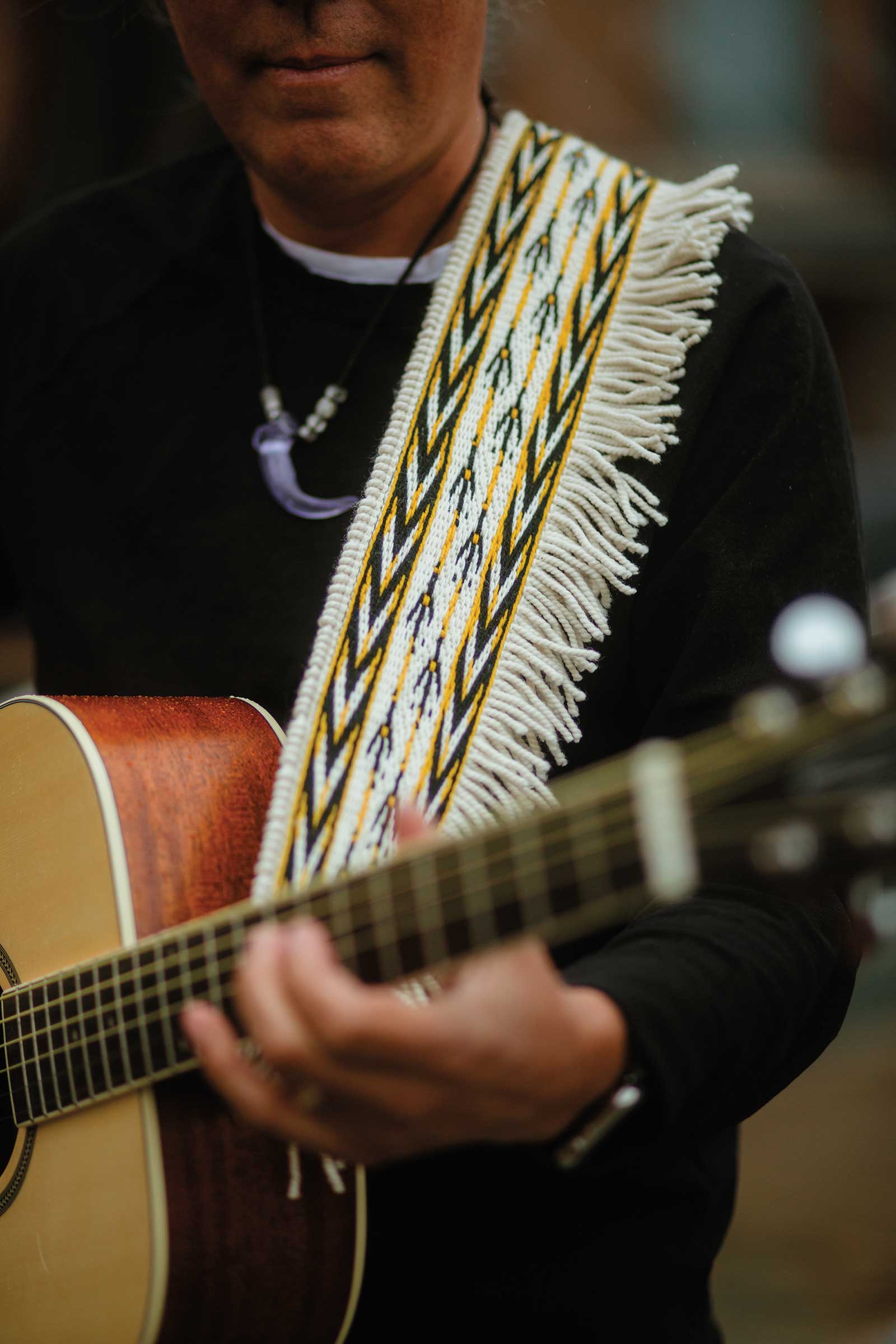
Eagle Footprints Guitar Strap, thigh-spun 100 percent merino wool warps, hand-dyed merino weft yarns, 23 x 6 in. “[Glass artist] Preston Singletary commissioned this work and helped choose the patterns. He loved my original Raven Footprints, but his mother was Eagle, so we modified it just for Preston. He wears this guitar strap when he performs with his Washington-based band, Ku.Eex. —LH
Her mother wrote, “I am one of millions of visionary vessels from which creation flows, and to add to my blessings, I am born to a landscape, people and culture rich with beauty, diversity, strength and community. Gratefully, we Tlingit are grounded within the guidance of our ancestral customs, traditions and relations.” —
Lily Hope’s booth is LIN W 787 at Indian Market.
Powered by Froala Editor


