“I really enjoy the sound of the blade cutting through the leather-hard clay. It’s really satisfying as carving is one of the enjoyable parts of making a piece of my pottery,” says Daniel T. Begay (Santa Clara Pueblo/Navajo (Diné)), an award-winning Native potter. His connection to the pottery-making process, as well as his unique forms and designs, have placed him among the top young, innovative potters working today. Begay grew up in an artistic home, where his father, Harrison Begay Jr., and his mother, Marie John, were both potters. His precision-oriented carved vessels have become recognized for their unique shapes, designs and style of carving. Begay has focused on these technical aspects to create impressive works that challenge our perceptions and expectations of contemporary pueblo pottery.
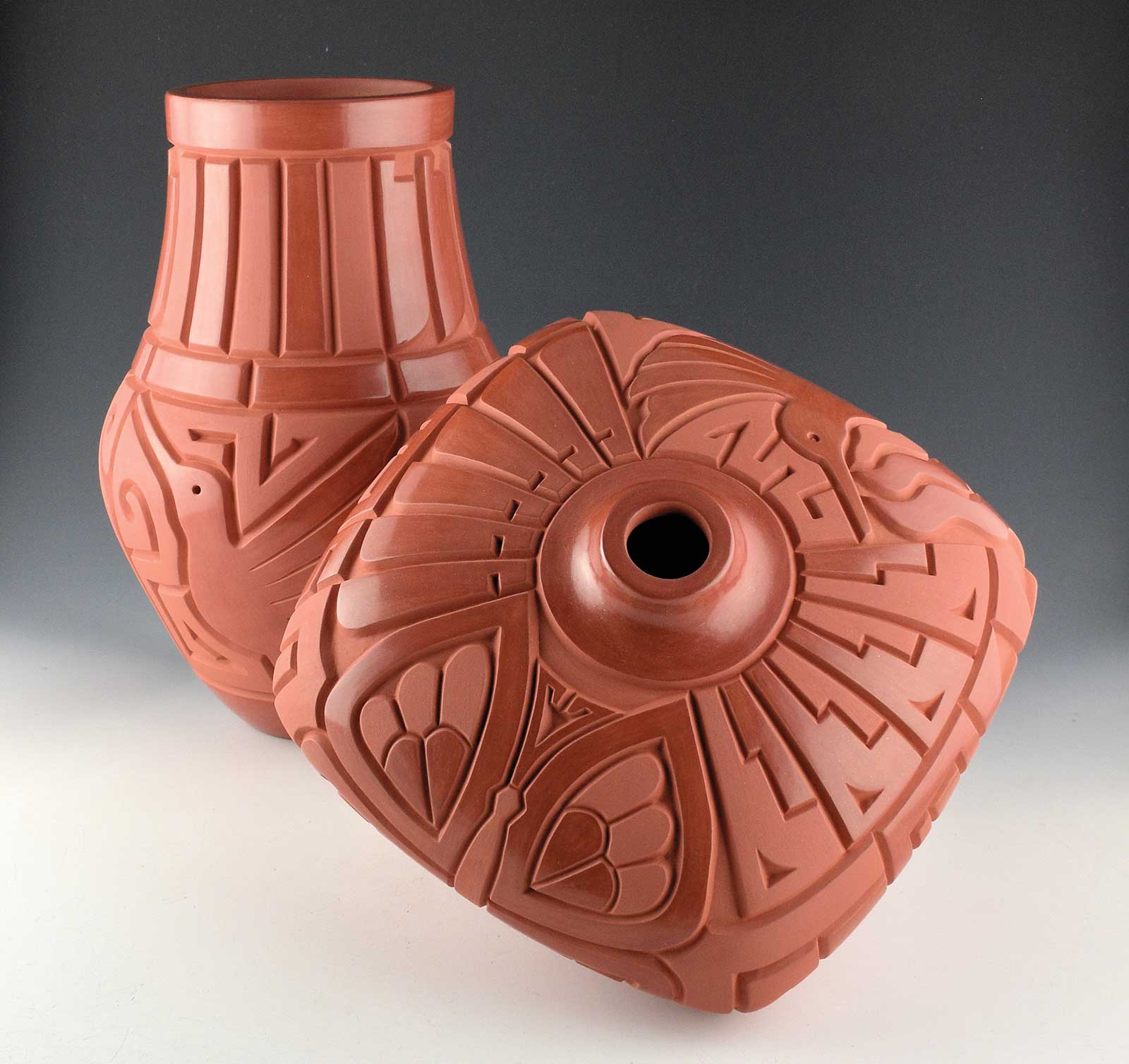
Red fired vessels, native clay, native fired
“I am both Santa Clara and Navajo. That’s an important part of my story and has created a path that is different from other Native potters,” he says. “For a long time, I felt like I was an outsider. Begay is a Navajo last name, yet I grew up at Santa Clara Pueblo until I was 12 years old. Then I lived in Santa Fe until I went to college. I learned to make pottery from my dad. My mother’s Santa Clara side of the family are potters, and I’m an enrolled member at Santa Clara Pueblo. Today, I am just starting to find my place among the historic potters in my family. I think I’ve grown out of the feeling of being an outsider; there is a growing feeling that I belong.”
Begay began by making small clay animals and pots, steadily learning to build larger pieces. In high school, he grew even more confident in carving. After receiving his undergraduate degree, he worked for 10 years at the University of New Mexico while still working with the clay in his free time. Around 2022, he decided to become a full-time potter. “I had encouragement from gallerist Charles King, and more importantly, my family. About 99.9 percent of the decisions I make are about my family,” he says. “With the support of my wife, Melodie (Ohkay Owingeh), I made the decision to move from a desk job to becoming a pottery artist. It takes a lot of discipline and organization to be a full-time artist. I have to make sacrifices for both family and art. There is no set schedule and deadlines have a different meaning. In a lot of instances, family comes first. Is it difficult? Sure. But I enjoy the flexibility and life I have now.”
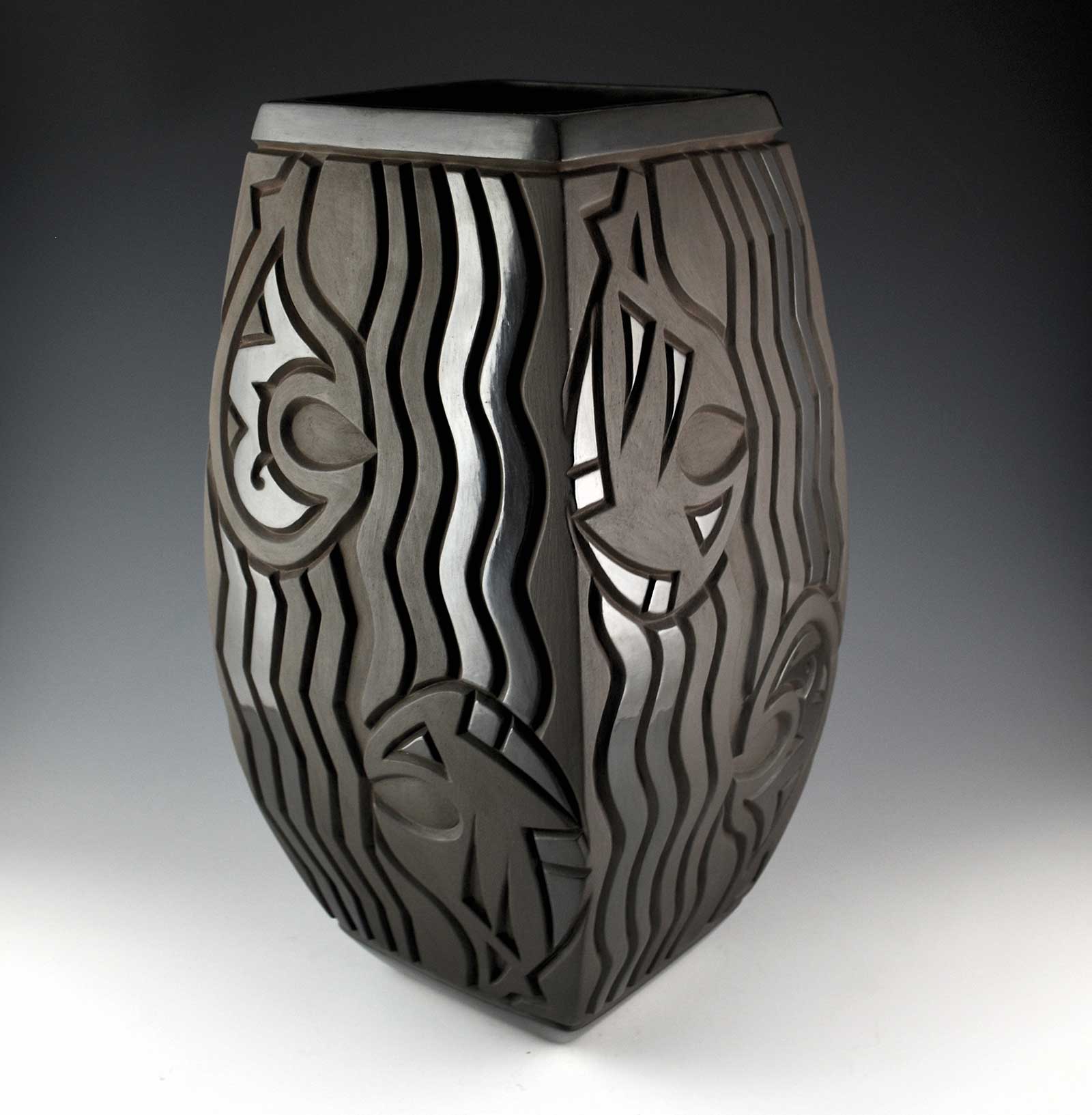
Bears by the River, native clay, native fired
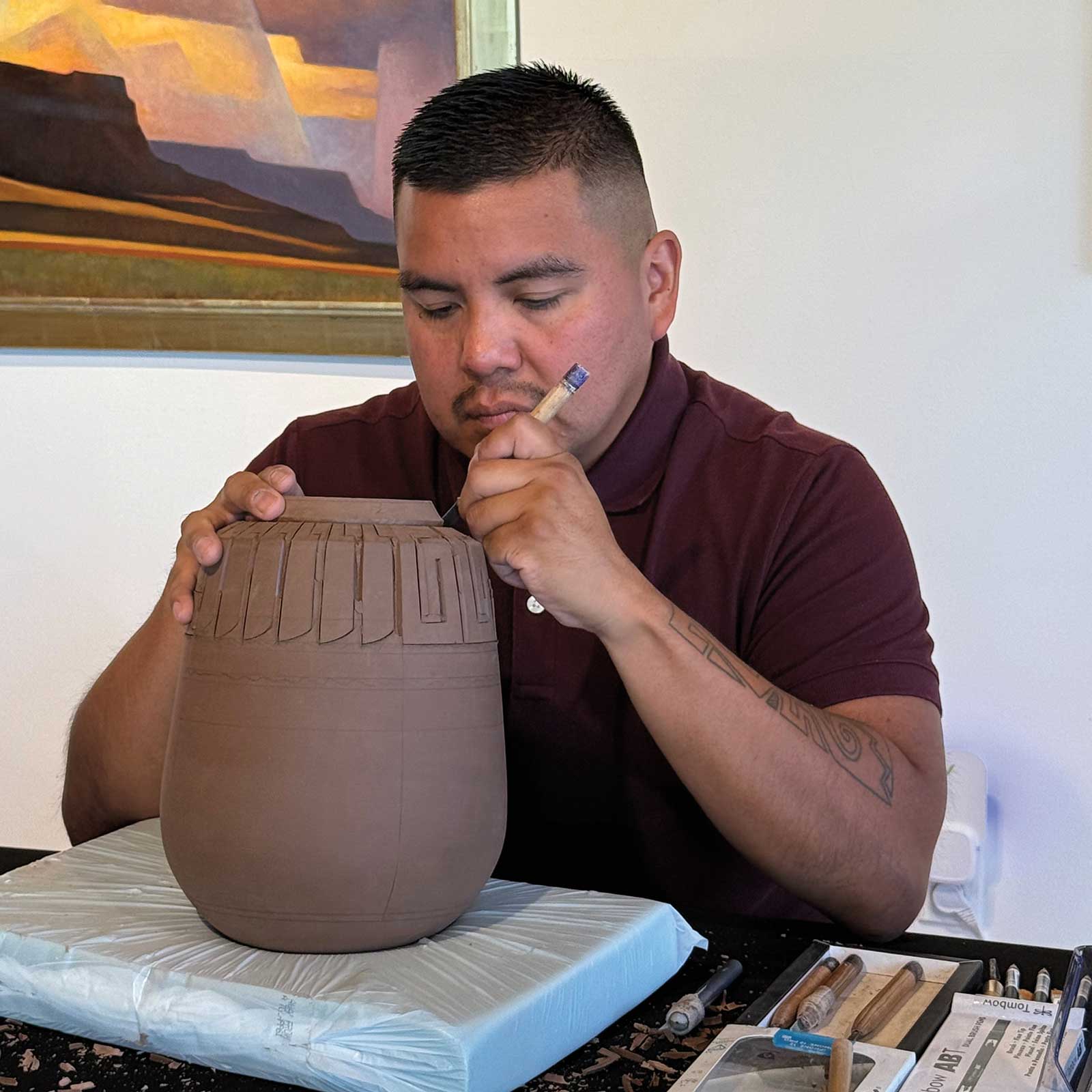
Daniel Begay carving pottery.
He digs his clay from an area near Santa Clara Pueblo, where his parents dug the clay when he was a child. Each piece is then coil-built before it is designed, carved and stone-polished. “I love when I get to sit down and make a piece of pottery. It’s therapeutic and I’ve adopted a mindset when I start to build,” he says. “I can’t be overly stressed. I can’t be angry about anything. I just need to find that space where I feel my mind is flowing. When it comes to the clay, I always need to be respectful of the clay and remember where it came from: the earth.”
The potter creates shapes ranging from classic water jars to more unconventional forms. His angular or square-shaped pieces are among his most sought-after pieces. “I find the most enjoyment when I’m trying to build something new, that I’ve never done before. It’s a bit intimidating and nerve-racking. But when it’s done, and I’m able to look at it from all angles, it’s really satisfying. I started making the square pieces in the mid-2000s. My dad has always experimented with shape, and he started to create pieces that were square with rounded corners. I wanted to make something similar but with sharper edges. It was a challenge as the edges on square pieces are more delicate when carving and polishing, but when they are done—amazing.”
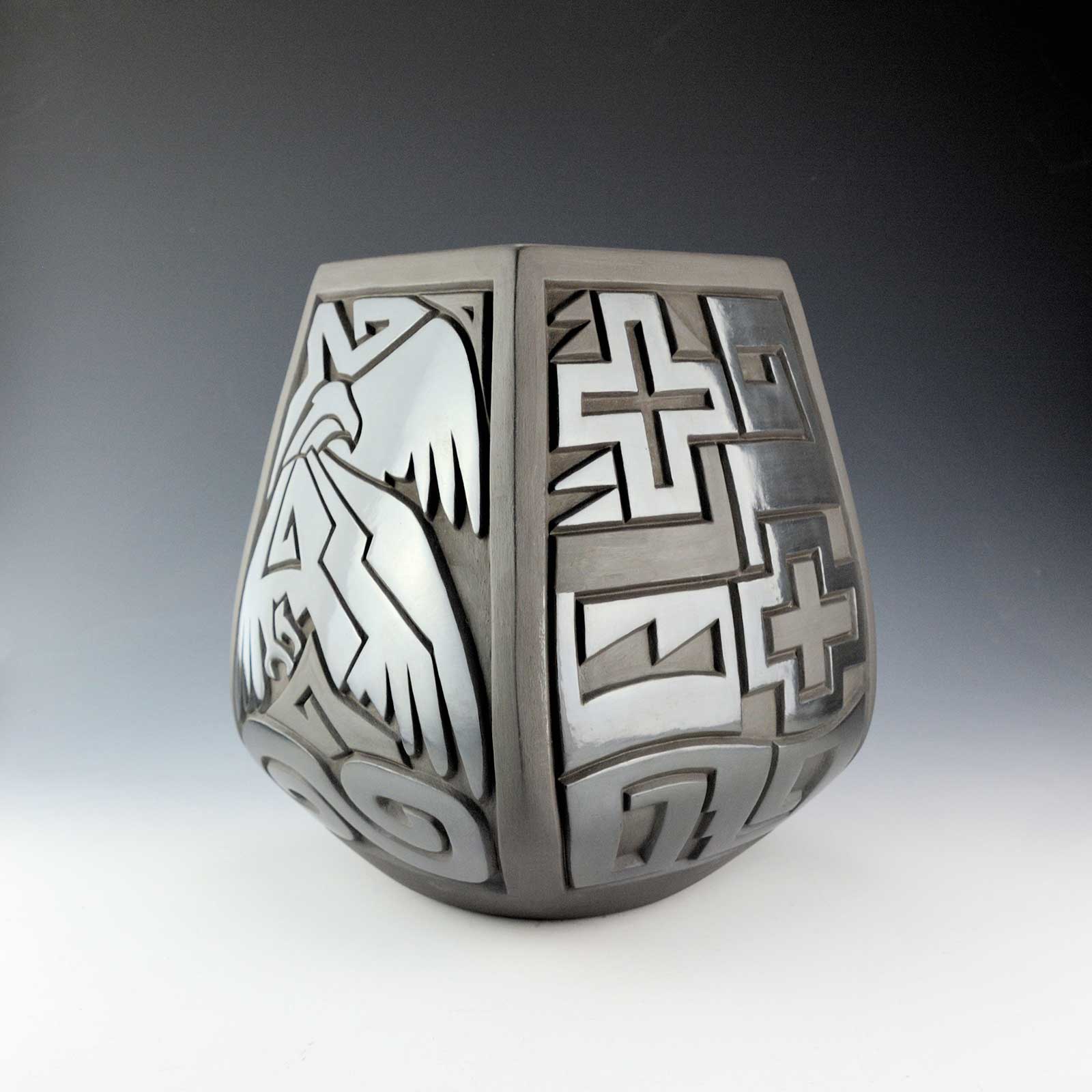
Eagle in the Stars, native clay, native fired
When the jar is still wet, or “leather hard,” that is when Begay starts to carve into the clay. Taking a closer look at each piece reveals his signature V cut, a technique he acquired from Harrison’s teaching, which is more of a beveled surface than a straight, deep cut. “I carve with a V cut, which means I have to turn the piece back and forth a lot. It can be tedious. But when I’m finished, when the vessel is still leather hard and not dry, I place it so I can look at the shadows created from the carved channels. At that point, it looks so vivid and I like the small things in my work, like the shadows my carving creates.”
These exciting shapes create a “canvas” for his carved designs. Interestingly, his imagery is not limited to that of Santa Clara Pueblo or Navajo pottery. “When I begin to design a piece, I try to create a balance between realism and the abstract. Many of my pieces have animal motifs but I want my animals to look representational but not too realistic. I’ll then think about their placement and the story I want to tell in the clay.”
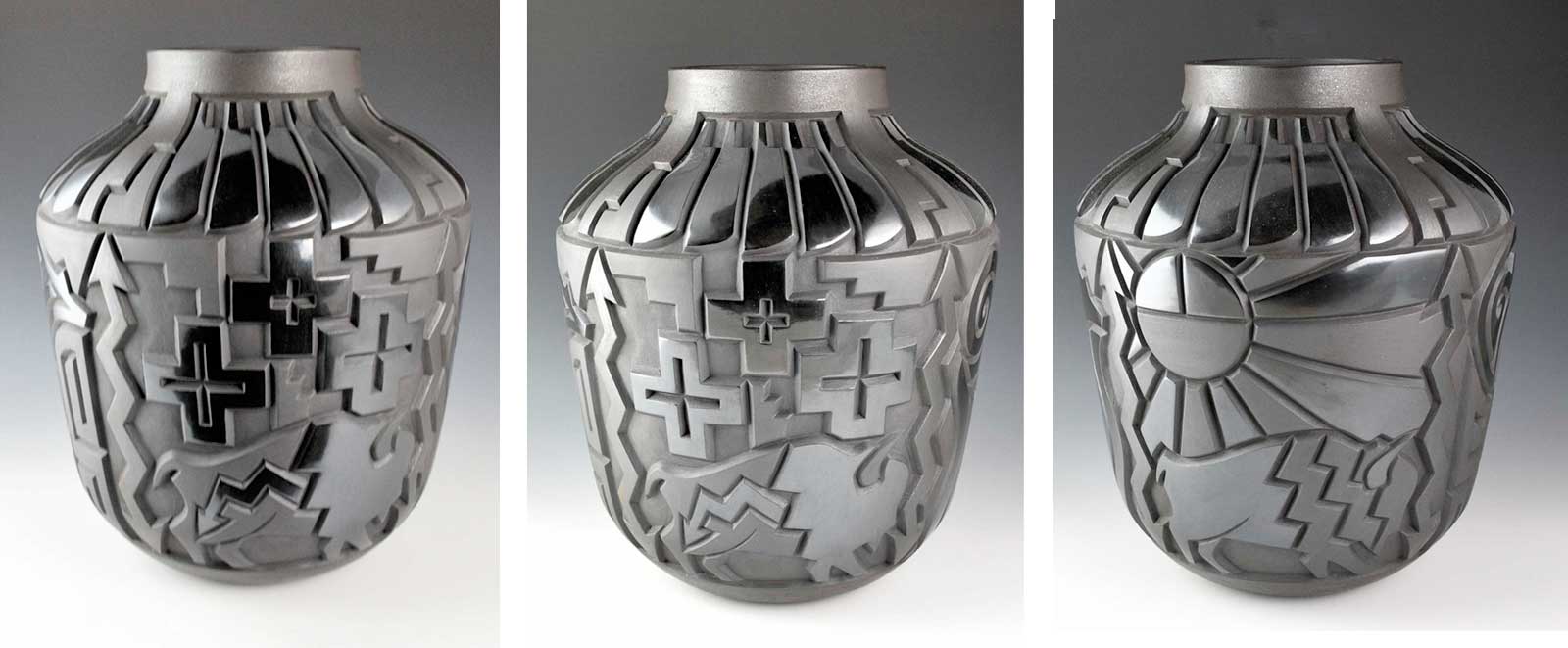
Storage Jars and Stars, native clay, native fired
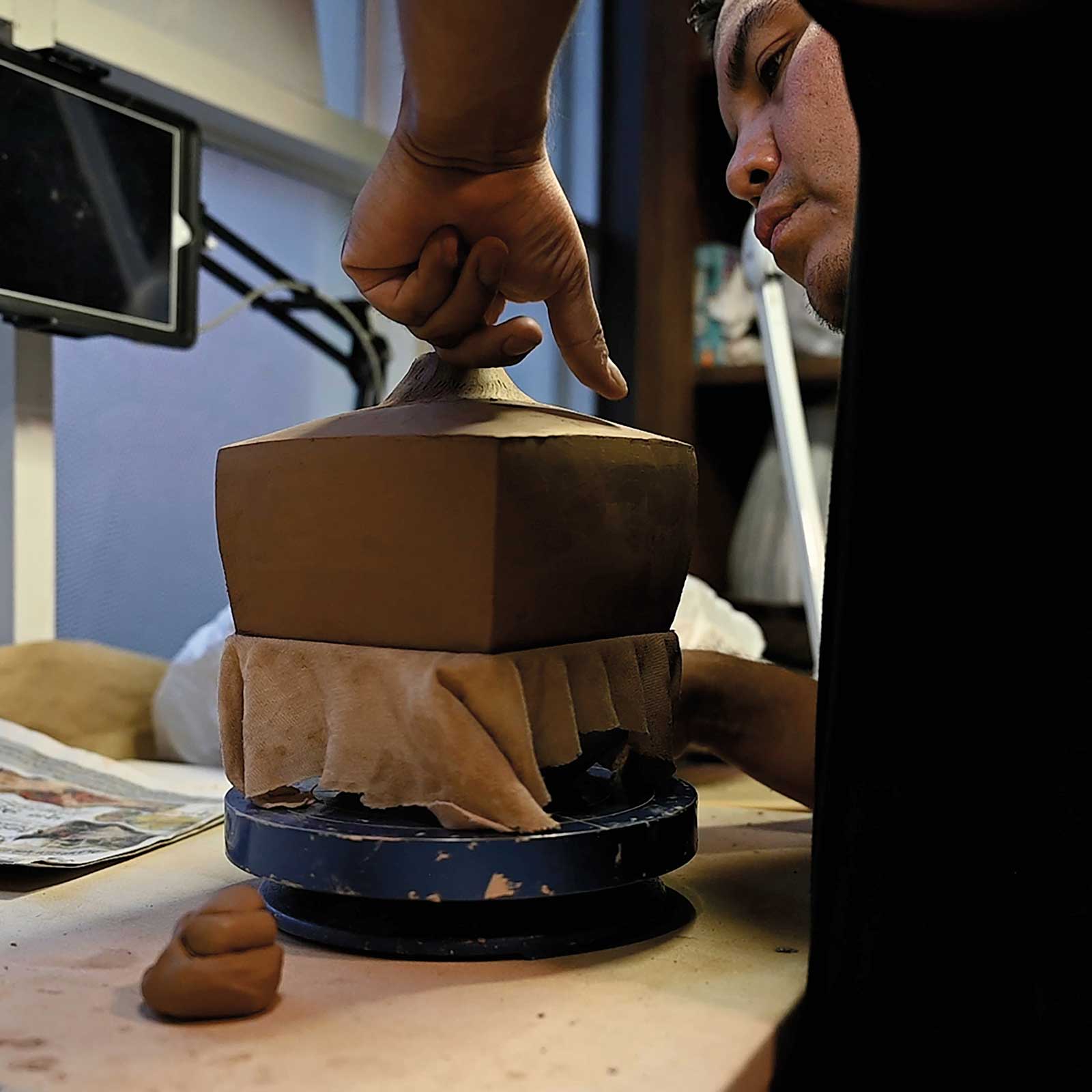
The artist coil-building a pot.
He continues, “Most of the designs have a story that is usually attached to me, my family or my upbringing as opposed to something told to me. Hummingbirds are special to my oldest daughter. I feel like I’m always telling a piece of her story when I’m designing a hummingbird. Butterflies are similar because they make me think of my wife. Not only is she a fan of butterflies, but she had the honor of dancing the Ohkay Owingeh Butterfly Dance several times. These connections from family that influence my design choice.”
One of Begay’s most popular designs is his running antelope. “Antelope are important to me because that is where my dad is from. He is from Jeddito, Arizona, which translates as ‘Antelope Springs,’” he says. “For me, there is a poetic motion in watching an antelope run and how their feet connect to the ground. The antelope also led to my first pieces with deer. When I made my first deer jar, I wanted something bold to take up the entire space. I tried designing it so it looked like was running, but it didn’t want to come out that way. I thought I’d try something more calm. That became the deer just standing there, alert and majestic.”
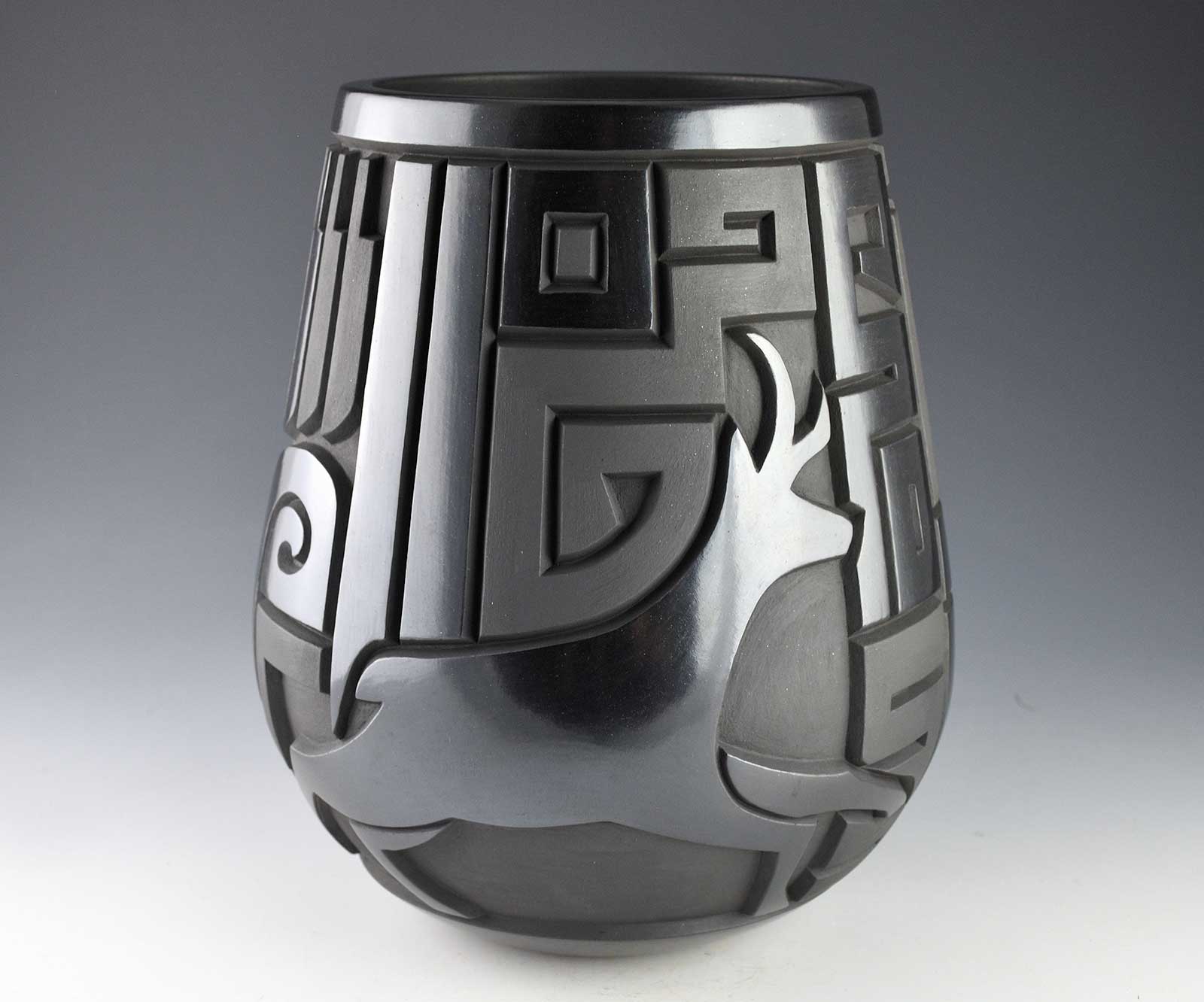
Antelope Canyon, native clay, native fired
Once the piece is carved and dried, it is then stone polished. He must decide which areas are polished and which will remain matte. This is part of the visual impact of his work, as too much polish will overwhelm his designs, so he has to carefully choose how to accentuate the complex carving. “Polishing takes the most time and requires the most patience. For me, it was the second hardest skill to master after carving.”
From gathering the clay to polishing the surface, Begay will spend months completing one piece of his pottery. Once the polishing is finished, the day arrives to fire his pottery at Santa Clara Pueblo. Each piece is traditionally fired outdoors. At this point, he has chosen whether to fire his piece black, red or brown. “When I’m firing, there is little control over things like the temperature of the wood as it burns, the weather or humidity,” he explains. “I always hope for a day with no wind, which is perfect for firing. I realize now that, much like when I sit down to make a piece, I need that same positive attitude when I start firing. I realize how little control I have over the process. I acknowledge that while I’m the creator of the clay vessel, I don’t have a lot of control over the outcome, and I need to trust and leave it in our creator’s hands.”
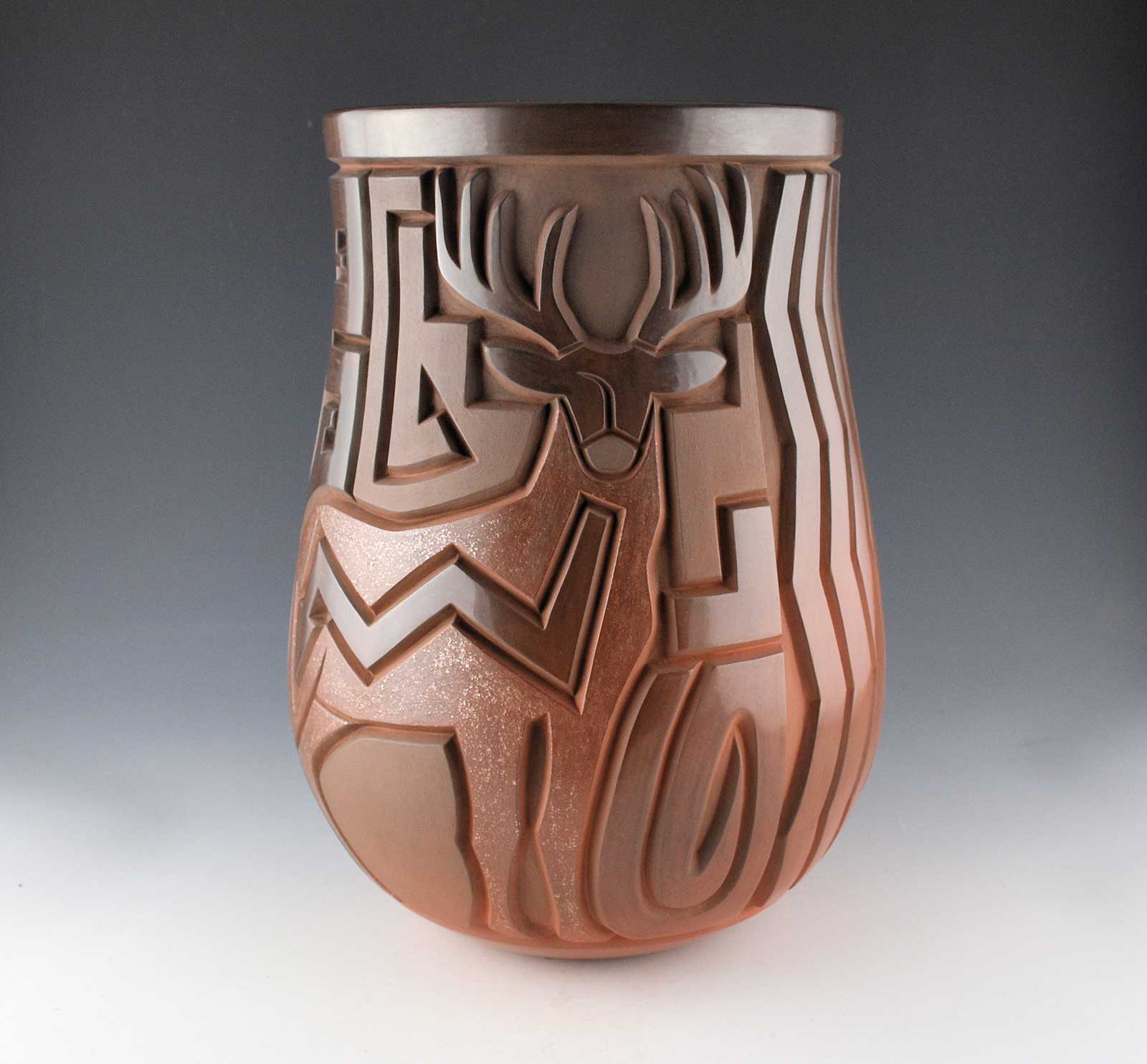
Walk Into the Canyon, native clay, native fired
What’s next for Begay? “I’ve been thinking about my next challenge. In 2024, I went to the School for Advanced Research in Santa Fe, New Mexico. I spent an afternoon with some of the beautiful, fascinating and huge pieces of historic Santa Clara pottery. I have been wanting to start making bigger pieces. It was inspiring to see so many large vessels and the idea of knowing there’s a way to make pieces that size, and have it make it through the entire process, is proof that it can be done. In a way it is comforting. Making a large piece is a huge challenge and it can be overwhelming. It takes days or even weeks to carve and clean out all the channels. All the time put into one piece can be intimidating because your mind starts to wander. Then I refocus and recenter my about how to approach the process. I come back with respect and patience. Once I am able to place trust in my skill, remember what I was taught by my dad and grandmother, I find the process energizing and it gives me momentum to continue.”
“I’m at a unique moment in my career,” he adds. “I feel like I’m a bit in new territory, gaining ownership in different parts of my artistic life. It is also so much about my family. Without them, there’s no ‘me’ at all. I’m really fortunate to have my family, learned from my parents, and now teach my children where I came from, as I get ready to go where the clay takes me.”
Begay will have a booth (PAL S 222) at Santa Fe Indian Market on Palace Avenue. He will also be showing at King Galleries on August 14. —
Charles King is the owner of King Galleries, which shows contemporary and historic pottery. Daniel Begay is represented at the gallery. King is also an author of numerous books on Native American pottery.
Powered by Froala Editor


