Faust Gallery recently acquired more than 200 katsina carvings, which will be offered at a major new show. Widely recognized as katsina dolls, the hand-carved figures are not decorative; they are sacred representations of ancestral spirits, forces of nature and the values of Hopi life.
Throughout the month of August, including during this year’s Santa Fe Indian Market, Faust’s Santa Fe gallery will present the carvings to collectors starting on July 31.
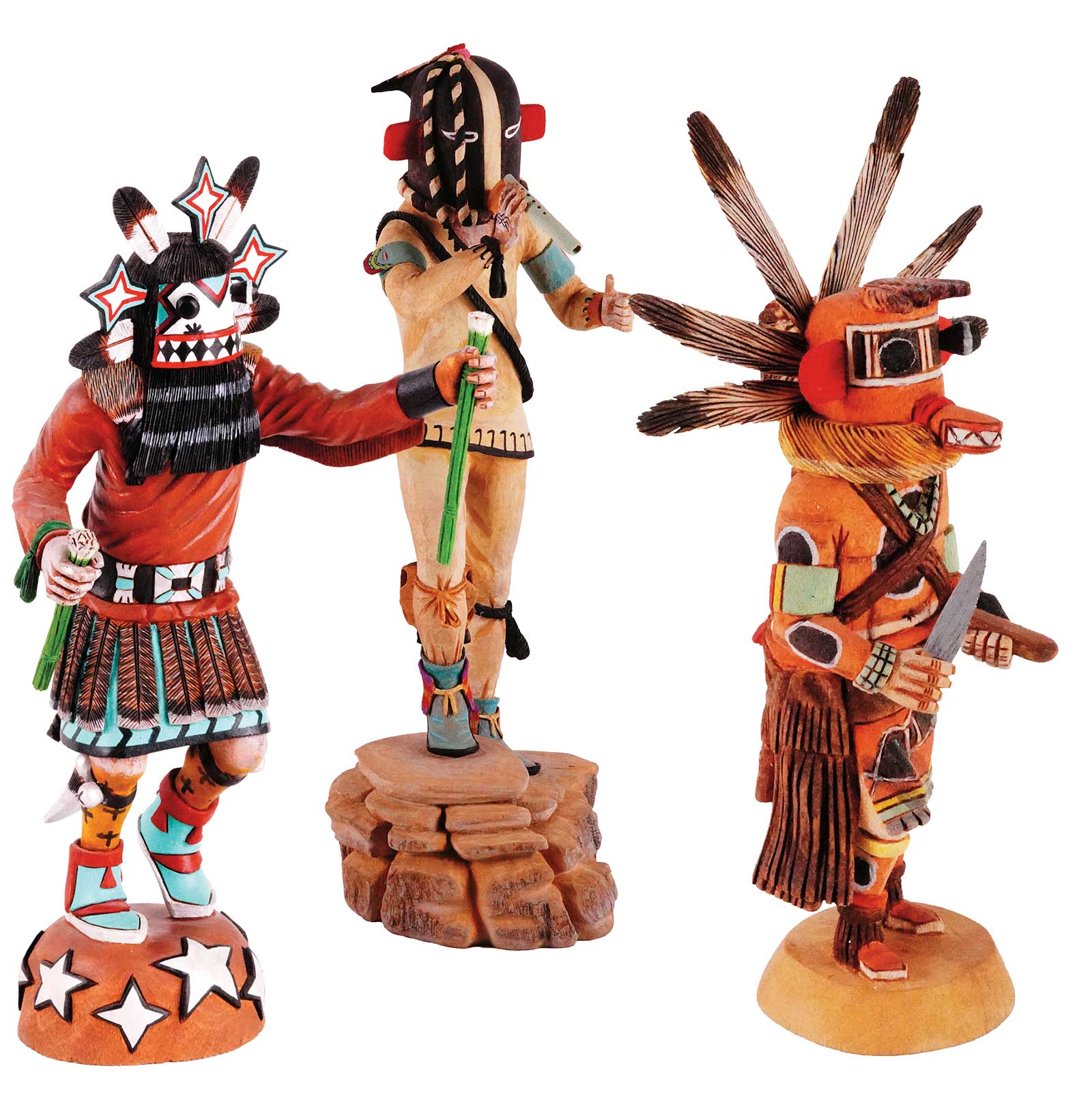
From left to right: : Delbert Silas (Hopi), Ogre Cheveyo, carved cottonwood root; Michael Dean Jenkins (Hopi), Flute Player, carved cottonwood root, 13½ in.; Leonard Tawahongva (Hopi), Star, carved cottonwood root
“These spirits are the friends of the Hopi and other pueblo cultures. They represent the supernatural elements of the world like the rain, stars, animals and the ancestors and act as intermediaries who bring health, fertility and rainfall for survival,” says Bill Faust, gallery owner.
In Hopi culture, the katsina spirits live in the San Francisco Peaks of Northern Arizona and other sacred places. They are messengers between the human and spirit worlds and are central to Hopi ceremonial life. They are present during ceremonies, appear in sacred dances throughout the year, and community members dress to embody specific katsina figures.
“During ceremonies, the men dress as these katsinas wearing masks and regalia, taking on the identity of a specific spirit, losing his identity and transforming into the spirit he represents,” says Faust. “At some point they hand out flat dolls to children as an educational tool to help them understand their culture.”
Each katsina has its own personality and purpose—some bring rain, dance and ritual, others teach and protect. The dolls are also a means of passing down spiritual knowledge to the next generation. Traditionally given to children, especially girls, during ceremonies like Powamuya, as educational tools to teach the identity, dress, symbolism and role of the katsina it represents.
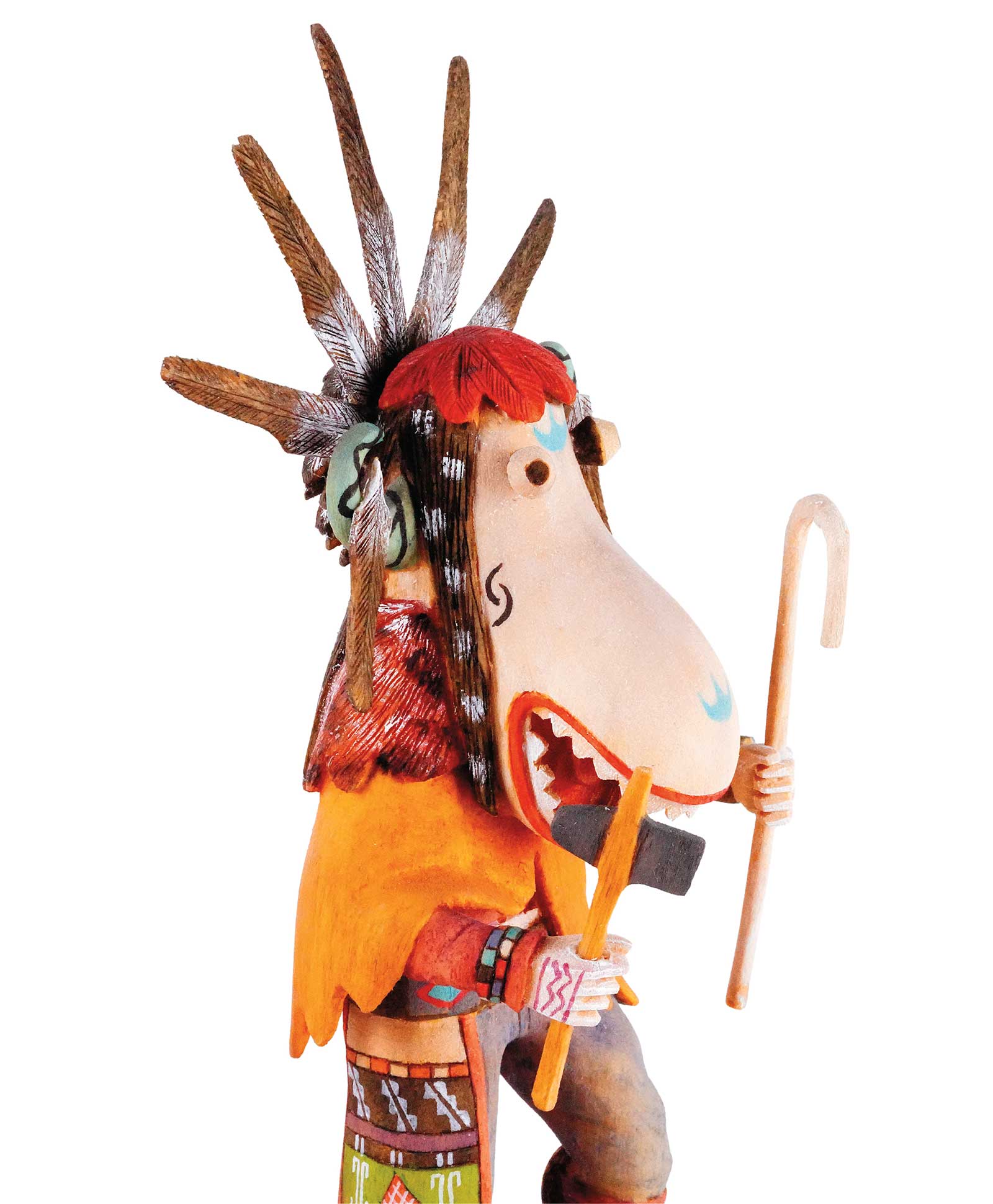
Leonard Tawahongva (Hopi), White Ogre, carved cottonwood root, 13 in.
While the dolls have always held ceremonial significance, in the late 19th century they began to attract attention from collectors and scholars. The mid-20th century saw Hopi artists refining their work into a true sculptural art form. They began to introduce animation, detail and movement while holding true to the dolls’ spiritual meaning.
“Delbridge Honanie carved a sculpture with parrots and bears, both life symbols, and Michael Dean Jenkins carved his famous Imitator as Austin Powers, comically hysterical in exceptional detail,” says Faust. “Today there are many famous carvers who carve with such precision and execution that their sculptures are in the five-figure range.”
Other artists, including Wilson Tawaquaptewa, Milton Howard, Wilmer Kaye, Loren Phillips, David Jensen and Eugene Dallas have helped transform katsina carving. Whether traditional or contemporary, their carvings reflect the sacred origins and spirit of the katsina, while pushing the boundaries of sculptural form.
The carvings are more than decorative; they hold centuries of practice and tradition in the carved cottonwood root. During the this important carving-themed show, Faust Gallery presents visitors with the opportunity to slow down and consider purpose and story of each doll and admire smaller details in a large collection of carvings. The show runs until August 31 and will host a reception on Friday, July 31. —
Faust Gallery
July 31-August 31, 2026
142 Lincoln Avenue, Suite 102, Santa Fe, NM 87501
(480) 200-4290, www.faustgallery.com
Powered by Froala Editor


