New Mexico artist Jeroma Nakagawa jokes that his life has bounded forward in 11-year jumps. First, there was a career in photojournalism, which took him all around the country documenting crime, weather, sports and breaking news. That was about 11 years. Then there was work at a legal aid organization that served people who had been denied disability rights or faced gender discrimination. Again, 11 years. “My life has been a series of chapters,” he says. “All the same size”
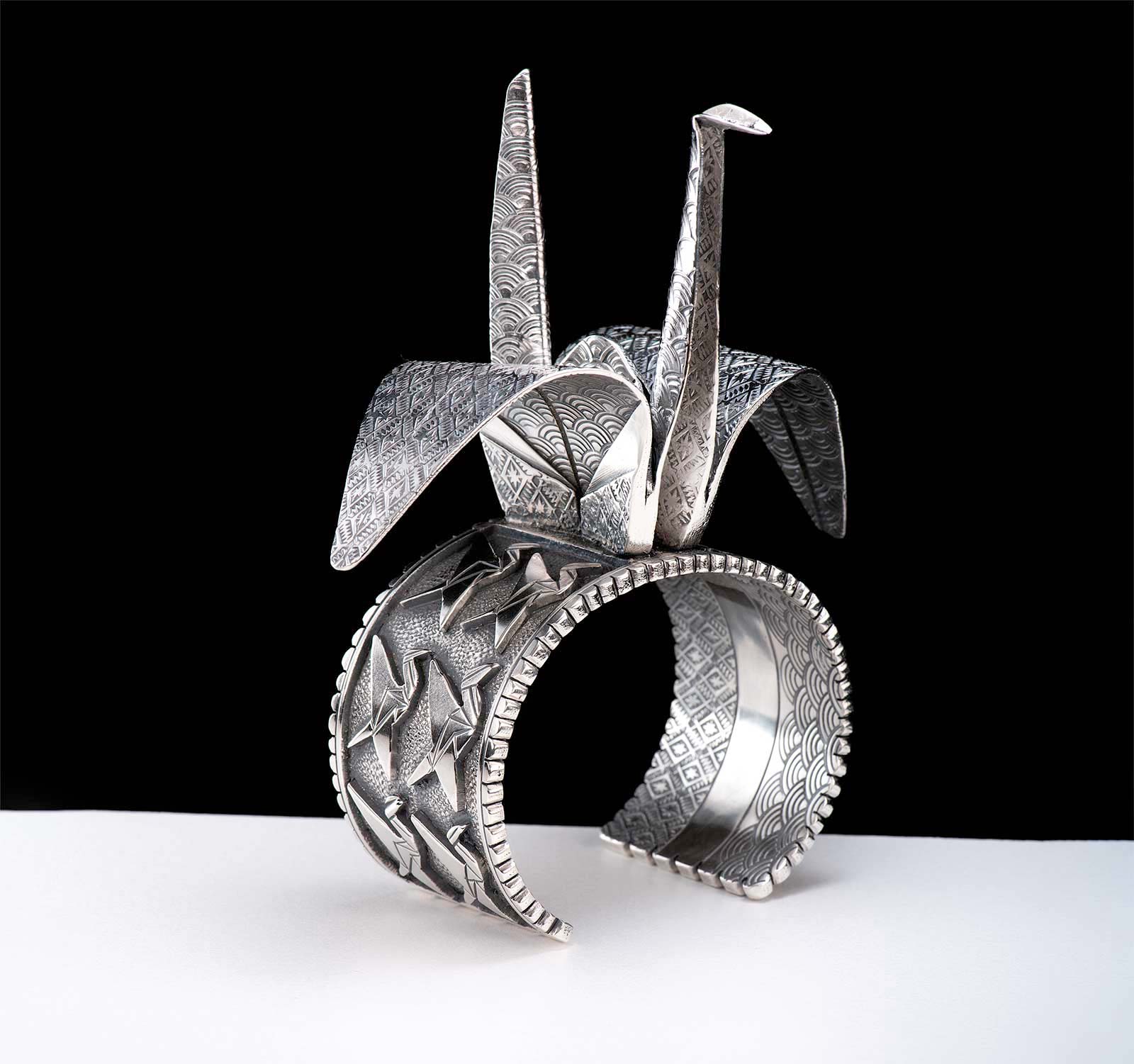
Sterling silver Japanese crane cuff with applique and hand-stamping, 2025, 5¾ x 11/8 in.; opening: 15/16 in. Photo by Jerome T. Nakagawa.
The most recent chapter of his life started in 2020, when he enrolled in the jewelry program at the Institute of American Indian Arts (IAIA) in Santa Fe, New Mexico. His first classes were during the fateful spring 2020 semester that was zapped into oblivion by the Covid pandemic. Education around the country essentially stopped, especially IAIA’s jewelry classes that normally involve students learning from workshops in hands-on settings. Instead, the classes went online. With the universe seemingly warning him, and with other careers to fall back on, another artist may have given up. But not Nakagawa. He saw this new chapter of his journey as a way of reclaiming his lineage. “There I was at age 40, and I really started to kind of have this deep-seated feeling that I wanted to reconnect with my cultural heritage,” he says.
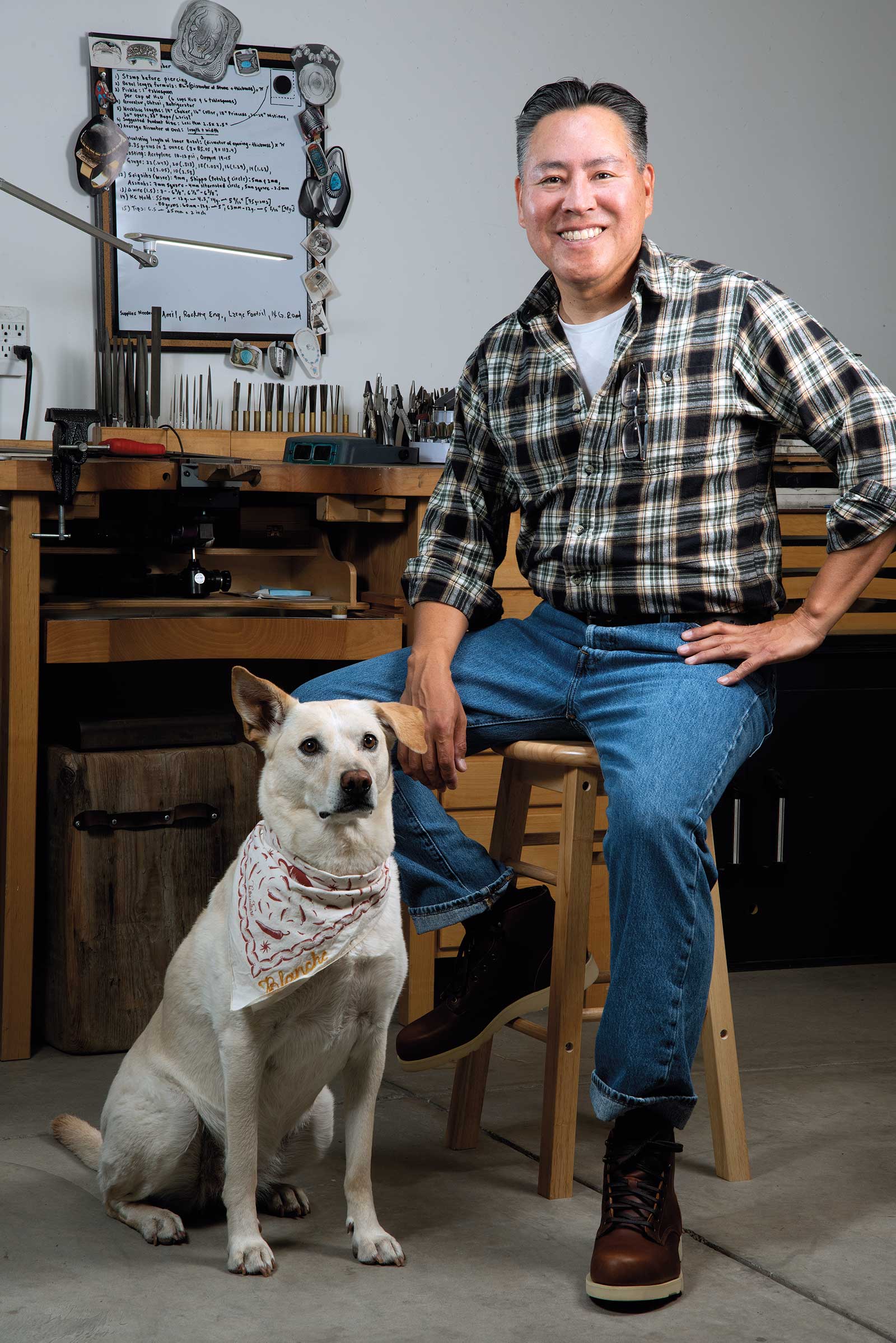
Diné and Japanese metalwork artist Jerome Nakagawa poses for a self-portrait inside his studio in Santa Fe, New Mexico. Seated beside the artist is his trusty studio dog, Blanche. Photo by Jerome T. Nakagawa.
This desire to rediscover his heritage came from his parents. His Navajo mother came from Shiprock, New Mexico. His Japanese American father was a jockey, one of the first Japanese jockeys in horseracing. They met in Castro Valley, California, and raised their family in the Bay Area city of Hayward, California. Although elements of both Japanese and Navajo cultures were present in the home, they were also mixing with other subcultures, creating a fusion of styles and influences. “My childhood was mixed with not only the Navajo experience and the Japanese experience, but also hip-hop. As a young child, I was a breakdancer. I had this kind of mishmash of all these different cultural experiences in the Bay Area,” Nakagawa says, adding that he characterizes his childhood as that of an “urban Native.” “I didn’t grow up on the reservation, so it wouldn’t really be authentic for me to really be completely immersed in that story. I had a different story.”
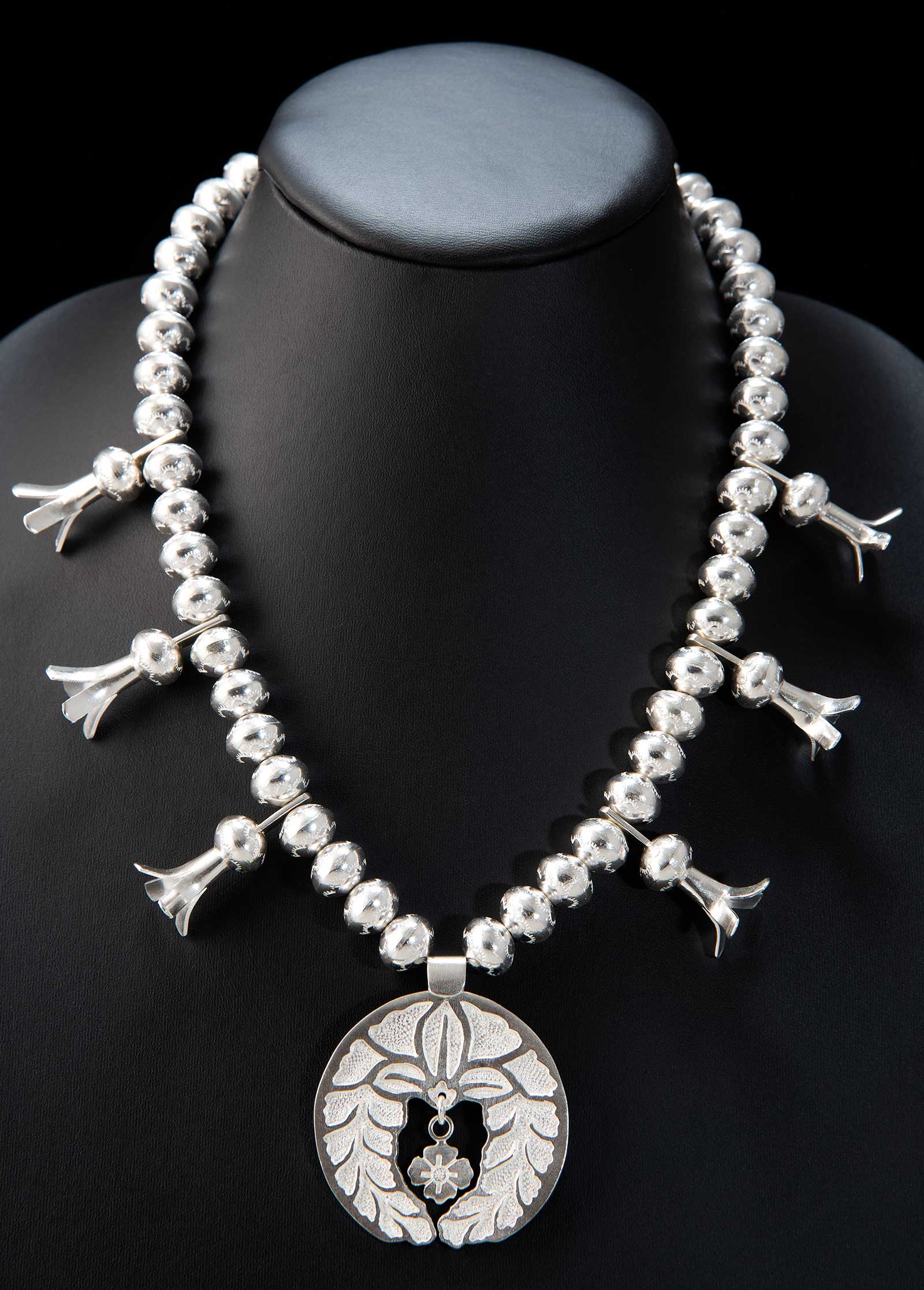
Sterling silver overlay and hand-stamped Wisteria squash blossom necklace, 2025, length: 21 in.; ornamental Wisteria naja: 2¼ x 2 in. Photo by Jerome T. Nakagawa.
But so did his mother. She moved to California as part of the Native American Urban Relocation program, which was designed to help Native Americans assimilate in major cities. While many Indigenous people do not speak fondly of the program, which removed Native people from their cultures, Nakagawa says his mother had a different experience. “For her it was mostly positive. When we talk about it, it’s important for her to mention that she made the choice to move from the reservation to the Bay Area. She was that type of person—assertive and strong,” Nakagawa says. “She worked at University of California, Berkeley, and she surrounded herself with a Native community.”
Ironically, his mother was also a welder and metalworker and worked in large factories making Peterbilt diesel trucks, mechanical equipment and even Bradley fighting vehicles. Her son was not yet interested in metal. Instead, when he was a teenager, he moved to Washington, D.C., to serve as a page in the House of Representatives for California Congressman Pete Stark. Nakagawa was only 16 years old.
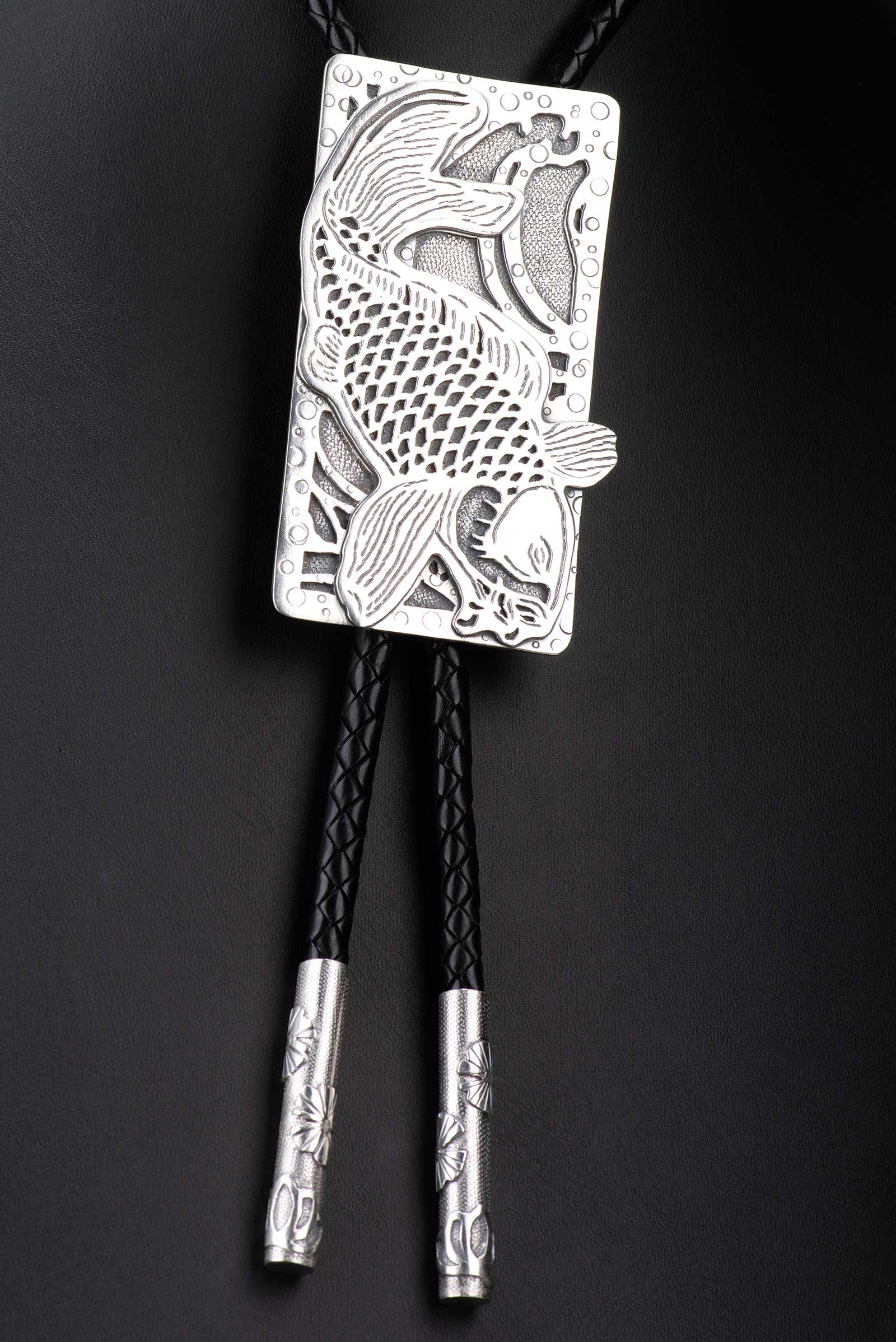
Sterling silver hand-stamped and overlay Nishikigoi bolo tie with lotus and lily pad tips, 2025, 3¾ x 2 in. Photo by Jerome T. Nakagawa.
Back in California, Diné traditions were present in the home, including the Navajo language, which was introduced but didn’t stick. “My mother tried with the language when I was a young child. She made the effort. I didn’t put in the work and I regret that,” Nakagawa says. Many years later, as he was considering joining IAIA and starting a jewelry career, it wasn’t the language that nudged him forward—it was family. “We have a large family that’s still in Shiprock, and also their children who have moved to Denver and Phoenix and other places. I really wanted to connect with them and with the area. That’s why I started looking into IAIA. When I left California to move to New Mexico, it was completely based on faith. And luckily my partner, Janelle, was very supportive.”
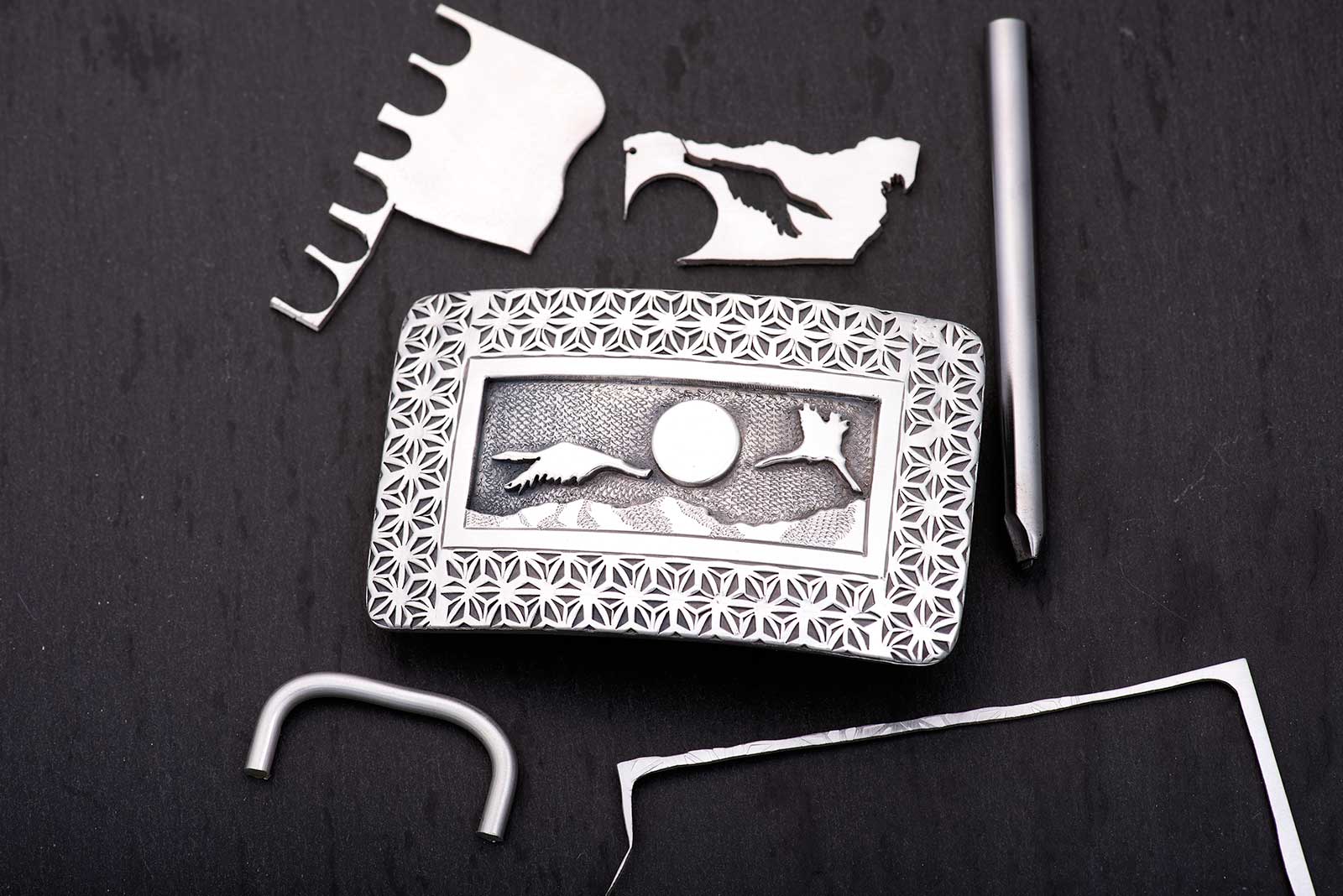
Sterling silver hand-stamped Asanoha and flying cranes applique belt buckle, 2026, 3 x 1¾ x 5/8 in. Photo by Jerome T. Nakagawa.
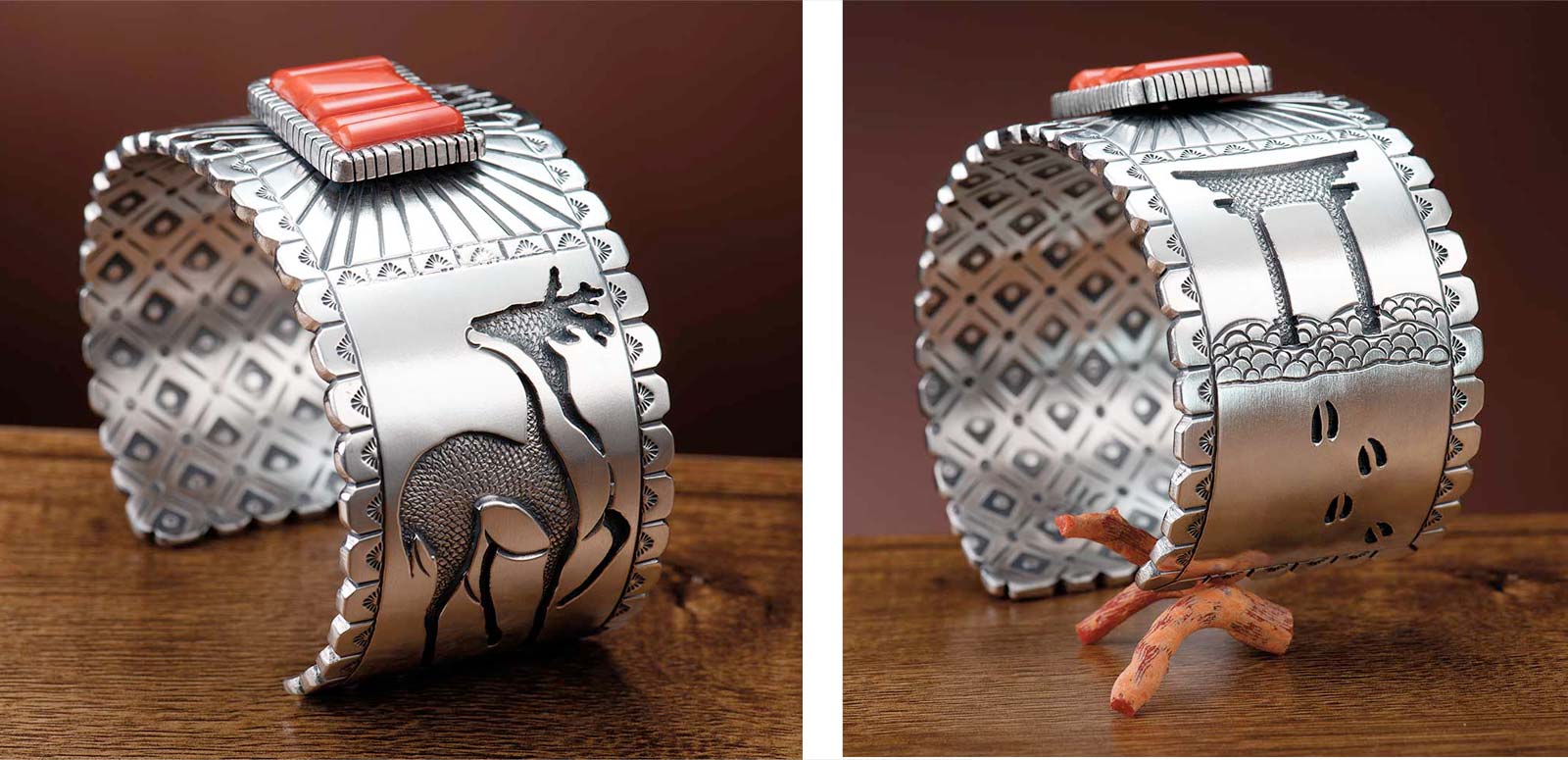
Sterling silver deer and Miyajima Island overlay cuff with Mediterranean coral channel inlay, 2025, 5¾ x 17/16 in.; opening: 1¼ in. Photo by Jerome T. Nakagawa.
Today, Nakagawa lives in a rural community in Santa Fe and works out of a tidy space in his garage that includes large equipment for shaping and cutting metal and stone, as well as more intricate tools for his delicate silverwork. He graduated from IAIA as a first-generation jeweler in 2022, and he credits a number of people who helped him on his journey to that point and beyond, including IAIA professor Brian Fleetwood, and jewelers Cody Sanderson and Keri Ataumbi, who he still refers to as Mrs. Ataumbi out of deep respect. “Working with her was a momentous experience for me. It was very raw and she taught me so much,” he says. “I remember at that time that I still wasn’t very good with soldering. A lot of my work was still very brittle. At the start of each session, Mrs. Ataumbi would sit me down in her office and just talk to me about my personal history. Not only my Navajo side, but also my Japanese side as well. She really helped me hone my voice as I was continuing my journey,” he says. “It’s important for me to say that I have a very cursory knowledge of both cultures. But that’s kind of the point of what I’m trying to do. I’m trying to spend the rest of my life dedicated to learning more about myself from both cultural sides.”
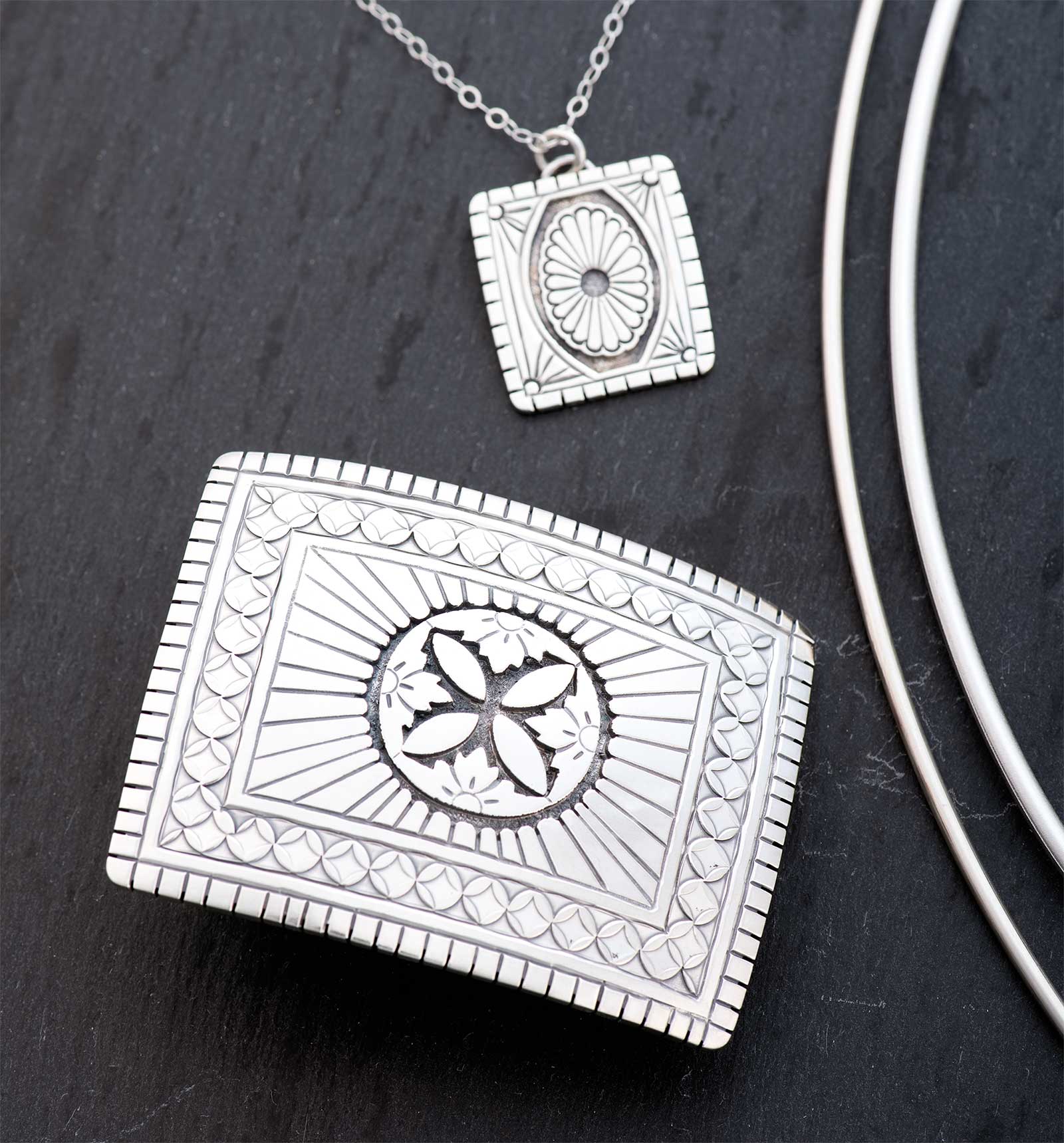
Sterling silver hand-stamped Shippo and floral overlay belt buckle, 2026, 2¾ x 21/16 x 3/16 in. Photo by Jerome T. Nakagawa.
Ataumbi admires the rising jeweler, and notes his persistence. “Jerome is a wonderful student. Metalwork is a medium that offers the opportunity to continue to learn and grow even if you have been working with metal for years,” she says. “When Jerome began his internship with me, he immediately showed humility and curiosity, the two most important traits in becoming an artist. I think his career has great potential to flourish in the future. His birthright to combine Japanese and Navajo aesthetics brings an incredible depth and beauty to his pieces.”
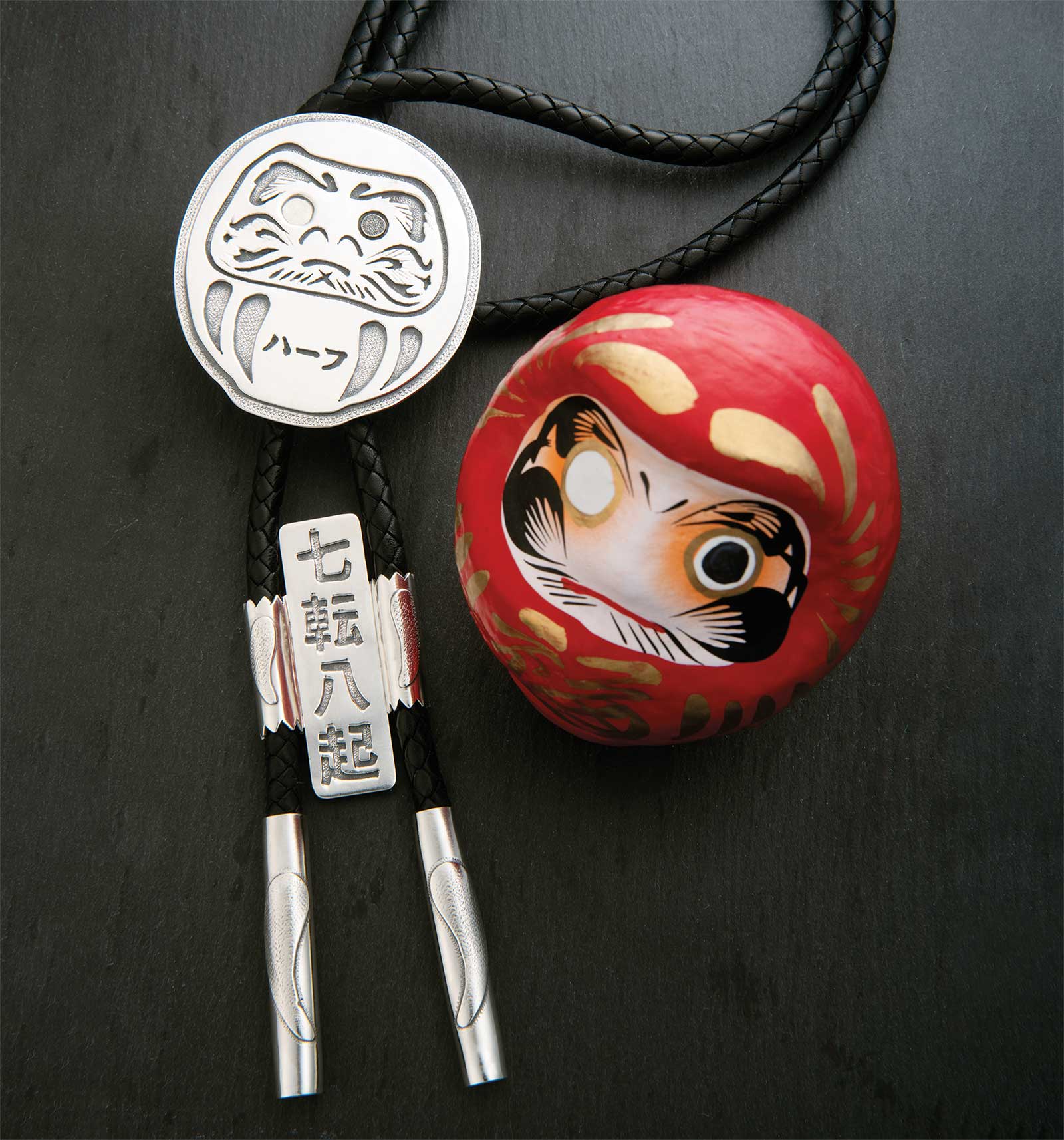
Sterling silver overlay and applique Japanese daruma bolo tie, with hand-woven beveled kangaroo lace cord, 2026, 40 in.; ornamental clasp: 2¾ x 23/8 in. Photo by Jerome T. Nakagawa.
As Nakagawa’s work has developed and found wider praise in jewelry circles, he’s bringing those two cultures together in inventive ways. Both cultures have great affection for water and the land (squash blossoms and lotus blossoms), both have rigid design elements that can be open to modernization and even experimentation, and both emphasize history and tradition through artistic visual storytelling. The cultures also share dark chapters of their histories: Japan had cities decimated by American bombs (two of them nuclear) and Japanese Americans were imprisoned in internment camps during World War II, while the Navajo people had the Long Walk, imprisonment in Bosque Redondo and forced assimilation.
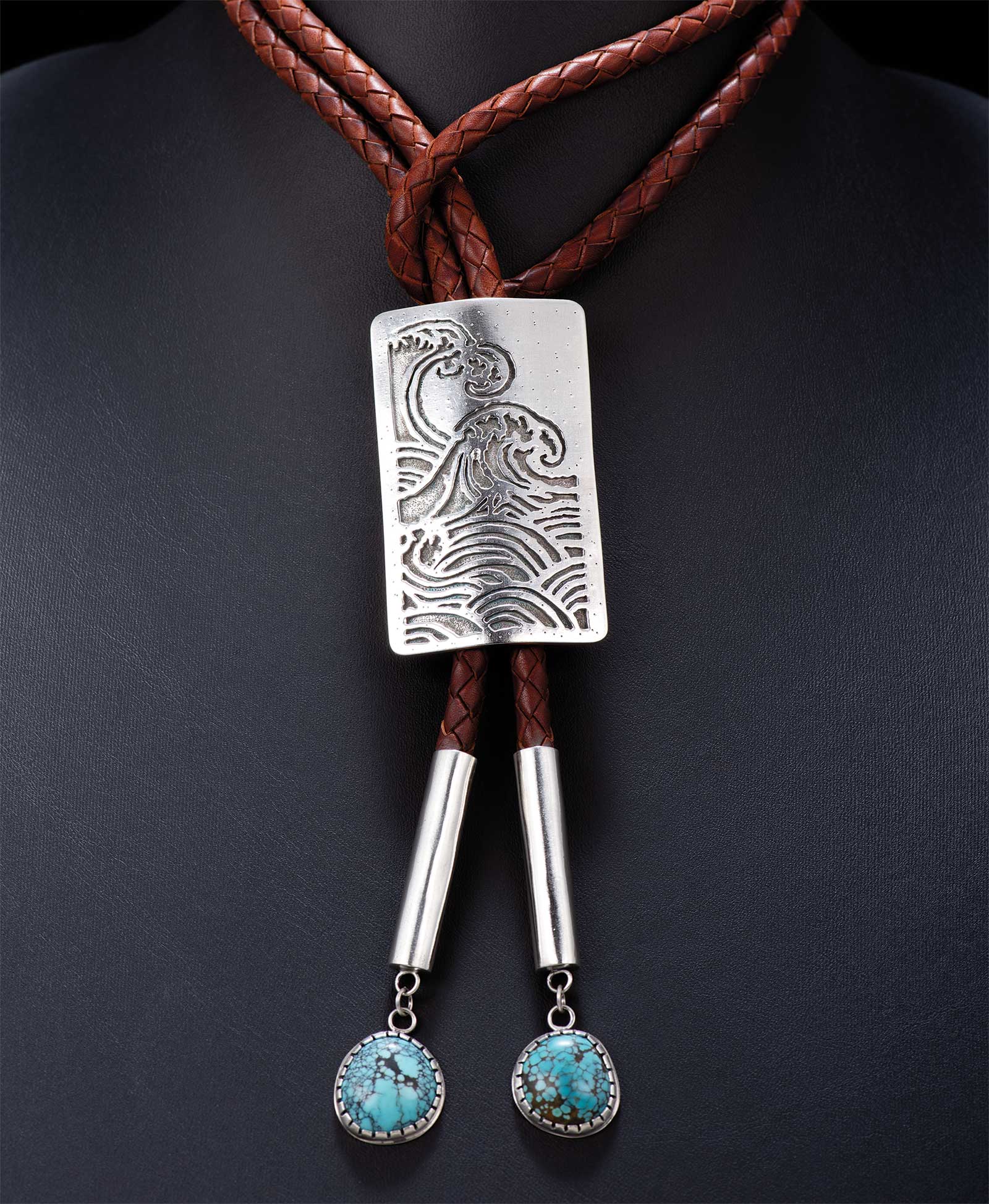
Sterling silver overlay Japanese wave bolo tie, 2025, sterling silver, Blue Moon turquoise, hand-woven beveled kangaroo lace cord, 38 in.; ornamental clasp: 2½ x 1½ in. Photo by Jerome T. Nakagawa.
While those bleak aspects of the shared histories could inform artwork, Nakagawa prefers to look at the more positive stories. One recent work was inspired by Sadako Sasaki, a 2-year-old survivor of the nuclear bomb that was dropped on Hiroshima in 1945. Sasaki suffered severe radiation exposure that manifested years later as leukemia. Before she died in 1955, she turned her attention to a piece of popular Japanese folklore. “In Japanese legend, it says that cranes can live up to 1,000 years. And so, in Japan, they say that if you can fold 1,000 origami cranes then you’re able to have a wish granted to you. So, while she was in these medical centers with all of these other very sick children, she would explore the medical grounds and look for any kind of wrappers and papers that she could find on the floors so she could make cranes. Her wish was, of course, to improve from her condition—to be cured. Unfortunately, that never happened. She passed away in the medical center,” Nakagawa says. “The crane is a national treasure in Japan. It’s a symbol of enduring peace. I was exposed to her story after visiting the Hiroshima Peace Museum. I have family who live near Hiroshima, so this story really inspired me. I made a Japanese crane cuff to continue her story. Janelle even folded me some origami cranes as I was making it.” The artist points out both Japanese and Diné design elements on the cuff that unites his cultures.
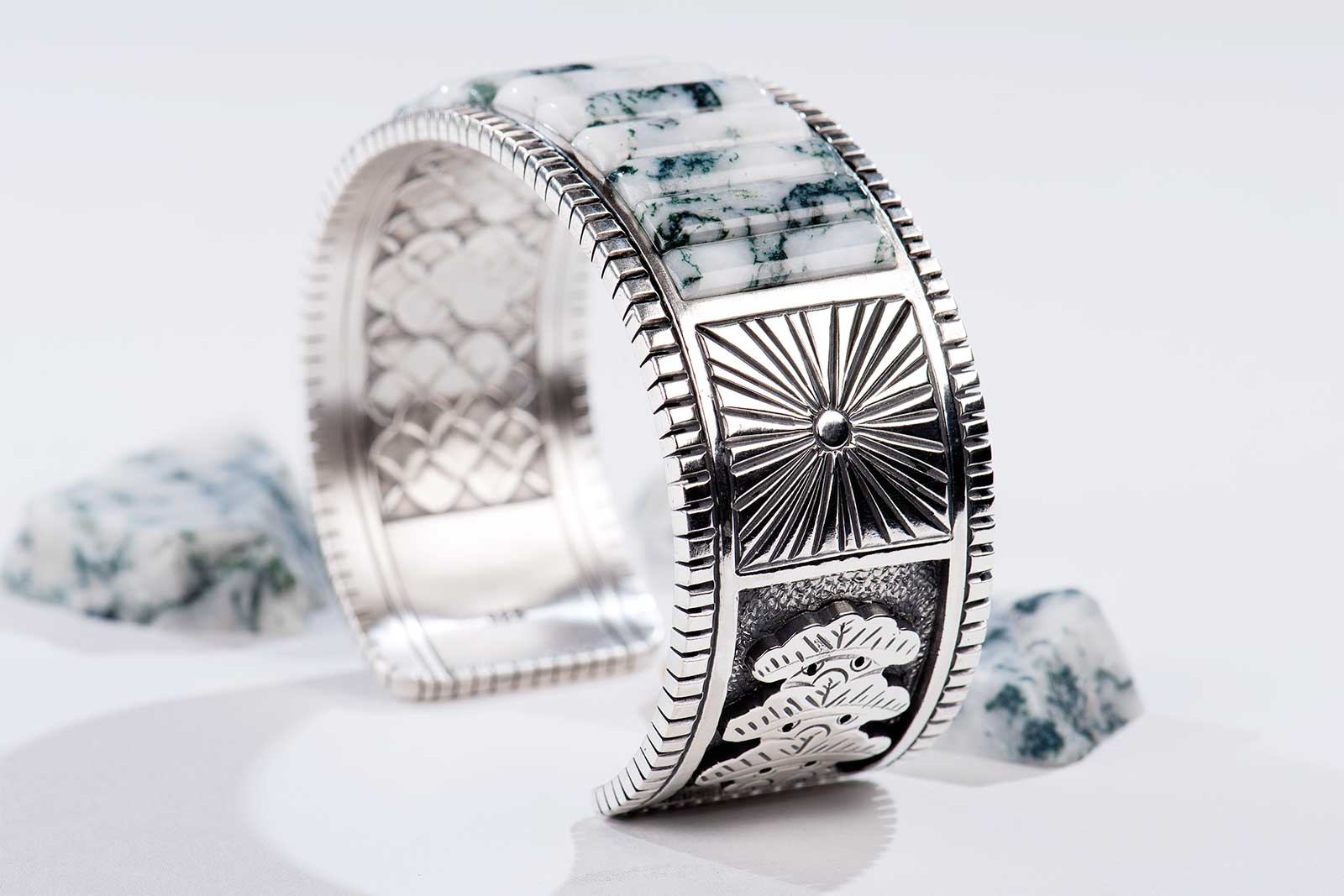
Sterling silver Japanese pine applique cuff with tree agate channel inlay, 2025, 5¾ x 11/16 in.; opening: 13/16 in. Photo by Jerome T. Nakagawa.
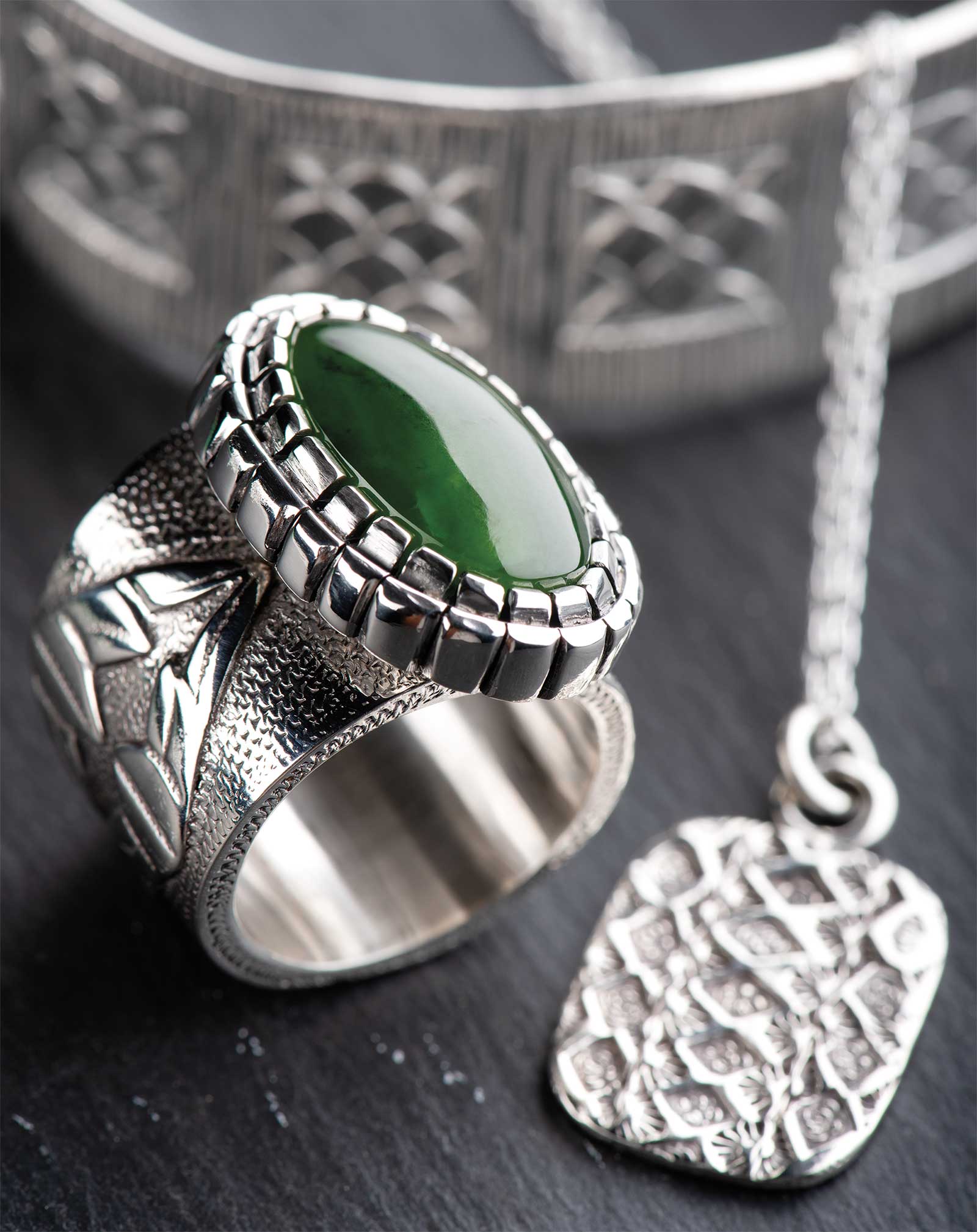
Sterling silver and nephrite jade thick shank ring with bamboo applique, 2025, ring size: 7¼. Photo by Jerome T. Nakagawa.
Another part of his Japanese heritage that will turn up in new work is the daruma doll, which is a symbol of gratitude and determination. The round figures are always depicted with blank eyes. When a person sets a goal, makes a wish or plans for the future, they color in one of the eyes. When that goal is achieved, the other eye is colored in. The artist notes that there has been considerable interest—his exact words are “feverish enthusiasm”—in Native American jewelry in Japan, with artists such as Cody Sanderson having success in Asian markets. Nakagawa is excited about the cultural exchange, especially when Japan and its people can interact with Native American culture inside the United States. “When I show at Santa Fe Indian Market, there are many visitors from Japan, and they always get to my work and get this confused face when they see it. They are familiar with the Japanese iconography, but it feels very foreign to them,” he says. “My work explores the cultural liminality of my experience being Japanese and Navajo. I try to be respectful about it as I use this heritage and combine it in my work. So far, people have been very supportive and appreciative. Ultimately, I think my jewelry-making endeavors are kind of a three-dimensional journal of my experience of learning more about myself and my cultural histories.”
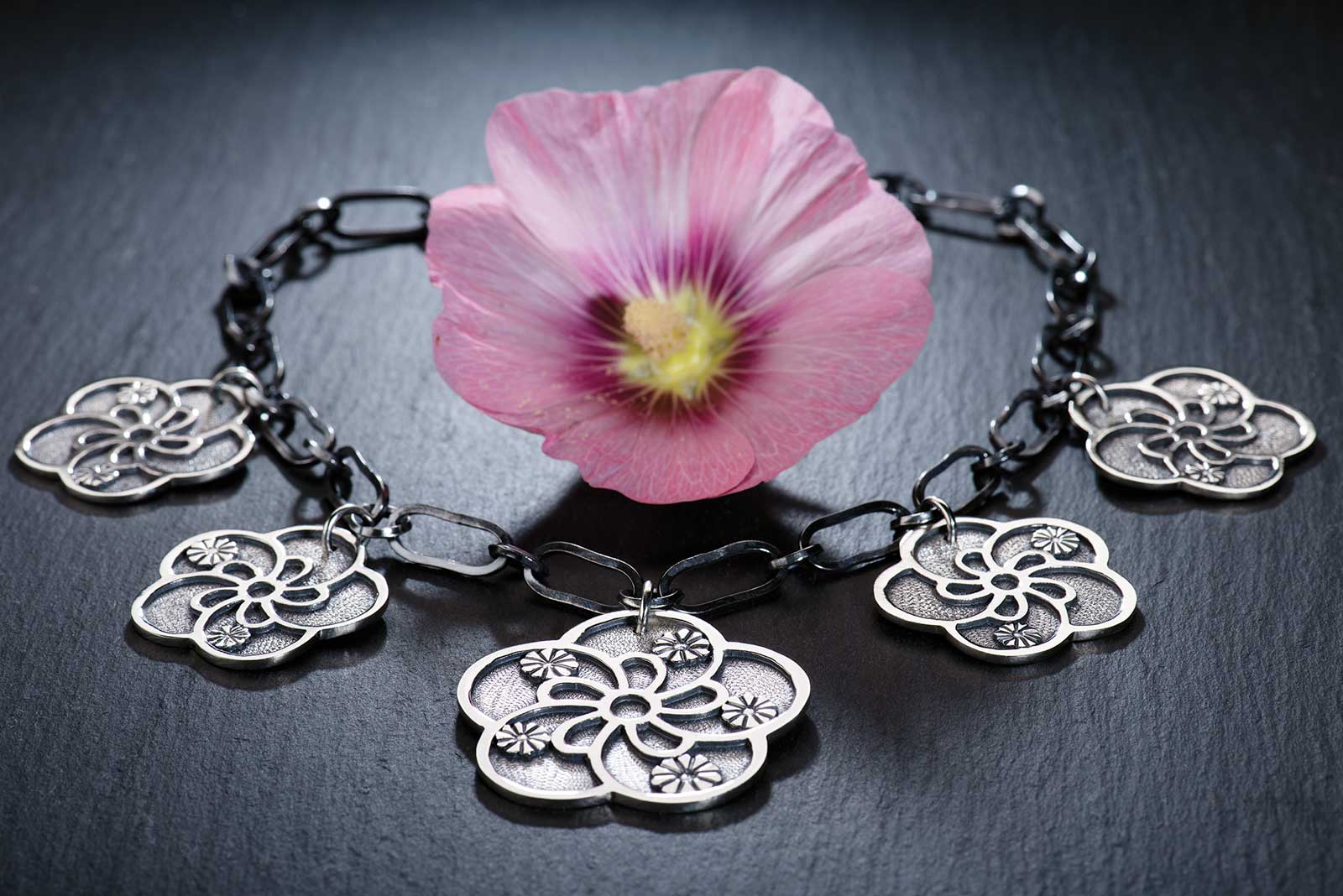
Sterling silver overlay and hand-stamped plum blossom charm necklace, 2026, 20 in. Photo by Jerome T. Nakagawa.
Nakagawa chews on this point about his personal history, and then circles back. “I don’t have the cultural equity to tell a full and traditionally Navajo story,” he says. “But I do want to tell an authentic story about me and my personal experience and my personal history. And my history is a blending of these two cultures. That’s who I am.” —
The artist will be showing in this year’s Santa Fe Indian Market—Booth FR S 336. He also has work on view at Hecho a Mano near the Santa Fe Plaza.
Powered by Froala Editor
Powered by Froala Editor


