Craig George’s parents attended Sherman Indian Boarding School in Riverside, California, as part of the Indian Relocation Act of 1956. The act was an attempt to solve the “Indian Problem” by providing incentives for Native people to leave their reservations and begin their lives in major cities across the country. George’s parents returned to their roots on the Navajo Nation in Arizona, where George was born in 1971. They soon returned to Los Angeles, where he grew up within a multicultural community.
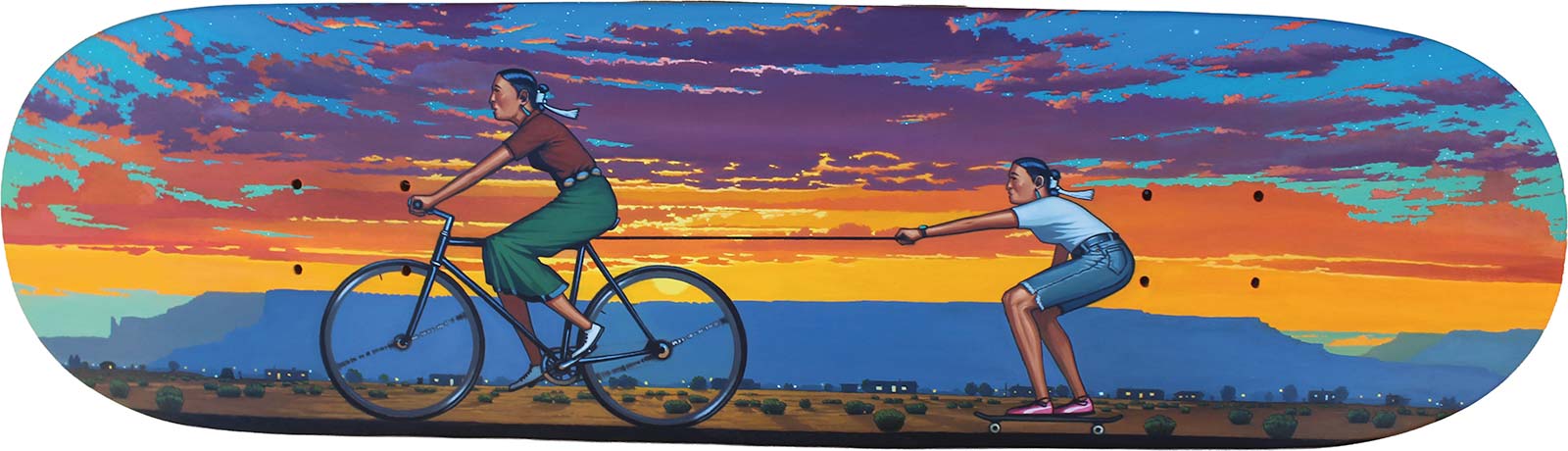
Big Sister, mixed media on skateboard deck, 14 x 36 in.
Writing about George, Noreen Mirabal-Montoya (Taos Pueblo), elaborates, “He would return to the ‘Rez’ for summer vacations to spend time with his family and learn about his culture. A self-taught artist from the age of 5, he received his first ‘Best Artist’ award in the second grade. Here the seed of artistic talent was planted. The urban streets provided Craig with creativity and knowledge of street art. Especially in the world of graffiti tagging. Markers and spray paint became the medium. Although the streets of L.A. were tough, Craig saw the beauty in the people, music and life’s small blessings. He made a name for himself amongst graffiti artists and his confidence grew. He believed art could open new doors and avenues for him.”
George credits his friends in the Hispanic community for teaching him the art of tagging. “The urban streets of LA provided me with all my creativity and materials. With the alleyways of empty walls, that was my sheet of paper to practice on,” he says. “Learning the basic skill of drawing and then cartoon characters, I moved up to small tags with magic makers and escalated to graffiti spray cans. Freestyle graffiti was a total game changer for me, constantly having to keep my art up at all times to let other neighborhood graffiti artists know that I’m not to be messed with. Graffiti has its drawbacks—getting into trouble with the law was a headache for my parents. They had enough of it and sent me to the reservation boarding school but that didn’t stop me from my art. I kept on pursuing my gift.”
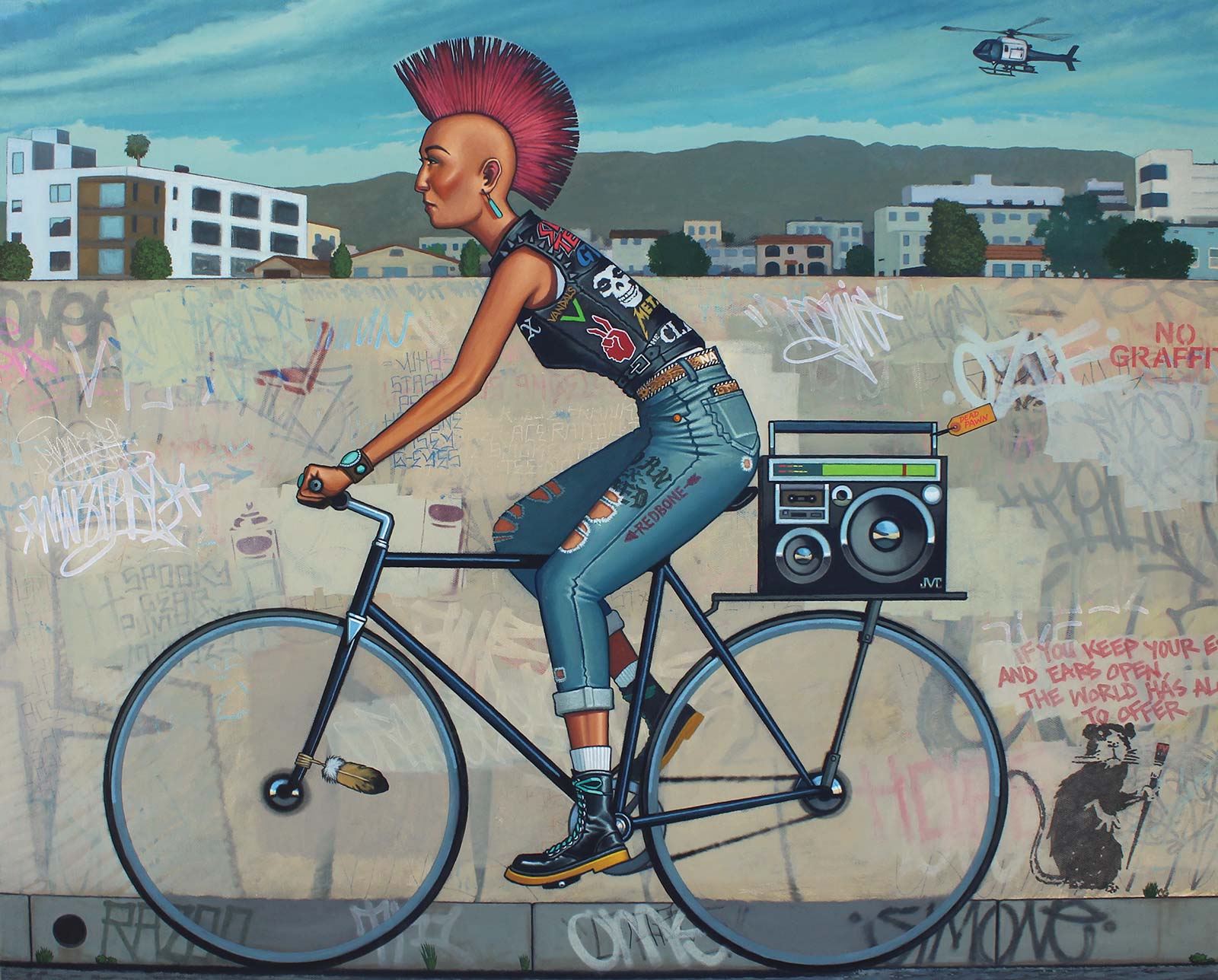
Pink Rock Girl, oil on canvas, 24 x 30 in.
Yet, it was a policeman who often caught him tagging walls, who encouraged him to pursue that gift.
After earning his GED, he attended the Institute of American Indian Arts (IAIA) in Santa Fe, New Mexico, from which he graduated with honors majoring in two-dimensional art and printmaking. Mirabal-Montoya comments, “Attending IAIA exposed him to the many Indigenous tribes of Native America. Yet, his heart remained true to his upbringing between L.A. street life and knowledge of his culture, which he portrayed through his paintings and print works.”
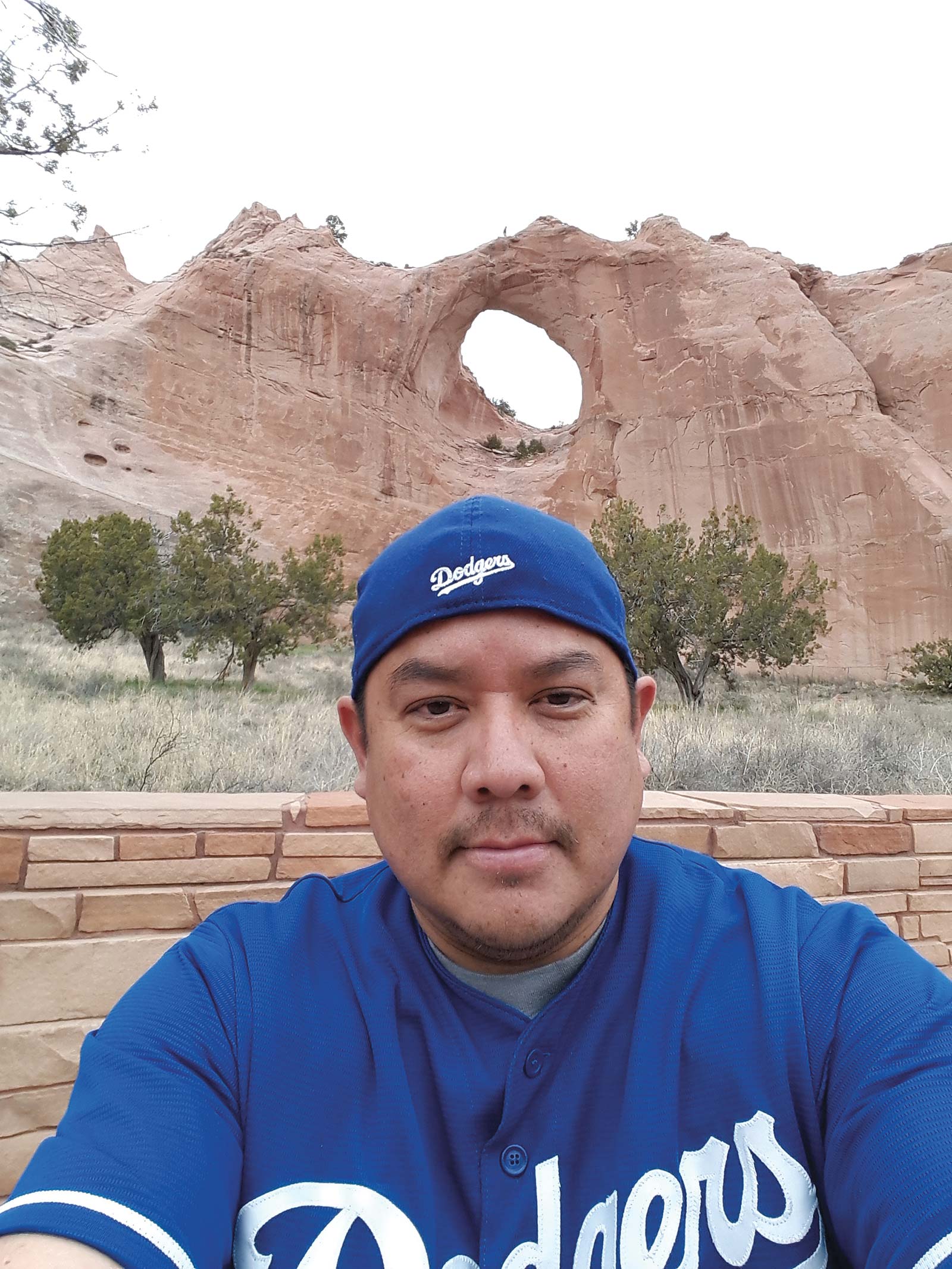
Craig George at Window Rock in Arizona.
George relates, “Back in LA, I got a job as an artist’s assistant. This was my first time painting with oil and learning new methods of mixed media on canvas, and I began to incorporate that knowledge into my own paintings. After leaving that job, I became a full-time artist selling my artwork to private collectors, museums and at art shows. Now back on my homeland of the Navajo Nation, I’m more grounded and focused on my arts. Each day is a new learning process for me, with so many ideas floating in my head, each piece has its own fictional/nonfictional story of everything around that time and date.”
Known for his bicycle paintings often crossing in front of graffiti-covered walls, George brings together the richness of his Diné culture as it expresses itself in the contemporary world.
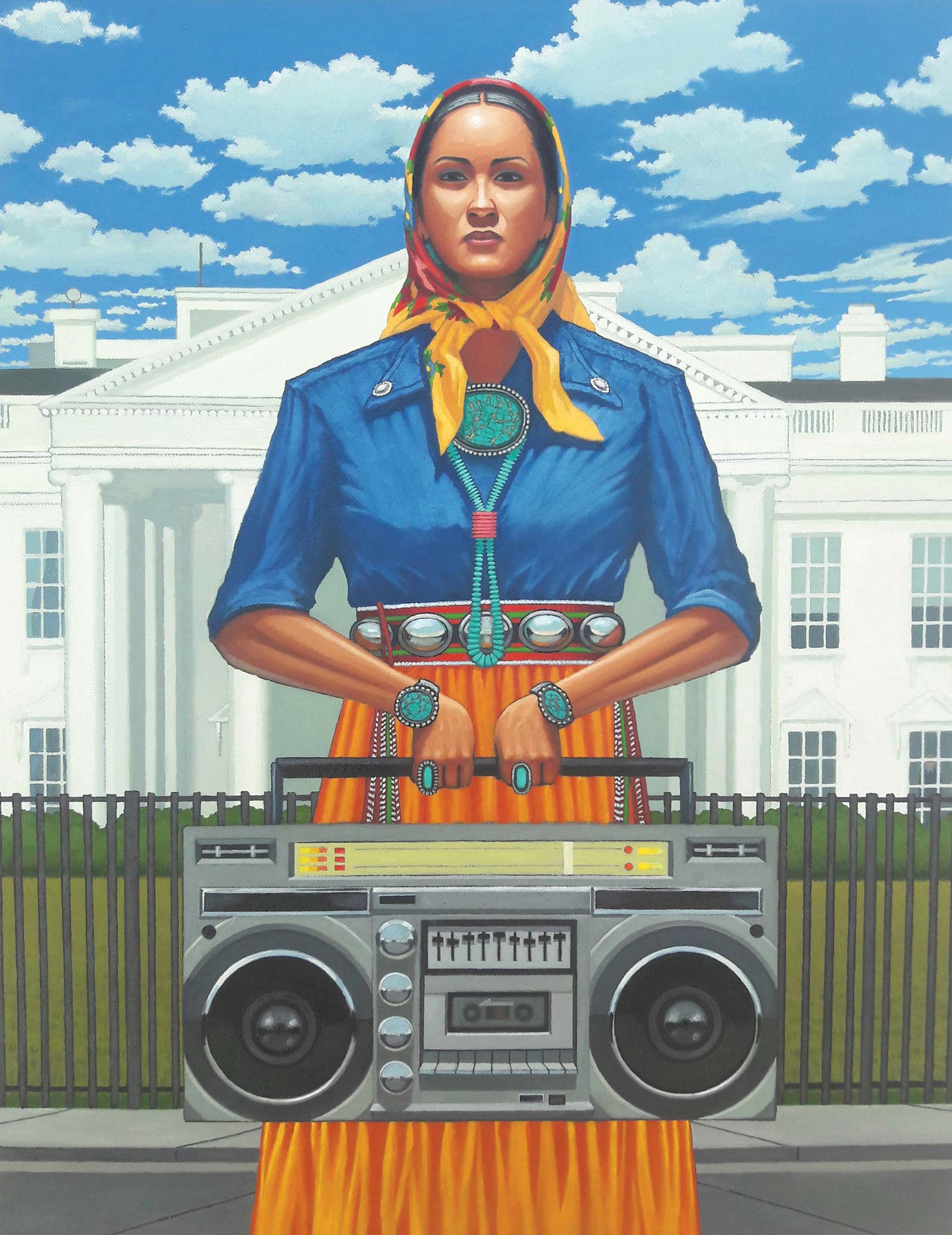
Hear Me Now, oil on canvas, 24 x 18 in.
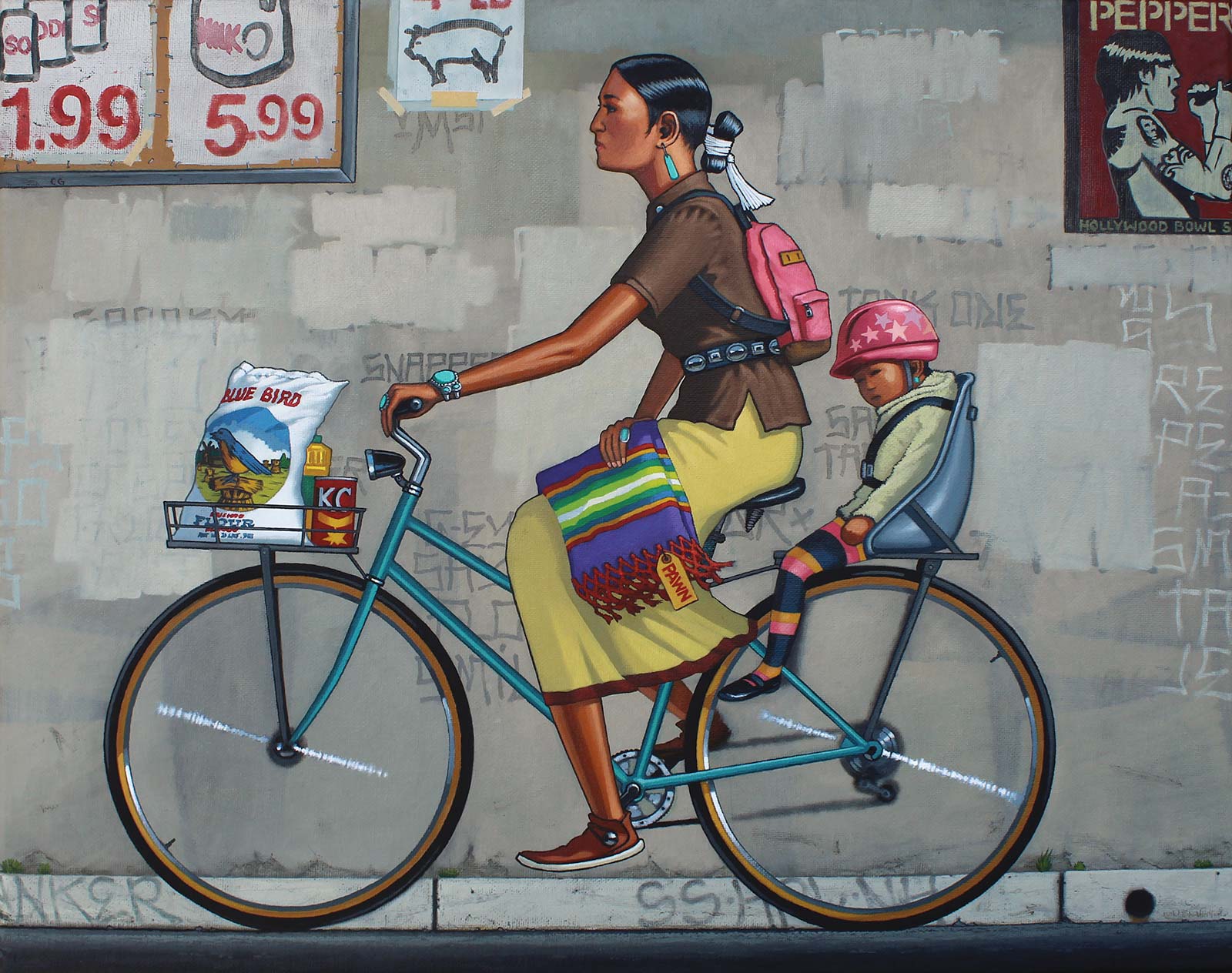
Self-Made Woman, oil on canvas, 16 x 20 in.
On the painting Self-Made Woman, George explains, “There are so many self-made women in our Native communities. The mothers who must fulfill both parental roles. Said woman epitomizes the role of Mother. Regardless of the situation, she adapts. She knows it’ll be hard, yet she’s headstrong and determined to give her girl a better life. The continuation of strong daughters.”
He continues to comment on Proud Father, “Anyone can be a father, but it takes someone special to be a dad, and that’s why I call you dad, because you are so special to me.” The father pedals his bike precariously, sharing something in his phone with his daughter as they pass a liquor store on which a graffiti artist has screen printed Albrecht Dürer’s Praying Hands.
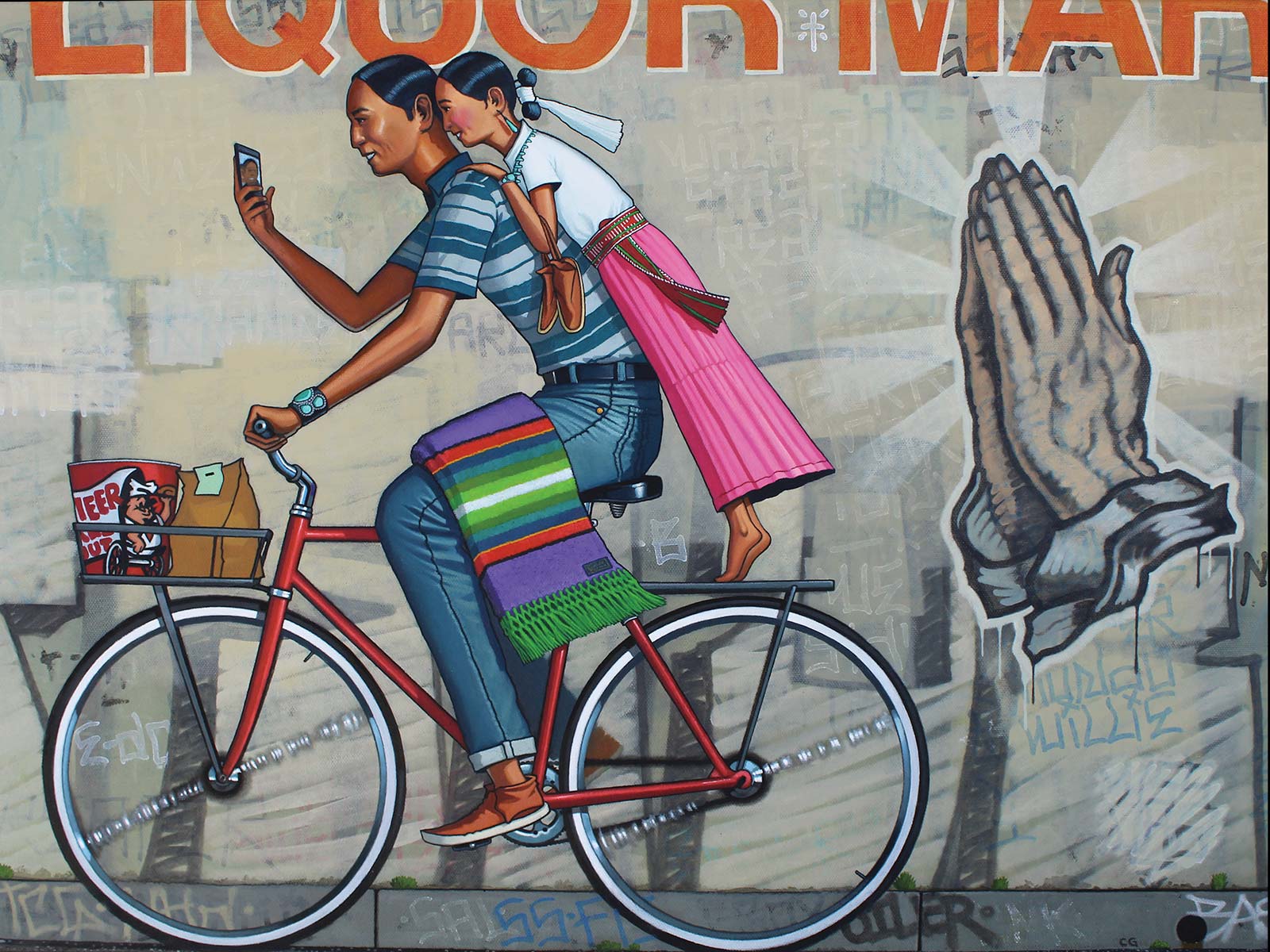
Proud Father, oil on canvas, 24 x 28 in.
The mother figure in Self-Made Woman, on the other hand, passes by a poster for the Red Hot Chili Peppers—a band that, like George, spent time in the subcultures of Los Angeles—as her daughter is strapped into a bike seat and wearing a helmet. The basket contains the makings of bread and across her knees is a blanket meant to be pawned for cash.
George incorporates ancient and modern traditions in his work. He comments on Grandma’s Favorite, “When in Gallup, every trip must end with a visit to Earls. Grandma’s one stop to enjoy a good meal, see relatives, make new friends and purchase a new piece of jewelry. But because it’s grandma, it’s usually half-price from one of her many vendor buddies.”
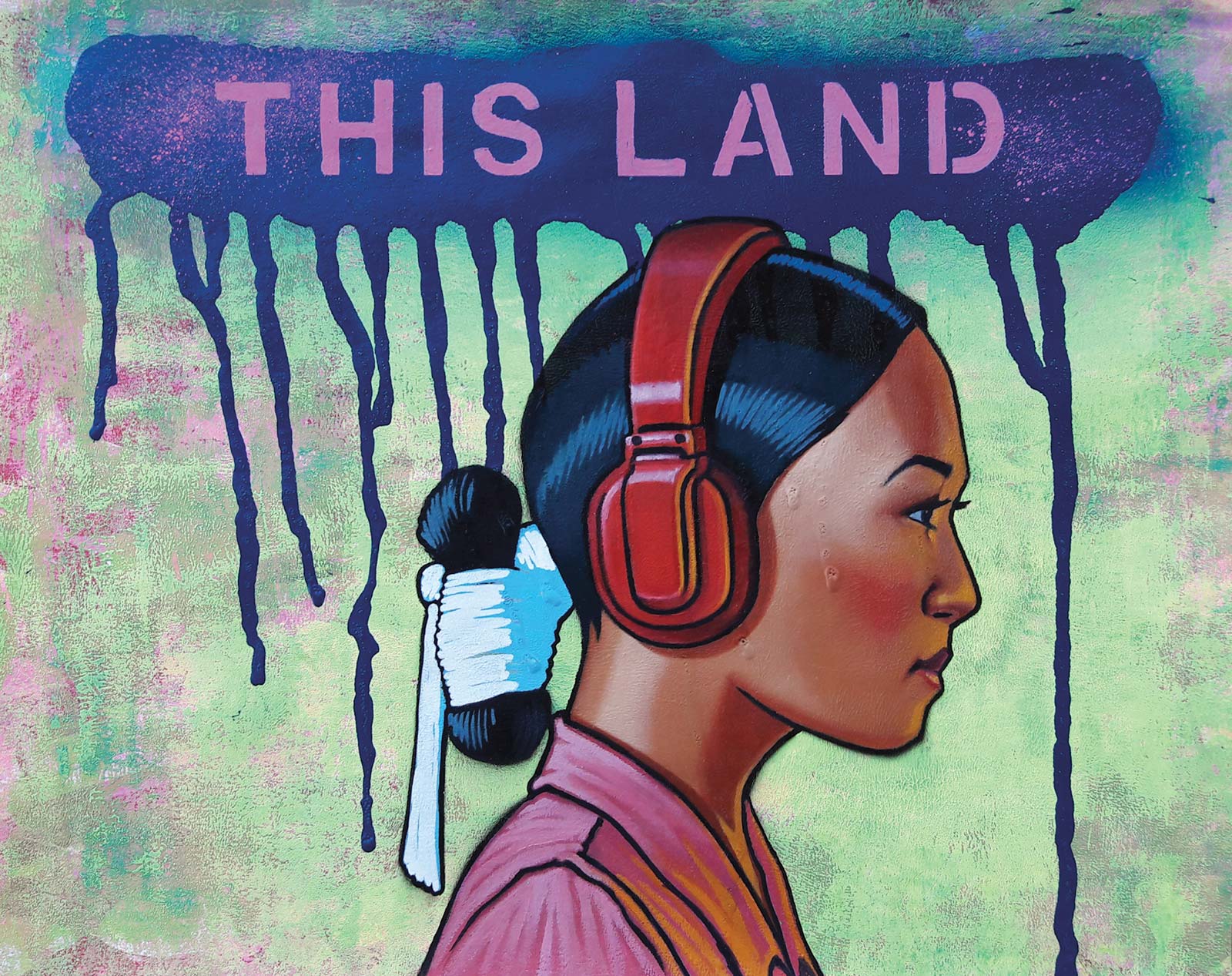
Podcast, mixed media on paper, 10½ x 14 in.
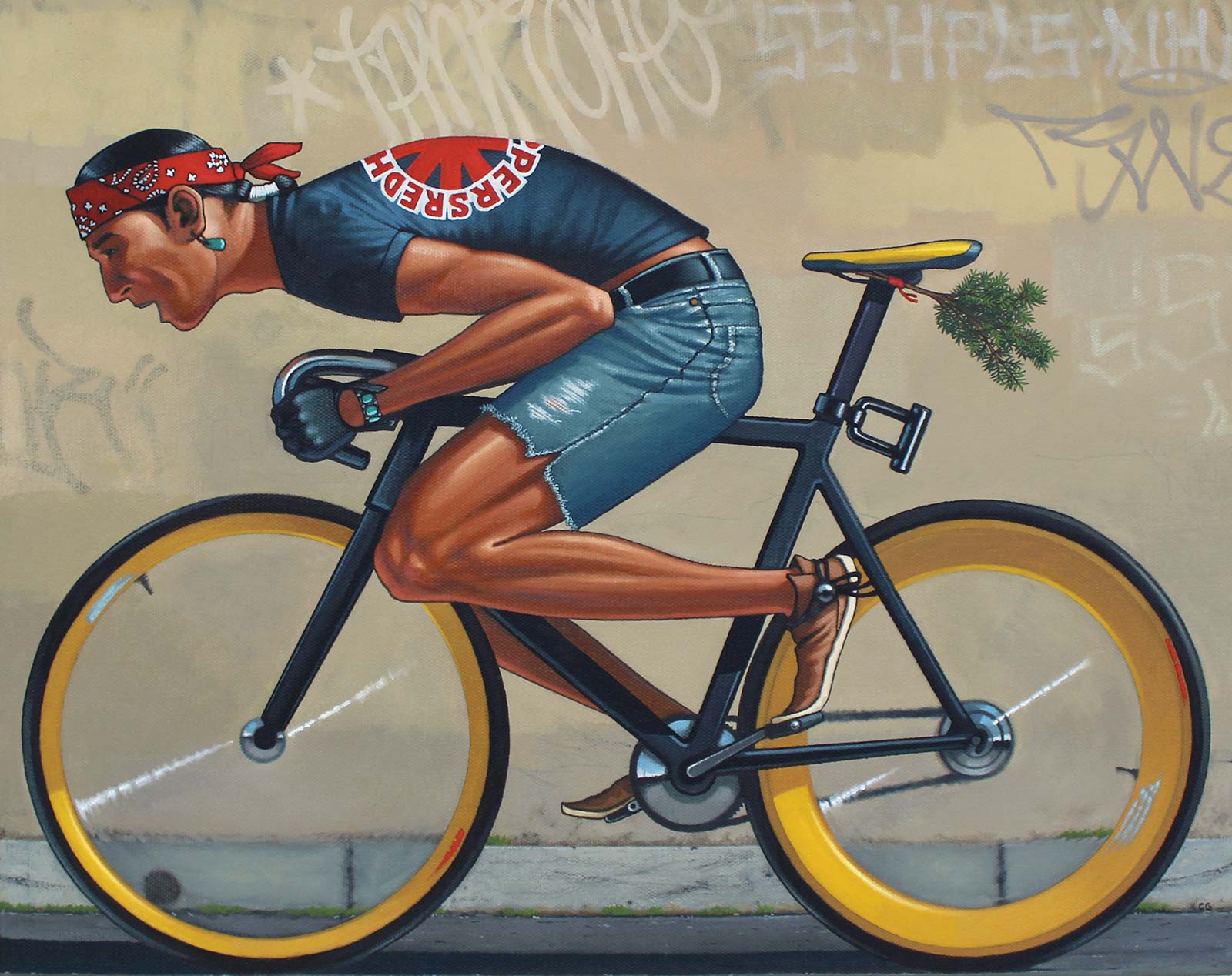
The Need for Speed, oil on canvas, 16 x 20 in.
His grandmother, strong and resolute despite the difficult years through which she has lived, is complemented by the young woman in Hear Me Now. Standing resolutely in tribal garb in front of the White House, she carries a huge boombox. “With the strength of her ancestors and the prayers of those to follow, her song will be heard,” the artist says. “A call to action to bring our missing women home. She will be heard, no longer silenced, no longer invisible.”
Hear Me Now was used as the cover art for the 2023 book Invisible No More: Voices From Native America by Raymond Foxworth (Navajo (Diné)) and Steve Dubb.
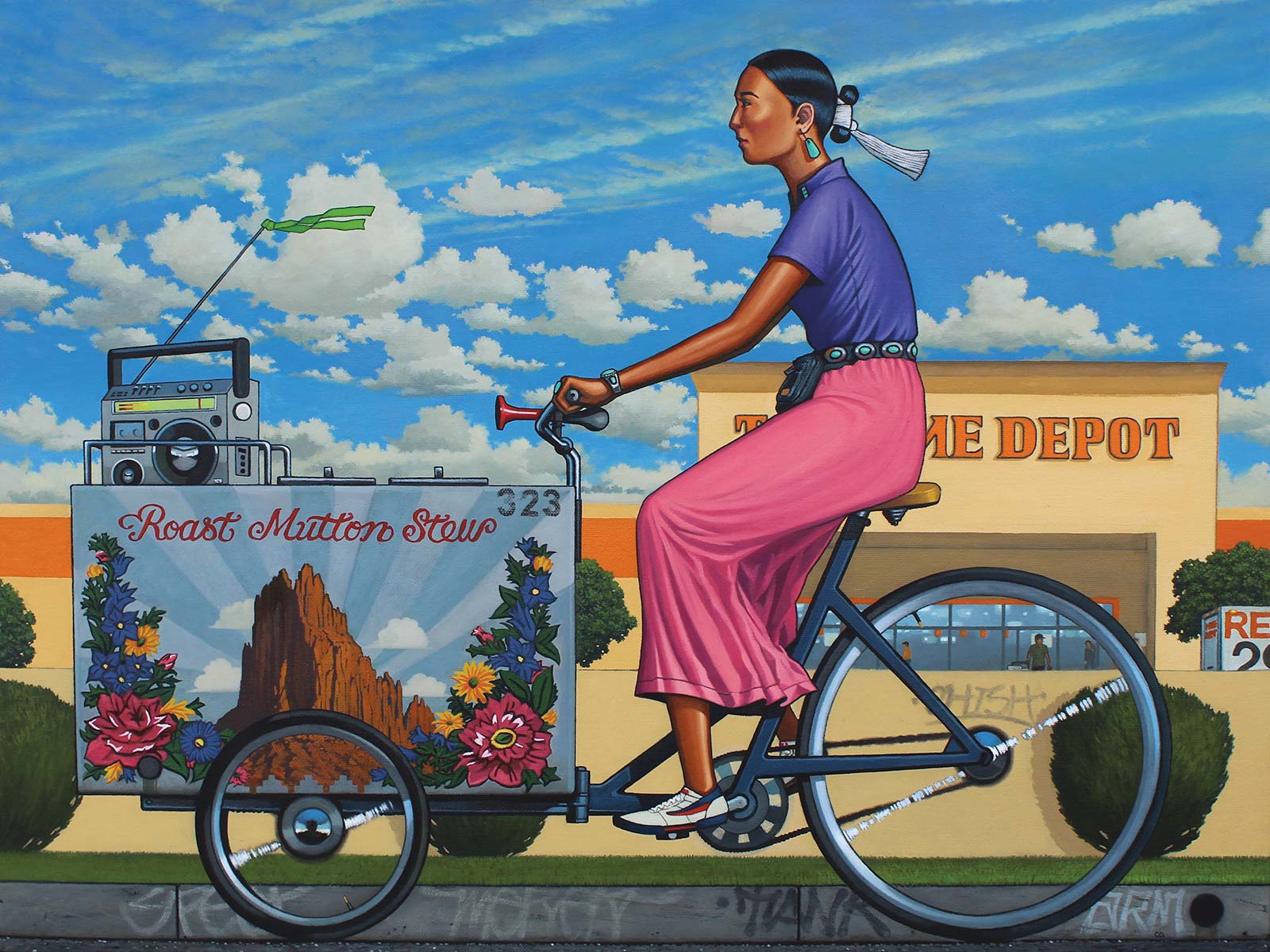
Mutton Girl, oil on canvas, 18 x 24 in.
Far from his days spray painting the walls of Los Angeles, but still animated by its energy, George says, “I was born on the rez, raised in LA and now I’m back on the rez.” It's on the rez where he absorbs the heritage of his people and the energy of the land; where he learns to be at peace with Mother Nature. Armed with that energy, he supports and encourages the upcoming Native artists of today…two wheels at a time. —
Follow the artist and his work on Instagram (@craig.george23).
Powered by Froala Editor


