When Charles King was in high school, he discovered the beauty of pueblo pottery, which became a singular purpose in his life. When school broke for spring break, King skipped some of the normal teenage rituals and instead planned trips to the New Mexico pueblos to meet the potters. “I had lists of people I wanted to meet,” he says. “I was little bit of a geek about it.”
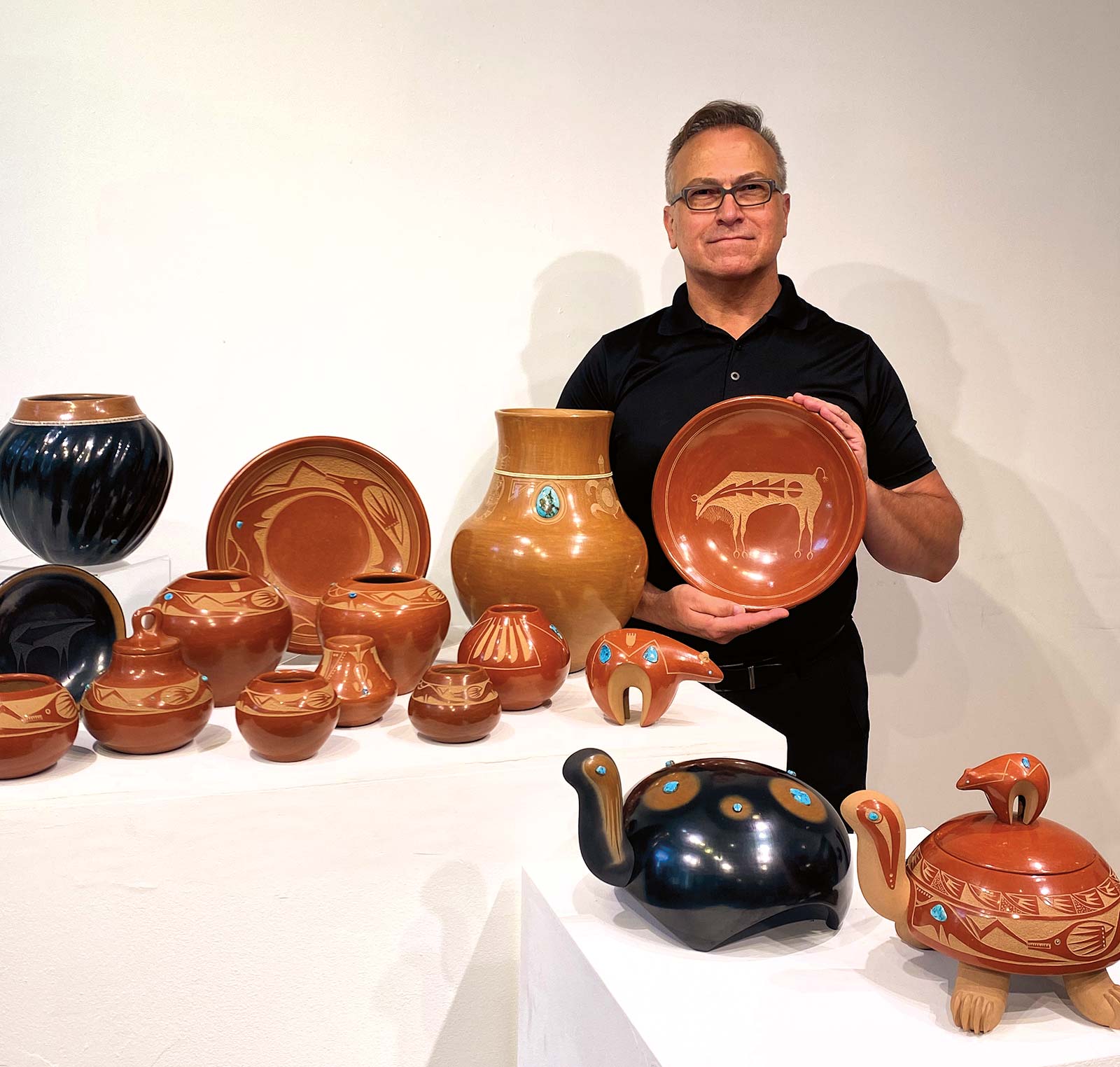
Charles King and collection of Tony Da pottery, Santa Fe, 2024.
He grew up in the art world and had an appreciation for many art forms. His parents, Sam and Sue King, had a Native arts gallery in Estes Park, Colorado, starting in 1982. King worked at the gallery throughout high school and into college. While the family business dealt in Native American arts, its focus wasn’t specifically in pottery. It was this medium—hand-coiled clay, stunningly decorated and traditionally fired—that would serve as the catalyst for King’s own art business, King Galleries, which he started in October 1996.
Three decades later, King and his eponymous gallery have created two magnificent venues—one in Scottsdale, Arizona, and another in Santa Fe, New Mexico—where pueblo pottery is, forgive the pun, king. Collectors, curators and artists would say he’s gone even further than that with King Galleries representing one of the premier destinations for contemporary Native American pottery in the country, and a place where the boundaries of pottery are continuously being pushed and expanded. To celebrate the gallery’s milestone, King is hosting a 30th anniversary show on October 24, three decades to the day since he first opened the gallery.
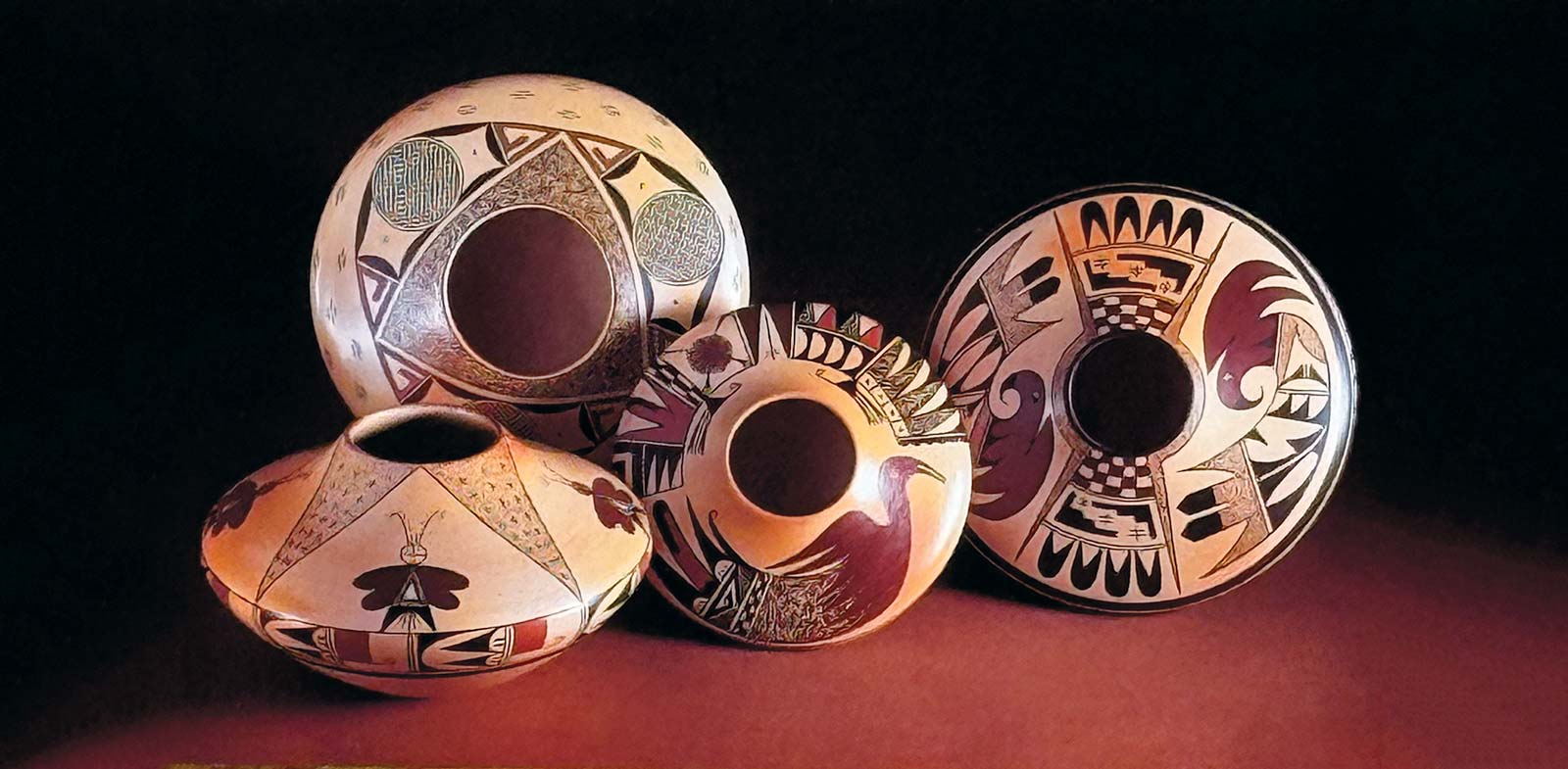
Pottery by Mark Tahbo for the first show at King Galleries.
Although King was knowledgeable of the art world and its many intricacies—he was mentored by his parents, and art experts Richard Spivey, Robert Nichols, Dick Howard, John Krena and Marti Struever—he remembers feeling a sense of awkwardness opening the gallery in 1996. “There was a strange feeling opening the doors because I was asking people to trust me, to give me their artwork to sell, and to support my vision,” he says. “My first gallery was in Scottsdale, opposite of the corner where I’m located now. It was about 700 square feet of space. I started with probably 100 pieces, from artists including Mark Tahbo, Russell Sanchez, Grace Medicine Flower and others. Opening day, I was so nervous. Just to get the doors open with all those pots, I was left with $45 in my account. By the end of the night, I had sold two thirds of the inventory. It was shocking and exciting, and I was very grateful.”
Collectors were on board and artists were thrilled, but so were critics, including Danny Medina at the Art-Talk newspaper. “Speaking of wishing people well, there’s a person I don’t need to wish well because he’s going to do quite well, thank you very much—and that would be Charles King,” wrote Medina in December 1996. “Now, if you flipped his name around, he would be King Charles and that’s a more appropriate moniker…as in King of Native American pottery. It has been a long time since I have seen a new gallery with the [wherewithal] to become an instant success, but Charles is doing just that. He recently opened King Galleries of Scottsdale on Main Street and what a jewel of a gallery. Loaded with top-quality (NO JUNK) Native American crafts, but specializing in pottery…and because of that, I think he will be enormously successful.”
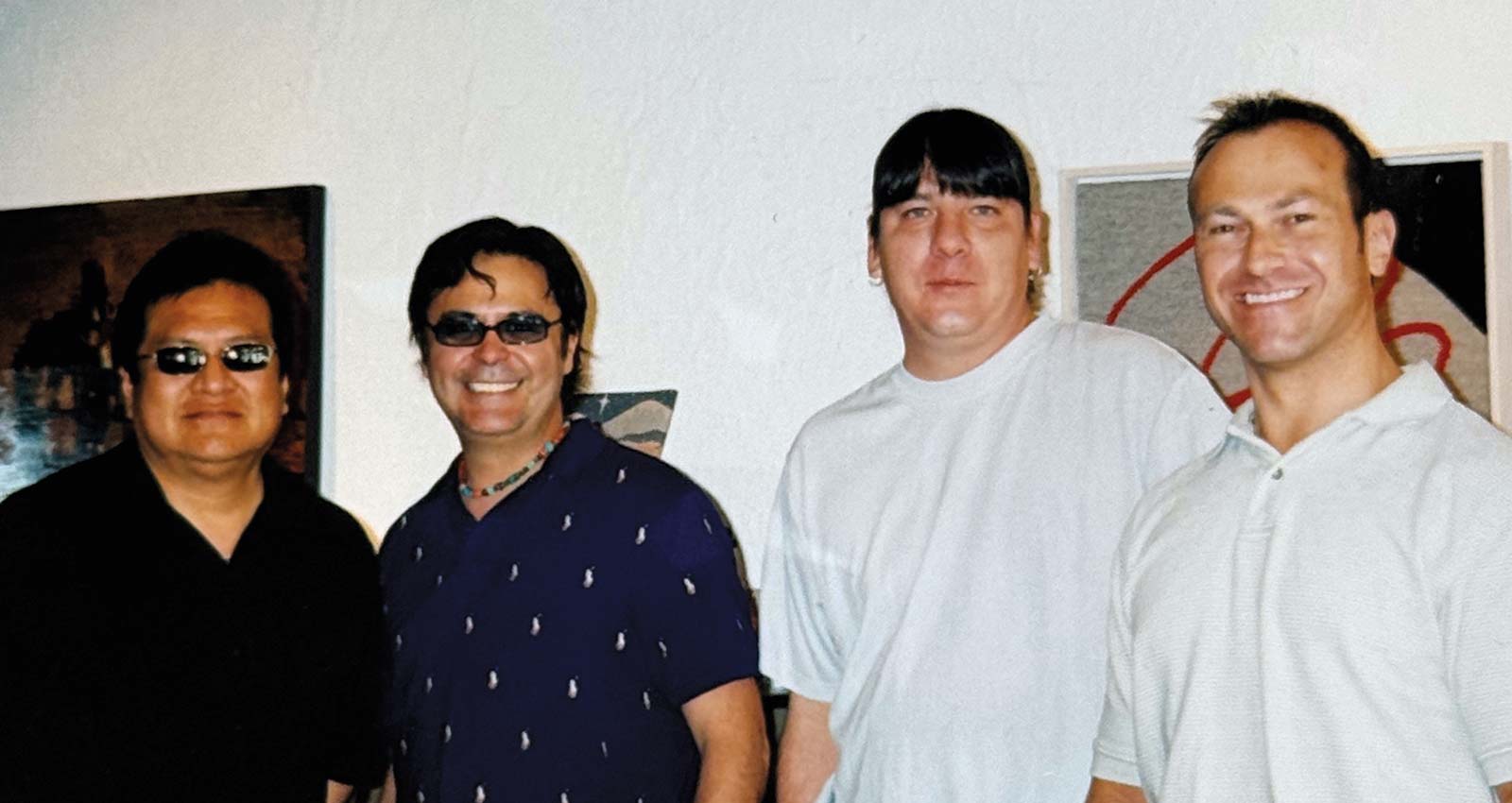
Mark Tahbo, left, Russell Sanchez, Erik Fender and Charles King early in the gallery’s history.
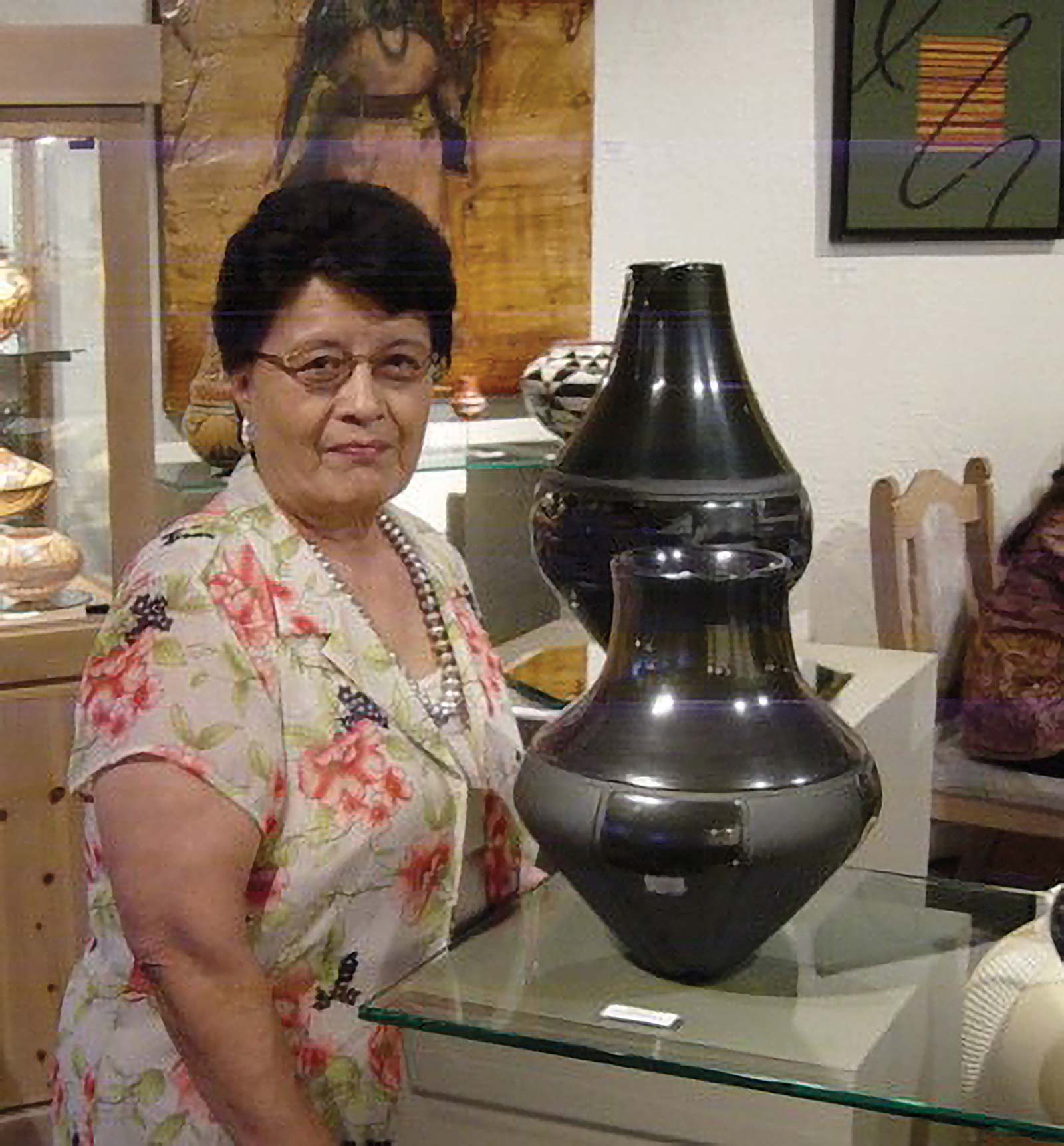
LuAnn Tafoya at a 2022 show in Scottsdale, Arizona.
With his first of many successes behind him, and a bank account well north of $45, King slowly grew the gallery, its reputation and the exciting community that was building around cutting-edge contemporary Native American pottery. Since his 1996 debut, he’s moved the Scottsdale gallery location twice (he’s been in his current location since 2018) and opened a Santa Fe gallery in 2015. He’s also authored numerous books—Collecting Authentic Indian Art: Pueblo Pottery, Born of Fire: The Life and Pottery of Margaret Tafoya, The Art and Life of Tony Da, Virgil Ortiz Revolt, Spoken Through Clay and Virgil Ortiz: Revolution—and written magazine articles and given lectures. All of it to increase the awareness, collectability and education of pueblo pottery.
“I see pottery as great art. As important art. Early on, one of the things I felt was important was to let the artists tell their own stories. The gallery was meant to be a voice for them and their way of thinking. When I started working with artists, I would ask them, ‘What is this?’ or ‘What does this mean?’ and they would just stare at me. No other gallery had asked them those questions before,” he says. “I just wanted to make a space where the artists could create great work, and their success became our success.”
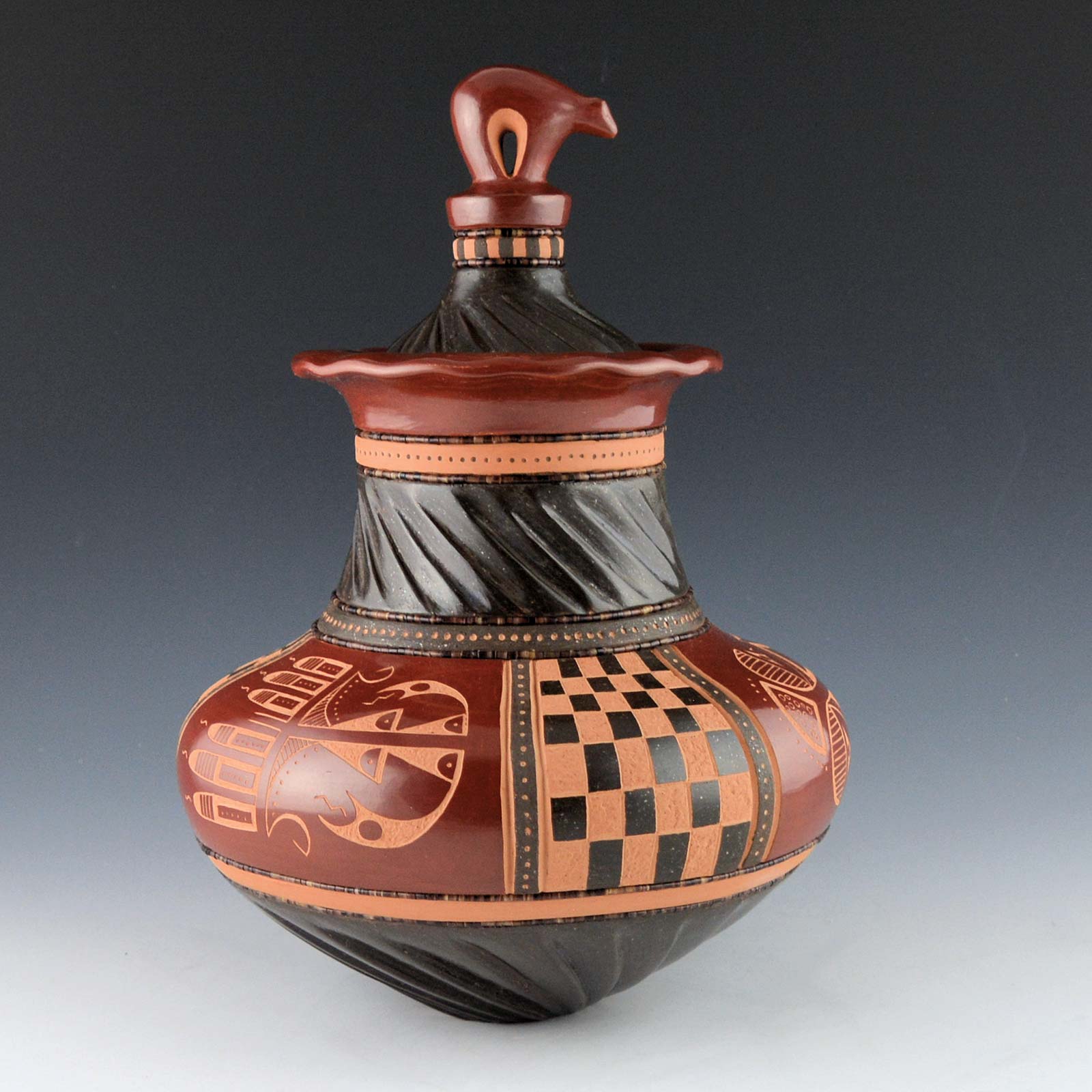
Russell Sanchez (San Ildefonso Pueblo), black and red water jar with bear paw lid
It was this inquisitive and open dialogue, and the safe spaces he created for pottery, that allowed King to earn the trust of many artists over the years. Some of the trust was earned by just showing up. He recalls countless trips to the pueblos to pick up pots and meet with his artists. “It was fun, but it was hard work. I had to call everyone and get organized, and then make the trip and hope they were done working when I got there,” he says. “I was there for many firings. And when a piece broke and they were sad, I was right there with them being sad. It was beyond money. It was about their creation.”
Today, King exclusively represents about 18 artists, and works with dozens of others. They are considered some of the best Native American potters in the country. One of them is San Ildefonso artist Russell Sanchez, who has shown with King Galleries since day one. “What’s great about Charles is his eye for pottery, and his willingness to look at new ideas. He’s never limiting. He always encourages us to go beyond the things we are capable of—to explore. He’s always telling us, ‘Push it, push it, push it,’” Sanchez says. “This is sacred art, so it’s important how it received into the world. So I don’t trust anyone with my work. I want them to understand it and appreciate it. And Charles King does that.”
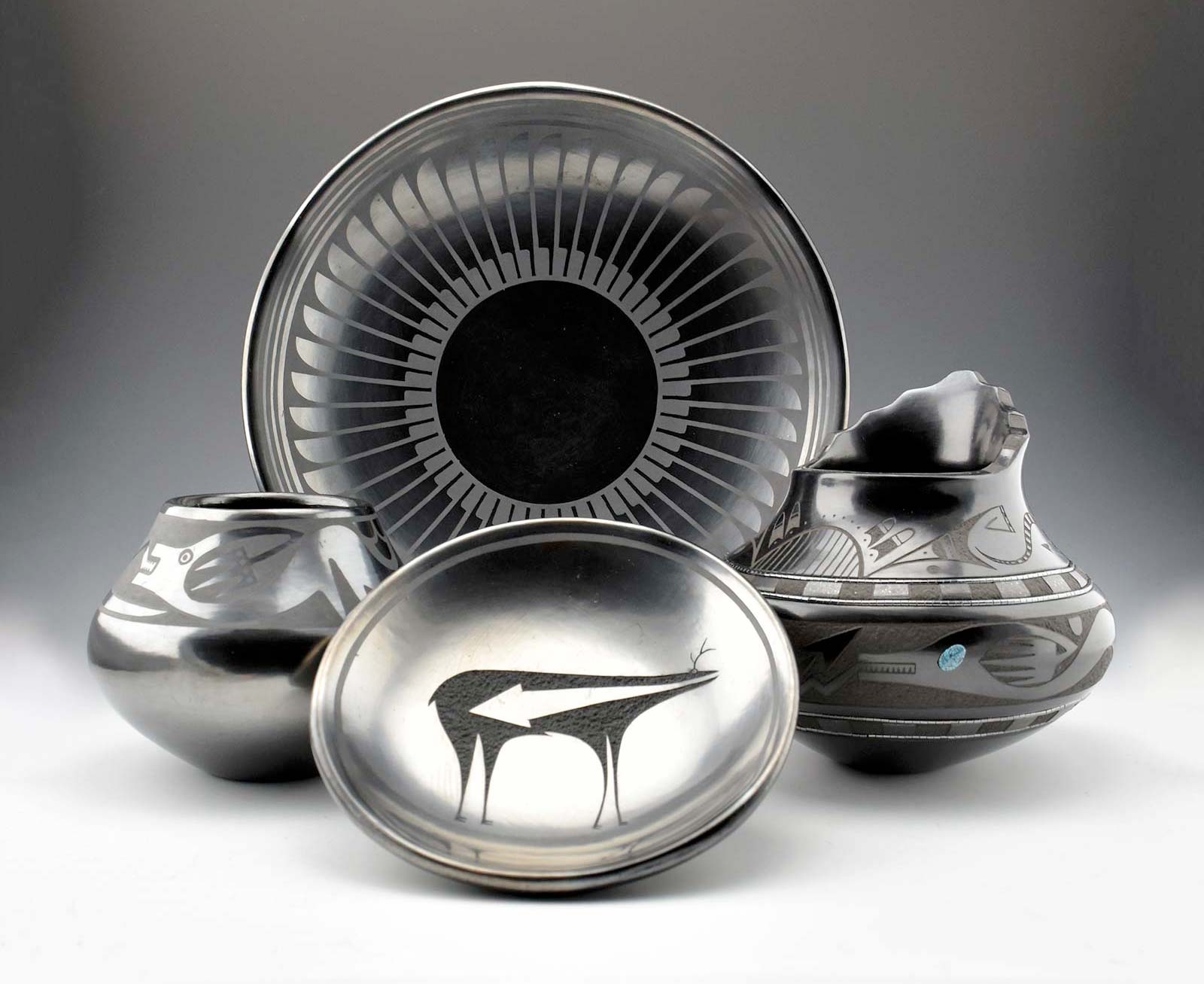
Pottery by Maria Martinez (San Ildefonso Pueblo), Tony Da (San Ildefonso Pueblo) and Russell Sanchez (San Ildeofnso Pueblo).
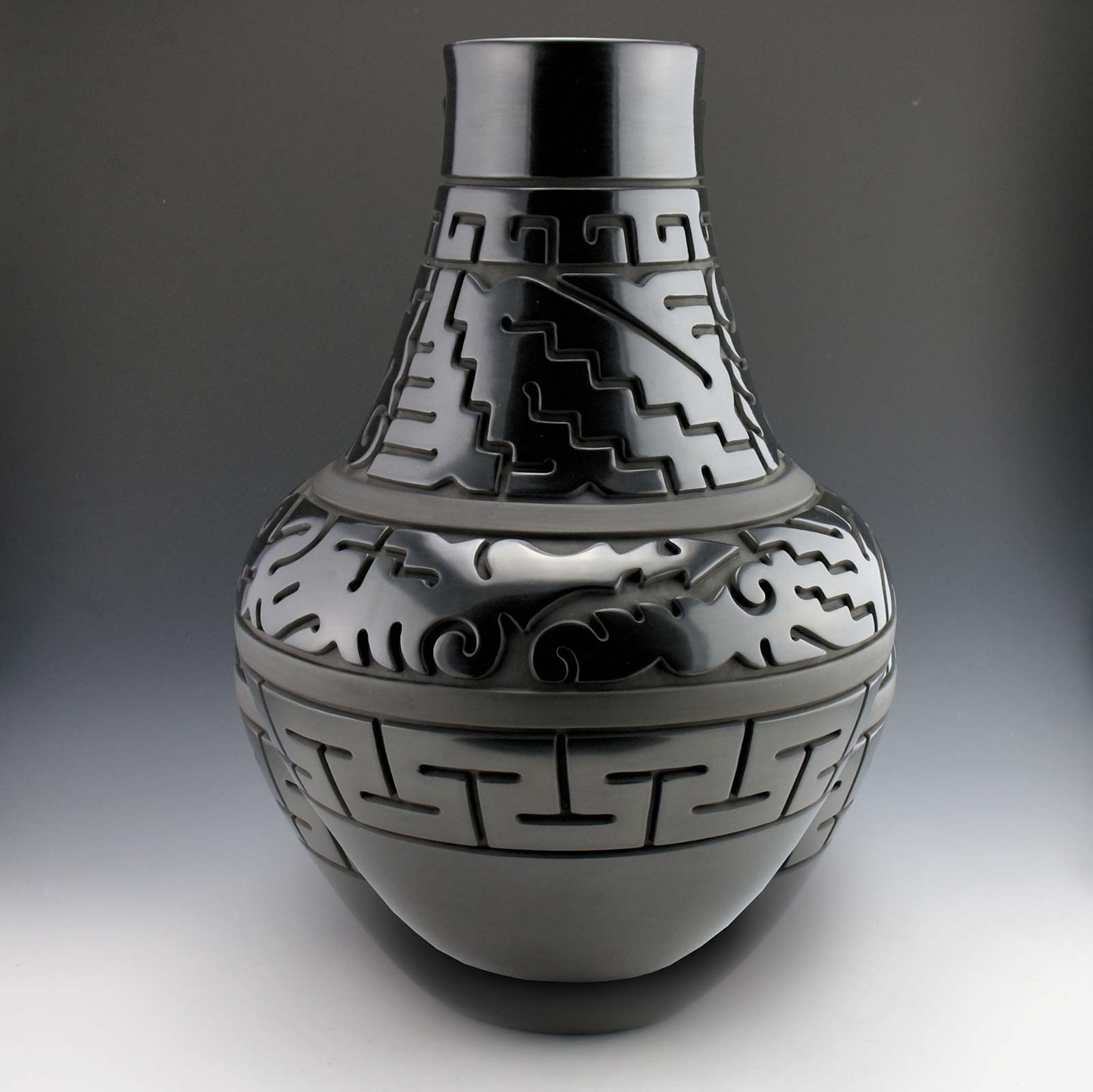
Nathan Youngblood (Santa Clara Pueblo), Large Water Jar with Avanyu, 2018
Santa Clara Pueblo potter Nancy Youngblood, known for her iconic swirl designs, has shown with King Galleries for more than 25 years. She considers King the premier venue for pueblo pottery. “Education is very important to me, and Charles continues to support that with pottery. Once a year, we organize a firing for the public so collectors can come out and watch it happen. It’s important for them to see that process, because seeing really gives them a greater appreciation of what goes into each piece,” Youngblood says. “I also think it’s amazing that Charles understands the market and knows what we need to hear. I’ve been doing this for 52 years, and I appreciate him letting me create, but he’s also active about letting me know what’s popular with his collectors. He wants us to be successful at every step.”
Nancy Youngblood, the granddaughter of Santa Clara matriarch Margaret Tafoya, is the mother of three other important potters: Chris Youngblood, Sergio Youngblood-Lugo and Joseph Younblood-Lugo. All are represented by King Galleries.
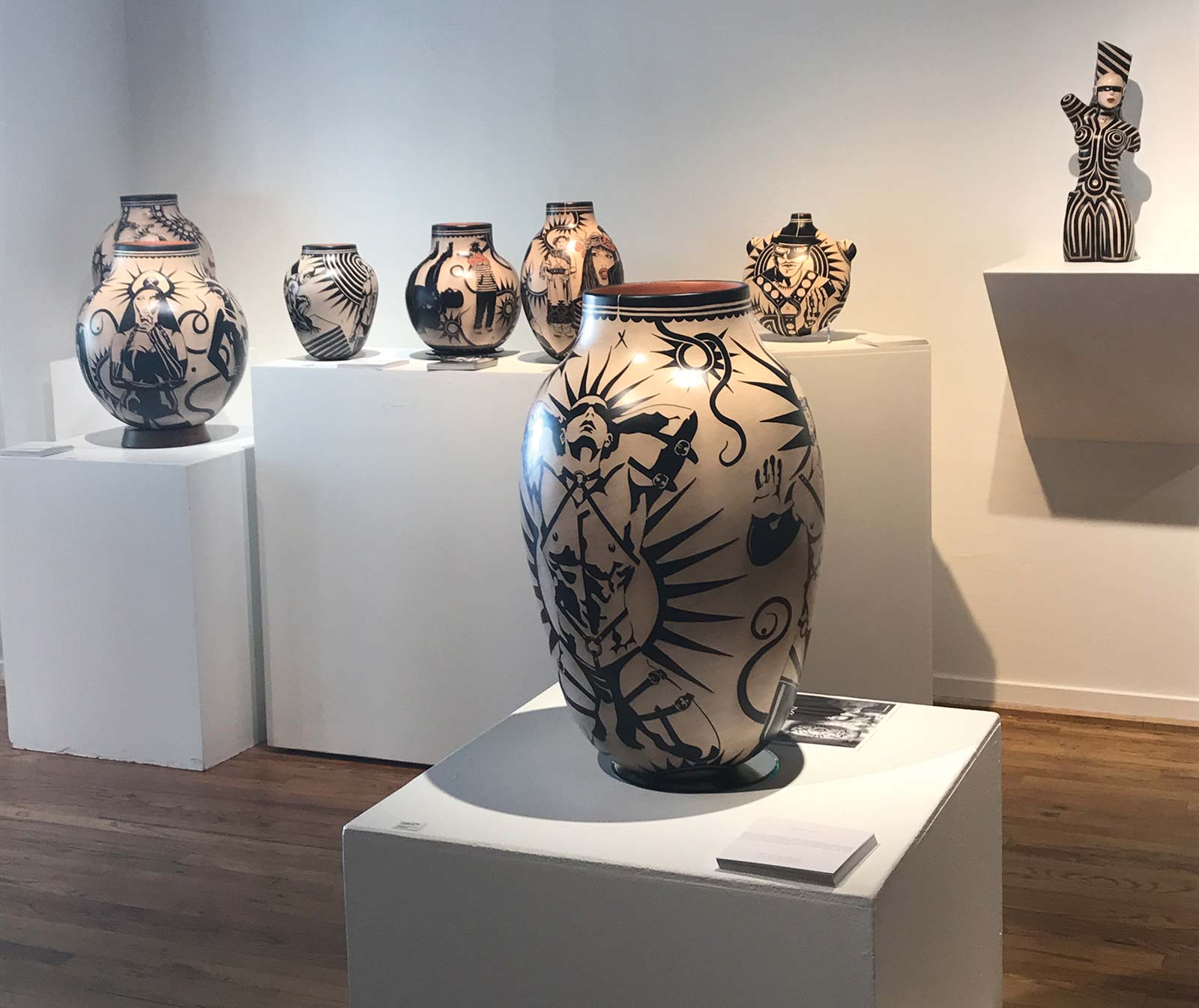
Virgil Ortiz’s Taboo Show, Scottsdale, 2017.
Other artists at the gallery include Al Qöyawayma (Hopi), whose work often involves architectural details and scenes of Native American ruins; Daniel Begay (Santa Clara Pueblo), whose pots feature deep carvings and bold designs; Jared Tso (Navajo (Diné)), an artist who is exploring new pottery forms that include heads and masks; Les Namingha (Hopi-Tewa/Zuni), who creates brightly painted pots in a modernist style; and Jeff Suina (Cochiti Pueblo), whose vessels take the form of angular, geometric shapes. Additionally, the gallery also shows historic works, including pieces by Maria Martinez, Tony Da, Margaret Tafoya and others. Each piece of art offered at the gallery expands on the definition of what Native American pottery can be.
“Native American art is great American art. That’s important, especially since ceramics is sometimes seen as more craft than art. Pottery is going through a slow-burn evolution that makes it very clear that it is much more than craft. And Native American pottery is a leader in this,” King says. “Any chance I have to shine a light on this and make it more understandable, I will take it. I want to always be one step ahead in the game.”
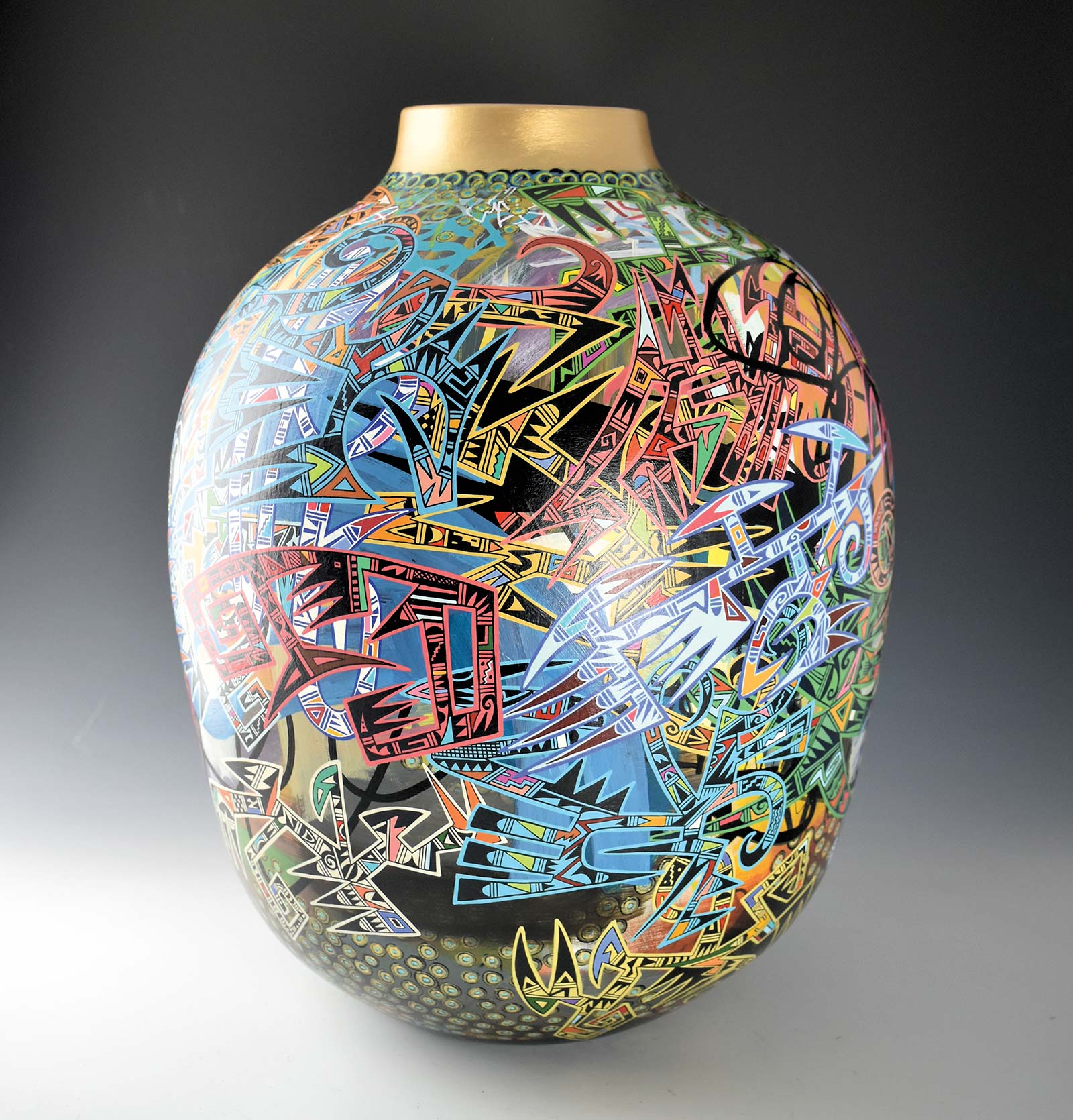
Les Namingha (Hopi-Tewa), Layers Jar
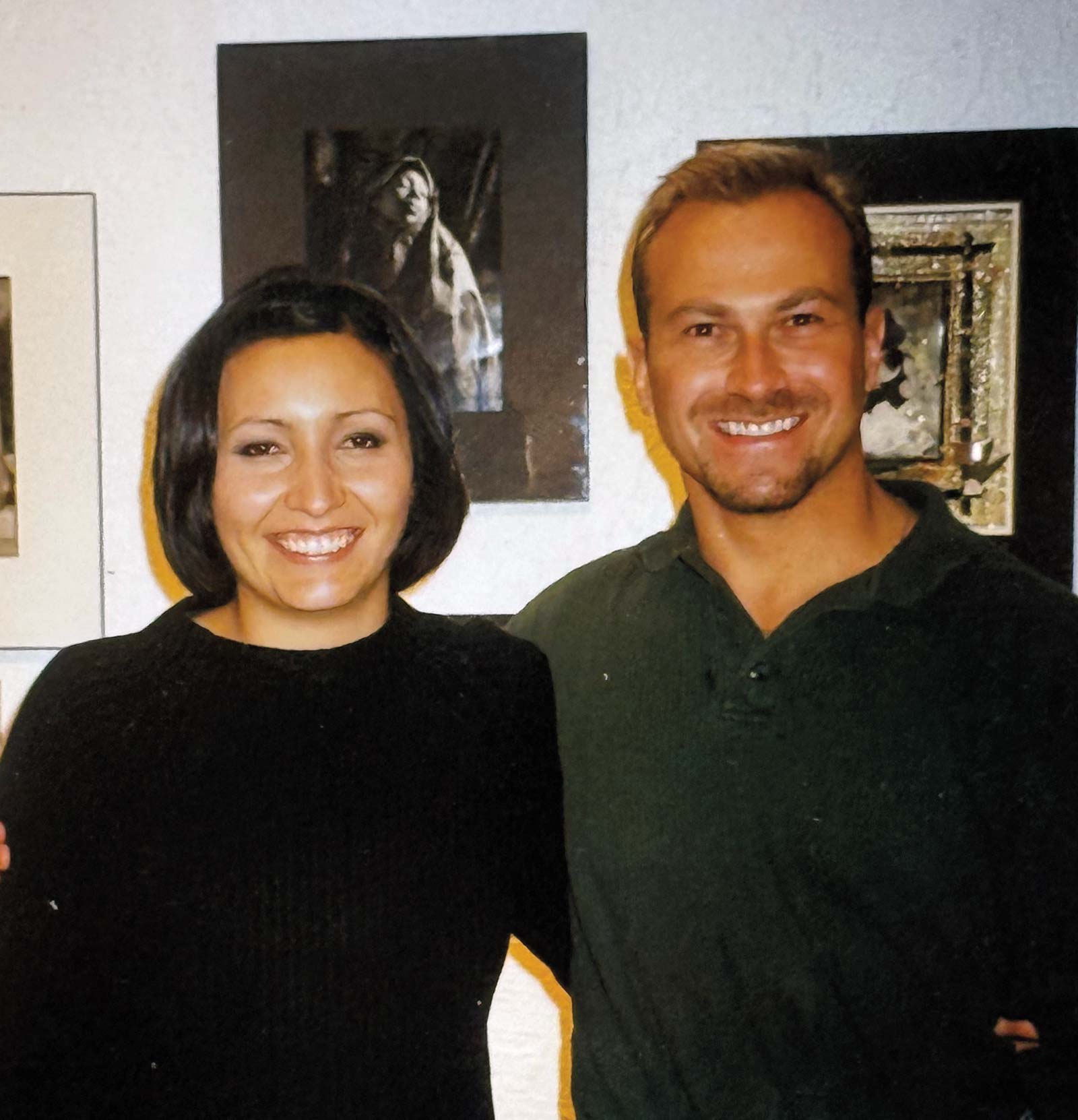
Charles King and Susan Folwell in 1999.
Santa Clara artist Susan Folwell, who has shown at the gallery for nearly 30 years, celebrates the three-decade milestone because the gallery’s owner is a friend, but also because he has built a venue that deeply honors potters and pottery. “It was very early on when the gallery gained a reputation for taking on newer artists. Using myself as an example, we were in our early to mid-20s and we were just starting out. We were trying to find out who we were. And Charles was there,” Folwell says. “It’s a roulette wheel investing in an artist. Will they make it? What are they going to do with themselves? Will it stand the test of time? Will they get better? With Charles, he knew the answers to those questions very early on. He had a great eye and he believed in us. That’s a lot of trust, but he was always there to bring out the best in our work.”
King Galleries’ 30th anniversary will open on October 24 at the location in Scottsdale. —
October 24, 2026
30th Anniversary Show
King Galleries 7077 E. Main Street, Suite 20, Scottsdale, AZ 85251 (480) 481-0187, www.kinggalleries.com
Powered by Froala Editor


