Jared Tso (Diné) has been an innovative voice in Native pottery for the past five years. Tso’s pottery background is a blend of academic rigor and family legacy. Many of his coil-built pieces have come to challenge expectations about how we view Native pottery. Over this brief period he has been recognized for his creativity by winning Best of Pottery twice at the Heard Museum Guild Indian Fair & Market (2023 and 2026), the Tony Da Innovation Award at the Santa Fe Indian Market (2022 and 2024), and Best of Pottery at the Gallup Ceremonials (2024). Dwell magazine named him one of their 24 Rising Stars in Design in 2022. Tso sat down with us and answered a few questions about his background, his techniques and his philosophy of working with clay.
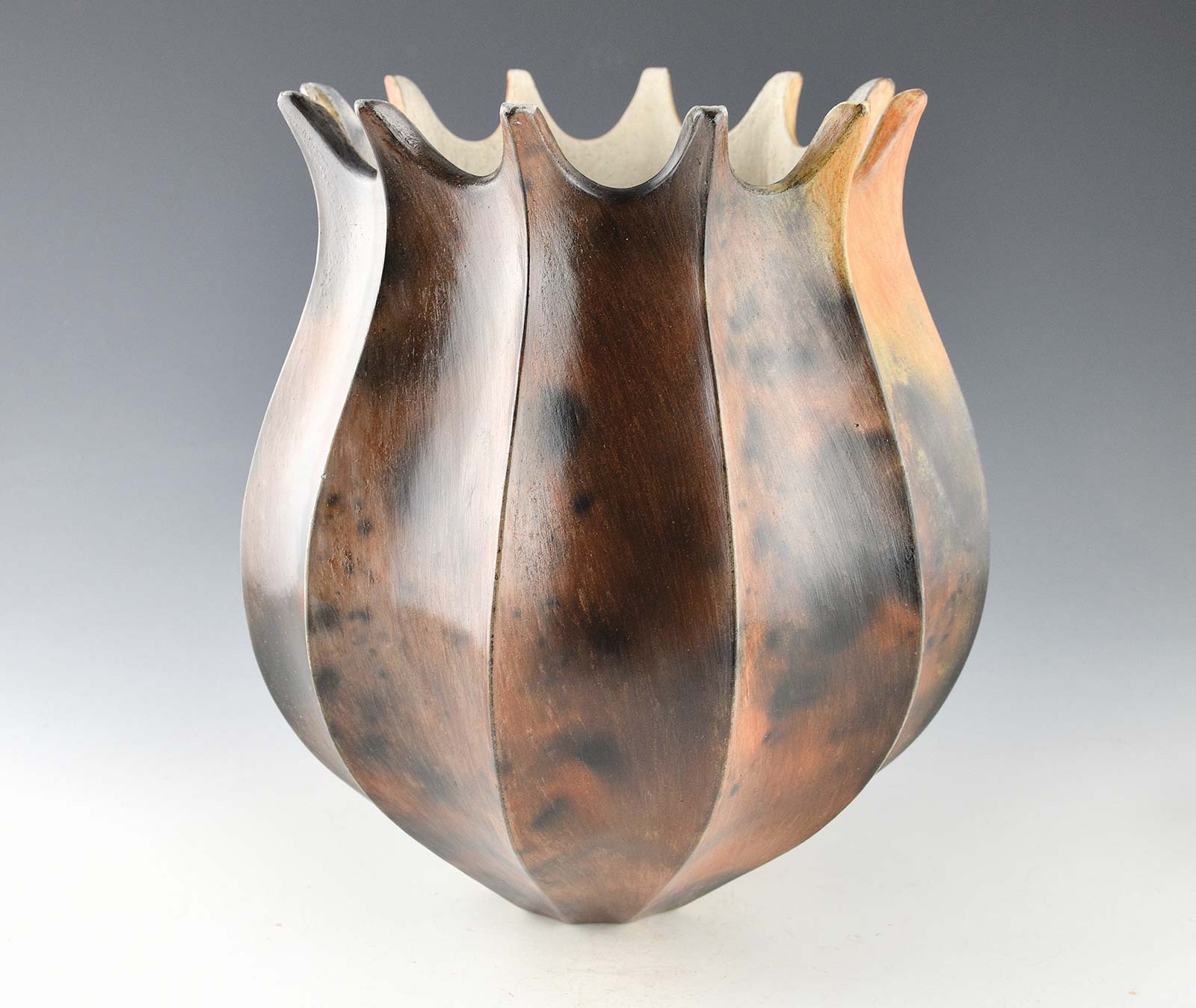
The Moment, native clay, native fired, piñon pitch
What is your background?
How did I get here? It’s really just a story about interweaving two important parts of my life. I studied at the University of New Mexico and got my degree in electrical engineering and began working in that field. Once I started working, I felt a draw to the clay, reflecting on my family connections and experiences from when I was younger. My grandmother, Faye Tso, was a famous Diné potter, and I also sat with my father making clay figures. I decided to go back to UNM and get my master’s in fine art (2021). That was a pivotal moment. I spent more time with the clay and for the first time, started to think of it as an artist. I also realized that my skills in design, mathematics, patience and precision, naturally complimented the making of pottery. I don’t think I ever saw the two paths competing with one another, but rather, they were building blocks creating a foundation for me. Once I finished my MFA, I decided to take the risk and make pottery full time. Looking back, that was a huge step to go from a full-time job into the art world. The first few years really took time to develop my personal techniques and find that distinctive voice in the clay. I think it also challenged me to continue to take risks with each body of work I have created. I don’t want to be repetitive or become stagnant in my growth. I have so many ideas that every time I get back to the clay, I’m excited about what is going to come next.
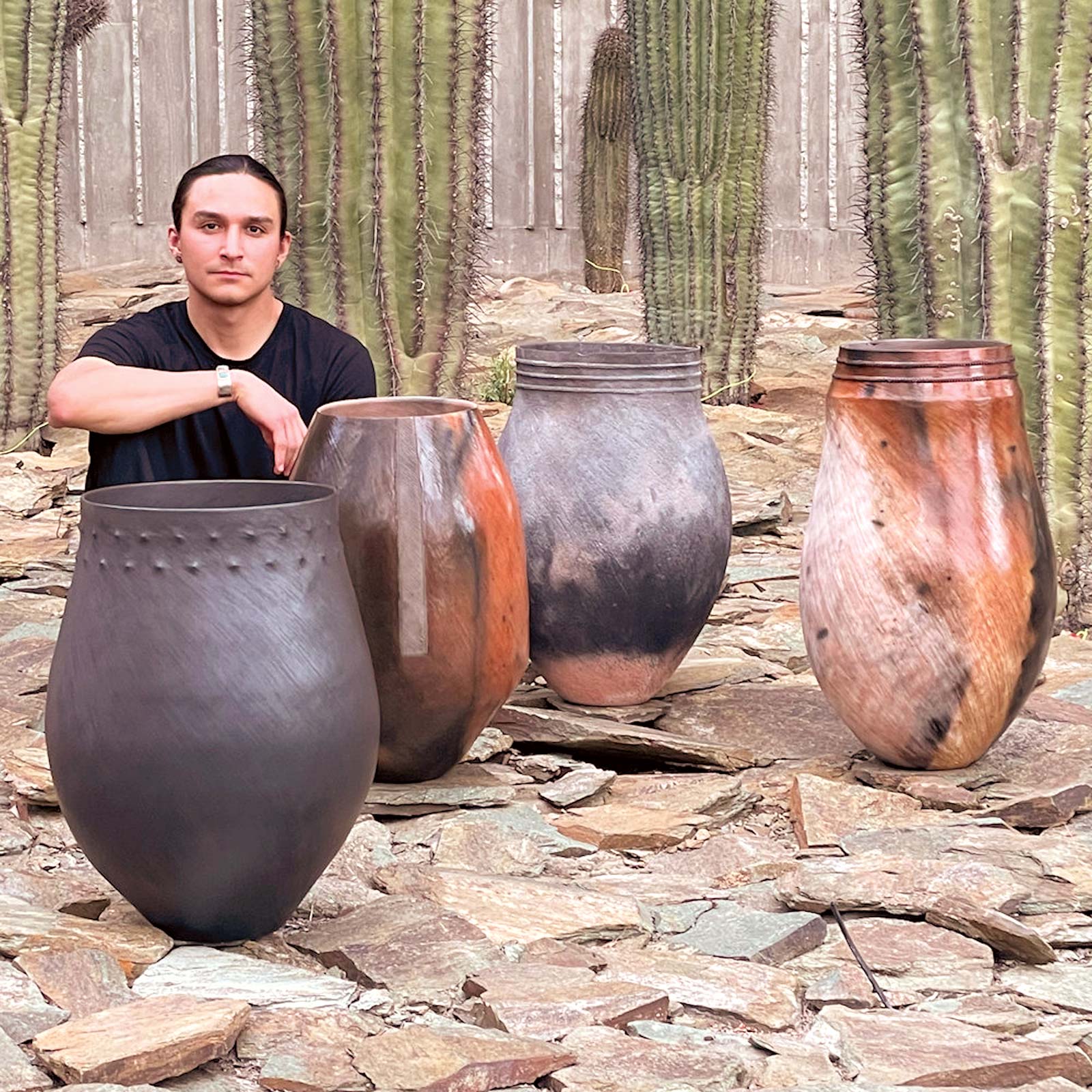
Jared Tso (Diné) with some of his pottery in 2023.
How do you incorporate your Navajo culture into your pottery?
There is a visual language in Navajo pottery, as well as in Navajo life, that coexists. The classic Navajo clay vessel is made as a response to the environment in terms of color, shape and certainly the historical needs of the maker. They also extend beyond functionality and find influence from the smallest seeds or blossoms to the regional landscape, to give them form. Looking more broadly, silversmithing is ubiquitous to our lives as Navajos. I can see how the beauty of a silver box can find the same voice in one of my clay boxes.
When you look at one of my traditional pieces, there is an area called “the necklace” near the lip of the vessel. It is a raised coil that is sometimes decorated with impressions or carving. Traditionally, it was used as a ridge to hold a hide down for either storage vessels or drums. There is almost always an open space in that design that is a “doorway,” or a general opening so you don’t close your own work off and it allows your pottery to breathe.
In my work, I visualize a line that balances Navajo culture, history, the environment and myself. It is all connected and, at times, only portions may show through, or it may include a combination of many underlying themes. This is how I can create a wide variety of work in different styles or forms. I’m surrounded by inspiration and always open to it.
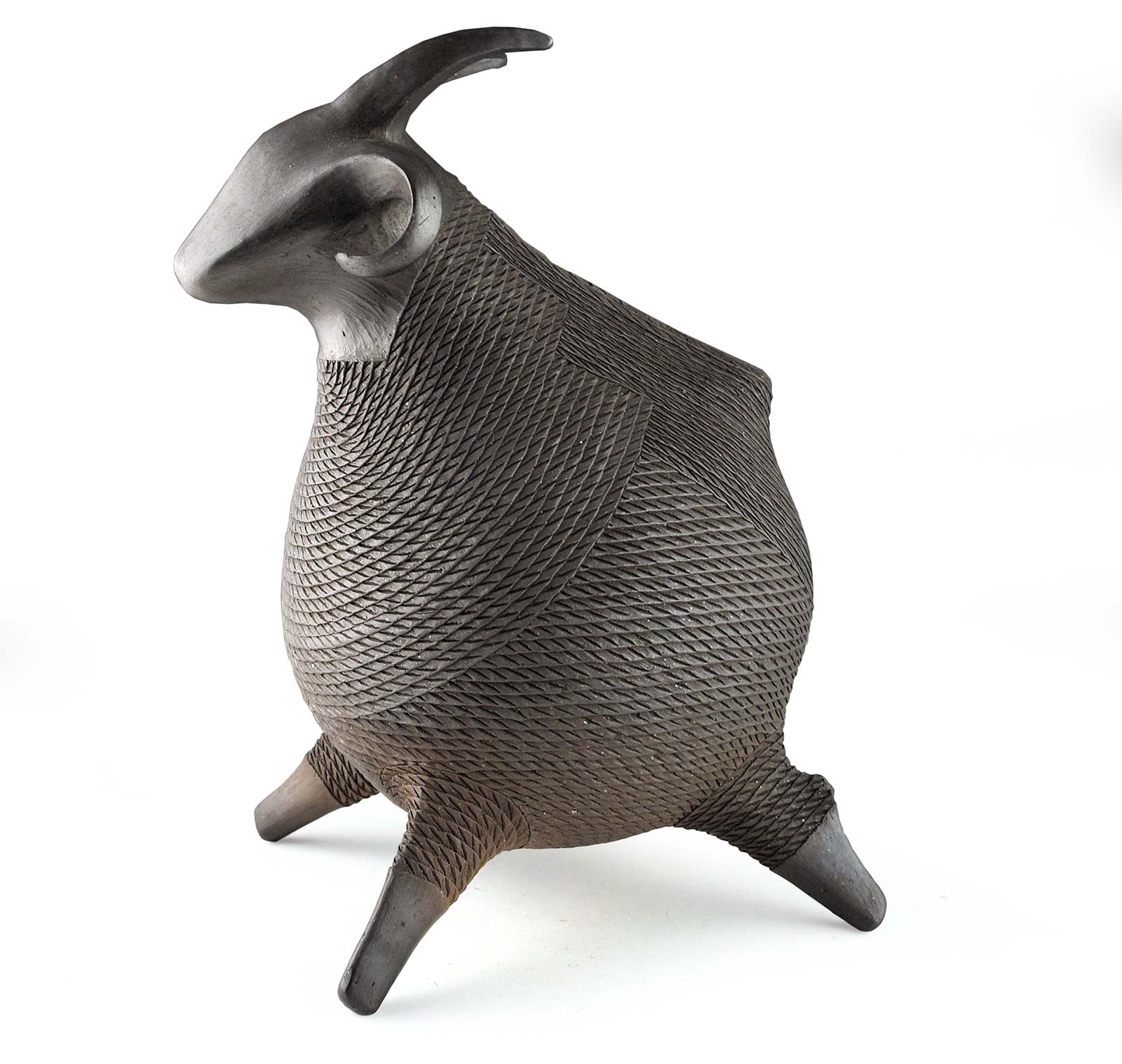
Corrugated Ram, native clay, corrugated, reduction fired
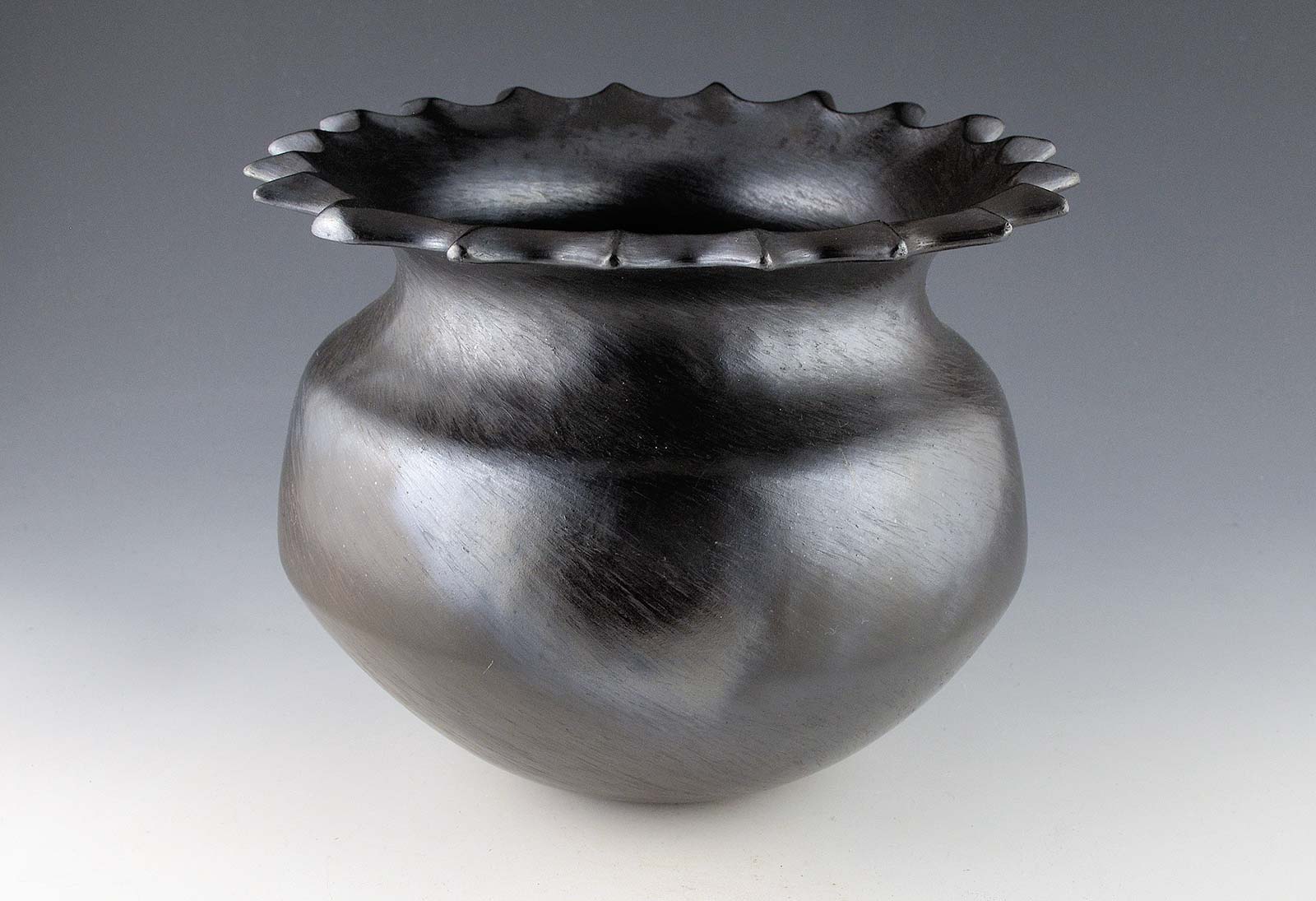
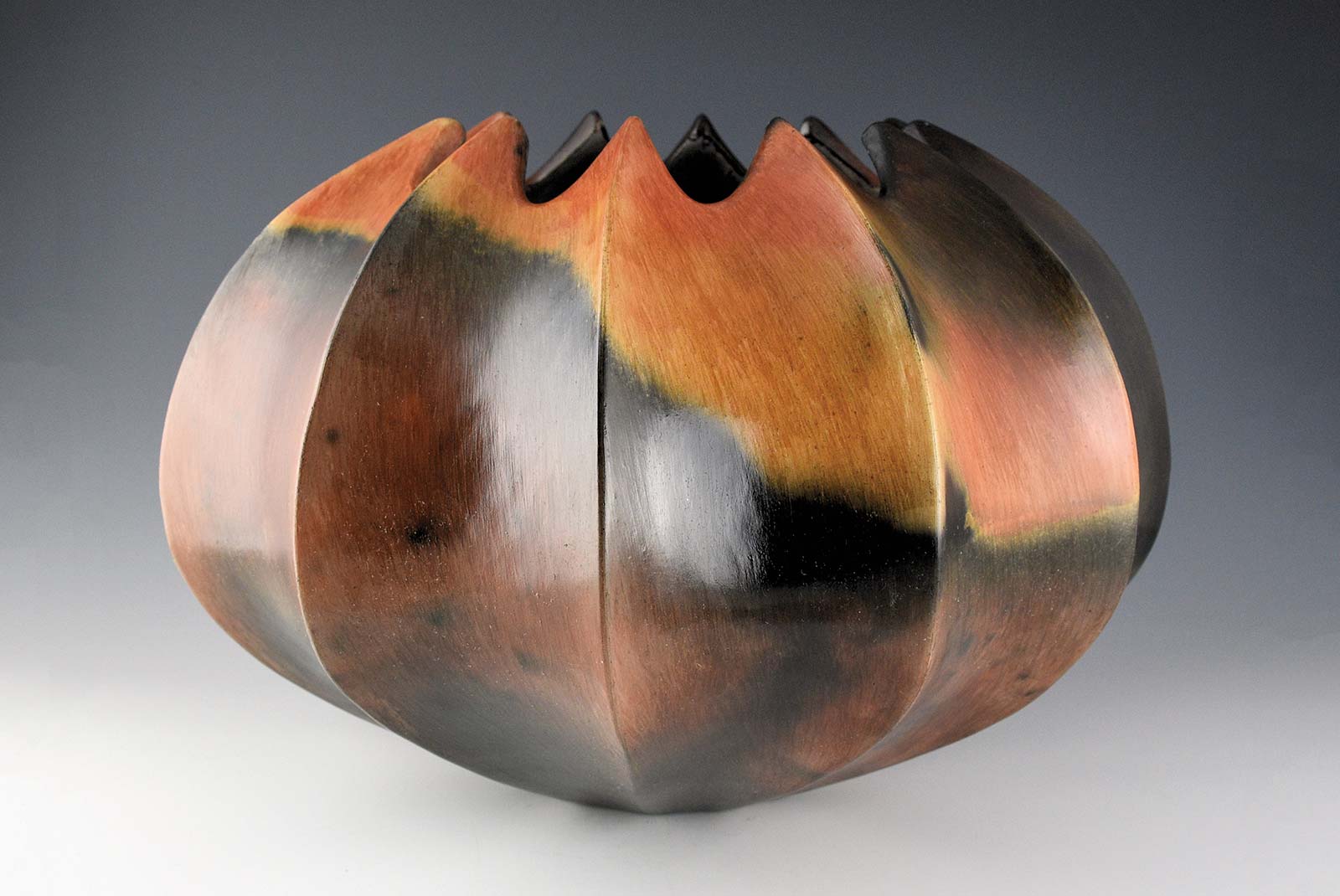
Moon Flower, native clay, reduction fired
Can you explain more about the evolution of your process?
When I first started, I focused on the classic Navajo shape of the drum vessel. It was a reference point for inspiration. As I focused on the vessel, I began to alter and modify the form. It is important to me that I don’t get bored with what I create. I don’t want to keep making the same thing over and over again. So, for example, recently, the idea of plant life or, more specifically squash blossoms, inspired me to create a whole new body of work. I wanted to explore petals and have thought about how other potters have formed rims and made them flowing and soft with curvature. For me desert plant life is just the opposite. We have yucca and cacti and goatheads, with sharp and angular shapes. I like that sharpness and, in turn, created jars with sharp shoulders or spikes on the rim.
The color on my pieces comes from both clay slips I apply before firing, as well as from the smoke and flames of the firing itself. When I start out, sometimes it is clear that the piece needs or wants to be a certain color. Other times, I’m not sure if a piece might be black or red, but I prepare for either scenario so that I can make that decision later. It might be that when it is drying, how well it has been polished and will that complement the red or the black. I also go back to my own desire to not be repetitive and to allow for variety, so that if I’ve made a group of red pieces, I might start on some that will be fired black. The only time the color is really locked in is when it is going to be white. When I make a piece that is corrugated, I usually fire them black. I think it is that the texture of the corrugation shows so well in a black firing.
Traditional Navajo pottery was covered in pinon pitch after the firing. I wanted to continue this process in various pieces of my work. At certain times of year, I go out and collect the piñon pitch or resin myself from the pinon trees. I hike in areas near my home to find where the trees are growing. The location of trees determines the consistency of the pitch I’m looking for, and then I’m then able to harvest it. The piñon pitch is heated up and applied at the end of the pottery firing. Putting the piñon pitch onto the hot clay vessel is stressful. It has a short window to apply it correctly and requires super high focus.
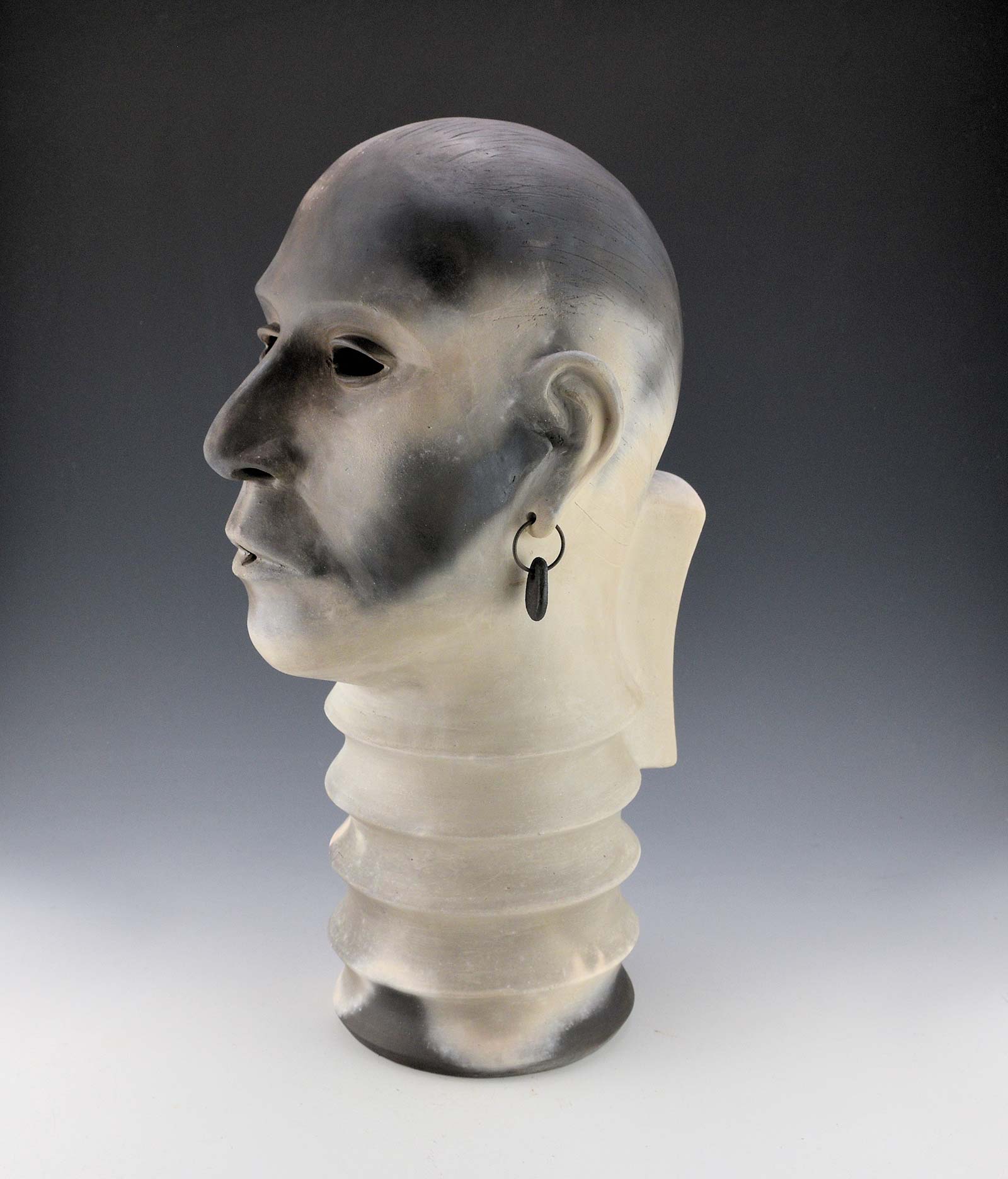
Hastiin Bob Square Bun, native clay, native clay slips. This piece won Best of Pottery at the Heard Museum Guild Indian Fair & Market in 2026.
What is your favorite part of making pottery?
Believe it or not, it continues to change. In the beginning, I liked constructing, building and working with the wet clay. As of late, I have this idea in my head of what I want to make. At the same time the forms are becoming more complex so I can’t draw them out in detail. The clay has its own personality and so there is a “negotiation” in the process. Working through how the clay shapes into what I envision is the part I currently like the most.
I dig my own clay, so when I’m making a piece, I first think about how much clay I’m going to use. I also think about the clay sites and not overharvesting. I want the clay to last for those generations after me.
Daybreak, native clay, native fired, piñon pitch
Why did you decide to make your clay “jewel” boxes?
The clay boxes were inspired by silversmithing and the boxes that are made by Navajo silversmiths. I thought about the stamp work and shrinking the scale. I wanted to focus on the technicality and precision of the boxes. How boxes are just lidded vessels. In silver, the stones are inlaid into the box. The “stones” I inlay on the top are all made from clay are adhered with pinon pitch. I wanted to show what clay can do. By changing the slip or polishing or firing, I can give them a different appearance and make them look like stones. The clay, in itself, can be beautiful without embellishing with stones we perceive as valuable or precious. People always ask if they are wood or stone. I love that. The trompe l’oeil of the boxes is part of what makes them so fun. I love playing with people’s perceptions of my work.
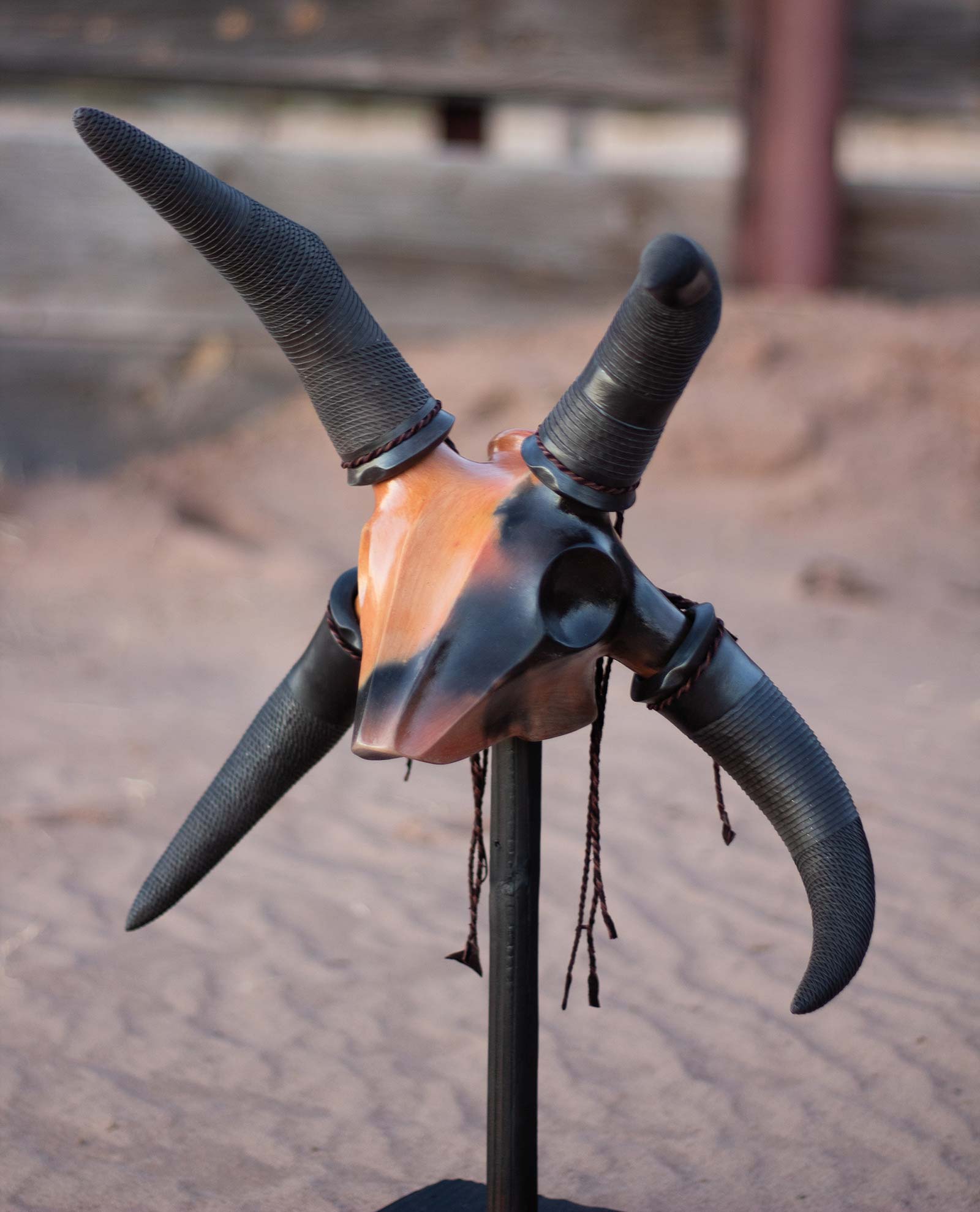
Dee’ Dij Canteen, native clay, corrugated horns, native fired
You recently made your first piece in bronze. What’s the importance of that piece?
I made my first bronze in 2026, and it is a goat named Hastiin Goldie. When I was younger, I saw clay goats made by my grandmother, Faye Tso. I admired how she had turned a simple vessel into a figurative ram. Later, with my father, one day we started making rams together, and that was my first one in clay. They are difficult to make but an important part of my overall creative style. Navajo perspectives and lives are deeply connected to their livestock and sheep are among the most important. People make a living from goats and sheep, and as I make them out of clay, they are also now part of my livelihood. While I don’t have my own sheep, I still want to honor the legacy of the weavers who raise their own sheep for wool. It is grounding to a part of this connection through the clay.
There is naturally an overlap between clay and sculpture. There is a different type of permanence to bronze versus the innate fragility of clay. Bronze can also read differently, especially on the surface, in a way that traditional pottery cannot. For this piece, I helped design the patina over a day-long process. The patina is created on the metal surface by heating it with a flame. Similarly, the surface of all of my pots is also impacted by flames in the outdoor firing. For me, it was a familiar experience, within a different context and using different techniques.
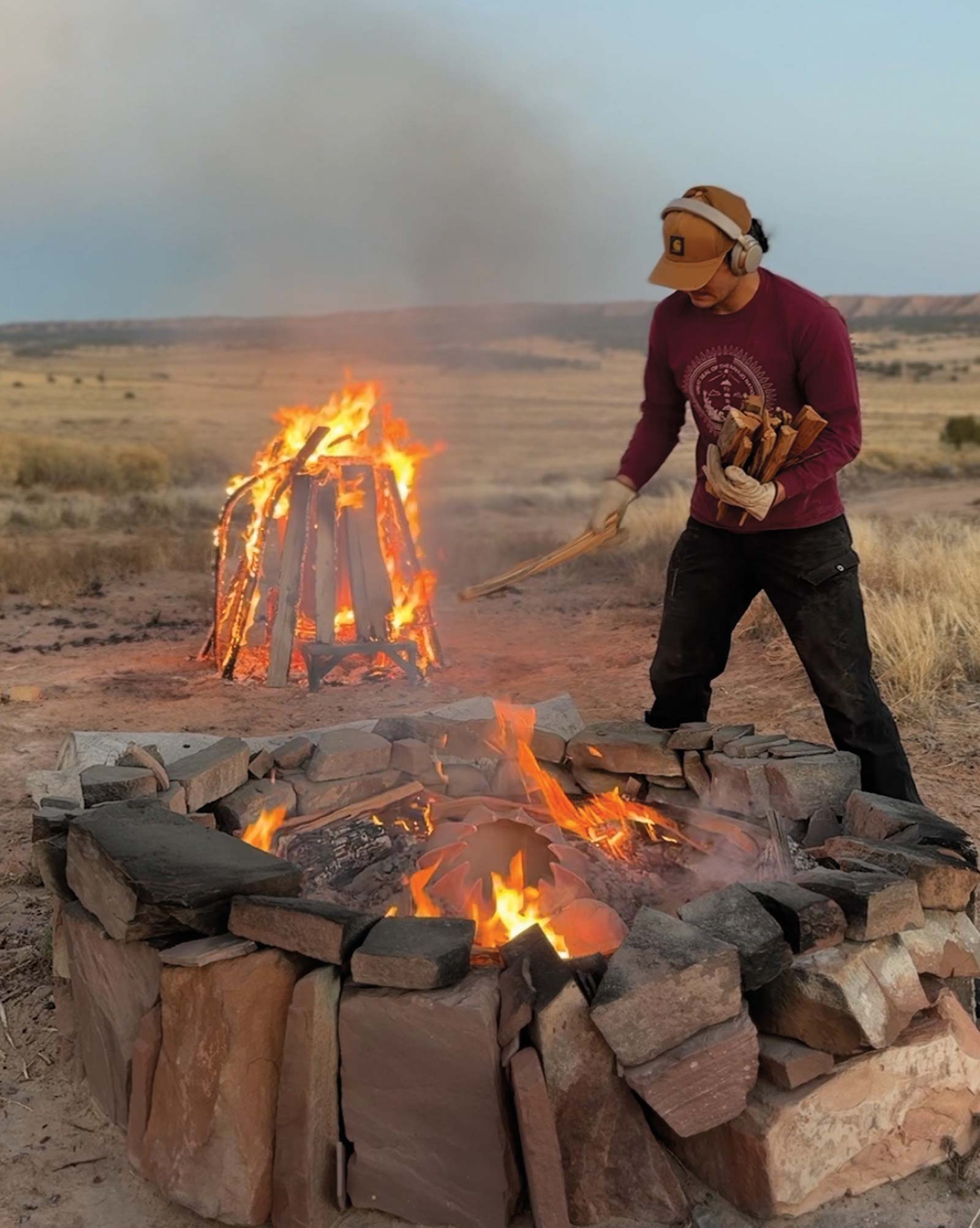
Jared Tso making a piece of pottery in 2025.
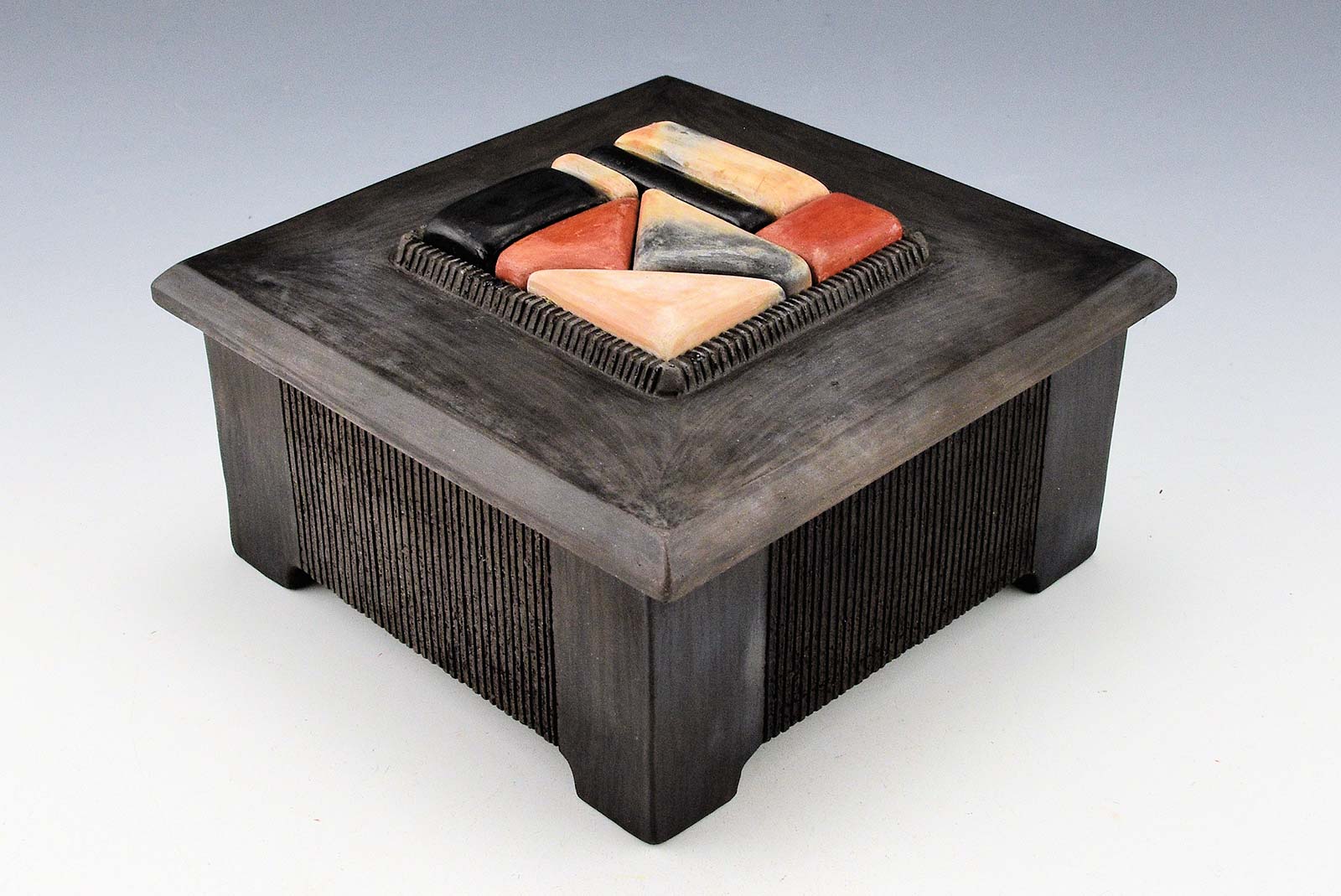
Mud Box, native clay, native fired, polished and fired clay insets
You recently won Best of Pottery for a clay bust at the 2026 Heard Indian Fair & Market. How did that come about?
The first bust I made was in 2022. Since then, I have made six and the seventh finally turned out. Each one was a different size, and each one cracked in the firing. Sometimes it was caused by the firing, and sometimes from building of the piece. The failures encouraged me to keep going and I became determined to figure out how to make a bust. The human form is delicate to create, challenging, and can easily look terrible. The name of the bust that finally turned out is Hastiin Bob Square Bun. To me, the bust looks incredibly stoic, but I didn’t want a stoic name or have it feel too grandiose. Navajos have such a great sense of humor. When looking at the qualities of the bust, I wanted to inject some of that humor. Even the earrings, which are made from clay, are attached with bailing wire. It’s just another connection to Navajo life.
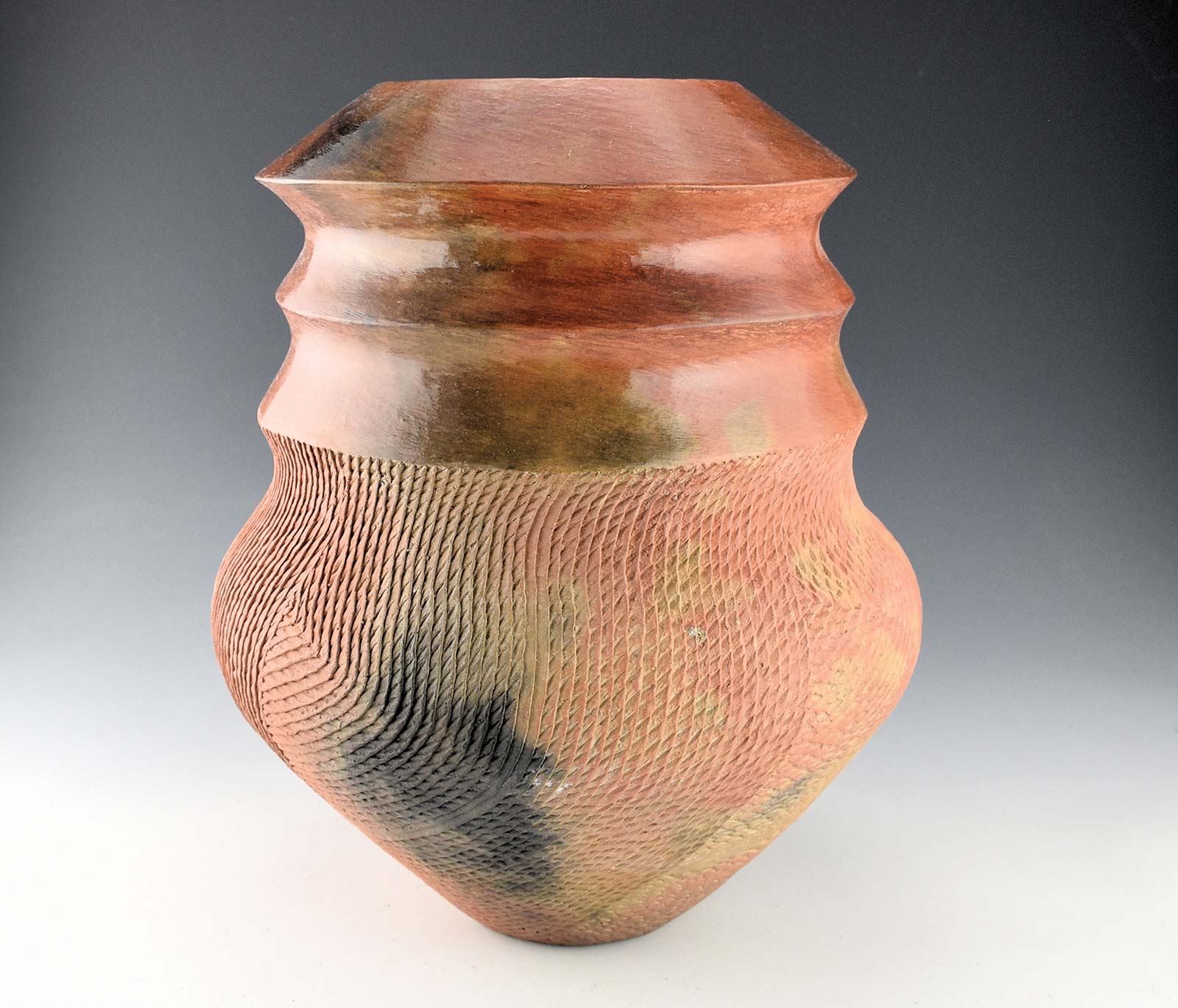
Native clay, polish, piñon pitch, corrugated. This piece won Best of Pottery at the Gallup Ceremonials in 2024.
What should we expect next?
Good question. It’s better not to say and just let the clay speak for itself. Every piece is a collaboration between me and the clay. I love the excitement of figuring out what is coming next as much as everyone else. —
Interview and images courtesy Charles King, King Galleries. See more at www.kinggalleries.com.
Powered by Froala Editor


