In Northern Arizona, roughly 300 miles northeast of Phoenix, is Canyon de Chelly, a vast network of canyons and cliffs carved by the headwaters of the nearby Chuska Mountains over the course of 200 million years. For more than 5,000 years, these fertile lands, with their dramatic rock formations and towering spires, have been the continuous home to Indigenous people, including Ancestral Puebloans, the Hopi and, for the last 400 years, the Navajo (Diné). Today, the land, which has been designated a national monument, is part of the Navajo Nation.
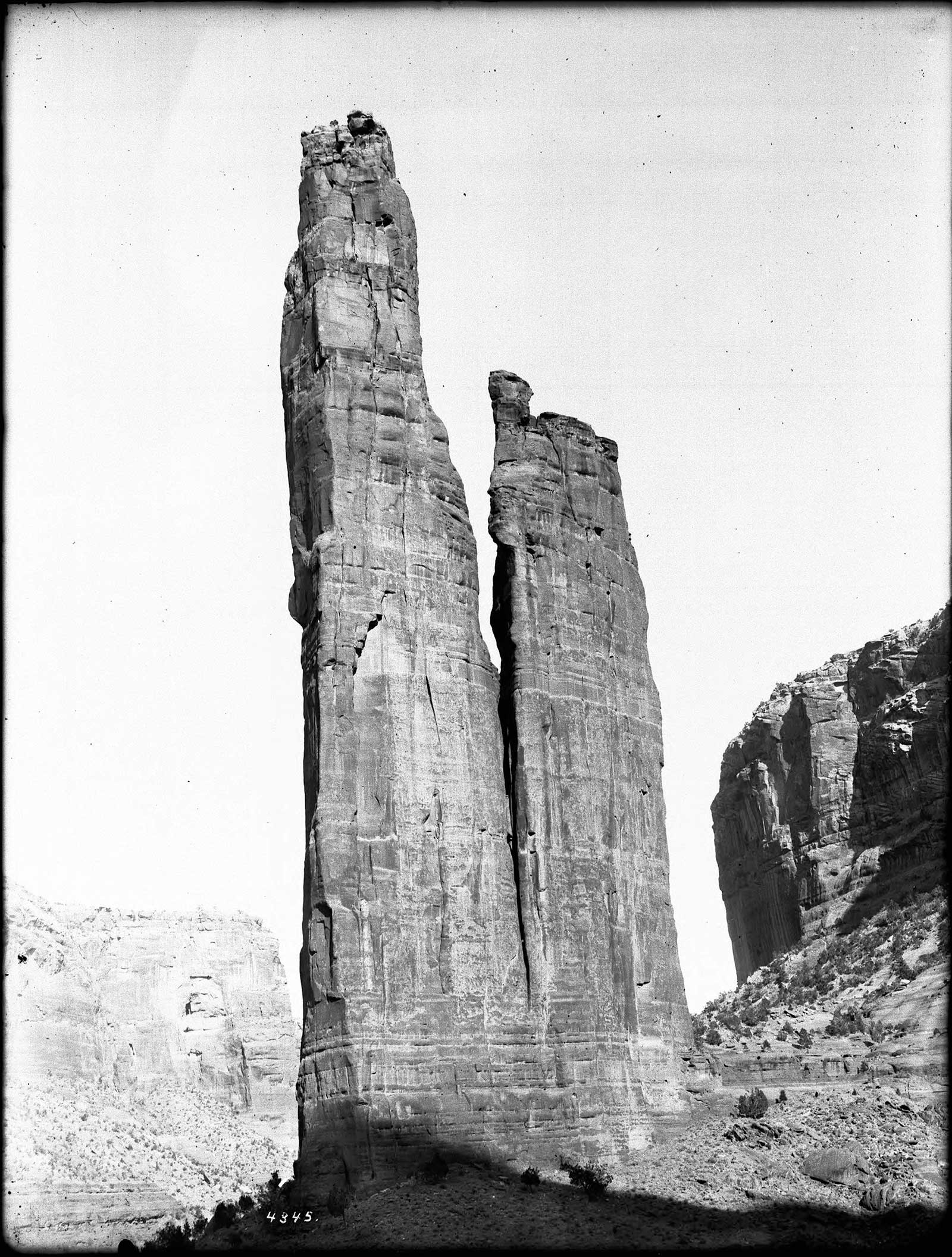
Sacred Spider Rock at the entrance to Del Muerto Canyon, Canyon de Chelly, Navajo Indian Reservation, Arizona, ca. 1900, glass plate negative, 22 x 17 in. California Historical Society Collection, 1860-1960, CHS-4345.
One of the most iconic destinations within the canyon is a twin V-shaped spire that juts out dramatically from the junction of Canyon de Chelly and Monument Canyon. Known as Spider Rock, the narrow fingers of sandstone rise up more than 750 feet, up to nearly the edge of the canyon’s nearby rim. The taller of the twin spires is identified by the Diné as the home of Spider Woman (Na’ashje’ii Asdzaa), the first weaver of the universe. Spider Woman, who is also known as the Spider Grandmother, features prominently in the Navajo creation story, where her gifts of weaving shaped the universe and the Navajo people, including artists whose talents are often traced back to Spider Rock from mother to grandmother to great-grandmother over countless generations. Spider Rock, with its dusty canyon trails and monolithic towers, is part of Diné history. But, for a growing cadre of artists and art experts, Spider Woman’s home and all that it represents to Diné culture is not a window to the past, but a vision of the future.
According to Navajo legend, recorded in Gladys Reichard’s 1934 book Spider Woman, weaving was a divine act attuned with nature: “Spider Woman instructed the Navajo women how to weave on a loom which Spider Man told them how to make. The crosspoles were made of sky and earth cords, the warp sticks of sun rays, the healds of rock crystal and sheet lightning.” The Navajo loom was then, and is today, an upright loom, not like the Spanish treadle (or pedal) loom. The artist works out the entire design in their mind in order to have it work out on the loom. There’s no room for error.
California-based art dealer Kim Martindale, is one of those who think Navajo artists weren’t just acknowledging their history in their work, but rather tapping into an early form of modern art. Navajo artists are known for many forms of art, including sumac basketry, silver and turquoise jewelry, hand-coiled pottery and, starting in the 20th century, painters. But for Martindale, the proof is in the weavings.
“Navajo weavings and textiles should be considered some of the most important artworks within American art,” Martindale says. “These weavers, primarily women, were creating these incredible weavings—bold patterns, contrasting and vibrant colors, flawless designs and skill—and they were doing it outside of the art world, and the world at large. And decades before others would do anything even remotely similar in paintings. I believe these Navajo artists deserve the credit for being the first modern artists in America.”
What Martindale is advocating is that credit is due earlier in art history. What he’s pushing up against is the notion, a false one, that Native American weavers stumbled into their designs and didn’t understand what they were creating, which is why modern art, including geometric abstraction and abstract expressionism, could take shape with Josef Albers, Mark Rothko, Marsden Hartley, Arthur Dove, Piet Mondrian and others. For Martindale, Navajos aren’t footnotes in the book on modern art—they are the first chapter. Even as far back as 40 years ago, artist and textile collector Tony Berlant observed that weavings are paintings with wool. In time, this has become a more common understanding of the art form.
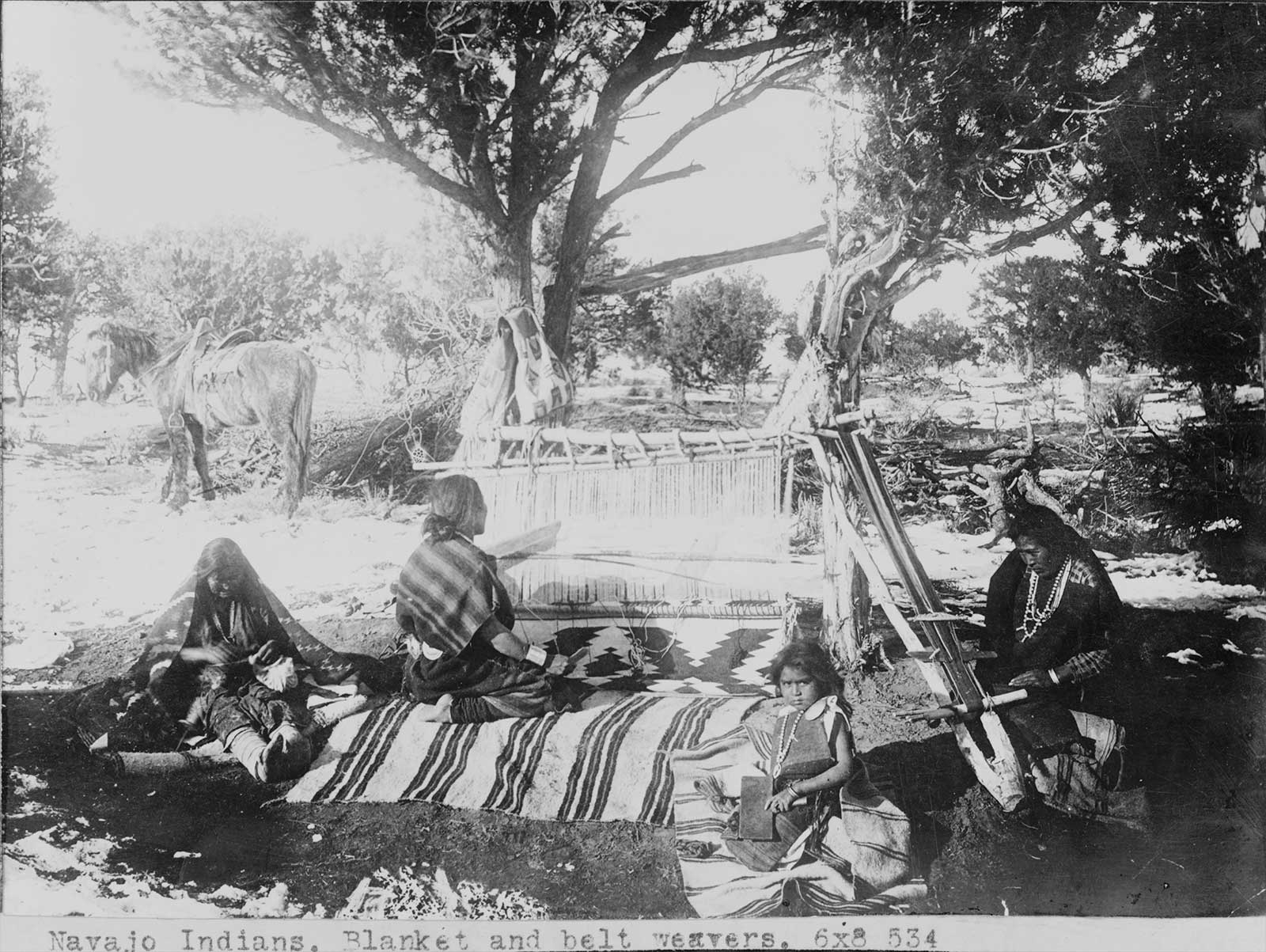
Navajo Indians, blanket and belt weavers, 1892-93, by James Mooney (1861-1921). Library of Congress Prints and Photographs Division Washington, D.C., 12337-4.
“The fact they did what they did with limited resources out in the middle of the Navajo Reservation in the 1800s, really shows how pure their art and designs were,” he says. “They didn’t have access to everything. No magazines. No newspapers. No one was giving them art books showing them things created on the East Coast. They relied totally on their imaginations and their talent to create things that had never been created before. What they did was unique because it came purely from who they were as creators and artists.”
Martindale is not alone in his assertion that Navajo weavers were instrumental and early members of the modern art movement. Native American art dealers, curators, artists and others have subscribed to this belief for many years, even as contemporary Diné weavers such as D.Y. Begay, Melissa Cody and Philip Singer are being shown at the Smithsonian’s National Museum of the American Indian, MoMA, the Hammer Museum and other major venues that are keen to explore a part of art history that has been previously marginalized into “ethnographic studies.” When Charles and Valerie Diker donated their stunning Native American art collection to the Metropolitan Museum of Art in 2017, it came with a major caveat: The work was to be shown as American art, not ethnographic or Indigenous art. The Diker Collection represented a major paradigm shift, one that has benefited Martindale’s longstanding belief that Navajo weavers created pivotal art at a crucial time in the country’s history.
While some acknowledge all of Navajo weaving prior to about 1910, Martindale focuses on an even more specific time and movement; one that started in 1870 and lasted barely 30 years. It all started with a little bit of Germantown yarn and commercial dyes.
Navajo Weaving History
The first major movement of Navajo weaving was the chief’s blanket, which itself came in three distinct eras: first phase (1700-1840s), second phase (1840-1860) and third phase (1860-1868). Today, the different phases are denoted by their unique patterns and design, not simply by the years of creation. For example, first phase is recognizable for its stripes, the second phase for its stripes with rectangular blocks, and the third phase is known for its stripes with diamonds and triangles. The name “chief’s blanket” is a misnomer since the Navajo clans did not have chiefs. The weavings received their name because the blankets were widely traded with other Indigenous tribes, and they were prized possessions by Native people with wealth or status in the Great Plains, hence the term was created because only those individuals could afford to have one. These blankets are still prized today and can be found in museum collections all around the world. In 2012, a first-phase blanket sold for $1.8 million at John Moran Auctioneers. It created a shockwave among dealers and in the weaving community. Other weavings created early in the 19th century included serapes, saddle blankets, child’s blankets and eventually rugs in the early 20th century.
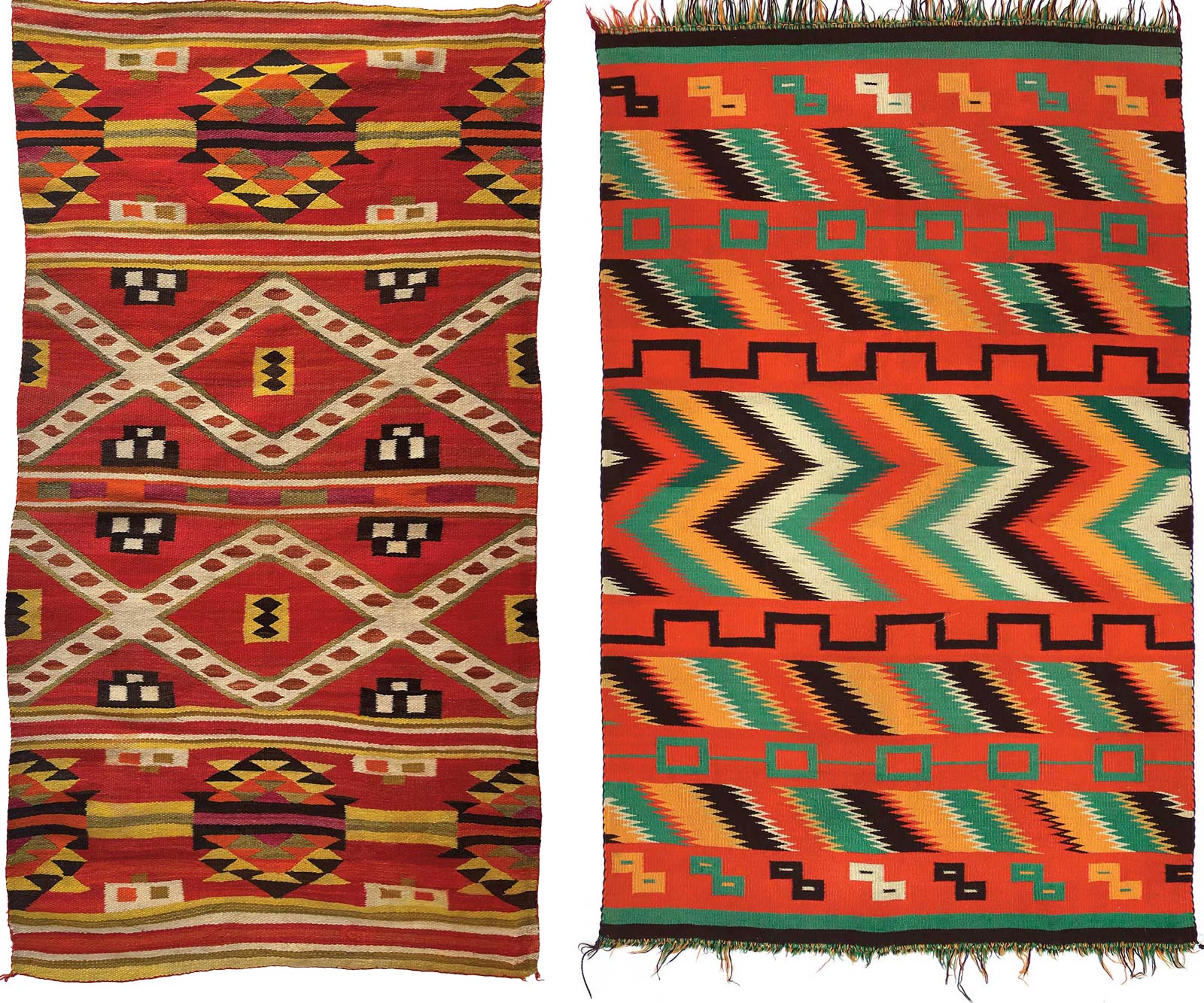
Left: Navajo Transitional Blanket woven with homespun yarn, 57 x 104 in. The weaver used color from packets of commercial dyes that were being brought to the trading posts along with the Germantown yarn. These homespun textiles are generally much thicker than a textile woven with Germantown yarn. One can still see how, even with these transitional blankets, that modern patterns are being developed. Weavers are no longer weaving certain sizes; they can let their creations be any size they want. This particular weaving is much longer than classic period blankets. Right: Navajo Germantown textile, 1870-1895, with added Germantown fringe, 35½ x 58 in. Featured on the cover of The Navajo Weaving Tradition 1650 to the Present by Alice Kaufman and Chris Selser. The fringe was added on to accent the design and to give more flare to the textile, a pioneering detail to this era. This weaving incorporates some traditional design elements: the boxes connected with lines, the stair step pattern and the overall banded/stripe pattern. What is seen in each band, and the combination, is also a new technique. The overall palette that was used was never seen prior to the 1870s.
Everything changed in 1864, when the U.S. government forced more than 9,000 Navajo, along with several hundred Apache, to march 300 miles from their homelands into eastern New Mexico to be imprisoned in Bosque Redondo near Fort Sumner.
Once the Navajo reached Bosque Redondo, what they found was starvation, slavery, forced assimilation and cultural annihilation. Prisoners were expected to speak English, convert to Christianity and to espouse the American ideal of individualism. They were also expected to farm like Americans and yet were offered land that was not suitable to grow anything. Conditions remained terrible at Hwéeldi, the Navajo word for Bosque Redondo, even after years of captivity. By 1866, government officials could no longer hide the suffering, and they ordered no more prisoners transferred to the site. By 1868, the government signed a treaty with the Navajo for their release and established a 27,000-square-mile reservation in present-day Arizona, New Mexico and Utah. They were allowed to keep their lands only because the U.S. government hadn’t found gold, silver or anything of value on it while they were in Bosque Redondo. In Uncle Sam’s eyes, it was a worthless chunk of desert.
The Diné may have had their lands, but they returned to a changed landscape. Their crops and orchards were burned, and there was little to grow or eat. Conditions were rough. “They had to start over,” Martindale says. “They had to develop their farming again and had to reintroduce sheep. This is when a key development happened. This is when the trading posts flourished on the reservation. They didn’t have anything, so the trading posts are where they began to rebuild their lives. Of course, the trading posts meant that the government still had some control over them, but these posts did offer opportunities to rebuild. The trading posts are where the people are getting all of their goods. Blankets were being sold there from companies back East. Tin pots and other metal goods. It all starts coming into these posts.”
Up until this point, after returning from Bosque Redondo, most Navajo weavers acquired all their materials through their own methods. Everything was made or harvested, and nothing was purchased. The wool came from their sheep, with the weaver handling every step of the process: raising the sheep, shearing the wool, carding the wool and then spinning it into yarn. The looms were built by hand, as were all the tools. Even the dyes came from natural sources. Their palette was limited: indigo came from a plant, cochineal red was the product of grinding up small bugs, yellow came from rabbit brush and they also had the natural color of the wool. This kind of wool was called homespun.
But like so much during this time, Bosque Redondo and the conditions on the reservation after imprisonment created some unique and challenging opportunities for weavers to start over. Today, this period has a name: the Transitional Period.
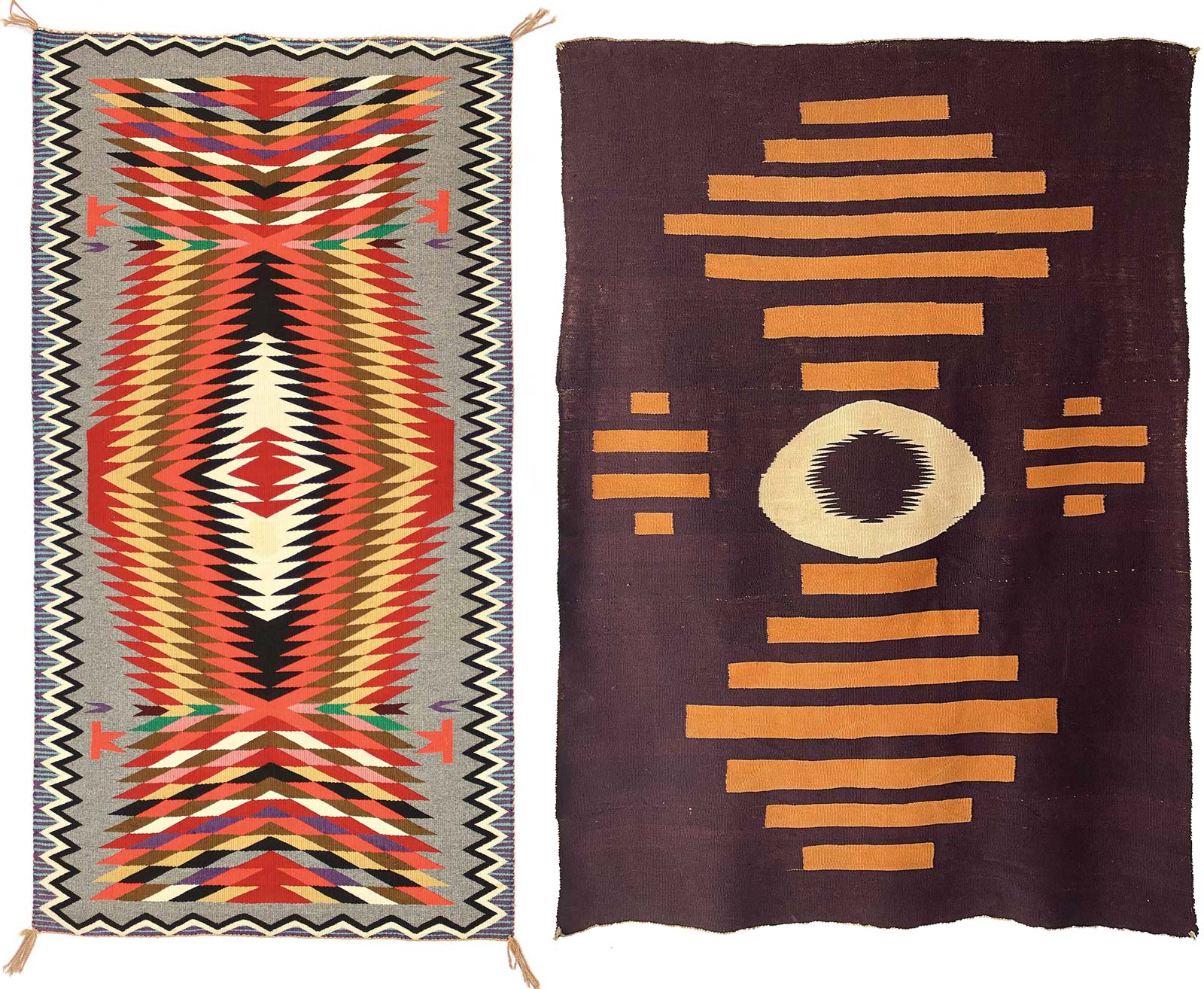
Left: Navajo Germantown textile, 1885-1900, 29½ x 54½ in. What is notable with this weaving is how the central design vibrates within the gray background. This central design element comprises parallelograms that collide into each other, with contrasting colors that form a shape never seen before in traditional textiles. The borders are also a new introduction in this era with the stripe detail from this serrated line pattern as a completely new design invention using traditional elements. Right: Navajo Germantown textile, 1870-1895, 49½ x 54½ in. Brown and yellow stripes with white circle. This textile uses the banded pattern from the classic period but presents them in a new, minimalist form. It also introduces a brand-new design: a bold circle with a serrated circle in the center. Curved lines are more difficult to achieve in Navajo weaving, so this demonstrates the weaver’s prowess.
Four-Ply Revolution
The success of the trading posts and the artistic exploration of Navajo weavers created a seismic opportunity for change sometime around 1870. The moment came when Germantown yarn—so named because it came from mills on the East Coast, predominately from Germantown, Pennsylvania—started arriving at the trading posts. Martindale says there are no records of the details, which adds a poetic twist to the lore. No manifest or train record. No letter from a merchant detailing the transaction. No organized plan from Pennsylvania. It’s been thought that the yarn could have come by train with other goods into Albuquerque, New Mexico, or Denver, and then by wagon into the trading posts, but no records survive showing its route from the mills to the Navajo Nation. When the yarn did arrive, it promptly blew the doors off what was possible.
Martindale explains: “As great as the available resources were, the natural dyes had their limitations. It meant these weavers had a fairly limited palette, a palette limited by the sheep’s natural color. But then the Germantown yarn arrived. It was a super fine and commercially carded, spun and dyed four-ply yarn. This four-ply yarn just made finer weavings. But the big thing was the new color palette. All of a sudden these artists had access to the finest yarn and an array of beautiful colors—an explosion of colors they had never had before…These were already the best weavers in the country, and now they don’t have to worry about raising sheep and processing wool or even dying yarn.”
“When they had access to Germantown yarn, they could focus completely on their weavings, including their designs. The impact this had on the artists was huge,” emphasizes Terry DeWald, collector of Native American art and gallery owner.
Almost immediately after acquiring the Germantown yarn, the artists began developing an entirely new and entirely modern way of weaving in regards to design. And whatever customs and traditions were holding them rigidly to past designs, evaporated once they were at their looms with new colors and new ways of thinking about design. They didn’t abandon their traditional designs entirely, but they merged them seamlessly with the boldness of their radical new aesthetic. “It was a true moment,” Martindale notes. “These women had an artistic expression that is truly unique in art. They had all this technical ability to make any weaving they wanted, but suddenly these colors and yarns allowed them to go even further, deep into their artistic mind’s talent. This explosion was all released at once. Some of these weavings created the style known as eye dazzlers, with fine detail and vibrating color. Others put colors together that would have never been done before. Greens with dark purples, or blues outlined with bright yellows. They were framed in these blocks of color and design. They had modernist concepts, even though they didn’t yet know what modernism was.”
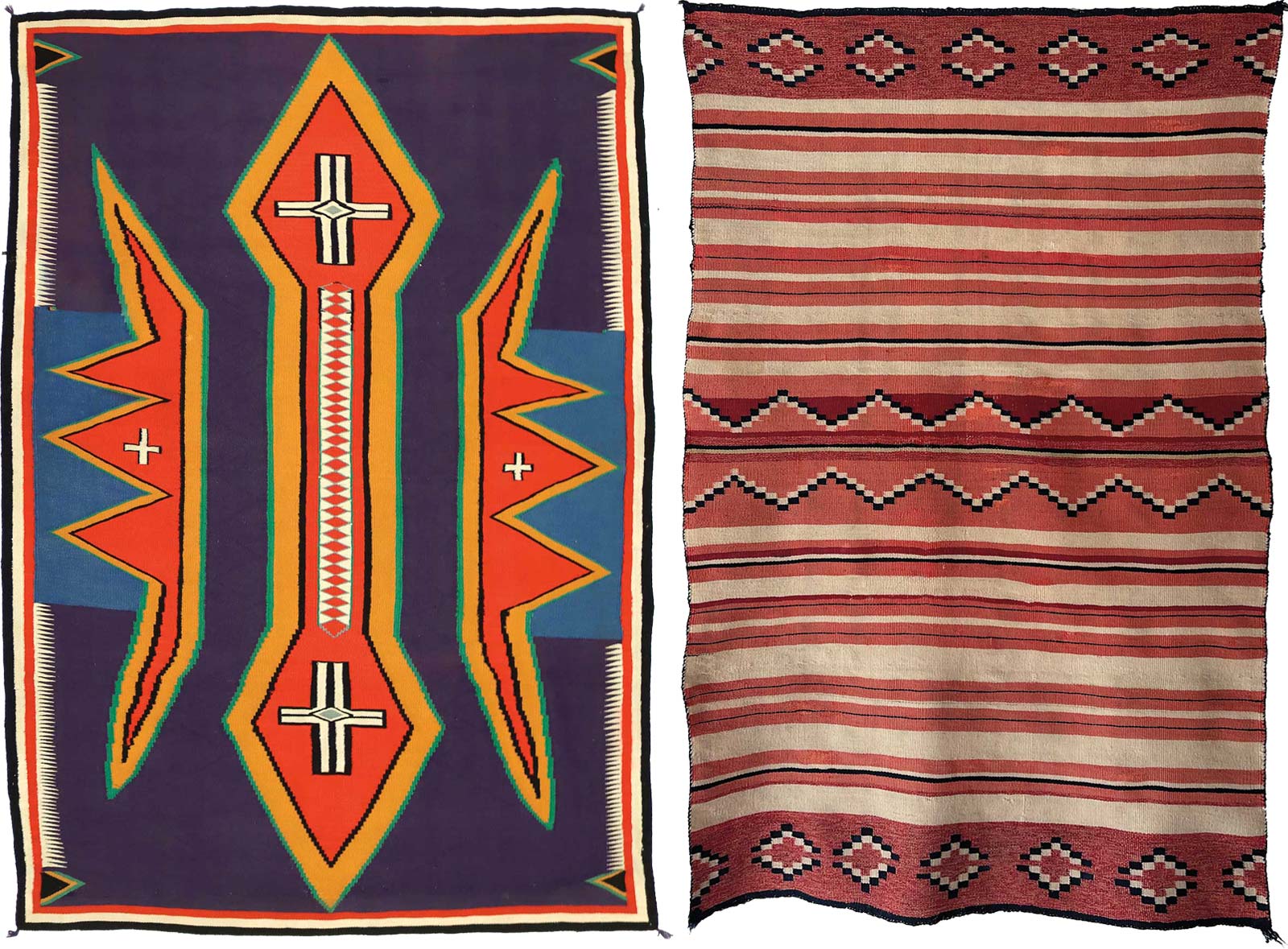
Left: Navajo Germantown textile, 1870-1895, 49½ x 69 in. The bold design elements are a unique design and completely new to the era. Right: Navajo Child’s Blanket, 1855-1870. This blanket shows the main palette of colors prior to the 1870s, using the red (cochineal dye) in many different ways. There is also indigo blue, and the natural colors of the sheep wool. Other hues are gray, brown and black.
Martindale suspects that the traders may have given the Germantown yarn to the best weavers, knowing that their high-dollar weavings would come back to them for sale or trade. Almost all of the weavings were made for commerce, which is why so many survive still today. “No one has a number, but it’s probably several thousand of them out there. They are still fairly rare,” he says. “When I host a show, I might see 50, maybe 100 Germantown weavings, if I’m lucky.”
Modern Art’s Origins
To put Navajo weavings into perspective, it helps to look at the history of modernism. Although some descriptions of modernism will cite dates in the 1860s, the movement hit the gas primarily in the 1880s with artists such as Vincent van Gogh, Georges Seurat, Paul Gauguin, Edvard Munch, Paul Cézanne and others. If you’re keeping score, you’ll notice all of these artists were based in Europe. Developments in the early 20th century with the -isms—impressionism, post-impressionism, fauvism, cubism, expressionism and others—saw the rise of Pablo Picasso, Georges Braque, Wassily Kandinsky, Henri Matisse and others. Again, all artists from across the Atlantic. It wouldn’t be until the 1913 Armory Show in New York City when American audiences would get to explore firsthand the power of modern art. The fuse was lit by a Frenchman—Marcel Duchamp and his cubist masterpiece Nude Descending a Staircase, No. 2—but it whetted the appetite of American collectors. By the end of World War II, there were more movements and even more -isms, including ones that were unknowingly calling out to Navajo weavings from up to 60 years earlier. Consider the work of Robert Delauney, Theo van Doesburg, Piet Mondrian, Charles Demuth, Willem de Kooning, Barnett Newman, Adolph Gottlieb and Mark Rothko. These artists weren’t copying Navajo artists, but they were certainly embracing the same freedom of composition, the explosion of color and the radical veering away from established norms. More remarkable is the timeline the weavers were on. They were creating this kind of work in the 1880s, decades before “modern art,” and 10,000 miles away from the birth of impressionism.
“What makes what the weavers were doing such a great moment in art history, is that they were technically proficient weavers who, all of a sudden, were transforming weavings into something very different than what it was. Their palettes increased, in some cases twentyfold, and so did their artistic design choices,” Martindale says. “I tie it all back to the arrival of the yarn and commercial dyes. That’s what led to the drastic shift from the artists. Once the yarn arrived, you can see how the weavings went from traditional to these amazing weavings that no one had ever seen before. And we know the weavings were a hit because they kept making them for another 30 years. There was a market for them.”
Gallery owner and author Mark Sublette, like Martindale, is one of the foremost dealers in Navajo weaving. He shares Martindale’s opinion that Navajo weavers were the first modern artists in the country, although he ties it less to Germantown weavings and more broadly to most Navajo weavings done before 1910 or so. “I see the handspun and Germantown as both being important,” Sublette says. “For me, it’s more about the timeframe, because a lot of the weavings during that time were incredible, and they were allowing a seismic change to happen in the way artists were making blankets and rugs. And with that change came all these great colors and simple geometric patterns. Just the fact that they had colors there to experiment with is remarkable, and then also the proliferation of trading posts and the need to stop making blankets to make rugs. All of this allowed them the freedom to experiment.”
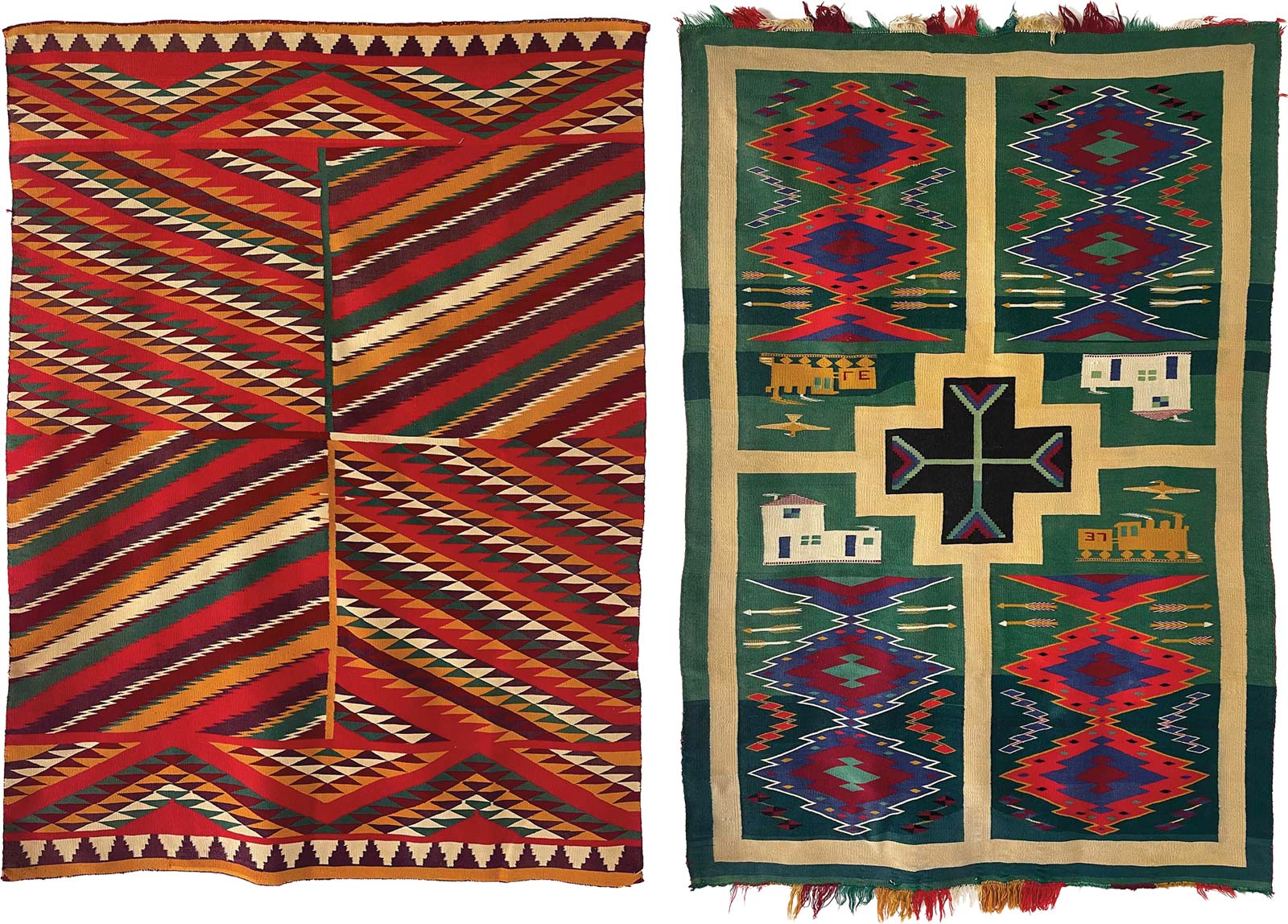
Left: Navajo Germantown textile, 1870-1895. This weaving is the consummate eye-dazzler pattern with the field being divided into four sections. Each contains serrated lines outlined with contrasting colors. Right: Navajo Germantown textile, 1870-1895, 54 x 85 in. This textile incorporates an element of Pop Art with trains and adobe homes, a new visual they had previously never been seen before but were becoming a forceful part of the visual landscape. The arrows from their historic past are items of great importance. This is all a part of an overall pattern that uses bold designs and eye dazzling elements of contrasting colors, highlighting serrated edges. These serrated diamonds contain smaller forms that harken back to the Mexican serapes.
Sublette’s 2017 book on weavings, Homage to the Square: Navajo Masterpieces 1860-1950, draws a direct line from the Diné right to the heart of modern art in paintings. “In 1949, Josep Albers conceived his Homage to the Square series which looked at the interaction of multiple, progressively smaller colored squares stacked on each other to form a resonance of color and three-dimensional composition. He produced about 2,000 of these square paintings in his lifetime,” Sublette writes. “Gazing intently into these color quadrants, one feels a pulsation of color that changes in depth and sensibility, a unique concept for the time unless you examine Navajo weavings that predate Albers paintings by a half century. The Navajos who have been weaving for hundreds of years have been drawn to square and polygon structures, often incorporating them into the designs of their textiles, much like Albers. Often these boxes are found within subtle gradients of color, the weaving palette implementing a sense of texture and subtle color change expressed through the carding of wool. Often the placement of boxes in Navajo weavings reflect religious significance as with the ‘emergence hole.’ The hole, usually designated by a small square, is the place the Diné believe they escaped from the third world into the present fourth world, and the four sacred mountains that make up the world of the Dinétah surround the entrance. It’s the Diné artistic strength that sets these modern aesthetic weavings apart. Bold, simplistic renderings of color, form and repetitive patterns engage the eye similar to works by contemporary masters of the modern art world.”
Sublette can point to painters like Albers, but he can also see Navajo design in sculpture, such as the work of Donald Judd, who created boxes and forms built around right angles and uniformity. Even Louis Nevelson has Navajo design built into her assemblages of wood parts and conjoined boxes. Nevelson and Judd worked in three dimensions, but Navajo weavers were doing the same things in two dimensions, and decades earlier. And it’s important to note that even though these artists were using different materials—wool, paint, wood, steel, bronze, graphite, pastel—the design principles were identical, even if comparing a painting on canvas to a wool textile can be a little unwieldy and awkward.
“Think about the 1960s,” Sublette says. “An explosion of music and clothing, cultural change… it was primarily because of the Vietnam War and the ending of the previous war, World War II. But now, imagine what the Navajos were experiencing a century earlier. In 1868 they go back to the reservation from Bosque Redondo…No one could perceive at that time how they would be foreseen in the future. But today we can look back and see exactly what they were doing and why it is important.”
Next Steps
Martindale works with artwork that is frequently 150 years old, so he’s aware that change doesn’t happen overnight. But he’s hopeful that weavers continue to have their roles in Navajo art history—and more broadly in American art history—expanded and celebrated. “I still get excited when I see a weaving that I’ve never seen before come up, either at my booth or a gallery or a show or an auction,” he says. “There is still a lot of great material out there, so there’s still more to be learned. It’s my ultimate hope that there are major museum exhibitions in the future that continue to explore Navajo weavers as the first modern artists.”
Both Martindale and Sublette agree that the world of Native American weaving can be cyclical. Prices can rise and fall depending on interest and availability, but knowledge and education can benefit art collectors as they meander through the art market. When they understand the material and its place in the art world, they are more likely to seek it out and pay top dollar for it. And maybe the best part: Weavings are still being made today, even some in the Germantown style, now frequently referred to as Germantown Revival.
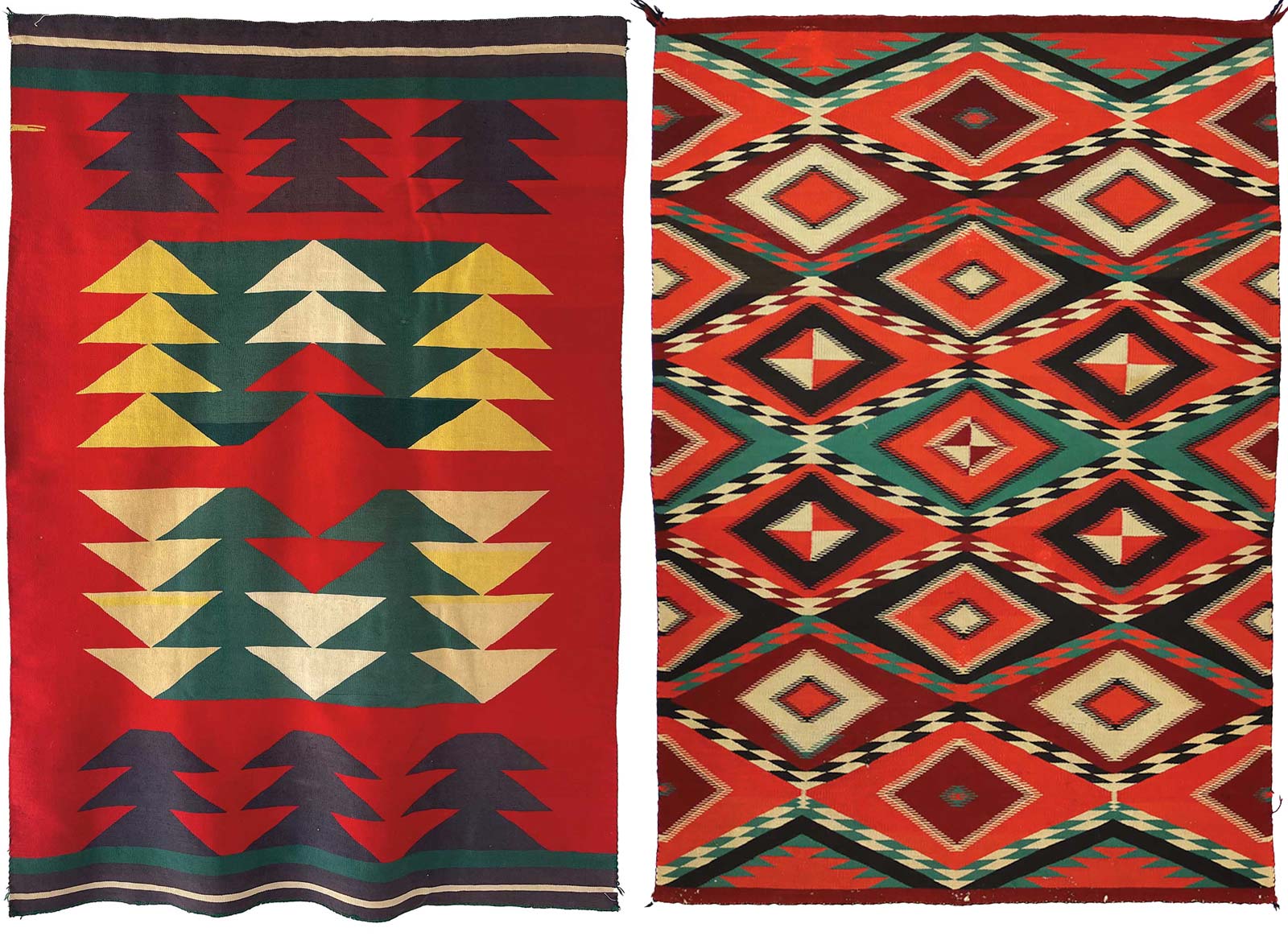
Left: Navajo Germantown textile, 1870-1895, 52 x 83 in. Bold design with stacks of vertical triangles in strong contrasting colors, the simple design is heightened by its use of negative and positive spacing. It gives the textile a sense of depth. These types of designs were being used for the first time in this fashion. This particular textile uses the triangle form from third phase chief’s blankets and introduces it in a new way. Right: Navajo Germantown textile, 1870-1895, 36 x 52 in. This weaving, with its bold design of diamonds interrupted by zigzag lines, consists of contrasting parallelograms and diamonds formed out of contrasting serrated patterns.
Melissa Cody, daughter of award-winning homespun weaver Lola Cody, is one of those artists pushing the style further into the future. Cody is a fourth-generation weaver and has already ascended high in the art world. Her most recent show, Melissa Cody: Webbed Skies, was at MoMA PS1, an East Coast venue far removed from Western and Indigenous museums in the Southwest.
“For me and my work,” Cody says, “it was all about the three-dimensional design and the way [earlier weavers] incorporated movement into their weavings. I am very influenced by Op Art and I’ve always studied color theory to see how I could use warm values with cool tones, as well as grayscale and negative space and these other ideas. I am always examining how to make a sound composition in order to create these otherworldly atmospheres. The heart of my work is in the Germantown Revival style, which has a foundation in the materials from Germantown, Pennsylvania, and the northeastern mills of the United States. This is kind of the second edition of that whole movement. When I started weaving, the Germantown Revival was in the early 1990s. At that time, I was learning about the Long Walk and learning how these yarns came into the hands of weavers. It was almost like this lightbulb clicked on for me. It really resonated deeply with me because what they were doing was taking this new idea with their material and applying it to their work. The story, the vision, the history of these people was being put into weavings without any restriction.”
Cody agrees that Native American artists, especially weavers, were working with modern designs long before others. “It may have not been evident when it was happening, but in hindsight we know they created a shift in the movement that resulted in a huge transformation,” she says, adding that the shift occurred after the Long Walk and Bosque Redondo, events that would reshape any people. “Any time a culture goes through a traumatic period, the people are always faced with the realization of their own mortality. It’s natural to want to preserve life and to preserve culture after that. The immediate response from the weavers was to cherish their designs and to allow the spark of creativity to influence what they created next. They had a prolonged passion to keep the knowledge they had alive. When they were in Bosque Redondo, they were sharing ideas and learning from one another, even while imprisoned. So, when they were released, some went back to traditional weavings, but others had that fire underneath them forcing them to explore the things that had just happened to them during those traumatic experiences. It transformed the way weavings could be made, and what weavings could symbolize for many generations.”
Cody is not alone. Other artists are borrowing from the past as they create weavings in the Germantown Revival style. What’s remarkable about these new artists working today is that they still celebrate the origins of their weavings. They do it in the most appropriate location—at the rim of Canyon de Chelly. It’s become a pilgrimage for weavers to stand at the edge of that canyon, the expanse of the desert and rocks at their backs as they hold up their newest creation. Over their shoulder is the twin spire of Spider Rock, home of the Spider Woman. If this is where weaving was invented, the artists return to honor their gifts, their lives and their futures. —
This article was created in collaboration and partnership with The Unibrow. Learn more at the-unibrow.com.
Powered by Froala Editor


