Donald Lomawunu Sockyma currently lives on the Hopi Reservation, and is a member of the Sun Clan from the Village of Kykotsmovi. This has always been home for the artist. It’s also where Sockyma learned to create his elaborate and culturally significant katsina carvings, which are greatly influenced by his mentor and teacher, Bennett Sockyma, who is also his father.
“[My father] learned from his father, Chester Sockyma, who would carve the simple, flat doll style,” the artist explains. “As a young carver, I would learn by watching and observing. We would sit together either outside or at the kitchen table and carve together. This was all before the internet and phones, so we would listen to the radio and carve.”
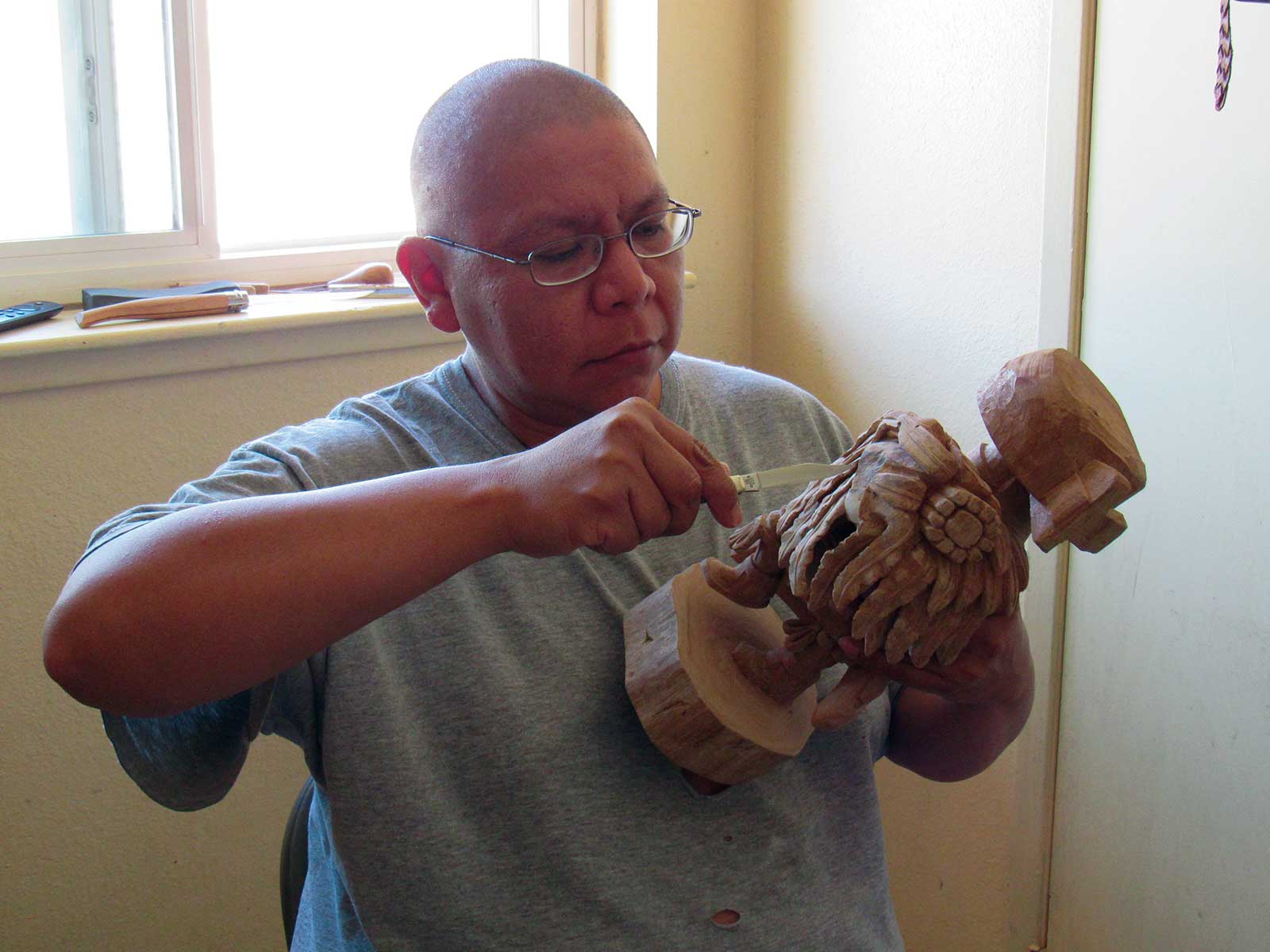
Donald Lomawunu Sockyma at work in his studio.
Using carving knives, files, hacksaw blades, sharpening stones, sandpaper and a piece of cottonwood root, Sockyma would emulate his father’s carving techniques, focusing on the parts of the doll such as hands, feet and proportions. “It took my father many years to learn and perfect his craft,” Sockyma adds. “He was part of the Renaissance period of carving when the techniques started to evolve. He had no mentors of his own to turn to when he started carving because it was a period when no other carvers were creating the full piece figures. It began all at once during the ’70s when this type of carving was first introduced. So, I credit my father for the style I produce today.”
Sockyma notes, however, that each carver has their own unique style, and Hopi artists try not to copy each other’s work. “Each carver has a mentor and that’s the style you hope to improve on and get better,” says the artist. “So, in a way, each generation of carvers gets a head start and who knows where this will take the genre of Hopi carving. Since I got a head start from my father, I learned quickly.”
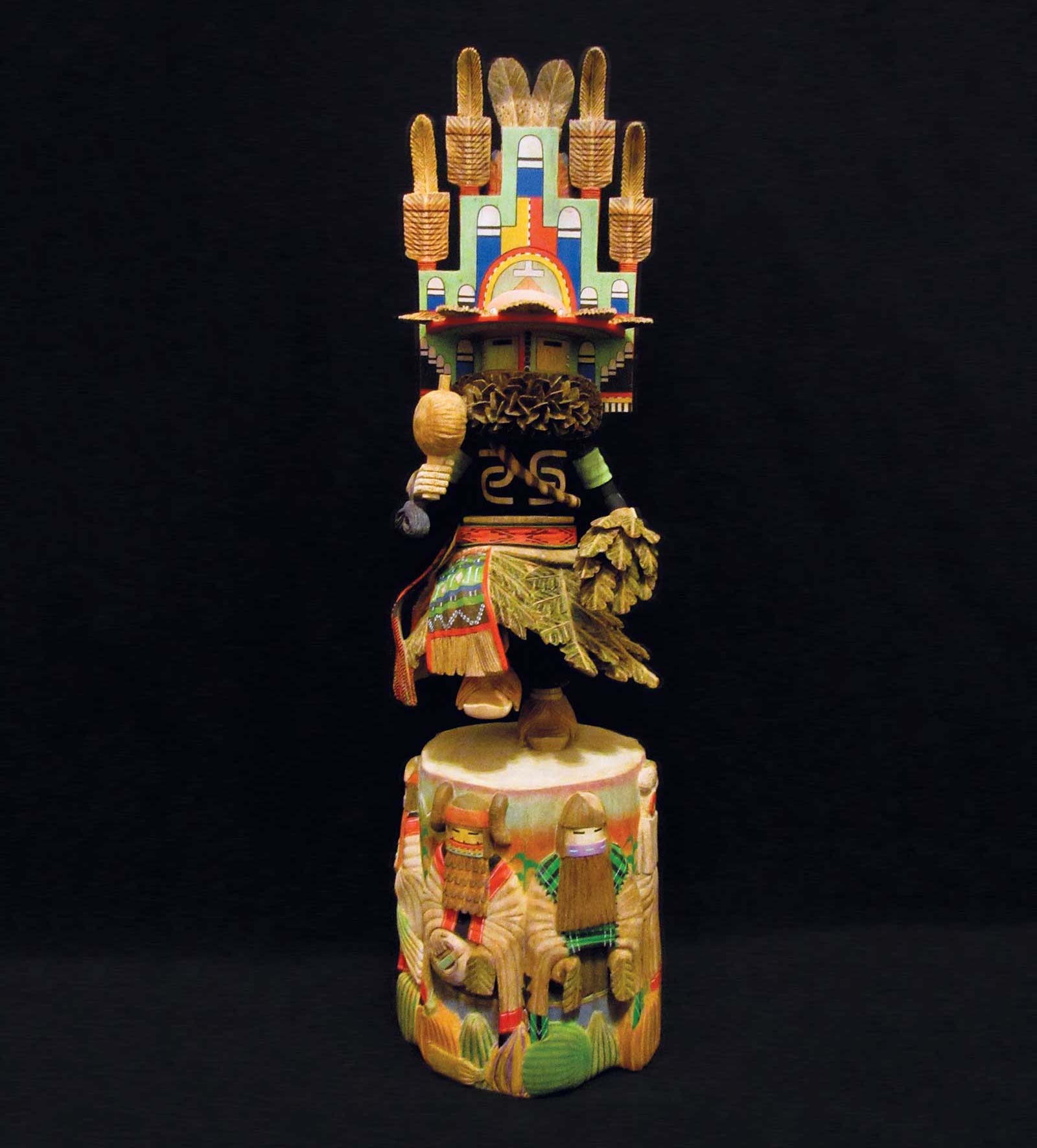
To a Bountiful Harvest, mixed media, 24 x 8 in.
Sockyma first started by making sculpture carvings and flat dolls, a technique all carvers start with first when beginning to learn on their art journey. “This style is the traditional art form all carvings were derived from,” says Sockyma. “It was only when tourists became interested in purchasing the katsina dolls when carvers began making the intricate, detailed pieces with arms and legs. I remember making small, flat dolls out of my father’s scrap wood pieces, and I would sell them to family members and local shops on the reservation. It became a way to earn extra money, and I would be so proud when I would sell a piece.”
He continues, “The sculpture form is another style used by carvers to make [pieces] using the cottonwood root not big enough to make into the traditional or full piece carvings. It’s a way for artists to display their artistic expressions, so there is no wrong way when creating with this technique. As I got older and wanted to keep learning, I then started carving the full pieces with arms and legs.”
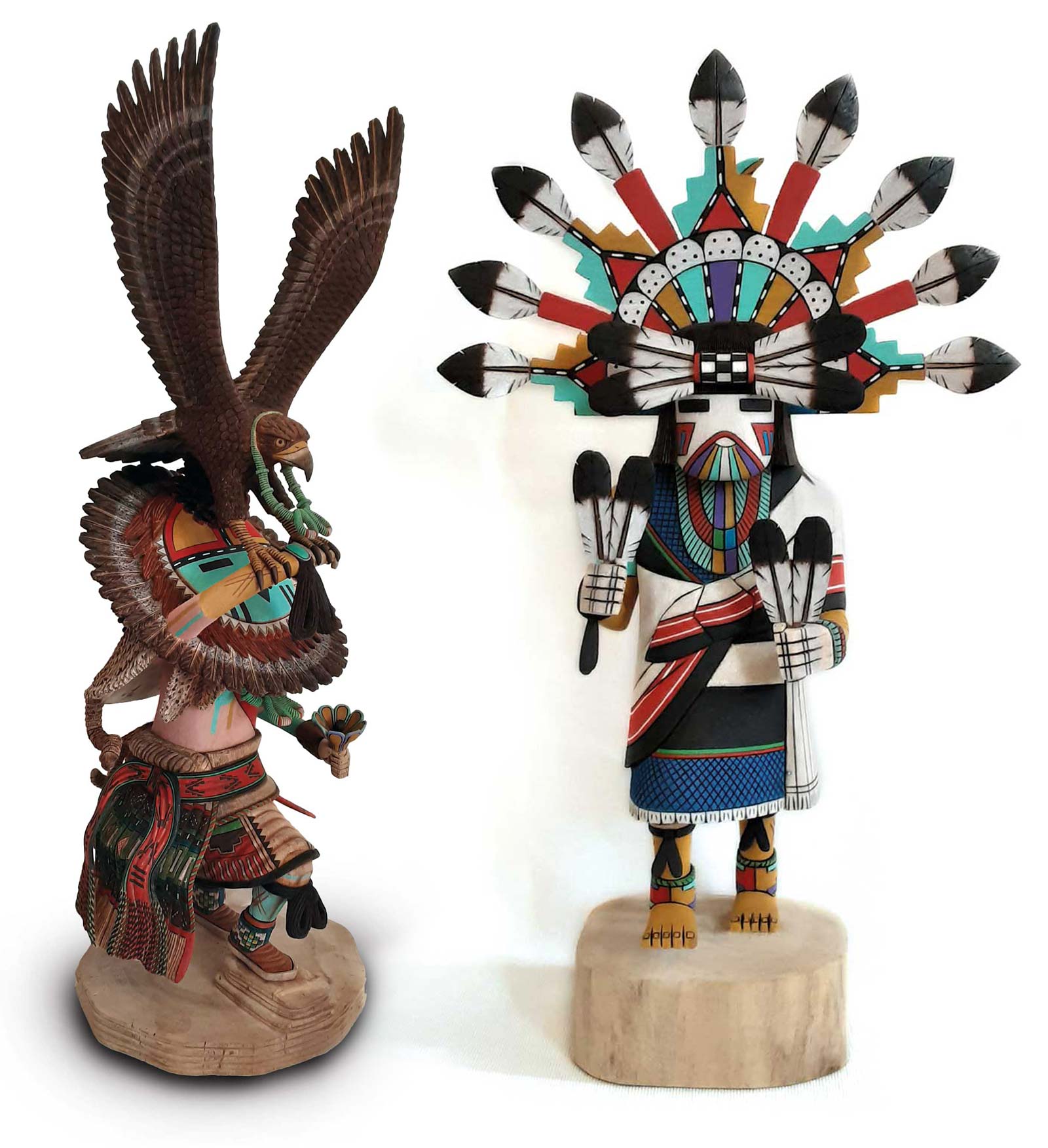
Left: The Eagle Has Landed, mixed media, 30 x 9 in. Right: Palhik-mana (Water Maiden), mixed media, 12 x 4 in.
For Sockyma’s personal style, he focuses on making carvings as authentic as possible, by creating the katsinam as he sees them, and staying true to the real representation. Sockyma is also known for including feathers, hair, fur and making the textiles as realistic as possible. “The feather work in particular is my claim to fame, in my opinion,” says the artist, “because there are only a handful of carvers able to recreate the technique I use. Not only do you have to make the carving, but you have to showcase your finishing techniques, which includes woodburning and painting. Each carving is a blank piece of wood and it’s up to you as an artist to bring out your artistic talents by painting each piece.”
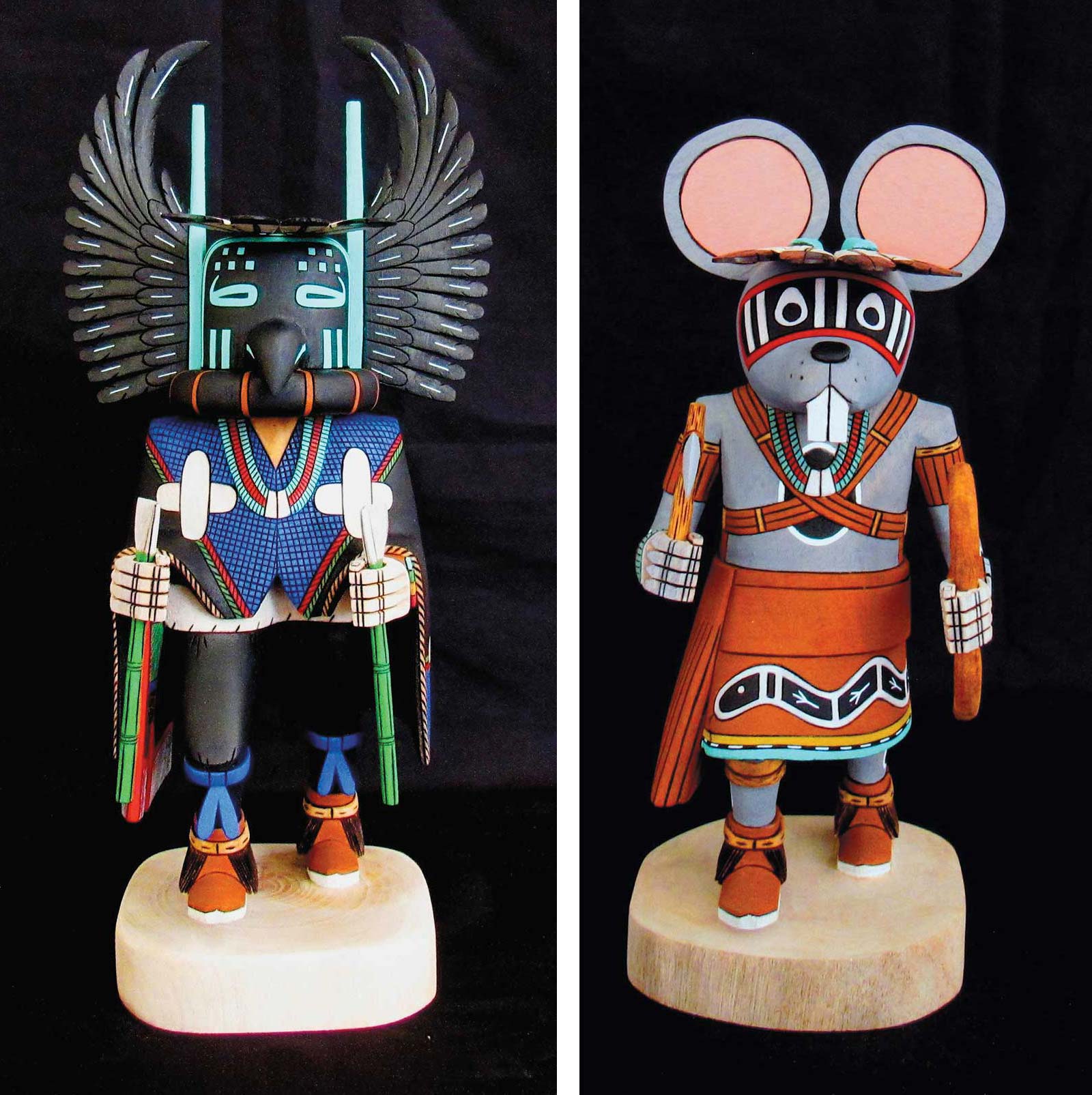
Left: Crow Father Katsina, mixed media, 12 x 4 in. Right: Warrior Mouse, mixed media, 10 x 4 in.
Sockyma considers his one-piece carving work, To a Bountiful Harvest, to be his “breakthrough carving” because it was his first, and it won first place and best in classification at an adult competition. The award was achieved at the Heard Museum Guild Indian Fair & Market in 2019. “It portrays a Hemis katsina during the Niman Ceremony held every July by the Hopi,” Sockyma shares. “It displays not only the male, but also the female aspects on the base. The different types of maidens carved in a relief technique are shown circling the base, and are carrying their musical instruments and the gifts that they bring during the ceremony to the people. The Hopi are farmers at heart, and it’s the main reason they were able to survive thousands of years.”
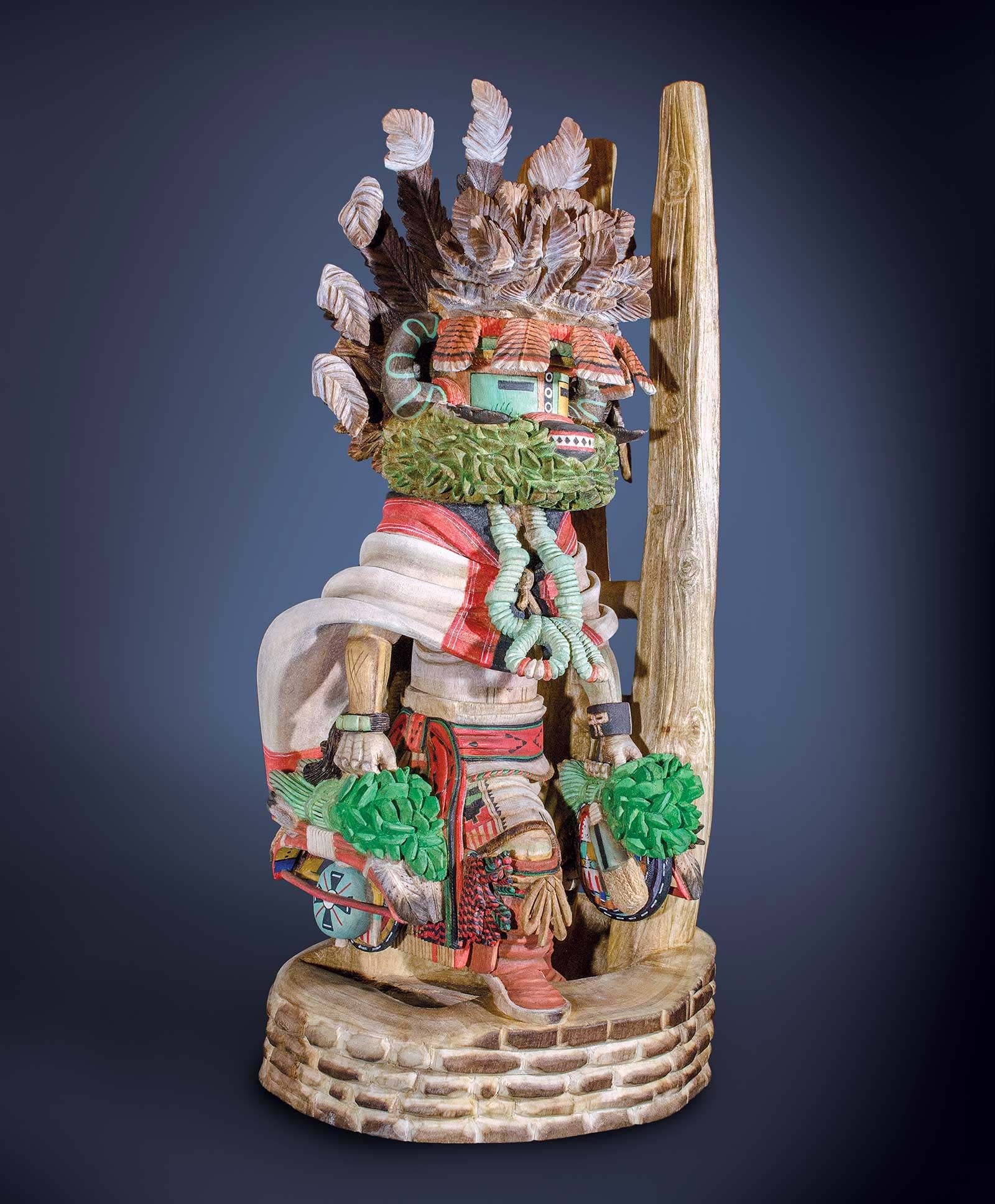
Hototo (Badger Katsina), mixed media, 20 x 8 in.
Overall, the Niman Ceremony is powerful, in that it’s meant to bring early fall rains that the Hopi depend on to sustain dry, farmed crops.
Another strong piece, The Eagle Has Landed, also achieved first place and best in classification at the Heard Museum Guild Indian Fair & Market in 2025. “This piece portrays a sun katsina sending an eagle off in flight for blessings to the Gods,” Sockyma says. “The Hopi, and many other tribes, believe the eagle is the only bird able to reach the heavens, which is why the eagle feathers are used for ceremonies, blessings and to bring messages to the Gods.”
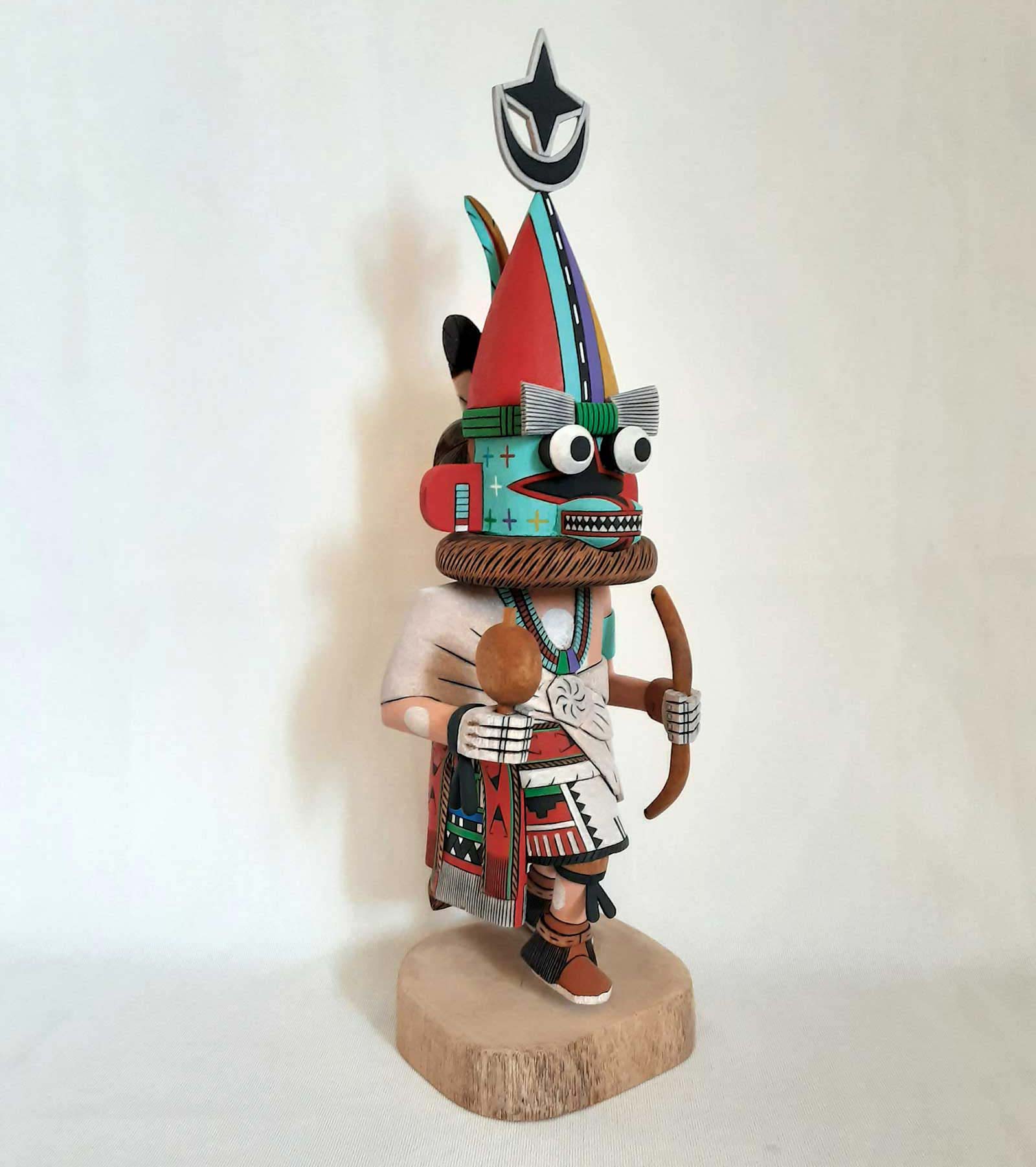
North Star Katsina, mixed media, 11 x 4 in.
Sockyma’s inspiration in creating this piece was metaphorical. The eagle was meant to represent a spaceship, representing the future of mankind. “The path we are leading is not beneficial to Mother Earth and her children—humankind,” Sockyma says. “There are so many Native legends where we as a people will return to the stars. The eagle represents our only hope of achieving this. The eagle in the carving is wearing a necklace made from turquoise, an identity marker to the Hopi people, so when we reach our destination in the future, we can remember that famous quote by U.S. astronaut Buzz Aldrin, when landing on the lunar surface: ‘The eagle has landed.’”
Sockyma notes that not just the Hopi were meant to benefit from these teachings, but rather, the whole world. So, when Sockyma sees customers at a show, he tells them about what each piece represents and “people walk away feeling like they are a Hopi at heart because of the similarities [we share],” he says, adding that the katsina dolls were also meant as teaching tools for young Hopi children. “It’s how we first learn the values and teachings of Hopi culture. When making a piece, I get inspired by going to the various ceremonies and witnessing the katsinas in person. I try to bring that gift to the public by re-creating the ceremonies that most are unable to see. It’s a way to immortalize that specific moment in time for the rest to enjoy.”
While Sockyma has earned many additional awards and achievements over the years for his katsina carvings, he looks to the future and to the three shows he participates in each year. Find him at the Heard Museum Guild Indian Fair & Market, held every March in Phoenix; the 24th Annual Katsina Marketplace at the Heard Museum, April 11; and the Santa Fe Indian Market on August 15 and 16 in Santa Fe, New Mexico. —
Powered by Froala Editor


