Edmonia Lewis: Said in Stone, an exhibition of the first sculptor of Afro-Caribbean and Mississauga descent to achieve widespread international acclaim, is now on display at the Peabody Essex Museum in Salem, Massachusetts, through June 7.
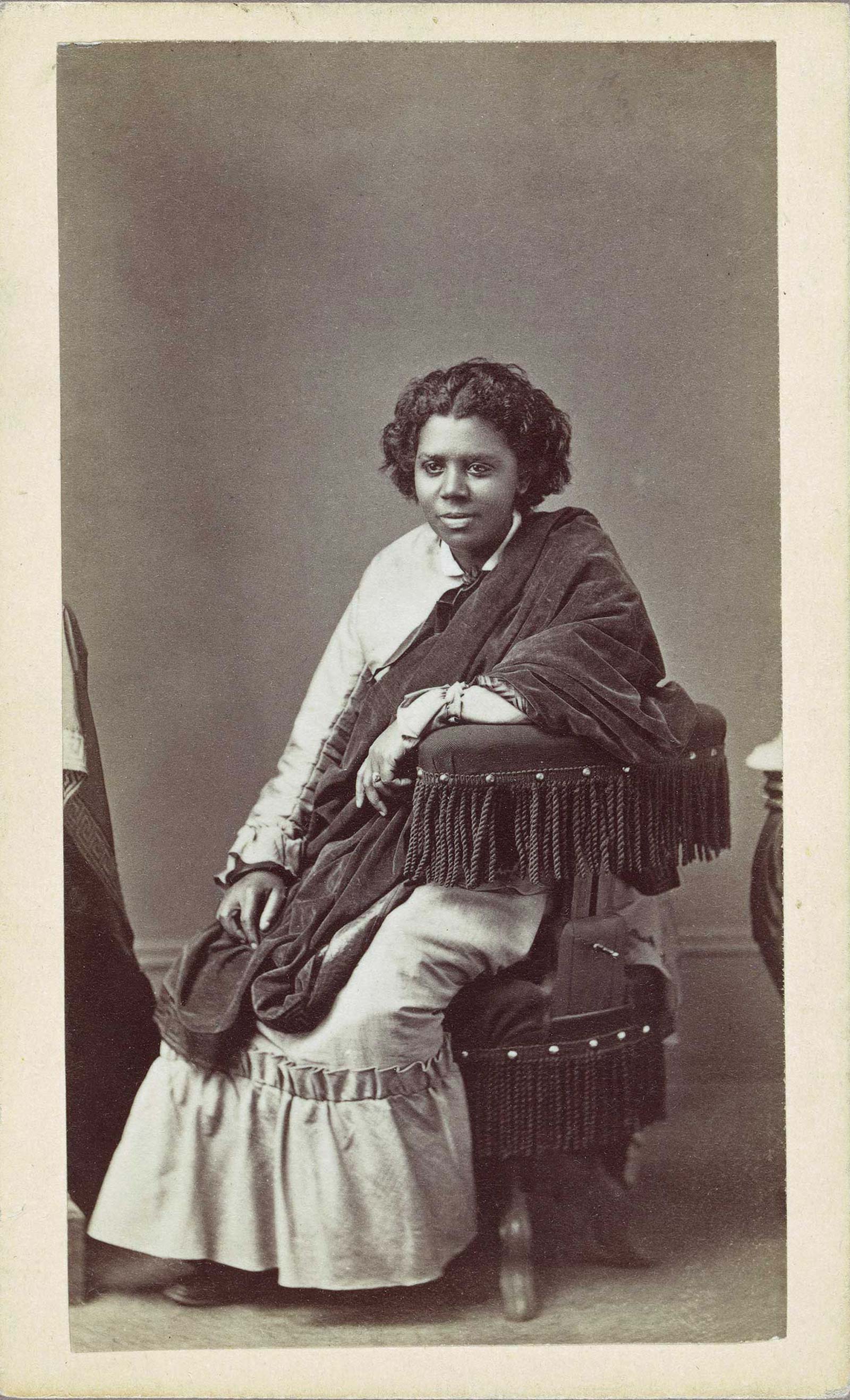
Henry Rocher (1824-1887), Edmonia Lewis 1845-1907, about 1870, albumen silver print on card. Transfer from Special Collections, Fine Arts Library, Harvard College Library, Bequest of Evert Jansen Wendell. 2010.67. Harvard Art Museums Fogg Museum. Photo © President and Fellows of Harvard College.
In the exhibition catalogue, the museum’s executive director and CEO, Lynda Roscoe Hartigan, writes, “In 1985 it was my honor to curate for the Smithsonian American Art Museum the exhibition Five Black Artists in Nineteenth-Century America, accompanied by a similarly titled publication. Combined, these projects celebrated the museum’s acquisition of significant bodies of work by the painters Joshua Johnson, Robert Scott Duncanson, Edward Mitchell Bannister and Henry Ossawa Tanner, and the sculptor Edmonia Lewis. As a rising curator focused on modern and contemporary art, I experienced the challenge of venturing into new territory, especially at a time when appreciation let alone knowledge, of these 19th-century artists was nascent. Researching their lives and work was heart-wrenching and enriching because the evidence of their talent and successes despite obstacles—and the evidence of their absence from the so-called mainstream of American art history—was undeniable.
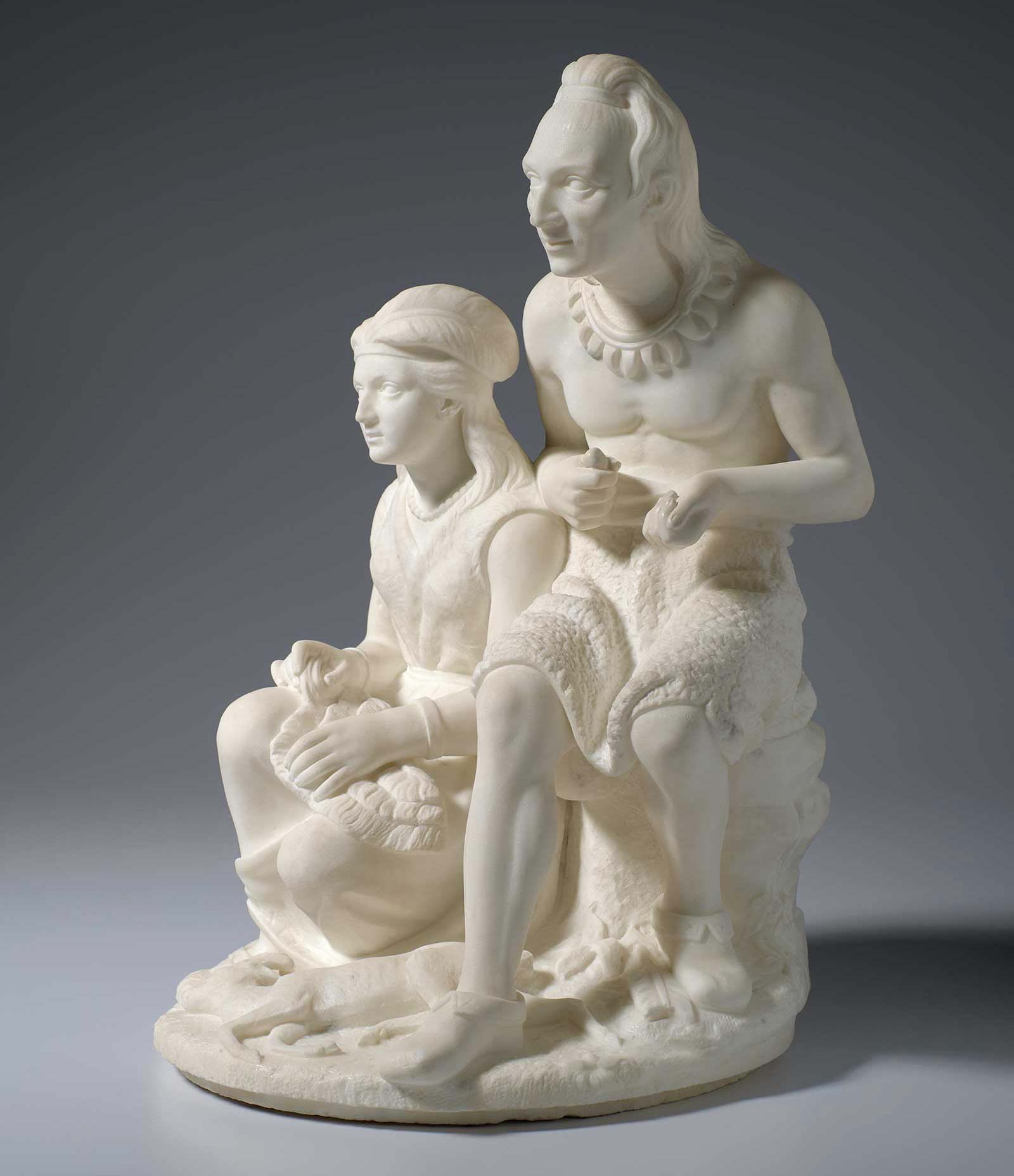
Edmonia Lewis (Mississauga, 1844-1907), The Old Indian Arrow Maker and His Daughter, modeled 1866, carved 1867, marble. Gift of Marilyn Jacobs Preyer, 2022.6. North Carolina Museum of Art, Raleigh.
“Similarly absent from this history have been the achievements of Indigenous artists, from the historical to the contemporary. Almost from its inception in 1799, the Peabody Essex Museum (PEM) has collected Native American art. For several decades now, PEM has advanced recognition, scholarship and interpretation of Native American art through innovative exhibitions, collection installations, publications, and convenings, as well as through our fellowship program that trains the next generation of Native leaders in the cultural heritage sector.”
The curators of the exhibition are Shawnya L. Harris, curator of African American and African diasporic art at the Georgia Museum of Art, and Jeffrey Richmond-Moll who was curator of American art at the museum. Richmond-Moll is now curator of American art at PEM. They have assembled an extraordinarily comprehensive group of scholars to examine Lewis’ place in abolitionist, feminist and Indigenous visual cultures as well as her time sculpting in Rome. The catalogue contains all of her known work as well as the work of her contemporaries and artists of later generations who were influenced by her.
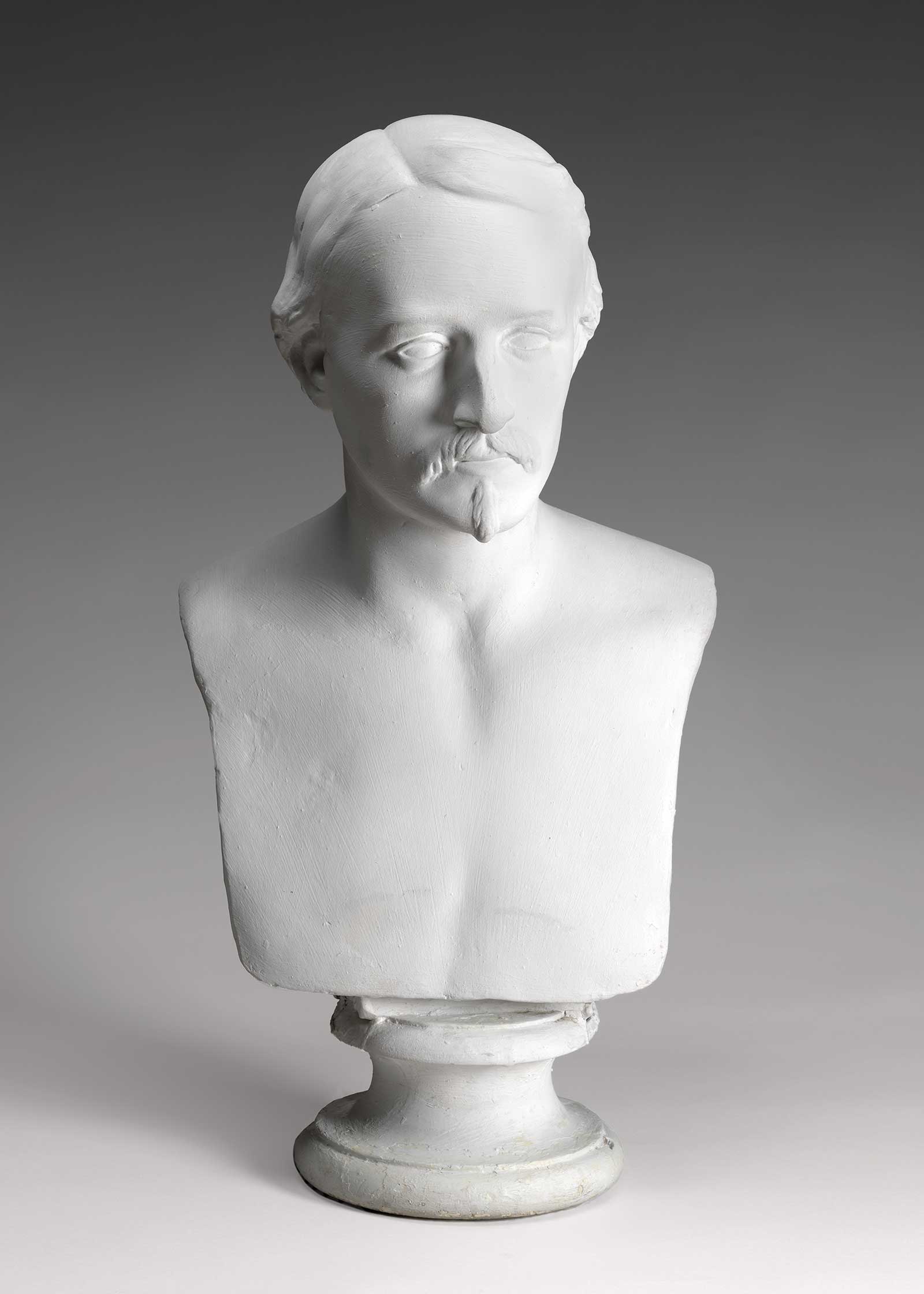
Edmonia Lewis (Mississauga, 1844-1907), Bust of Robert Gould Shaw, 1864, plaster. Collection of the Massachusetts National Guard Museum and Archives. Photo by Stephen Petegorsky.
Karen Kramer, the museum’s curator of Native American and oceanic art and culture, worked with Harris and Richmond-Moll to trace “the spotty lines of published scholarship on Lewis’ Indigenous ancestral ties, reconstructing this background through primary source research…Throughout this process, we remained committed to examining Edmonia Lewis’ story with Native collaborators to better place these relationships into extant Mississauga and Haudenosaunee principles of belonging within the broad colonialscape. This commitment provided a starting point for the Peabody Essex Museum’s one-day scholarly convening in November 2024, featuring historians, scholars, artists and educators…”
Lewis was born in Greenbush, New York, near Albany in 1844. She was orphaned at an early age and raised by her maternal aunts near Niagara Falls.
Her half-brother, Stephen, profited in the California gold rush and enabled her to attend Oberlin College and, later, to pursue her artistic career in Boston. Although Oberlin admitted women and non-white students, it required women to follow a different curriculum. In1859, she enrolled in the Young Ladies’ Preparatory Department before joining the Young Ladies’ Course from 1860–1863. In 1862, two white female classmates accused Lewis of poisoning their drinks, after which she was beaten violently by a white mob. She was acquitted of the charge but the following year she was accused of stealing art supplies—a charge of which she was also acquitted. The college prevented her from registering for her final term and she left Oberlin in 1864.
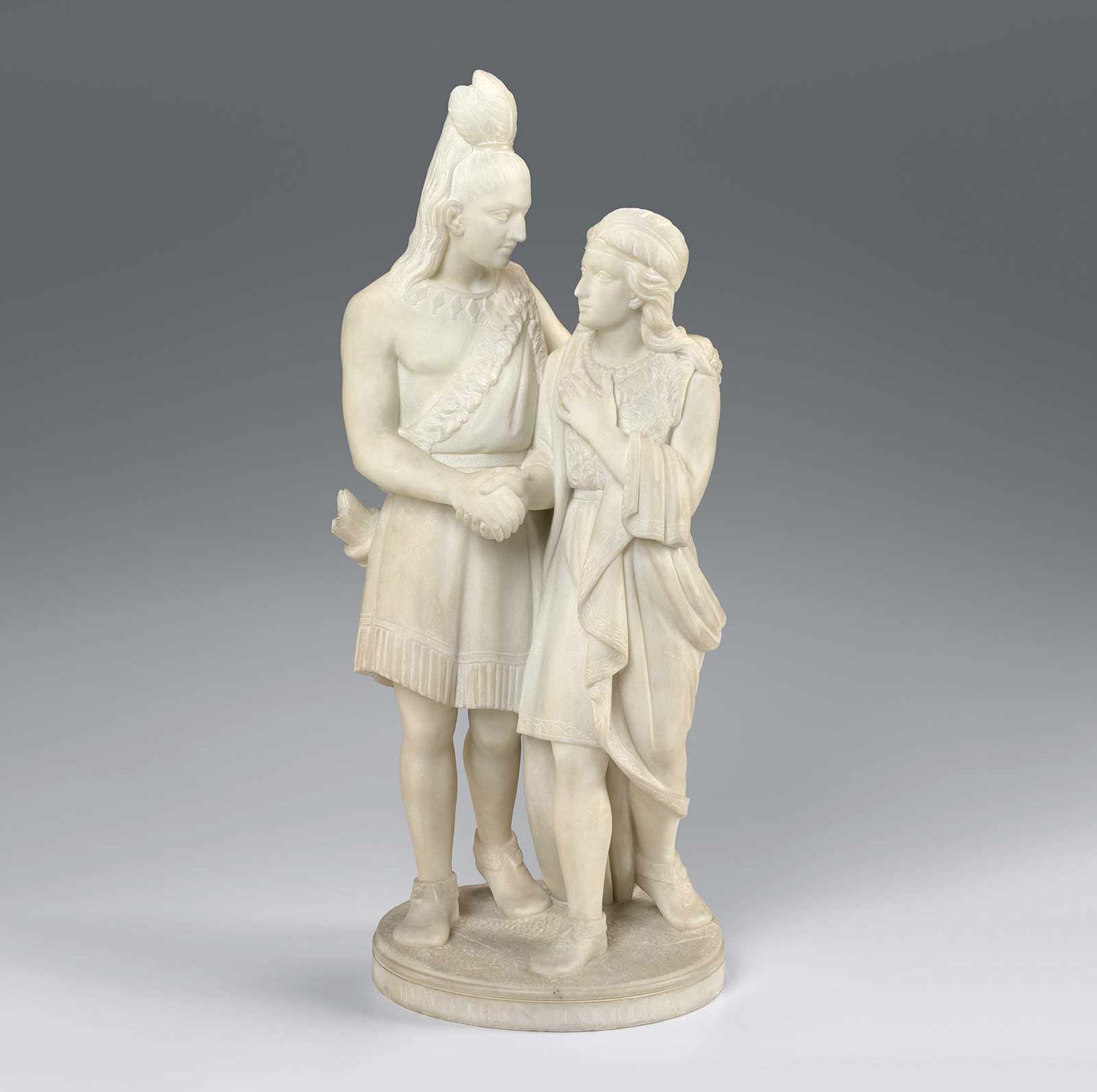
Edmonia Lewis (Mississauga, 1844-1907), Hiawatha’s Marriage, modeled 1866, carved 1870, marble. Richmond. J. Harwood and Louise B. Cochrane Fund for American Art, 2024.26. Virginia Museum of Fine Arts. Photo: Troy Wilkinson. © Virginia Museum of Fine Arts.
In 2022, Oberlin awarded her a “posthumous diploma of the Ladies’ Course.” That same year, the U.S. Postal Service featured her on a stamp in recognition of what had become her illustrious career.
Lewis had met the abolitionist Frederick Douglass when he visited Oberlin and he advised her to “go East.” She then moved to Boston where she studied with the sculptor Edward Augustus Brackett who taught her to model clay and plaster sculptures. In Boston, she sold portrait medallions of famous abolitionists.
While there, she witnessed the departure of the Black 54th Massachusetts Regiment in May 1863, commanded by Col. Robert Gould Shaw. He would soon die in the Battle of Fort Wagner, South Carolina, in July 1863. Her plaster portrait bust, modeled from photographs of Shaw, was a commercial success, enabling her to fund a move to Rome in 1865.
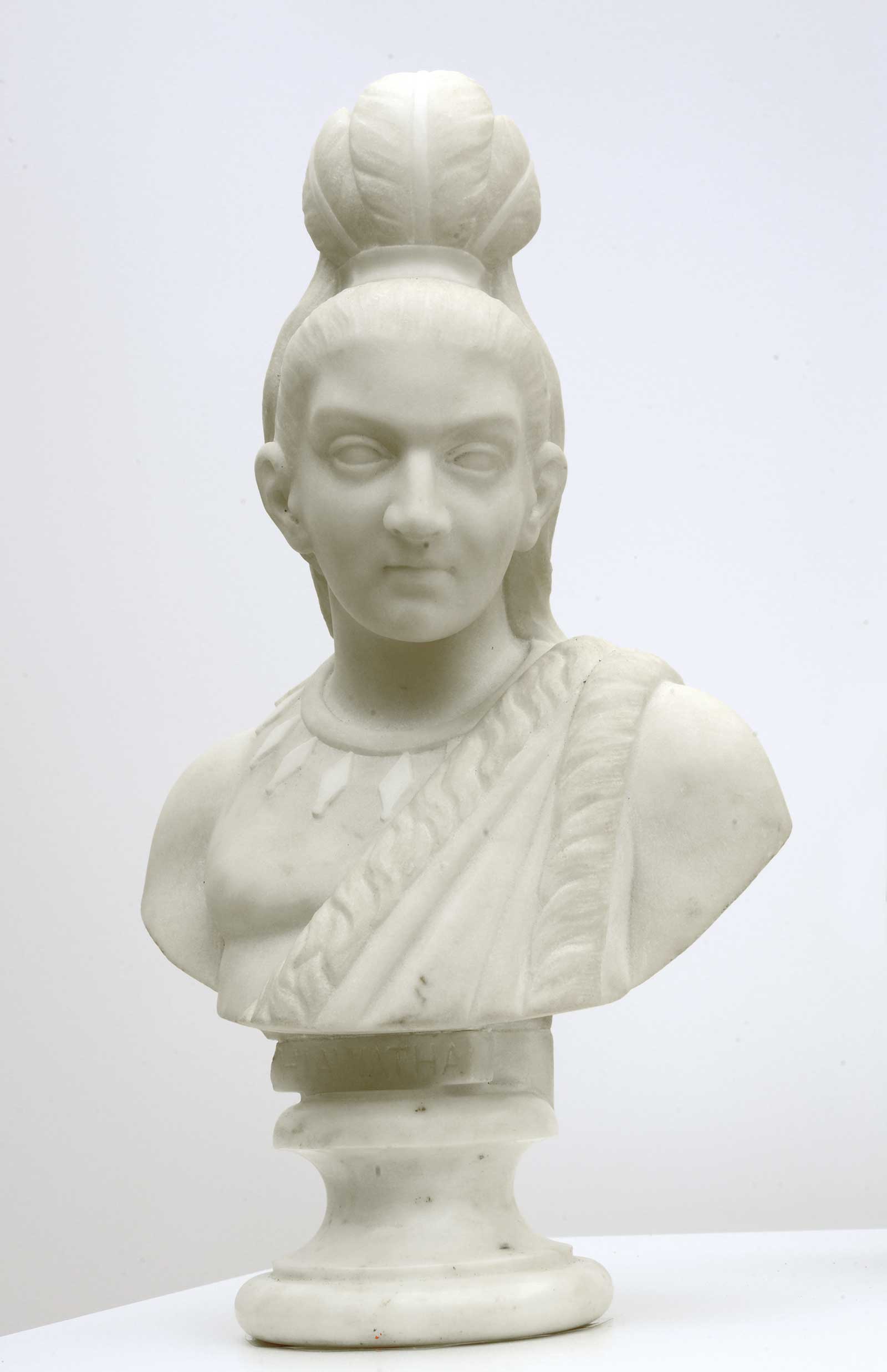
Edmonia Lewis (Mississauga, 1844-1907), Hiawatha, 1867, marble. Morland-Spingarn Research Center, Howard University Gallery of Art Collection.
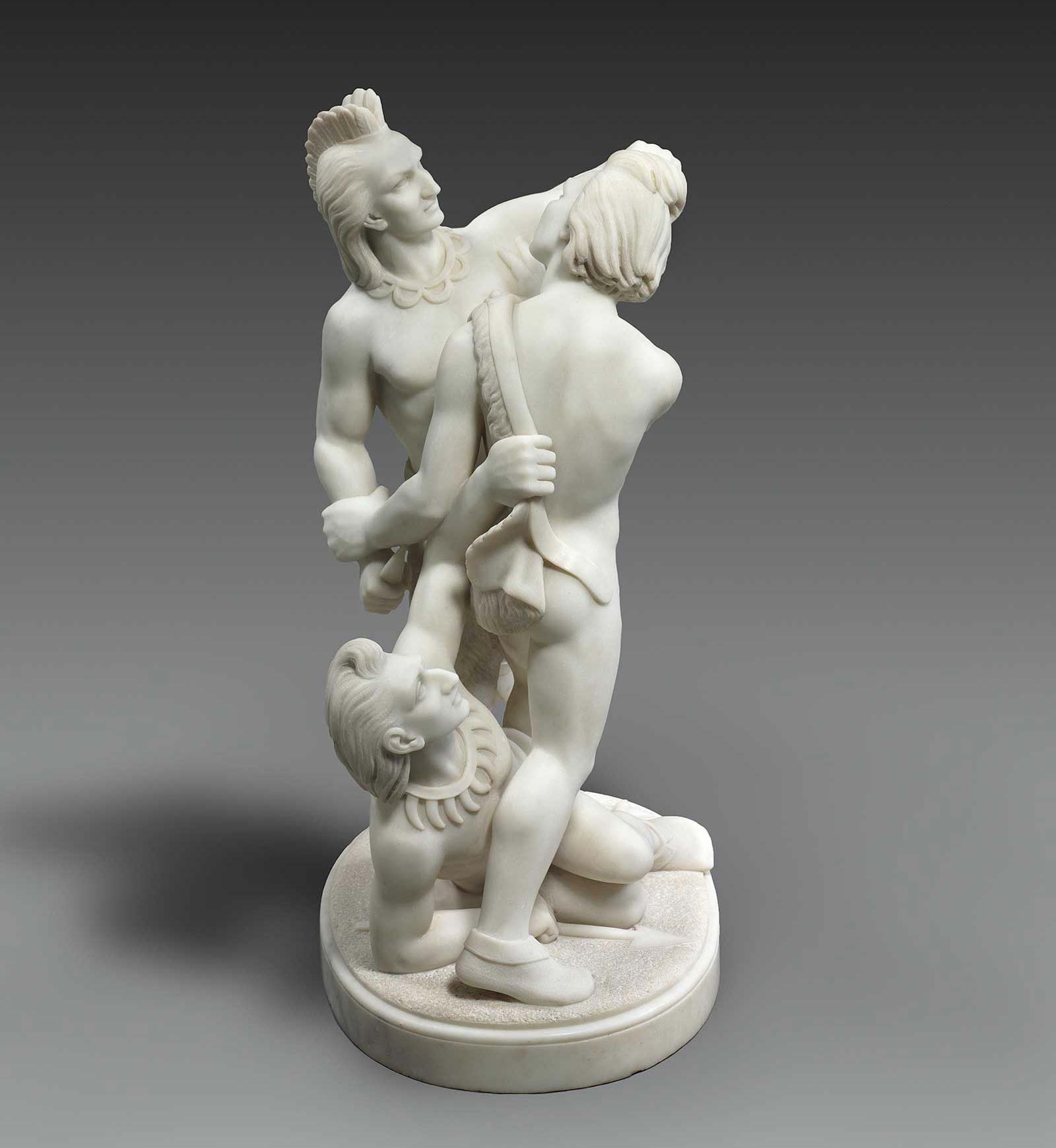
Edmonia Lewis (Mississauga, 1844-1907), Indian Combat, 1868, marble. American Painting and Sculpture Sundry Purchase Fund and Purchase from the J. H. Wade Fund, 2011.110. The Cleveland Museum of Art.
In 1878, she wrote, “I was practically driven to Rome, in order to obtain the opportunities for art culture, and to find a social atmosphere where I was not constantly reminded of my color. The land of liberty had no room for a colored sculptor.”
Between 1866 and 1872, she created a series of sculptures based on themes from Henry Wadsworth Longfellow’s popular epic poem The Song of Hiawatha, published in 1855. The story combines various Native American stories and features the fictional Ojibwe warrior Hiawatha and his wooing and marriage to the Dakota woman, Minnehaha.
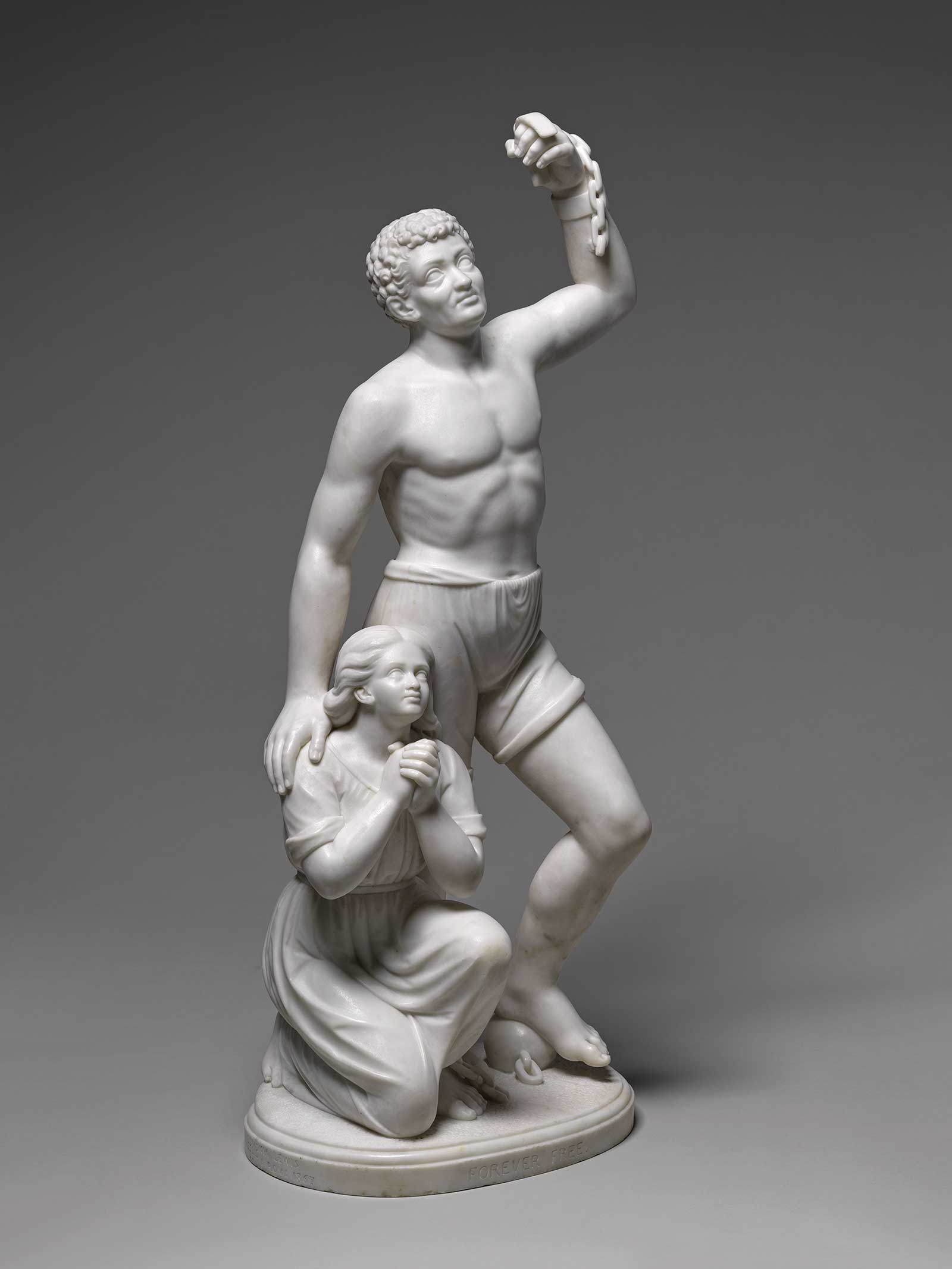
Edmonia Lewis (Mississauga, 1844-1907), Forever Free, 1867, Carrara marble. Howard University Gallery of Art, Washington D.C. / Licensed by Art Resource, NY. Photo: The Metropolitan Museum of Art.
Referring to the poem, the National Park Service’s Longfellow House and Washington’s Headquarters in Cambridge, Massachusetts, comments, “Longfellow set out to honor Native American heritage, but simultaneously perpetuated stereotypes and the false assertion that Indigenous culture was dying in America. Since then, the merits and pitfalls of Hiawatha have been rightly debated as its hold on American culture endures.”
Lewis’ sculpture The Old Indian Arrow Maker and his Daughter depicts Minnehaha at the feet of her father “plaiting mats of flags and rushes,” Longfellow wrote. Between them is a red deer Hiawatha had brought to them. Harris and Richmond-Moll note, “Lewis chose a quiet moment from Longfellow’s narrative, one that emphasizes artistry and the passing of intergenerational knowledge…The sculpture calls to mind the artist’s own childhood when her maternal Mississauga relatives taught her weaving, beadwork, moccasin making and other creative practices.” The marketing skills Lewis learned from her aunts were invaluable. She also used photography to promote her work and frequently returned from Rome to make sales and gather commissions.
Hiawatha’s Marriage depicts the following lines from the poem: “‘In the land of the Ojibways, In the pleasant land and peaceful. After many years of warfare, Many years of strife and bloodshed, There is peace between the Ojibways And the tribe of the Dacotahs.’ Thus continued Hiawatha, And then added, speaking slowly, ‘That this peace may last forever, And our hands be clasped more closely, And our hearts be more united, Give me as my wife this maiden, Minnehaha, Laughing Water, Loveliest of Dacotah women!’”
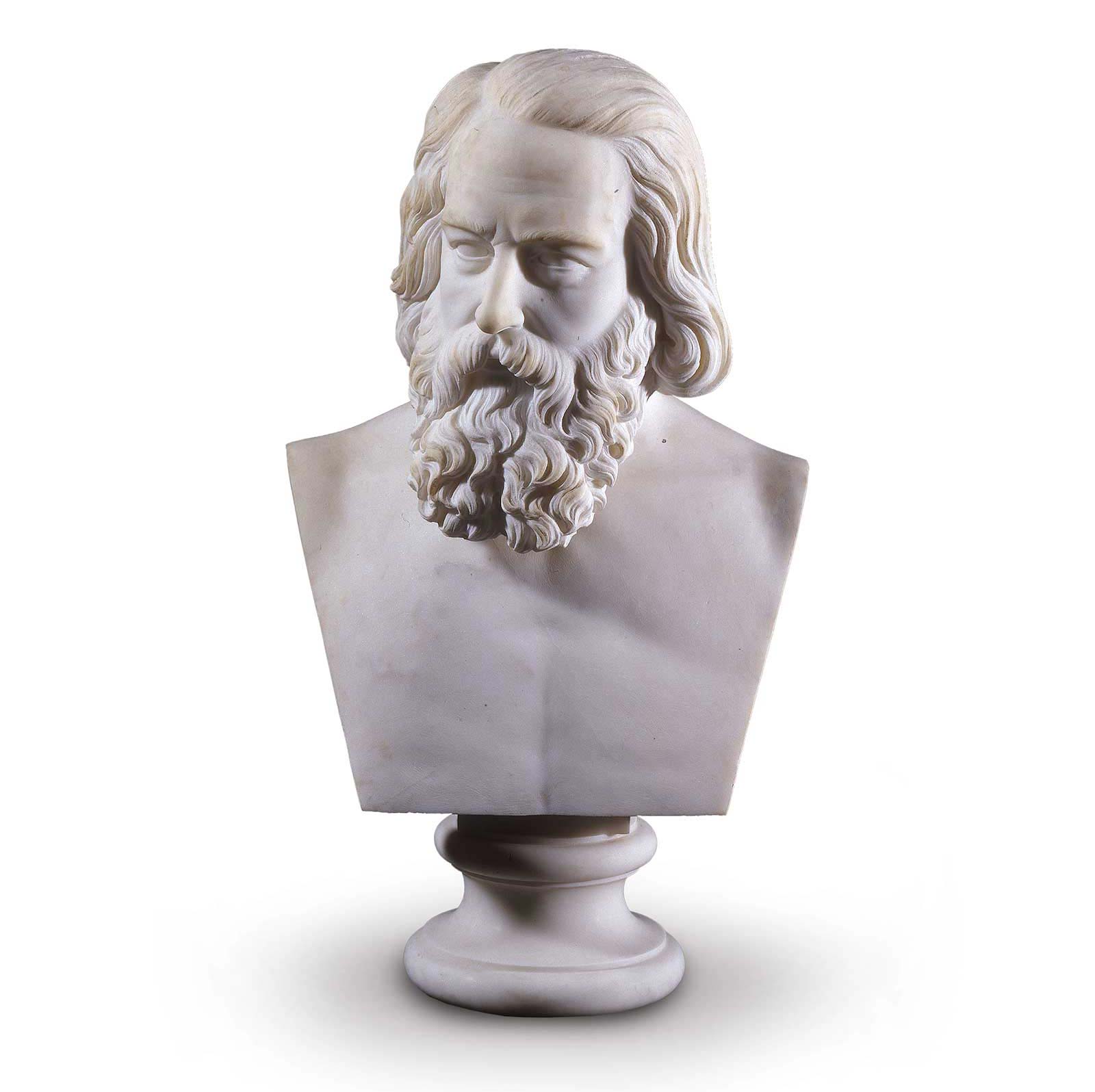
Edmonia Lewis (Mississauga, 1844-1907), Henry Wadsworth Longfellow, 1872, marble, 28¾ x 16 x 12¼ in. Courtesy National Museums Liverpool, Walker Art Gallery. Accepted by H M Government in lieu of Inheritance Tax and allocated to National Museums Liverpool in 2003, WAG 2004.5.
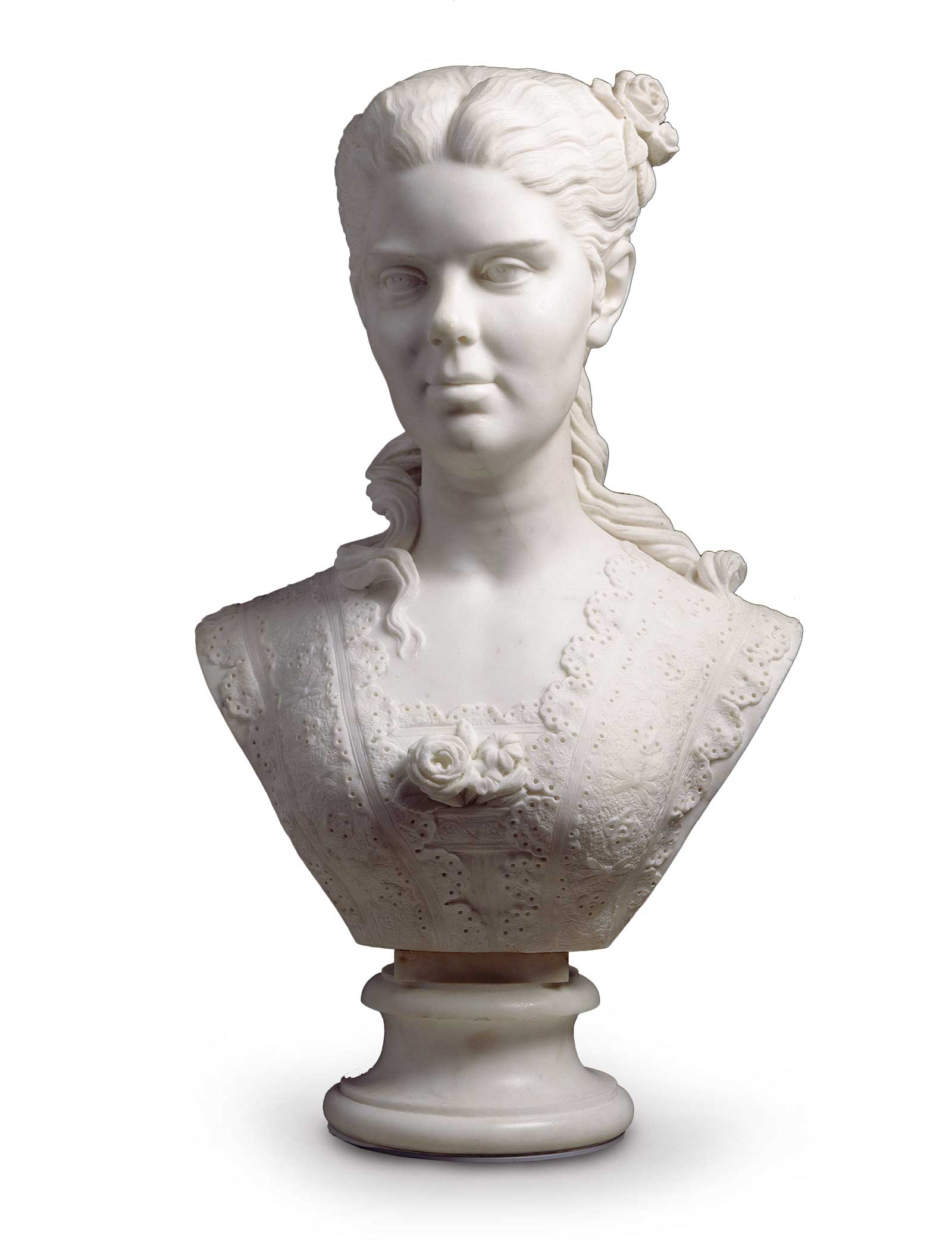
Edmonia Lewis (Mississauga, 1844-1907), Portrait of a Woman, 1873, marble. Museum Minority Artists Purchase Fund and partial gift of Thurlow E. Tibbs Jr., 1:1997. Saint Louis Art Museum
Lewis created a neo-classical bust of Longfellow himself, sketching him as she followed him around near his hotel on his visit to Rome in 1869, creating a rough portrait before inviting him to sit for her as it neared completion. Longfellow grew his distinctive beard to cover scars from burns he received after his wife’s dress caught fire. Longfellow saved her from the fire, but she died the next day.
In an afterword to the catalogue, Kirsten Pai Buick, professor art and art history at the, University of New Mexico, writes, “Always both Black and Indigenous, regardless of subject, Lewis’ sculptures can coexist only in a dialectical standoff, even as her life’s work is always in danger of being relentlessly bifurcated. Lewis is both Black and Indigenous at the same time. She is Native as she sculpts Black-centered work, and Black as she sculpts Native-centered work. I hope that the pursuit of wholeness that this exhibition and catalogue represent can serve as the necessary inflection point that finally changes the stories we tell of Lewis’ life and career.”
Following its run at Peabody Essex Museum, Edmonia Lewis: Said in Stone will be shown at the Georgia Museum of Art in Athens, August 8, 2026, through January 3, 2027, and at the North Carolina Museum of Art in Raleigh, April 3 through July 11, 2027. —
Through June 7, 2026
Edmonia Lewis: Said in Stone
Peabody Essex Museum 161 Essex Street, Salem, MA 01970 (978) 745-9500, www.pem.org
Powered by Froala Editor


