In Silver Honors Stone, the Wheelwright Museum shines a light on the mid-20th century Santo Domingo jeweler Julian Lovato and his contemporaries.
“When you think about Native jewelers in the mid- to late-20th century, you’re often thinking about Charles Loloma or Kenneth Begay, but we’re really interested in jewelers whose careers are slightly earlier than those figures, and whose work may not be as widely known,” says Henriette Lidchi, executive director of the Wheelwright.
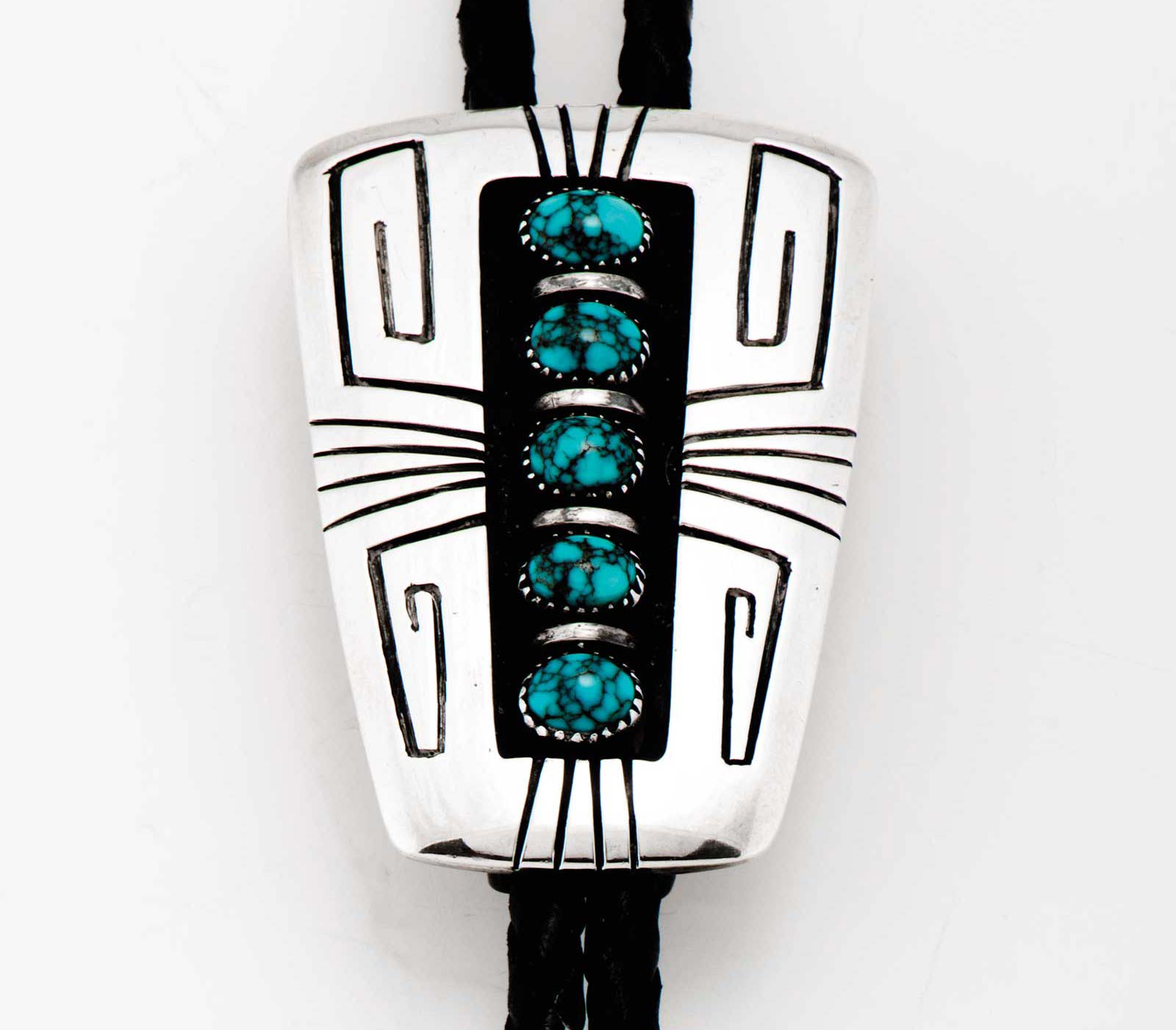
Julian Lovato (Santo Domingo Pueblo, 1925-2018), Lone Mountain turquoise bolo. Photo by Arland Ben and published in Turquoise in America Part Two, 1910-1990, copyright Callais Press, 2020
Lovato began his career as a teenager working in Maisel’s manufacturing shop in Albuquerque. “He came from a family of lapidary workers, so he’d done a lot of stone cutting as a child, which he learned from his father and grandfather,” says Lidchi.
In the 1940s, he served in Japan during World War II, and when he returned he learned woodworking through the G.I. Bill and started making jewelry at the Thunderbird Shop. It wasn’t until the early 1970s that he set up his own studio in Kewa Pueblo, where he worked for himself alongside his wife, Marie.
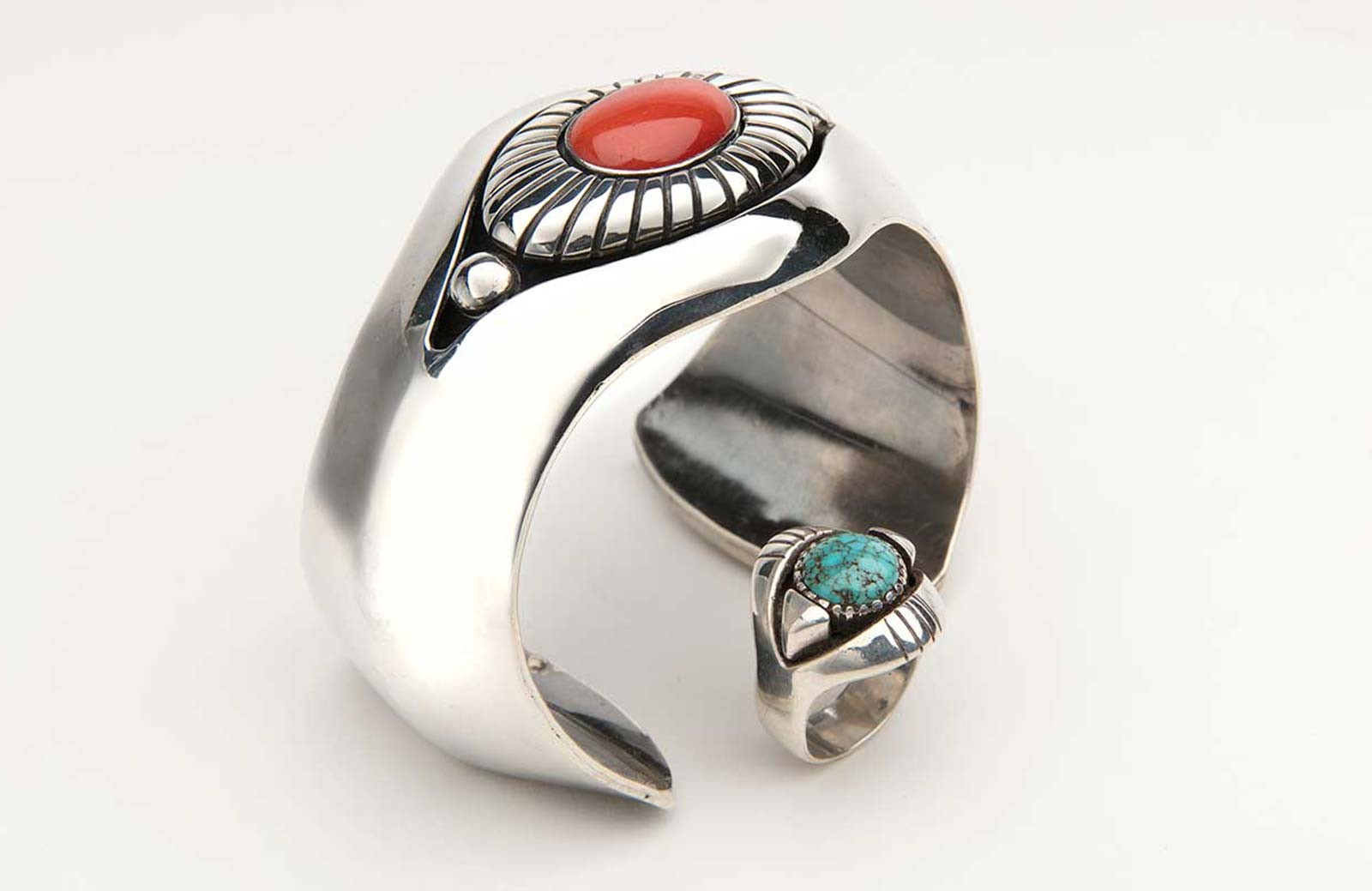
Julian Lovato (Santo Domingo Pueblo, 1925-2018), hollowform silver bracelet with set coral, made by the artist while at Packards. Wheelwright Museum Collection / Stephen Schultz collection.
Lovato was an incredibly gifted technician, and described his work as having a “raised dimensional design.” Because he worked in a manufacturing setting from a young age, he developed a level of precision that helped him take his work to a new level. “If you know anything about soldering, it’s that if you’re very good at it, it looks very easy, but it takes a lot of practice,” Lidchi explains. He knew how to solder in a way that allowed him to create sculptural, sumptuous pieces.
For Lovato, the stone was the most important element of his work, with silver acting as the framing. He was very precise with his use of stone, typically using high quality turquoise or coral, and he often created patterns that were almost like arrows or sunbursts that drew the viewer’s eye directly to the stone.
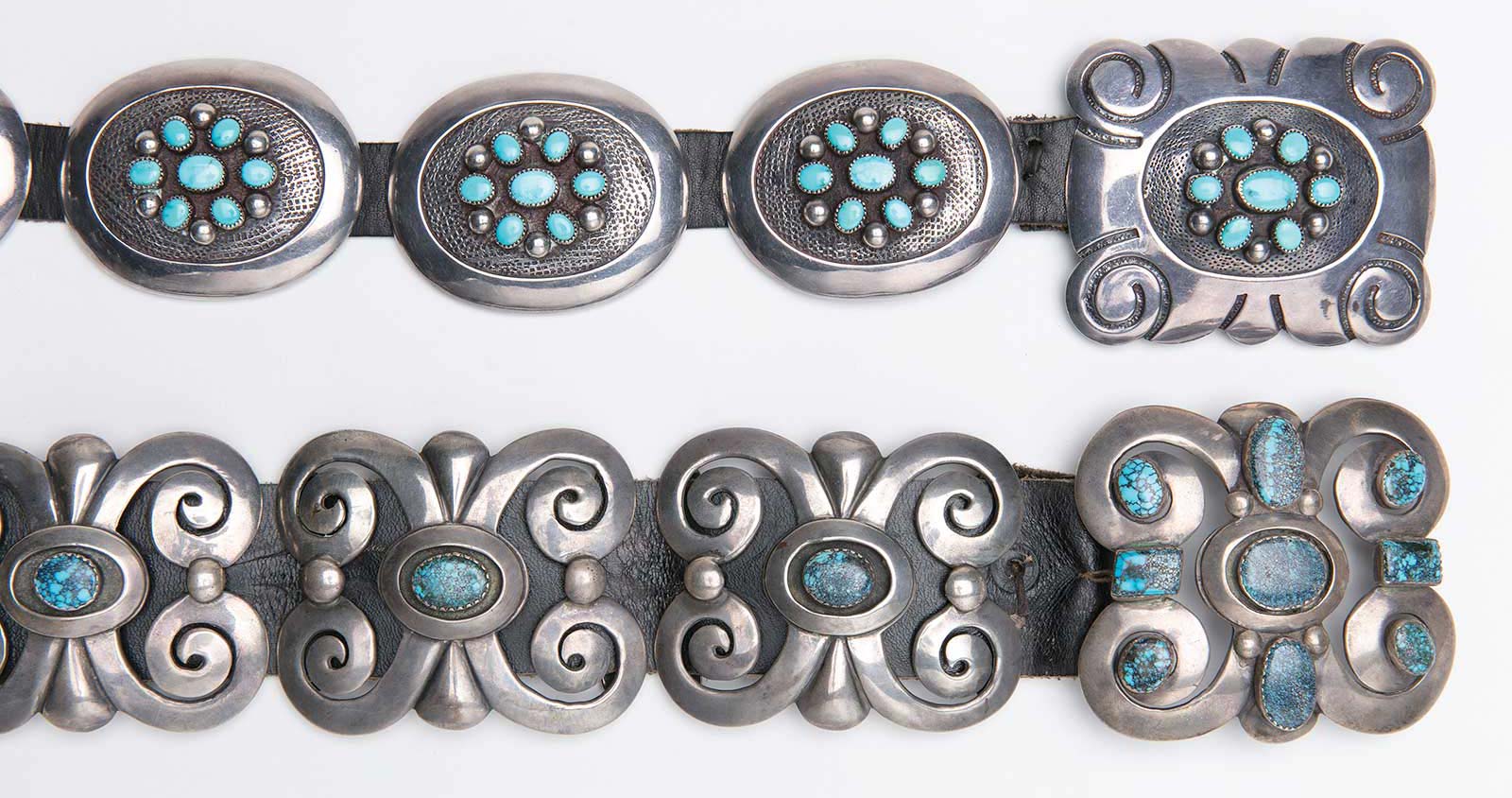
Turquoise and silver concho belt with scroll design by Frank Patania above (Stephen Schultz collection) and turquoise and silver belt by Hopi jeweler Lewis Lomay below (Wheelwright Museum Collection).
One piece featured in the exhibition is a squash blossom necklace created from silver and coral. It’s an unusual piece that uses hollow forms and raised silver, a technique derived from Scandinavian modernism. Lidchi says, “Squash blossoms are a real test of skill, because you have to repeat forms very precisely, and the dimensions of things are calibrated so they sit properly on the neck.”
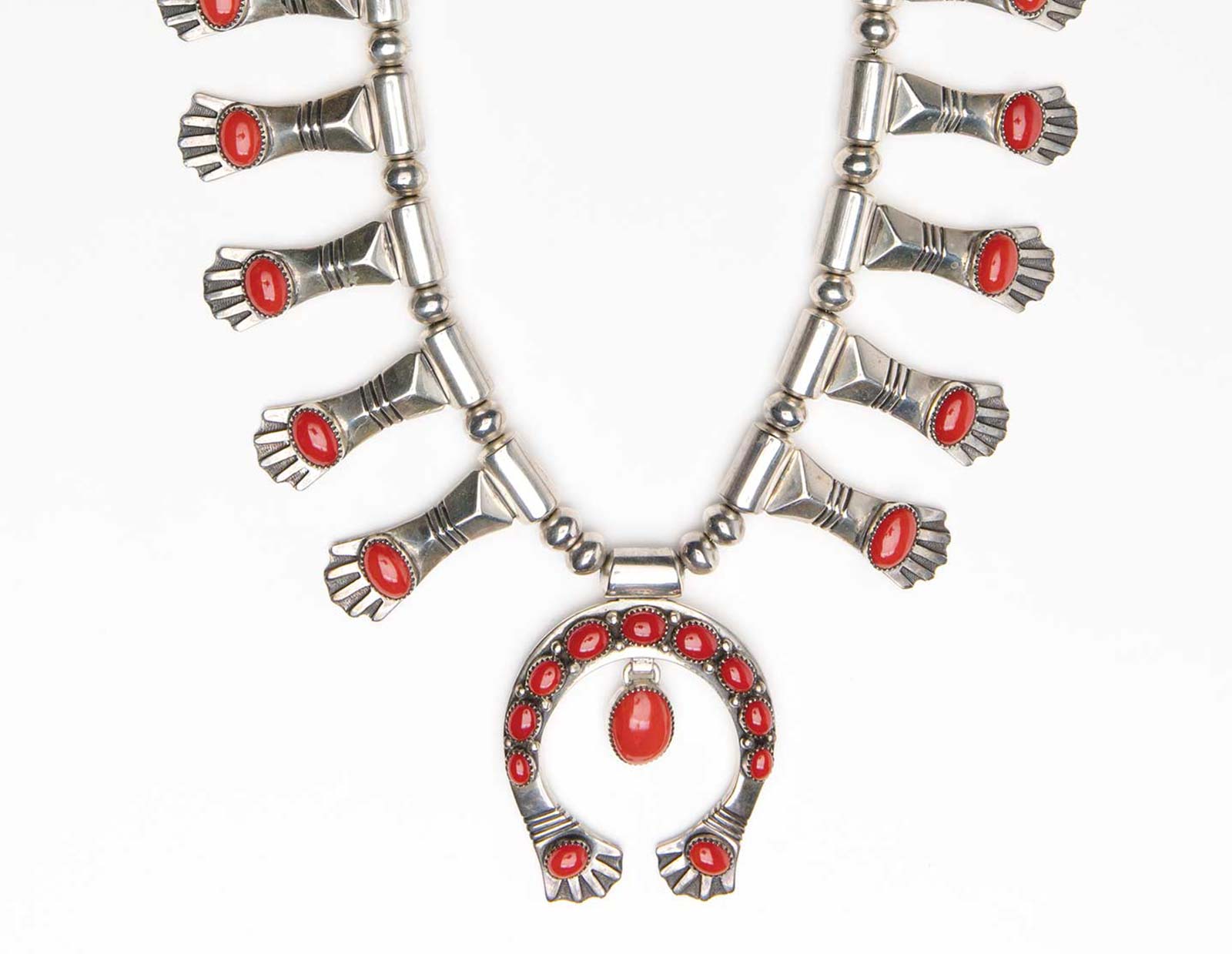
Julian Lovato (Santo Domingo Pueblo, 1925-2018), squash-blossom necklace with hands of silver and coral, made after 1971. Wheelwright Museum Collection, Daniel E. Prall Fund.
The exhibition also displays Lovato’s jewelry alongside the work of his peers, including Louis Lomay, Joe Quintana and Mark Chee. “This is a generation of work coming out of the 1950s and 1960s that has more of a modernist flair,” Lidchi says. “It uses traditional style, but it’s rendering them in a rather distilled fashion.”
Silver Honors Stone opens on April 10 and remains on view at the Wheelwright Museum through October 17. —
April 10-October 17, 2026
Silver Honors Stone
Wheelwright Museum of the American Indian
704 Camino Lejo, Santa Fe, NM 87505, (505) 982-4636, wheelwright.org
Powered by Froala Editor


