In a world where contemporary art often favors novelty over depth, Cole Red Horse Taylor stands apart. This is not because he rejects innovation, but because his creative evolution is grounded in something far more profound, an unrelenting commitment to research, cultural memory and the diligent work of understanding what came before. At just over a decade into his professional career, this Mdewakanton Dakota artist has already established himself as a formidable presence in contemporary Native art, combining traditional techniques with conceptual thoroughness in ways that challenge both the Native art world and the broader contemporary art establishment.
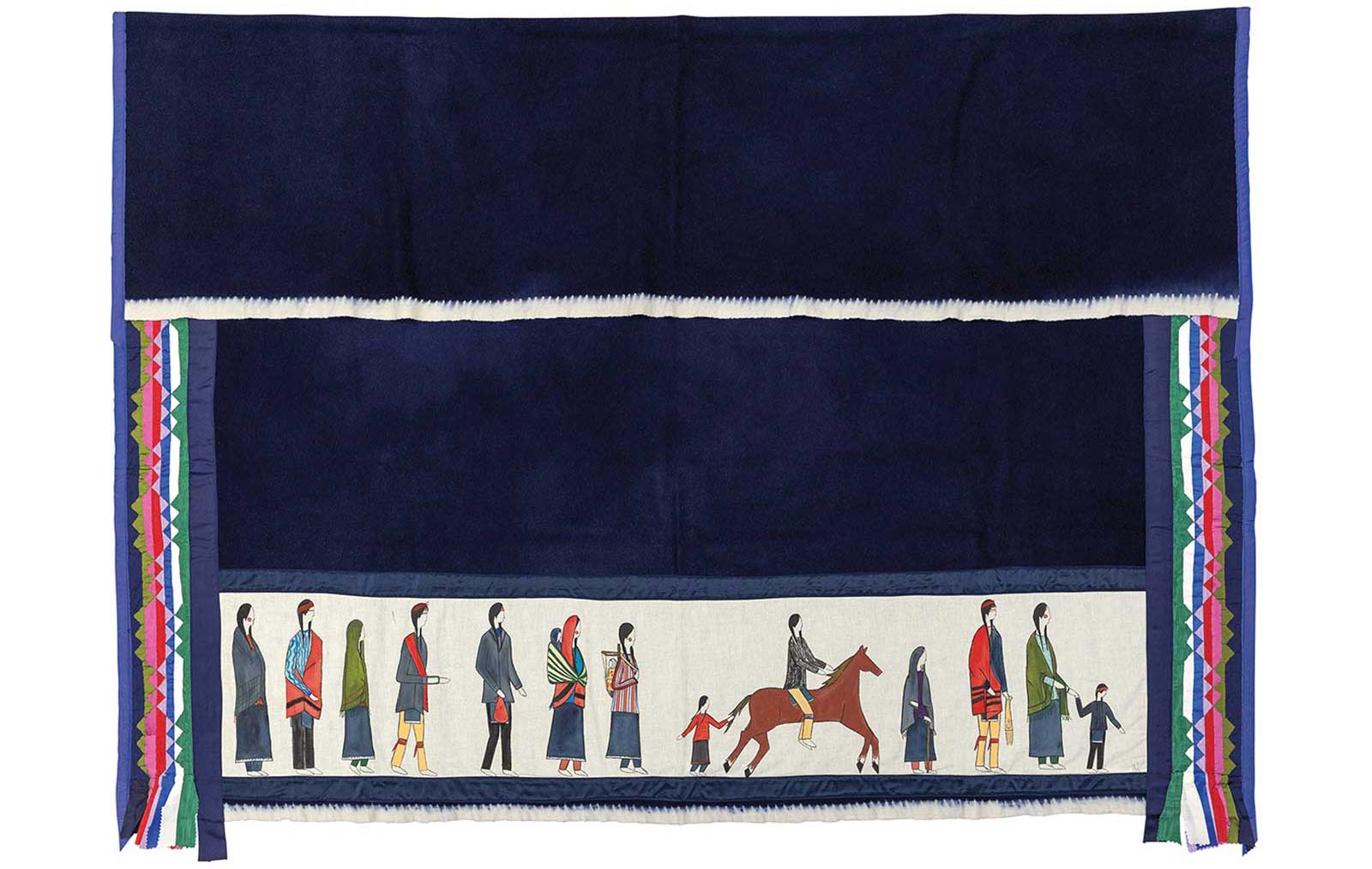
Exodus and Diaspora, hand-dyed wool, muslin, silk, taffeta, thread, acrylic and ink, 63 x 60 in.
What makes Taylor exceptional isn’t just his technical mastery across multiple mediums, including beadwork, quillwork, ledger and textile arts, though that alone would be impressive. It’s his eagerness for learning, his willingness to dig into archives and museum collections, and his ability to synthesize historical research with personal narrative and cultural continuity. This is an artist who doesn’t simply create beautiful art; he excavates meaning, works within the bounds of tradition, and positions himself as both witness and participant in an ongoing cultural conversation that stretches back generations.
Taylor’s artistic practice draws from two distinct but complementary lineages. The first is his formal training that includes a Bachelor of Fine Arts from the Minneapolis College of Art and Design, and later, a Master of Fine Arts from the Institute of American Indian Arts in Santa Fe. The second lineage is more intimate because it is the knowledge passed down through his family, including a great-grandmother known for her beadwork and a great-grandfather who was a pipe maker. “I believe that it’s those relatives who gave me the ability to do what I do,” Taylor explains, acknowledging that his hands carry the memory of their work.
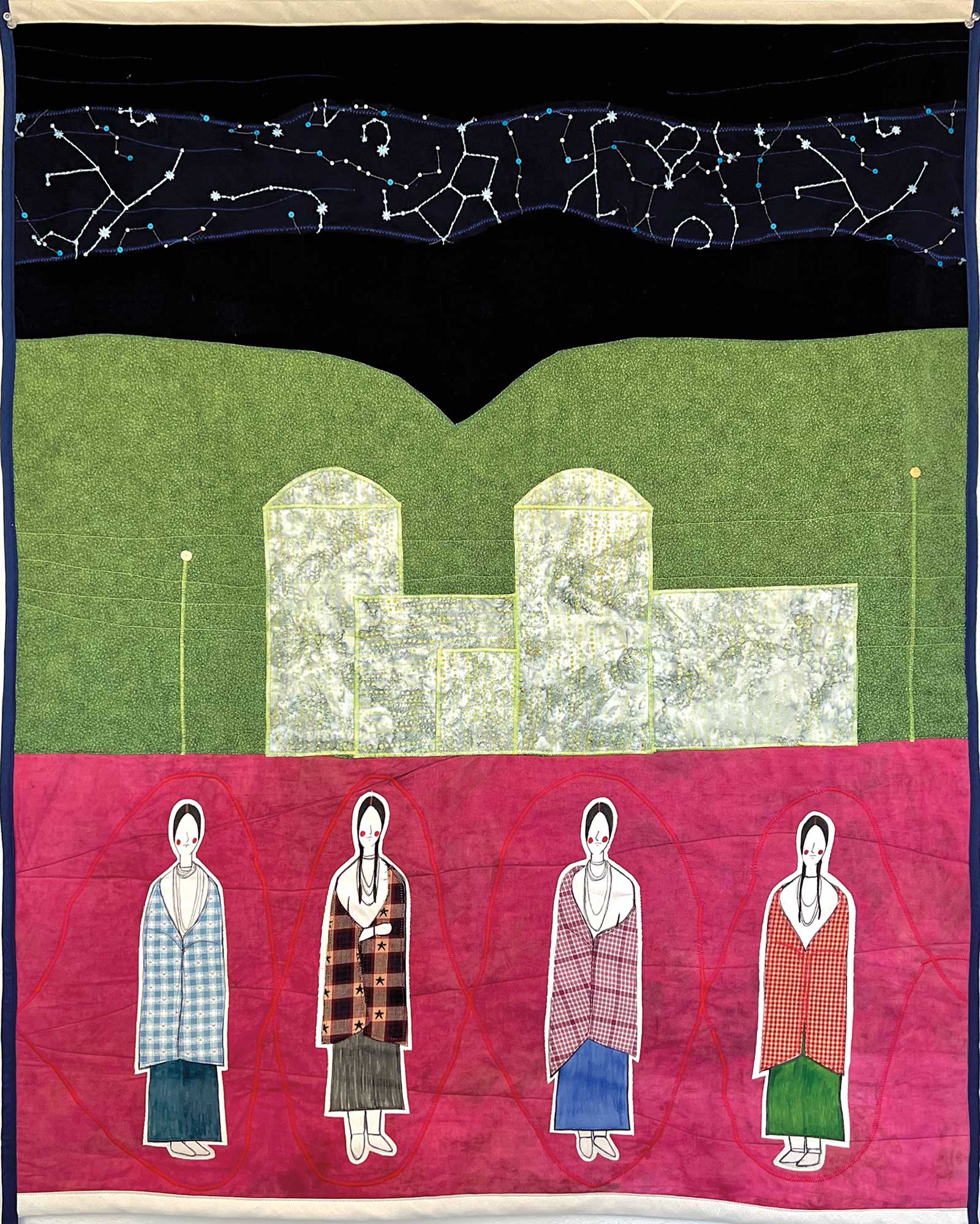
In the shadow of NSP, wool, cotton fabric, hand dyed cotton fabric, muslin, ink, acrylic paint and lace, 40 x 30 in.
But Taylor’s journey hasn’t been about choosing between these worlds. Instead, he’s spent his career finding ways to honor both, often in the same piece. He learned beadwork at 13 and quillwork at 21; skills that connect him directly to Dakota material culture. Yet, he’s equally conversant in contemporary art theory, ledger art traditions, and the work of artists like Dyani White Hawk, Teri Greeves and Bisa Butler. This dual fluency allows him to create work that speaks to multiple audiences without compromising its integrity or cultural specificity.
What distinguishes Taylor from many of his contemporaries is his dedication to archival research. In 2018, fresh out of his undergraduate program, he was awarded the Minnesota Historical Society’s artist-in-residence, where he focused on studying Dakota pucker-toe moccasin histories and construction for communities both within and beyond Minnesota’s borders. This wasn’t a purely artistic project; it was an act of cultural restoration that required him to study collections at the Minnesota Historical Society, the Milwaukee Public Museum and the Smithsonian’s National Museum of the American Indian.

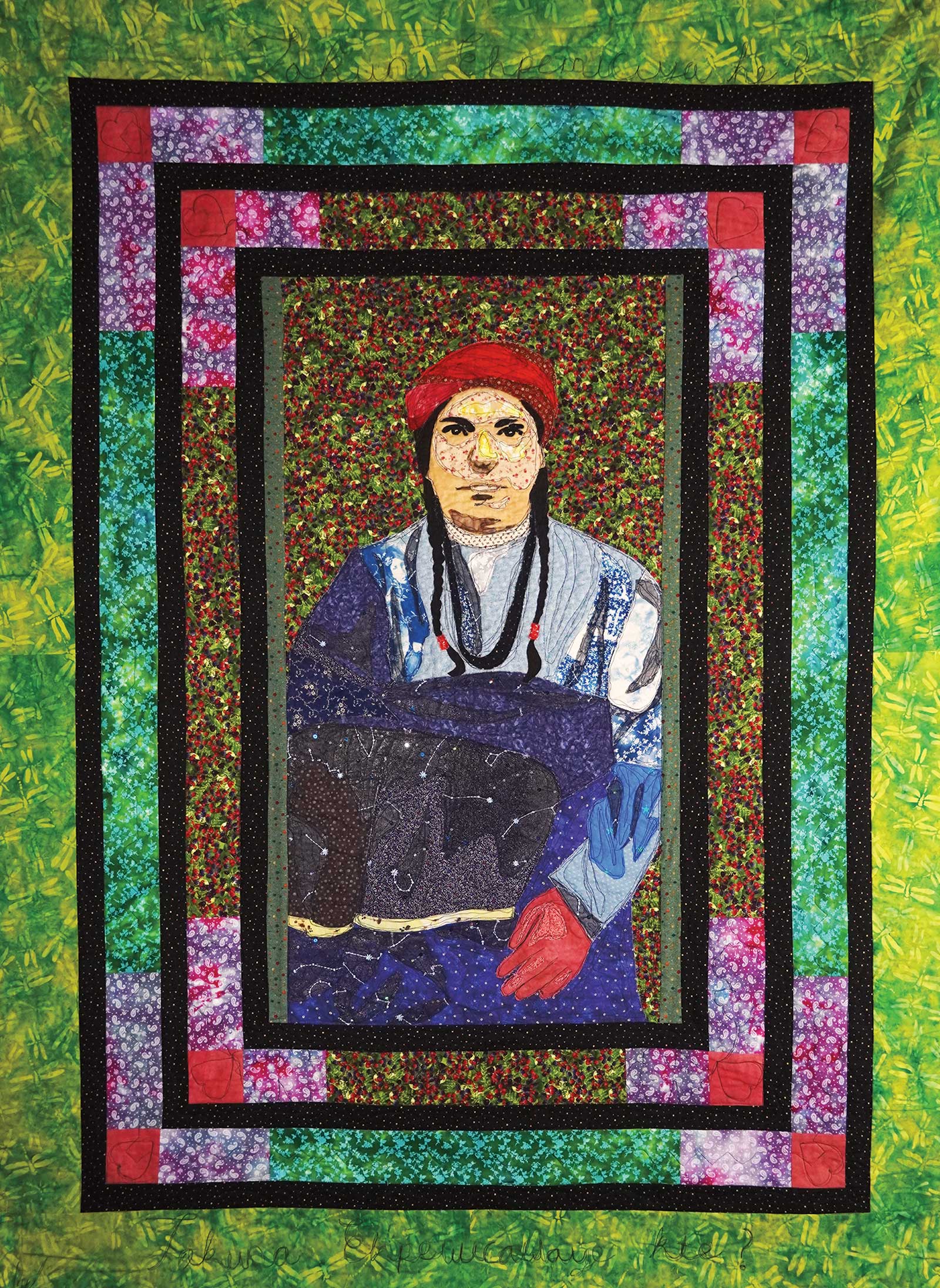
Takuna Ehpewicawaye kte?, cotton fabric, cotton batting, thread, silver beads and lace, 71½ x 53½ in.
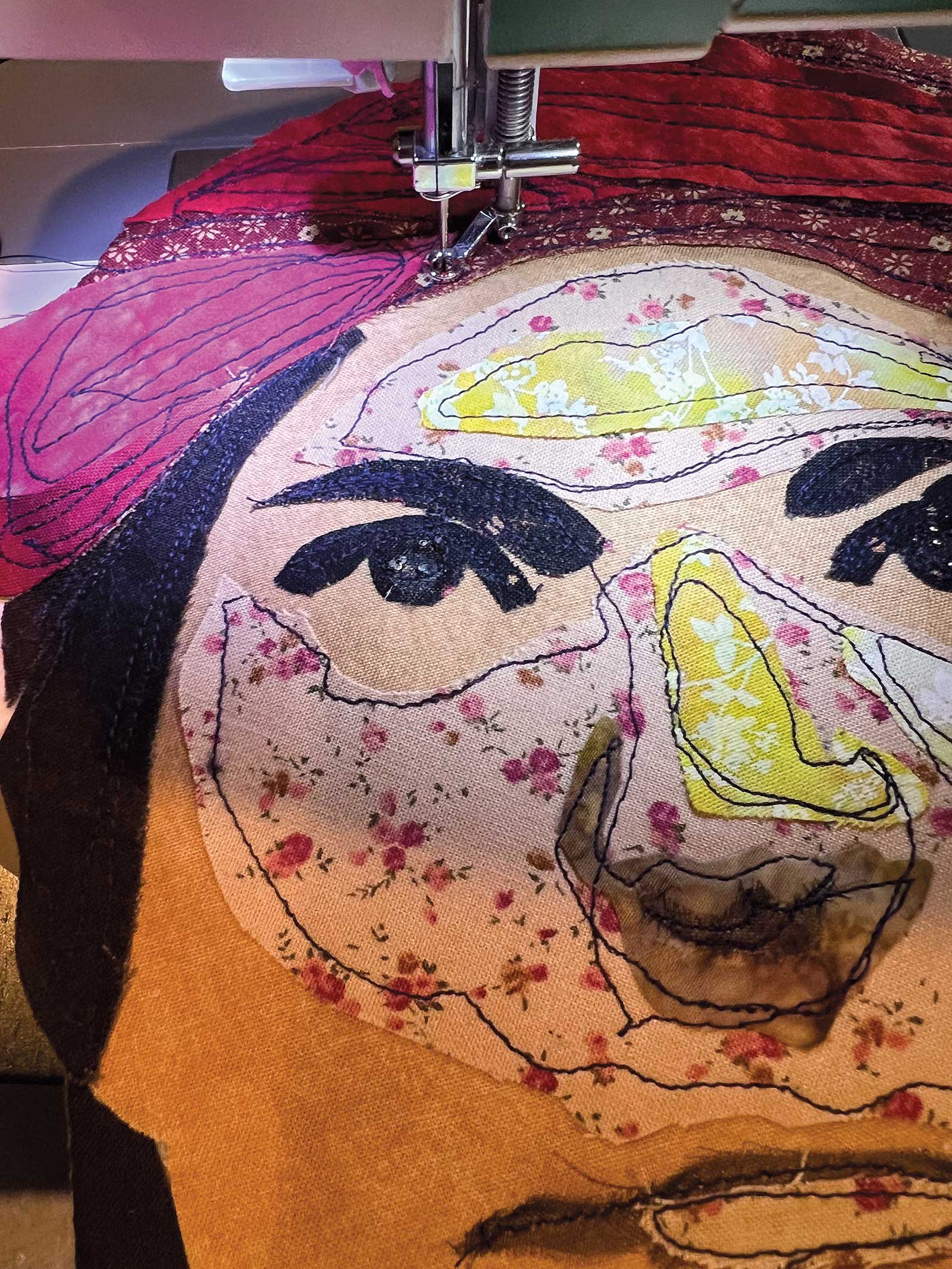
Takuna Ehpewicawaye kte? (detail), cotton fabric, cotton batting, thread, silver beads and lace, 71½ x 53½ in.
The experience transformed his understanding of what it means to be a Native artist navigating western institutions. “I was confronted with all of these objects,” he recalls of his time in the archives, “and it really opened my eyes and made me feel very much in relation with my ancestors.” He left tobacco for objects, talked to them and promised to remember them. For Taylor, these aren’t merely artifacts to be studied, they are living relatives who are extensions of the ancestors who made them.
This research became foundational to his artistic practice as he continued to grow his researching skills. For example, by examining glass plate photographs from the 1860s, he discovered how Isanti (Eastern) Dakota people dressed before their removal from Minnesota, noting how their material culture reflected their woodland origins and bore similarities to Ojibwe, Ho-Chunk, and Sac and Fox traditions. These weren’t academic observations; they were revelations that would directly inform his textile work, particularly his attention to ribbon work—a decorative technique he noticed on a blanket worn by a Dakota woman in a photograph from the Fort Snelling imprisonment of 1862-63.
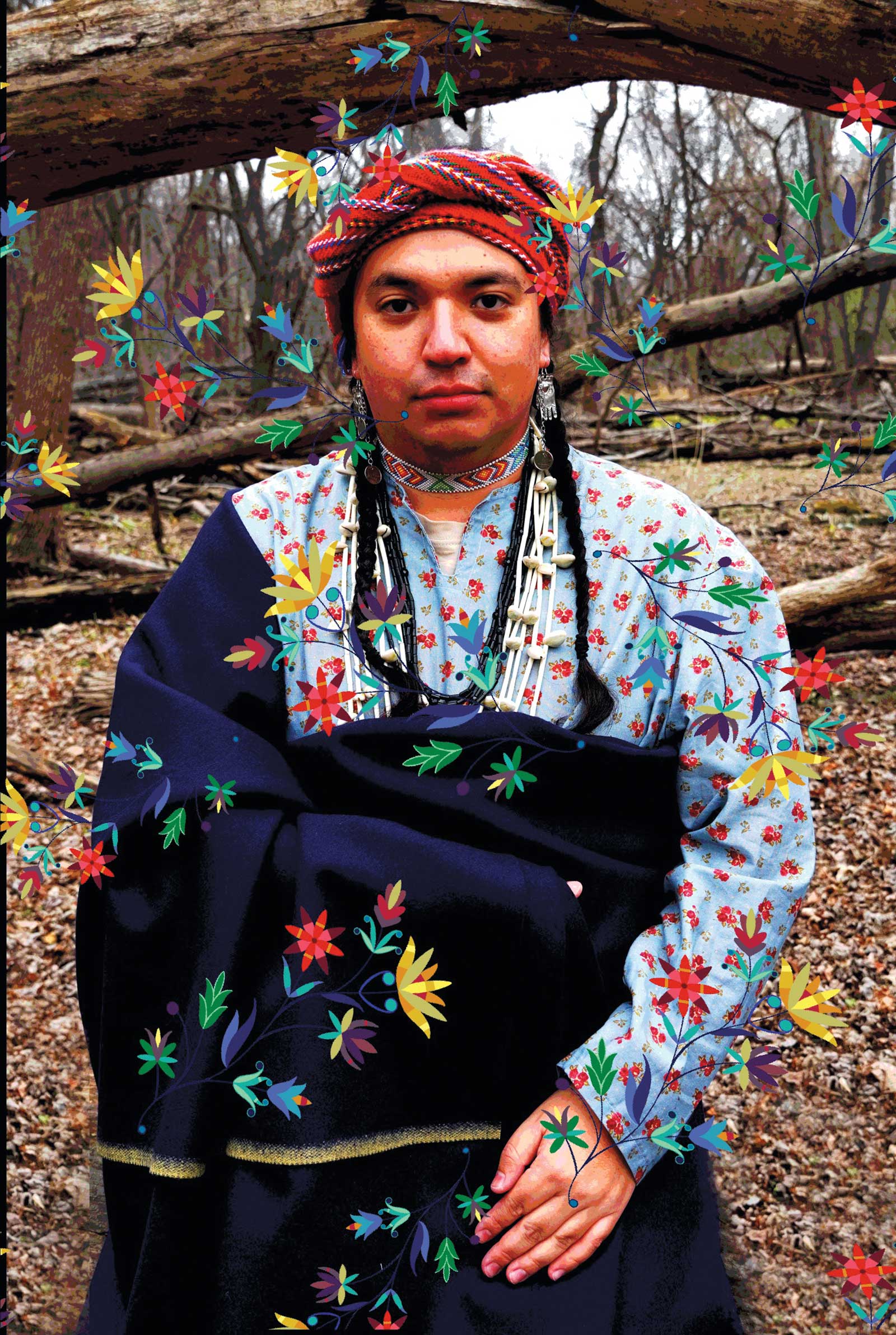
Untitled Portrait series, 2024, photograph and graphics by the artist.
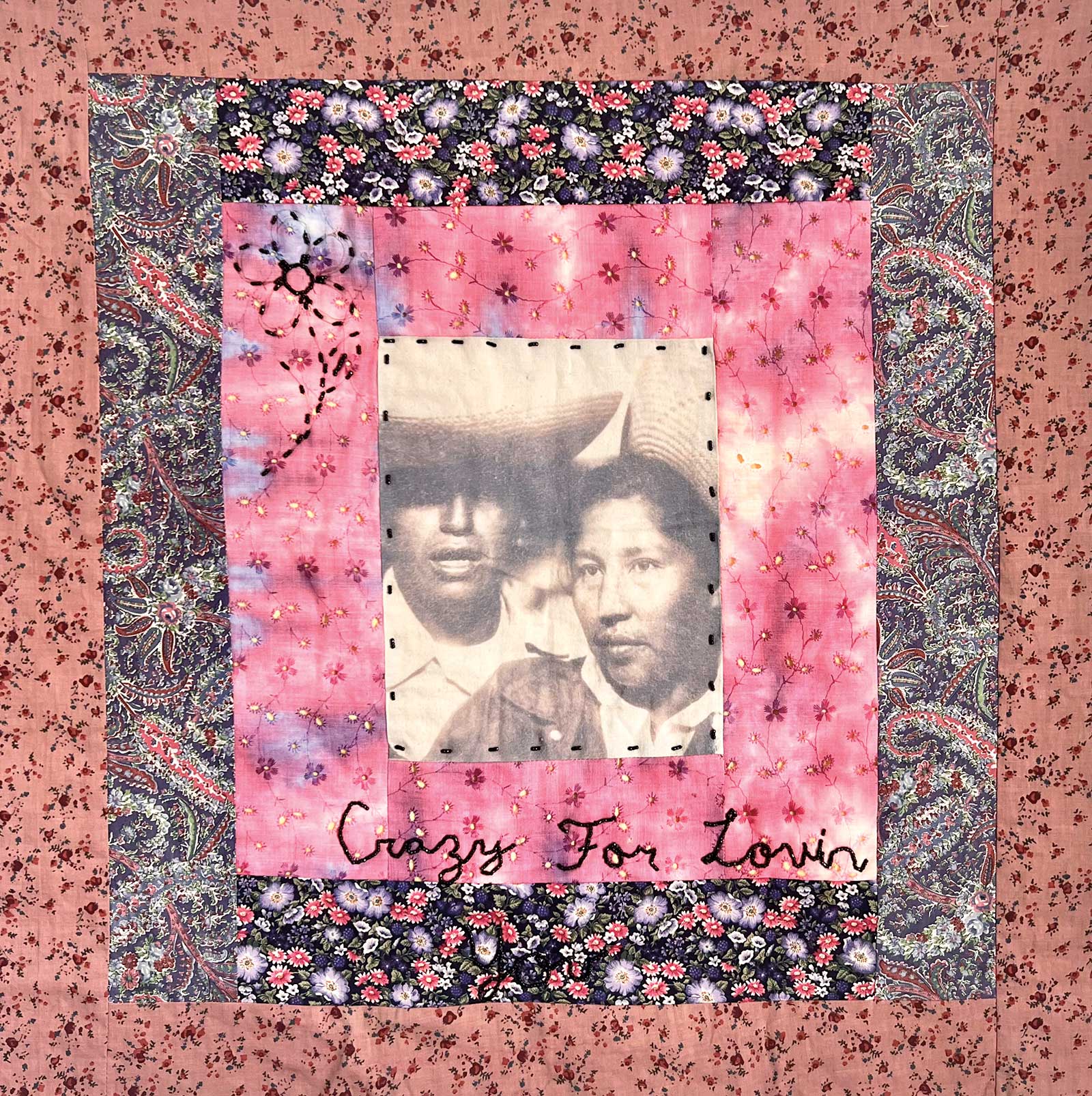
Crazy For Lovin’ You, solar fast image on cotton fabric, cotton batting, thread and vintage cut beads, 24½ x 24½ in.
Taylor’s research coalesced in a pivotal 2022 work created during a residency at the Anderson Center in Red Wing, Minnesota. Exodus in Diaspora is a hand-dyed wool blanket adorned with silk ribbon work side panels in the traditional cut-and-fold style, with a bottom panel painted in ledger style on muslin. The piece depicts Dakota people marching in one direction, each figure representing a story from oral history about the forced removal, exile and return of Dakota people to Minnesota.
The work synthesizes everything Taylor had been studying; the historical material culture of Dakota people, the significance of blankets in Dakota ceremonial life, the visual language of ledger art and the deeply personal stories passed down through his family. He thought about the woman in the 1860s photograph, about what she would have sacrificed to keep that blanket during the imprisonment at Fort Snelling; about the concentration camp conditions his ancestors endured during the winter of 1862-63.
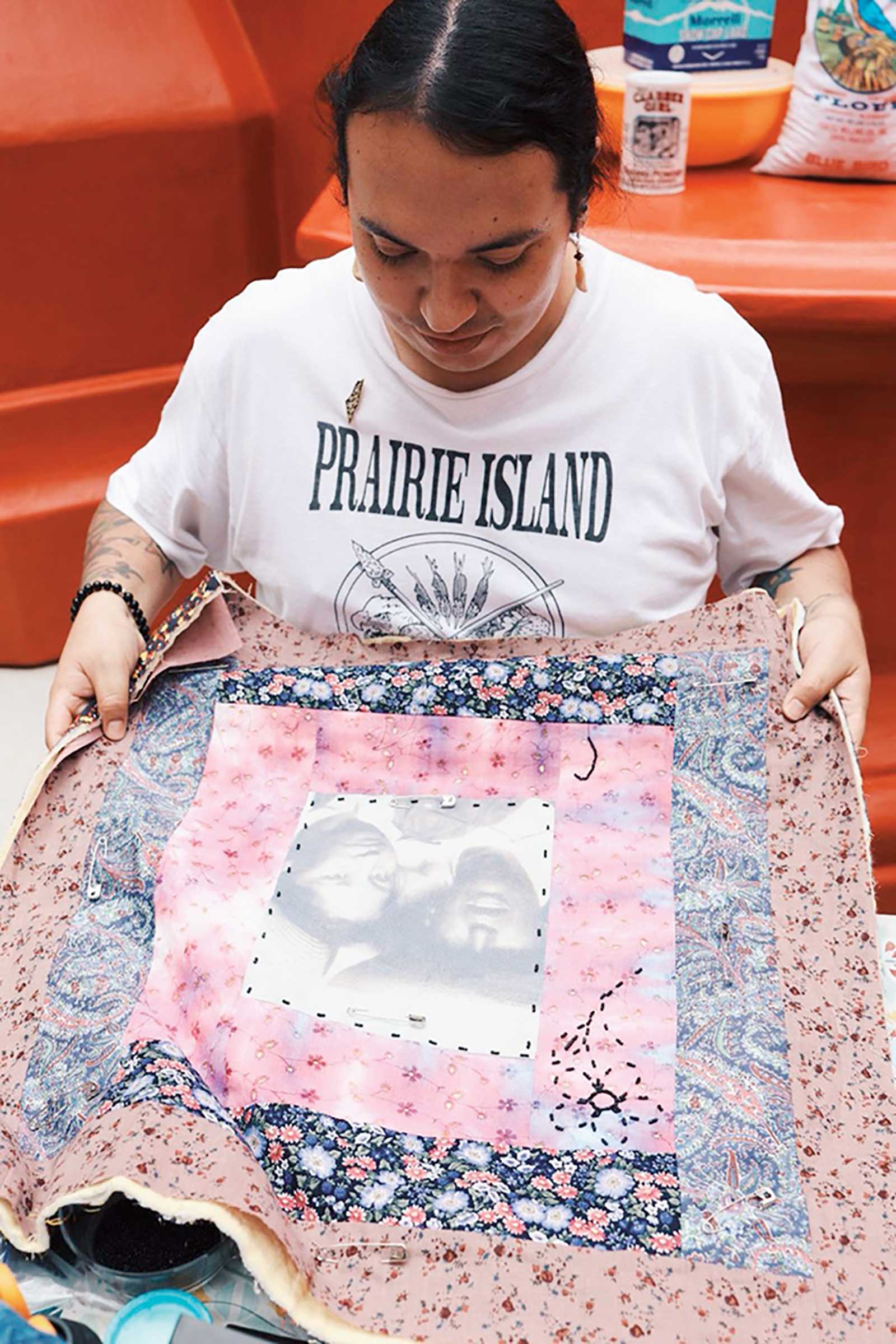
Candid photo during Venice Biennale performance, 2024. Photo by Ursala Kadsune Hudson.
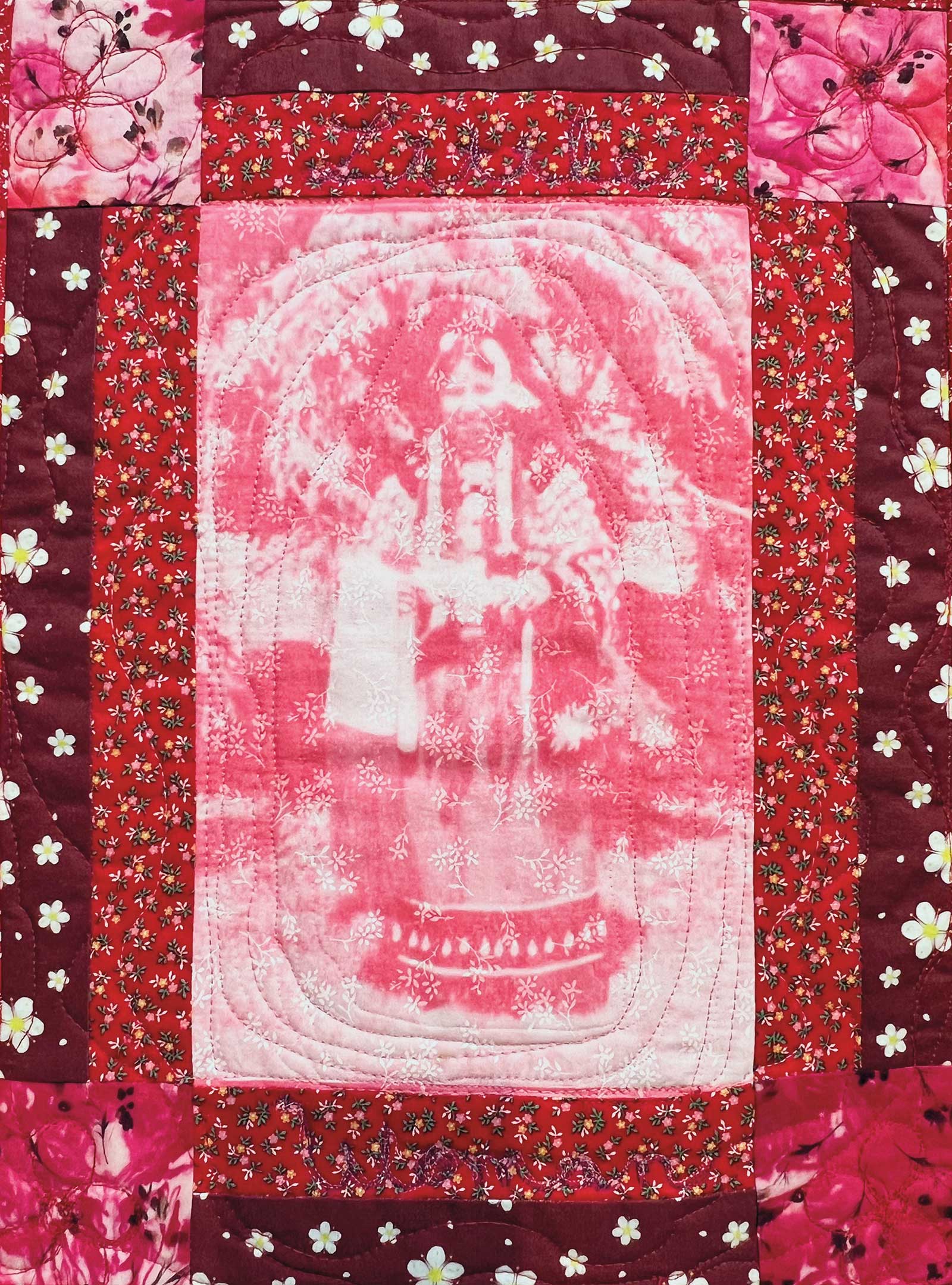
Little Woman, solar fast image on cotton fabric, cotton batting and thread, 17 x 13 in.
But he also thought about his own position as a Dakota person still living in Minnesota, “the almost privilege,” as he calls it, when most Dakota people remain in diaspora, scattered across Nebraska, North and South Dakota, Montana, Canada and beyond. The piece became both memorial and meditation, honoring those who were forced to leave while acknowledging the complexity of being among those who stayed.
Exodus in Diaspora marked a turning point for Taylor because it launched the inspiring convergence of all his artistic practices into a new form of creation. Witnessing an artist like Taylor explore textiles, ledger, beadwork, ribbon work and original design, inspired by cultural memory, is a testament of Indigenous brilliance. Exodus in Diaspora was also included in the significant exhibition Dreaming Our Futures, which featured 29 Dakota, Lakota, Nakota and Anishinaabe artists, proving Taylor as an artist capable of working at the intersection of historical documentation, traditional craft and contemporary conceptual practice.
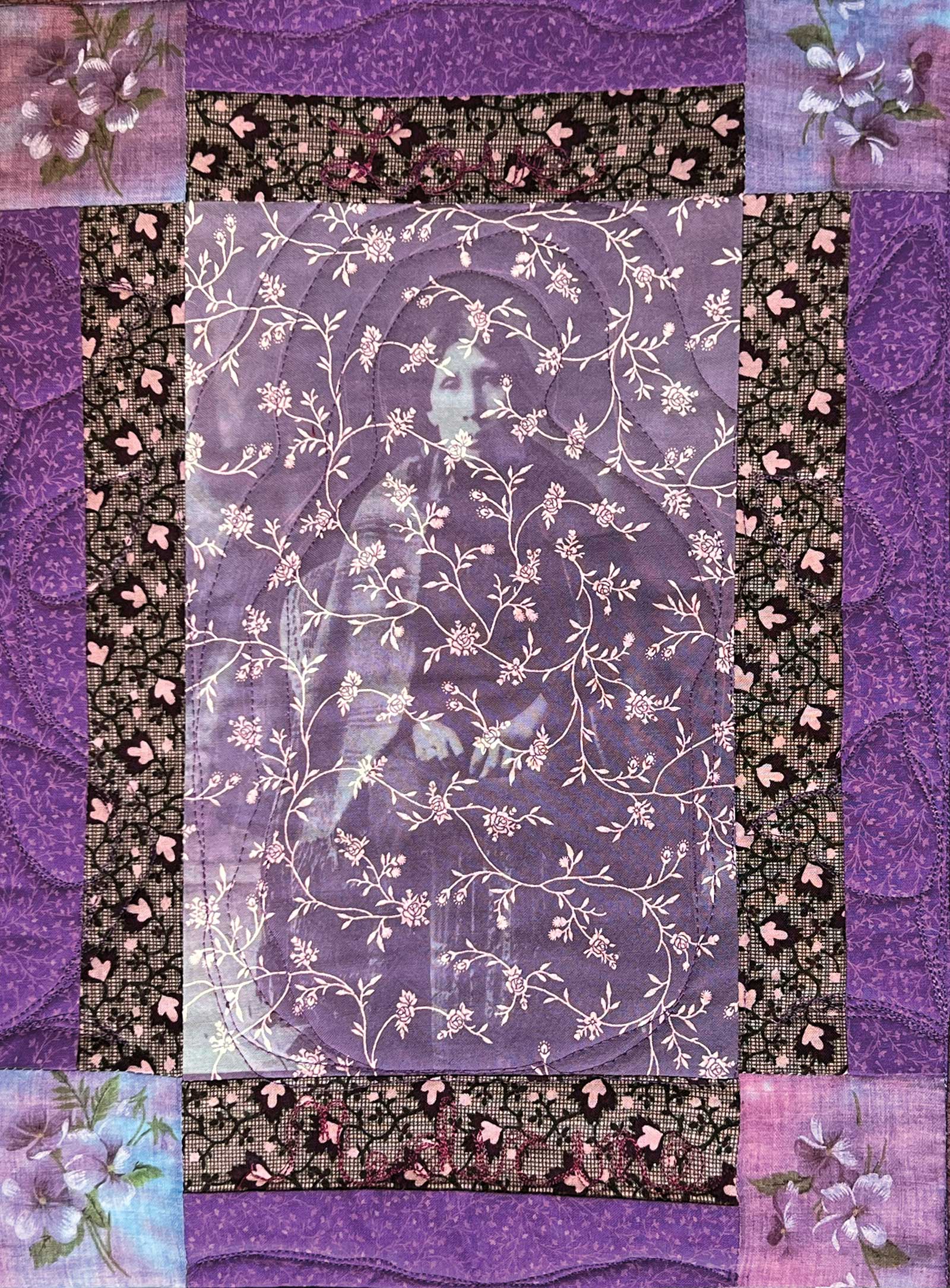
Love Medicine, solar fast image on cotton fabric, cotton batting and thread, 17 x 13 in.
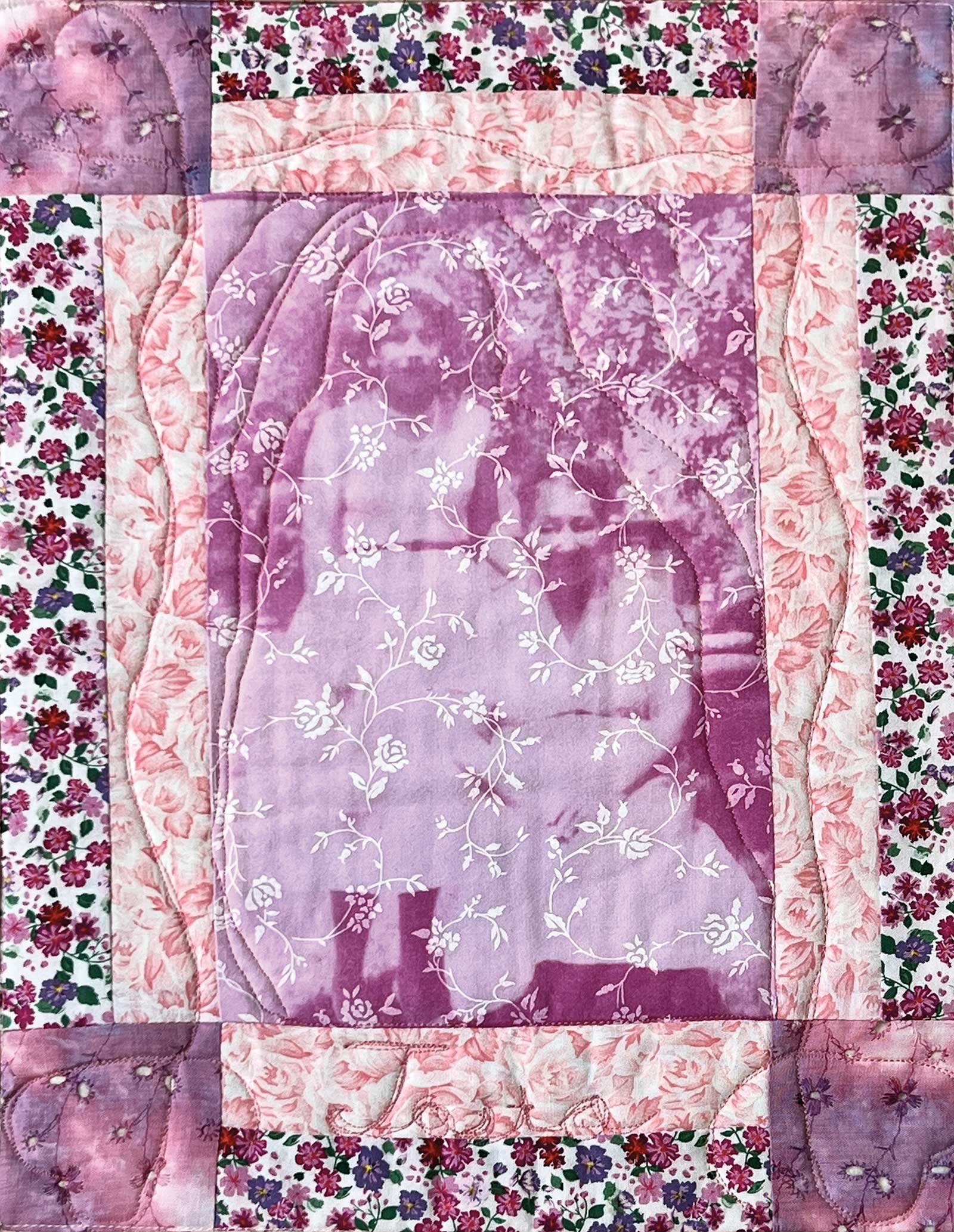
Tosta, solar fast image on cotton fabric, cotton batting and thread, 17 x 13 in.
When the Institute of American Indian Arts (IAIA) recruited Taylor at the 2022 Heard Museum Guild Indian Fair & Market, he saw an opportunity to push himself further. The low-residency MFA program attracted six students in his cohort; all established artists at different career stages but united by a common desire to challenge themselves and expand their practices.
Taylor’s time at IAIA coincided with personal loss when his grandmother passed away just as he began the program in 2023, and this grief became central to his graduate work. He began experimenting with quilting, thinking about the quilting circles common in Dakota communities, and how quilting had been imposed on Native women but had become traditional in their hands, and the profound significance of star quilts and blankets in Dakota life.
He discovered snow dyeing—a technique for creating fabric using snow itself—and began studying artists like Gwen Westerman, a Dakota scholar and textile artist, and Bisa Butler, whose portrait quilts drawn from historical photographs offered a model for how textiles could carry narrative weight. Taylor’s first major quilt, Crazy for Lovin’ You, was a portrait of his grandparents created using solar fast photo techniques. The title came from his grandfather’s favorite Patsy Cline song, and the piece explored themes of love, loss and spiritual reunion.
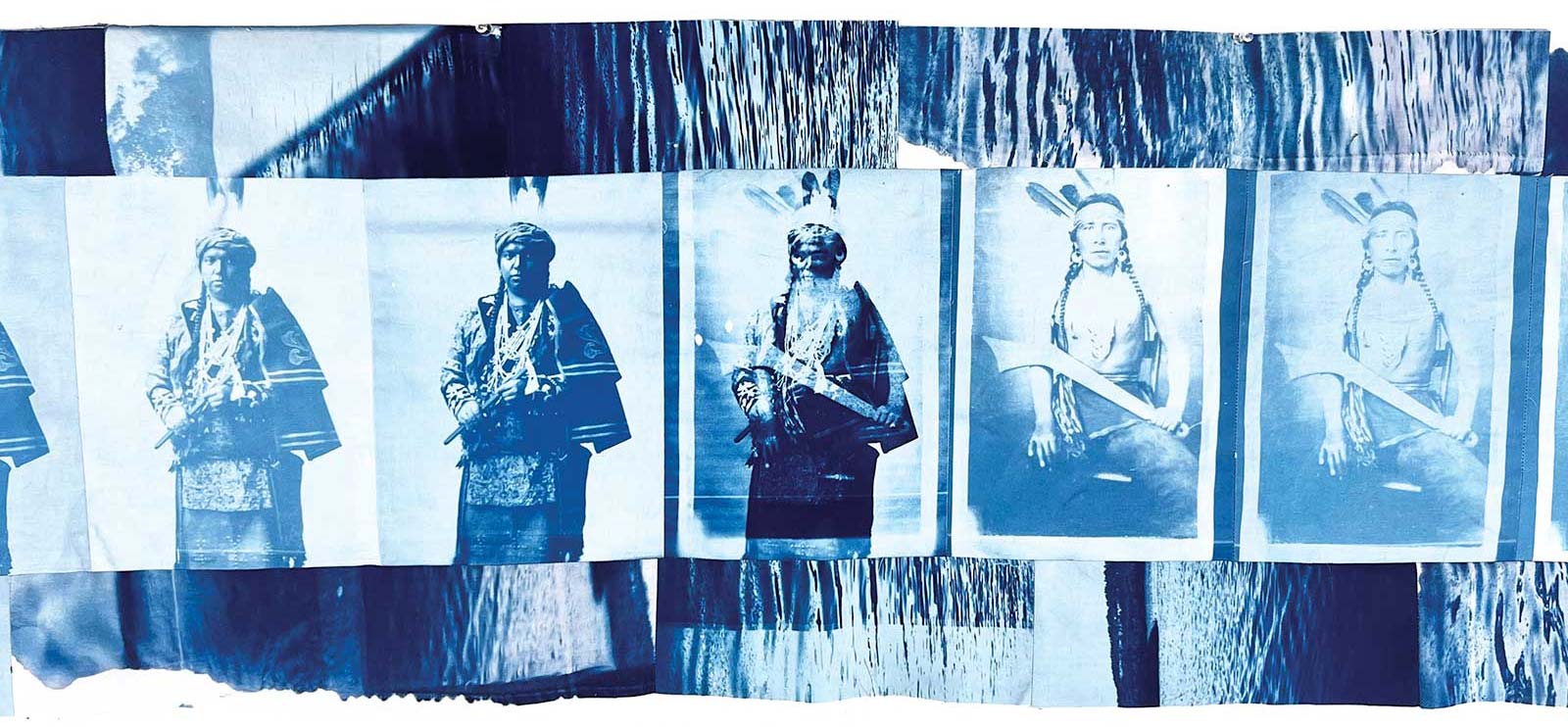
Ehanna: Reverberations, cyanotype images on cotton fabric, thread and cotton batting, 13 x 55 in.
The culmination of his MFA came in May 2025 with his first-ever self-portrait, an almost life-sized portrait quilt showing Taylor dressed in the manner of his 1860s ancestors. The same clothing style he wears for powwow dancing and ceremonies. The piece, titled takuna ehpewicawaye kte? (Dakota, what shall I leave for them?), centered Taylor himself in the conversation he’d been having with his ancestors throughout his career. Paired with four smaller works, which were placemats bearing portraits of his mother, grandmother, great-grandmother and great-great-grandmother, the installation honored his maternal lineage and the kitchen table as a site of cultural transmission and artistic creation.
Taylor continues working in textiles, preparing pieces for the 2026 Heard Museum Guild Indian Fair & Market. We can expect to see Taylor’s expansion into textile portraitures that stitch together cultural memory, traditions and contemporaneity. Simultaneously, we can expect to see his remarkable beadwork and quillwork skills that explore the bounds of diverse arts. For collectors and curators still discovering Taylor’s work, this is an artist whose practice is driven by rigorous research, personal investment and technical excellence. He’s not simply making beautiful objects, though his work is undeniably beautiful. He’s engaged in the much harder work of cultural reclamation—showing how contemporary Native art can honor the past while creating something entirely new.
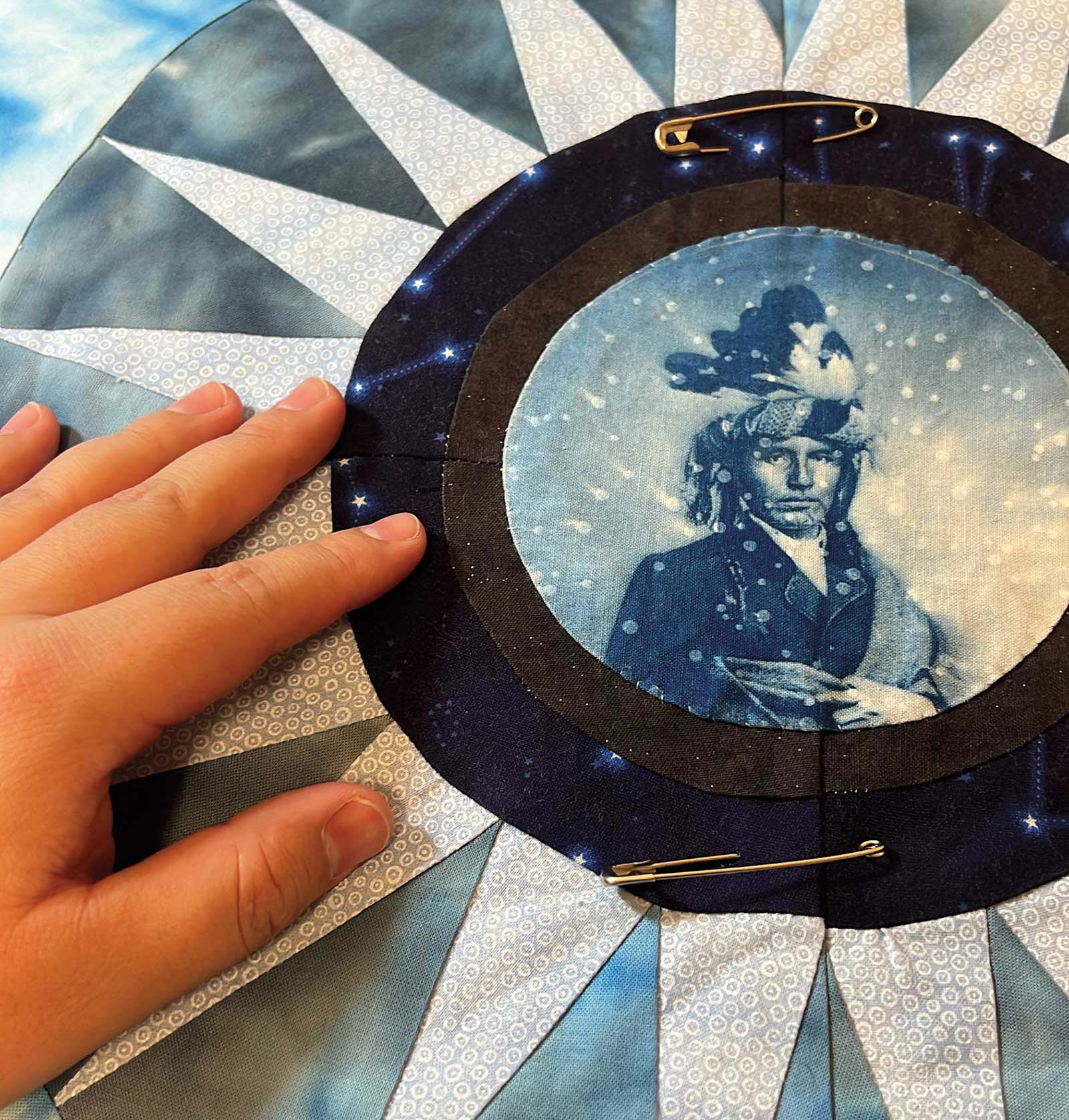
But his trajectory suggests something larger than individual exhibitions or awards. Taylor represents a new generation of Native artists who refuse to be confined by expectations, whether those expectations come from the Native art market, the contemporary art world, or anyone else. His work doesn’t apologize for being rooted in traditional techniques, nor does it shrink from conceptual complexity. He makes no distinction between the “craft” of beadwork and quilting, and the “fine art” of painting and installation. For Taylor, they’re all vehicles for connection with his ancestors, documenting cultural continuity, and ensuring that future generations will have something to hold onto. —
Jessa Rae Growing Thunder comes from the Fort Peck Assiniboine/Sioux tribes in northeastern Montana. She is a third-generation traditional beadwork and quillworker who has spent her life learning from her mother and grandmother. As a scholar, Jessa Rae is an Indigenous feminist historian who specializes in Indigenous-led arts research-creation.
Powered by Froala Editor


