Cherokee artist Kay WalkingStick’s landscape paintings speak to something even larger than the panoramic scenes they depict. An award-winning artist with achievements including the Eiteljorg Museum’s Distinguished Artist Award and the Joan Mitchell Foundation Award, WalkingStick works with oils and other materials to paint the American landscape, focusing on its connection to both Indigenous peoples and all American citizens.
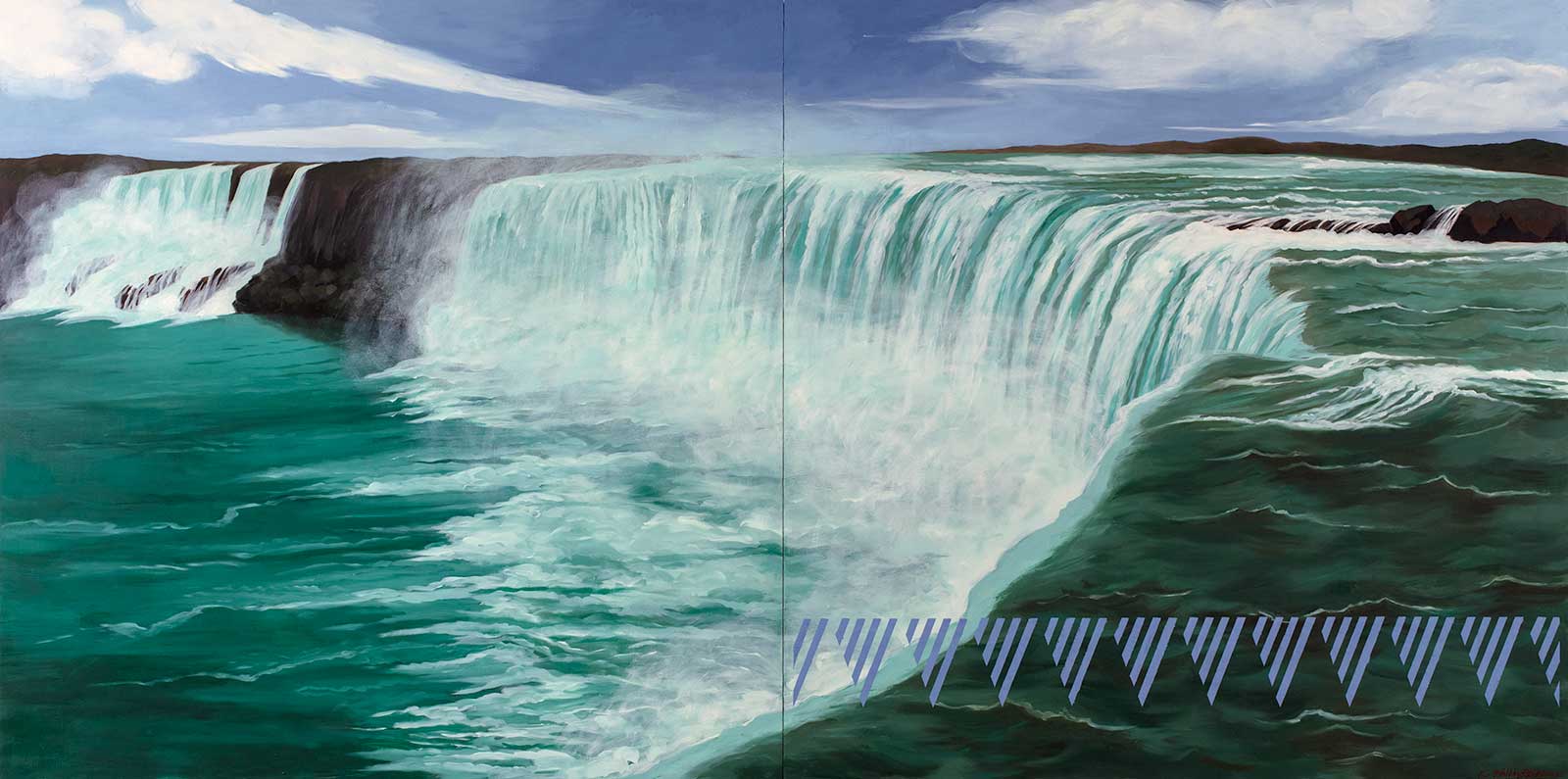
Kay WalkingStick (Cherokee), Niagara (diptych), 2022, oil on panel. The New York Historical, Purchased through the generosity of Agnes Hsu-Tang and Oscar Tang; Nancy Newcomb; Anonymous; Barry Barnett; Helen Appel; Belinda and Charles Bralver; Dorothy Tapper Goldman; Margi and Andrew Hofer; Louise Mirrer; Jennifer and John Monsky; Suzanne Peck and Brian Friedman; Pam and Scott Schafler; Barbara and Elliott Wagner; and Linda Ferber, 2023.2ab. © Kay WalkingStick.
As WalkingStick so aptly notes in an artist statement, “The landscape sustains us physically and spiritually. It is our beautiful corner of the cosmos.”
A new exhibition at the Heard Museum, organized by the New York Historical Society, explores WalkingStick’s landscapes in conversation with classic works from NYHC’s collection of Hudson River School paintings. More than 40 works will be on display from the prolific Cherokee painter as well as a number of historic artists like Asher B. Durand, Albert Bierstadt and John Frederick Kensett. But where the Hudson River paintings offer classic depictions of the North American landscape, WalkingStick’s works often feature various traditional Native American patterns. This can be observed in pieces like Niagara, Our Land Variation II and Wampanoag Coast, Variation II.
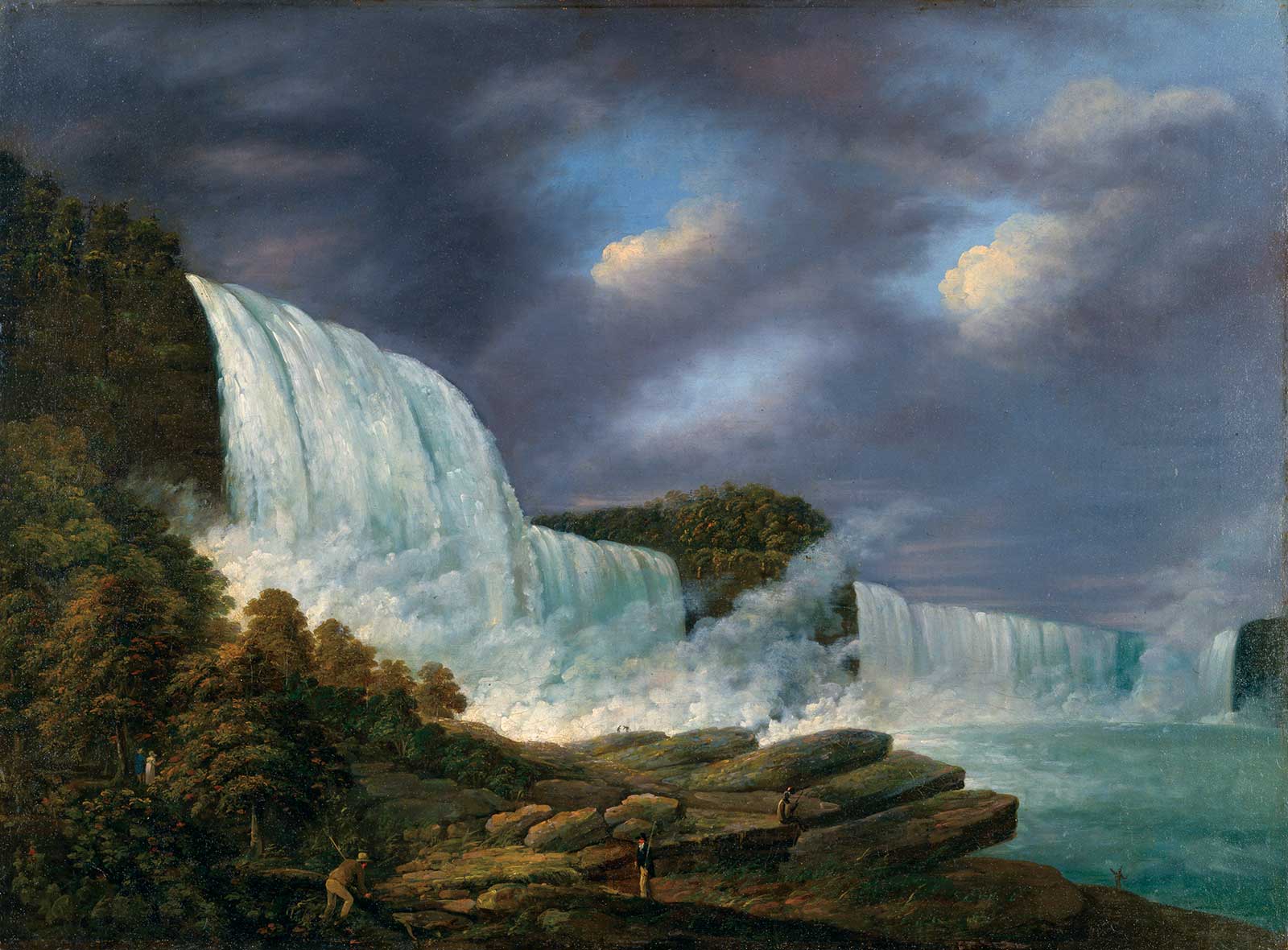
Louisa Davis Minot (1788-1858), Niagara Falls, 1818, oil on linen. The New York Historical, Gift of Mrs. Waldron Phoenix Belknap Sr. to the Waldron Phoenix Belknap Jr. Collection, 1956.4.
“This exhibition is both critical and celebratory of the Hudson River School tradition. It is important to Kay—and hence to me—that the show not only grapples with serious issues like colonization and land dispossession but also honor nature and leave visitors with a sense of joy in the beauty of this land,” says Wendy Nālani E. Ikemoto, curator at the New York Historical Society.
“Kay is a trailblazer. In her recent work, she claims space for Native Americans in the American landscape tradition, inserting Indigeneity into a Euro-American tradition that has historically denied Native agency and rights. I can speak only for myself, but as a Native Hawaiian working in American art, this is impactful and empowering. And I believe—visitors have told me as much—that it has been revelatory for those who hadn’t previously considered the absence of Native people in the history of American landscape painting. It can be easy to miss what you don’t see—and Kay helps us to see what’s been missing.”
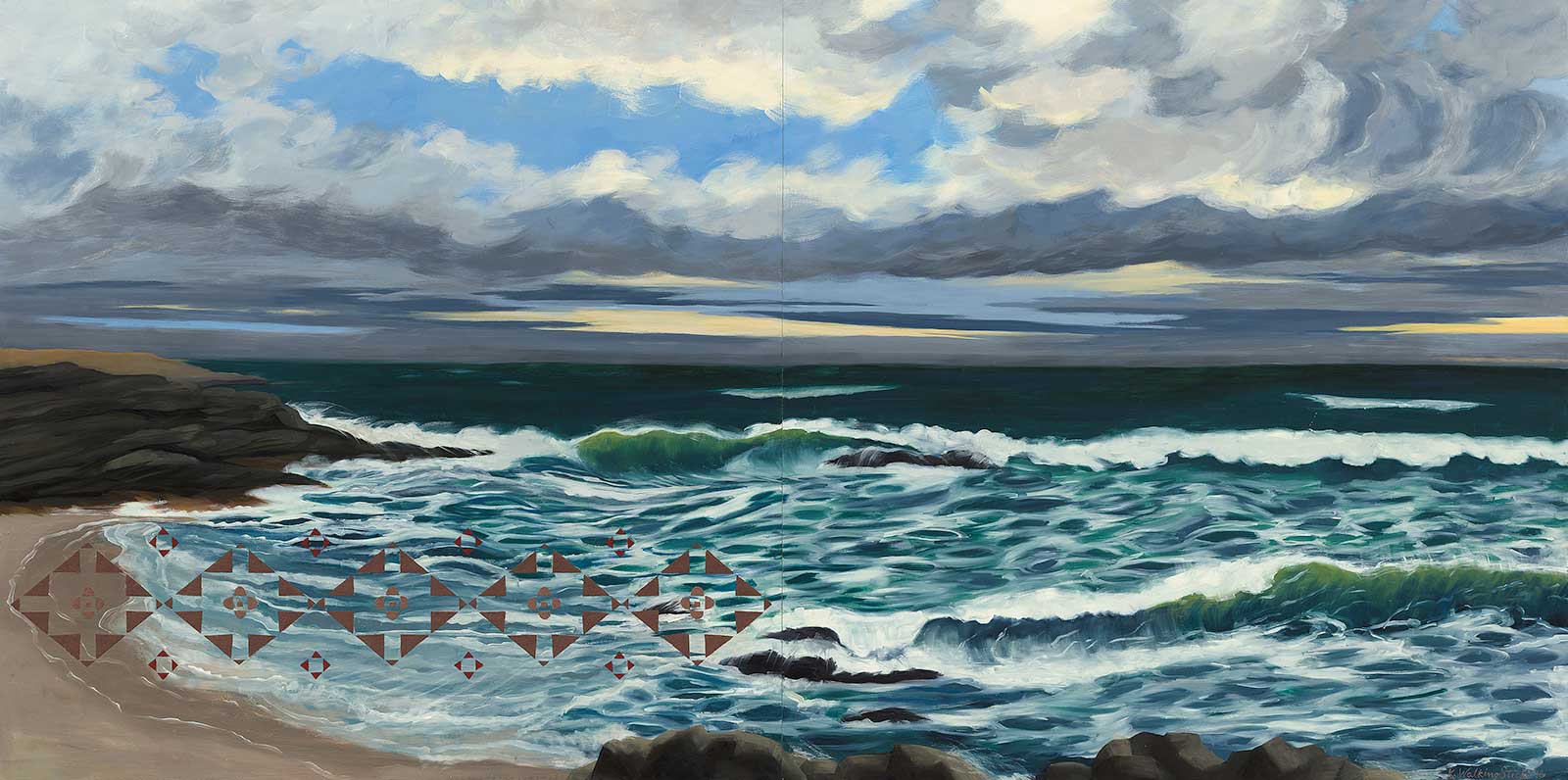
Kay WalkingStick (Cherokee), Wampanoag Coast, Variation II (diptych), 2018, oil on panel. Collection of Agnes Hsu-Tang, Ph.D., and Oscar Tang. © Kay WalkingStick.
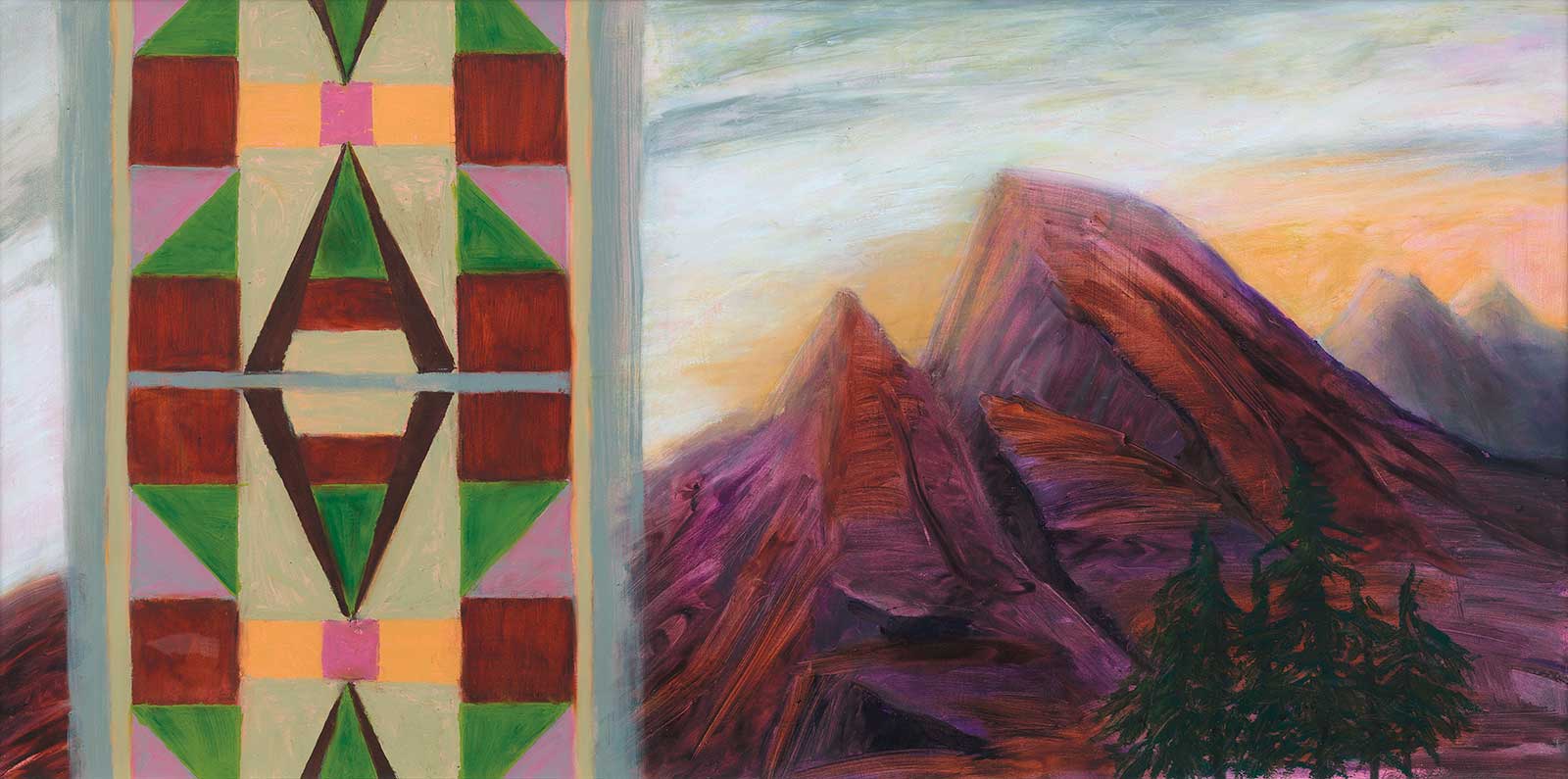
Kay WalkingStick (Cherokee), Our Land Variation II, 2008, oil stick on paper. Miller Meigs Collections. Photo by JSP Art Photography. © Kay WalkingStick.
WalkingStick’s 2022 diptych Niagara, which can be compared to Louisa Davis Minot’s 1818 Niagara Falls, both revels in and reclaims Niagara Falls. “WalkingStick captures their sublime sweep by suspending the viewer at the brink and spilling the water edge-to-edge across two square panels,” NYHC notes. A band of Haudenosaunee patterning is placed in the bottom right corner of the painting, honoring the Native Americans and First Nations peoples who first inhabited (and still live) within this region.
The modern-day artwork of WalkingStick and her 19th-century counterparts find common ground in their shared reverence for nature. “At first glance, Kay’s Satyr’s Garden might not appear to have any connection to the Hudson River School, but the work is a landscape. As Kay notes, it is a sensual garden that a satyr might like. And its sensuality extends into the way it’s painted,” says Ikemoto. “Kay mixed acrylic paint with a beeswax medium that smells of honey and spreads like mayonnaise, and she applied it directly with her hands. Imagine scooping up gobs of mayonnaise and spreading it around, she told me. The material is gooey and juicy—and her process gestural and bodily and celebratory. Her work rejoices in the luscious land and the sensual materials of nature. This is the same impulse Kay finds in Hudson River School paintings, created by artists trying to understand and express the tremendous beauty of the environment.”
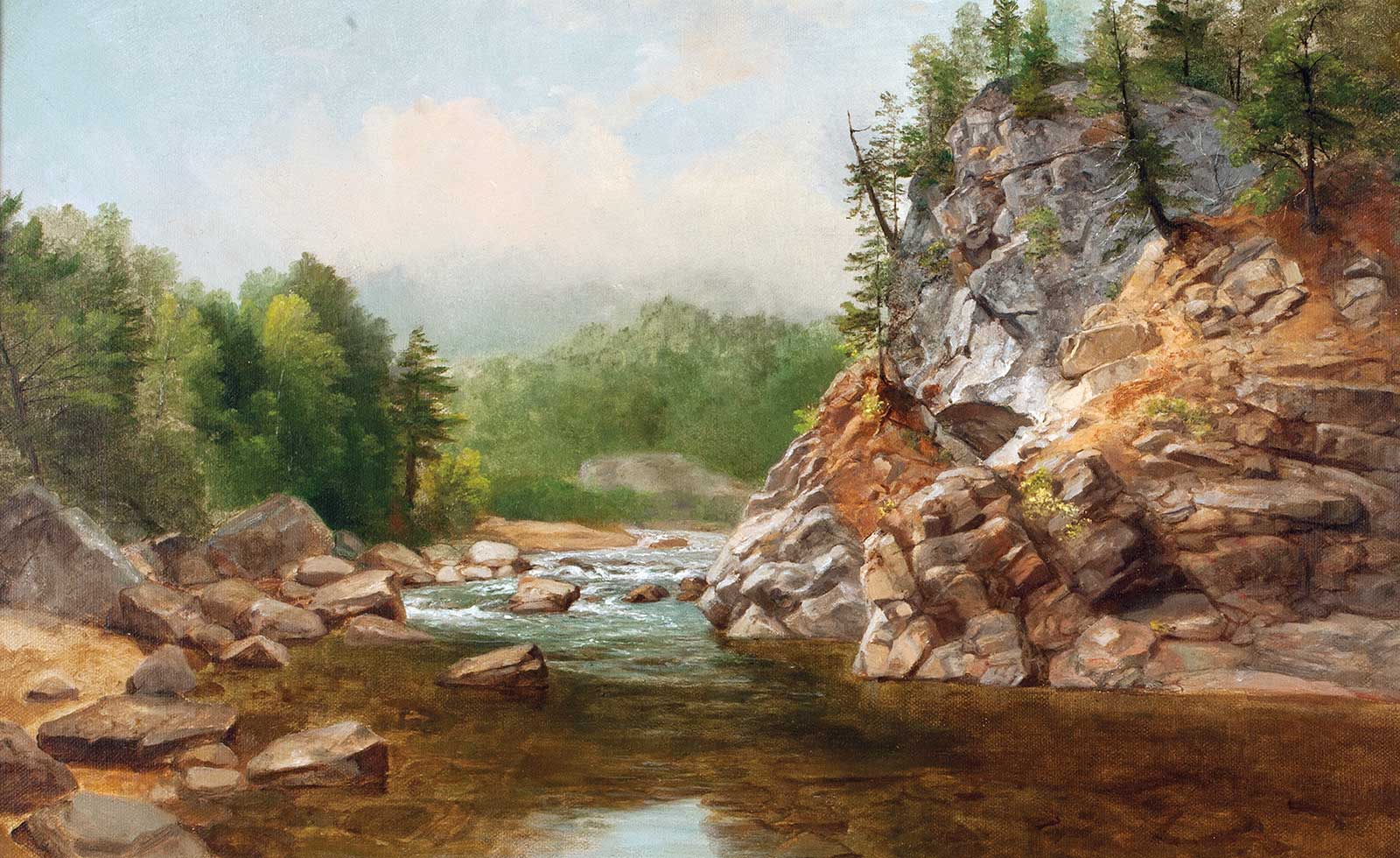
Asher B. Durand (1796-1886), East Branch of the Ausable River, 1837-78, oil on canvas. Long term loan courtesy of Mr. Chet Schmitt, New Britain Museum of American Art, 2003.76LTL. Image courtesy New Britain Museum of American Art.
Another deep-rooted connection between WalkingStick and the Hudson River School artists comes from the practice of plein air painting based on direct observation. For instance, in order to create her 1995 ink drawings of the Gihon River in Johnson, Vermont, near the Vermont Studio Center where she served as a visiting teacher and artist that year, WalkingStick sat directly in the river and mixed the flowing water into her sumi ink.
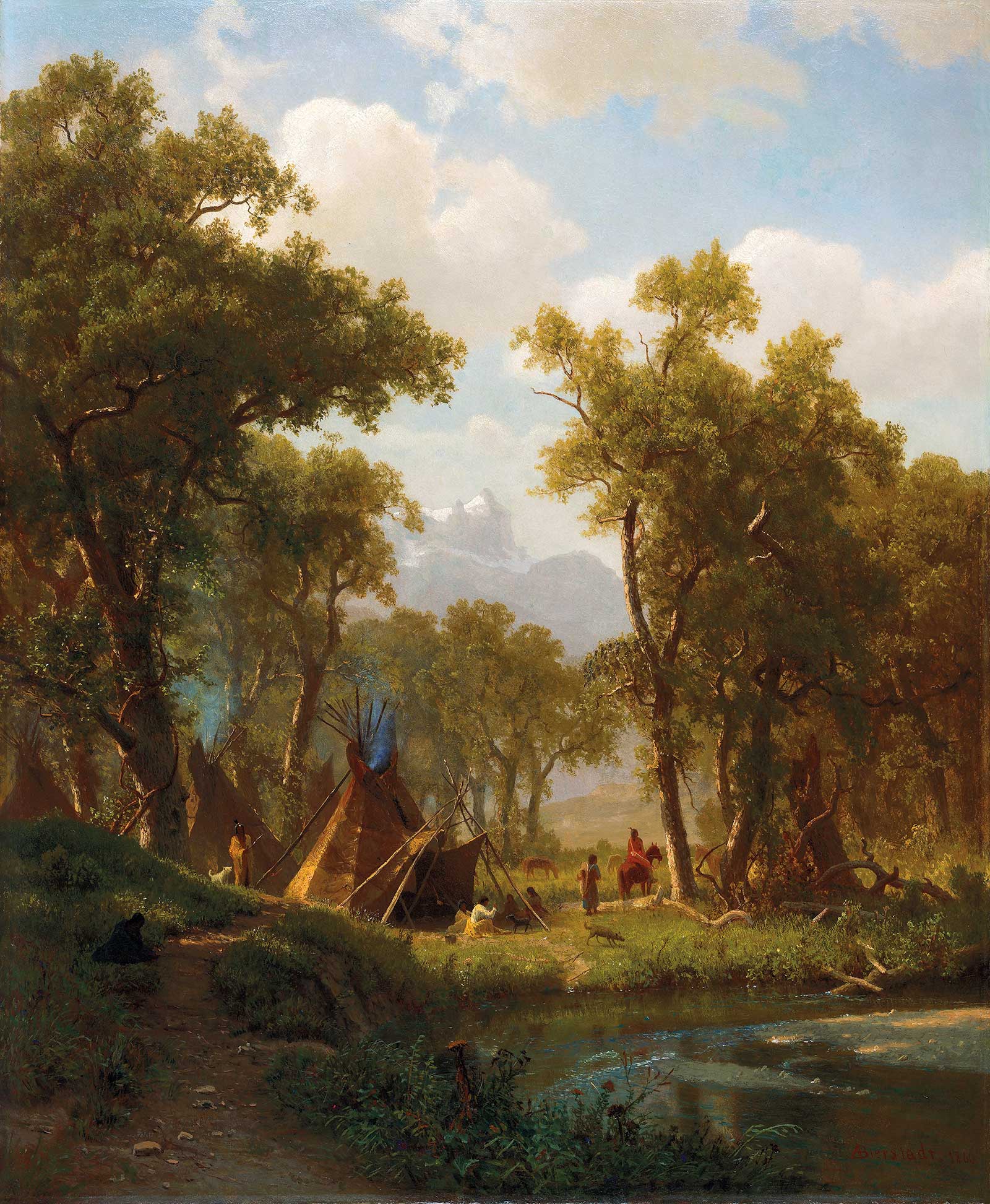
Albert Bierstadt (1830-1902), Indian Encampment, Shoshone Village, 1860, oil on millboard. The New York Historical, The Robert L. Stuart Collection, the gift of his widow Mrs. Mary Stuart, S-52.
“In other words, her marks are indexical: this is river water literally flowing over the paper,” Ikemoto adds. “Hudson River School artist Asher Durand aimed for a similar type of convergence of art and subject, urging a student in 1855 to ‘paint and repaint until you are sure the work represents the model—not that it merely resembles it.’ Some of his paintings embed detritus like dirt and bits of insects from being made outdoors, and so true to nature are his paintings that some of them are currently being used to help scientists learn about now largely lost old growth forests. Of course, there are also important differences between Kay’s and Durand’s work. Unlike Durand, Kay is interested not in exact description but in the abstract patterns found in nature. Her work is about the inherent abstraction of the water surface—its moving patterns—as well as the pulse and flow of the water, which she would have been feeling against her body as she sat painting in the river.”
Kay WalkingStick/Hudson River School will hang at the Heard Museum from January 23 to May 25. —
January 23-May 25, 2026
Kay WalkingStick/
Hudson River School
Heard Museum
2301 N. Central Avenue, Phoenix, AZ 85004 (602) 252-8840, www.heard.org
Powered by Froala Editor


