Growing up on the coast of Massachusetts half-way between Boston and Plymouth, the first public sculptures I became familiar with were two of Cyrus Dallin’s sculptures of Native Americans—Massasoit, overlooking Plymouth Rock and the harbor, and Appeal to the Great Spirit at the entrance to the Museum of Fine Arts, Boston.
More than 11 feet tall and standing on a rock at the top of Cole’s Hill in Plymouth, Massasoit is awesome. Massasoit was his title, “Great Sachem,” but the English colonists thought it was his actual name. His Wampanoag name was Ousamequin, “Yellow Feather.”
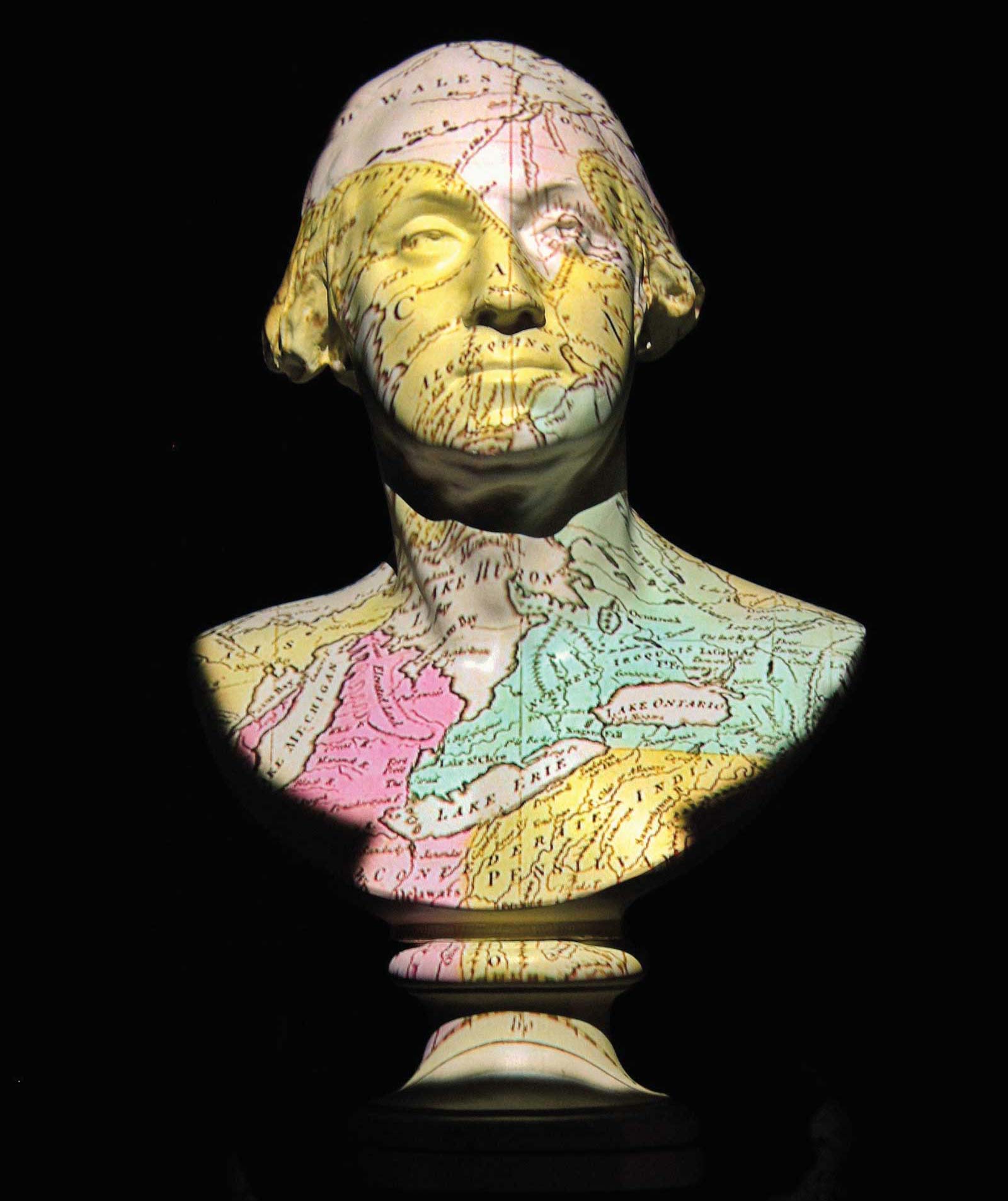
Alan Michelson (Mohawk member of the Six Nations of the Grand River), Hanödaga:yas (Town Destroyer), ed. 1 of 3, 2018, high-definition video, bonded stone replica of Jean-Antoine Houdon’s late 1700s bust of George Washington, antique surveyor’s tripod, and artificial turf. Sound: members of Six Nations of the Grand River Territory. Digital video looped, 5:57 minutes. Peabody Essex Museum. Museum purchase, by exchange.
The sculpture was commissioned to commemorate the 300th anniversary of the arrival of the pilgrims by the Improved Order of Red Men, a fraternal, social, insurance and political society whose membership was exclusively white males. It promoted patriotism and charity but appropriated aspects of Native American culture while excluding Native people from membership.
The complex and often apocryphal stories of English settlers and Native people often surface around public sculpture. Near the setting for Massasoit is another rock with a bronze plaque stating, “Since 1970, Native Americans have gathered at noon on Cole’s Hill in Plymouth to commemorate a National Day of Mourning on the U.S. Thanksgiving holiday. Many Native Americans do not celebrate the arrival of the Pilgrims and other European settlers. To them, Thanksgiving Day is a reminder of the genocide of millions of their people, the theft of their lands, and the relentless assault on their culture. Participants in National Day of Mourning honor Native ancestors and the struggles of Native peoples to survive today. It is a remembrance and spiritual connection as well as a protest of the racism and oppression which Native Americans continue to experience.”
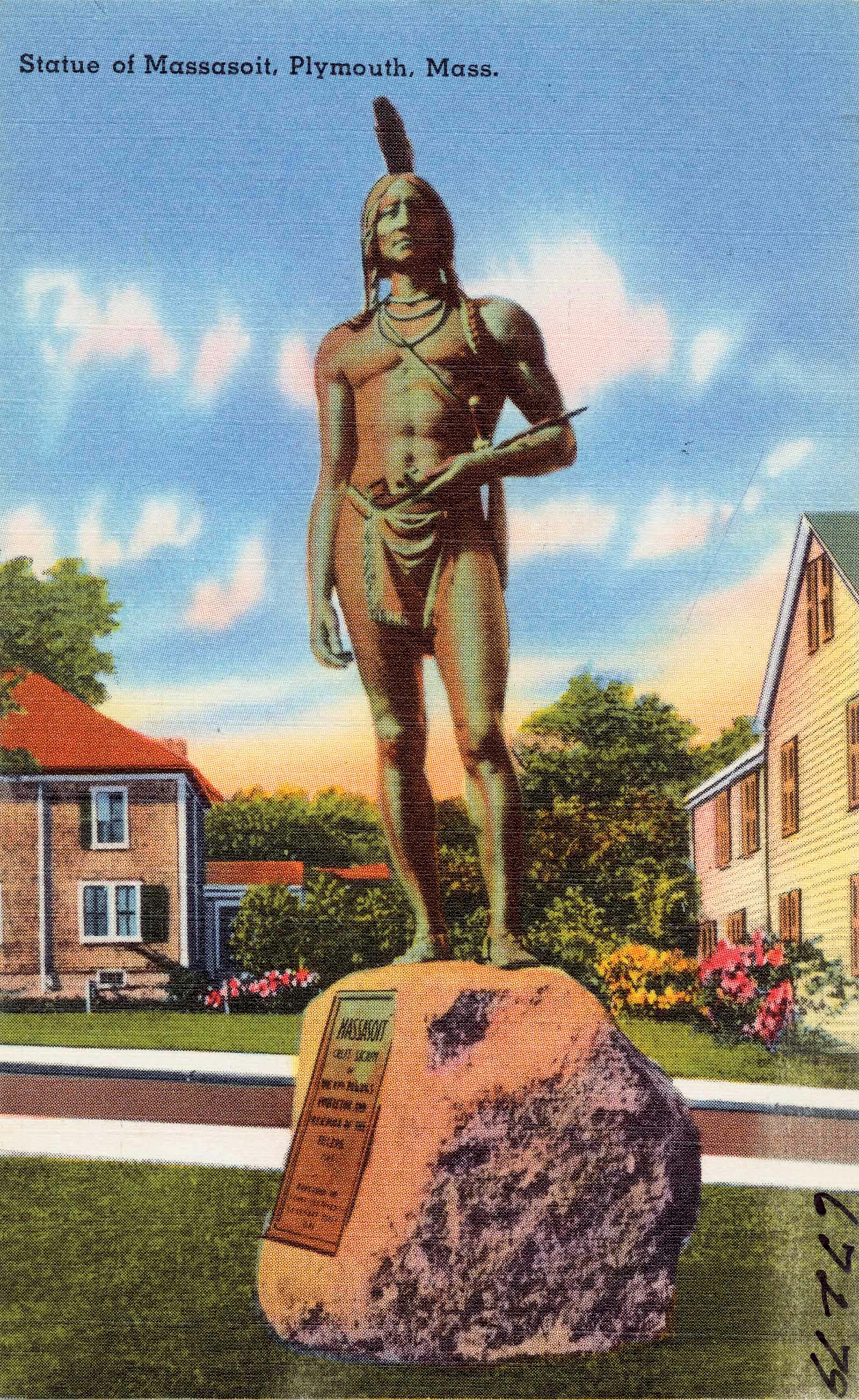
Statue of Massasoit, Plymouth, Mass., postcard, linen texture, color, 5½ x 3½ in. Boston Public Library Tichnor Brothers collection, Boston, MA.
Although there are many interpretations of Dallin’s sculptures, he was an important advocate for his subjects. The Cyrus Dallin Art Museum in Arlington, Massachusetts, comments, “In the 1920s, he held the great honor of serving on the board of the Indigenous-led Algonquin Indian Council of New England. His colleague on the council, LeRoy Perry (Wampanoag) shared this touching sentiment: ‘Dr. Cyrus E. Dallin, a sculptor who has done more to perpetuate the red man in his characteristic poses as hunter, warrior, medicine man and at workmanship than any other living man—a true friend and one whom we honor and respect. Great is Dallin!’”
North of Boston, in Salem, is the Peabody Essex Museum whose director for 25 years, Dan Monroe, retired in 2019. He oversaw an extraordinary expansion of the museum’s endowment, physical facilities, place in the wider museum community, and the presence of Native American art and people. He was also one of the original authors of the Native American Graves Protection and Repatriation Act (NAGPRA), which is federal legislation enacted in 1990 regarding repatriation of Native American human remains and cultural items. Monroe served three terms on the National NAGPRA Review Committee.
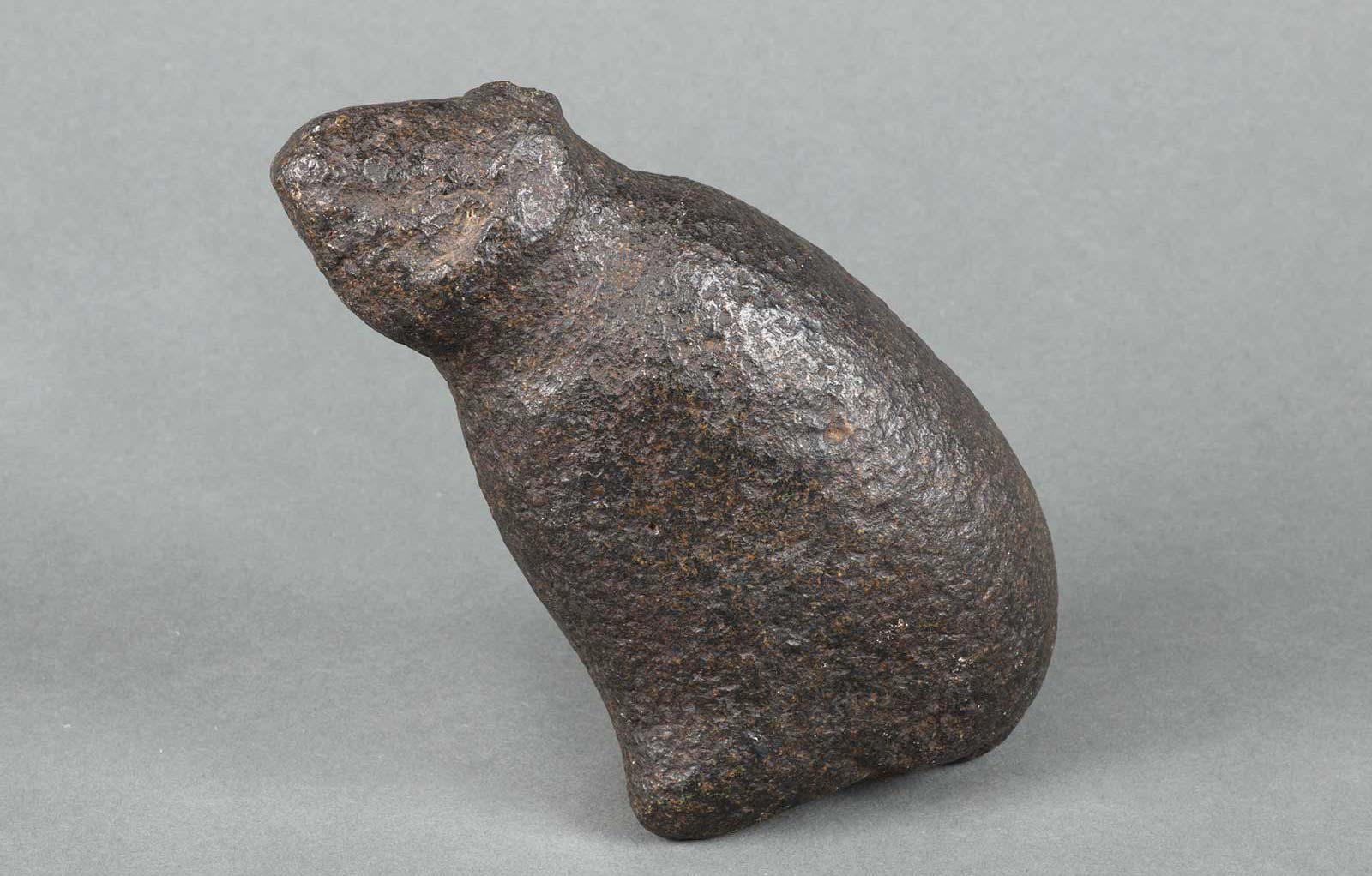
Sculpture, 1500s, likely Pawtucket band of Massachusett artist, name once known, Naumkeag (now Salem, Massachusetts). Basalt. Peabody Essex Museum. Gift of Miss Bessie Eaton, 1898.
His successor, Lynda Roscoe Hartigan, who, in 2003, was named the museum’s first chief curator and, in 2016, deputy director, worked closely with Monroe on defining PEM’s future. Hartigan has also served as chief curator at the Smithsonian American Art Museum and deputy director for collections and research and chief innovation officer at the Royal Ontario Museum.
Innovation is an active word at the museum. Karen Kramer is curator of Native American and oceanic art and culture, and she directs PEM’s Native American Fellowship program. The program provides training for rising Native American leaders in the museum, cultural and academic sectors. She joined the museum staff in 2002 after serving two years as a research assistant at the Smithsonian Institution National Museum of the American Indian. Among her groundbreaking exhibitions at PEM is On This Ground: Being and Belonging in America, which she co-curated with Sarah Chasse, curator-at-large, who has worked with the museum’s American collections since 2003.
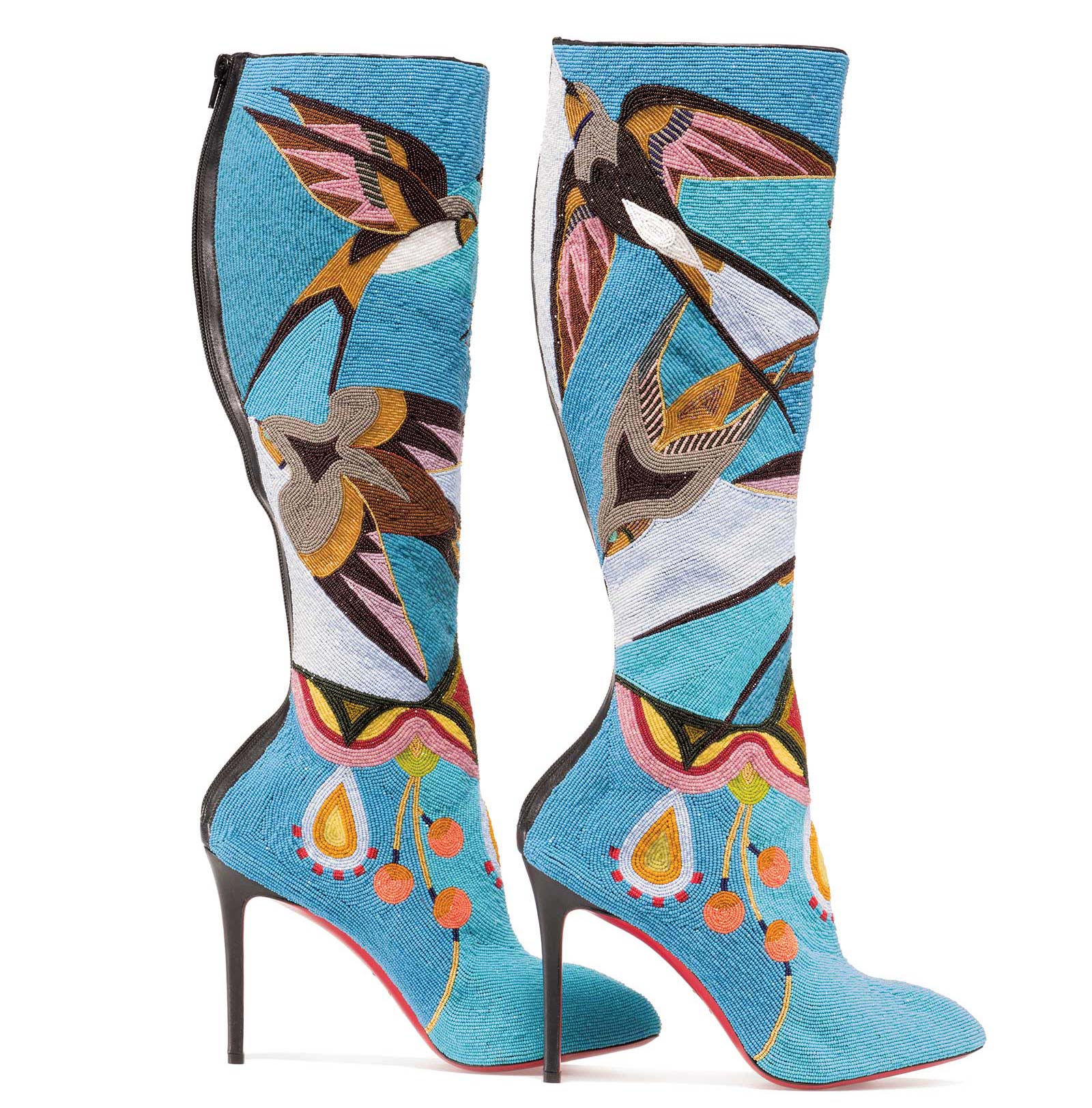
Jamie Okuma (Luiseño and Shoshone-Bannock), Boots, 2014, glass beads on boots designed by Christian Louboutin. Peabody Essex Museum, Salem, MA. Museum commission with support from Katrina M. Carye, John Curuby, Karen Keane and Dan Elias, Cynthia Gardner, Merry Glosband, and Steve and Ellen Hoffman and the Willoughby Stuart Memorial Fund. 2014.44.1AB.
The days of Native American artifacts in dusty display cases labeled as the anonymous work of long-dead people are, happily, gone. Museums across the country are collaborating with their local communities and representatives of Indigenous communities to explore ways to present Native traditions and the work of innovative contemporary artists.
The material for On this Ground answered a gnawing question I’ve had about the use of the word “unknown” in museum labels. A PEM exhibition panel states, “Museums have long collected and displayed historical Native American objects without identifying individual makers and have instead emphasized tribal affiliations, functional uses and geographic regions. In our labels, we are using the phrase ‘name once known’ to recognize and restore the individual humanity of Native artists whose names cannot be recovered. This shift in approach is a direct response to outdated and dehumanizing museum practices of the past.”
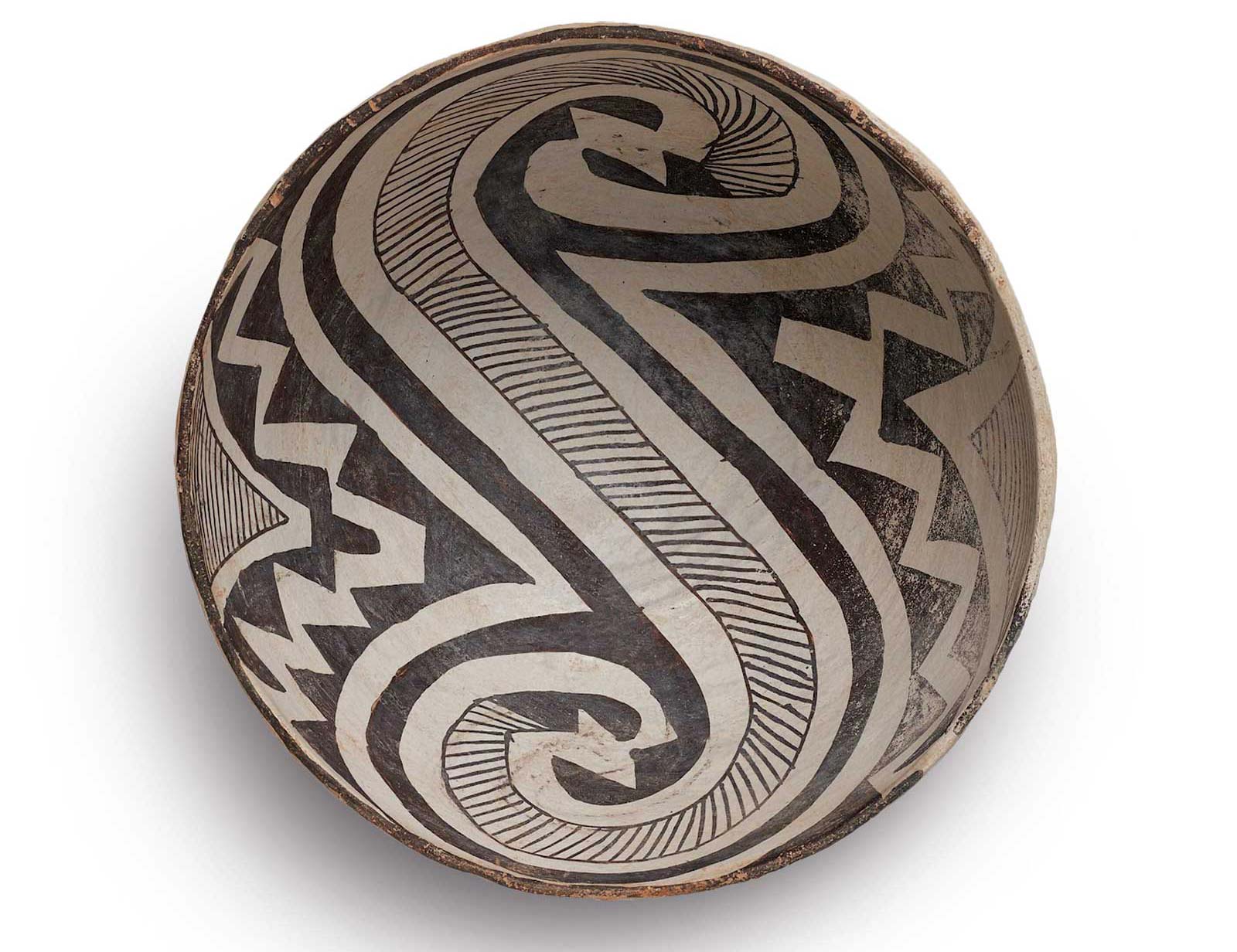
Ancestral Pueblo potter Bowl, ca. 950-1100, earthenware, 5 x 8 x 8 in. Fine Arts Museums of San Francisco, Gift of the Thomas W. Weisel Family to the Fine Arts Museums of San Francisco, 2013.76.26. Photograph by Randy Dodson, courtesy of the Fine Arts Museums of San Francisco.
Kramer notes, “The Peabody Essex Museum is the first American museum to bring together Native American art and American art on an equal footing. No other museum in the nation is doing that to the degree that we are doing that here.”
An extraordinary early piece in the collection is a basalt sculpture of a bear from the 1500s, labeled, “Likely Pawtucket band of Massachusett artist, name once known.” The label explains, “An Indigenous artist from this region likely created this stylized sculpture of a black bear. This object can be seen as a representation of the interconnectedness between humans and the natural world and as an expression of a strong relationship with the land. This bear may have been created just decades before European settlers arrived in 1626 in the place we now call Salem, displacing the Pawtucket peoples already living there.”
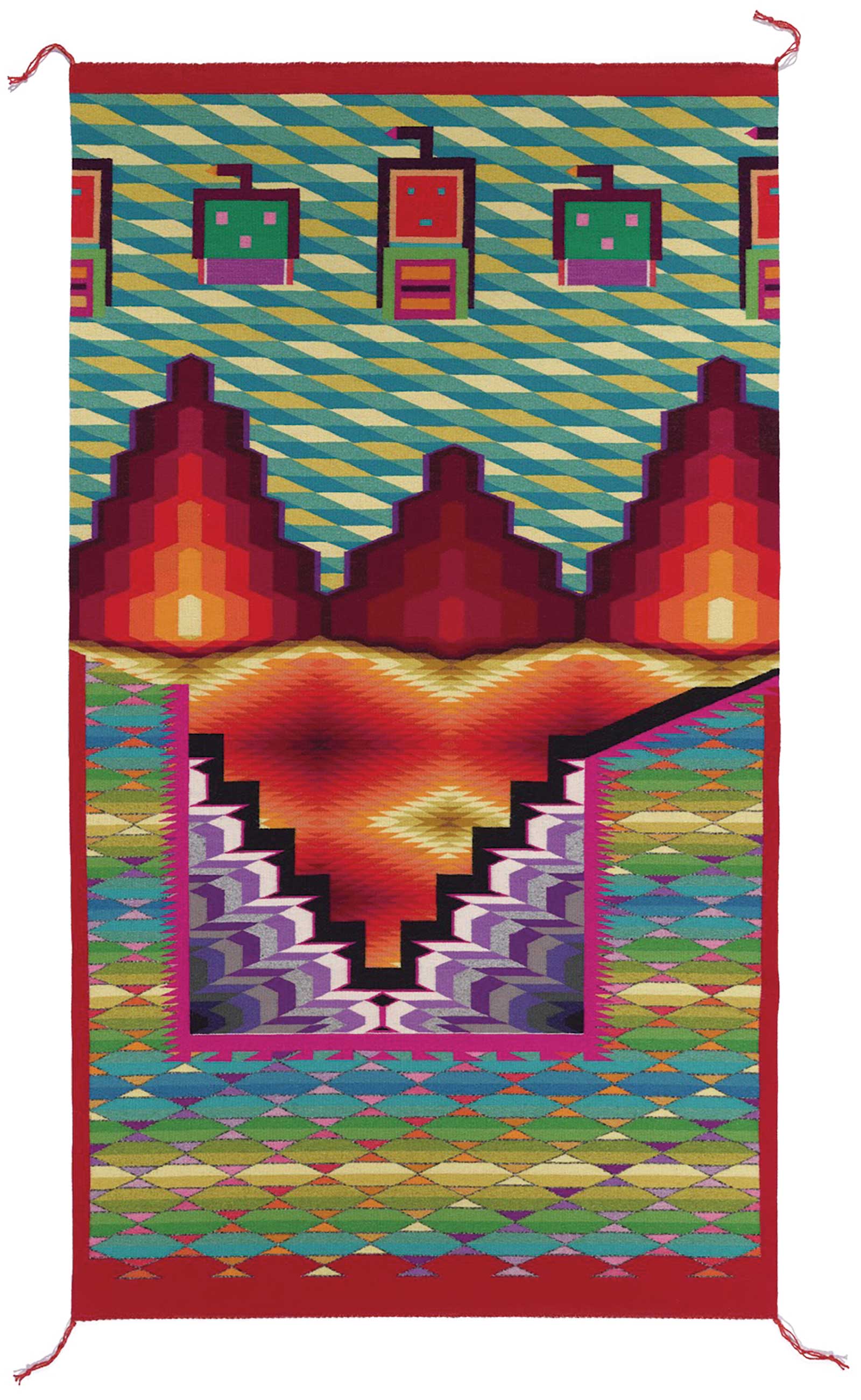
Melissa S. Cody (Navajo (Diné)), Sailing the Cosmos, 2024, wool warp, weft, selvedge cords and aniline dyes, 86½ x 49 in. Fine Arts Museums of San Francisco, Museum purchase, Phyllis C. Wattis Fund for Major Accessions, 2022.55. Artwork © Melissa S. Cody. Photograph by Randy Dodson, courtesy of the Fine Arts Museums of San Francisco.
Among the contemporary pieces in the collection is a pair of beaded boots, 2014, by Jamie Okuma (Luiseño/Shoshone-Bannock). The exhibition label continues, “Jamie Okuma hand-stitched thousands of antique beads onto these luxury boots—only their famous red soles, a symbol of French aristocracy, remain exposed…These fierce boots express how, for Okuma, Native concepts of dress and beauty are inextricably bound to identity and tradition.”
Alan Michelson (Mohawk member of the Six Nations of the Grand River) projects historical maps, documents, portraits and site markers onto a reproduction of Jean-Antoine Houdon’s bust of George Washington. “The archival images trace the history of the 1779 campaign against the Haudenosaunee people. General Washington ordered ‘total destruction and devastation’ of their homelands in current-day upstate New York in waging the American Revolution. Led by Major General John Sullivan and Brigadier General James Clinton, the troops seized livestock and goods, and burned 60 villages to the ground. Washington’s armies forced more than 5,000 Haudenosaunee to flee as war refugees and experience land dispossession, famine and death. These actions earned Washington the name Hanödaga:yas, or ‘Town Destroyer,’ which singers chant in various dialects.”
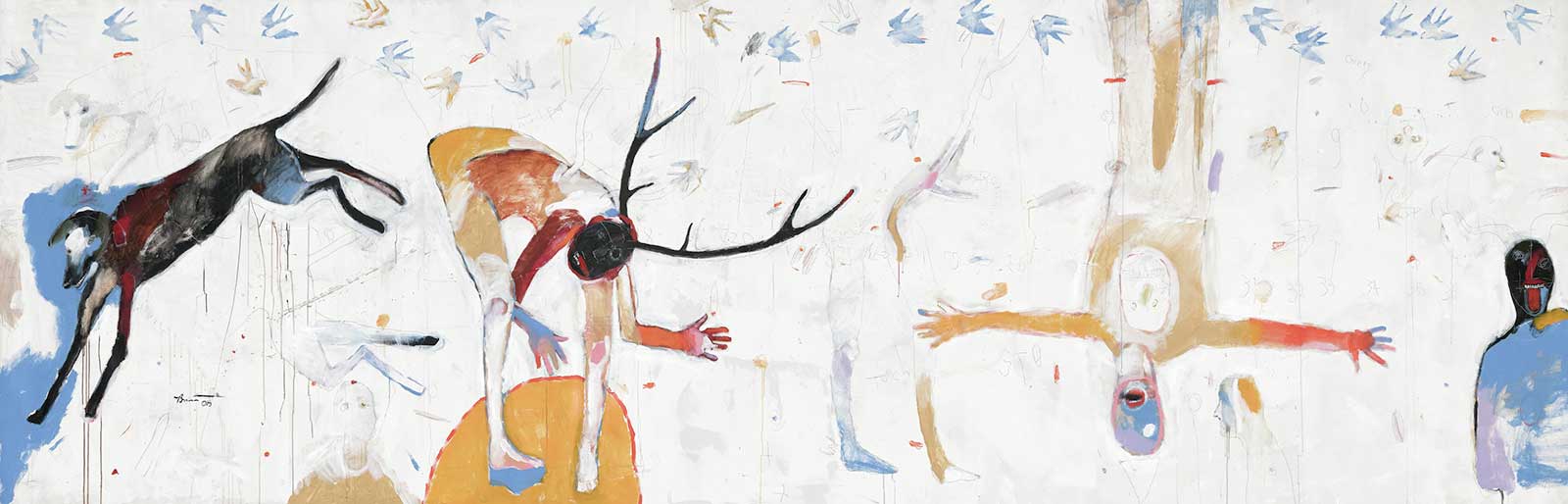
Rick Bartow (Wiyot, 1946-2016), The Magical Mind in Rural America, 2015, acrylic and graphite on unstretched canvas, 73½ x 219½ in. Fine Arts Museums of San Francisco, Museum purchase, Phyllis C. Wattis Fund for Major Accessions, 2024.16 Artwork © Rick Bartow Trust Photograph by Randy Dodson, courtesy of the Fine Arts Museums of San Francisco.
Last year, the Museum of Fine Arts, Boston unveiled Michelson’s sculptures The Knowledge Keepers, installed on empty plinths behind Dallin’s sculpture. The figures are contemporary local Indigenous cultural stewards. The museum explains, “Michelson’s selection of them as models emphasizes their roles as cultural models. By extension, The Knowledge Keepers seeks to honor and celebrate the beauty, presence, agency and endurance of the Indigenous nations of Massachusetts.”
Across the country, the de Young Museum in San Francisco recently opened a new presentation of Native American art “celebrating the vibrancy and diversity of Indigenous arts of the Americas. Visitors will experience works spanning over a thousand years of history and incorporating many diverse types of media, challenging expectations about what Native art is and can be.”
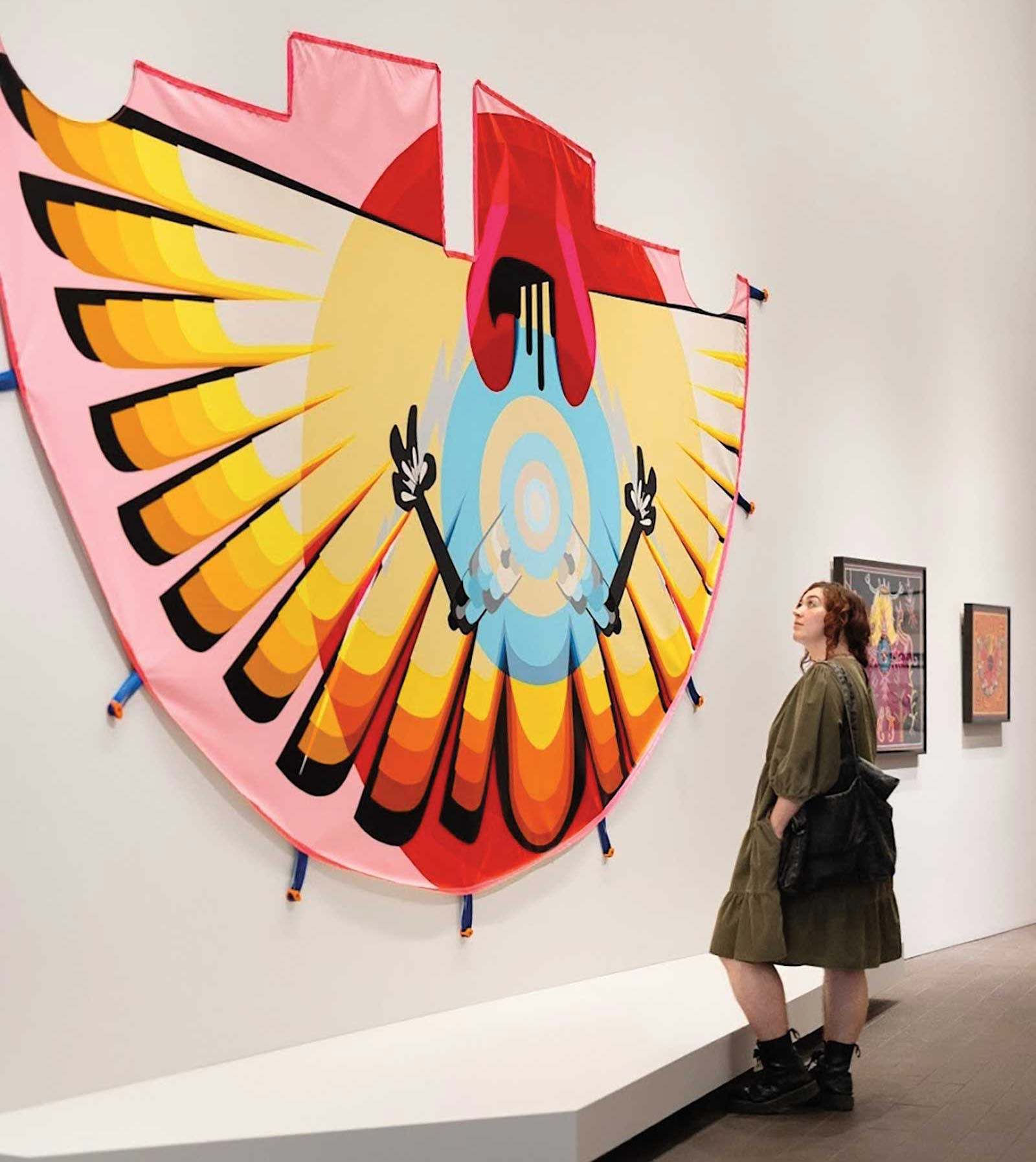
Installation view of Arts of Indigenous America at the de Young Museum, San Francisco, CA, 2025. Cannupa Hanska Luger (Mandan/Hidatsa/Arikara/Lakota), Special Forces, 2025, acrylic and mixed media on canvas, 110 x 193 in. Fine Arts Museums of San Francisco, Museum purchase, Phyllis C. Wattis Fund for Major Accessions, 2024.45a-j Artwork © Cannupa Hanska Luger, courtesy of the artist and Garth Greenan Gallery, NY Photograph by Gary Sexton, courtesy of the Fine Arts Museums of San Francisco.
Arts of Indigenous America was organized by a team of primarily Native curators. Hillary C. Olcott, curator of arts of the Americas, explains, “We have opted for a multi-vocal interpretative framework instead of a single curatorial perspective. Our hope is that this will bring a liveliness to the galleries and will re-center people within the stories of this art.”
Works in the reinstallation range from Rick Bartow’s 18-foot-wide canvas The Magical Mind in Rural America, 2015, to a 5-by-8-inch bowl, circa 950-1100, by an Ancestral Pueblo potter.
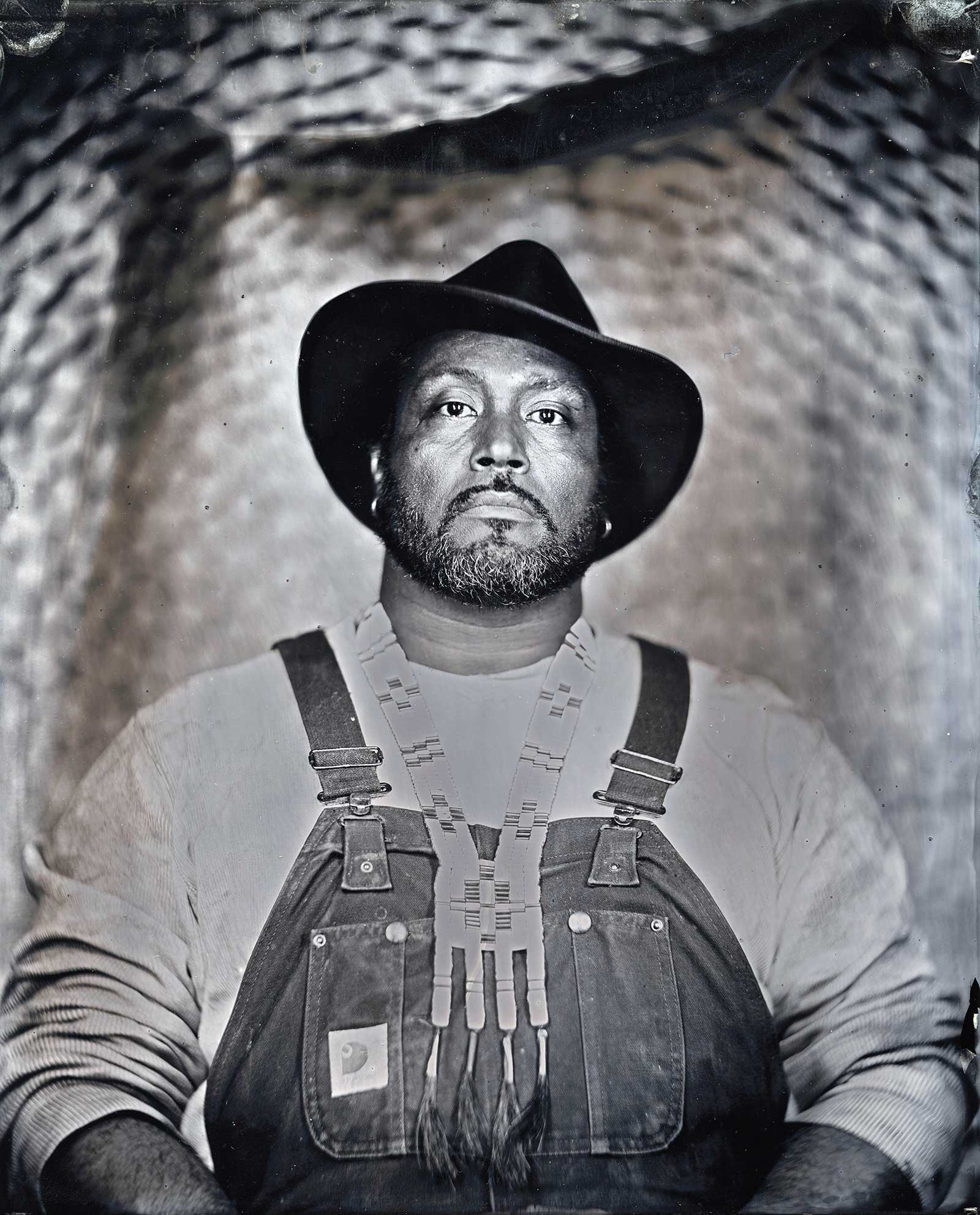
Will Wilson, (Navajo (Diné)), David Weeden (Mashpee Wampanoag), from the ongoing Critical Indigenous Photographic Exchange series, 2019. Archival pigment print from wet plate collodion scan, printed 2021. Peabody Essex Museum. Museum purchase, made possible by the Ellen and Stephen Hoffman Fund for Native American Art Acquisitions. 2021.26. Courtesy of the artist: willwilson.photoshelter.com.
Museums are acknowledging their presence on Native land. A bronze plaque on the Fifth Avenue façade of the Metropolitan Museum reads: “The Metropolitan Museum of Art is situated in Lenapehoking, homeland of the Lenape diaspora and historically a gathering and trading place for many diverse Native peoples, who continue to live and work on this island. We respectfully acknowledge and honor all Indigenous communities—past, present and future—for their ongoing and fundamental relationships to the region.” —
Powered by Froala Editor


