Virgil Ortiz is truly a revolutionary multi-media artist. Not only is the Cochiti Pueblo artist known as one of the most innovative potters of his time, Ortiz has also made a name for himself in the fields of décor, fashion, video and film, and for his ability to bring them all together into a cutting edge art form all his own.
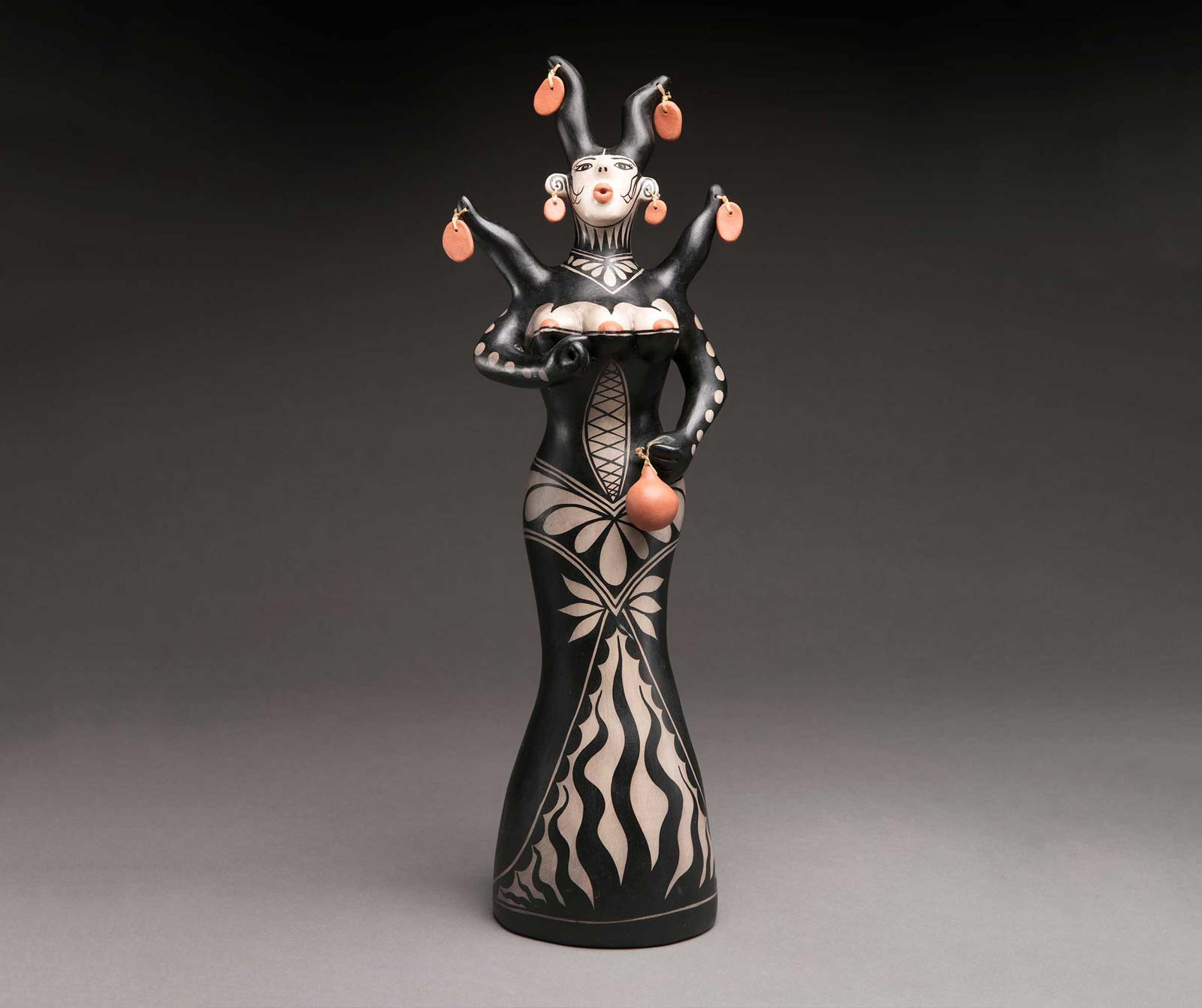
Opera singer figure, ca. 1999, clay.
Ortiz draws from and upholds his artistic and cultural Cochiti heritage, and translates it into a contemporary language that blends apocalyptic themes, science fiction and storytelling. Themes of revolution course through his work so it’s fitting that the August 10 opening of an exhibition of Ortiz’s work at the Wheelwright Museum of the American Indian coincides with the anniversary of the 1680 Pueblo Revolt. The Revolt was a revolution against Spanish oppression imposed upon the Pueblos, and the only successful Native uprising against a colonizing power.
Recent works from Ortiz’s Revolt 1680/2180 series are among the roughly 30 works that comprise the exhibition Gestural in Form, and span the past four decades. “Ortiz’s Revolt 1680/2180 is fascinating,” says Will Riding In, the museum’s curator of collections and engagement. “The characters in the series each have a back story and play a role in a futuristic sci-fi storyline which blends Pueblo history. Ortiz uses his art to inform audiences about the 1680 Pueblo Revolt, as these histories are not often taught in school.
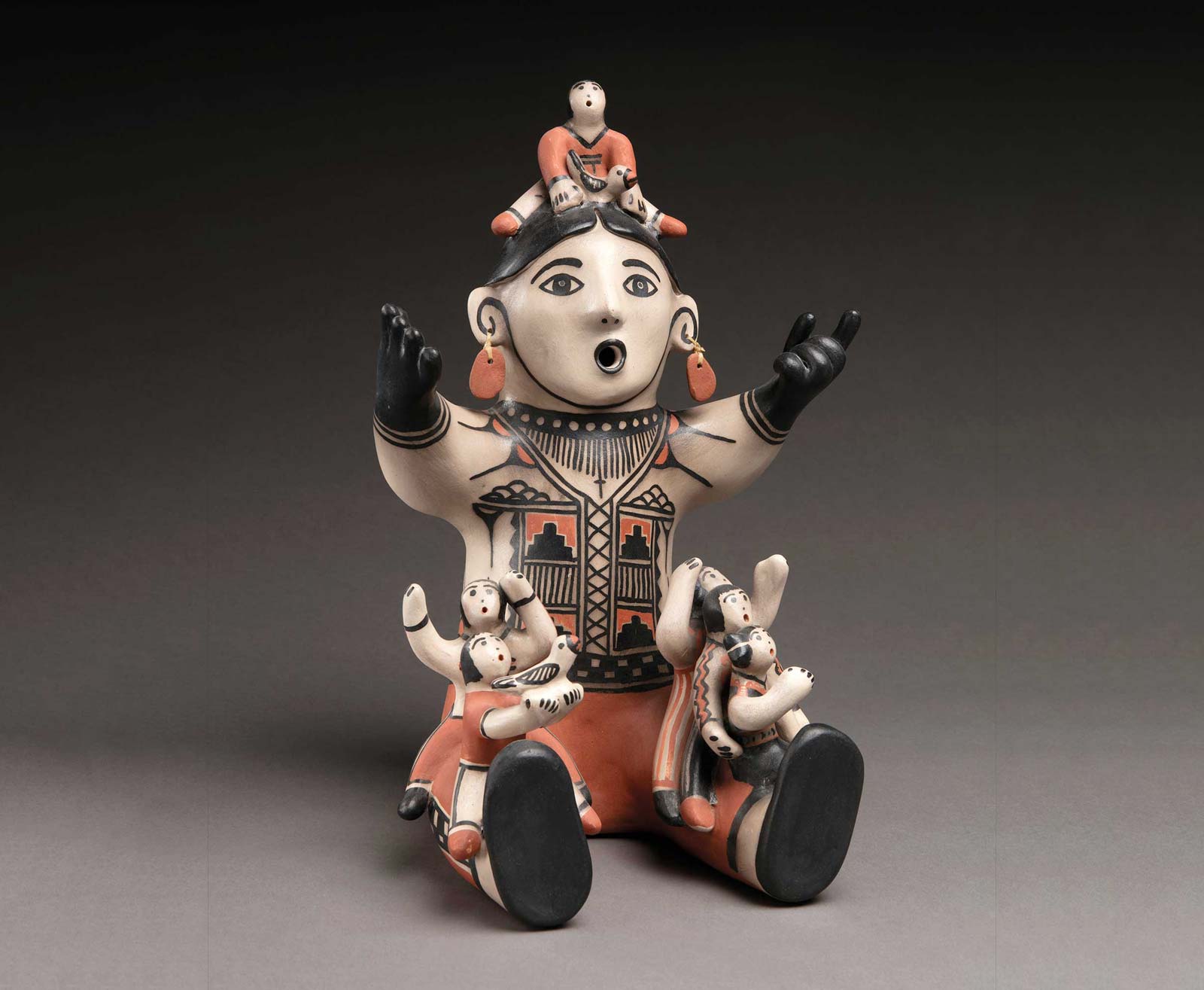
Storyteller, ca. 1990-94, clay.
Riding In continues, “Some examples of what wwill be seen are a bear storyteller with her cubs climbing over her, created in the 1980s, some of his revival mono figures from the 1990s, anamorphic hybrid figures from the early to mid 2000s, and works from his Pueblo Revolt series. In addition, there will be a few of his lithographs on view.”
Riding In points to Happy Man as a prime example of Ortiz’s interpretation of historic figures known as “monos,” which were being created at Cochiti Pueblo in from the late 1800s through 1920s. Monos were caricatures of opera singers, circus performers and tourists who were coming into the Santa Fe, Cochiti and Albuquerque region. “Happy Man is very reminiscent of the historic monos, with his arms in the air, his hands have four digits, and the emphasis on facial hair,” explains Riding In. “Even though this sculpture reflects historic works, Ortiz has distinctly created it in his style in form and painting style. Seen on Happy Man are wild spinach, and bird motifs. In addition, he is adorned in a necklace with naja pendants.”
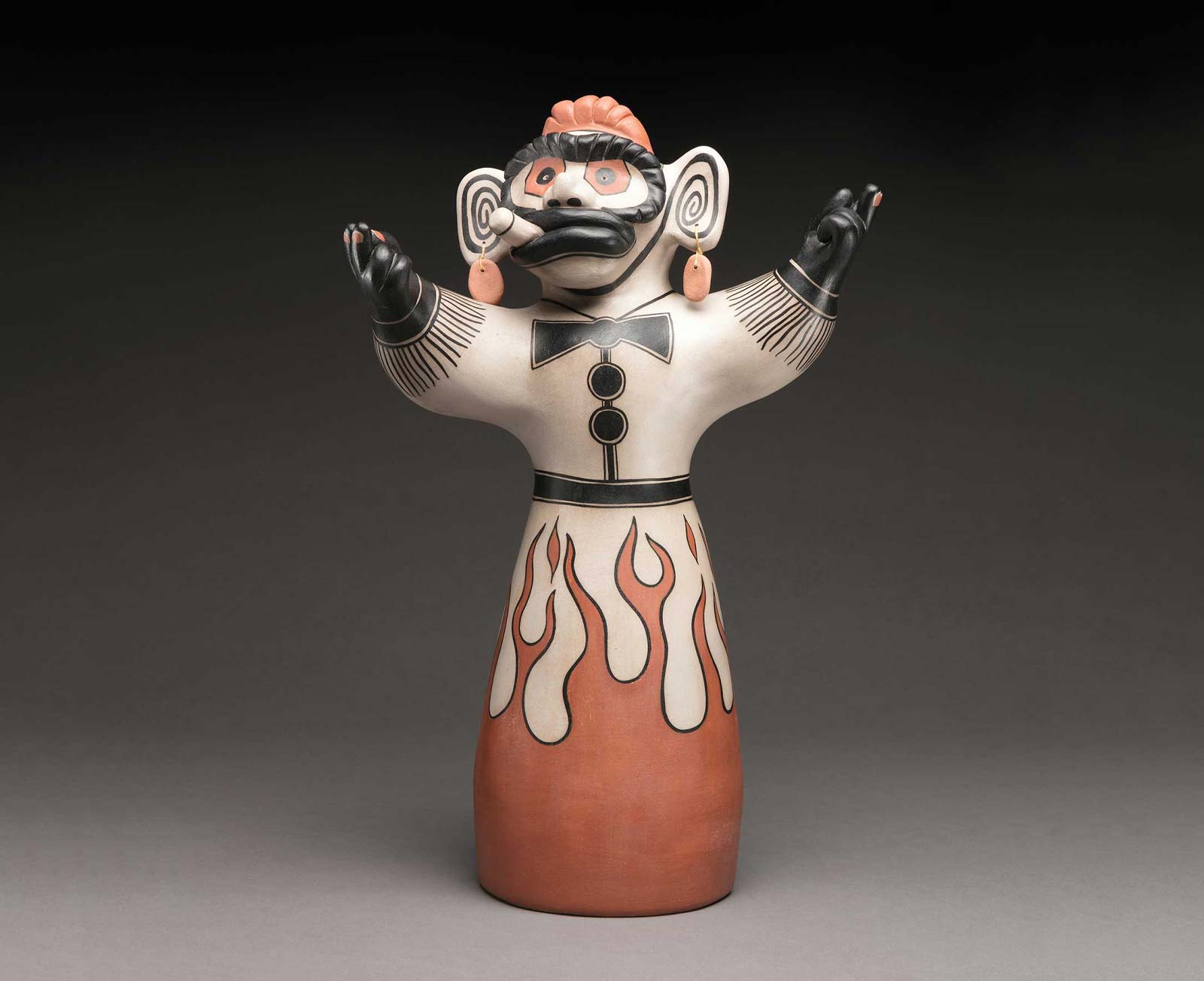
Zorba figure, ca. 1999, clay
Other works that highlight Ortiz’s evocative interpretations of historic monos are Opera Singer, a shapely the three-breasted figure who might be mid-aria; and Zorba, a mono whose painted face clamps down on a stogie. The pieces are somehow celebratory and confrontational.
A small display of pottery by Ortiz’s family will also be featured in Gestural in Form to highlight the continuity of the pottery making tradition in his lineage. Ortiz learned from his mother, renowned potter Seferina Ortiz, and she learned from her mother Laurencita Herrera. “I felt this was necessary to highlight the family’s work because they have all influenced each other over the years,” says Riding In, “and I feel it’s important to acknowledge those familial mentorships.”
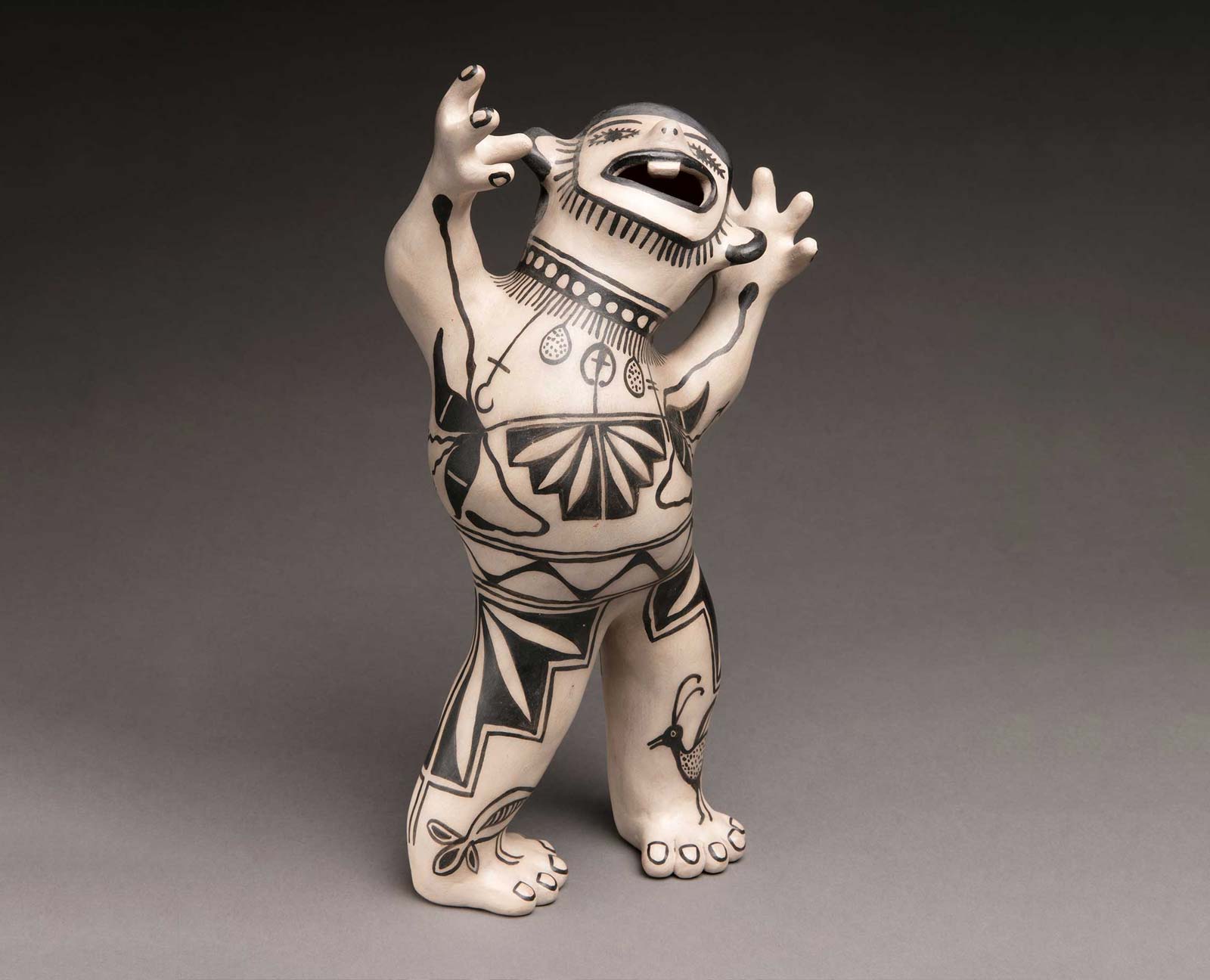
Happy Man, ca. 1992, clay.
Gestural in Form runs through January 11, 2026. —
August 10, 2025-January 11, 2026
Gestural in Form
Wheelwright Museum of the American Indian
704 Camino Lejo, Santa Fe, NM 87505
(505) 982-4636, wheelwright.org
Powered by Froala Editor


