What is required of an artist? Talent, inspiration, motivation, innovation.
It’s a big ask.
What about collectors? If artists are expected to be bold and take risks, should the same be expected of collectors?
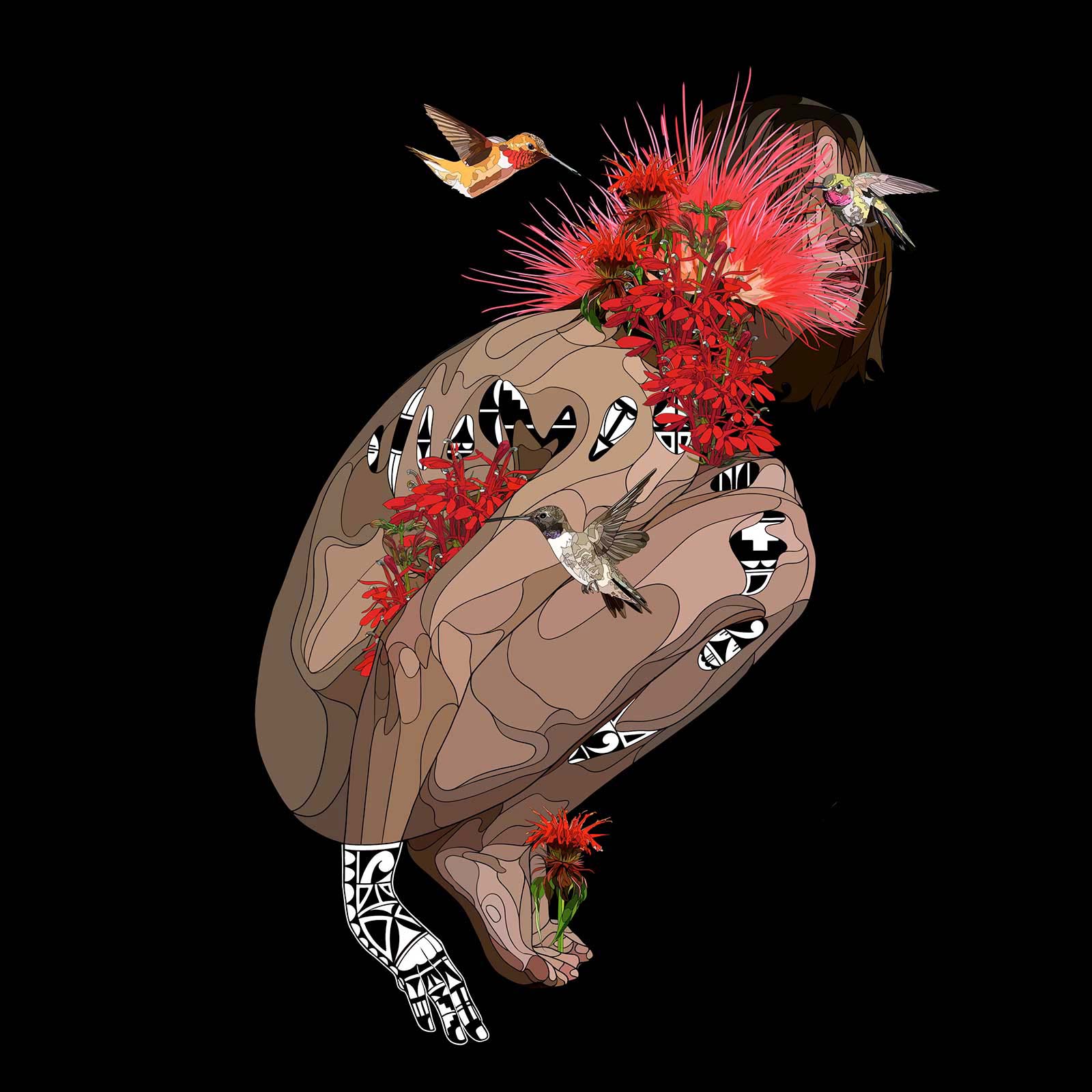
Ambrosia, acrylic and DTG printing, 12 x 12 in.
Tse Tsan (Santa Clara Pueblo) knows “the look.” The look on the faces of potential collectors when she tells them her artworks are digitally produced. Digital illustrations. Drawn on a computer and printed by an electronic machine.
She got “the look” exhibiting at her first Santa Fe Indian Market in 2024. “The bias was definitely there,” Tsan says. “There was that initial impression where [visitors] come up, they love the work, they love the concept and then they learn the medium. I see that little pause where I can see them reevaluating the way they’re looking at the art; their impression of its value has changed.”
That’s when Tsan goes into sales mode. No problem. In 2023, she graduated summa cum laude from Southern New Hampshire University with a bachelors in business administration.
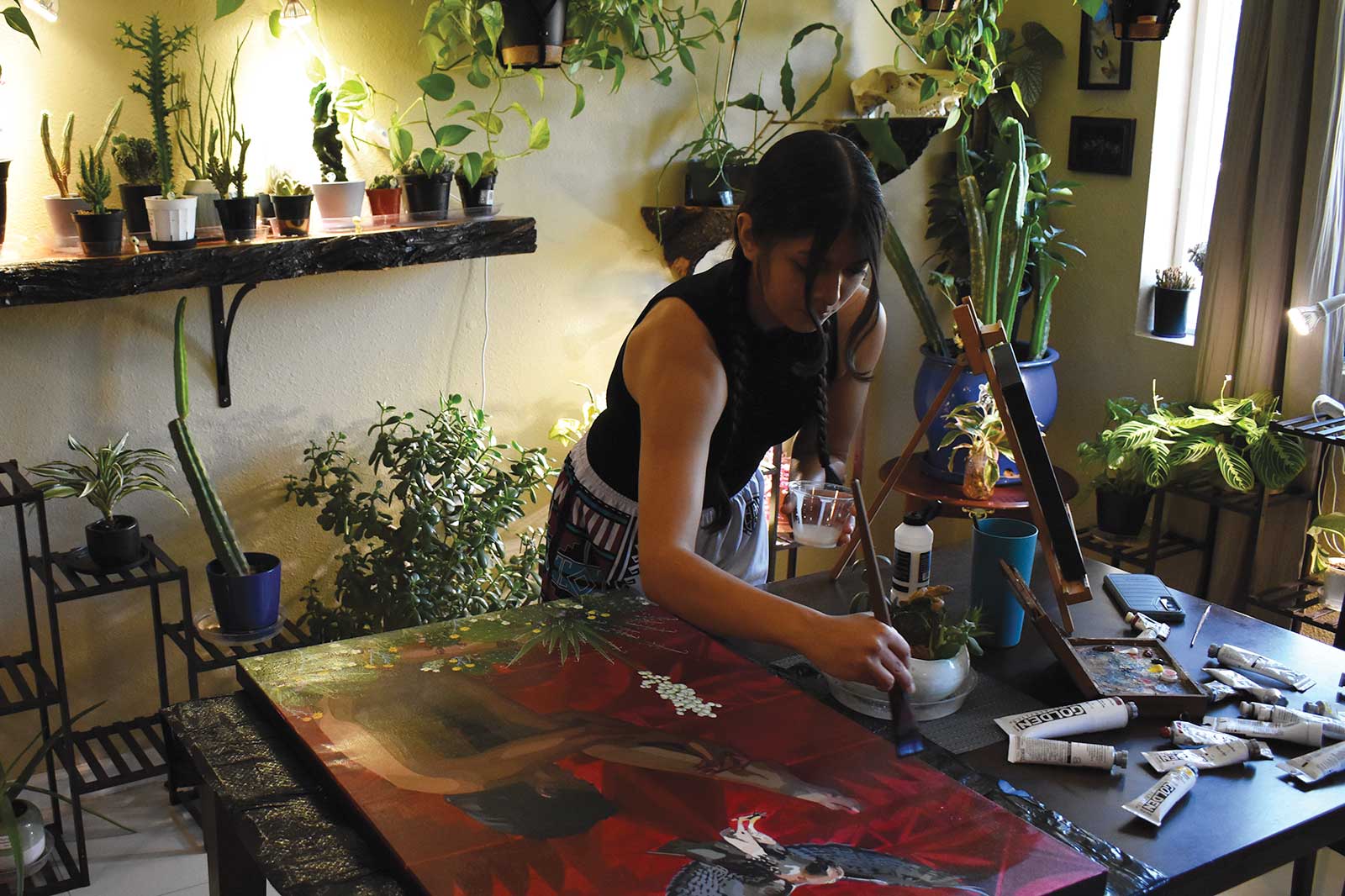
Tse Tsan at work in her studio.
“The way I like to explain it is the time and the care is still there. One of the primary ways that I perceive value in art is that time investment,” she says. “How long has the artist spent honing that craft? How long did they spend making the piece itself? I put the same amount of effort into these pieces as I would a traditional medium. If I explain it that way, people understand.”
Tsan’s hand-illustrated digital images each take months to complete. They are created in Adobe Photoshop with a Wacom tablet. In layman’s terms, she’s drawing on a computer.
The 2024 Santa Fe Indian Market judges understood.
Tsan’s surrealist Necrosis, depicting a nude figure lying in a desert landscape, garnered a blue ribbon for excellence in its classification—paintings, drawings, graphics and photography—and an orange ribbon signifying best of division, which was computer-generated graphics.
Not bad for a first timer.
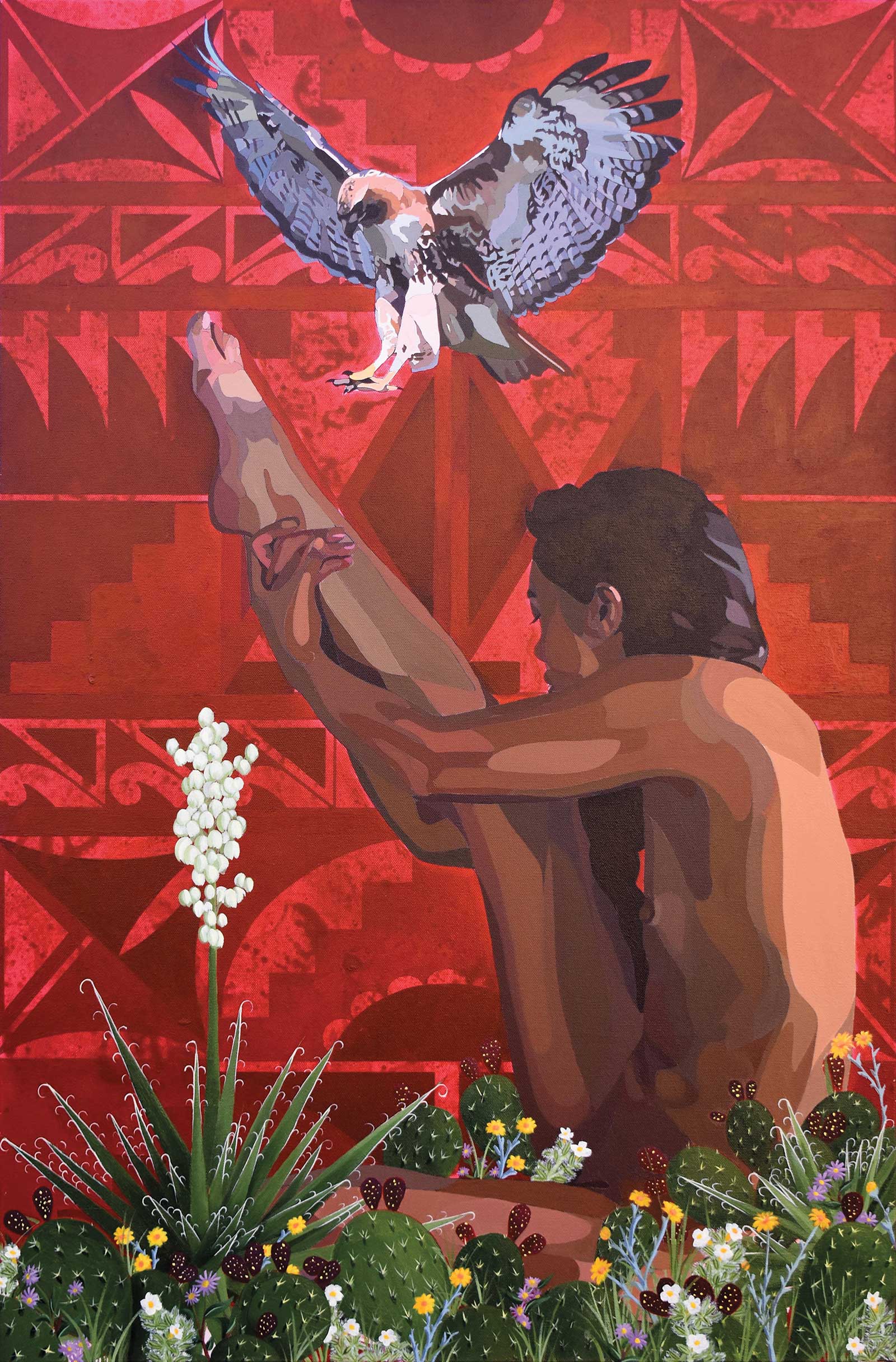
Sovereignty, acrylic and DTG printing, 36 x 24 in
Digital Evolution and Back Again
For 2025’s Santa Fe Indian Market, Tsan is expanding her repertoire, producing mixed-media pieces using DTG-printed canvas as the underlayer for acrylic paint. DTG stands for “direct to garment.” These machines allow her to produce a detailed, hand-illustrated image, feed that into a computer and have the printer reproduce the image directly on canvas. She then paints over the top of the printed canvas.
Lloyd Kiva New would be smiling. The founder of the Institute of American Indian Arts famously said, “The future of Indian art lies in the future, not the past.”
Tsan’s artmaking lives in the future.
Same as the artmaking of Oscar Howe in his day and Jody Folwell today. Putting a 25-year-old in their company is premature, but her innovative spirit follows the legacy of giants who dared to break new ground.
Howe (1915-1983), in a famous letter to the Philbrook Art Center, defiantly defended his unconventional artwork: “Are we to be held back forever with one phase of Indian painting?”
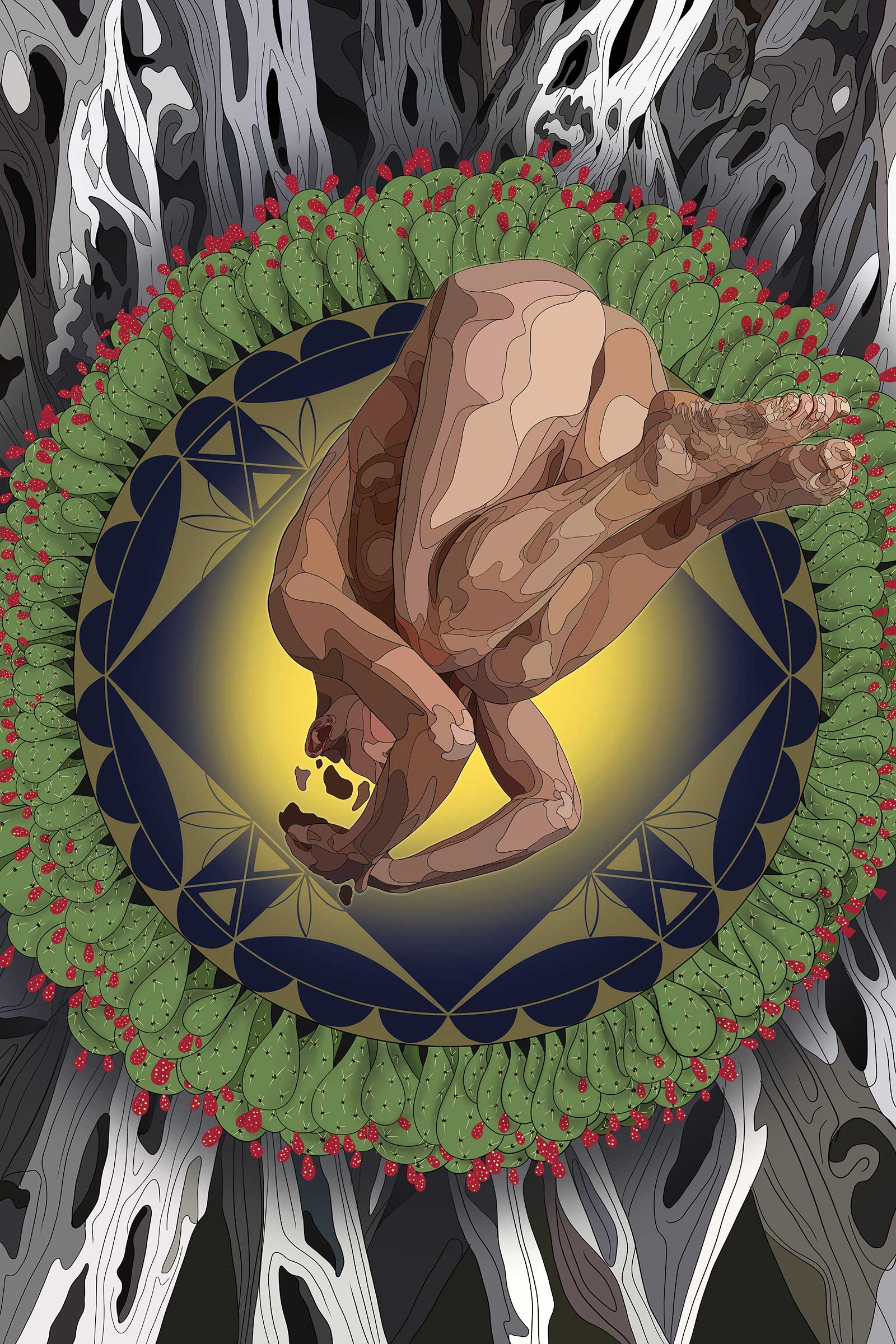
Desert’s Void, digital illustration on archival paper, 36 x 24 in.
Collectors, are you paying attention? Do you go back far enough to remember when Folwell’s colorful and unusually shaped pots caused a scandal at Santa Fe Indian Market nearly 50 years ago? Does your collecting live in the future or in the past? Collect whatever you love, but remember that all the greats, from Claude Monet to T.C. Cannon, got weird looks when they broke with tradition.
Tsan’s adoption of digital technique stems from her age and comfort with technology as a digital native—someone who’s grown up with computers and the internet. Also, she spent formative years at the New Mexico School for the Arts, a charter high school in Santa Fe. “A lot of the opportunities I was getting approached about, they did want a very specific set of work. They wanted paintings of dances. They approached me for being able to say that this was made by a Native artist, not because they were interested in my work itself,” she explains. “That’s what made me swing so far left with the medium.”
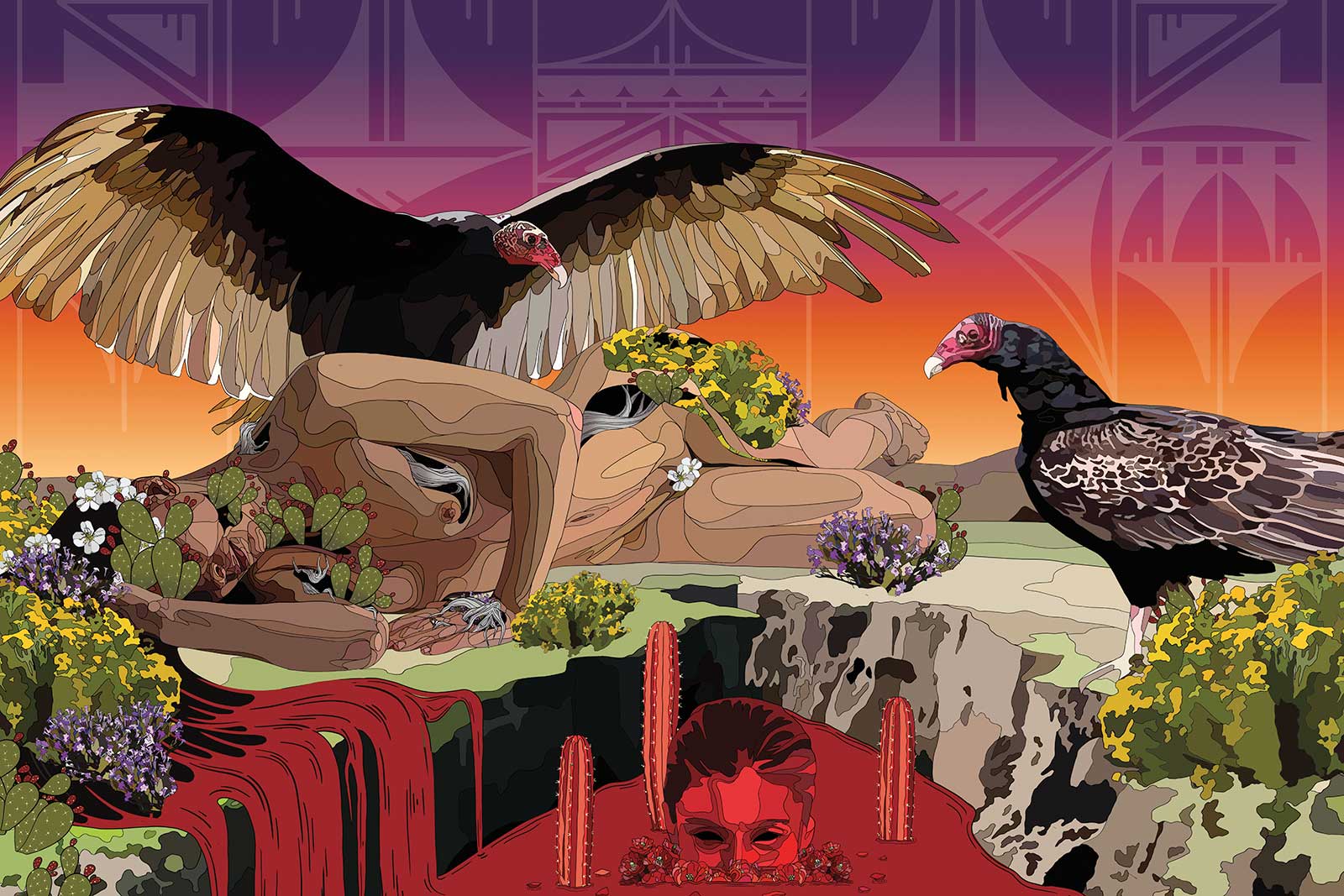
Necrosis, digital illustration on archival paper, 24 x 36 in.
A Famous Name
Bonus points to anyone who finds the name Tse Tsan familiar. That was Santa Clara painter Pablita Velarde’s (1918-2006) name. Tse Tsan means “Golden Dawn” in Tewa. Velarde is Tse Tsan’s great-great aunt on her mother’s side.
Velarde was a Dorothy Dunn student at the Santa Fe Indian School, one of the first female students in the art program. Unfortunately, the contemporary Tse Tsan—the name the artist prefers using when making and discussing her artwork—never met her iconic relative. “By the time I was old enough to have memories of family, a lot of my pueblo family had passed away,” Tsan says. “One of the reasons I have the style that I do, is that is my way of reconnecting with my culture.”
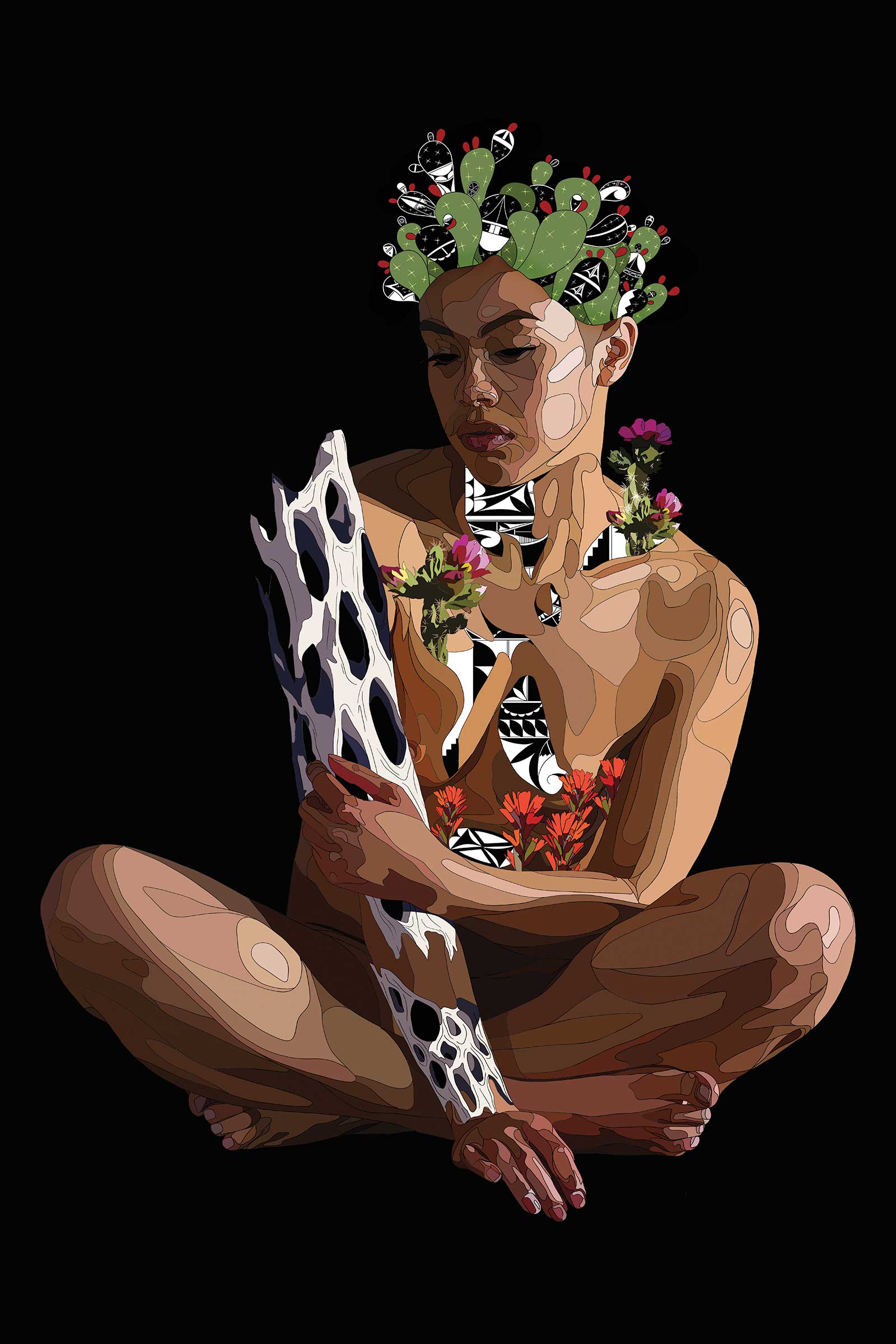
Seated Woman I, digital illustration on archival paper, 36 x 24 in.
Tsan has begun incorporating pueblo pottery designs as the background for her digital surrealist illustrations, rooting them in a timeless tradition, honoring that tradition in 21st-century fashion. Tsan’s paintings for Santa Fe Indian Market 2025—each a unique, one-of-a-kind piece—will feature the pottery design background.
Artists experiment. They take advantage of technological advancements to push their mediums. Digital art can feel unsubstantial, probably the way photography did to collectors 100 years ago. But that’s the job of the collector. To assess what’s new and distinguish the insignificant from the groundbreaking.
Those are the artists who are remembered, and those are the collectors who are remembered as well. —
Powered by Froala Editor
Powered by Froala Editor
Powered by Froala Editor


