1. Canyon Road American Indian Appraisals
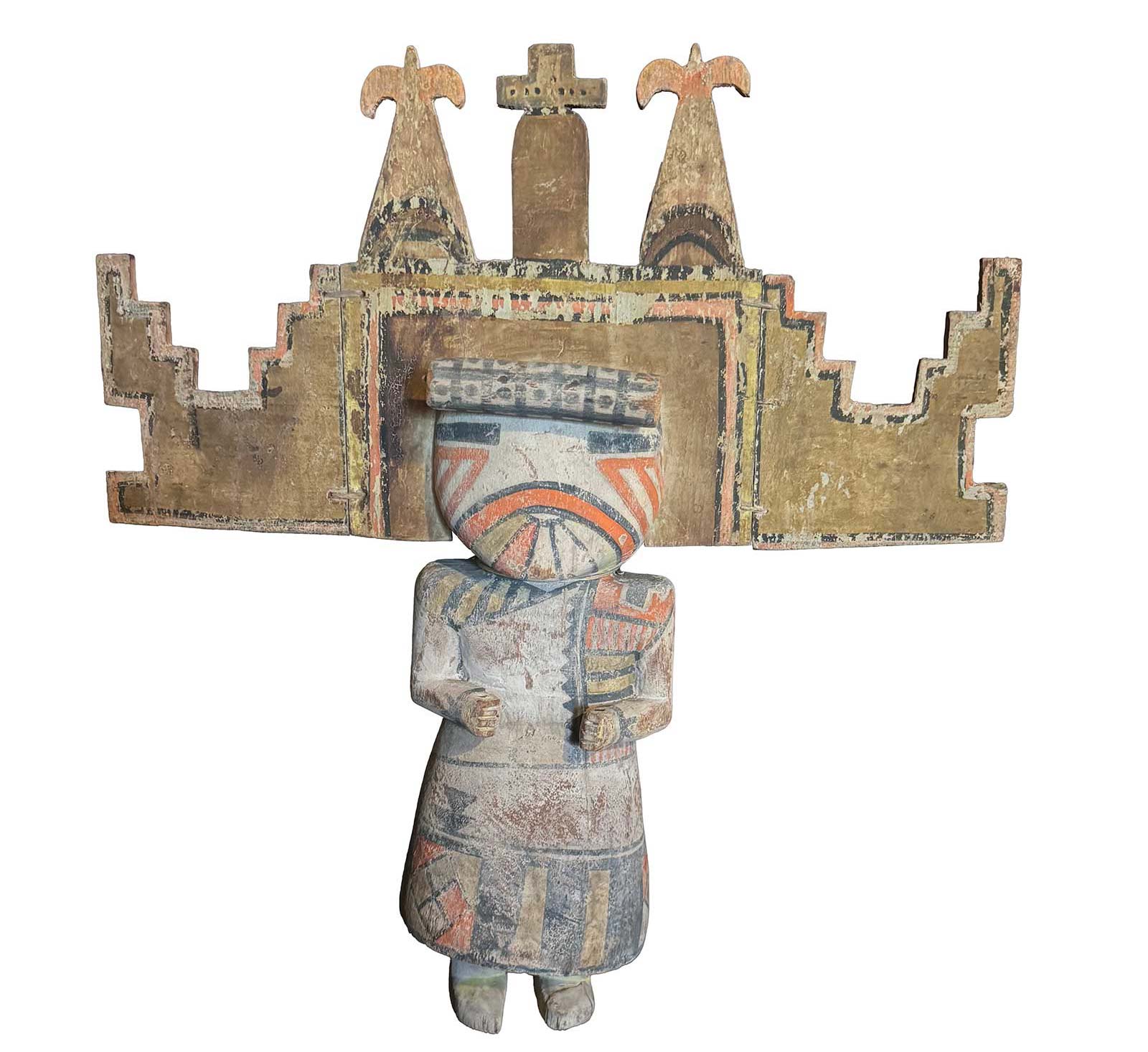
Now available in New Mexico, is a rare Palhlik Mana Katsina from the late-19th century. The carving will be offered via the Alan Kessler Gallery on Canyon Road. The gallery notes it is “of unusually large size. It is rare for a doll to have a monumental scale like this. It’s wearing a white ‘embroidered’ ceremonial costume and white case mask with rectangular eyes, and chin painted with colorful lines radiating from the mouth. Her elaborate stepped tableta incorporates cloud and rainbow symbols. A large corn filial is seen on the top of the case mask, along with a very large tableta. This museum-quality katsina checks all the boxes, and our ranking puts it up there with a Hopi Shalako Mana that sold at Sotheby’s NYC for a world record of $294,000 [in 1997].”
836 Canyon Road, Santa Fe, NM 87501 (505) 986-0123 • (505) 660-2637 www.alankesslergallery.com www.canyonroadappraisals.com
2. Buffalo Barry Indian Art
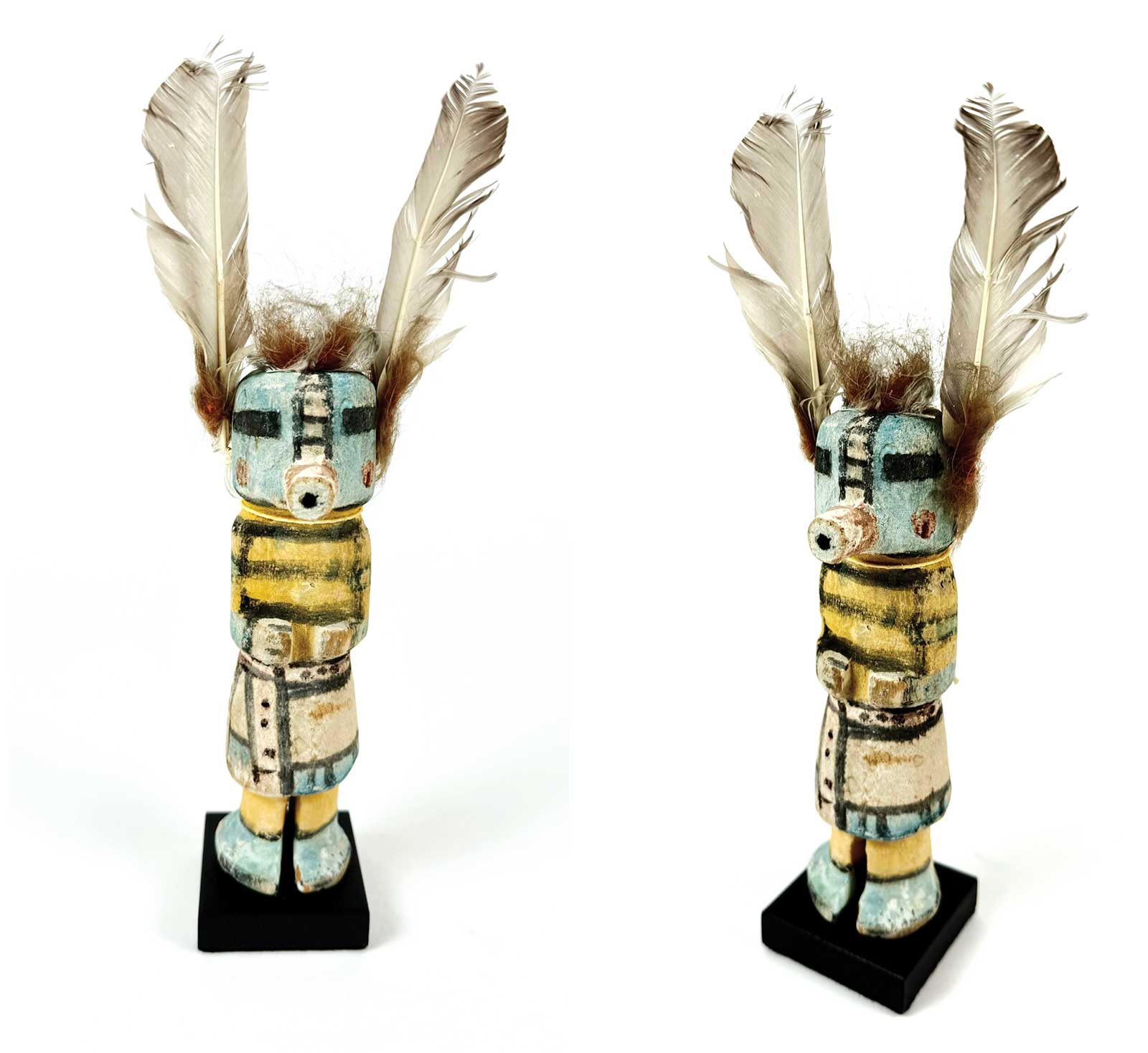
On this remarkable 1950s katsina, Barry Walsh notes, “Wilson Tawaquaptewa (1873-1960) was unique in the history of Hopi katsinam carvers in that he deliberately ‘mixed up’ or ‘made up’ all his work. He distorted them because of his important religious role as Kikmongwi or Village Chief of Orayvi. He believed that accurate representations should not be sold. This carving with exaggerated feathers is one of his ‘made-up’ examples. It does not resemble any Hopi katsina accurately…This is one of his humorous creations with the huge feathers, jailhouse stripes and polka dots.”
(508) 631-2703 • www.buffalobarry.com buffalobarry@charter.net
3. Bosshard Gallery
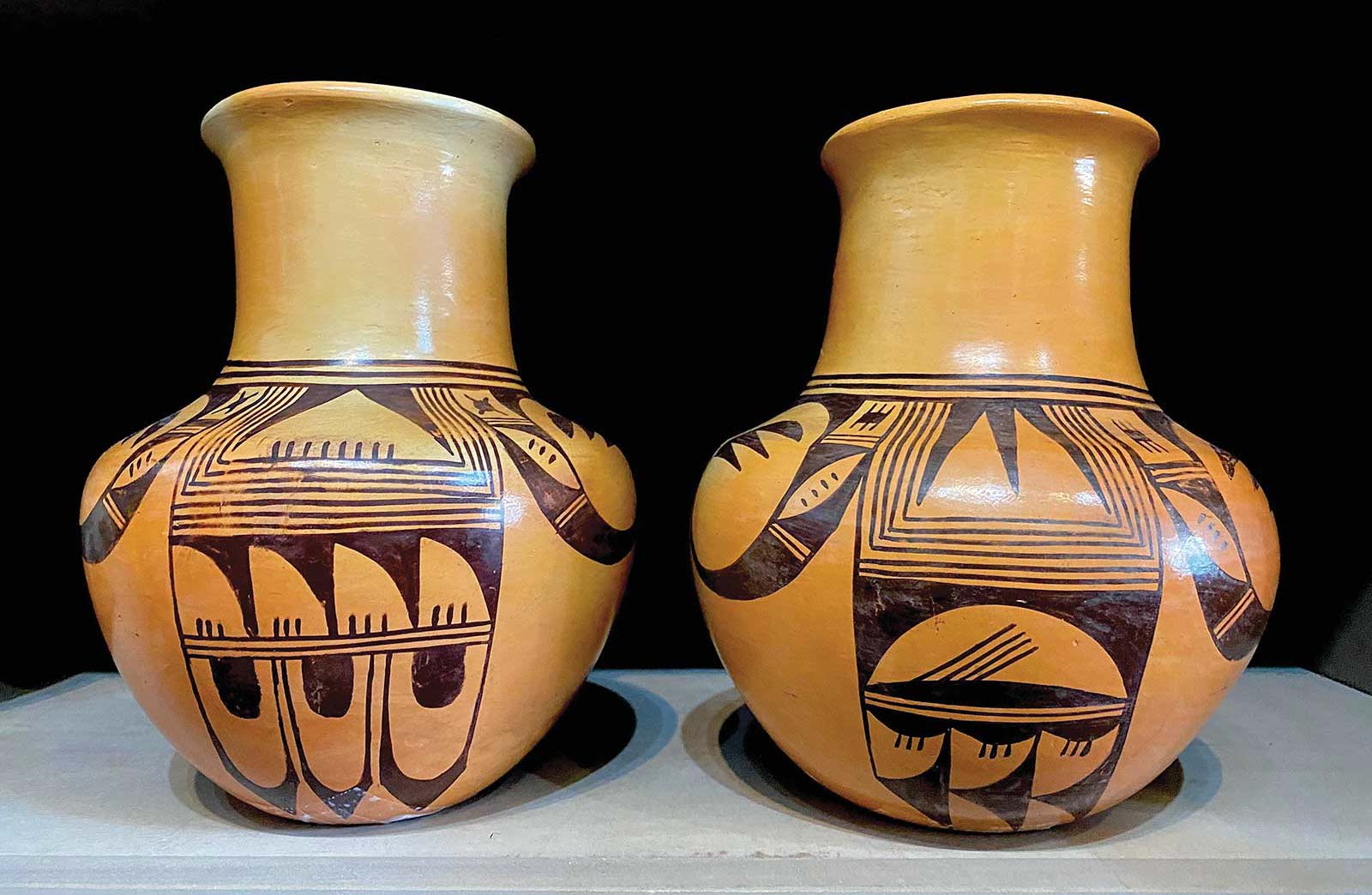
Now available at Bosshard Gallery in Abiquiú, New Mexico, are a pair of matched pots by Hopi potter Irene Shupla. The gallery notes, “[Here is] a rare matched pair of Hopi jars in mint condition, with bird and eagle tail designs, signed by Hopi potter Irene Shupla. She was active between 1930 and 1980. Her clan is the Kachina Parrot Clan. She is from the Hopi Tewa Village of Hano on First Mesa.” The pieces will be sold as a pair.
Abiquiú, NM • (505) 685-0061 bosshard1@yahoo.com
4. Territorial Indian Arts
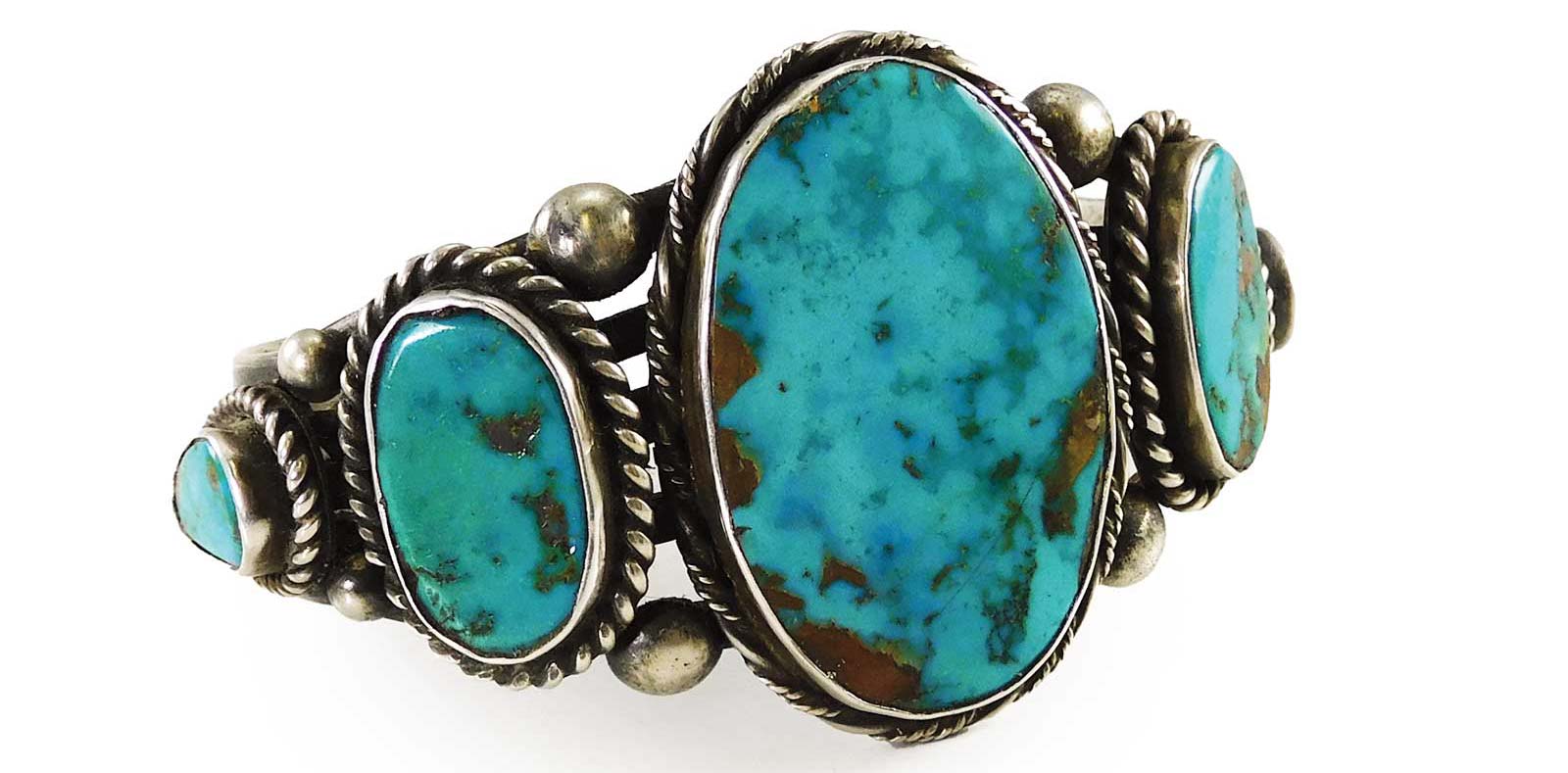
For 56 years, Territorial Indian Arts in Scottsdale, Arizona, has searched for unique silver jewelry from days gone by. Today the gallery features top-quality turquoise from American mines. The gallery has just acquired five gorgeous stones of Blue Gem turquoise set on a chiseled ingot cuff bracelet, enhanced with silver rope and raindrops. It dates from the late 1930s to 1940s, and is signed by Mose Blackgoat (1898-1975), Navajo silversmith from the Black Sheep People Clan for the Bitter Water People Clan. See this work in the gallery in Scottsdale, as well as at the Whitehawk Antique Indian & Ethnographic Art Show, August 8 to 11, in Santa Fe, New Mexico.
Alston & Deborah Neal • 7100 E. Main Street, Unit #3, Scottsdale, AZ 85251 • (480) 945-5432 www.territorialindianarts.com
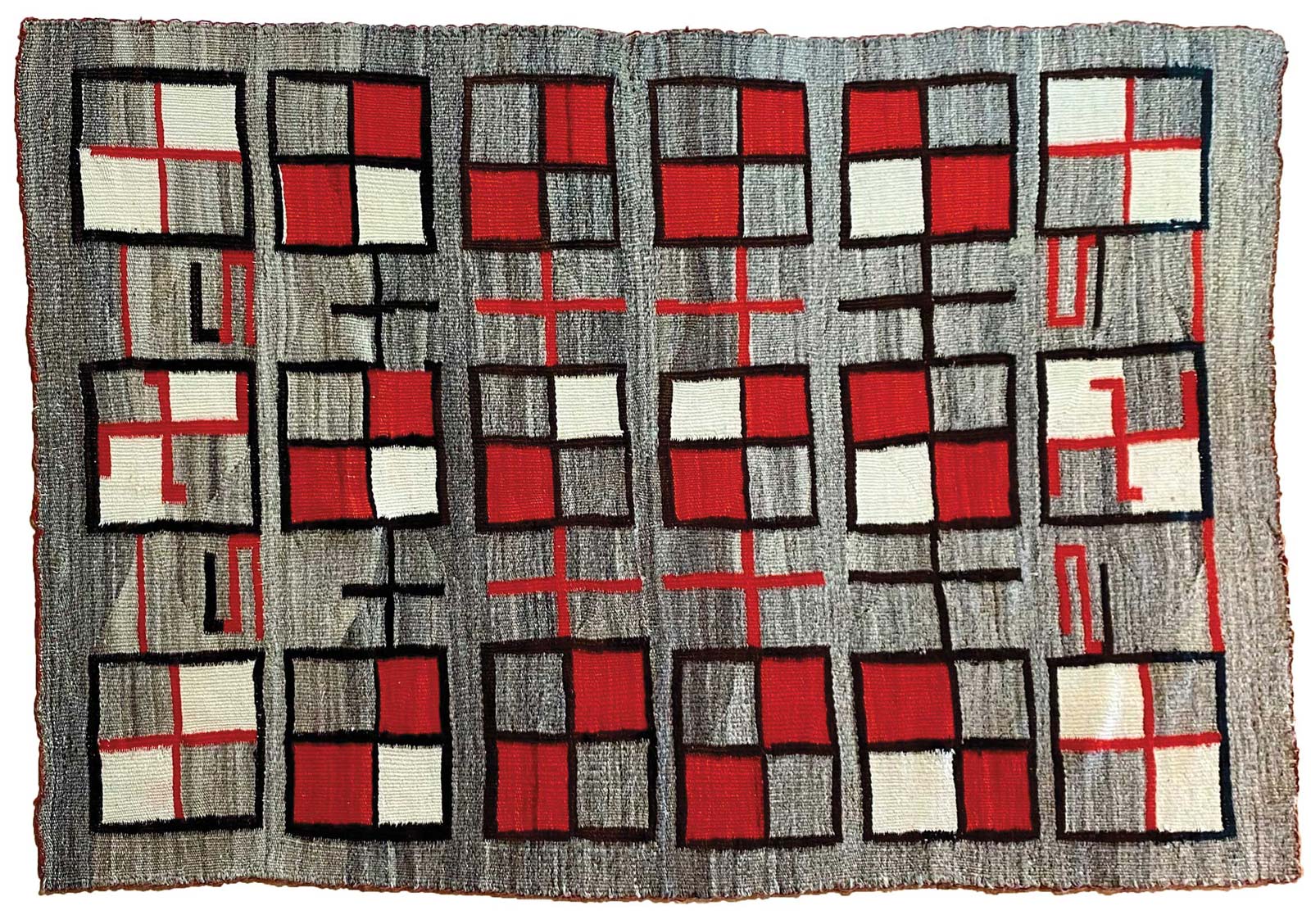
5. Sandbar Trading
A Navajo transitional rug or blanket, circa 1900, is now available at Sandbar Trading in Santa Fe, New Mexico. “While weavings from this era are typically considered rugs, most were woven by weavers that just a decade or two before were weaving only blankets,” the gallery says. “Commercial blanket companies like Pendleton, as well as European Woolen Mills, were selling a wool, colorful, inexpensive blanket option and the market for Navajo woven blankets was quickly disappearing. Beginning in the late 1880s, weavers and traders working together began to change to weaving rugs. This blanket-rug period was pretty much done by 1910. This block weaving with no border, beckons back to the 1800s blankets. It measures 76 by 52 inches.”
Richard (Rick) Gottsponer • 839 Paseo de Peralta, Unit K, Santa Fe, NM 87501 • (316) 655-7477 www.sandbartrading.com • rick@sandbartrading.com
Powered by Froala Editor


