Dan Vallo’s best of show winner at the 2024 Santa Fe Indian Market spotlights his multifaceted practice—one that includes wood, feathers, stone and leather—with materials he sources and processes himself. Titled Pueblo Revolt Ensemble, the elaborate bow, arrow and knife combination offers a glimpse into 17th-century technology, and commemorates a seminal event in New Mexico history.
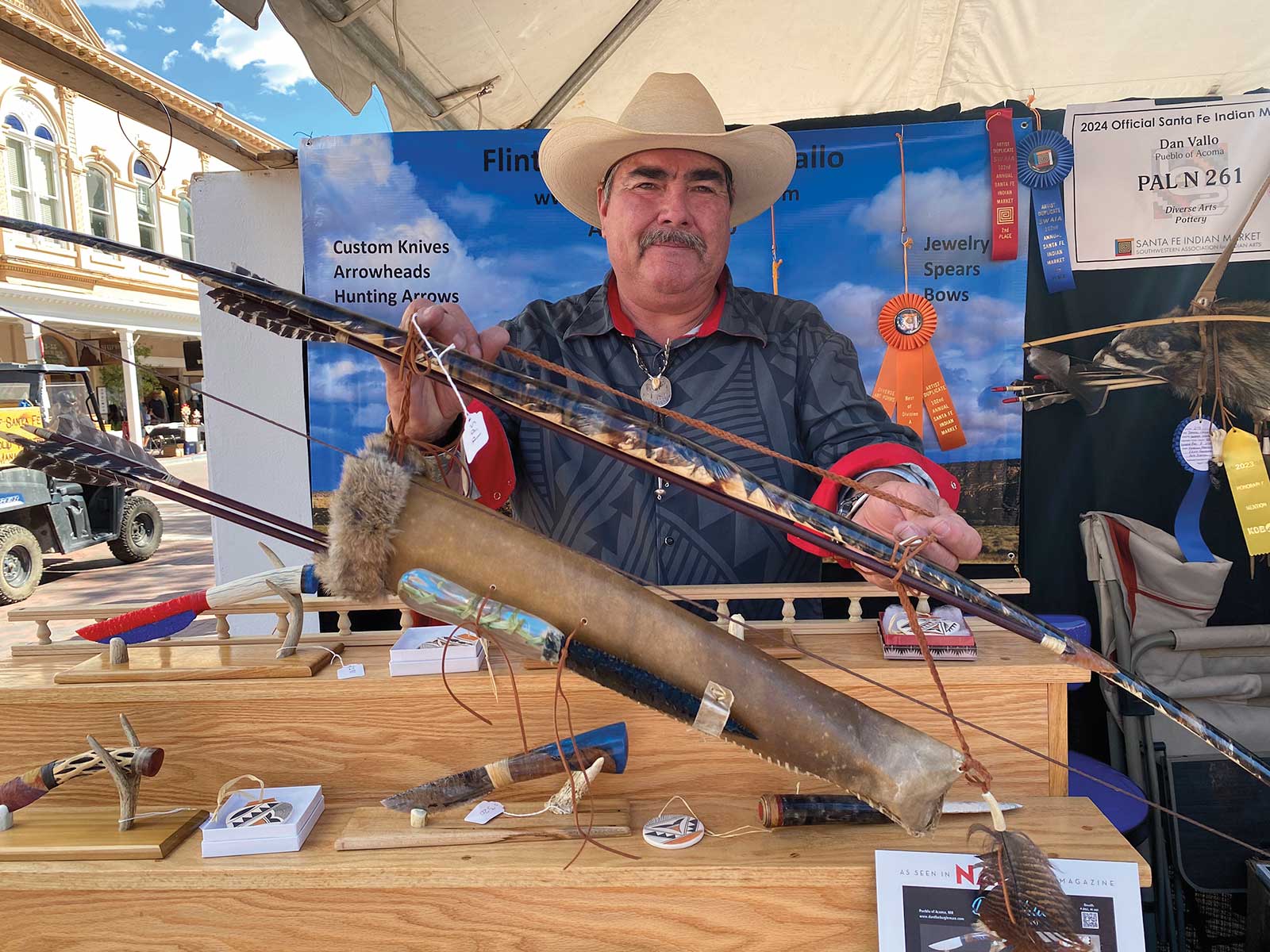
Artist Dan Vallo with his piece Pueblo Revolt Ensemble, which won best of show at Santa Fe Indian Market in 2024.
Vallo formed the bow using traditional stone tools and scrapers, and harvested his own sinew, a stringy tendon that is braided together to make the bowstring. The quiver, also sewn with sinew, was made from cowhide he scraped and tanned. After winning the bow-and-arrow category at Indian Market in 2023, Vallo wanted to level up with even more artistry in 2024, he says, so he backed this bow with more than 100 iridescent turkey feathers. “And that was kind of my little artistic flair,” he says.
At Santa Fe Indian Market, bow making falls into the category of diverse arts—a large, competitive field that encompasses woodworking, glass, knives, regalia, masks and many other items that were traditionally useful. “I thought for sure that was a really great definition of diverse art because of the diversity of the talents that I had to use,” he says of Pueblo Revolt Ensemble. “You know, between flintknapping, woodworking, preserving leather and brain tanning—all that came into play and each one of those is a specialized field that sometimes takes years and years to learn and to get good at.
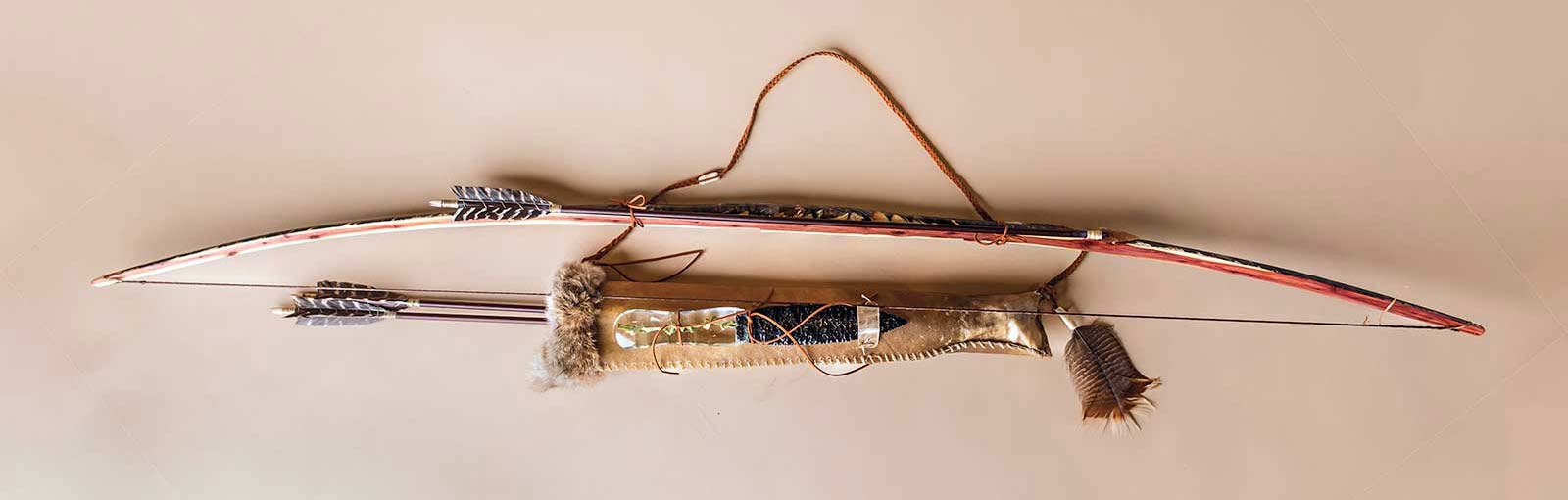
Pueblo Revolt Ensemble, rendition of a set of weapons used by many pueblo warriors during the time of the Pueblo Revolt: obsidian flint knapped dagger, handle made of yucca cord encased in clear resin, juniper bow backed with over 150 wild turkey feathers, handmade twisted bow string, rawhide quiver and red cedar wood arrows, 66 x 14 x 5 in.
Originally from Acoma Pueblo, Vallo is best known for flintknapping, an art form his ancestors used to create weapons and tools for everyday life. “The Spaniards had swords, we had little obsidian daggers. I got into flintknapping as a kid on the reservation, going hunting or walking the hills,” he remembers. Finding artifacts and arrowheads sparked his interest in how they were made. “So I just kind of experimented hands-on, banging rocks together and trying to create something that looked similar to a triangle.” That evolved into “about 40 years worth of practice and trial and error,” he adds.
Flintknapping starts with percussion flaking. Usually flint, obsidian or chert, a piece of material is broken off a larger stone by striking it with a hard river rock to get a basic form about the size of your hand. Next, it’s refined and made razor sharp by pressure flaking with an antler.
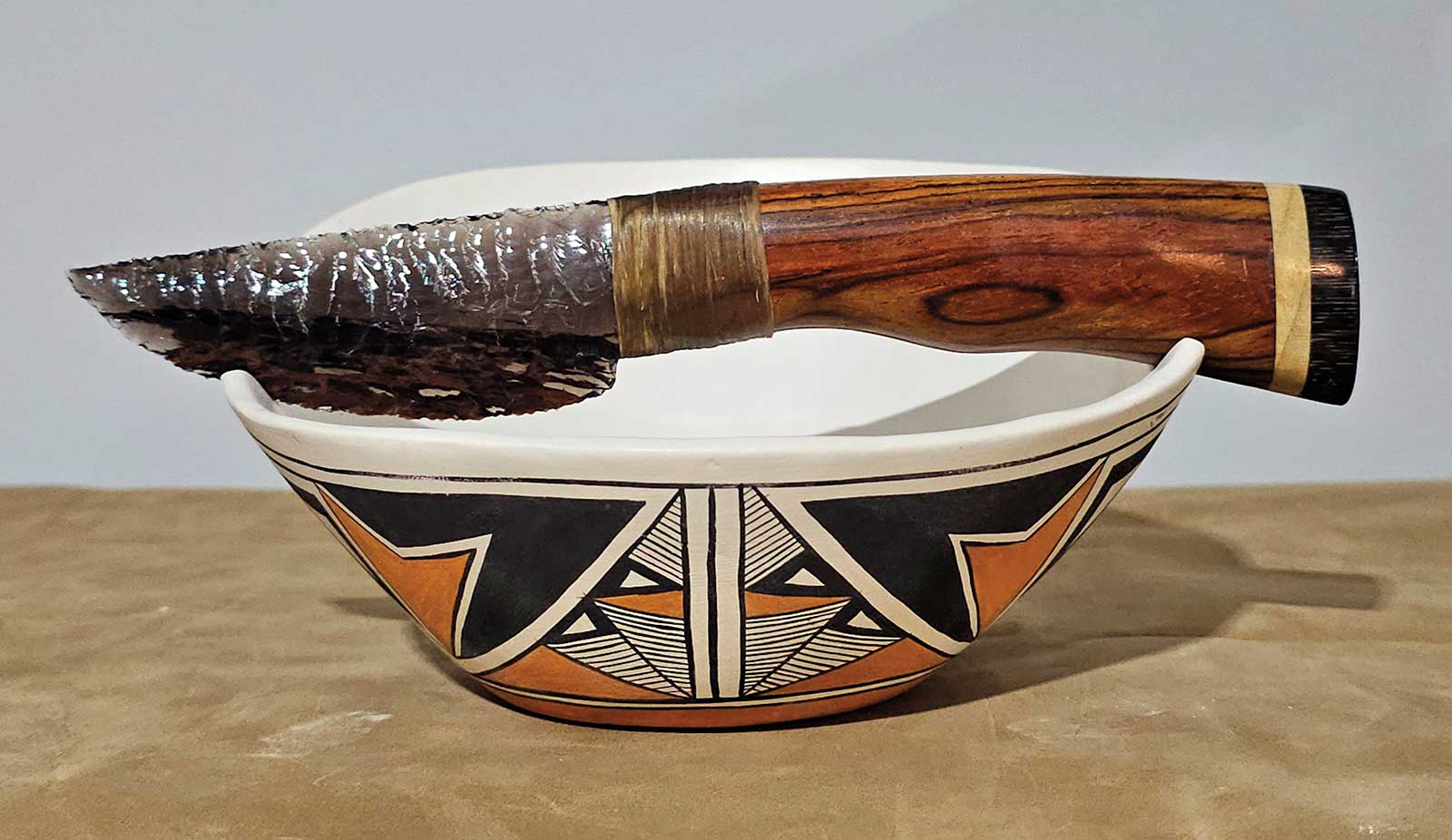
One of Vallo’s stone knives.
For Pueblo Revolt Ensemble, Vallo envisioned something that might have been used in the 1680 uprising that ousted the Spanish from New Mexico. Combining the essential weapons of a pueblo warrior, the work also pays tribute to the synchronization strategy used by the pueblo tribes living along the Rio Grande.
The yucca cord encased in the knife’s handle tells that story: In the days leading up to the revolt, runners distributed knotted cords to the spiritual leaders of each pueblo. A knot was untied every day, and when there were no knots left, “That would be the D-Day basically,” Vallo says of their surprise siege on Spanish settlements. “That way it was a unified attack and I think that was really instrumental in helping achieve our goal.” While short lived, the revolt and following 12-year period are known as one of the most successful counter-colonial efforts in the history of the West.
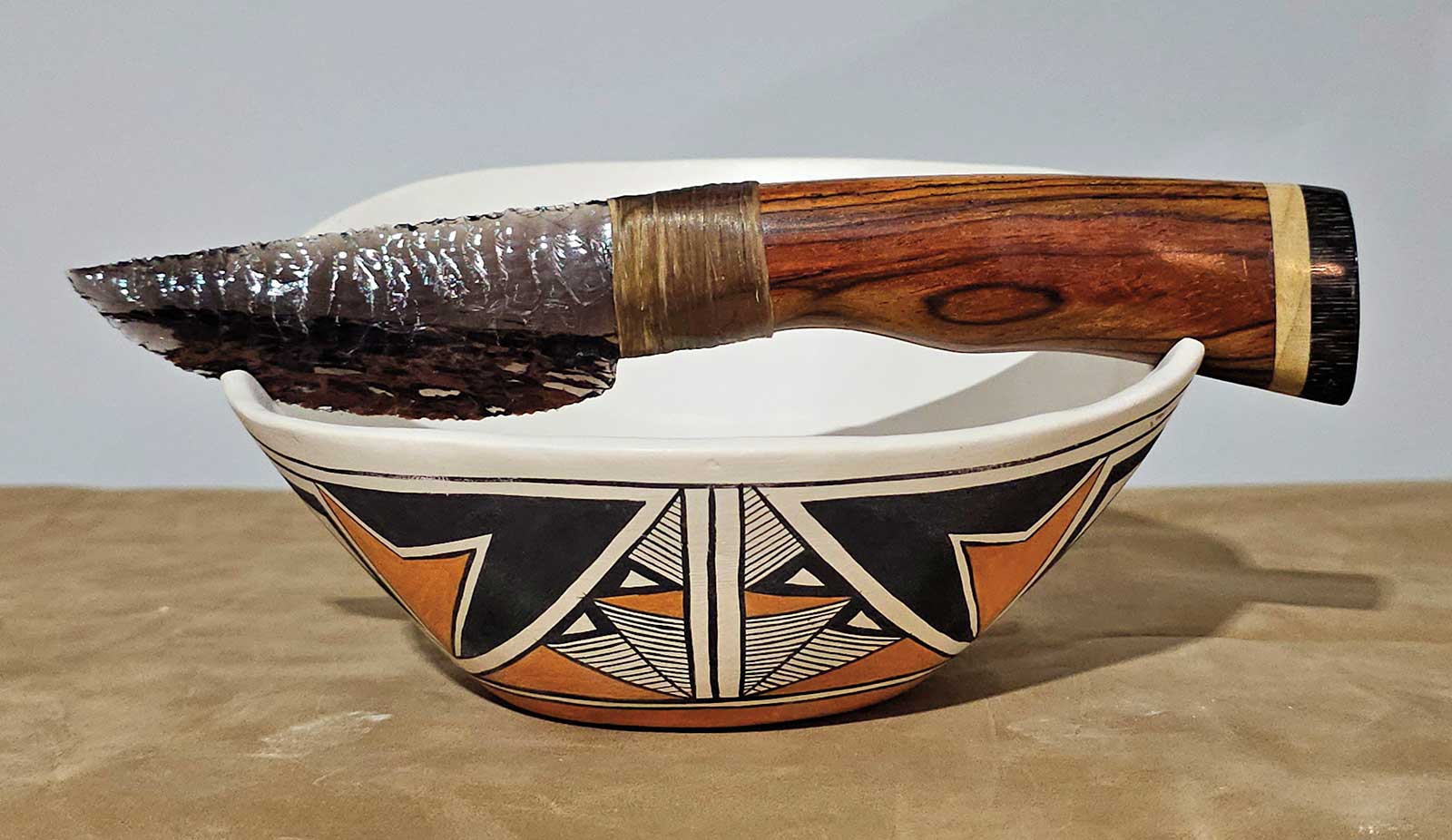
A handmade flintknapped knife on a custom piece of pottery that serves as a holder.
Last summer the conversation around two polarizing public statues—one of Tesuque Pueblo runners Catua and Omtua by George Rivera, and a Donna Quasthoff sculpture of Don Diego de Vargas, the Spanish governor who reconquered the Pueblo peoples after the revolt—“made the work even more timely,” Vallo notes.
“So there was kind of a buzz about the Pueblo Revolt, and I think timing was just perfect to enlighten everybody and tell the story of how it affected all the tribes in New Mexico to give us sovereignty and let us practice our religion and our beliefs without the Spaniards interfering or enslaving us,” says Vallo.
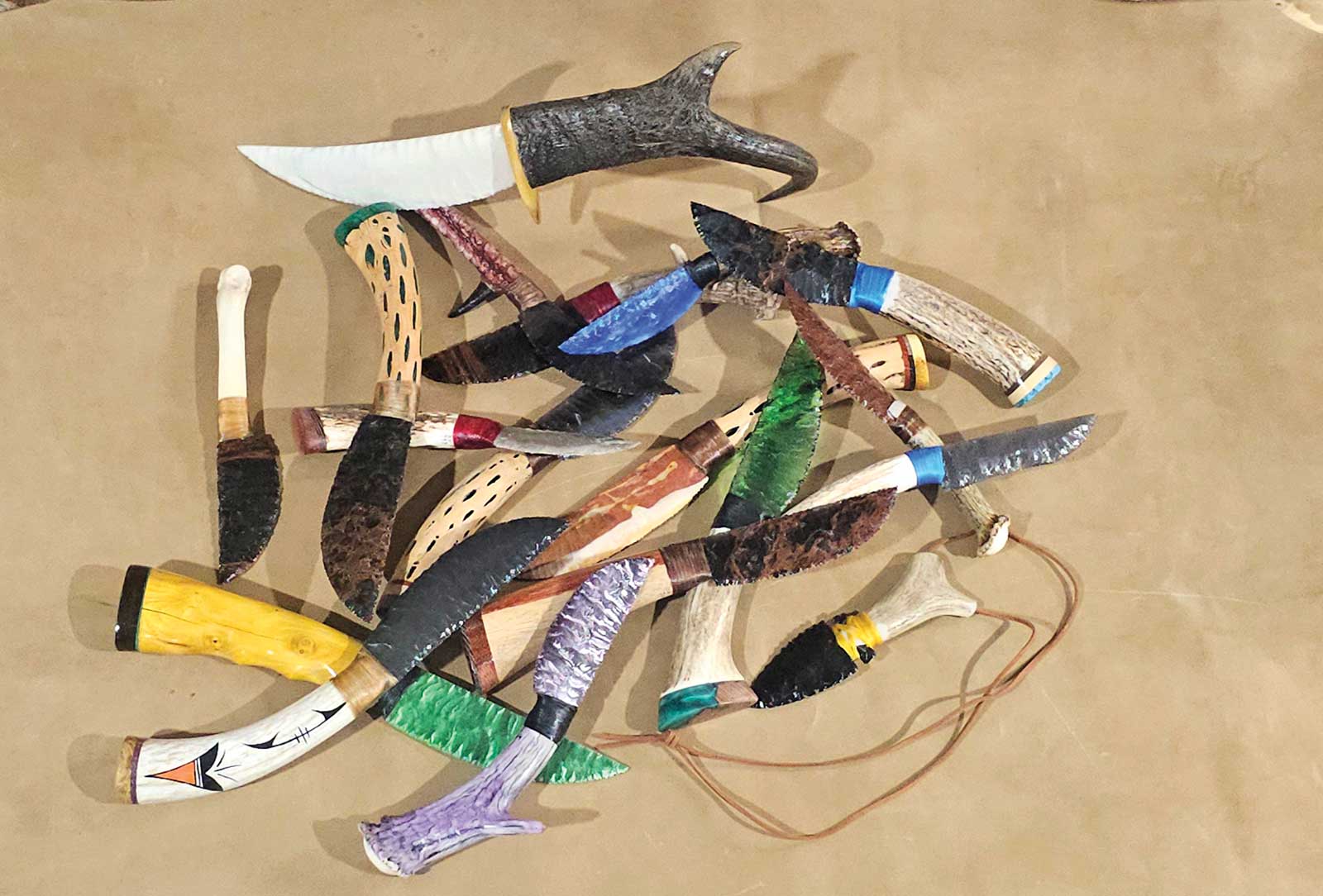
A collection of Dan Vallo’s handmade knives.
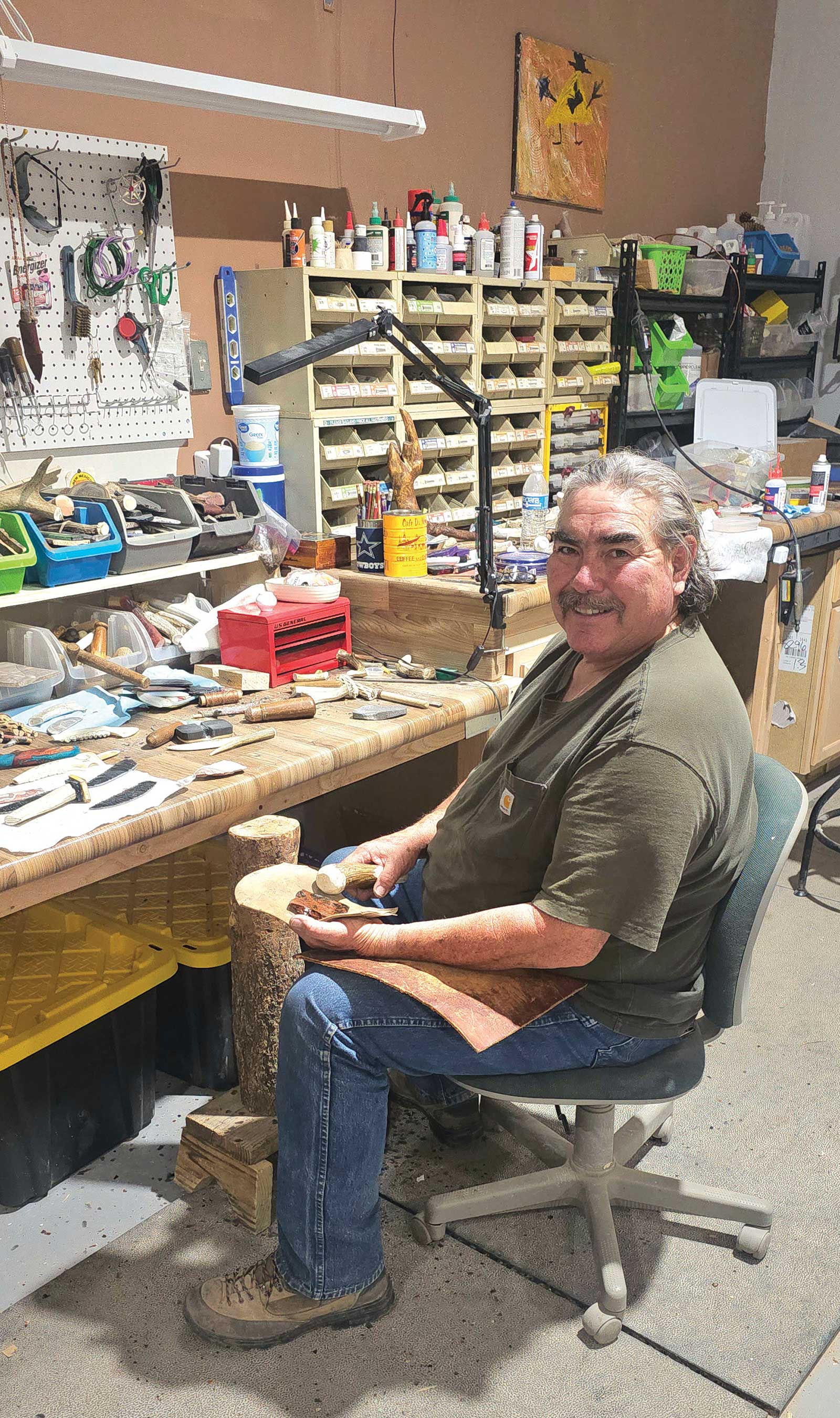
The artist in his New Mexico studio.
After winning best of show at Santa Fe Indian Market, Vallo is looking to his next chapter, which includes retiring from his job and making art full time. Recently, he built a bigger workshop where he can host classes and he’s been invited to demonstrate flintknapping for an archeological society. “It’s opened up so many doors that I just couldn’t even imagine,” says Vallo of the 2024 best of show award. Up next: “Without sounding a little bold, I’d really like to achieve some prizes with the pottery also,” he says.
Dan Vallo will be at Booth PAL N 261 at the 2025 Santa Fe Indian Market, August 16 to 17. —
Powered by Froala Editor


