With the planning stages starting nearly 10 years ago, the Museum of Indian Arts & Culture finally brings to light the special exhibition Makowa: The Worlds Above Us. Interrupted by the pandemic, the exhibition took a backseat, but resumed planning saw an expansion of the project to include Native American artworks depicting the day and night skies, as well as other aspects of contemporary, historic and ancient skywatching in the Southwest.
“This exhibit shows the relationships and connections between the sky and the earth and how humans have observed them,” says Marlon Magdalena (Jemez Pueblo), co-curator, noting that there are two entrances to the exhibit. “One entrance begins with the night sky and transitions into the daytime sky. The second entrance begins with the daytime sky and transitions to the night sky.”
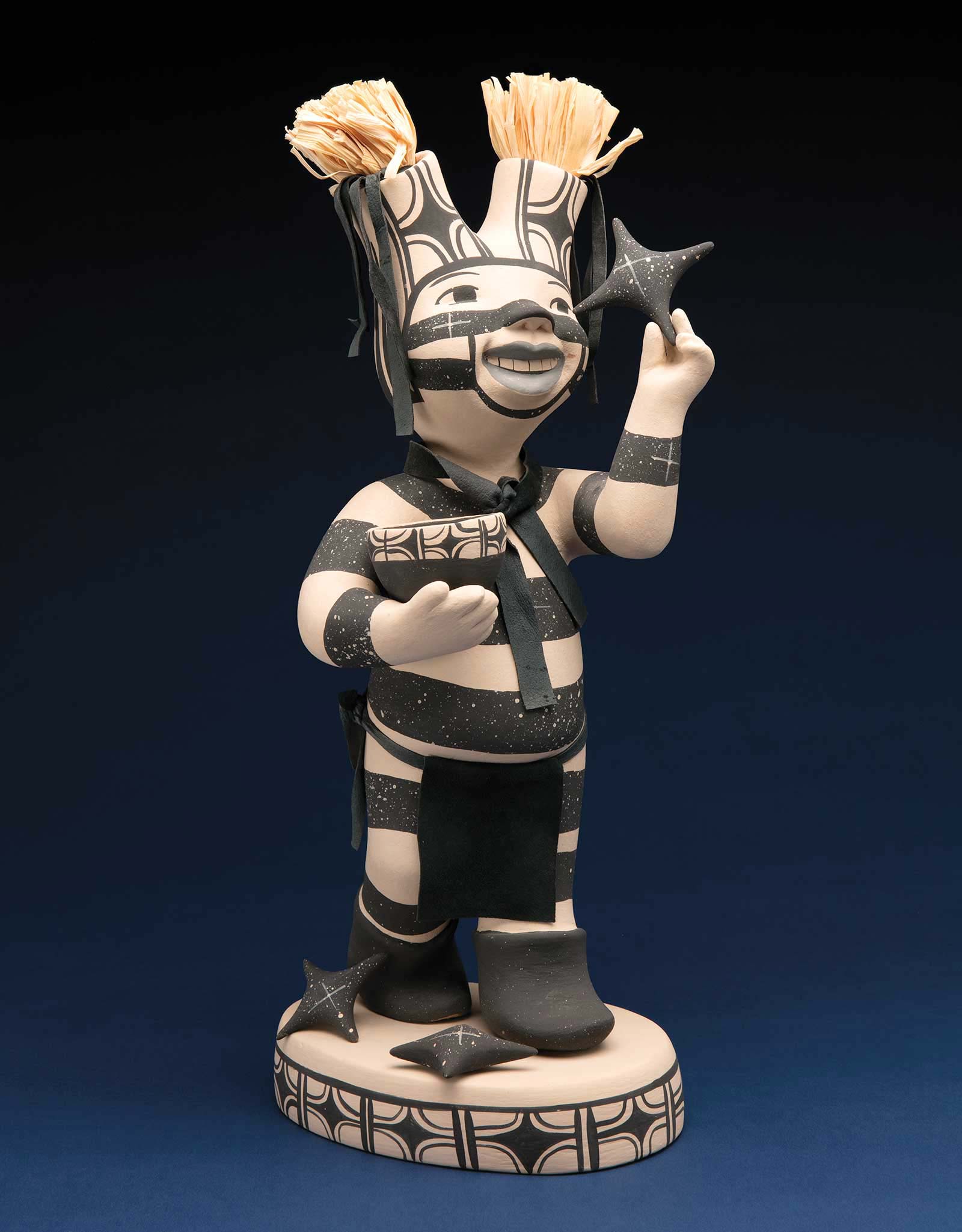
Kathleen Wall (Jemez Pueblo), Evening Star, 2009, clay and paint. Collection of Museum of Indian Arts and Culture, 60694/12. Gift of Ronald L. and Vickie Sullivan. Photograph by Adison Doty.
Magdalena’s study of pueblo astronomy “grounds the exhibit,” adds co-curator, Elisabeth Stone, “[as well as] stellar photography, stores and sciences. For Indigenous peoples of the Southwest, observing the sky brings joy, information and a sense of connection.”
It’s noted by Magdalena that many Indigenous cultures see the sky as a vast place where many beings or spirits live. Each object in the sky is seen as a spirit that has an effect on the world below. The sun provides light for plants to grow; rainclouds provide moisture for the plants; and birds carry prayers and communicate with the sky beings.
As in the case of Kathleen Wall’s (Jemez Pueblo) exhibition piece Evening Star, 2009, we see one of the artist’s iconic clay storytellers “representing the relationship between people on earth and the star spirits in the sky,” shares Magdalena. “This clown figure represents the many stories Indigenous people have regarding the stars and how they were placed onto the sky.”
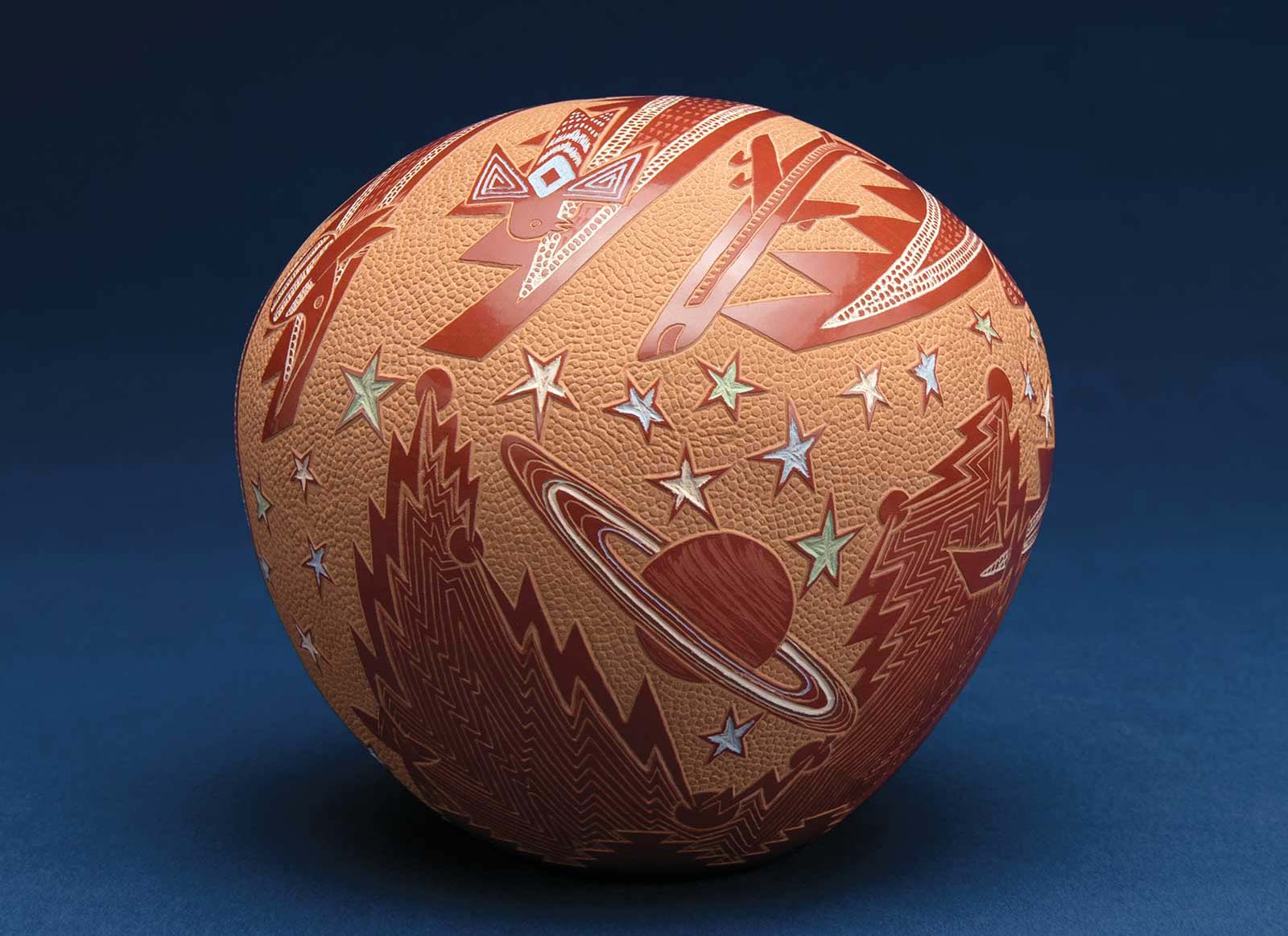
Rosemary Lonewolf (Santa Clara Pueblo), Spaced Out, 1992, sgraffito redware jar. Collection of Museum of Indian Arts & Culture, 53374/12. Photograph by Adison Doty.
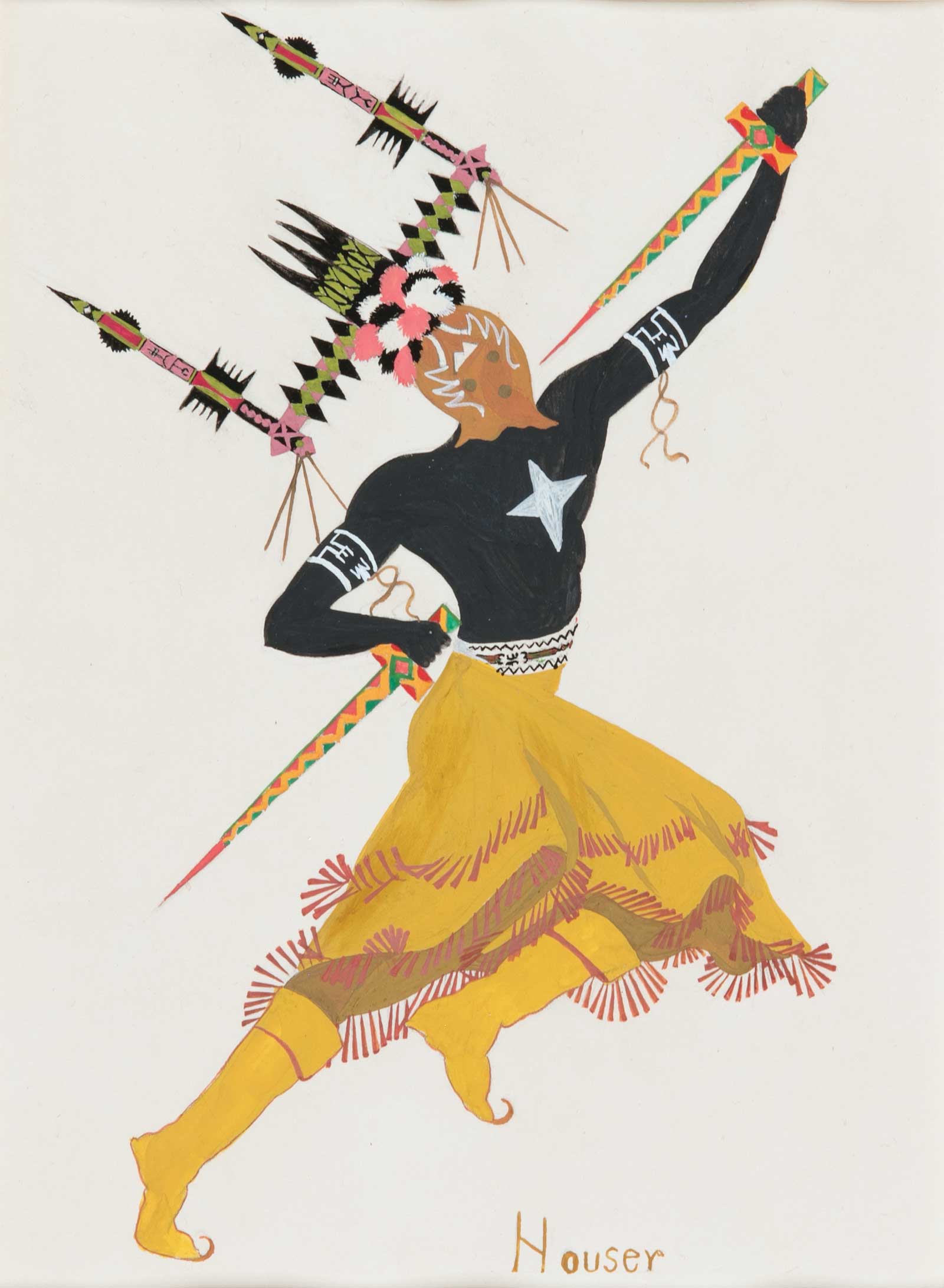
Allan Houser (Apache Chiricahua), Apache Devil Dancer, ca. 1934, gouache on illustration board. Collection of Museum of Indian Arts and Culture, 51375, Dorothy Dunn Collection.
In another clay piece, the sgraffito redware jar Spaced Out, 1992, by Rosemary Lonewolf (Santa Clara Pueblo), the artist showcases modern Indigenous views of celestial objects, while using traditional artistic methods of pottery making.
In a more historic gouache painting by Allan Houser (Apache Chiricahua, 1914-1994), Apache Devil Dancer, circa 1934, a figure with a star on its chest represents the Apache Mountain Spirit, or the “cardinal directions,” says Magdalena. The subject exemplifies the artist’s modern stylings, dressed in full, ornate regalia, with objects in hand and dancing for the sacred Apache ceremony.
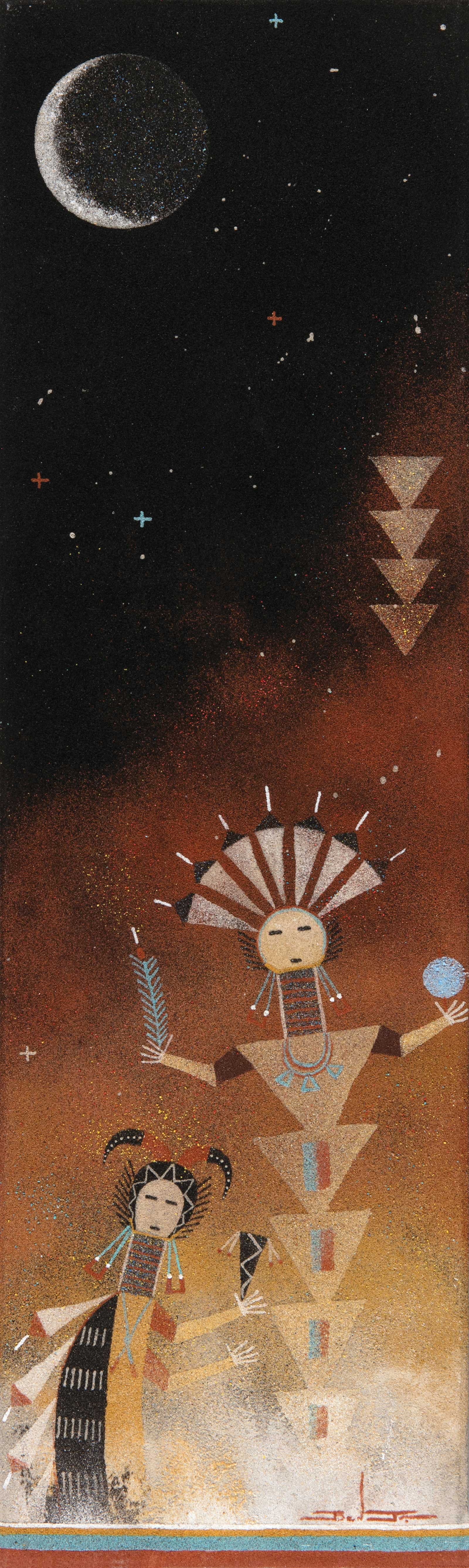
Joe Ben Jr. (Navajo (Diné)), Sand painting, ca. 2009. Sand on wood panel. Collection of Museum of Indian Arts and Culture, 59852/12. Gift of Carol Warren.
“We are excited to see art collectors engage with objects within a context that blends Western science, Indigenous ecological knowledge and other aspects of Native worldviews,” says Stone. “We hope that by bringing these perspectives into conversation, the artworks will be situated for observers in new ways.”
The exhibition, running from June 2 through September of 2026, will include an astounding 67 pieces. —
June 2, 2025-September 2026
Makowa: The Worlds Above Us
Museum of Indian Arts & Culture
710 Camino Lejo, Santa Fe NM 87501, (505) 476-1269, www.indianartsandculture.org
Powered by Froala Editor


