Beyond once in a lifetime. Beyond even seven generations. Two buffalo robes on view now at the Joslyn Museum of Art in Omaha, Nebraska, haven’t been back “home” since their creation in the 1830s. Both are loans from the Ethnological Museum in Berlin. They were collected by European visitors to the Great Plains shortly after their making and sent back overseas.
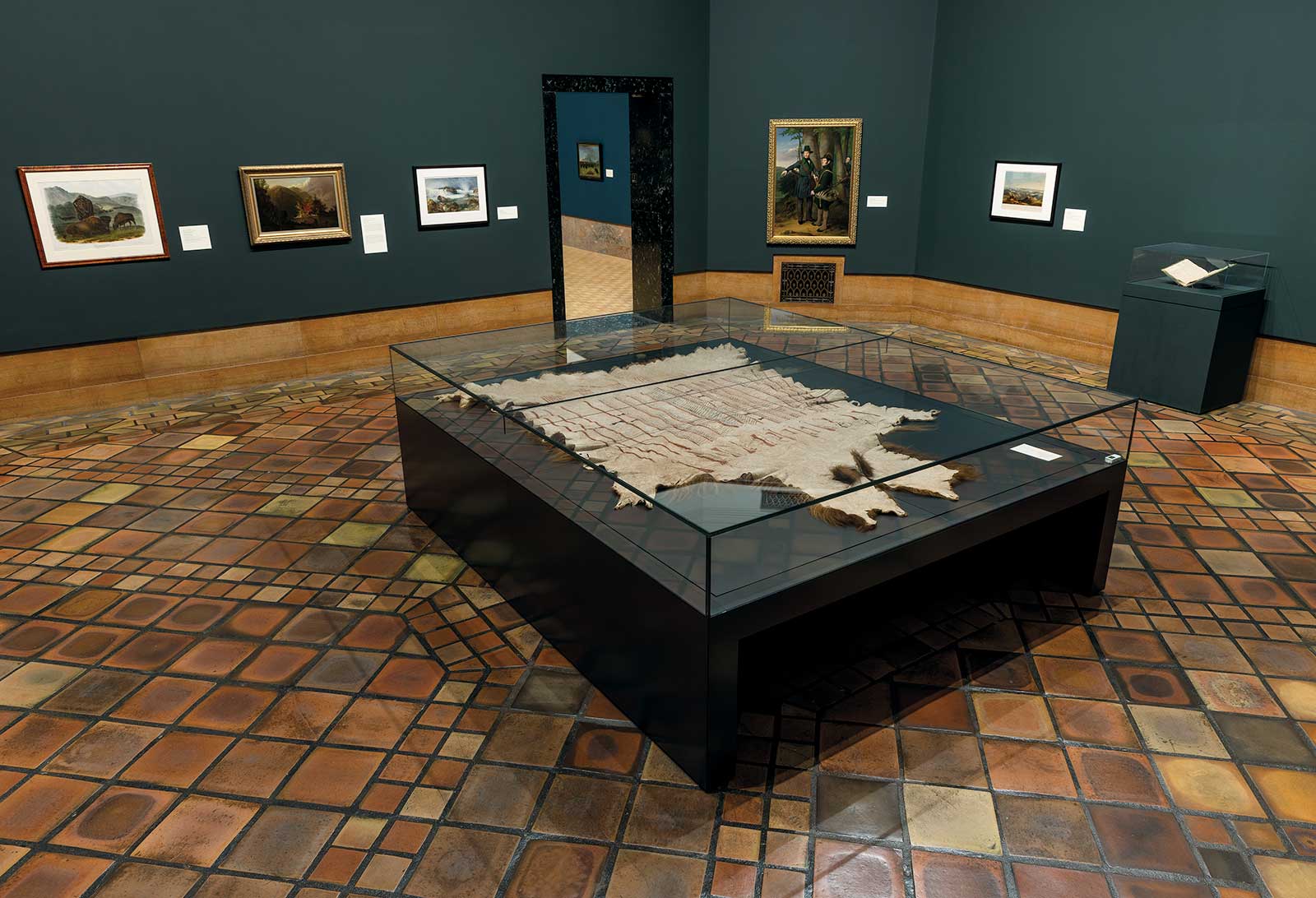 Installation view of the Joslyn’s Kingman Gallery. Pictured in foreground: Ancestor Artist (Hiraacá (Hidatsa)), Āashi (Robe), ca. 1830, bison hide and pigment, Maximilian zu Wied Collection, Ethnologisches Museum, Staatliche Museen zu Berlin, Germany, IV B 202. Photograph courtesy Bill Ganzel, Ganzel Group Communications, Inc.
One is a Hidatsa (Hiraacá) robe acquired during the famed Maximilian-Bodmer expedition along the Missouri River from 1832 to 1834. The other is a Lakhota, Očhéthi Šakówin (Sioux), robe picked up by Friedrich Köhler from Hildesheim during his tenure as valet to French Ambassador Adolphe Fourier de Bacourt in North America from 1840 to 1842. Both are “exploit” or “tally” robes of the absolute highest caliber depicting battle achievements.
The robes’ makers have been lost to time, a fact Joslyn museum staff, researchers and Indigenous knowledge bearers studying the robes hope to change.
“The most important thing is that they’ve come home,” Annika K. Johnson, curator of Native American art at the Joslyn, says. “That’s a term people continue to use with me, that the robes have come home. That reconnection with the physical objects, seeing the robes in the galleries, has been emotional for people, especially knowing the story that the robes survived two world wars and two transatlantic journeys. It’s amazing they still exist.”
The loan effort began in 2011 when Joslyn Museum of Art executive director and CEO Jack Becker visited the Berlin museum and saw the robes for the first time. He sweet-talked counterparts there for more than a decade, finally securing the robes for display in 2024 to coincide with the Joslyn’s reopening after a two-year closure for renovations and expansion.
The robes will remain on view in Omaha until summer of 2027 when they’ll cross the Atlantic for a third time and return to Berlin.
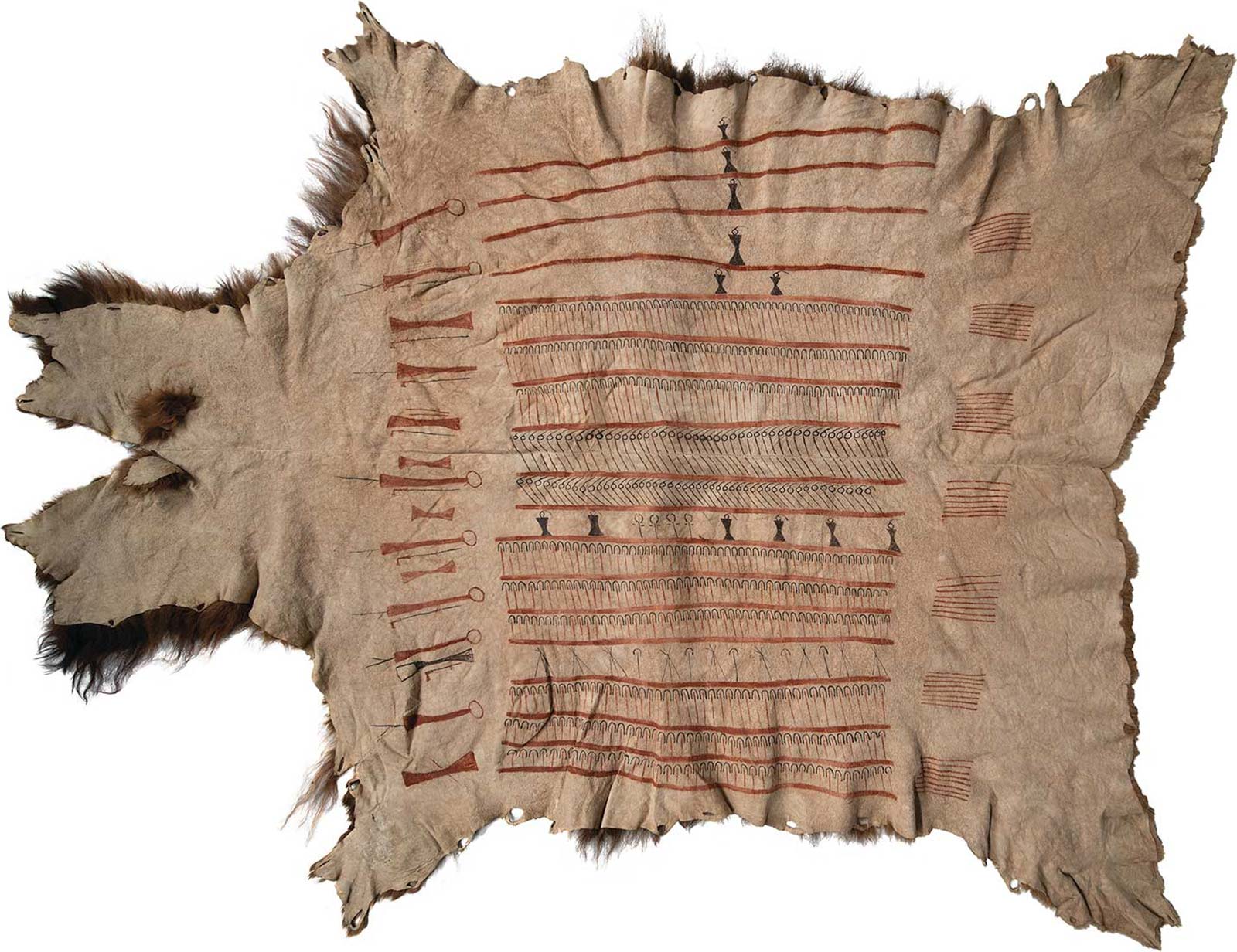
Ancestor Artist, Hiraacá (Hidatsa), Āashi (Robe), ca. 1830, bison hide and pigment, 10615/16 x 855/8 × 65/16 in. Maximilian zu Wied Collection, Ethnologisches Museum, Staatliche Museen zu Berlin, Germany, IV B 202. Photograph: Jon Hustead.
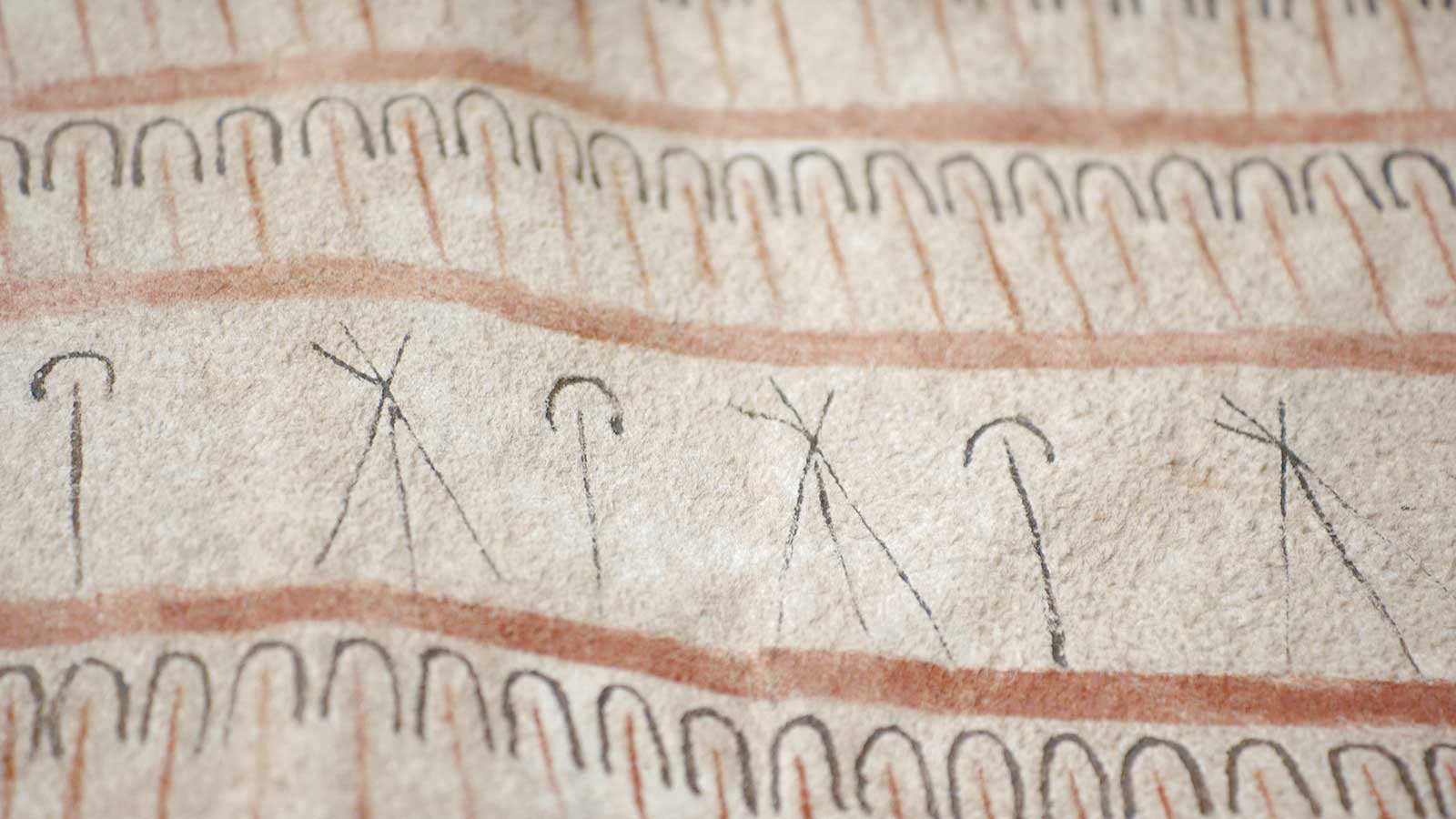
Ancestor Artist, Hiraacá (Hidatsa), Āashi (Robe), ca. 1830, bison hide and pigment, 10615/16 x 855/8 × 65/16 in. Maximilian zu Wied Collection, Ethnologisches Museum, Staatliche Museen zu Berlin, Germany, IV B 202. Photograph: Jon Hustead.
Hidatsa Robe
German naturalist Prince Alexander Philipp Maximilian of Wied-Neuwied, Germany’s (1782-1867) expedition from St. Louis up the Missouri River, went as far west as present-day Great Falls, Montana. Accomplished Swiss draftsman Karl Bodmer (1809-1893) was invited along to produce a visual record. He did so in some 400 drawings and watercolors produced along the way. Depicted are landscapes, plants and animals, and, most spectacularly, roughly 90 portraits of Indigenous leaders from the Missouri River tribes the party interacted with, unrivaled for their detail and historical accuracy.
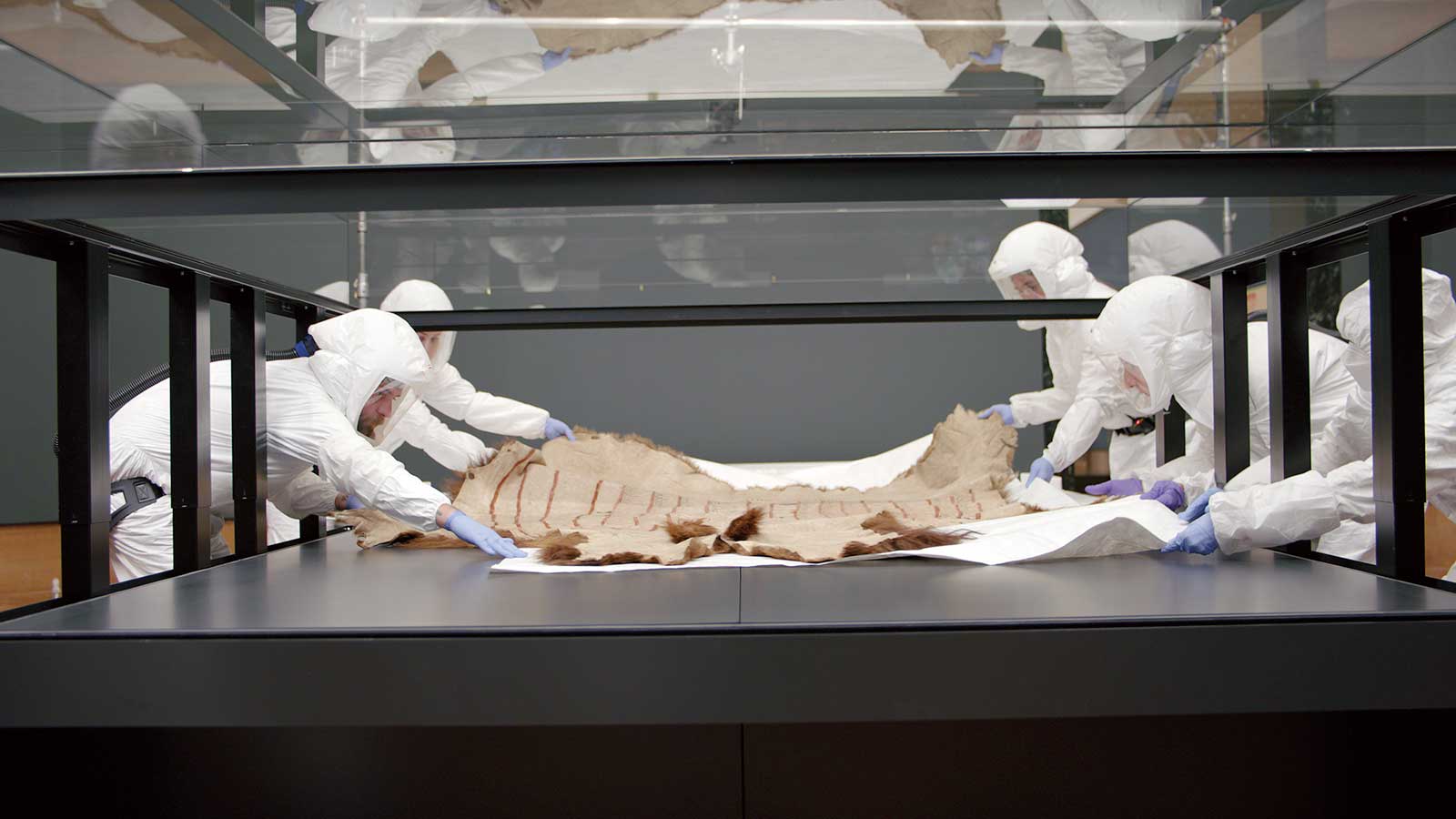
Staff from the Joslyn Art Museum and Ethnologisches Museum installing the Hidatsa bison robe in summer 2024. Photograph: Jon Hustead.
Combined with the Prince’s extensive journals—three volumes with sketches and written descriptions—what has become known as the Maximilian-Bodmer Collection represents perhaps the finest contemporary historical account of the American West because of its visual and narrative scope and thoroughness. The collection has been a centerpiece at the Joslyn since its acquisition in the 1980s.
The expedition spent more time with the Mandan and Hidatsa than any other nations. Nearly every Mandan and Hidatsa person wore a painted buffalo robe when posing for Bodmer, revealing the incredible importance of this cultural expression.
The Hidatsa painted buffalo hide robe, on view, is thought to have been acquired directly from the maker, either as a gift or through purchase. It features a complex pictographic system chronicling achievements in battle honoring a prominent Hidatsa leader, possibly Lachpitzí Síhrisch (Yellow Bear), from details in Maximilian’s journals. Bodmer’s journals record their encounter while Yellow Bear was in the process of making the robe using earth pigments from the region.
“The imagery is so unusual and in near perfect condition. You can tell the hide tanner was incredible,” Johnson says. “It has almost this polar-fleecy surface to it and, of course, handling it with gloves you can tell it’s butter soft, and there’s ochre pigment and probably a charcoal pigment on it.”
To anyone at the Joslyn or the Berlin museum’s knowledge, it has never been previously exhibited.
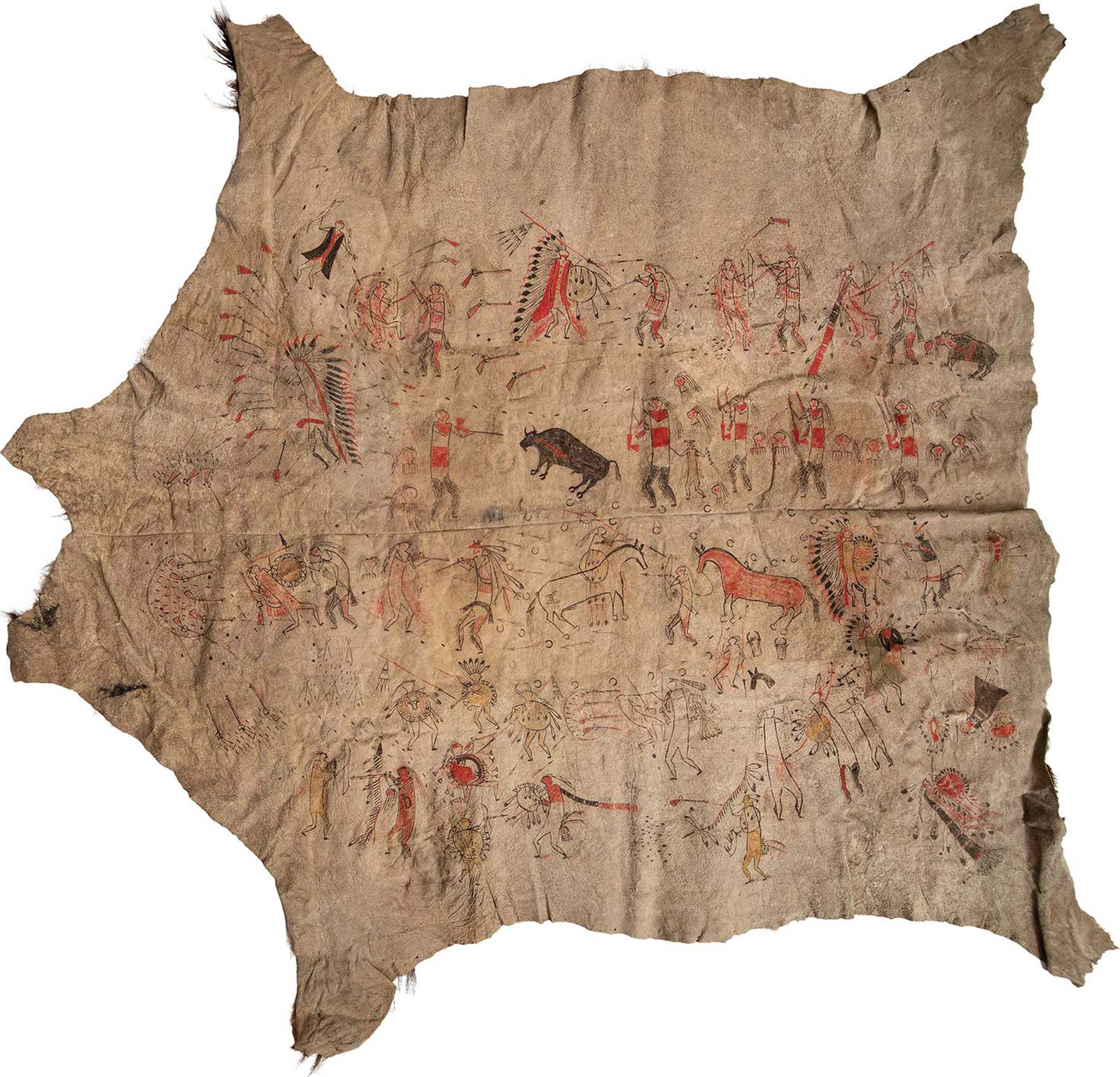
Ancestor Artist, Očhéti Šakówiŋ (Sioux), Tĥatĥáŋka Šiná Wiokíčhize Zuya Iyuŋpi (Painted Buffalo Robe), before 1846, bison hide and pigment, 873/8 x 8011/16 x 35/16 in. Friedrich Köhler Collection, Ethnologisches Museum, Staatliche Museen zu Berlin, Germany, IV B 208. Photograph: Jon Hustead.
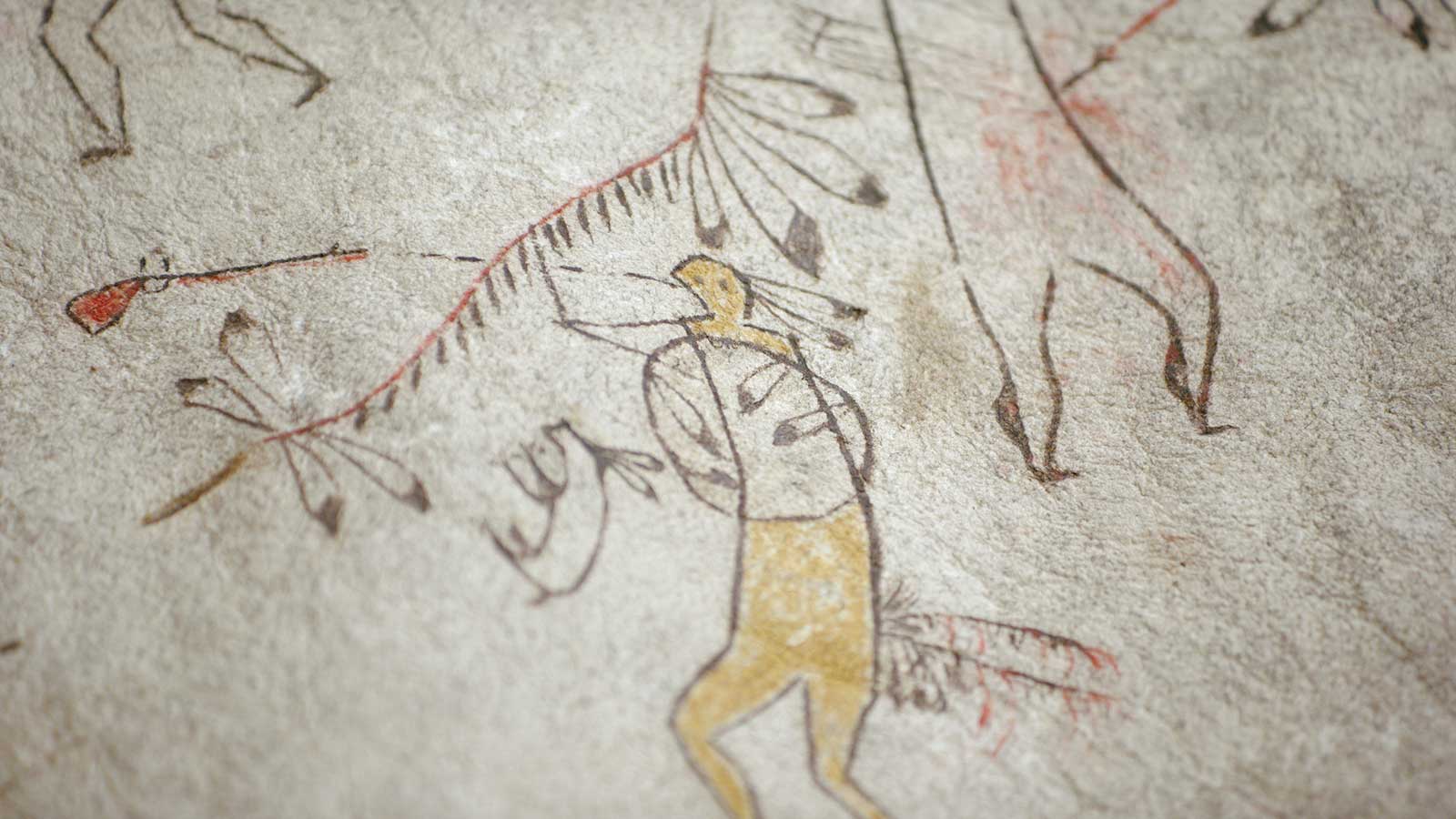
Ancestor Artist, Očhéti Šakówiŋ (Sioux), Tĥatĥáŋka Šiná Wiokíčhize Zuya Iyuŋpi (Painted Buffalo Robe) (detail), before 1846, bison hide and pigment, 873/8 x 8011/16 x 35/16 in. Friedrich Köhler Collection, Ethnologisches Museum, Staatliche Museen zu Berlin, Germany, IV B 208. Photograph: Jon Hustead.
“That just blows my mind,” Johnson adds. “I’ve seen it illustrated in texts before, but it hasn’t been on public view, and there’s clearly such an extensive story that that robe is telling; it’s tallying somebody’s accomplishments, and to an extent that’s just unseen. I can’t think of a robe that’s comparable.”
Johnson didn’t select the two buffalo robes for display in Omaha among all the robes possessed by the Berlin museum herself. She relied on Native knowledge bearers. For the Hidatsa robe, elder Gerard Baker (Mandan-Hidatsa Tribe of the Fort Berthold Indian Reservation) was selected. At one time, he was the highest-ranking Native American person within the National Park Service as superintendent of Mount Rushmore National Memorial. He was featured prominently in Ken Burns’ 2009 PBS film The National Parks: America’s Best Idea.
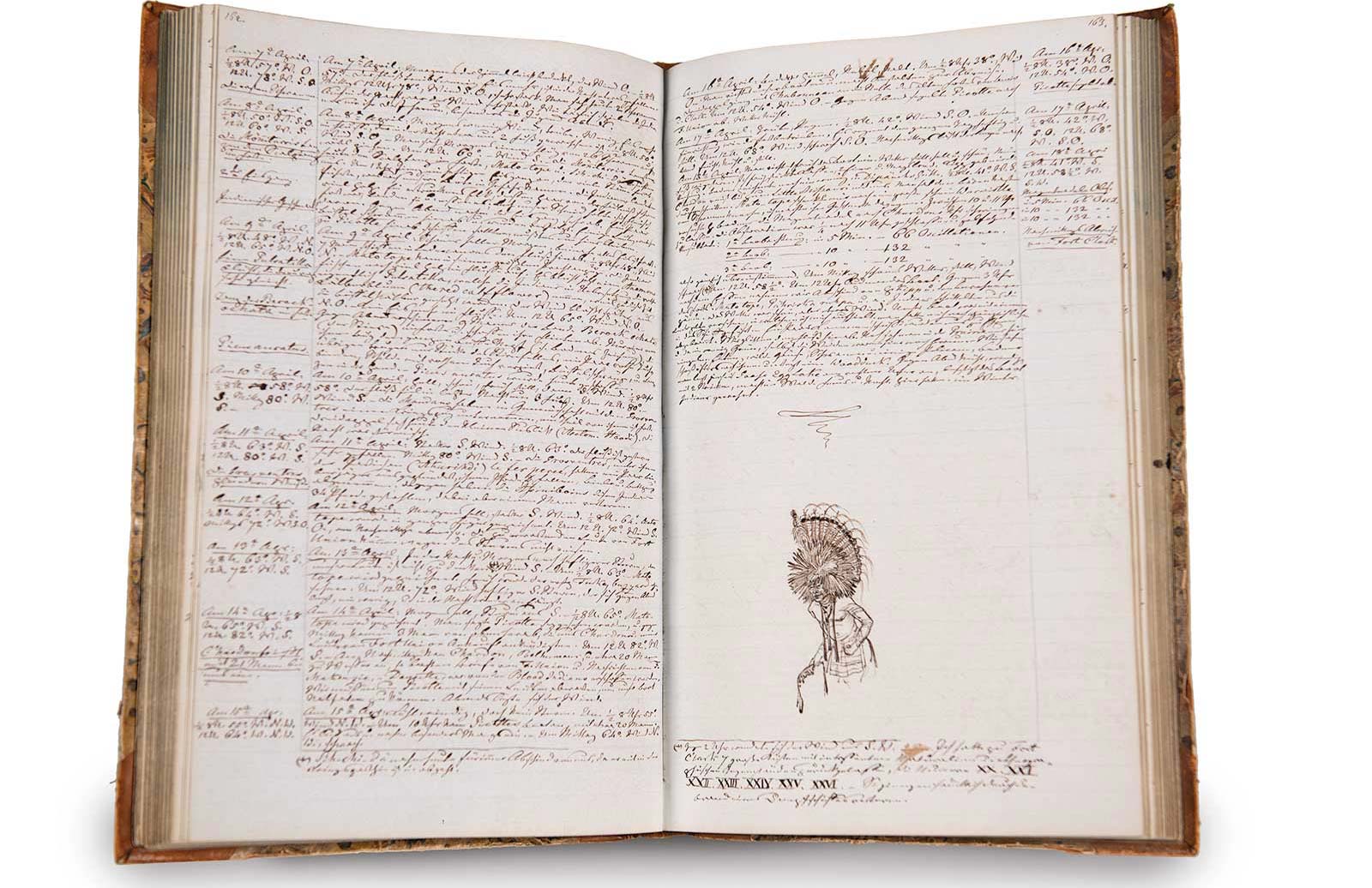
Prince Maximilian zu Wied (1782-1867), Journal (Tagebuch), Volume III, September 1833-August 1834, p. 162-163, ink and graphite on paper. Joslyn Art Museum, Omaha, Nebraska. Gift of the Enron Art Foundation, 511.NNG.
With Baker unable to travel to Berlin, Johnson went to him, visiting his Montana ranch with pictures of the various Hidatsa robes acquired by Maximilion. Aside from its exceptional material and artistic quality, Baker selected the one that most intrigued him, that he felt the most could be learned from in Nebraska.
Throughout the duration of the loans, the Joslyn has and will continue inviting Native scholars, students and community members to visit and study the robes, as well as non-Native researchers. The public, too.
The robe is included in a display alongside Prince Maximilian’s journals and Bodmer’s watercolor depictions of Hidatsa people offering a historic reunion of the Maximilian-Bodmer expedition materials after nearly two centuries.
“At (the Berlin Ethnographic Museum), they talked about Karl Bodmer and the Joslyn and Maximillion, and this whole story,” Becker remembers from his visit. “They have a significant collection of Indigenous material that was owned by Prince Maximilian, including one of the robes that is here now. At that time, for me, (a robe) felt like the missing piece of the puzzle. I had seen the Bodmer watercolors. I had seen the Maximillion journals. Here was this third component of these objects they collected along the way.”
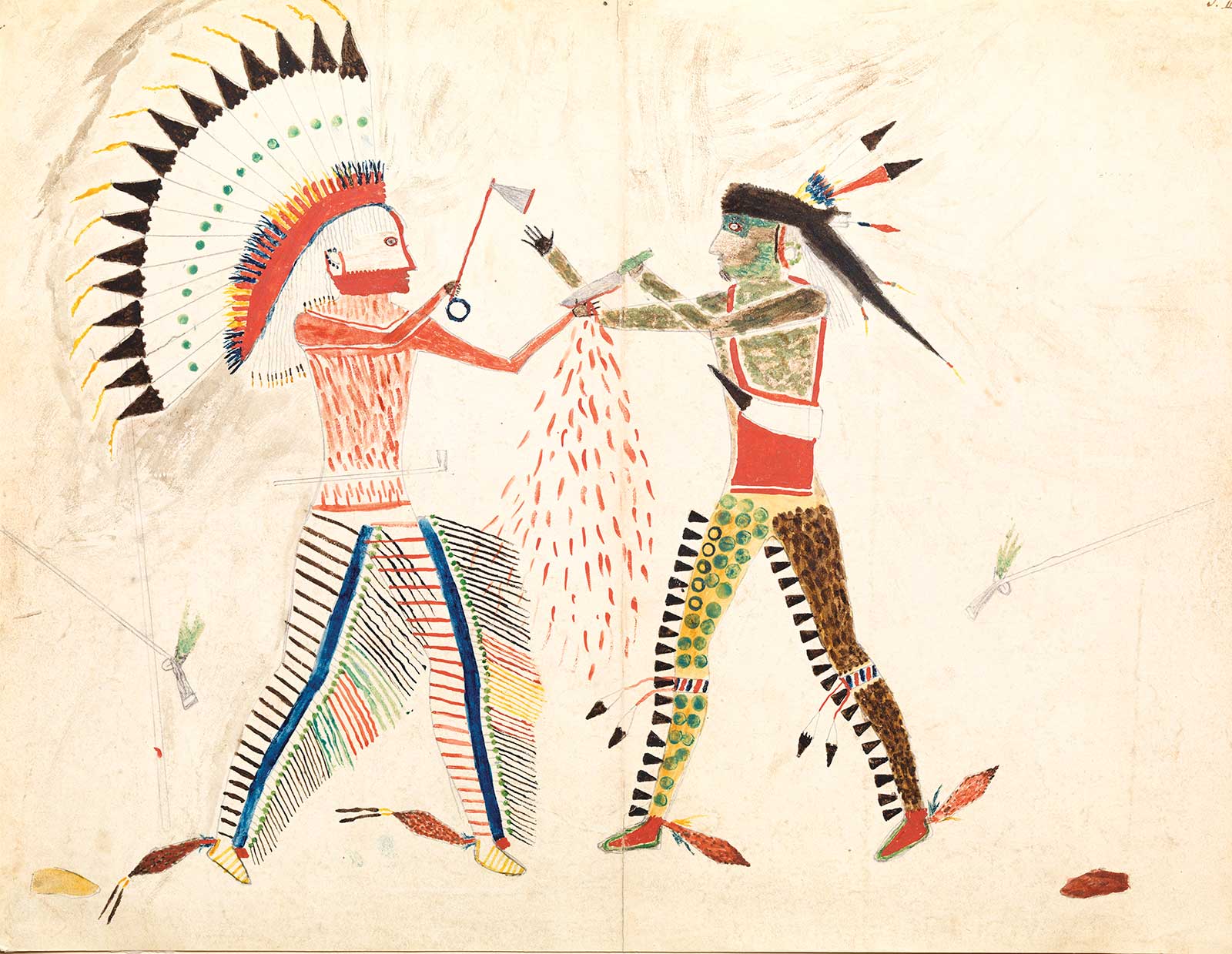
Mató-Tópe (Four Bears) (Mandan, ca. 1795-1837), Battle with a Cheyenne Chief, 1834, watercolor and graphite on paper, 12 x 155/8 in. Joslyn Art Museum, Omaha, Nebraska. Gift of the Enron Art Foundation, 1986.49.384. Photograph © Bruce M. White, 2019.
Lakota Robe
The Lakota robe collected by Friedrich Köhler features numerous figures engaged in hunting and battle scenes. An experienced warrior would reference the images to recount his war feats and tribal histories.
The robe’s creator remains unidentified, for now, but due to the evident exceptional skill and detailed portrayal of clothing and weapons, Johnson thinks the mystery can be solved.
“Because there are those shield designs, the feathered bustles, the staffs, all of that warrior insignia, we can get there,” she says. “It’s going to take more research. There’s another robe clearly painted by the same artist in Washington, D.C., at the Natural History Museum, so I think we can do it.”
The specificity of the figural scenes have allowed museum curators and specialist consultants to begin identifying individual warrior societies and historical battles depicted on the robe. Helping in that effort has been Lakota elder and knowledge bearer Steve Tamayo. He’s a hide tanner and painter himself, and accompanied Johnson to Berlin to hand pick the robe that would be returning to Omaha.
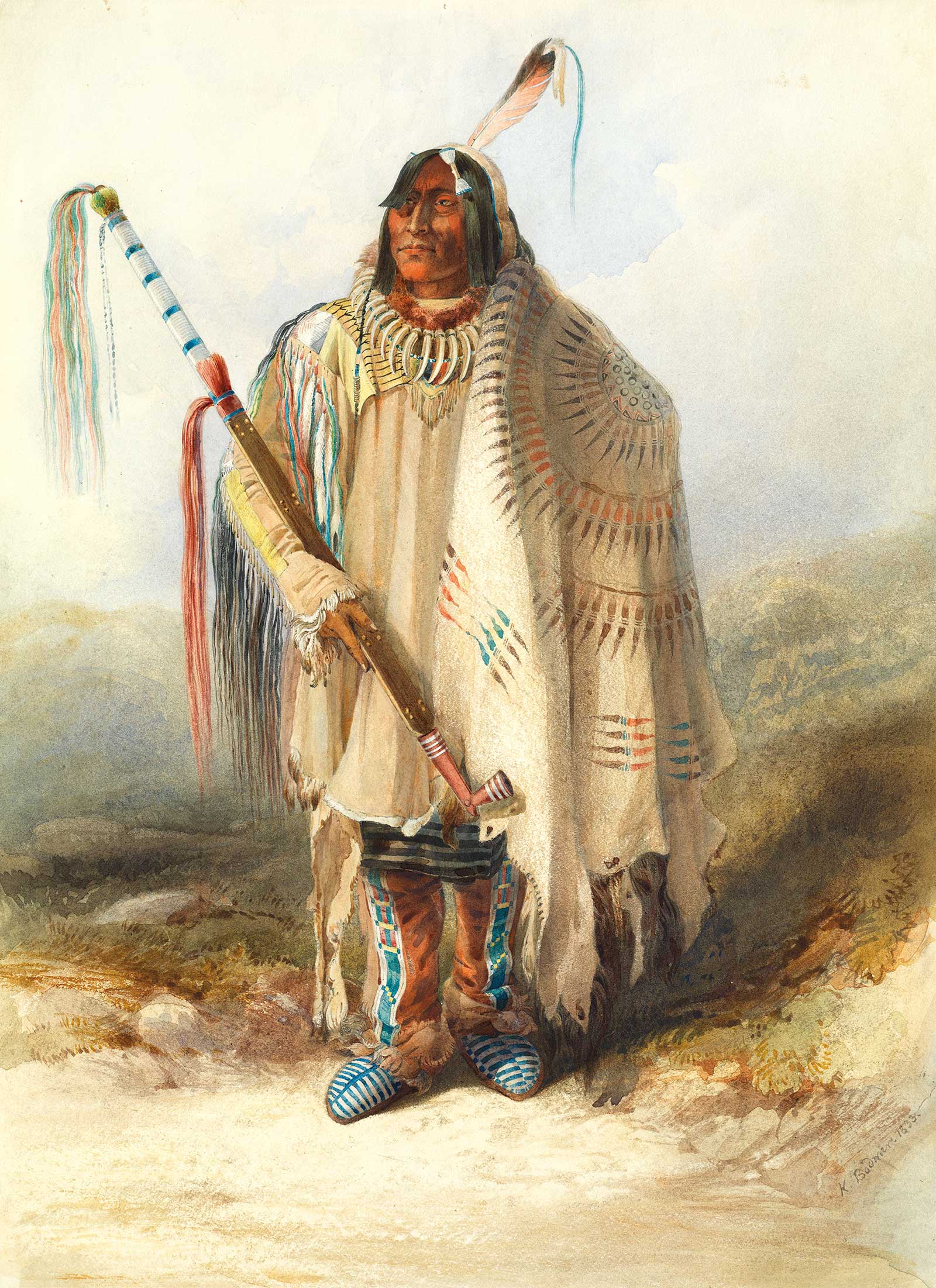
Karl Bodmer (1809-1893), Péhriska-Rúhpa, Hidatsa Man, 1833, watercolor and graphite on paper, 157/8 x 11½ in. Joslyn Art Museum, Omaha, Nebraska. Gift of the Enron Art Foundation, 1986.49.390. Photograph © Bruce M. White, 2019.
“He and I spent a couple of days in storage (at the Berlin museum) with conservators and they were pulling out all the robes in the Maximilian-Bodmer collection, their collection beyond that, and the (Lakota) robe we now have on view, the pictorial robe. Once they opened that drawer—we had curators, conservators, Steve was there, and we just gave him his moment—he gasped,” Johnson remembers. “Then he stared at it and we let him take his time. I could tell it was absolutely breathtaking for him to see this robe in person.”
When the robe arrived at the Joslyn, Tamayo performed a prayer for staff who would be handling it and in the company of the item.
“I could tell that staff thought of the project in a different way, thought of the connection to living traditions in a really respectful way, because they were able to go through that experience,” Johnson says.
Tamayo has identified the warrior societies represented on the robe, including the Bent Staff Society, as well as information about the buffalo at the center of the robe being pierced by a red arrow.
“This is a form of design that you see in Native art, and there’s a man offering (the buffalo) a pipe,” Johnson explains. “What Steve shared is that this man is basically thanking the bison for sacrificing himself. When you smoke that pipe, you share the air with the animal. It’s showing this kinship between humans and animals.”
Collaborative research of pre-1850 Plains Indian material culture between Native and non-Native scholars and Native community members—the likes of which is now being undertaken at The Joslyn on these robes—is virtually unprecedented. But for as much academic knowledge as will be drawn from their study, that value pales in comparison to the homecoming of these robes near to the place of their making, for communion by the descendants of their creators.
Admission to the Joslyn Art Museum is always free, as is pursuing “The Natural Face of North America” website. —
Learn More
The Natural Face of North America
www.maximilian-bodmer.org
Joslyn Art Museum
www.joslyn.org
Powered by Froala Editor


