“Vintage” has always been an elastic term when it comes to the arts. In art and antiques, the definition of vintage refers to items that are between 50 and 100 years old. The world of Native-made jewelry, however, measures the term vintage differently. This decision was shaped by the Indian arts industry and adopted by collectors, for the most part. Antique or historic Native-made jewelry is dated between the mid-19th-century, up to World War II. While the 1940s remain a somewhat debatable period, vintage Indian jewelry is largely considered to be made between 1946 and 1979.
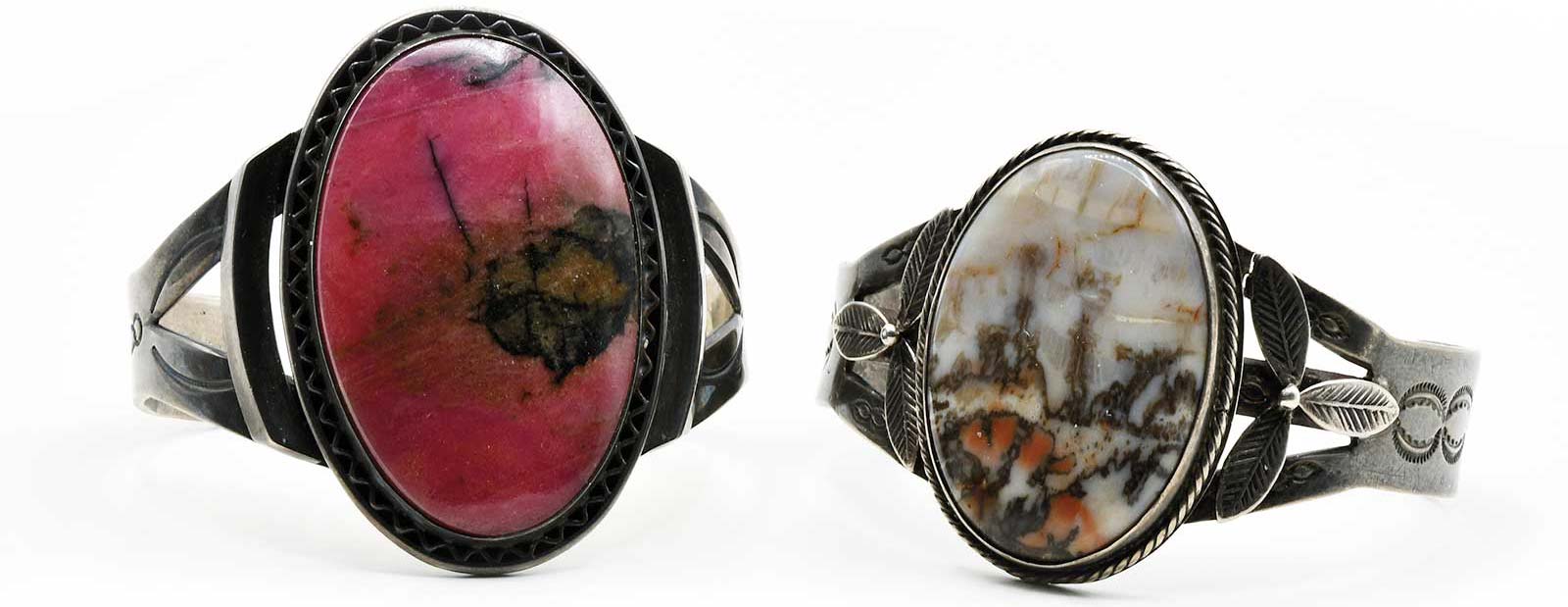
Red jasper and picture stone tourist bracelets, 1950s.
Some dealers in the Indian jewelry business feel that 1980s and 1990s adornment can also be termed vintage. This may be a reaction against deeming 1980 as the starting point for contemporary Indian art jewelry, meaning the term “contemporary” has therefore been in effect for 45 years. Despite this, there exists some disagreement on when the vintage label end date should be applied and what kinds of jewelry qualify as vintage. For example, should an artist’s early work be considered vintage? Do new jewelry forms created after 1945 meet the criteria for being called vintage wear?
Surveying the timeline of Indian jewelry designs, materials and techniques included, vintage work marks a mid-point between the historic and contemporary eras. This means that vintage-era pieces range from traditional and tourist designs to wearable art, craft and fine art creations. In order to evaluate these kinds of questions, eight examples from the private collection of Paul and Valerie Piazza, each piece fashioned between 1946 and 1979, can be considered. These works represent the beginning and end of certain jewelry forms and stylistic explorations.
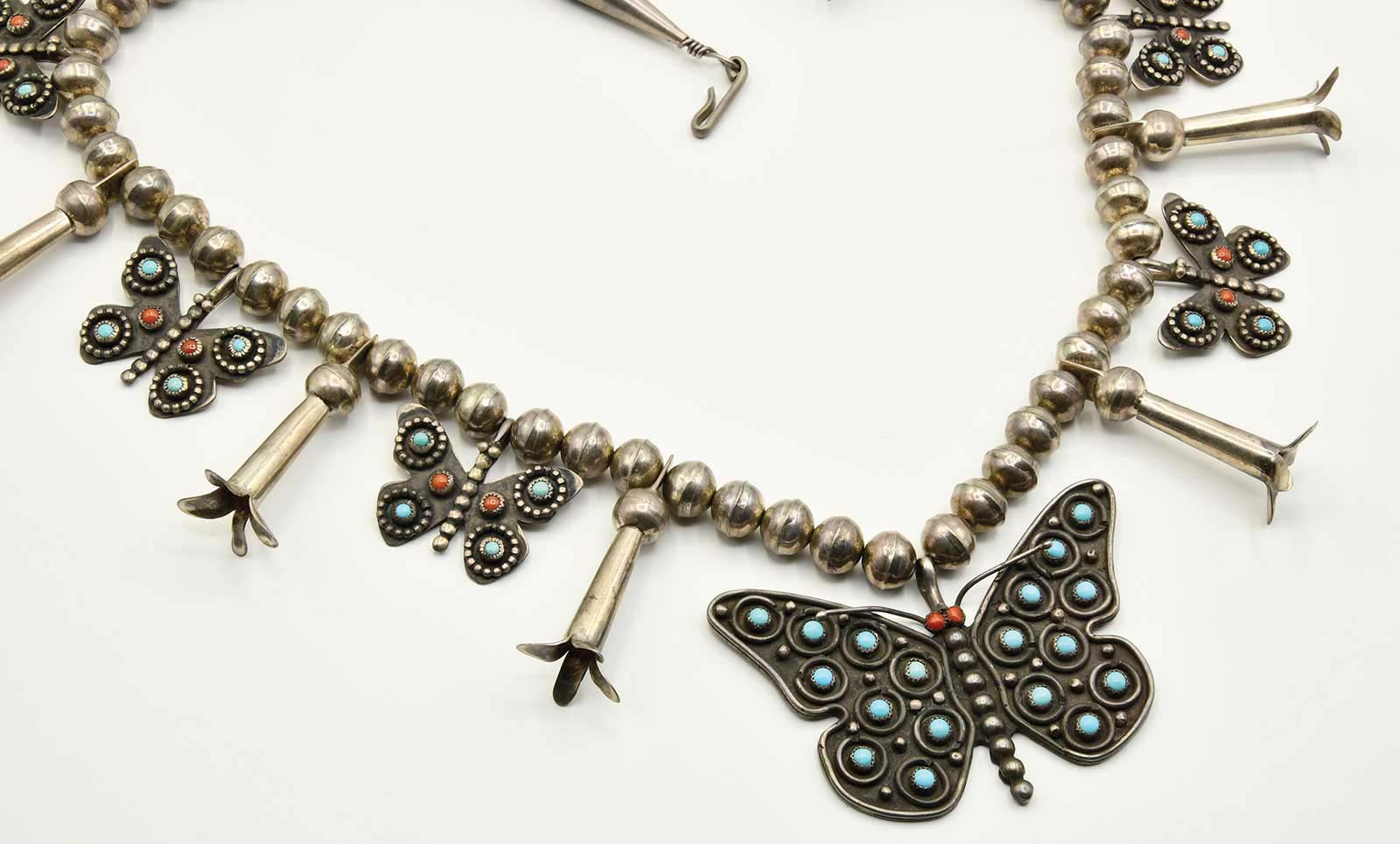
Mid-20th century squash blossom necklace with butterfly motifs interspersed with squash beads, and large butterfly in the center, replacing the traditional naja.
Our first example presents two tourist bracelets by unsigned makers. This type of bracelet originated in the historic era as part of souvenir wear, but continued into the vintage decades. The polished central stones—red jasper and picture stone—are local to the Southwest. These pieces were most likely made in the 1950s, and reflect the long-lasting appeal of a traditional style.
Squash blossom necklaces were an inventive historic jewelry form that came into being during the 1870s and 1880s. Navajo-made initially, the form spread to the Pueblos and other tribes after 1900. Thereafter, squash blossom necklace developed added decorative features through the decades; for example, these pieces often featured an external boxbow ornament in the 1930s. Postwar necklace-makers continued to experiment with decorations, as seen in this mid-century example where silver butterflies decorated with turquoise dots are interspersed between pomegranate beads, and a larger central butterfly replaces the naja ornament.
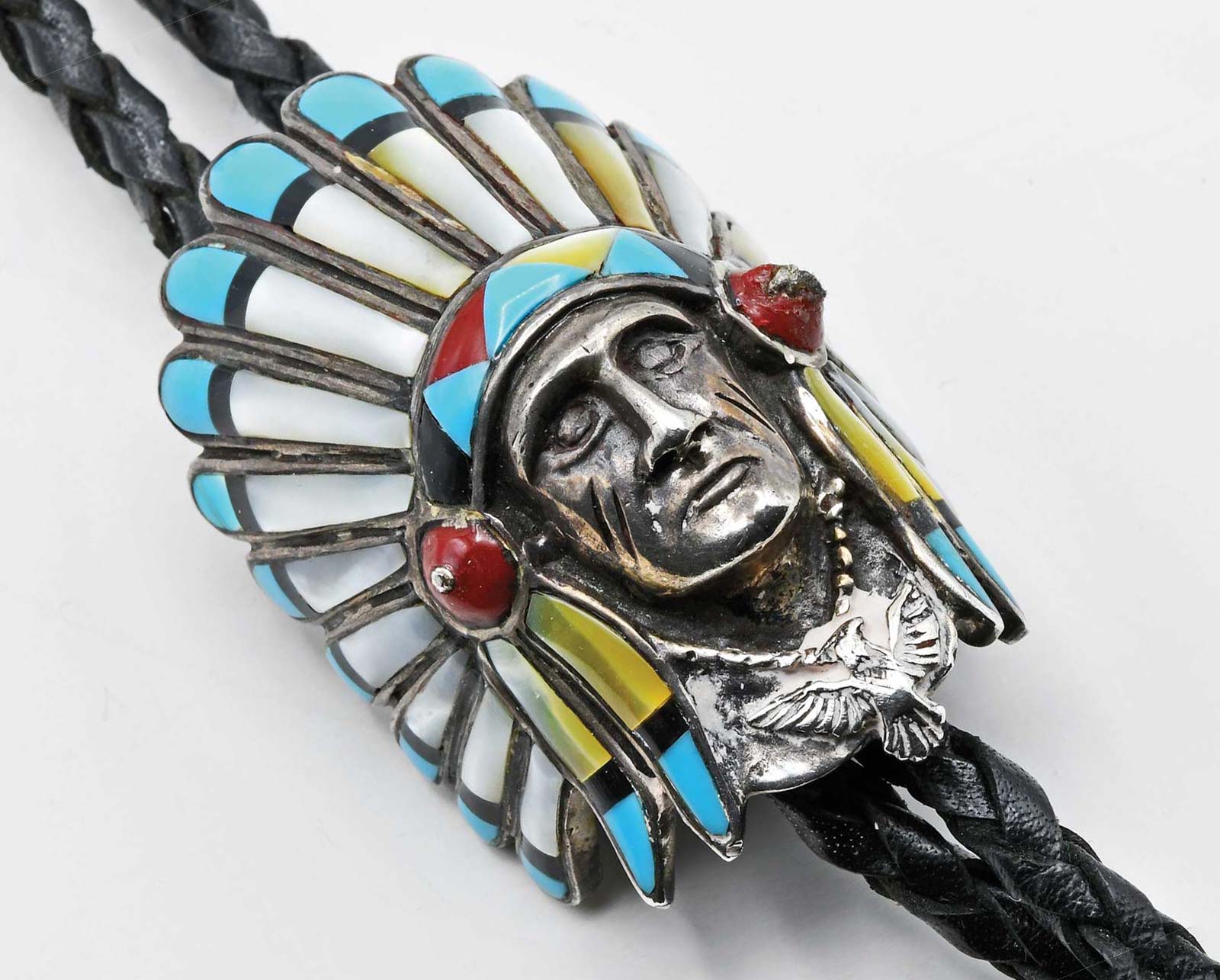
Commercially made tourist inlay bolo with chief’s head design and added inlay stones, ca. 1970.
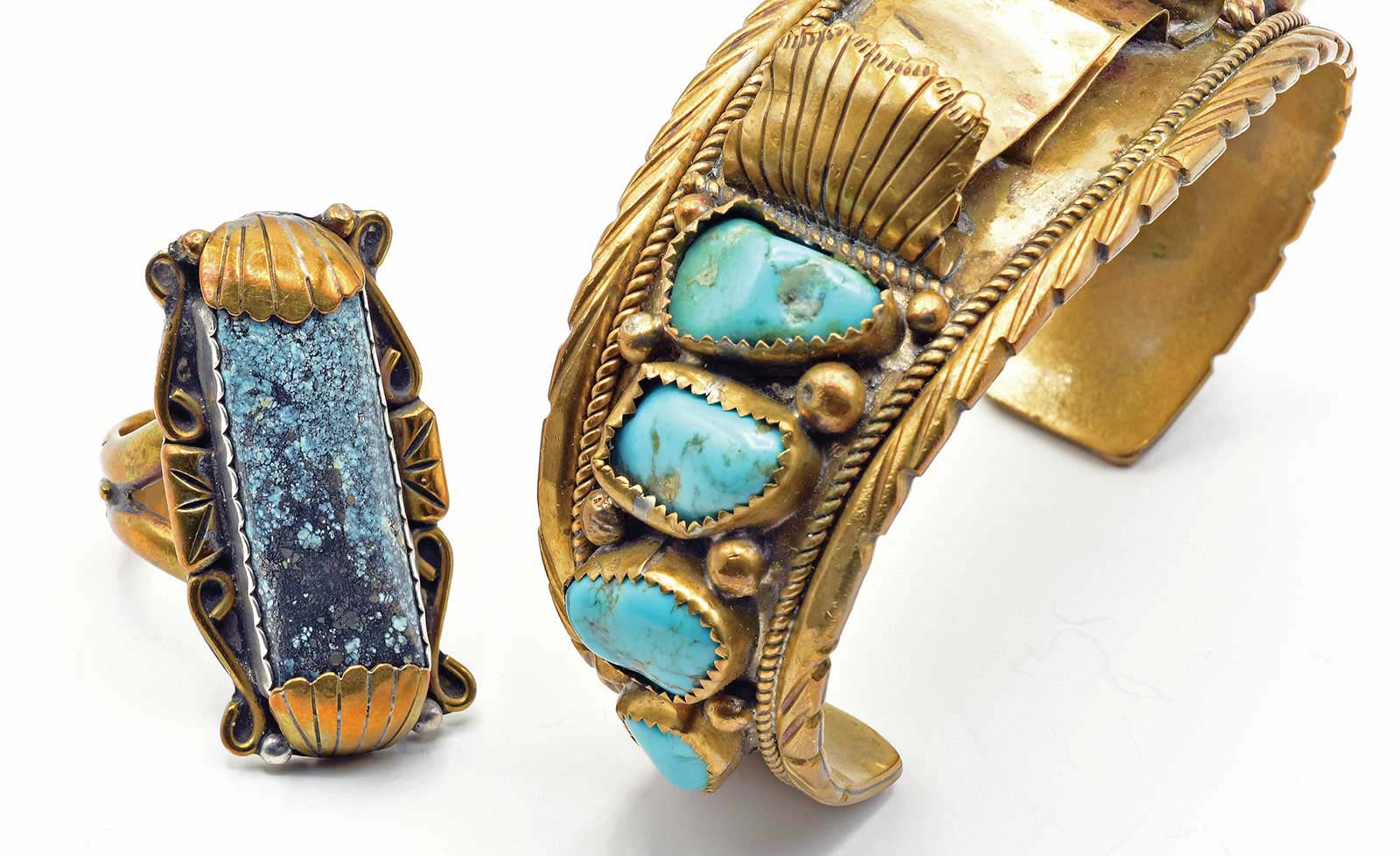
Turquoise and brass men’s watch bracelet with brass ring, 1960s.
The 1960s were the starting point for two new jewelry forms, the bolo and the watch bracelet. While wearable by both genders, these pieces tended to be masculine adornment. The watch bracelet shown here has turquoise and brass materials with a matching ring. Interestingly, Native-made watch bracelets faded out during the 1980s, replaced by watchbands and watch tips. Nowadays, those surviving watch forms are less commonly produced.
Vintage designs were born during the craft phase of Indian jewelry construction. Craft best describes work in the Pueblo of Zuni where families created and “owned” specific designs which were often made in multiples, sometimes with differing details. Zuni inlay artists, such as Anselm Wallace, created attractive jewelry. Wallace’s pin pendant is one of these pieces. Clearly designed for a feminine wearer, the design has fashionable flowers made with white and yellow shell petals and red shell centers. This piece dates to the late 1960s.
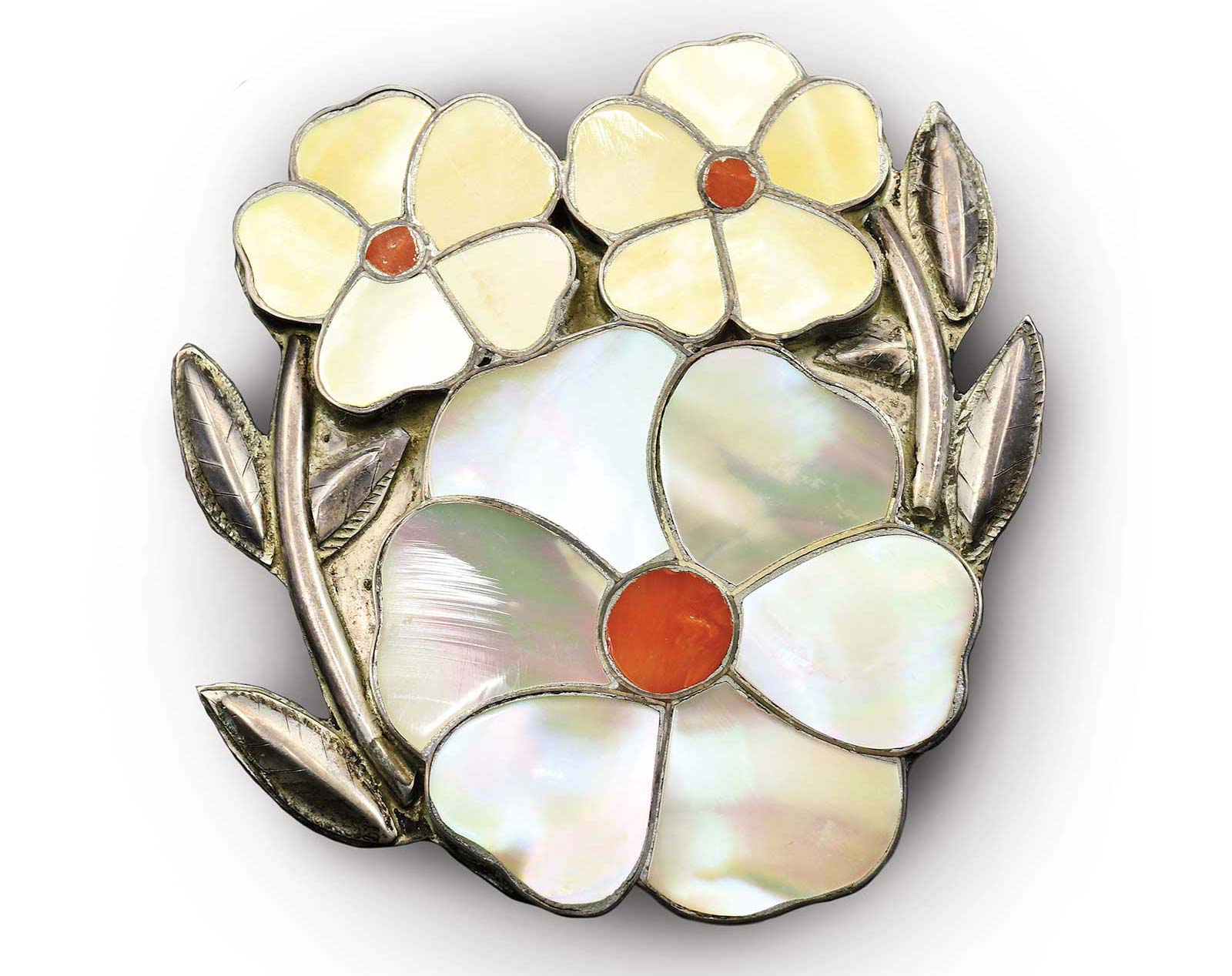
Zuni-style pin pendant by Anselm Wallace, with three flowers; petals made from yellow and white shell with red shell centers, late 1960s.
The next piece to be assessed proves to be the early work of a Native master jeweler. Should this bracelet be considered vintage? Preston Monongye came to public notice in the late 1960s for his sophisticated experiments in silver with inlay elements. Monongye was one of a number of fine artists who created enduring jewelry designs that greatly influenced artists of the 1960s, 1970s and later. While his artistry technically wasn’t vintage in nature, an early bracelet like this could be informally referred to as a “vintage design” only because it falls into the time frame of his early career.
The 1970s, often called a “boom” decade, was a period flush with old and new jewelry styles of variable quality. Some lower-grade pieces were spin cast, then finished with bench work by a Native American. The unsigned silver inlay bolo shown here typifies the vintage nature of the decade with its quirky representation of a chief’s head, complete with a headdress made from glass and inlay materials. This early 1970s design now appears laughably stereotypical, but it was probably a fairly popular souvenir choice for its time.
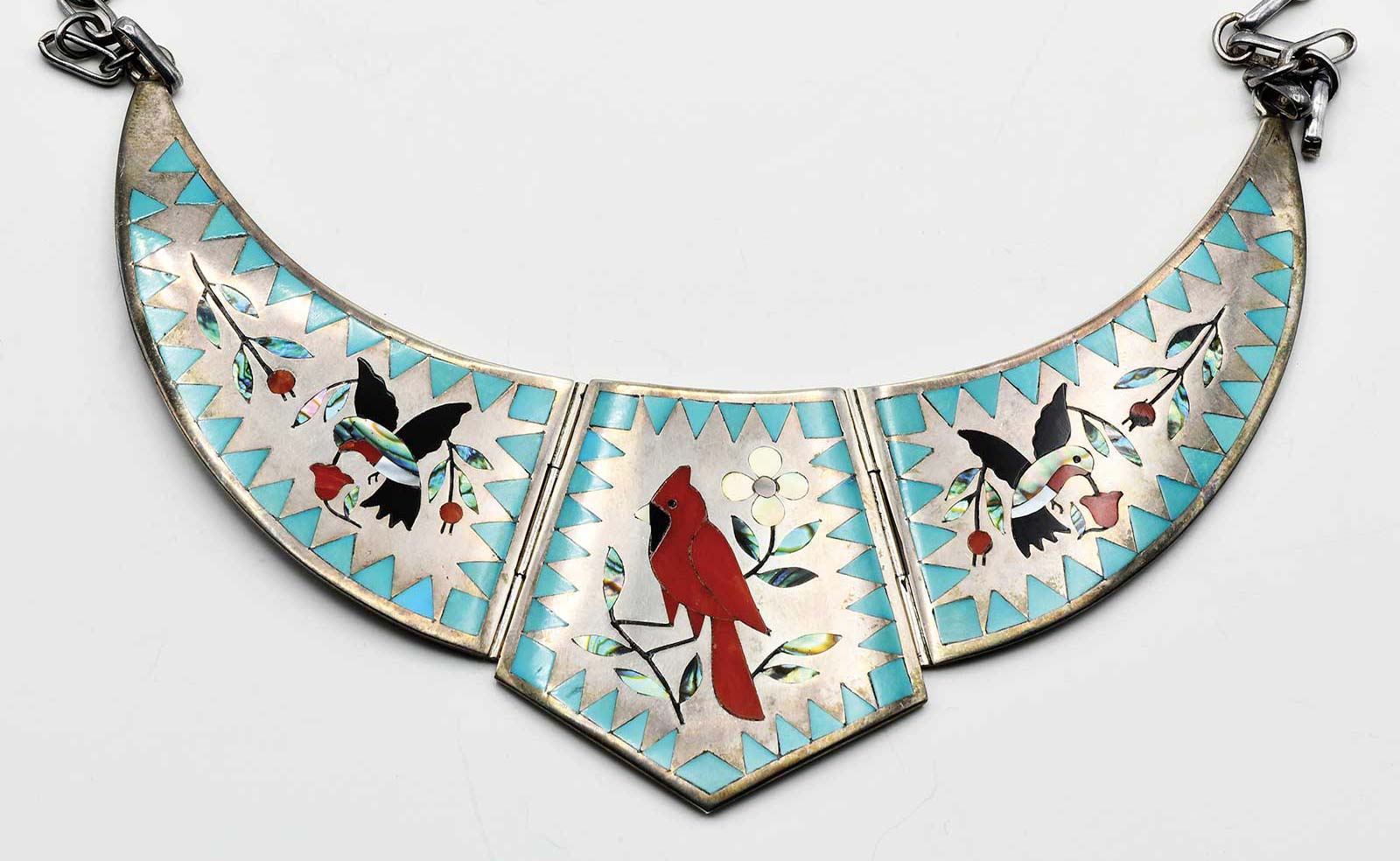
Silver and turquoise inlay collar necklace, central design of cardinal flanked by hummingbirds sipping nectar from flowers, by Dennis and Nancy Edaakie, 1970s.
On the other hand, some 1970s pieces could be made to look quite fashionable. This three-section necklace by Dennis and Nancy Edaakie represents refined Pueblo craft work with well-executed decorative design motifs. Based on early pectoral neck wear, this silver collar is illustrated with a central cardinal flanked by hummingbirds who sip nectar from a flower. Despite its vintage era origin, this work feels more stylish than dated.
The final example demonstrates how fine art creation can be mistaken for vintage-era illustration. The piece in question is a silver overlay bracelet made in 1978. Clarence Lee, the artist, was just beginning a career that lasted until his passing in 2011. Lee was a brilliant portrayer of traditional Navajo lifeways and whimsical figures. Unfortunately, his storyteller designs have sometimes been mislabeled as vintage in origin. While the subject matter conception may seem to be a product of pre-1980 illustrations, Lee created scenes so vibrant in detail that they demonstrate fine art jewelry-making at its best.
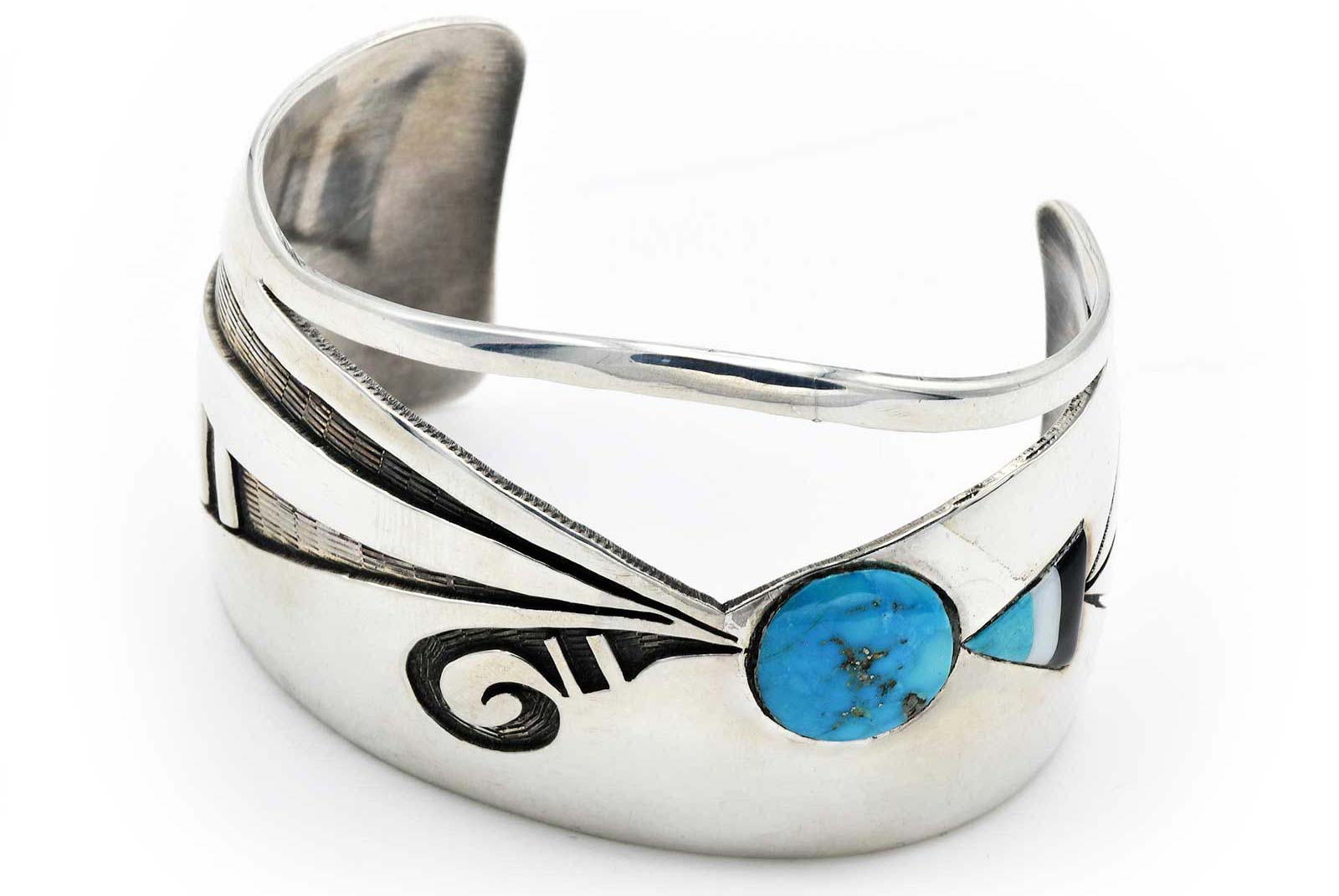
Early bracelet by Preston Monongye, silver with cutout top, one turquoise stone and triangular inlay, late 1960s-early 1970s.
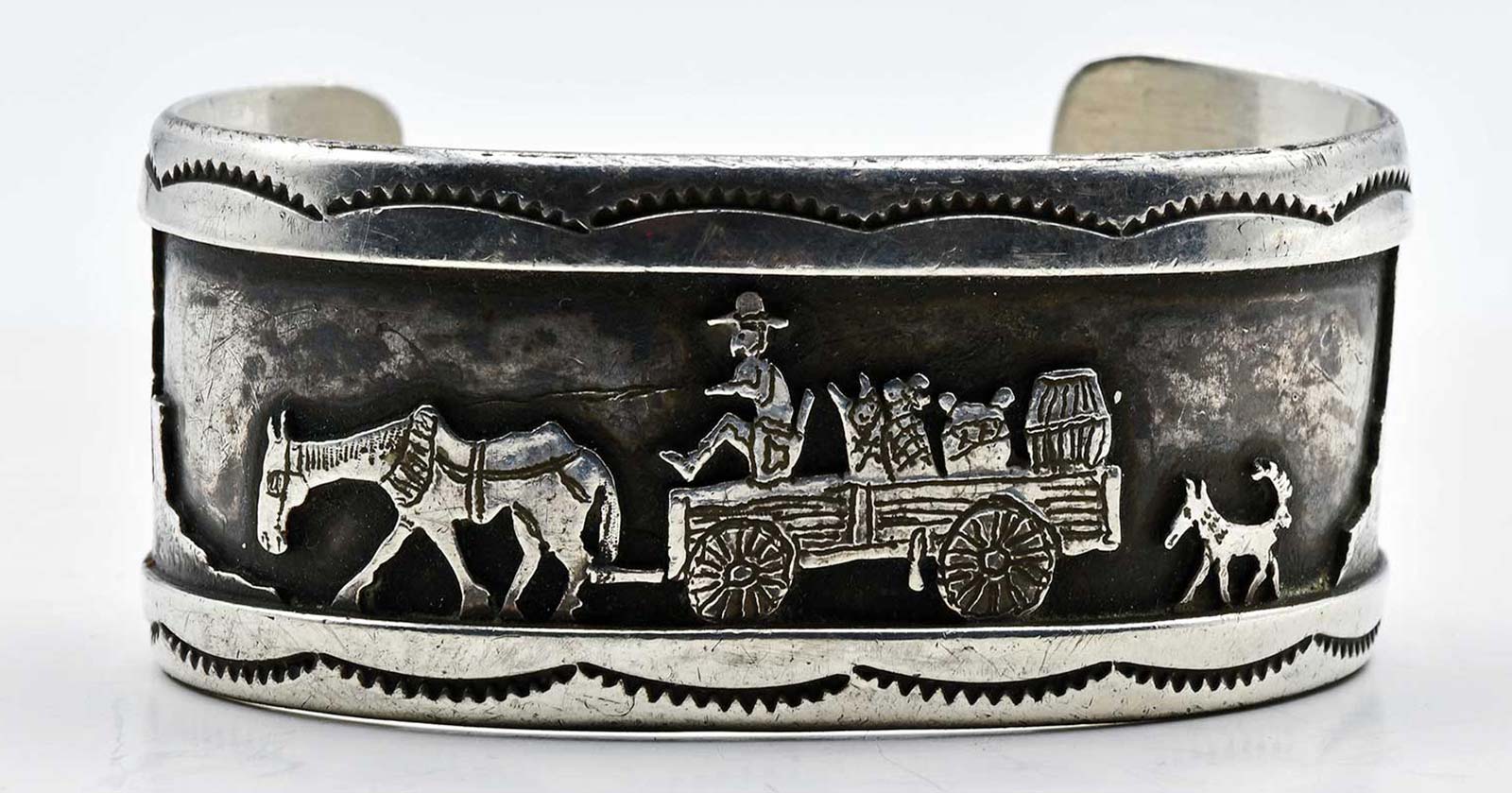
Early career silver overlay bracelet by Clarence Lee, storyteller theme from traditional Navajo life, bought at the White Hogan, Scottsdale, AZ, 1978.
The jewelry seen in this article illustrates how flexible the application of the term vintage can become. As a prelude to contemporary—or even postmodern—Native American jewelry, vintage work, typifies a period of artistic transition. Some of the pieces have a pleasant feeling of old-fashioned design. Others reveal aspects of change. Southwestern Native American jewelry made during the vintage era epitomizes the growth and expansion of designs from simple expression to newfound artistry. —
Paula A. Baxter, a former curator and adjunct professor from New York, is an independent design historian living in Scottsdale, Arizona. Her photographer is longtime husband Barry Katzen. Her sixth book, Navajo and Pueblo Jewelry Design: 1870 to 1945, was published in fall 2022. She’s working on a sequel which will cover the years 1946 to 2025, and will include Indigenous jewelers who aren’t Navajo or Pueblo, but live and work in the American Southwest. This book, Baxter says, will have “lots of contemporary Native voices.”
Powered by Froala Editor


