Kent Monkman (Fisher River Cree Nation) is on a mission to repaint, recast and upend art history. He draws from classical art, rearranging perspectives, narratives, victims and victors. Heavy themes of genocide become surreal when Miss Chief Eagle Testickle flies into the scene, a two-spirit avenging superheroine in high heels.
“Art history is very subjective,” Monkman says from his studio in New York City. “It’s told from the settler perspective; these are the histories that have been foregrounded and elevated in our museums without much thought to challenging the subjectivity of that work. That’s really been my project I started about 25 years ago, was to look at that work, understand the artists who made the work, understand their biases, and then to unpack it, challenge it and offer a different perspective on the mythology about this continent that was told by the people who came here. At the end that story was pretty much one-sided and at the expense of the Indigenous people.”
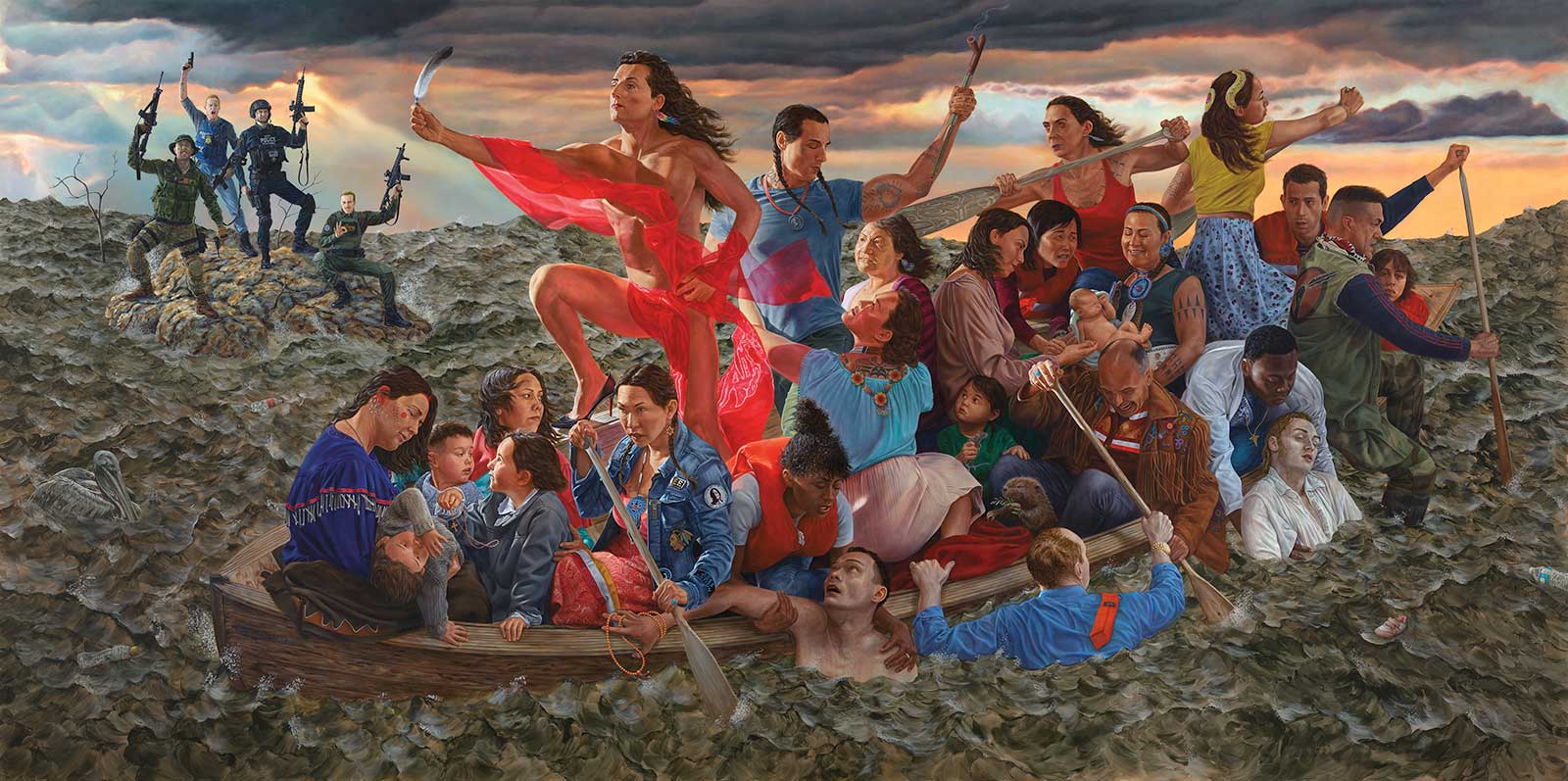
mistikôsiwak (Wooden Boat People): Resurgence of the People, 2019, acrylic paint on canvas, 132 x 264”. The Metropolitan Museum of Art: Purchase, Donald R. Sobey Foundation CAF Canada Project Gift, 2020.216b. © and image courtesy of Kent Monkman.
Monkman will offer his perspective of these histories at the Denver Art Museum, which will present his first major survey in the United States. The museum has partnered with the Montreal Museum of Fine Arts for Kent Monkman: History is Painted by the Victors, which features 41 of his paintings, including the monumental mistikôsiwak (Wooden Boat People), a diptych from the Metropolitan Museum of Art touring for the first time. The exhibition will open April 20 and remain on view through August 17.
“Visitors from Denver and around the country will have the unique opportunity to connect with Kent’s staggering history paintings rooted in the resiliency of Indigenous communities in the face of injustice,” says Christoph Heinrich, Frederick and Jan Mayer Director of the Denver Art Museum.
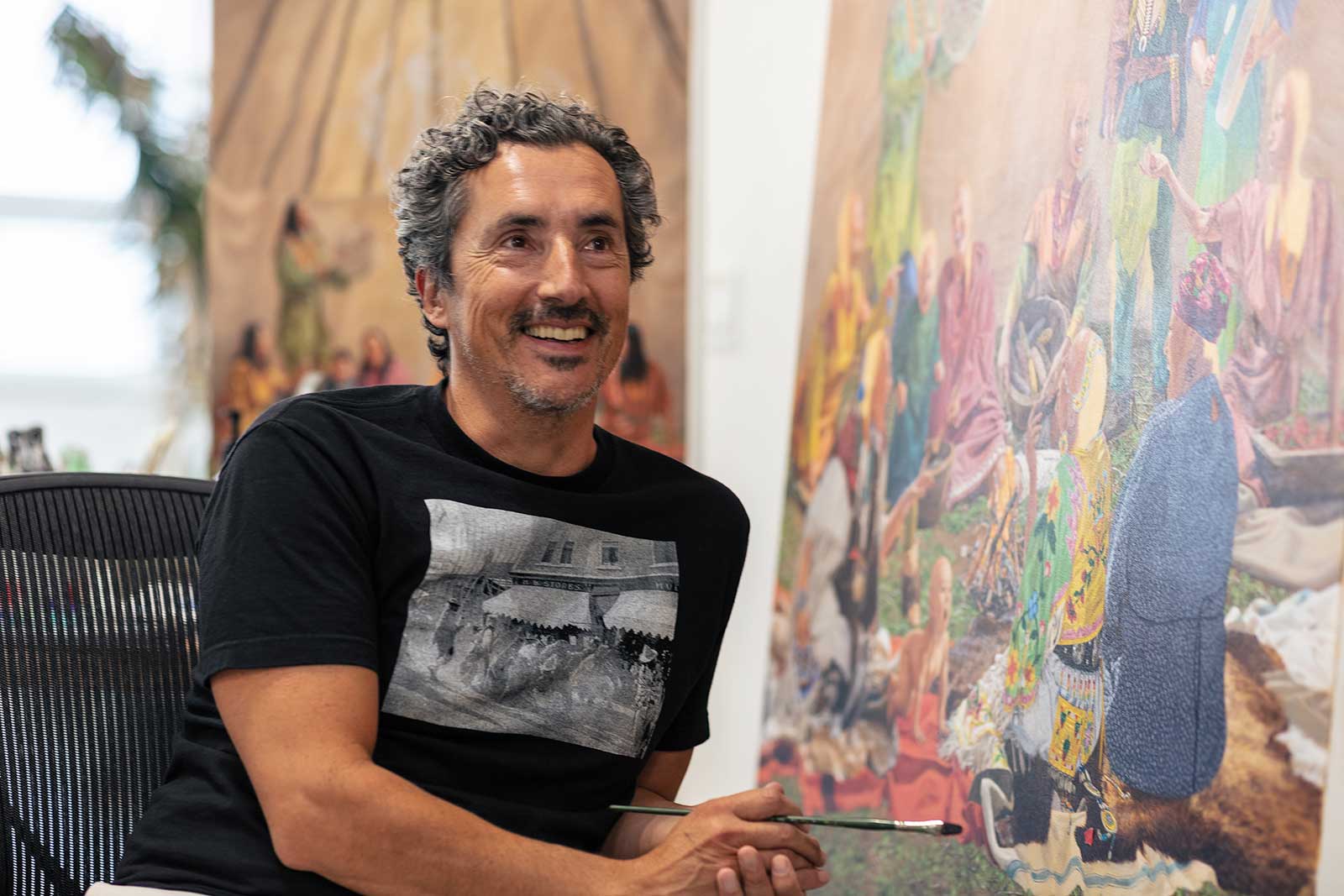
Kent Monkman in his studio. Image courtesy the artist.
The exhibition, and Monkman’s work at large, will include pieces that explore sexuality and gender. “With this idea of de-colonizing sexuality, he is trying to get people to realize that it’s not always been gender binaries,” says John P. Lukavic, the Andrew W. Mellon Curator of Native Arts and Head of the Native Arts Department at Denver Art Museum. “There’s not always been these feelings that people may have about the body, whether they’re male or female or whatnot. It’s getting people to recognize that there are cultural forces that have taught us that something might be viewed as bad or as shocking.
Kent’s work in many ways are entry points to these discussions for us to look more critically at about how we learn, what we learned, to make us feel the way that we feel. None of what he’s doing is intentionally meant to shock anyone. It’s to get them to consider why do they feel shocked and to really interrogate their own education, their own indoctrination, their own viewpoints that they have developed over the course of their lives and to think about whose life experiences that are different from [theirs] have been missing from their own lives. It’s meant to be more of a welcoming than anything else.”
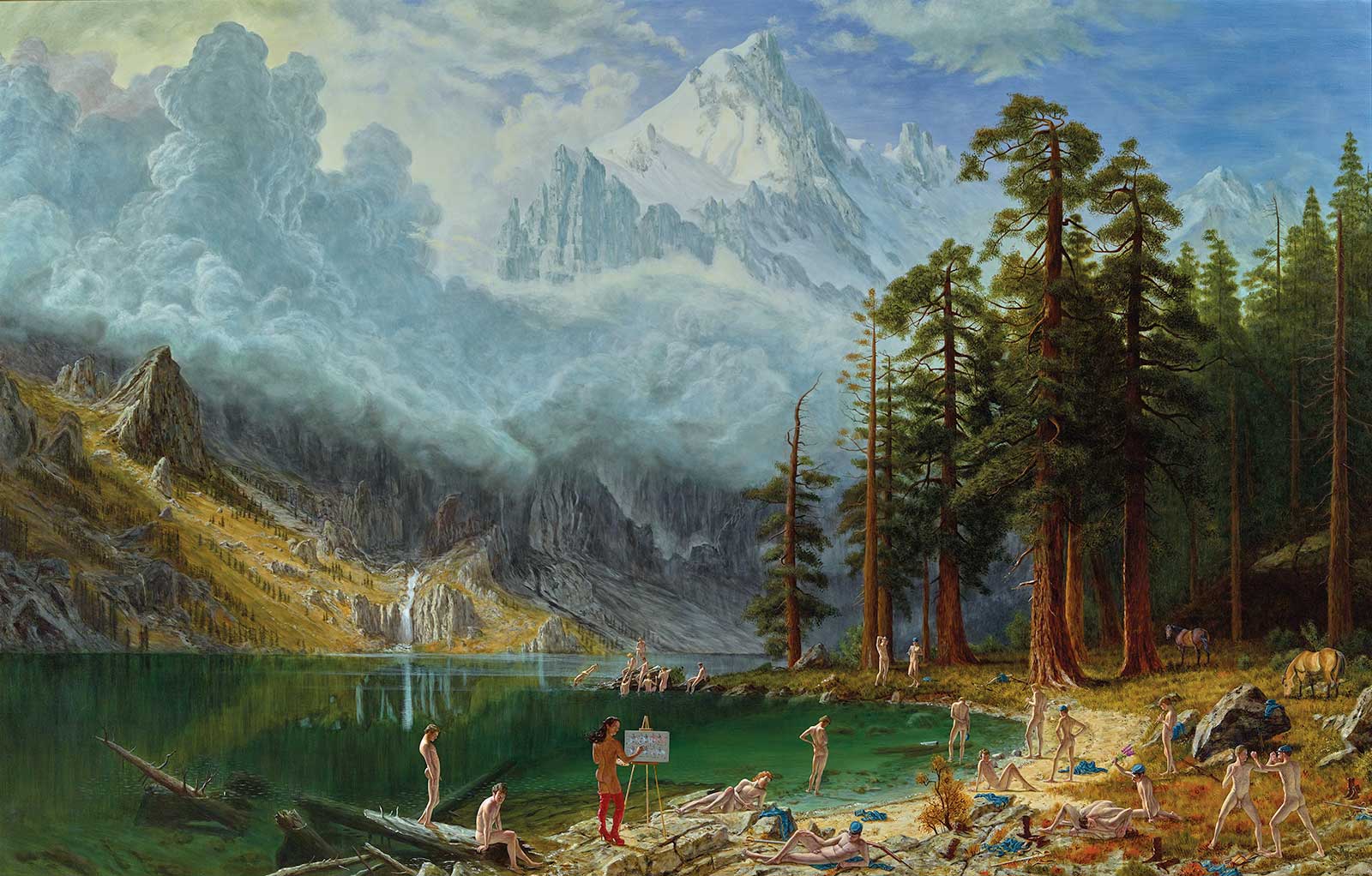
History is Painted by the Victors, 2013, acrylic on canvas, 72 x 113¼”. Gift from Vicki and Kent Logan to the Collection of the Denver Art Museum, 2016.288. © Kent Monkman.
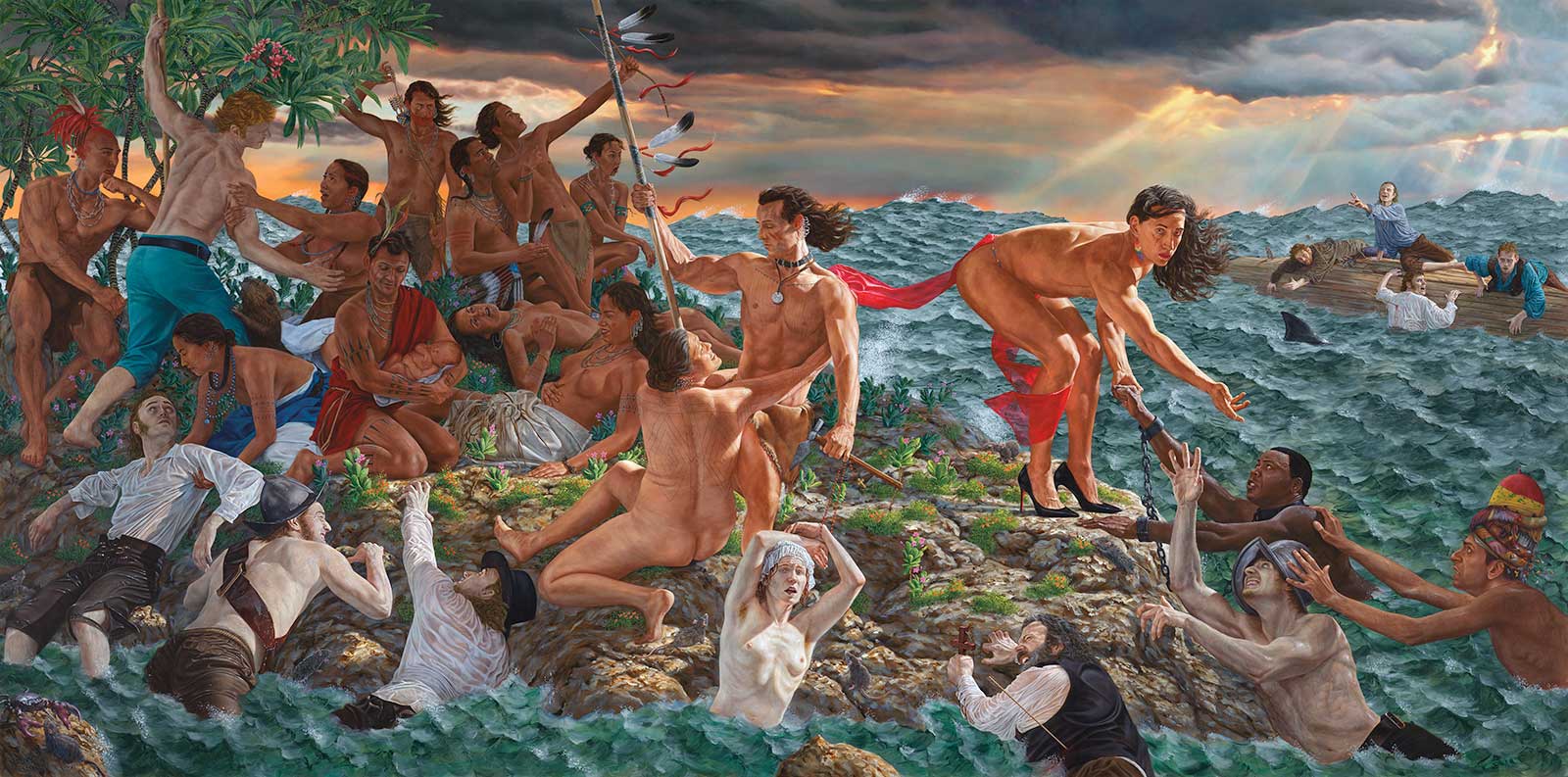
mistikôsiwak (Wooden Boat People): Welcoming the Newcomers, 2019, acrylic on canvas, 132 x 264”. The Metropolitan Museum of Art: Purchase, Donald R. Sobey Foundation CAF Canada Project Gift, 2020.216a. © and image courtesy of Kent Monkman.
Monkman’s work, many of them large in size and grand in ambition, call back to different art movements from around the world, including Europe’s long history with Renaissance, baroque and neo-classical art movements. “We just had an event here in New York at Sotheby’s,” Monkman says, “where we showed some Old Master paintings along with my work and had a conversation about that. I think people want to be able to approach Old Master work but sometimes they need a reminder of how to do that.”
He continues, “These are the colonial histories that have been foregrounded and elevated in our museums without much thought to challenging their subjectivity. I like to work with museum collections to engage those works in dialogue with my work. It’s not about diminishing that work or disrespecting it. I’ve learned a lot about painting from looking at the art of Old World masters and German painter Albert Bierstadt. I’ve been copying his landscapes and populating them with my own figures and narratives.”
Monkman’s technique is exquisite, with Old World backgrounds and landscaping, towering mountains, stately trees, rugged terrain and serene lakes. Then the jarring imagery: toddlers being ripped from their terrified mothers’ arms, Natives and settlers jammed onto boats with drowning people clinging to the sides, strange couplings of half-naked people wrestling, fainting, fighting and spanking each other.
In one of his wildest works, Miss America, the first in the Four Continents series he produced between 2012 and 2016, Miss Chief rides an alligator while raising a feather to the sky in prayer or triumph. She towers over a diverse tangle of figures: a basketball player, a British soldier, a mermaid that looks a lot like Marilyn Monroe, Indigenous Aztec peoples of ambiguous gender identities and men shooting from pick-up trucks. He even paints a beaver armed with a modern-day assault rifle in this out-of-control New World.
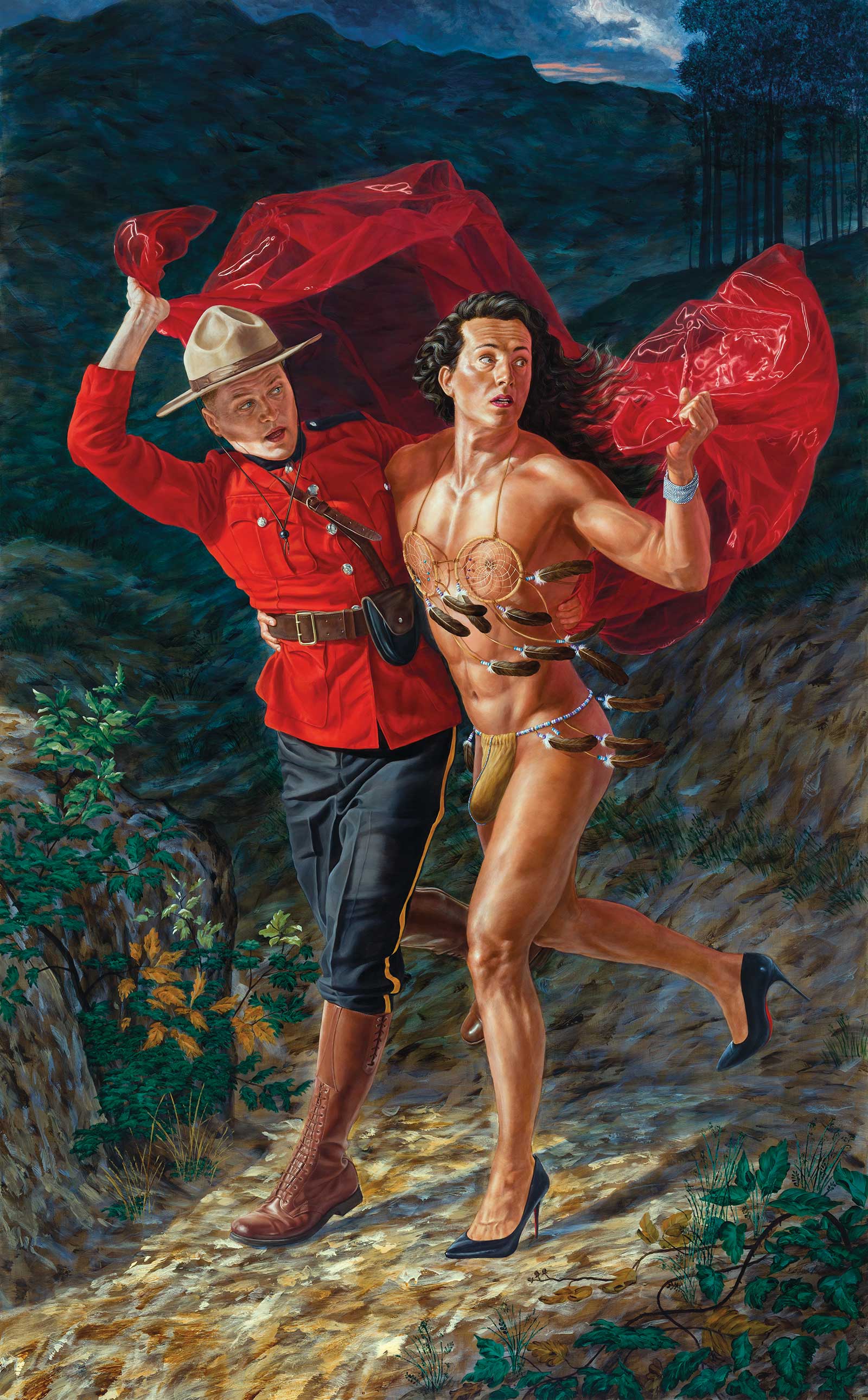
The Storm, 2021, acrylic paint on canvas, 116 x 72”. © and image courtesy of Kent Monkman.
“There’s lots to learn and a broad vocabulary of painting that offers opportunity to tell stories and to revisit those stories that were told by the people who came here,” Monkman explains. “I’ve spent a lot of time looking at the work of American painter George Catlin. Catlin was obsessed with Indigenous subjects like buffalo hunts and torture ceremonies. He saw himself as a documentarian of Native America. However, his eyes on his subjects were informed by his own moral and cultural biases. I like to look at that work and talk about that intersection in terms of that point of view and that perspective, and identify and suggest what was missing from his work.”
Asked how he goes about choosing which scenes to portray, Monkman says his process utilizes a few different sources he combines in sketches. “I might want to respond to a specific moment in history to authorize Indigenous experience, both historic and contemporary into this canon of history and pain,” he says. “I look at our storytelling, our mythologies, our perspectives, how our values are informed by how we tell stories. There’s a lot of opportunity to draw upon my own cultural perspective as a Cree person, specifically about the colonial period starting 150 years ago up to the present. The colonial project, however brief it was in that long timeline of history, still has great impact. Those events continue to reverberate in our communities.”
“But I’m an artist,” he adds. “I’m not just retelling facts the way a newsfeed would. Art is a way that you can transcend those difficult subjects by giving people an opportunity to see something positive in that. That’s really the beauty of art, whether it’s through humor or looking for those moments of hope and resilience.”
And where did Miss Chief come from?
“Miss Chief grew out of the response specifically to those settler artists that were looking at Indigenous people and sometimes painting themselves into their work. Again, George Catlin being a good example of that,” Monkman says. “In order to sort of respond to that work, I decided to create my own artistic persona that could look back, basically reverse the gaze and look back at the settlers as subjects.”
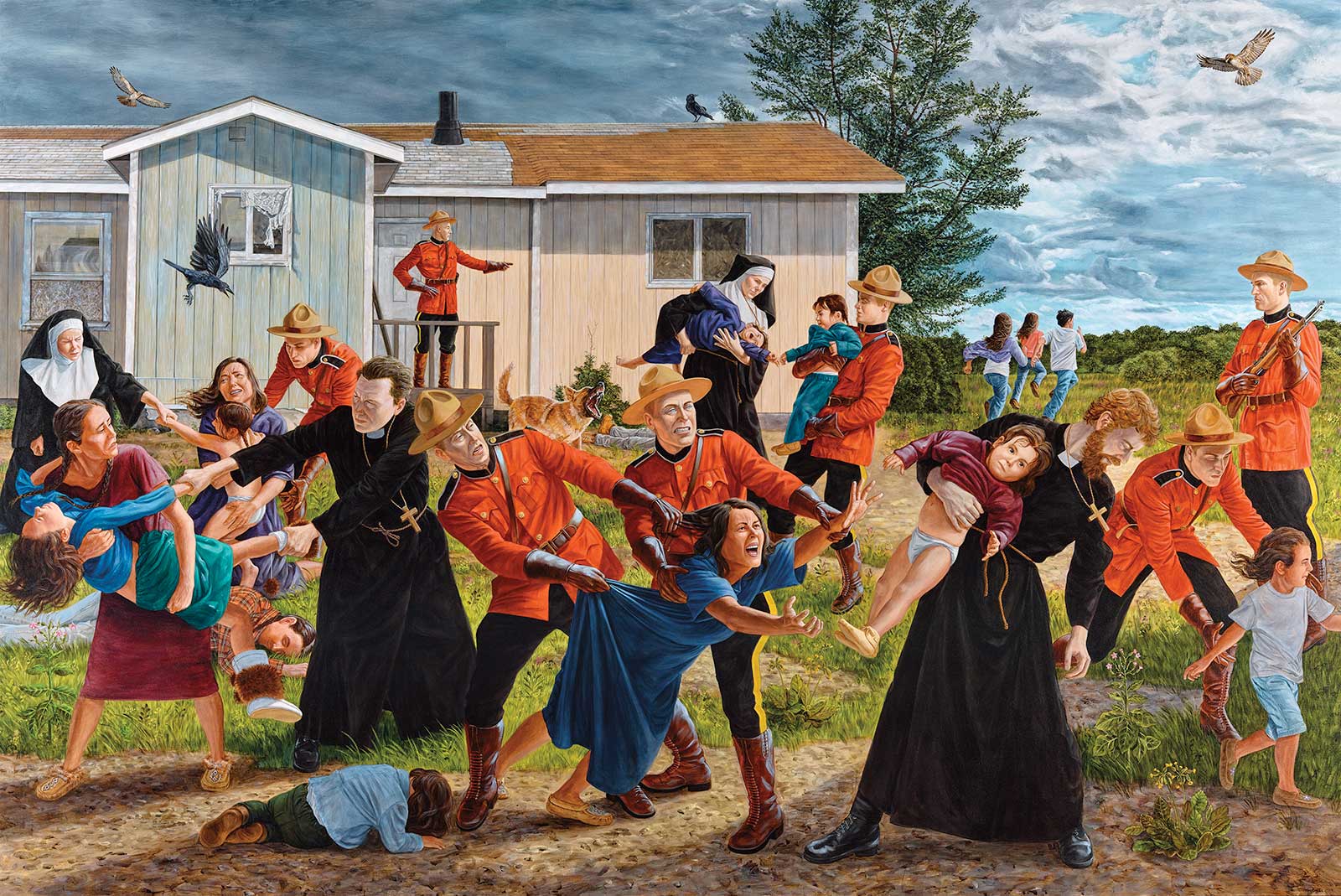
The Scream, 2017, acrylic on canvas, 84 x 132”. Denver Art Museum: Native Arts acquisition funds, purchased with funds from Loren G. Lipson, M.D, 2017.93. © Kent Monkman.
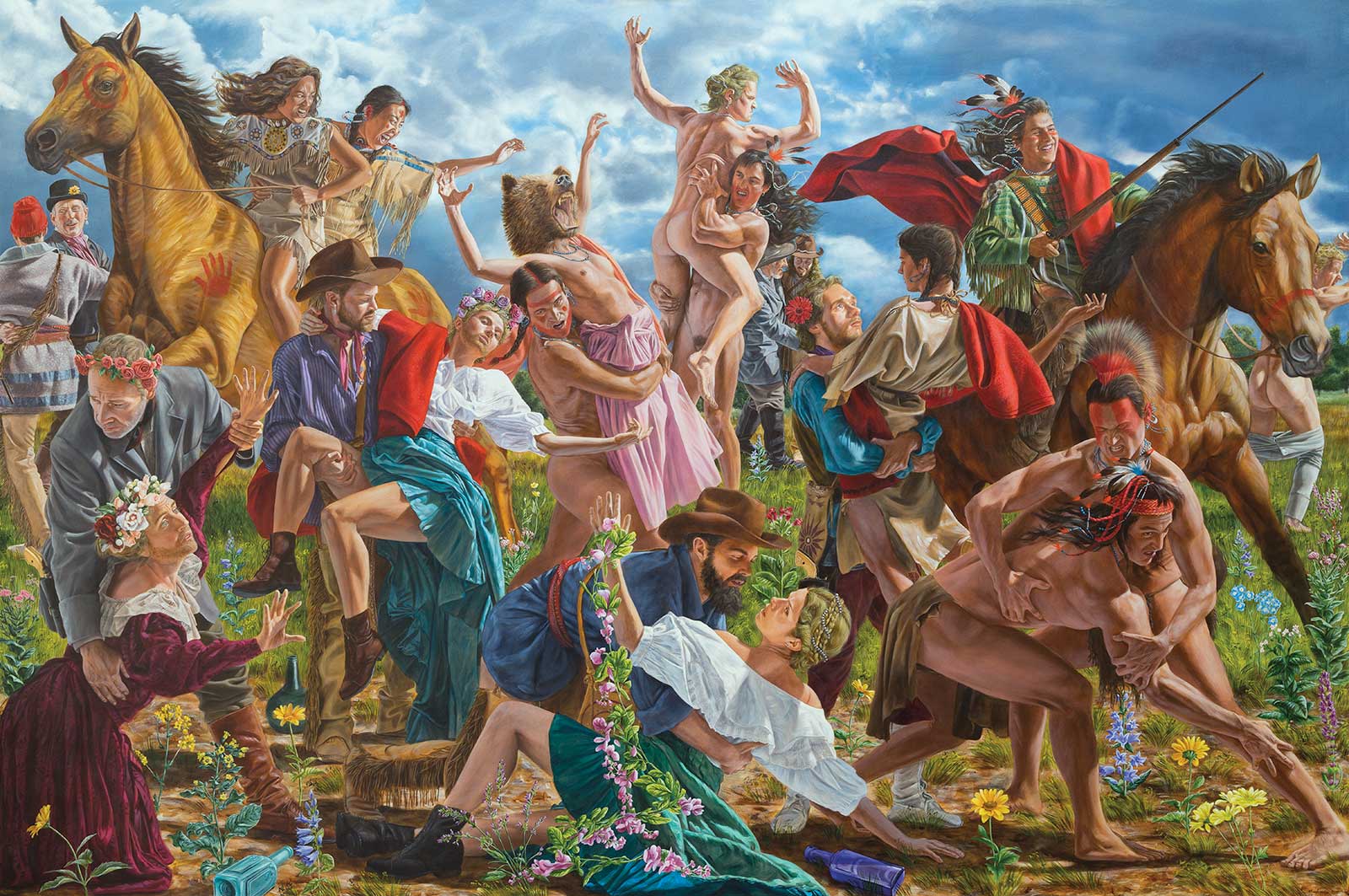
Saturnalia, 2017, acrylic on canvas, 84 x 126”. Collection of Alfredo and Moira Romano. © and image courtesy of Kent Monkman.
Monkman agrees that Miss Chief is shocking for those who have limited understanding.
“I created Miss Chief as this alter ego, but it really is this character that I’ve created, and in the future, different people will be playing that role. As the character evolved over time, I added more dimension, and I realized that that is a character that can be played or brought to life by other people and perhaps in performance,” the artist says. “It was a way of inserting myself into the work, a gender fluid character that could also represent an empowered perspective on gender identity, non-binary identity. The settlers brought with them this Judeo-Christian version of gender and sexuality which is very limiting, and it certainly didn’t encompass the many identities of Indigenous people across the continent. It still doesn’t.”
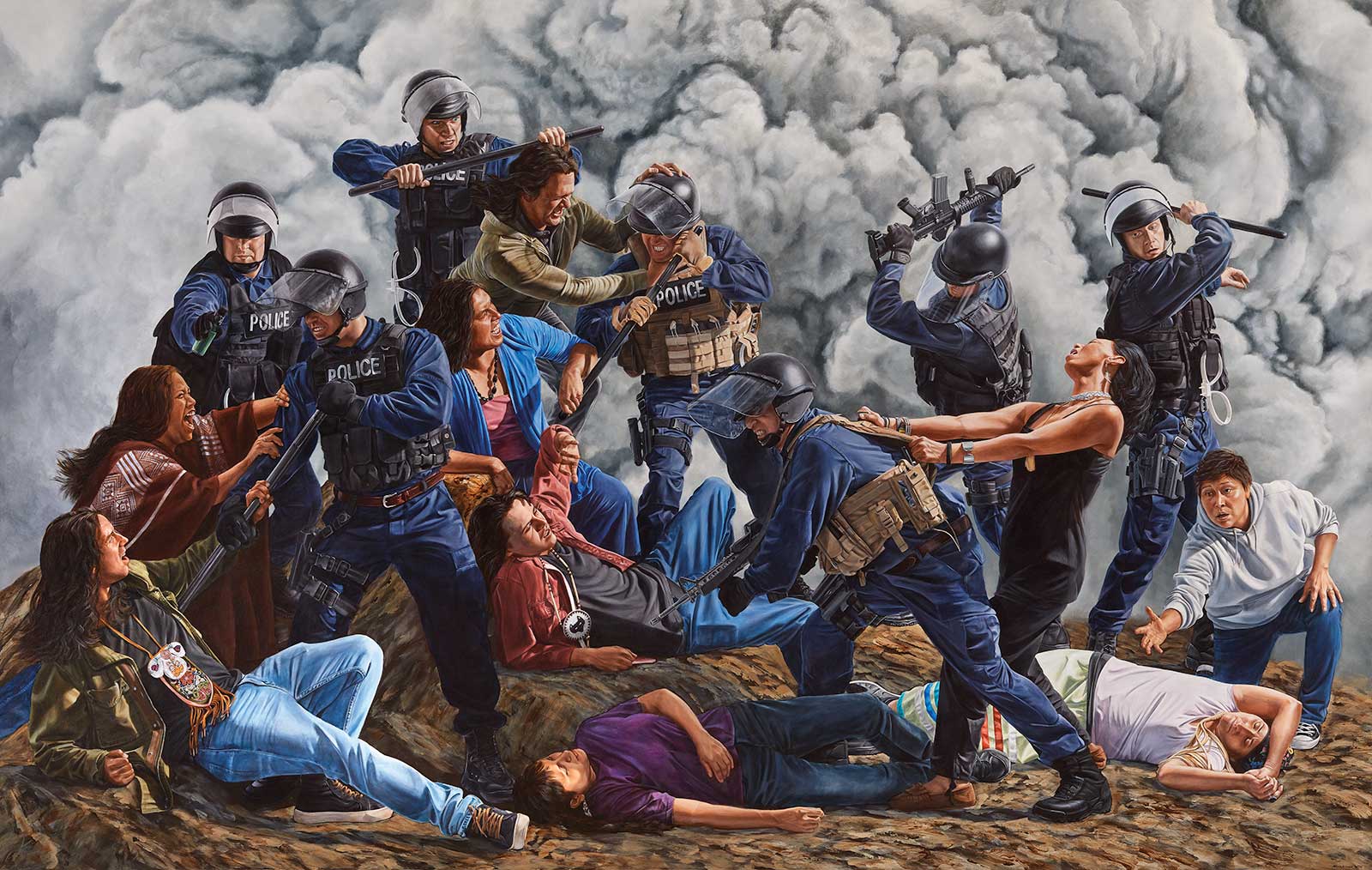
Victory for the Water Protectors, 2018, acrylic on canvas, 84 x 132”. Tia Collection, Santa Fe, NM. © and image courtesy of Kent Monkman.
Monkman gives Miss Chief power, both symbolic and literal. “I wanted her to be a powerful person. As for people’s reactions? I don’t really spend a lot of time thinking about what people think about my work, to be honest. There were a lot of people who embraced her and understood that, they identified with her, specifically in Indigenous communities, but even in our own communities, there’s homophobia, transphobia, so my question was why, why do we have that? Because that certainly wasn’t there before the settlers came. It’s all a part of decolonizing sexuality, decolonizing the way that Indigenous people think about our sexualities and gender identities…I’m very grateful that the Denver [Art] Museum is elevating this work and putting the resources into this exhibition. It’s a huge moment for me as an artist.” —
April 20-August 17, 2025
Kent Monkman: History is Painted by the Victors
Denver Art Museum 100 W. 14th Avenue Parkway, Denver, CO 80204
(720) 865-5000, www.denverartmuseum.org
Powered by Froala Editor


