Every spring in Phoenix, experts from all around the country descend on the Heard Museum to judge the artwork submitted to the annual Heard Museum Guild Indian Fair & Market. This is no small feat. Hundreds of works are submitted to the judges. Their job is to pick the award winners in each classification, as well as winners for special awards and the coveted Best of Show prize. All of this is done with the utmost care and consideration to the artists, their artworks and the stories they are sharing through their art objects. The awards are announced during the Best of Show Reception on February 28. For guests who can’t attend the reception, look for the 2025 ribbons in the booths during the market.
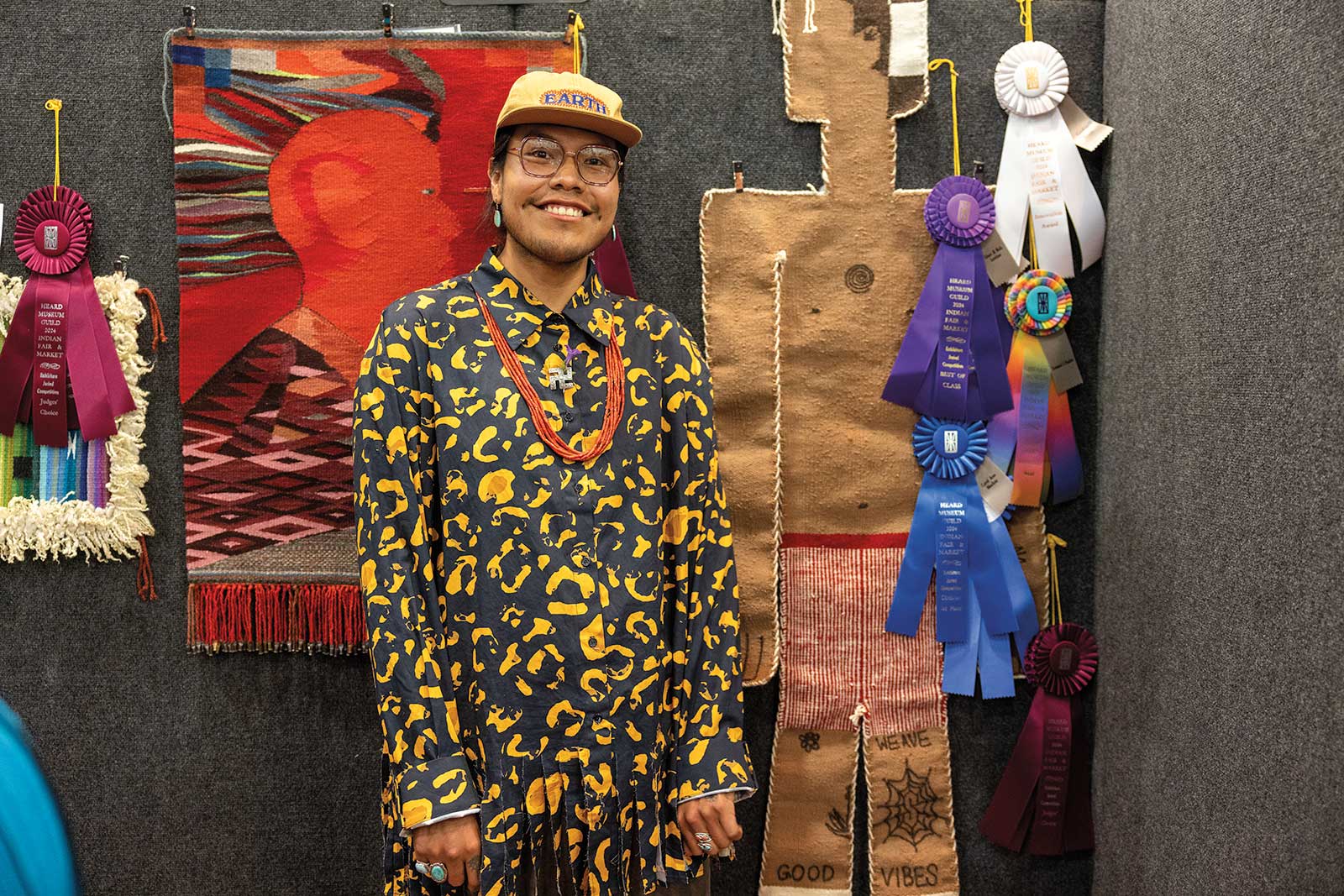
Ribbons are pinned to weavings made by Tyrrell Tapaha. Judges review every work submitted for judging at the Heard Museum Guild Indian Fair & Market.
Classification I – Jewelry & Lapidary Work
Dexter Cirillo
Author, lecturer and jewelry expert
A noted authority on Native American jewelry, she is author of Southwestern Indian Jewelry and Southwestern Indian Jewelry: Crafting New Traditions (winner of the 2008 New Mexico Book Award), as well as multiple articles on jewelry in American Indian Art, Southwest Art and Native Peoples. She has lectured widely on jewelry at museums across the country and judged at both the Heard Museum Guild Indian Fair & Market and the Santa Fe Indian Market. She holds a Ph.D. from the City University of New York.
Larry Golsh (Pala Mission/Cherokee)
Artist
Larry Golsh has achieved international fame as a jeweler and sculptor. After growing up on the Pala Mission reservation near San Diego, California, he studied architecture and art at Arizona State University. In 1969 he began to work with Paolo Soleri’s Arcosanti project touring major art museums in the United States and Canada. Shortly after that he met Hopi jeweler Charles Loloma, who he credits as his inspiration for beginning his world-renowned jewelry designs.
Classification II – Pottery
Brian Vallo (Acoma Pueblo)
Consultant
Brian Vallo is a member of the Pueblo of Acoma in New Mexico where he recently completed three terms as governor of his tribe. He has dedicated more than 30 years of his career working in historic preservation, sacred sites protection, repatriation of ancestors, language revitalization, cultural tourism and the arts. An independent consultant, Vallo works with museums across the country and internationally to advance collaborative work with source communities, promote responsible and culturally relevant stewardship of Native American collections, and ensure accountability and adherence to federal laws designed to protect cultural heritage items. He also serves on several boards including the Native Arts + Cultures Foundation, Native Lands Institute, Conservation Lands Foundation and is a trustee of the National Museum of the American Indian.
Nadine Basha
Former business owner, educator and advocate for early-childhood development
Nadine Basha is a former teacher, educator, small-business owner and volunteer who has spent her adult life advocating for Arizona’s children, particularly with regard to early childhood education within the state. She served as founding chair of the First Things First Board from 2007 to 2009, and recently completed a two-year term as the board’s chair. First Things First is committed to supporting the healthy development and learning of Arizona’s young children from birth to age 5. Basha developed Proposition 203, a ballot initiative to generate tax funds to establish a comprehensive system of early childhood development and health. It was approved by voters in November 2006. The First Things First (FTF) board is in charge of the implementation and oversight of Proposition 203. Basha has served on numerous boards and committees in conjunction with state and community agencies, the governor’s office and Arizona State University. In 1989, she founded the Children’s Action Alliance, a children’s public policy advocacy group that has significantly influenced the policies that enhance educational and medical needs for families with considerable financial constraints. Her accomplishments in the field of early childhood have been acknowledged by the countless awards she has received over the years. Basha was presented with an honorary degree of doctor of humanities from the University of Arizona in December 2009. She also holds an honorary degree of doctor of education from Northern Arizona University as well as Arizona State University‘s Distinguished Achievement Award. She received her bachelor’s degree in elementary education from the University of Kansas and a master’s degree in early childhood education from Arizona State University.
Garth Johnson
Writer, curator and educator
Garth Johnson is the Paul Phillips and Sharon Sullivan Curator of Ceramics at the Everson Museum of Art in Syracuse, New York. Before arriving at the Everson, Johnson served as the curator of ceramics at the Arizona State University Ceramics Research Center. Johnson has also exhibited his work and published his writing nationally and internationally, including contributions to the recent books Funk, published by Natsoulas Press, and Funk You Too: Humor and Irreverence in Ceramic Sculpture, published by the Museum of Arts and Design. Johnson is a self-described craft activist who explores craft’s influence and relevance in the 21st century. His research interests range from 1960s and 1970s artist-led movements in the field of ceramics to the intersection of clay, video and performance. His exhibitions at the Everson include Frank Buffalo Hyde: Native Americana, Natasha Smoke Santiago: O’tá:ra, Earth Piece: Conceptual and Performative Works in Clay and Key Figures: Representational Ceramics 1932-1972.
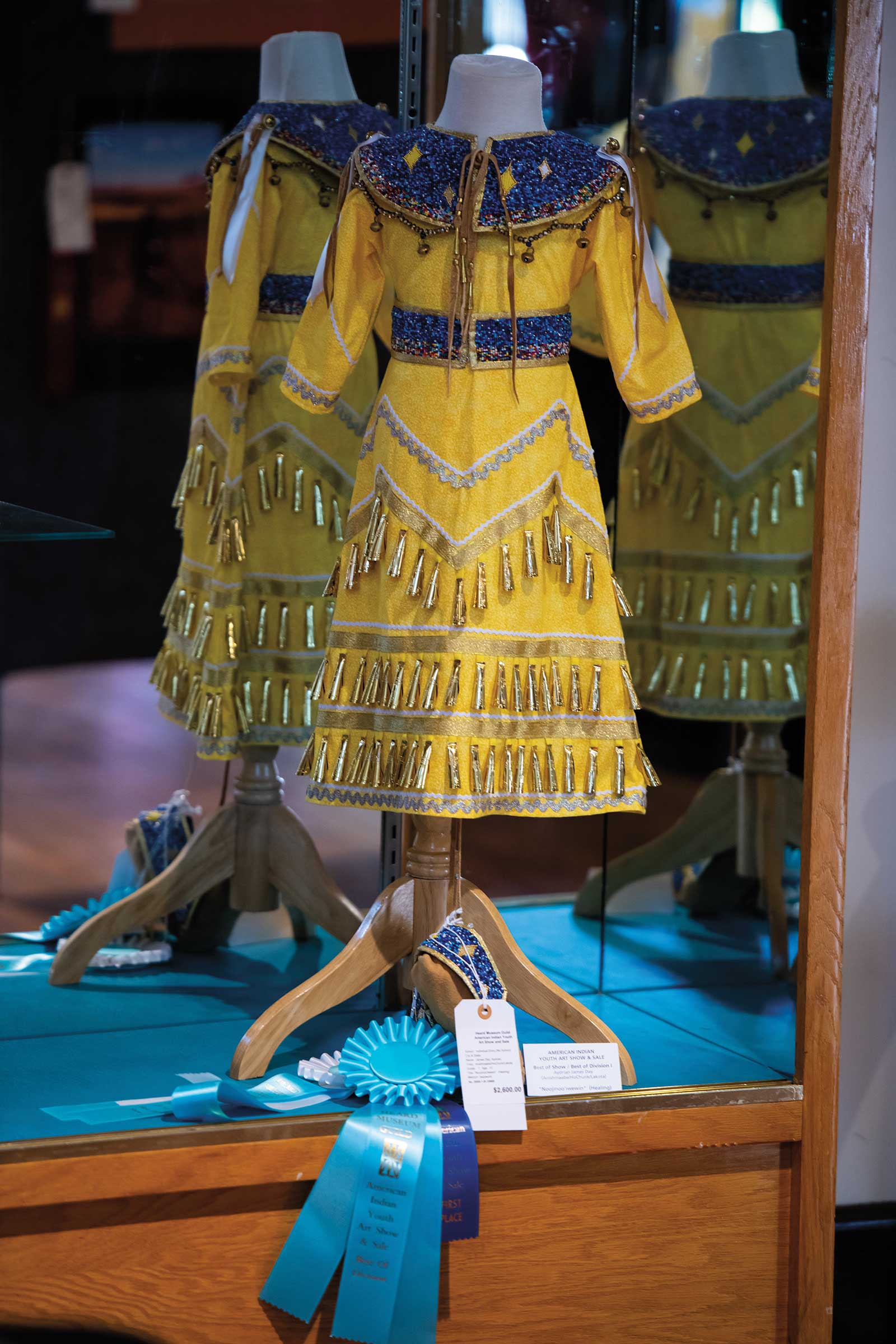
A ribbon is attached to a dress made by Aydrian James Day at a previous Heard market. Photo by Haute Media.
Classification III – Two-Dimensional
Kevin Coochwytewa (Isleta Pueblo/Hopi)
Creative director, designer and artist
Kevin Coochwytewa is a freelance designer who has worked in the field for 25 years, holding lead creative roles at the Heard Museum, Native Peoples Magazine and Eighth Generation. His portfolio includes logo, print design and exhibition graphics for notable organizations including the Denver Art Museum, First Americans Museum, Minneapolis Institute of Art, Smithsonian’s National Museum of the American Indian, PBS, Google and more. He has designed publications featuring work by distinguished artists DY Begay, Jim Denomie, Jody Folwell, Benjamin Harjo Jr., and poet Simon J. Ortiz. His design of the logo commemorating the Indian Fair & Market’s 50th anniversary in 2008 is still being used today in an adapted form. In 2024, Kevin collaborated on the design of Arizona’s new state logo—another pinnacle of his lasting influence in design.
Dakota Hoska (Oglála Lakhóta Nation, Pine Ridge, Wounded Knee)
Curator and artist
Dakota Hoska serves as the associate curator of Native arts and NAGPRA coordinator at the Denver Art Museum, where she has been employed since 2019. Hoska completed her master’s in art history, focusing on Native American art history, at the University of St. Thomas, St. Paul, Minnesota (2019). She also completed two years of Dakhóta language at the University of Minnesota (2016) and received her BFA in drawing and painting from the Minneapolis College of Art and Design (2012). Dakota has participated in multiple curatorial programs such as the EPIC International Curatorial Exchange Program through the Association of Art Museum Curators, the Otsego Summer Seminar sponsored by the Fenimore Art Museum, and the Shakopee Mdewakanton Native American Museum Fellowship at the Minneapolis Institute of Art.
Julie Sasse
Curator
Dr. Julie Sasse is Chief Curator Emerita at Tucson Museum of Art, where she organized more than 100 solo and group exhibitions of regional, national and international artists, including solo shows by Jaune Quick-to-See Smith and Brad Kahlhamer. Sasse is the author of more than 40 art publications, including James Havard (Hudson Hills Press, 2006), Trouble in Paradise: Examining Discord Between Nature and Society (Tucson Museum of Art, 2008), Contemporary Art of the Southwest (Schiffer, 2012), The Art of MF Cardamone (Pomegranate Press, 2016), Southwest Rising: Contemporary Art and the Legacy of Elaine Horwitch (Cattletrack and TMA, 2020), and Tucson Museum of Art: A Centennial History 1924-2024 (TMA, 2024). She continues to write and curate independently, including a recent exhibition of kinetic art at Sculpture Tucson (2024-2025).
Classification IV & V – Pueblo Carvings & Sculpture
William Howard
Trustee and former president of the board of trustees, Wheelwright Museum of the American Indian
Together with his wife, Kathy, William Howard has been an eager collector of American Indian art and artifacts for more than 35 years. From their homes in Scottsdale, Arizona, and Santa Fe, New Mexico, they have admired and acquired both traditional and contemporary Native American art and artifacts. They particularly enjoy knowing the artists and stories behind each object. Both have been active at the Heard and Wheelwright museums for many years.
Gloria Lomahaftewa (Hopi/Choctaw)
Curator
Gloria Lomahaftewa is Hopi and Choctaw, Cloud clan, from the village of Songopavi on the Hopi Reservation. Lomahaftewa previously served as the Native American liaison/NAGPRA specialist and assistant curator at the Heard Museum, as well as at the Museum of Northern Arizona. While working with tribes from throughout the country on behalf of the museum, she curated several interpretive exhibits on diverse topics. An exhibit that continues to be presented is the Hopi cultural exhibit of Hopi katsina dolls, Hopi clothing and cultural arts in the permanent exhibit HOME: Native People in the Southwest. Lomahaftewa is semiretired, enjoying consultant work, and living on the Hopi Reservation.
Nancy Rosoff
Andrew W. Mellon Senior Curator, Arts of the Americas, Brooklyn Museum
Nancy Rosoff joined the Brooklyn Museum in 2001 and is responsible for the ancient Americas collections. Prior to the appointment of a curator of Indigenous art, Rosoff also oversaw the Native American art collections from 2016 to 2023. In conjunction with the Museum’s 200th anniversary this year, she is on the curatorial teams for Toward Joy: New Frameworks for American Art; Solid Gold; and Breaking the Mold: Brooklyn Museum at 200. She is also a co-curator of Hopi Kachina Dolls: Treasured Gifts (opening 2026). Recent exhibitions include Guadalupe Maravilla: Tierra Blanca Joven (collaborating curator, 2022); Welcome to Lenapehoking (curator, 2021-24); and Climate in Crisis: EnvironmentalChange in the Indigenous Americas (curator, 2020-23). Rosoff holds a master’s in anthropology from the University of California, Los Angeles.
Classification VI – Weavings & Textiles
Laura Allen
Interdisciplinary curator, scholar and writer
Laura Allen’s work bridges historical, modern, and contemporary Native art. Her scholarship examines the visual and material culture of the Northwest Coast as well as Indigenous and intercultural dress, fashion, and textile history in the Americas. She recently curated Interwoven Power: Native Knowledge / Native Art, a significant reinstallation of Montclair Art Museum’s cross-temporal collection, and also co-organized Everyone Says I Look Like My Mother on the work of Jaad Kuujus (Meghann O’Brien) at Bard Graduate Center and Textile Arts Center in New York City. She holds a master’s in decorative arts, design history and material culture from Bard Graduate Center, and has served in various roles at the American Museum of Natural History, the University of Alaska Museum of the North, and other institutions.
Clarenda Begay (Navajo (Diné))
Clarenda Begay is Diné and was raised in Keams Canyon, Arizona. In her adolescent years, she moved onto Navajo land. Formerly of the National Park Service, Begay is now a retired museum curator from the Navajo Nation Museum. Begay has judged the arts at the Gallup Inter-Tribal Indian Ceremonial for many years and judged at the Natural History Museum of Utah. Begay has managed the Navajo Nation Fine Arts Competition at the world’s largest Indian fair in the capital of the Navajo Nation, Window Rock, Arizona, for many years. Currently, Begay is a Native American consultant to buy art directly from Native artisans and Native-owned businesses. Her hobby is creating and upcycling unique Native women’s wear and accessories.
Shándíín Brown (Navajo (Diné))
Curator and artist
Sháńdíín Brown is a citizen of the Navajo Nation and was born into the Towering House clan, for the white man. Her maternal grandfather’s clan is the Many Goats clan and her paternal grandfather was white. Her family is from Coppermine, Arizona, and she grew up in Phoenix. Sháńdíín is a curator, creative and graduate of Dartmouth College, where she earned her bachelor’s in anthropology and Native American studies and minored in environmental studies. Previously she held positions at the Heard Museum, Penn Museum, Hood Museum of Art, IAIA Museum of Contemporary Native Arts, School for Advanced Research Indian Arts Research Center, and Rhode Island School of Design Museum. Brown lives in Connecticut and is a Ph.D. student at Yale, where she studies multitemporal Native American art.
Classification VII – Diverse Arts
Shiloh Ashley (shilohMFA) (Cheyenne River Sioux Tribe)
Artist
shilohMFA’s work investigates identity related to Indigeneity, language, landscape, gender, generational trauma, the romanticism, sexualization and exploitation of Indigenous Peoples due to Colonization. A member of the Mnicoujou band—Plants by the Water—shilohMFA shares a special connection to Mníšoše (Missouri River) and an affinity for all water bodies. Works are developed conceptually and mediated into acoustic and electronic music compositions, video, sound, movement and performance, animation, drawing, beading, interactive installation, sculpture, digital technologies and community engagement. A reoccurring baseline in all of the work includes semiotics (glyphs and symbols) conceptual languages, poetry and prose.
Jordan Poorman Cocker (Kiowa)
Curator and beadwork artist
Raised in Oklahoma, Jordan Poorman Cocker’s Indigenous curatorial approach centers Indigenous research methodologies that prioritize collaboration, reciprocity, and sustained dialogues with Indigenous artists. She holds a master’s in museum and heritage practice from Victoria University of Wellington and a bachelor’s degree of design from Auckland University of Technology in New Zealand. She serves as the curator of Indigenous art at Crystal Bridges Museum. Cocker is an artist mentor for the Institute of American Indian Arts Master of Fine Arts. She is the 2021-25 Terra Foundation guest co-curator of Indigenous art at the Block Museum at Northwestern University.
Ellen N. Taubman
Curator
After leaving her position as vice president of American Indian, African and Oceanic art at Sotheby’s in New York, Ellen Taubman organized and curated a landmark three-part exhibition series titled Changing Hands: Art Without Reservation for the Museum of Arts and Design in New York City. The series focused on current trends in Native North American, First Nations and Inuit art, with each of the three exhibitions on view in venues throughout the United States and Canada. Her current affiliations include trustee at the Brooklyn Museum, New York; Rock Foundation, New York; Vera List Center for Art and Politics, the New School, New York; member of Art Advisory Committee, Hunter College, City University; exhibition committee, American Federation of Arts; and a member and supporter of numerous other arts-related organizations.
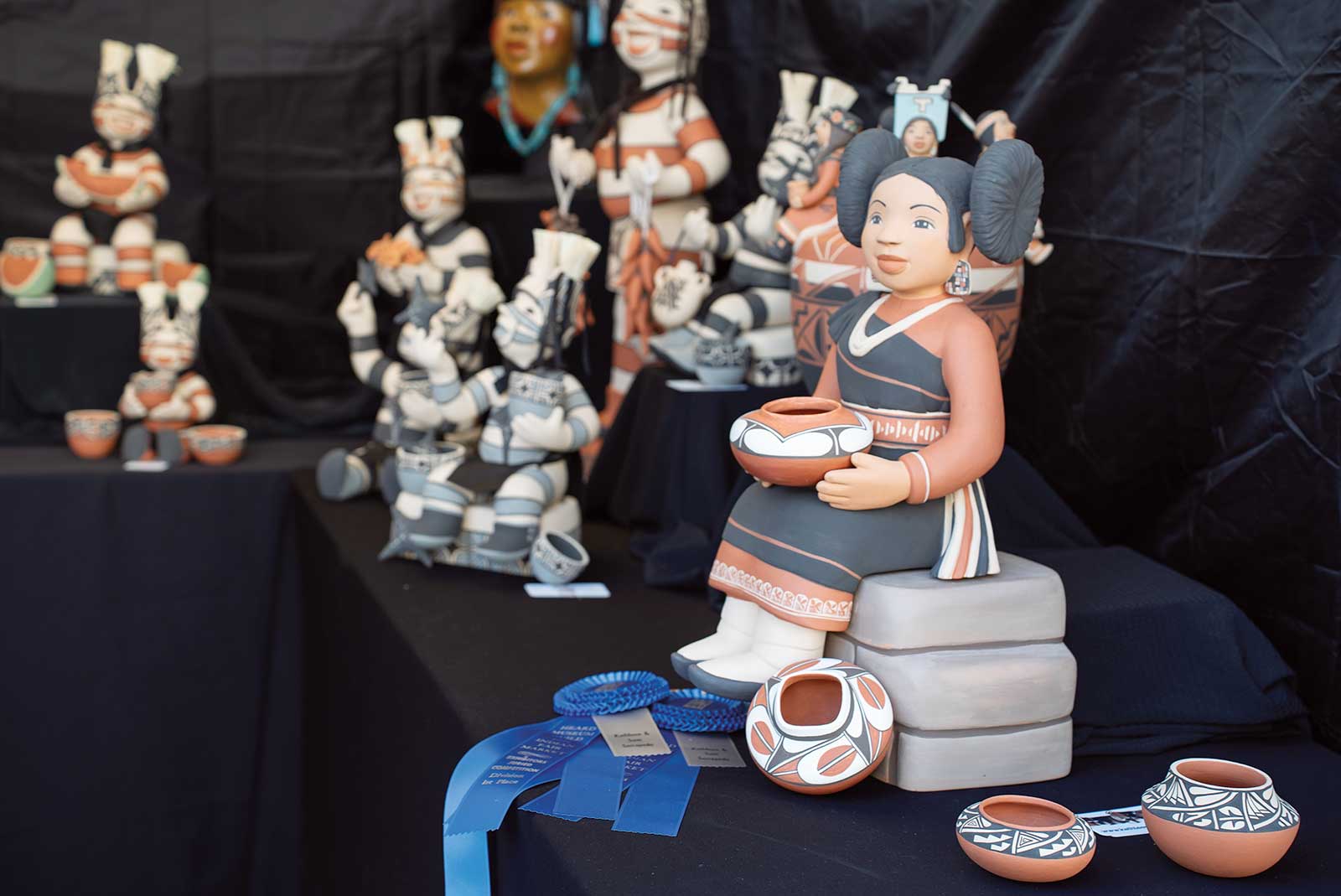
Kathleen Wall's award-winning work from the 2022 market. Ribbons are carefully awarded by Heard judges. Photo by Courtnay Hough
Classification VIII – Baskets & Idyllwild Arts & Indian Arts
Diane Dittemore
Curator
Diane Dittemore (MA anthropology, University of Denver) has been a curator of ethnological collections at the Arizona State Museum, University of Arizona, for more than 40 years. She has judged basketry for the Heard Museum, Gallup Inter-Tribal Indian Ceremonial, Santa Fe Indian Market and the Tohono O’odham Basketry Organization. She served as lead curator for the 2017 Arizona State Museum exhibit Woven through Time: Native Treasures of Basketry and Fiber Arts. The University of Arizona Press published her book, Woven from the Center: Native Basketry in the Southwest, in 2024.
Elaine F. Peters (Ak-Chin O’odham)
Director, Ak-Chin Him-Dak Department
Elaine F. Peters (Ak-Chin O’odham) is an enrolled member of the Ak-Chin Indian Community. Peters, a proud veteran, has worked more than 34 years for her tribe. Currently, she is the director of the Ak-Chin Him-Dak Department where she oversees programs that includes the Him-Dak Eco Museum, Him-Dak Records & Archives Program, Him-Dak Art Program, and Cultural Resources Program. She has served as a tribal council member for the community and currently serves on the National Museum of the American Indian Board of Trustees and represents the Ak-Chin Indian Community as part of the Four Southern Tribes Cultural Resource Working Group.
Shelby Tisdale
Retired, Director of the Center of Southwest Studies, Fort Lewis College, Durango, Colorado
Dr. Shelby Tisdale is the former director of the Museum of Indian Arts and Culture/Laboratory of Anthropology in Santa Fe, New Mexico, and the Millicent Rogers Museum in Taos, New Mexico. She has also served as an administrator and curator in other museums focusing on Native American art. Over the past 45 years she has curated numerous exhibitions on Native American art, culture and history and is an award-winning author who has published books and articles related to American Indian art. She contributed to and directed the Oklahoma Book Award-winner Woven Worlds: Basketry from the Clark Field Collection, for the Philbrook Museum of Art (2001). Her book, Fine Indian Jewelry of the Southwest: The Millicent Rogers Museum Collection (Museum of New Mexico Press, 2006) received two book awards. —
Powered by Froala Editor


