Raymond C. Yazzie is not a jeweler. He is not a lapidary, one who cuts gemstones. He is an artist, an iconic one that happens to make jewelry and cut gemstones.
His work is featured in the Smithsonian, in galleries, museums and collectors’ homes in many countries. This particular type of work takes serious time to build. Some of his art takes up to a year to produce. I have extensively followed and studied his work, and I know jewelry and inlay firsthand as I am a jewelry maker and lapidary, cutting gemstones for more than 55 years. He is the quintessential jewelry and inlay artist, one of the greatest I have ever seen. His metal work is complicated and fully hand-fabricated. I am truly humbled. Each time my wife Patti and I travel to Santa Fe for the Santa Fe Indian Market, we stop in Gallup, New Mexico. Each and every single time for the last five years, we park our car and start to walk around the shops. And then we hear a voice yelling for us. We turn around and there is Raymond, his truck stopped in the middle of the street. We talk for a minute or so, and not a soul behind him honks. That says a lot about a small town but also about Raymond. He is a good friend to many. Kind and gentle, but full of love for the jewelry industry and his Navajo heritage.
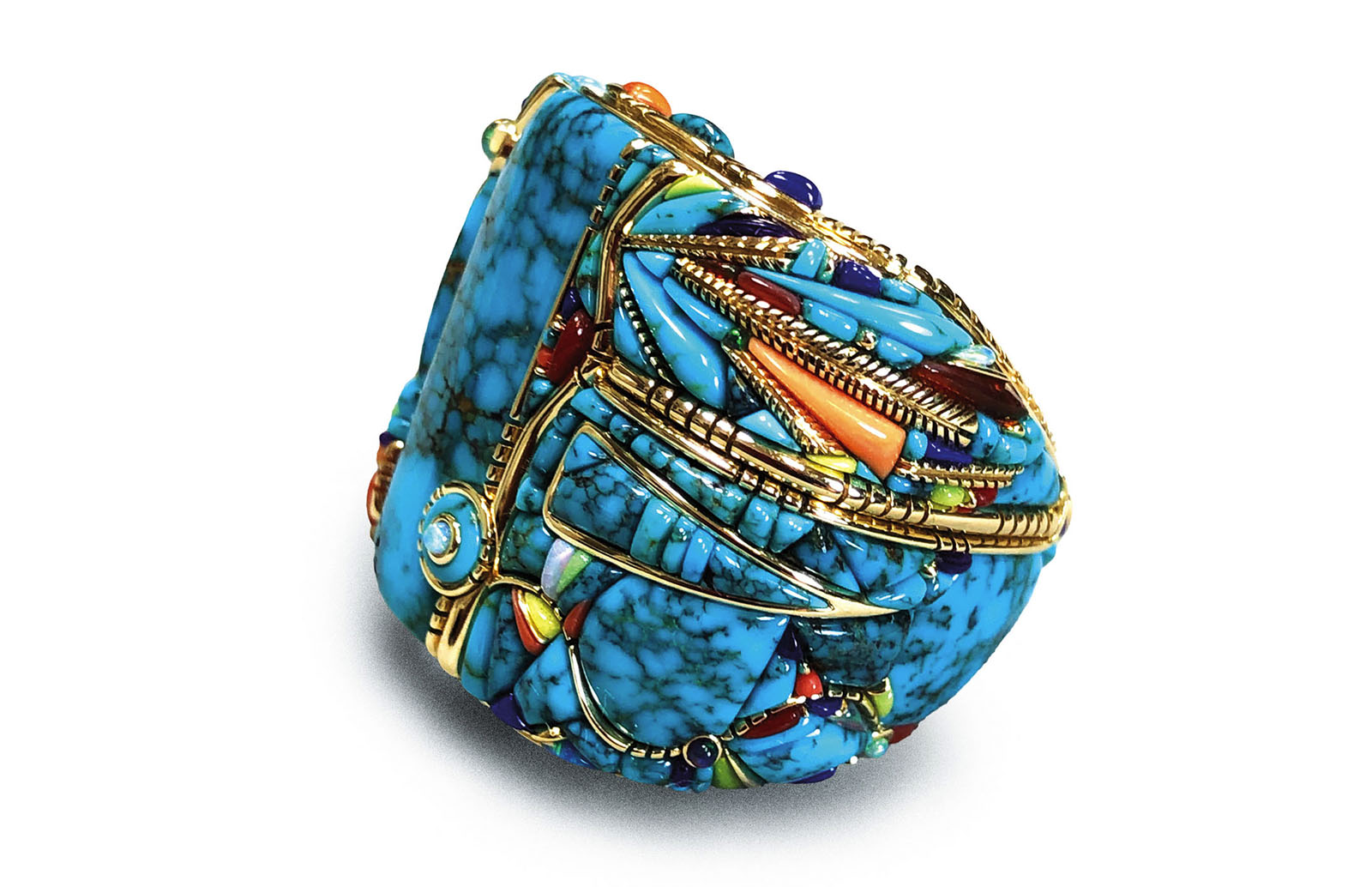 Raymond C. Yazzie (Navajo (Diné)), Inlay turquoise ring
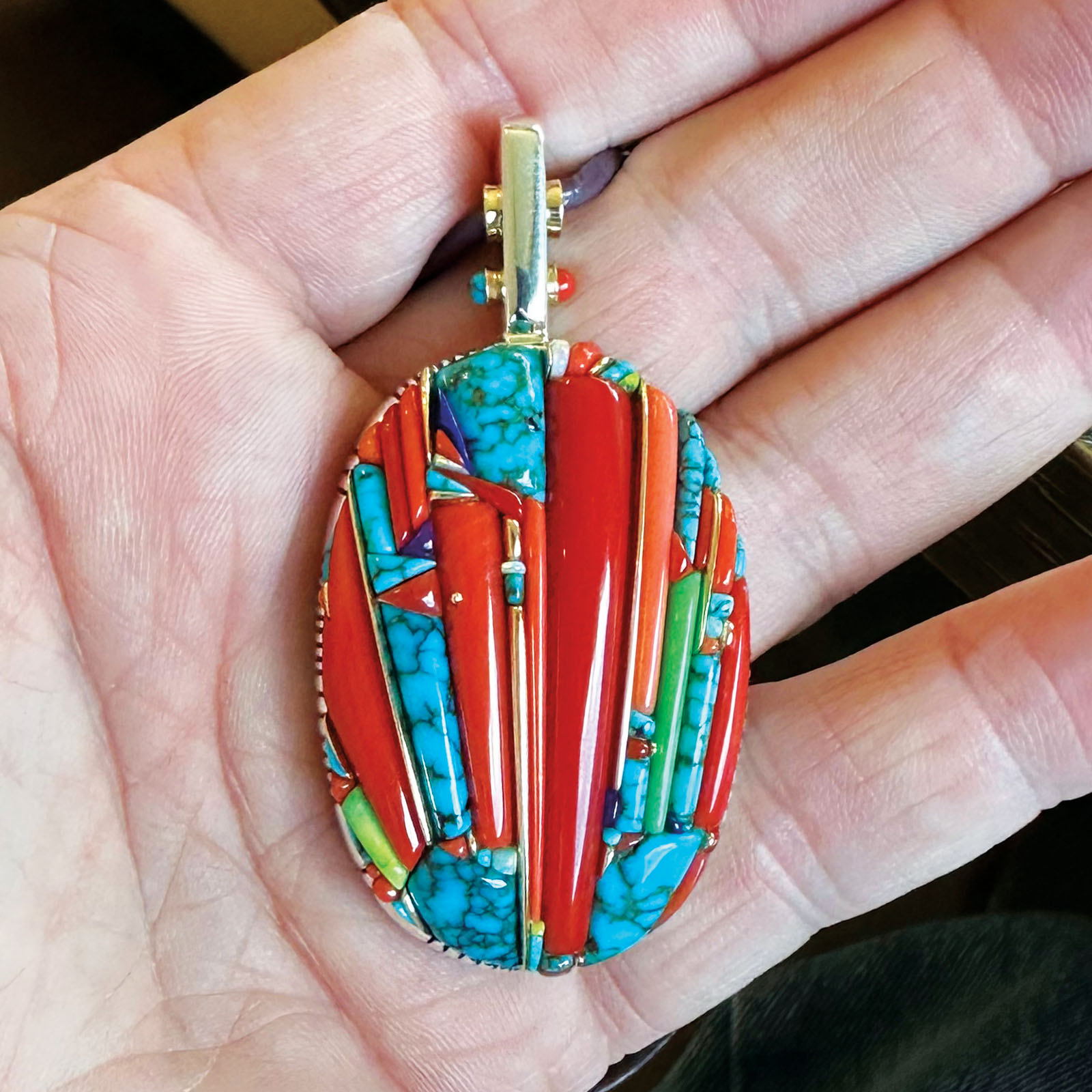 Raymond C. Yazzie (Navajo (Diné)), Inlay pendant, Lone Mountain turquoise and coral
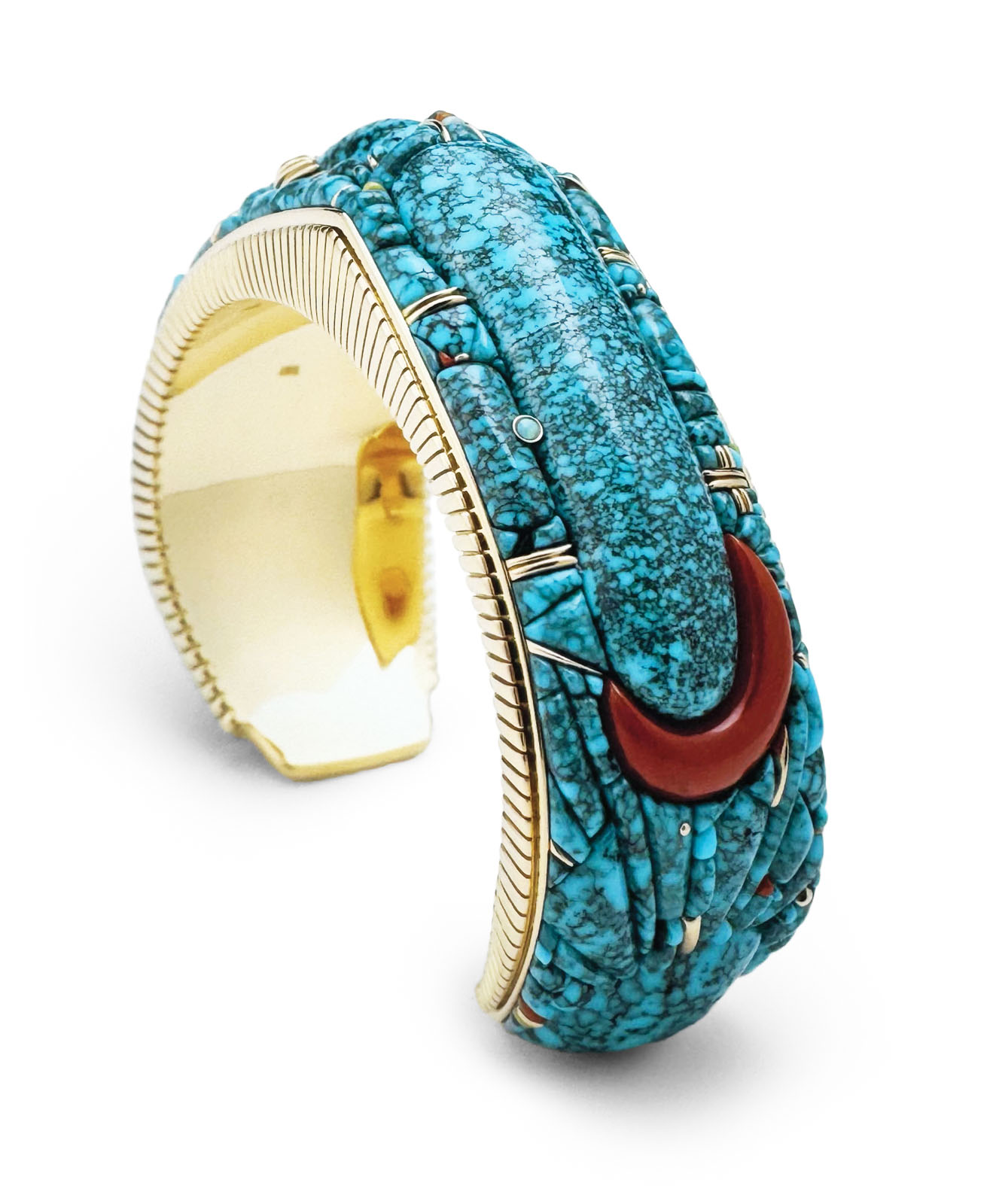 Raymond C. Yazzie (Navajo (Diné)), Life’s Beginnings, fossil Lone Mountain turquoise and coral. Photo by Togashi.
Raymond was born in 1959. This year he will be 65. He was born in Gallup and still resides there. When asked when he first started making jewelry, he replies simply, “I started making jewelry when I was 9 years old.” Raymond began his career cleaning, sweeping, dopping gemstones, cleaning the sticks and watching jewelry makers at Tanner’s Indian Arts, a trading post, at the age of 6 or 7. Joe Tanner, the owner, kept a watchful eye over Raymond and recognized a talent that few ever possess. Tanner’s Indian Arts has been in Gallup since the 1850s and their friendships to Native American artists has proven their worth. The gallery frequently gives gemstones up front to artists to complete a project and not asking for payment until after events like the Gallup Inter-Tribal Ceremonial. By the time he was 9, Raymond gained bench space there to build his own art—ideas poured out of him like a fire hose to quench the raging fire of his creativity. He just couldn’t wait to make jewelry and cut stones. He says, “Joe was like the father I never had… I dopped stones to be cut and swept the floors in the beginning, then basic inlay was taught to me by my brother Lee.” One can truly see that he has made inlay his career. Joe let Ray do his own thing, seeing that he needed little coaching.
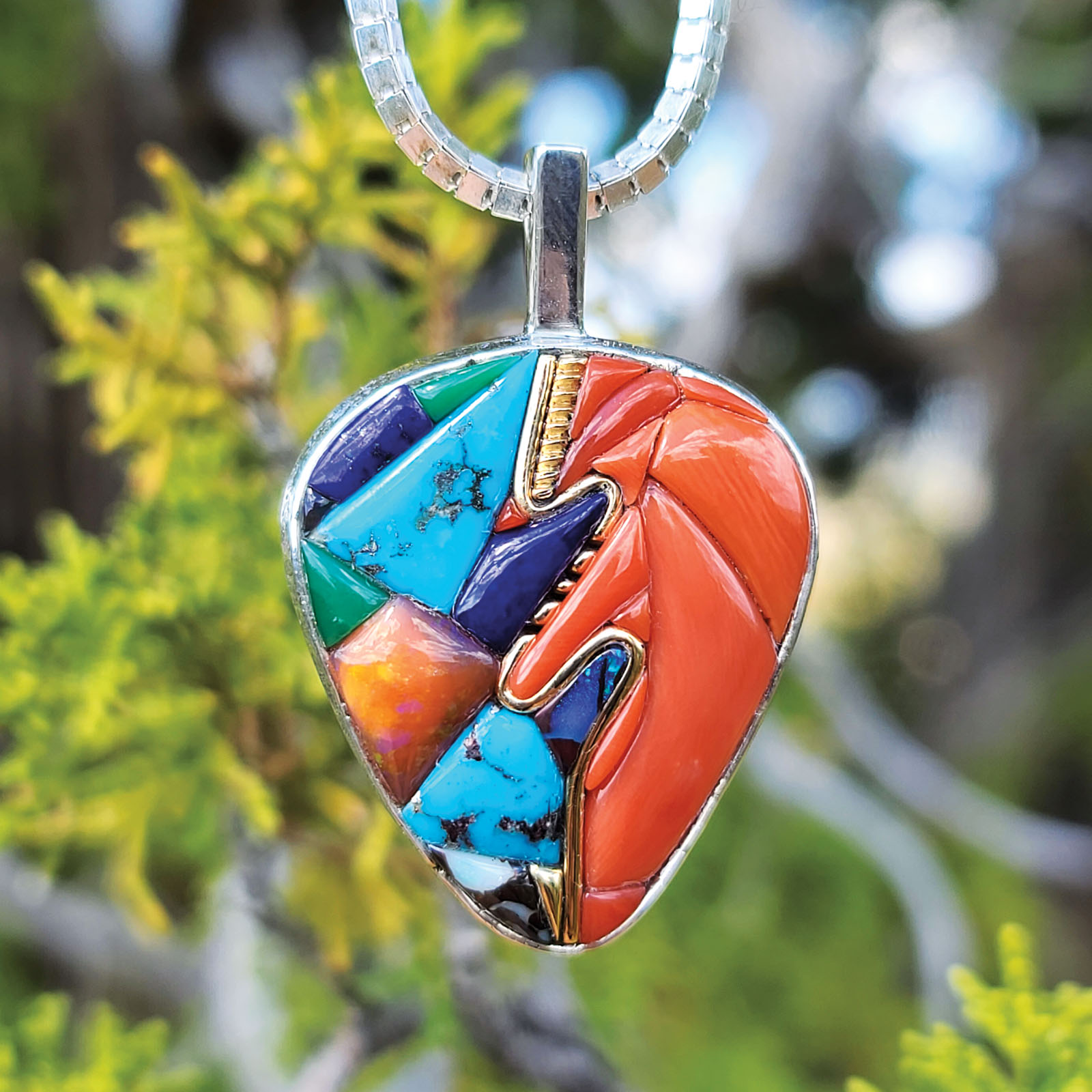 Christopher Yazzie (Navajo (Diné)), Inlay pendant
Joe Tanner is the fourth generation of the Tanner family business, and now Emerald, his daughter, holds that torch that was passed down to her. She represents the fifth generation, which is a remarkable achievement for the family. “Turquoise is what everyone wanted,” Joe says. “It is the all-important jewel of the Four Corners. To the Native Americans, it was the jewel of the world!” I learned that the Tanners helped Native Americans create masterful art by mining turquoise and acquiring as much high-grade turquoise as they could since day one. In fact, the very rare Lone Mountain turquoise in Raymond’s bracelets was from Joe himself.
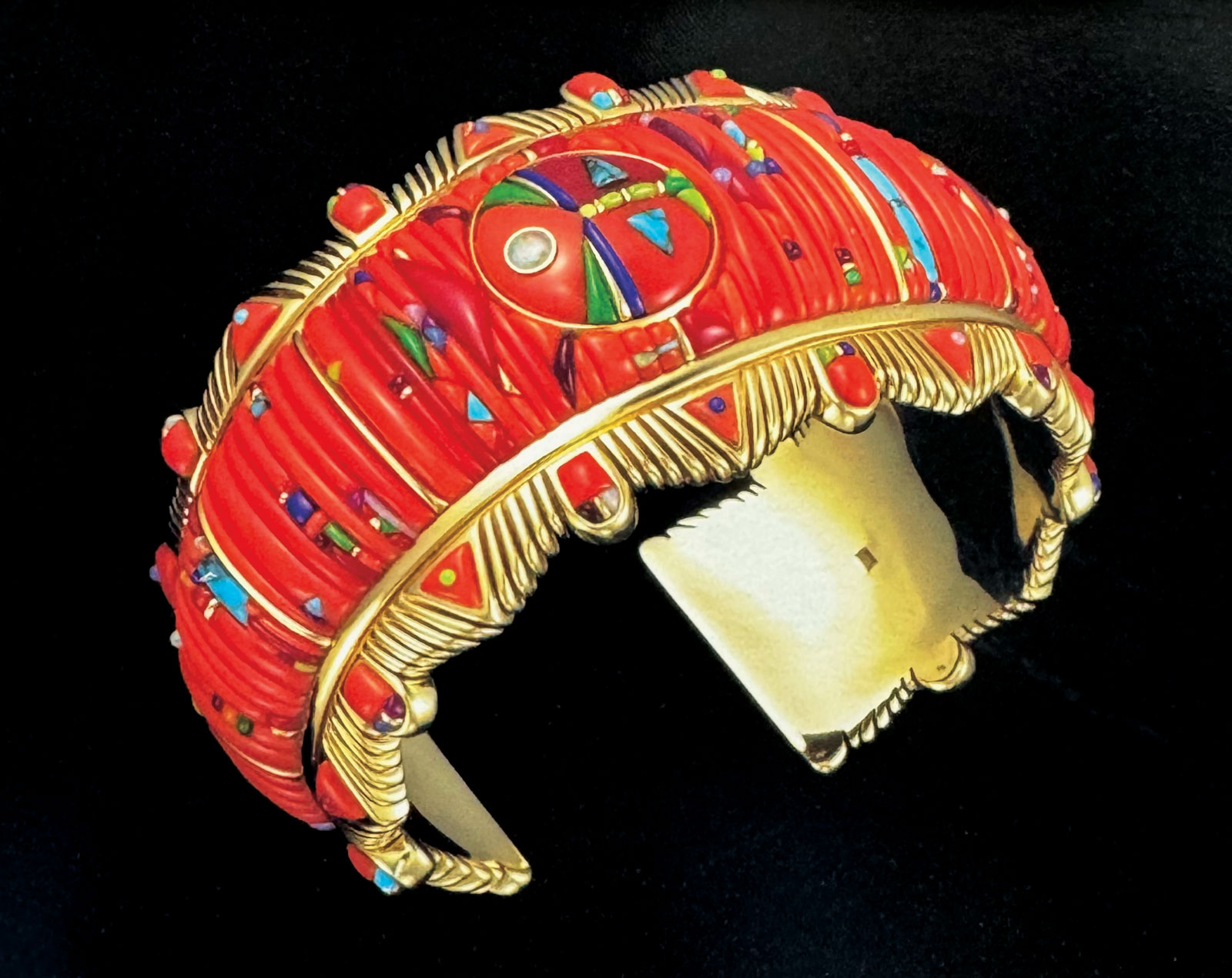 Raymond C. Yazzie (Navajo (Diné)), Life Goes On, coral bracelet. This piece was dedicated to the artist’s late stepson, Scott Joe.
Lee, Raymond’s older brother, worked for a time in Globe, Arizona. There he learned gem cutting and became quite skilled. He was particularly talented with inlay. Ray worked hard and often showed his mother, Elsie, his work. She always encouraged him in his art and life in general. He said he looked up to her, obviously placing her on the highest pedestal as he spoke about her with such joy. Emerald Tanner notes that “she did silversmithing, but most notably she made beads.” With those same beads, she also made beautiful squash blossom necklaces.
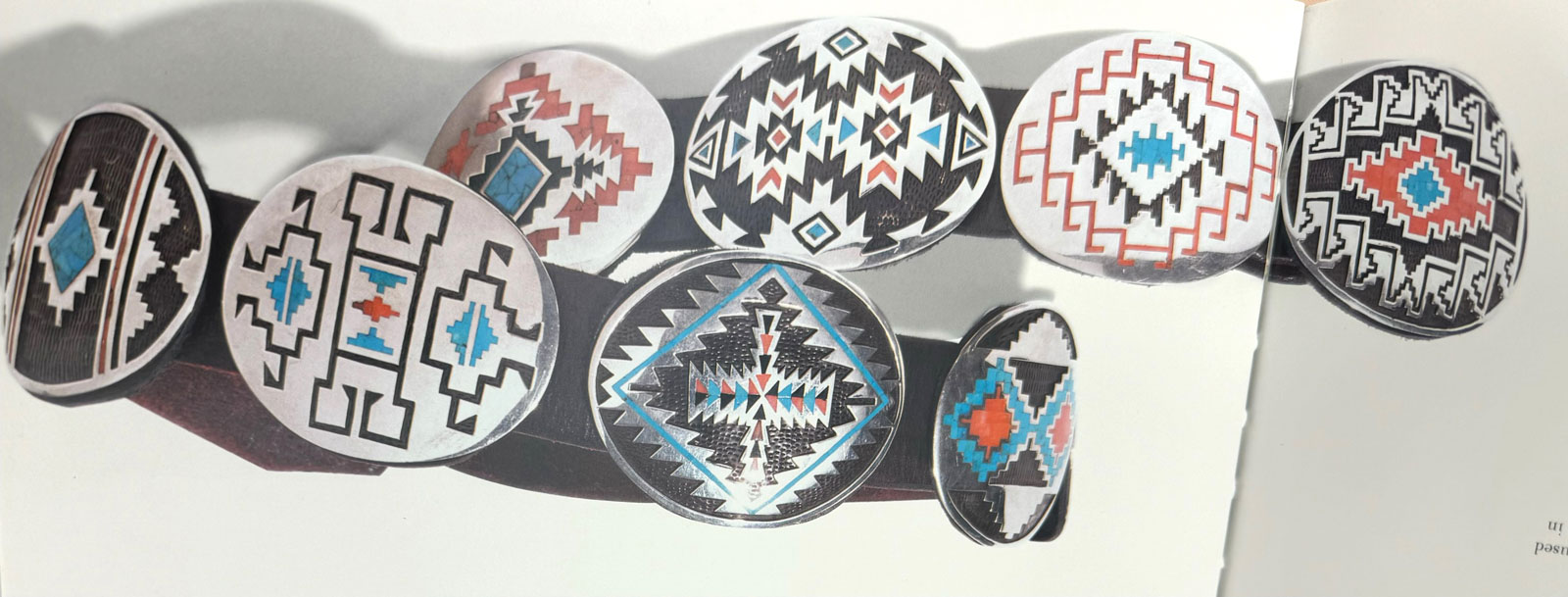 Raymond C. Yazzie (Navajo (Diné)) and Manuel Hoyungwa (Hopi, 1953-2011), overlay and inlay concho belt. Winner of the 1973 Best of Show at the Gallup Inter-Tribal Ceremonial. Photo by Hiyoshi Togashi.
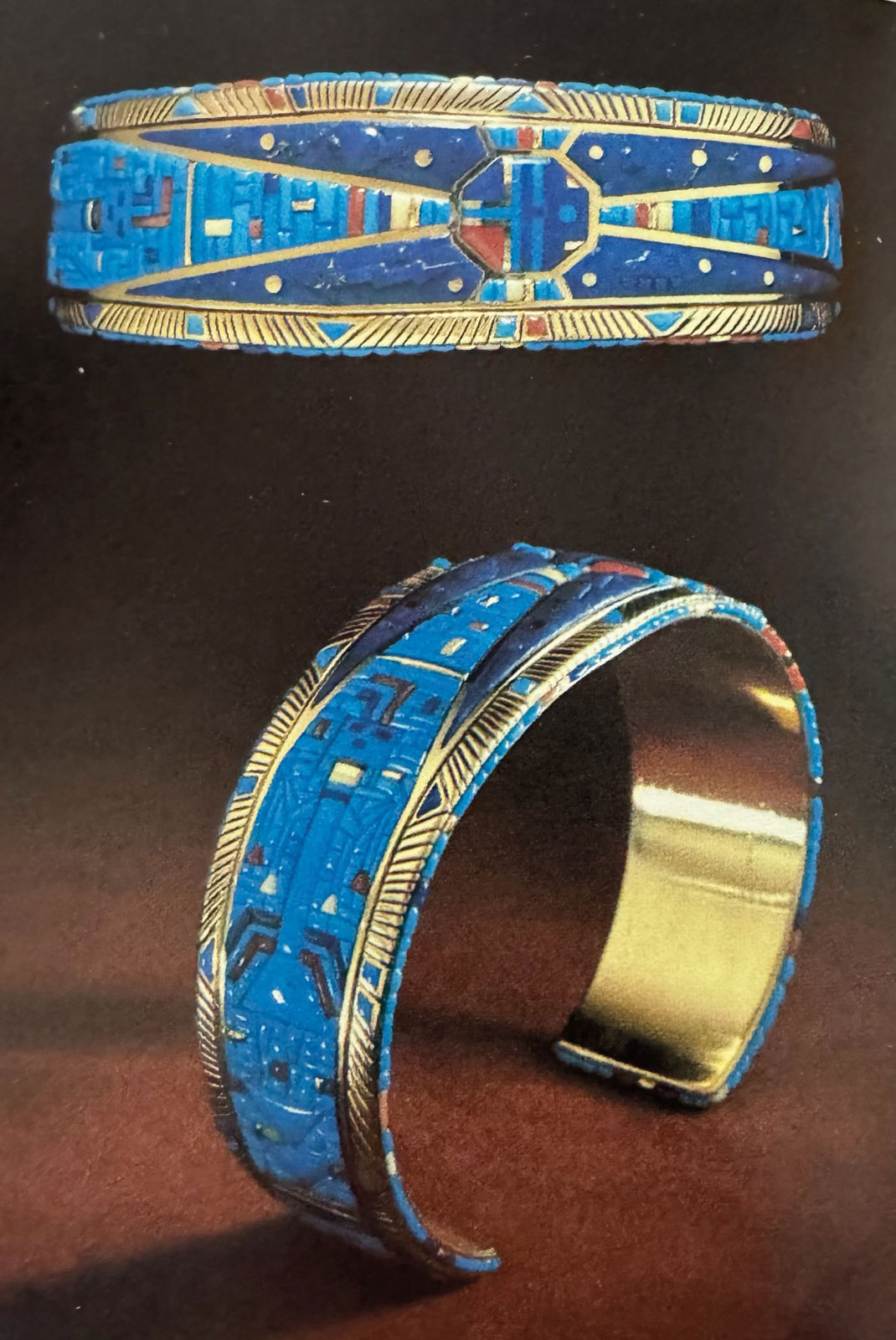
Raymond C. Yazzie (Navajo (Diné)), Universe 2, Blue Gem turquoise and lapis. Winner of the 1983 Best of Show at the Gallup Inter-Tribal Ceremonial.
Ray, the youngest, has 12 siblings, plus himself, for a total of 13 children in the family. He has a daughter, Felicia, and son, Christopher. He has three grandchildren. (Ray also had a stepson, Scott Joe, who sadly passed away in a car accident in 2000. The bracelet Life Goes On is a moving tribute to Scott.) Christopher has been apprenticing with his father steadily for two years, and his improvement is exemplary. Ray rules with a thundering velvet hand when it comes apprentices, which are very few and far between. “If you cannot figure things out on your own, you will never make it,” he says. “If you make mistakes, you will learn more—do not start over.”
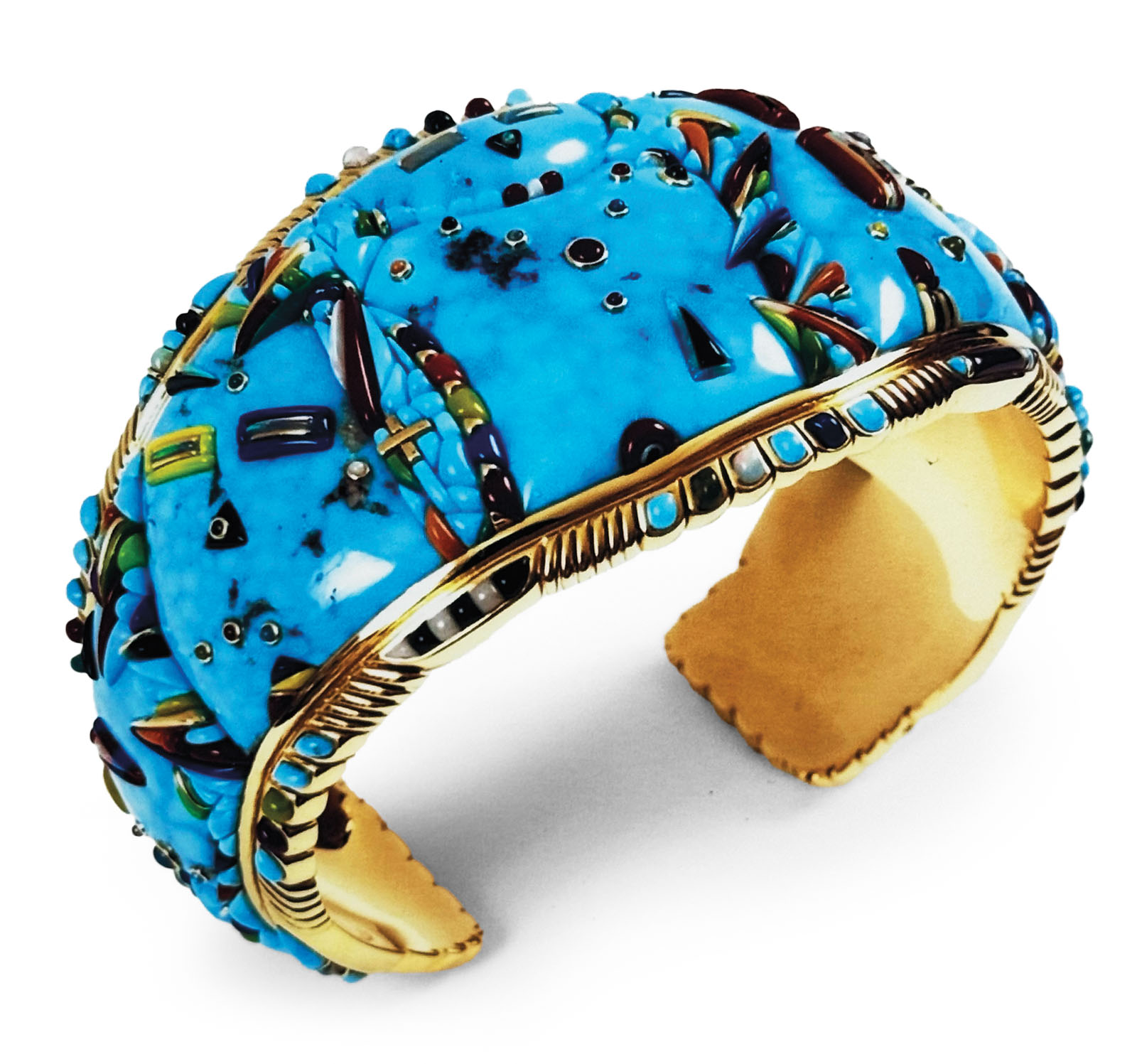 Raymond C. Yazzie (Navajo (Diné)), Blessings, Kingman Waterwbe turquoise with a multitude of other stones. Winner of the 2003 Best of Show at the Gallup Inter-Tribal Ceremonial. Photo by Hiyoshi Togashi.
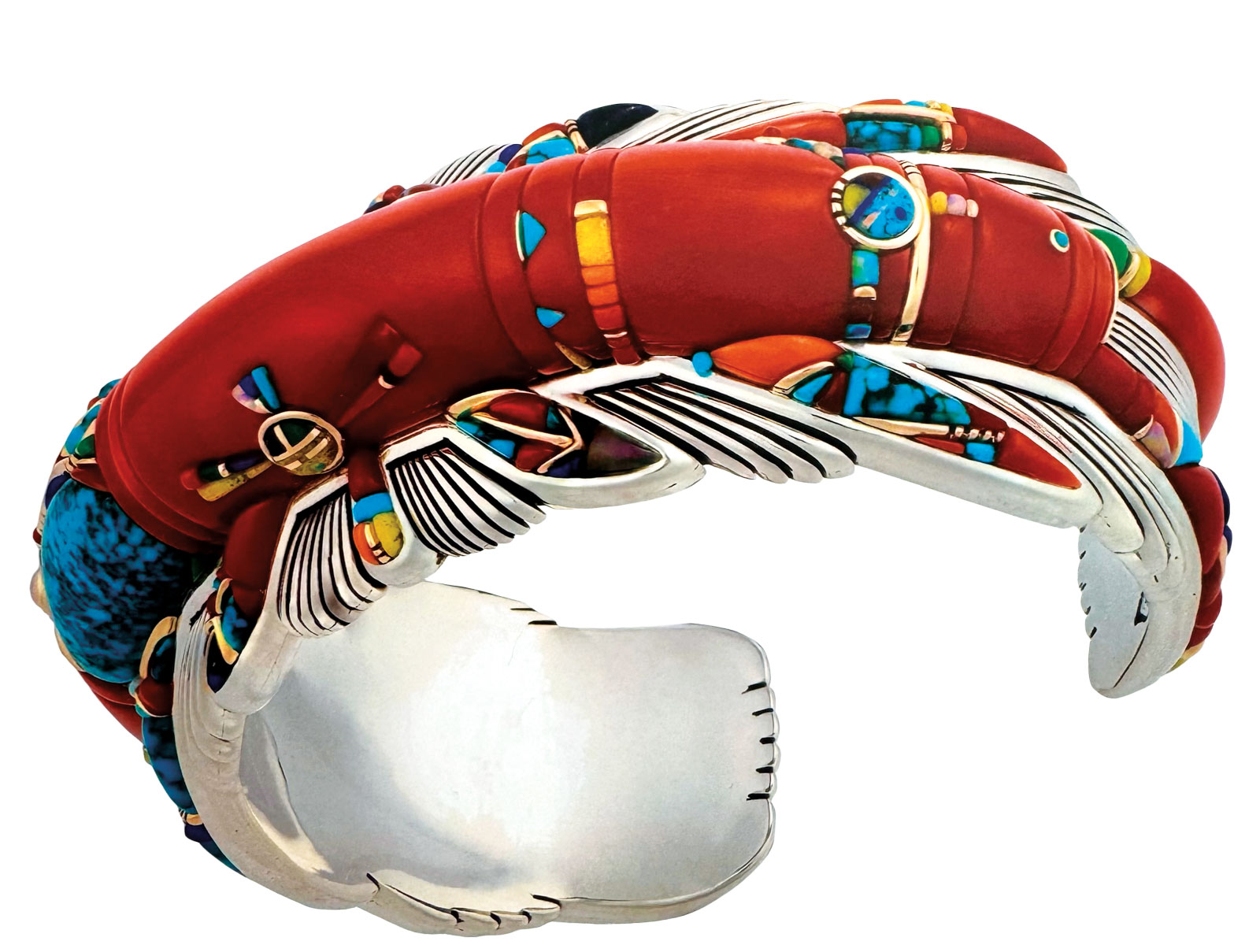 Raymond C. Yazzie (Navajo (Diné)), Lone Mountain Heritage, bracelet. Winner of the 2022 Best of Show at the Gallup Inter-Tribal Ceremonial. Photo by Samual Frank.
“I won best of show in Gallup Inter-Tribal Ceremonial at the age of 14 in 1973 with an inlaid belt. No other artist achieved such a feat at such a young age,” the artist says. Manuel Hoyungwa and Raymond collaborated together to build the award-winning concha belt because a minor needs to have an adult collaborator to compete in the adult division. Ray designed it and they made it together. He won Best of Show there again in 1983, then again in 2003, and yet again in 2022 at the 100th-year anniversary of the Ceremonial—four Best of Shows at one of the most important events for Indigenous artists. “Turquoise is an offering to Mother Earth. Stones talk to me; they need to fit in the finished piece,” he says. “They can sabotage your art if you try to force them into a space that is not meant to be. That is the killer of a ‘could be’ great piece.”
At Tanner’s Indian Arts, Ray met Tony Da (San Ildefonso Pueblo), Charles Loloma (Hopi) and Sonwai (Verma Nequatewa) (Hopi), Loloma’s niece. These artists, and many others, are at the top of the spectrum in the jewelry world.
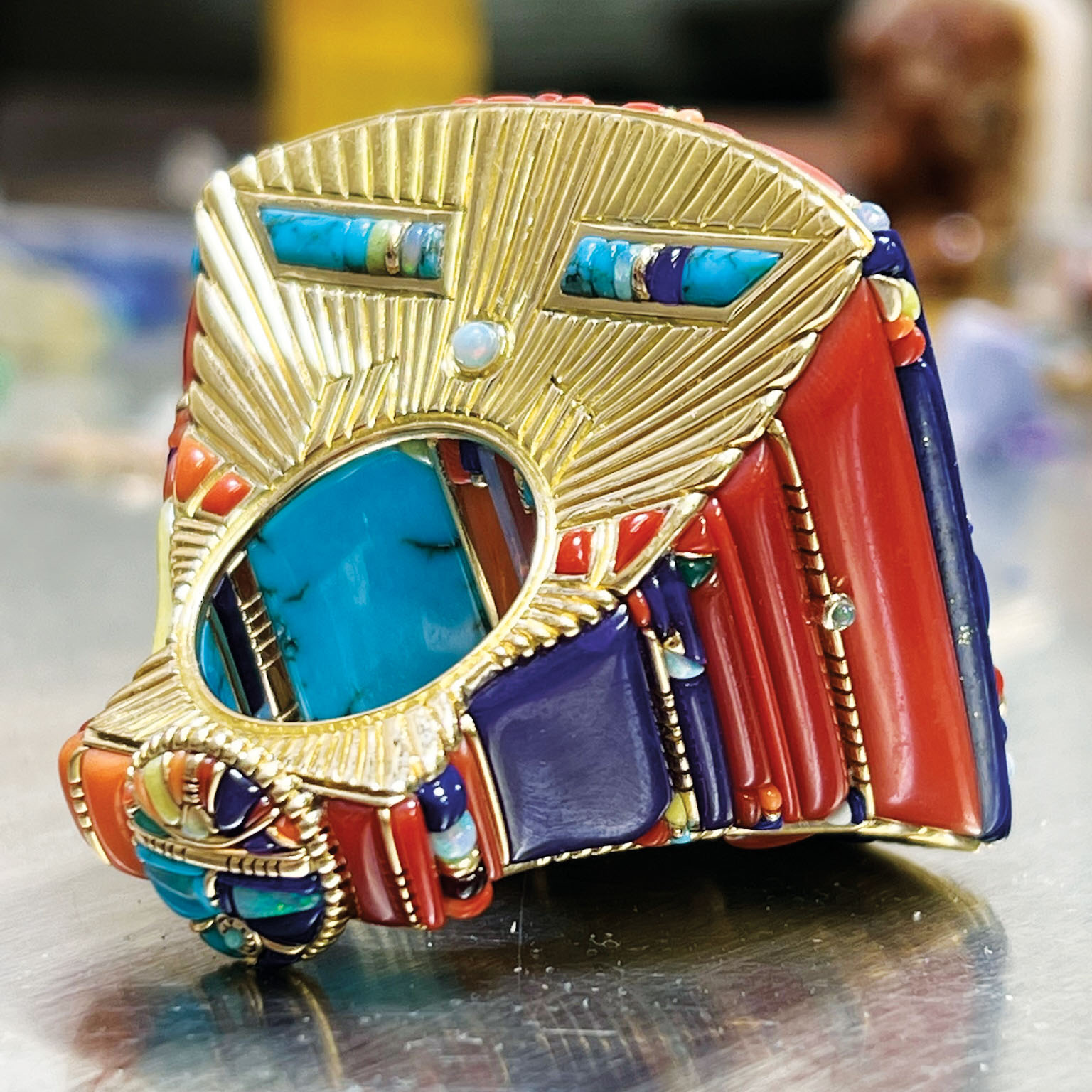 Raymond C. Yazzie (Navajo (Diné)), Sun Face, ring with Orville Jack turquoise, coral, sugilite and other stones.
You might be curious how many pieces Ray has made in his career. “Wouldn’t even want to say how many pieces I have made in my life,” he replies. Ray has become an institution in the jewelry world through his artwork, but also through the hardcover book Glittering World: Navajo Jewelry of the Yazzie Family, published by Smithsonian Books and written by Lois Sherr Dubin. It is the book of all coffee table books, highlighting jewelry made by Raymond and Lee Yazzie, and can be found on countless jewelers’ and collectors’ shelves.
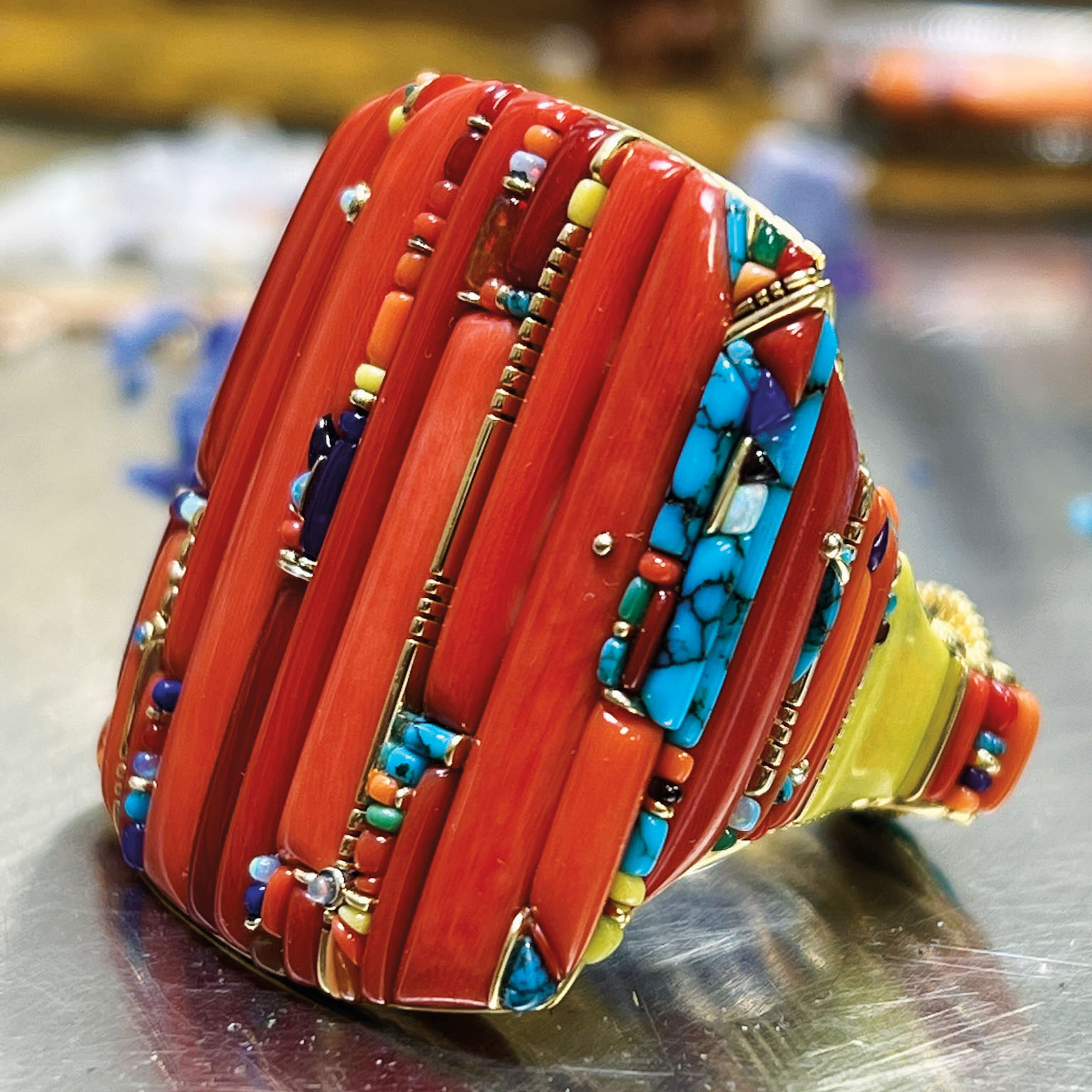 Raymond C. Yazzie (Navajo (Diné)), Sun Face, ring with Orville Jack turquoise, coral, sugilite and other stones.
As we look through Ray’s work, I ask how many stones are in one particular bracelet? He replies with a belly laugh, stating that he stopped counting long ago, because he doesn’t have to. When the piece is finished, it is finished, and he doesn’t look back. Ray’s work is always sold long before it is finished. His labor is one of love. He is building art so far out of the box, we come to realize Raymond C. Yazzie doesn’t even see a box. He is a true master of his craft.
John F. Heusler has been making jewelry for more than 54 years and sells his original designs as well as gemstones at all the major gem and mineral shows. He travels to teach classes and offers instruction at his studio in Southern California. He has a Facebook group called Heusler’s Lapidary and Jewelry. Follow him on Instagram (@GemologistJohn).
Powered by Froala Editor


