Folkebrant had collaborated with the Sámi artist Tomas Colbengtson on the installation Mygration which is on view through March 2, 2025, at MoCNA, which is run by the Institute of American Indian Arts (IAIA). Folkebrant was asked by MoCNA’s chief curator, Dr. Manuela Well-Off-Man, to create a mural for the museum in collaboration with a local Native artist of her choosing.
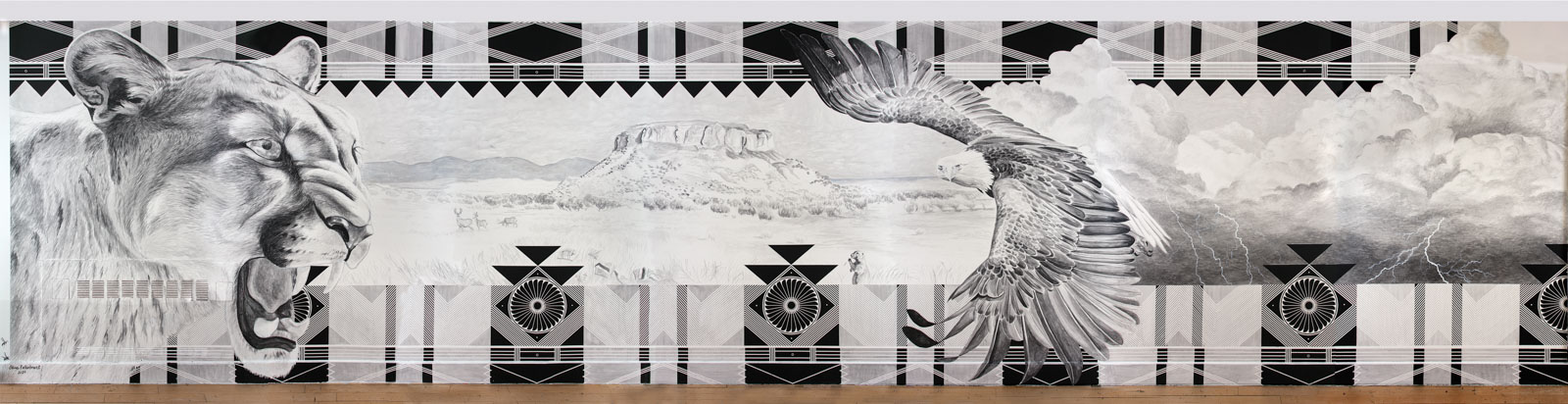 Okhúwa Munu mural at the Institute of American Indian Arts Museum of Contemporary Native Art, Santa Fe, NM. Photo by Addison Doty.
She returned to her studio in Stockholm and began to search for Native American artists on the Web. She discovered Naranjo’s black-and-white linear designs from pueblo pottery on Instagram. “I thought that this geometrical linear work is very different from my organic painting expression of landscapes and animals. I kind of listened to my gut feeling that it’s a very good match and that we could highlight each other. I did understand that his linear work was of traditional patterns but I didn’t know about the deeper meaning that actually lies behind them.”
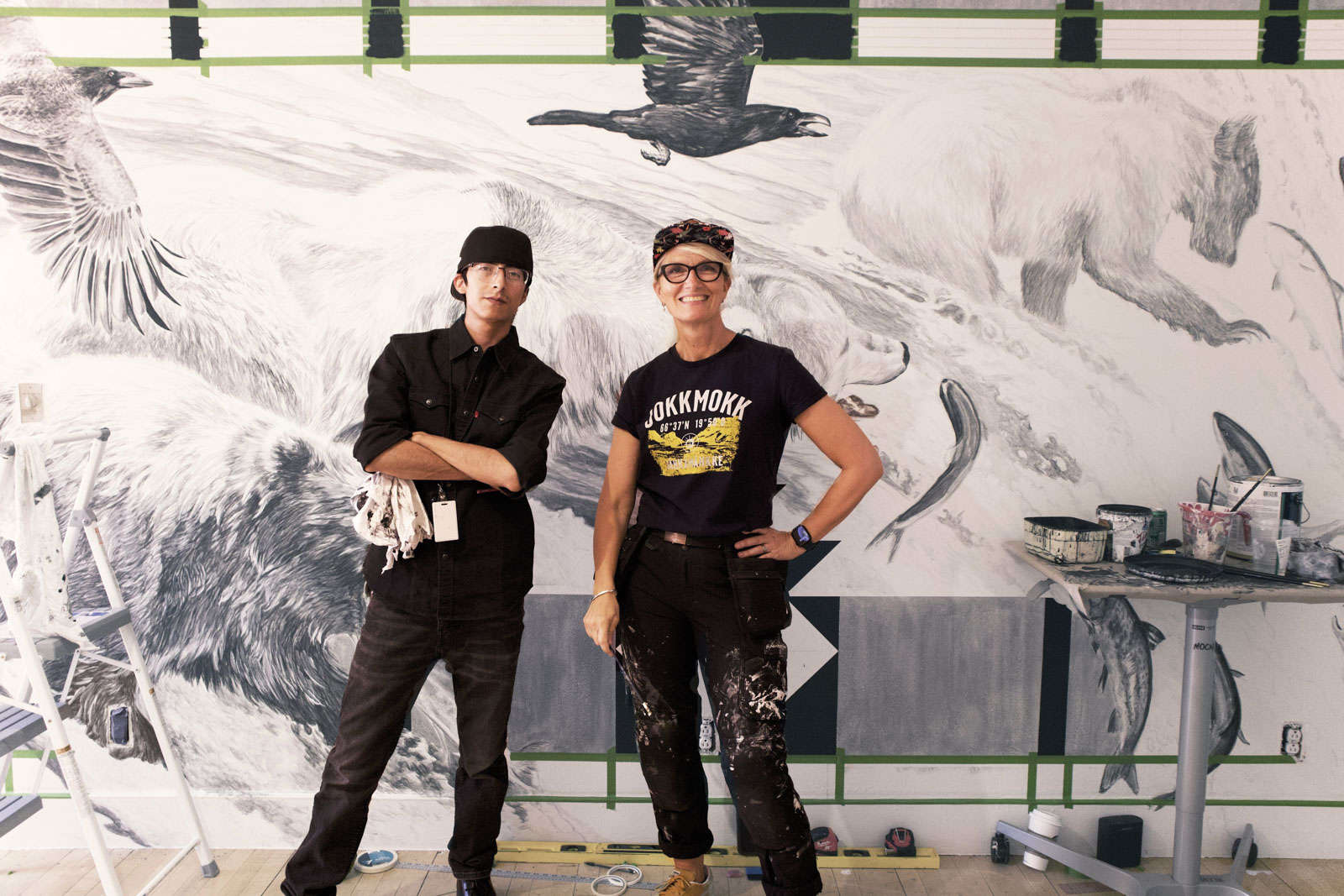 David Naranjo (Santa Clara Pueblo) and Stina Folkebrant pause while painting the Roaring River mural. Photo courtesy of MoCNA.
Deeper meaning enters the artists’ collaboration in many ways through the deeper realms of themselves. Folkebrant’s initial concept for the mural came from a dream and, as Naranjo explains, “To pueblo people, dreams are powerful. When you can manifest your dreams and make them tangible, people make them into reality, you are someone special. You are a creator and a visionary.”
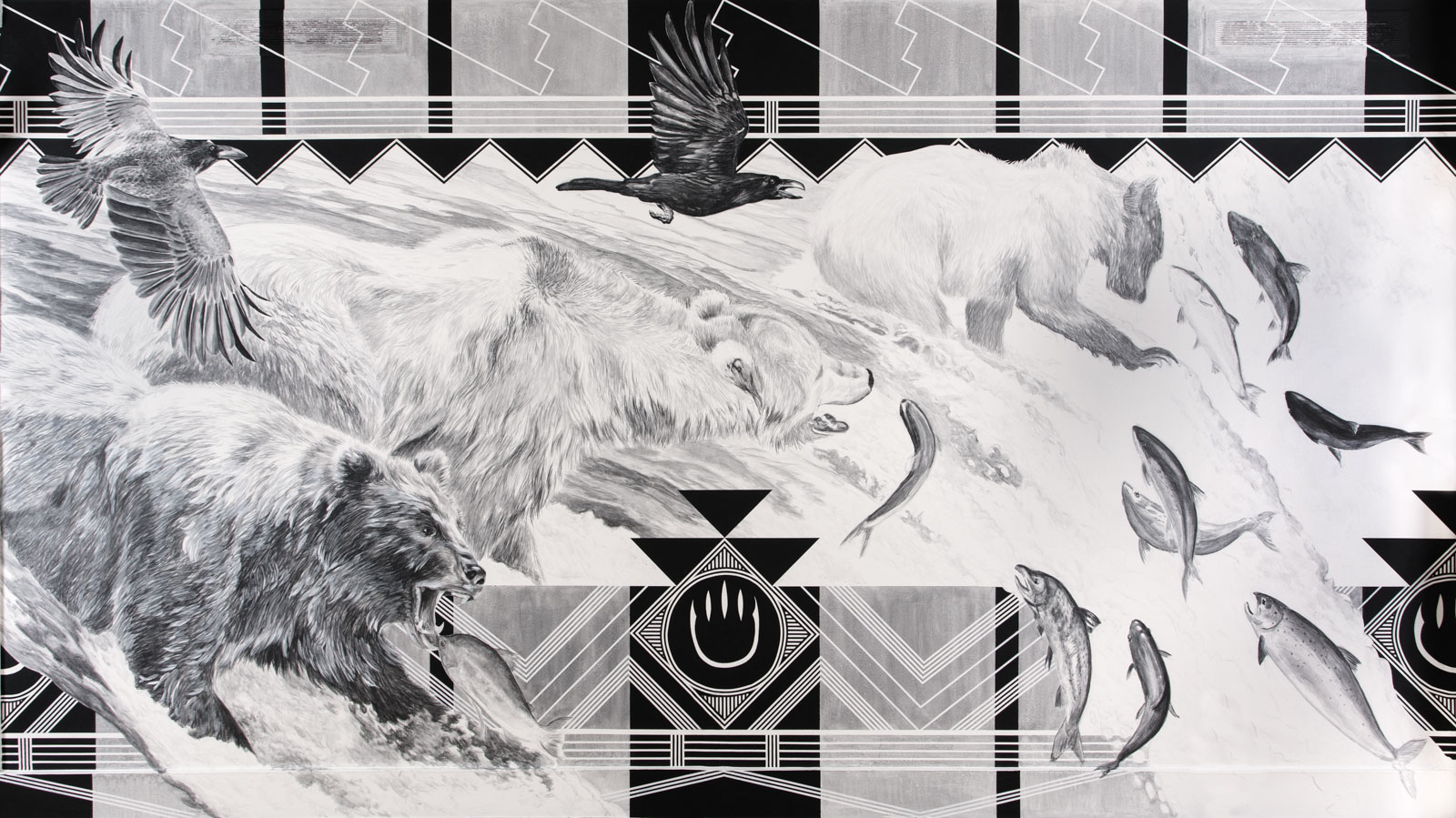 Roaring River mural at the Institute of American Indian Arts Museum of Contemporary Native Art, Santa Fe, NM. David Naranjo’s geometric design features the bear paw motif frequently found in Santa Clara pottery. The matriarchal potter Margaret Tafoya said, “It is a good luck symbol. The bear always knows where the water is.” Photo by Addison Doty.
Folkebrant relates, “I woke up one morning and I had had this totally clear dream where I saw an eagle flying in with a thunderstorm over a landscape and then a mountain lion roaring at the other end, with David’s linear geometrical work on top and below. I just did a sketch and sent it off to David.”
“I thought it was powerful,” Naranjo relates. “It had such strong traditional cultural symbolic notes that can really be appreciated. The eagle, more specifically, is seen as one of the most important intermediaries between us and what we perceive to be the divine. Here in the Southwest, whenever we are singing, dancing and praying, we pray for water, rain water and moisture. In theory, the eagle takes our prayers up into the zenith, up into the heavens, bringing along the rain, the water, the moisture.”
“I asked David, ‘Do you have a theme?’” Folkebrant says. “It’s your land and you’re from here. He replied, ‘Water is something scarce here in the Southwest. Some of the motifs, the iconography, in pueblo pottery are interpretations of water in all its various forms.’ So, I thought it was a very appropriate motif.”
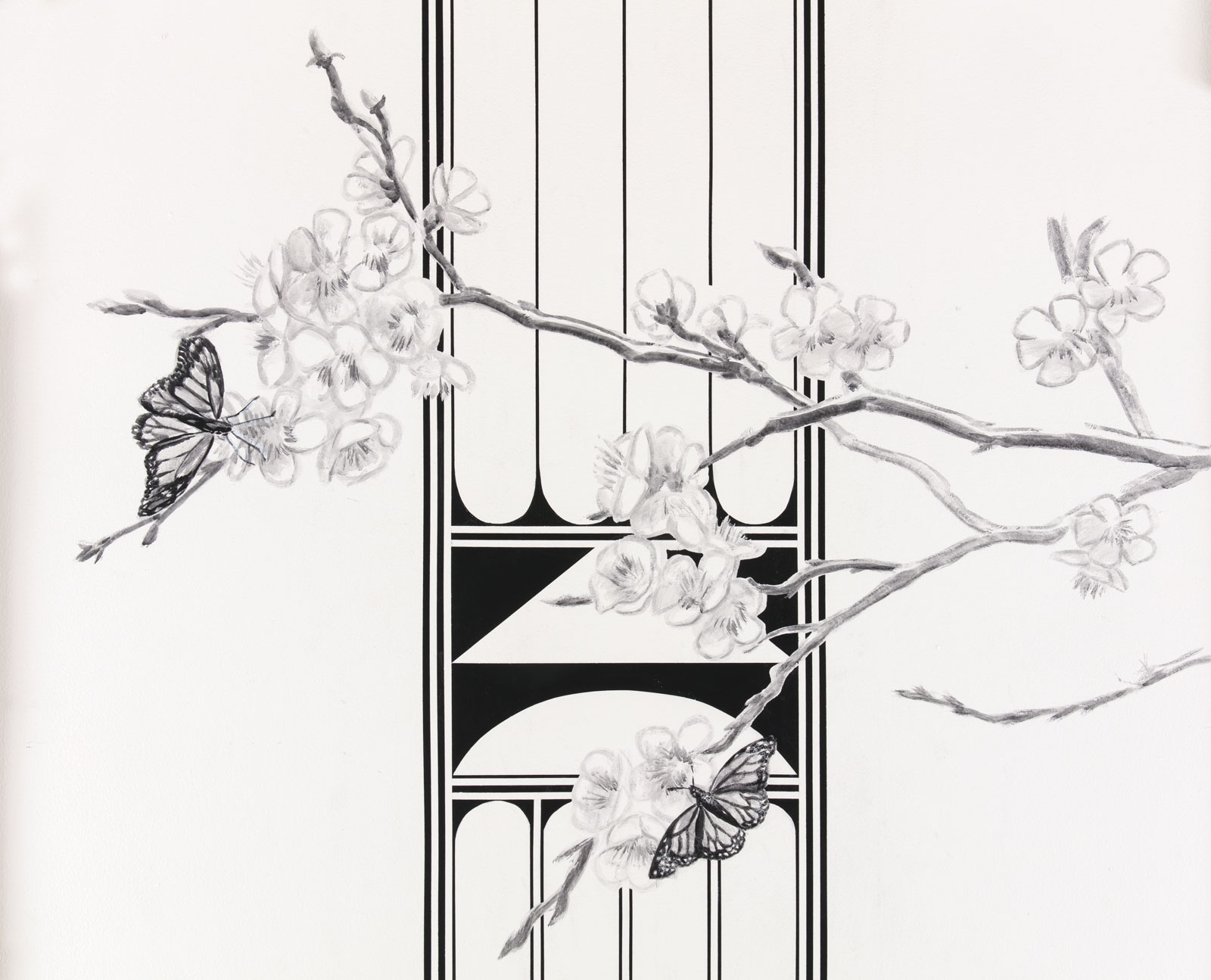 Detail of a wall painting between the windows opposite the Okhúwa Munu mural. Photo by Addison Doty.
Naranjo’s designs incorporate symbols for clouds and rain as well as eagle feathers. The latter is familiar to those who know the Santa Clara pottery of Maria and Julian Martinez who adopted the design from ancient Mimbres pottery.
Prominent in the landscape is Black Mesa on the land of nearby San Ildefonso Pueblo. The mural, titled Okhúwa Munu: A Dialogue Between Cultures and Nature or, in the local Tewa language, Turbulent Clouds, depicts a time before the arrival of settlers. In 1694, however, it was on top of Black Mesa that the Pueblo held off Spanish soldiers during their reconquest of New Mexico following the Pueblo Revolt of 1680.
Folkebrant paints organically, starting on the left of the design or the right and moving “all over the place” she says. Naranjo seeks the middle and works out, left and right, up and down. “I really want to achieve symmetry in my work to portray pueblo and cultural concepts of what we perceive to be the spiritual and physical worlds, the above and the below, the zenith and the nadir.”
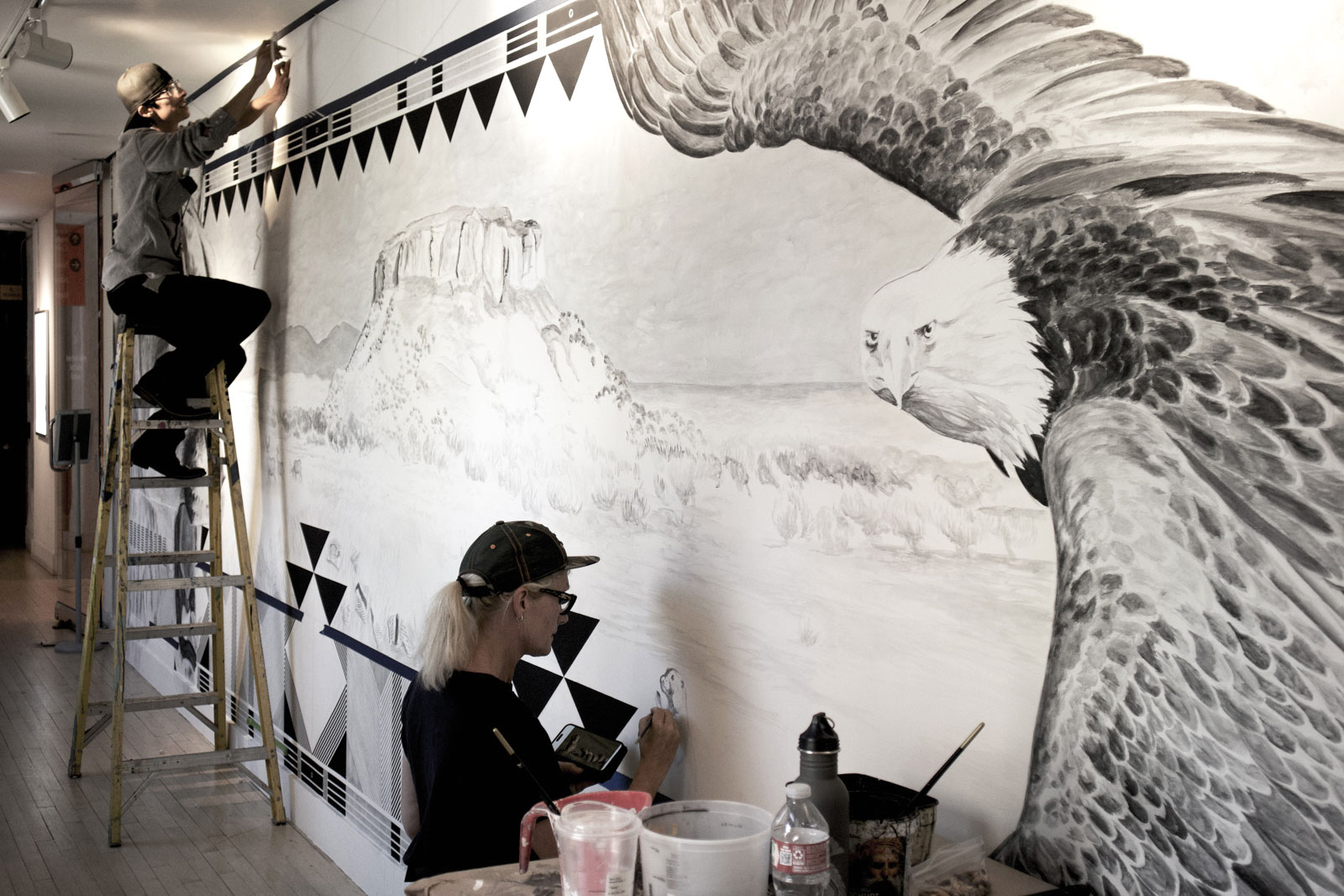 David Naranjo and Stina Folkebrant work on the Okhúwa Munu mural. Photo courtesy of MoCNA.
The artists’ contributions to the mural are both separate and overlapping. “We worked very much with our intuition,” Folkebrant explains. “I let the clouds go over David’s geometrical work, and in one section, the actual eagle feathers go over the geometrical pottery design.”
“You have the actual overlaying the abstract,” Naranjo says. “You have the abstract version of the clouds and you have their actual depictions.”
Folkebrant refers to the Buddhist concept of artless art. “My interpretation of artless art is that I don’t create art. I actually create a piece of nature. So when I’m painting an animal, I try to feel, to meditate on the animal so that I can paint the heart of the animal. I don’t create art in the Western way.”
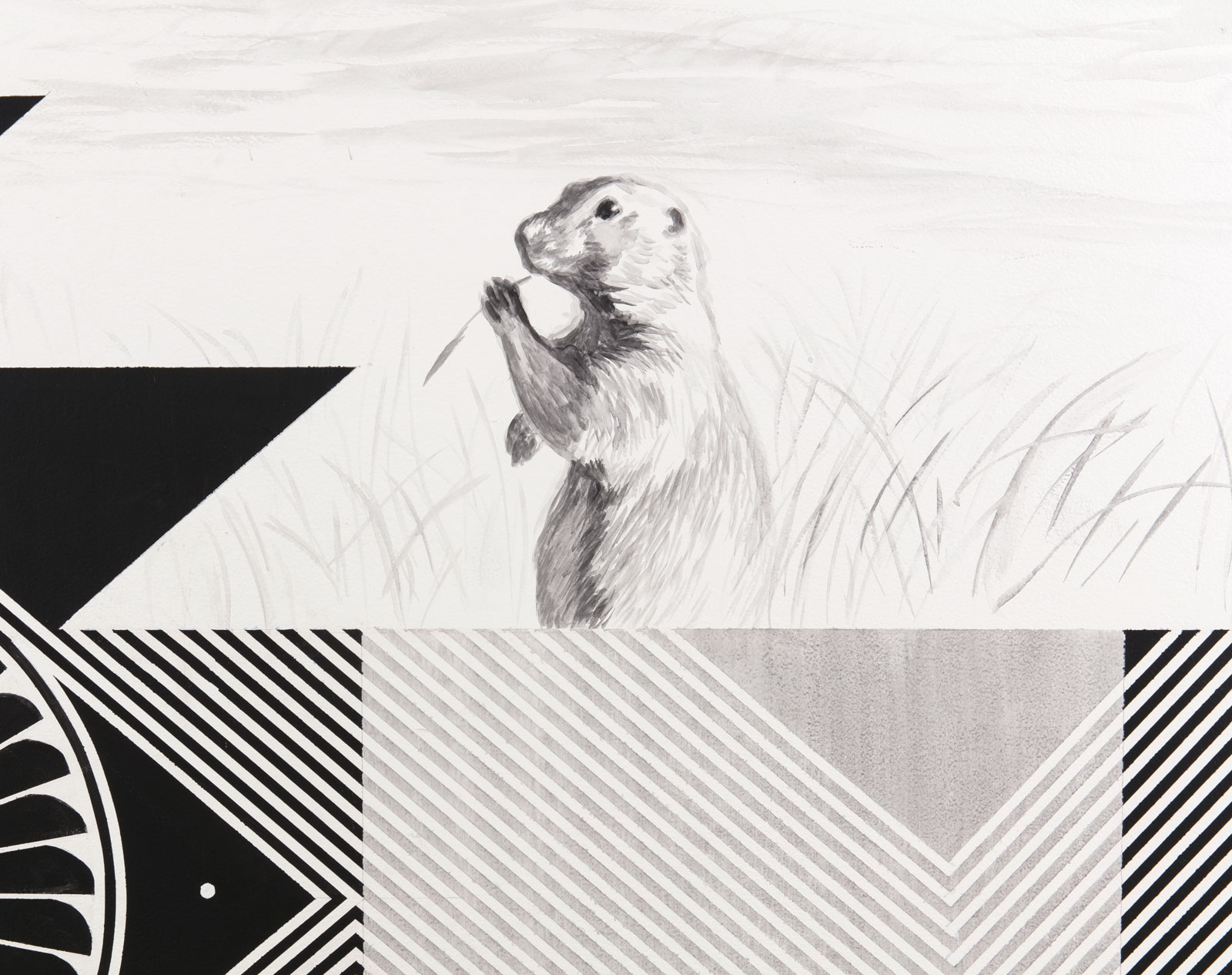 Okhúwa Munu mural at the Institute of American Indian Arts Museum of Contemporary Native Art, Santa Fe, NM, prairie dog detail. Photo by Addison Doty.
Naranjo complements the thought, remarking, “With a lot my work, I don’t really see it as a work of art but really as a way to extend my personal way of praying. I see it as a means of extending my breath to something much more loving, something much greater.”
The experience of the mural, its elements repeated on the opposite wall and in an additional mural in an adjoining vestibule, is immersive. The creative energy of the artists from different cultures, and that of the weather and animals they depict naturally and figuratively, is palpable.
Powered by Froala Editor


