“The whale is a metaphor for indigeneity.”
So says Courtney Leonard, a multimedia installation artist, ceramicist, filmmaker and enrolled member of the Shinnecock Indian Nation on Long Island.
How so?
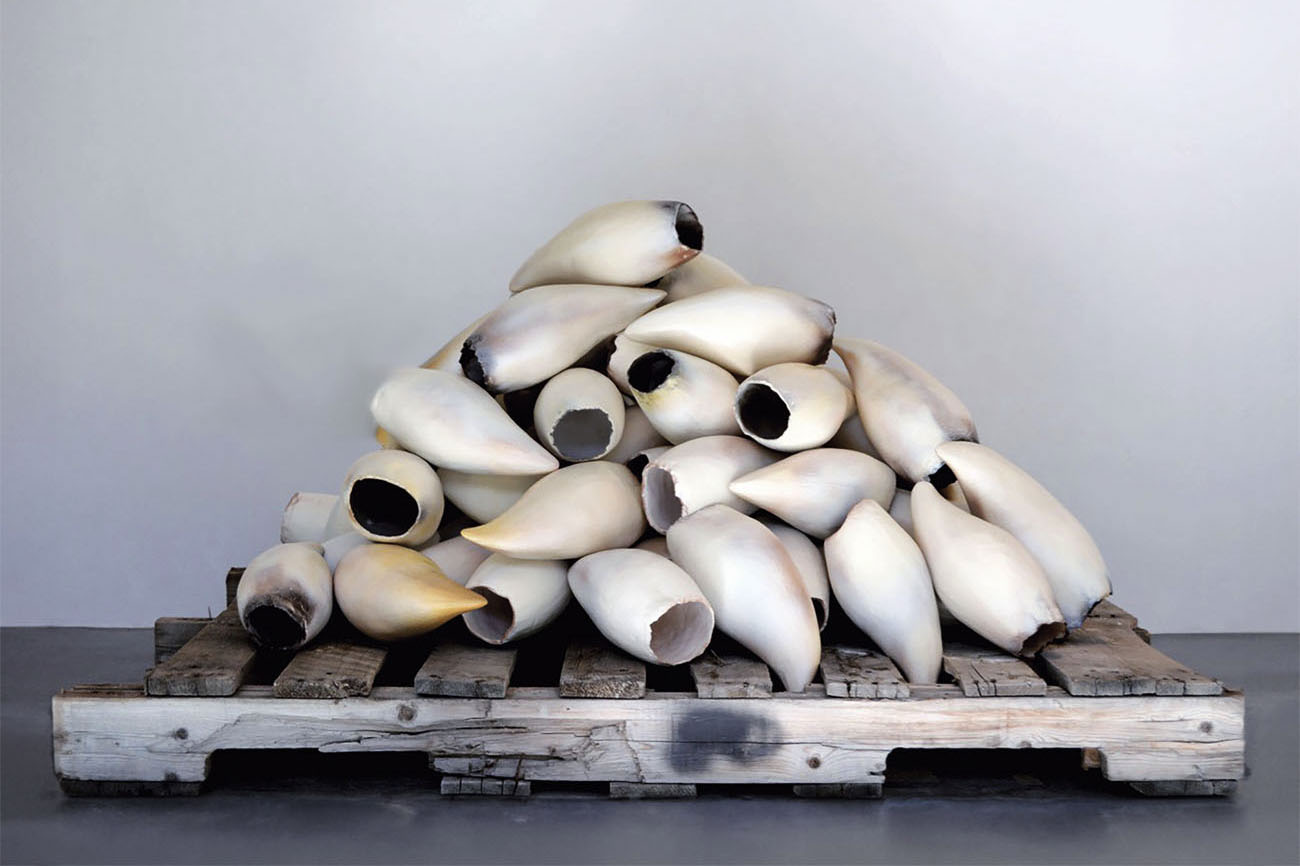 Courtney Leonard (Shinnecock), BREACH #2 (part of a limited series, started in 2015, marking the death of one whale), Ceramic sperm whale teeth and wooden pallet. Courtesy of the artist.
“Because more people care about a whale than they will Indigenous people,” Leonard says.
She has a point.
“Save the Whales” was a global rallying cry decades before MMIW (Missing and Murdered Indigenous Women) became a recognized acronym outside Indigenous communities or “truth and reconciliation” regarding Canada’s and the United States’ legacy of Indian boarding schools gained traction.
“Nobody really knows who Shinnecock people were or what we cared about—our voice,” Leonard says. The Shinnecock did not receive federal recognition as a tribe until 2010. “People care about a whale, but they don’t care about Indigenous coastal people that they’re living next to.”
Shinnecock people have been closely connected to whales since arriving in the area. Whales served as a food source. A resource for material objects. They were instrumental in ceremony.
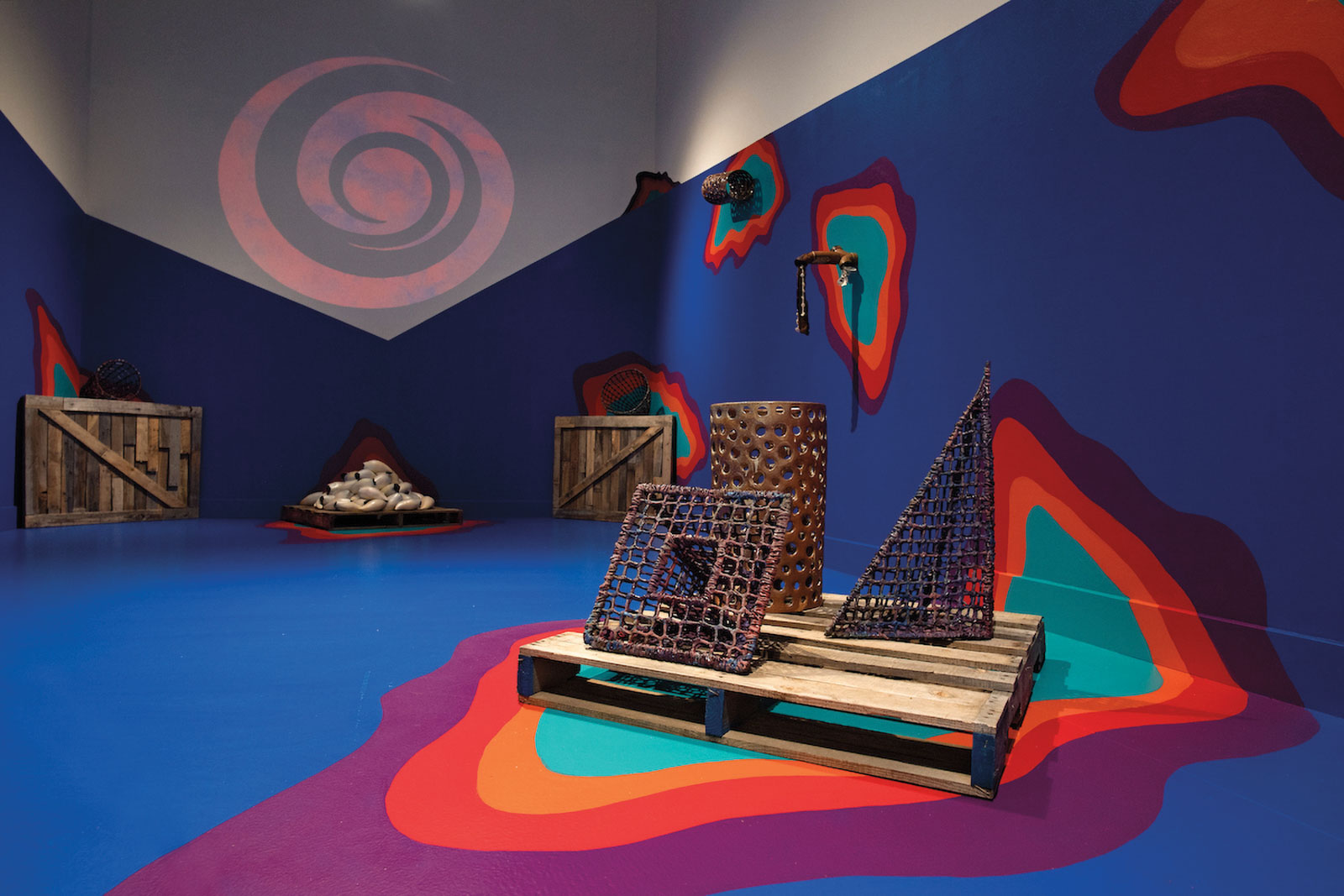 Installation photo from BREACH: Logbook23 | Coriolis at the West Carolina University Fine Art Museum at the Bardo Arts Center, Cullowhee, North Carolina, 2022.
That all changed with the emergence of industrial whaling around 1700, hunting the animals for their blubber and oil to fuel lamps lighting up cities across Europe and America. Ground zero was New Bedford, Massachusetts, just across Long Island Sound from the Shinnecock homeland.
Over the next 200 years, peaking in the mid-1800s, whalers based out of New Bedford and elsewhere obliterated historically abundant populations across the North Atlantic and around the world.
With multiple species teetering on the brink of extinction, Shinnecock and Indigenous access to whales on the Atlantic seaboard was cut off by the federal government in the name of science and conservation. No more subsistence hunting. No whales for ceremony.
Even already dead whales were off-limits to local Indigenous people where the animals washed ashore. Outside scientists were given priority.
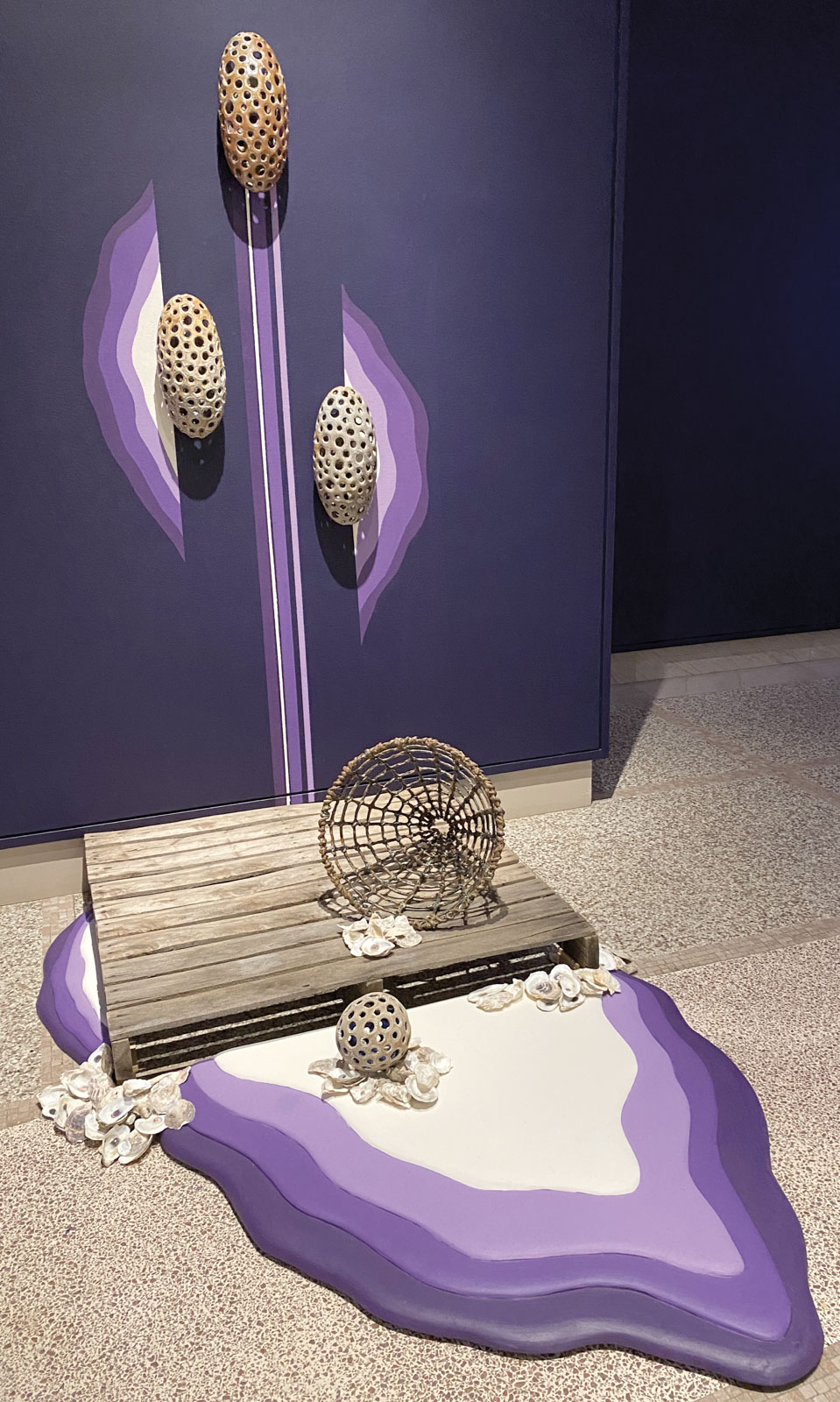 Installation photo from Courtney M. Leonard: Logbook 2004-2023 at the Heckscher Art Museum in Huntington, Long Island, 2023.
“The first time I’ve ever been with a whale was when it was struck by a shipping boat in 2005,” Leonard remembers. That was a finback whale. The moment didn’t last long. “We can’t access materials of the whale that we have cultural and ceremonial connections to, but these science spaces can house numerous amounts of whales if they have the space.”
At the end of January 2024, a dead North Atlantic right whale washed ashore on Martha’s Vineyard and for the first time Leonard is aware of, after the scientists came in, the Aquinnah Wampanoag Tribe asserted its right to keep the whale in their community.
Leonard explores the historical and contemporary ties between place, community, whales, and the maritime environment through her BREACH project. Her latest iteration of the ongoing series can be seen June 1 through November 3 at the New Bedford Whaling Museum during BREACH: Logbook 24 | Scrimshaw, a site-specific, multimedia journey conjuring the remains of whales, waterfront infrastructure and oyster shells, evoking Shinnecock knowledge and practices around water, resilience, and healing on unceded lands.
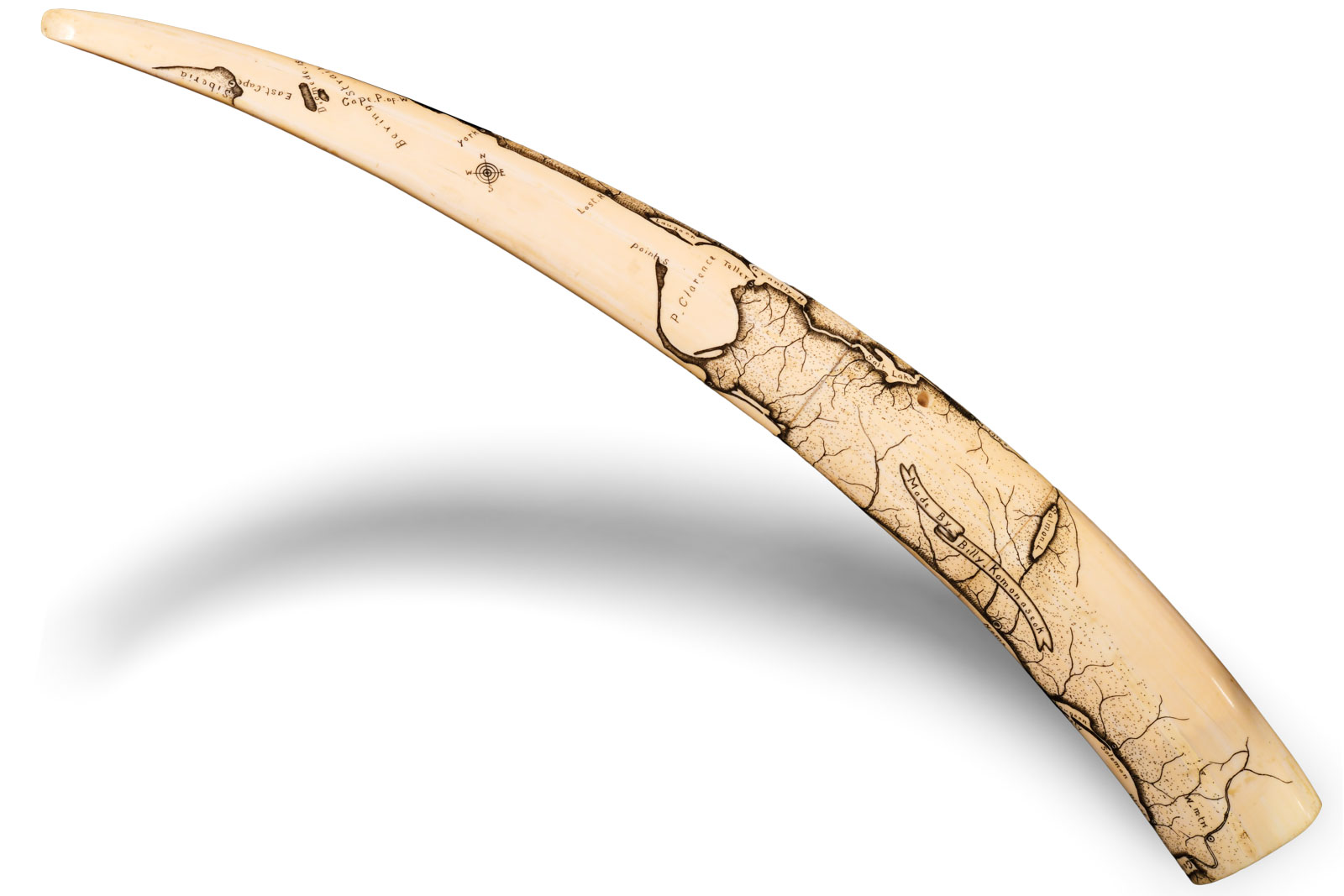 Billy “Billiken” Komoneseok (Iñupiaq), Cribbage board, 1908-1912, walrus tusk, 273/8”. NBWM 2001.100.2255.
Whales breach the ocean’s surface. An overflowing river can breach its banks. A breach can refer to a gap or a break. In legal terms, a breach is a violation. A breach of trust.
These multiple definitions all apply to Leonard’s BREACH project initiated in 2014, a potent commentary on environmental vulnerability and the complex relations between settler states and coastal Indigenous communities against the backdrop of whales.
“In my work I tend to use clay as an entry point to environmental issues and care, and it’s also something I have the ability to access,” Leonard explains. “Because of imposition, which is part of that definition of breach—to impose laws from another nation outside of our nation—we can’t access the material of the whale without going through a lot of legalese, so I’m able to access clay and fashion it into what I’ve interpreted as whale teeth.”
Access.
“Federal laws and the idea of who gets to be stewards of this knowledge and our cultural relatives—the whale is a lot for us as people—the years of imposition of other people saying we can take care of these things better,” Leonard says.
Using the rationalization of superior facilities, non-Native museums assuming ownership of Native material is a century old story universal across North America. Leonard, a museum studies graduate from the Institute of American Indian Arts, has seen firsthand how superior facilities don’t always result in superior care.
“You are not the authority in this. If anything, you lack knowledge and lack confidence, so you’re going to exude that to us and position yourself better; I see that with science in a lot of ways,” Leonard says. “I also have faith that we can work in an interdisciplinary way. Instead of being angry at the past 30 years of my life and not wanting to work with these people that come from historical harm—that’s not going to get me anywhere.”
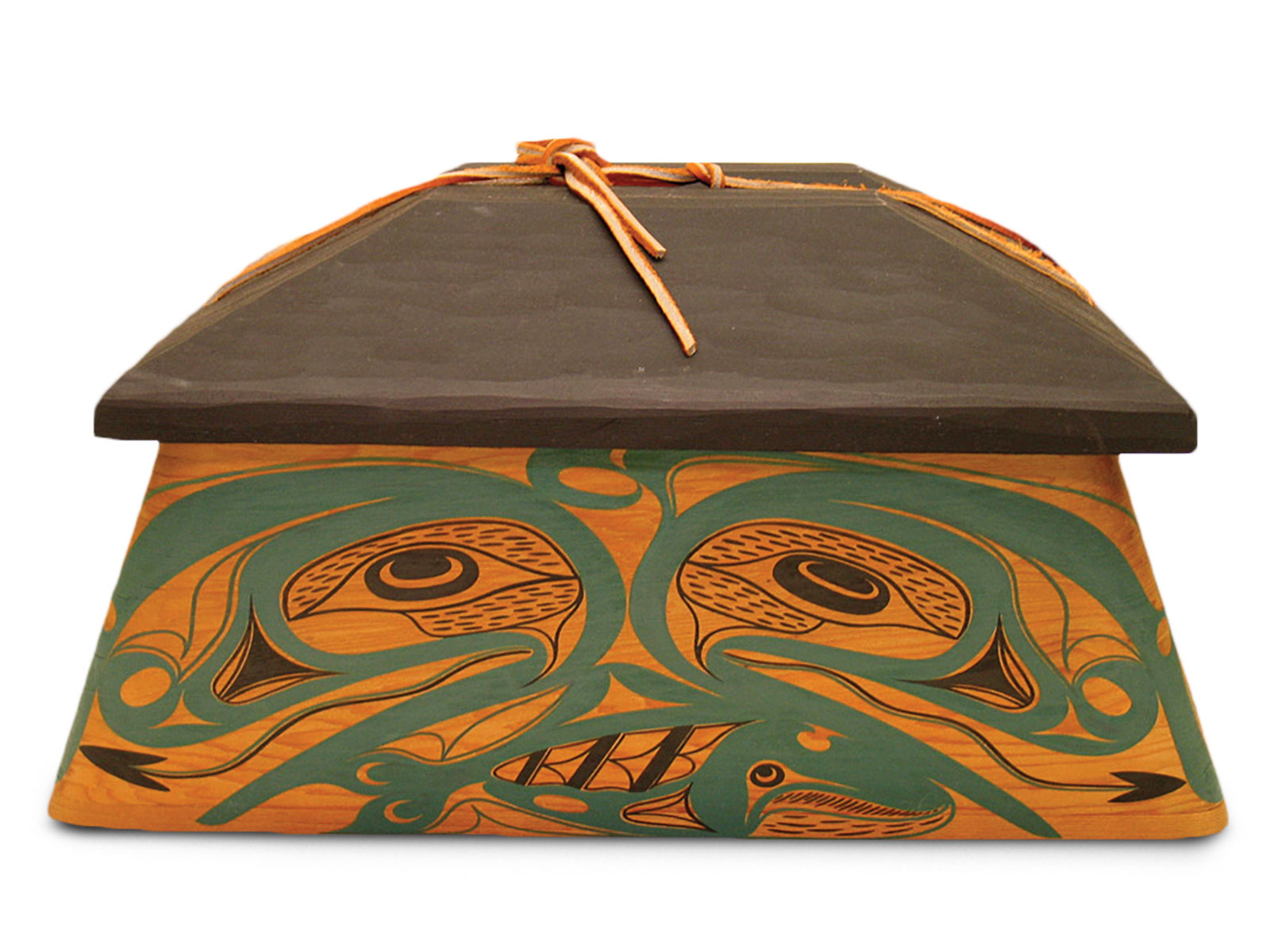 Art Thompson (Nuu-chah-nulth), Tackle Box, 1992, cedar, leather and paint, 181⁄8”. NBWM 2001.100.3433.
Leonard knows the damage caused to coastal Indigenous communities by restricting their access to whales. She’s also seen the other side. In 2016 she visited Alaska and was invited to Utqiagvik for a community whale feast.
“Seeing the beauty of being in a community that has the ability to continue their substance rights and harvesting of whales—and our community doesn’t—it was one of the most beautiful experiences I’ve ever had,” Leonard remembers. “It’s something people don’t see when they’re trying to save the whales—they will harshly attack Indigenous communities (for hunting whales). A large part of what I try to do with BREACH is amplify the issues that we are all collectively responsible for the care of whales.”
Subsistence hunting of whales was sustainable for centuries before the emergence of industrial whaling, and whatever number of whales could be taken by Indigenous people today is irrelevant to the species’ survival when compared to the wholesale global slaughter of whales by professional whalers of the past, the remnants of commercial whaling, and deaths caused by collisions with shipping vessels and entanglement in commercial fishing gear—the two greatest causes of whale mortality today.
Leonard further informs her BREACH project with research conducted on whaling ship logbooks. For BREACH: Logbook 24 | Scrimshaw, she specifically focused on the logbook for the ship Callao (1845-1849) which included Shinnecock whalers and a Shinnecock captain sailing out of New Bedford. The New Bedford Whaling Museum’s archives house the Callao logbook.
She found, not to her surprise, information recorded in the logbooks matched oral histories from her community.
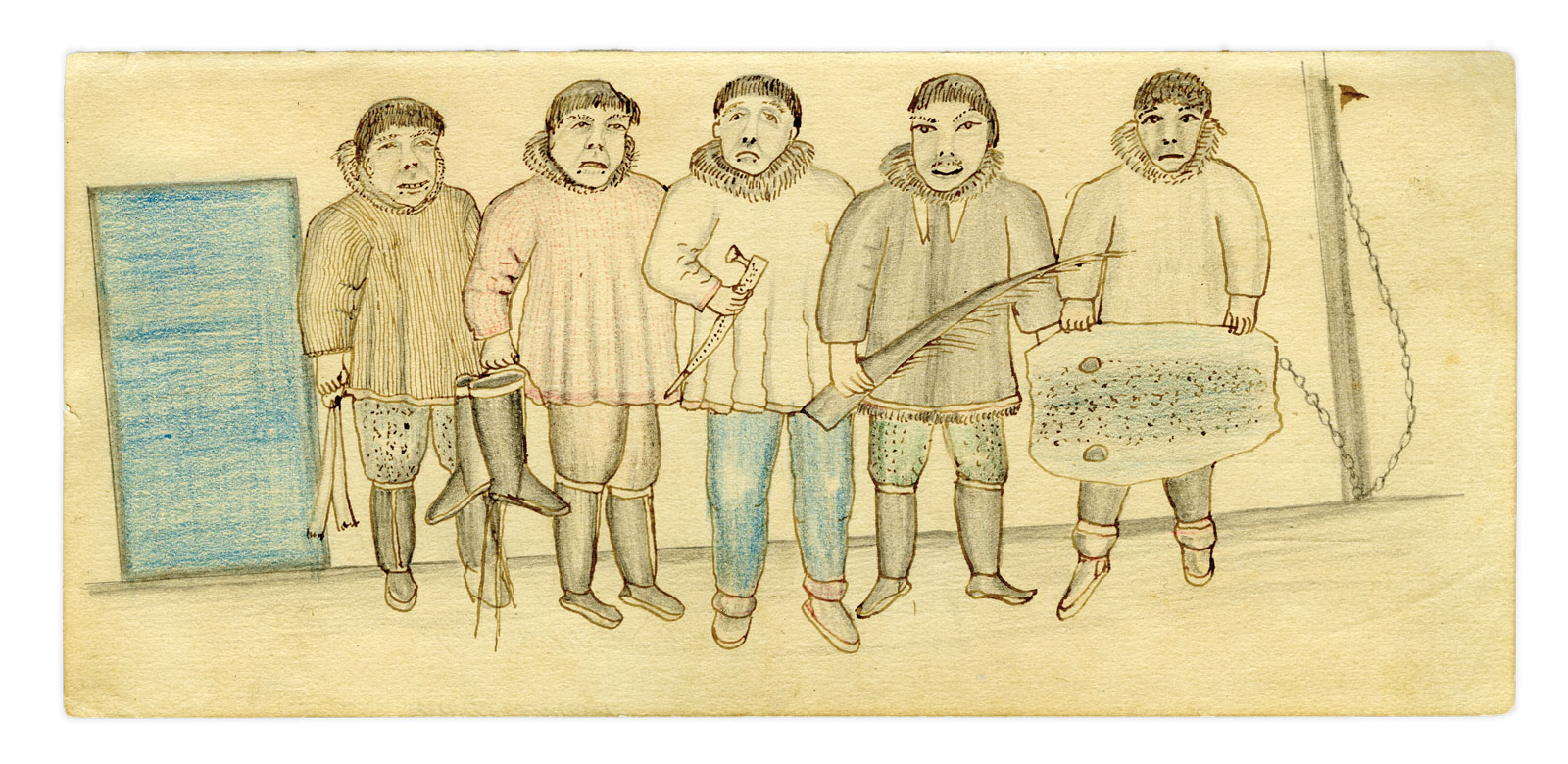 Maker once known (Iñupiat, possibly Port Clarence mission school), Iñupiaq men holding cultural belongings, ca. 1890s, pencil and ink on paper, 3½ x 77/8”. NBWM 1914.35.4.
Despite close proximity to the New Bedford Whaling Museum—Leonard received her postgraduate degree from the Rhode Island School of Design 30 miles asway—and her wide travels researching Indigenous whaling practices and logbooks, she had never visited the museum before starting research for this specific project in 2022.
“I think it’s fair to say, being Shinnecock, and other communities around here, we’ve experienced a lot of racism, other people being stewards of our (material culture),” Leonard says. “I’ve lived generationally knowing that some places were not welcoming for us to visit or be in, they weren’t engaging community. I never came to the New Bedford Whaling Museum…it wasn’t something I felt I could be a part of.”
That has changed in recent years, and Leonard credits New Bedford Whaling Museum chief curator Naomi Slipp for making the institution more welcoming.
“The BREACH Logbook work is about community,” says Leonard. “It’s about building connections, and also a documentation of our lived contemporary experiences and not always thinking of Indigenous people and this history as being a past history, it’s a present history for our communities.”
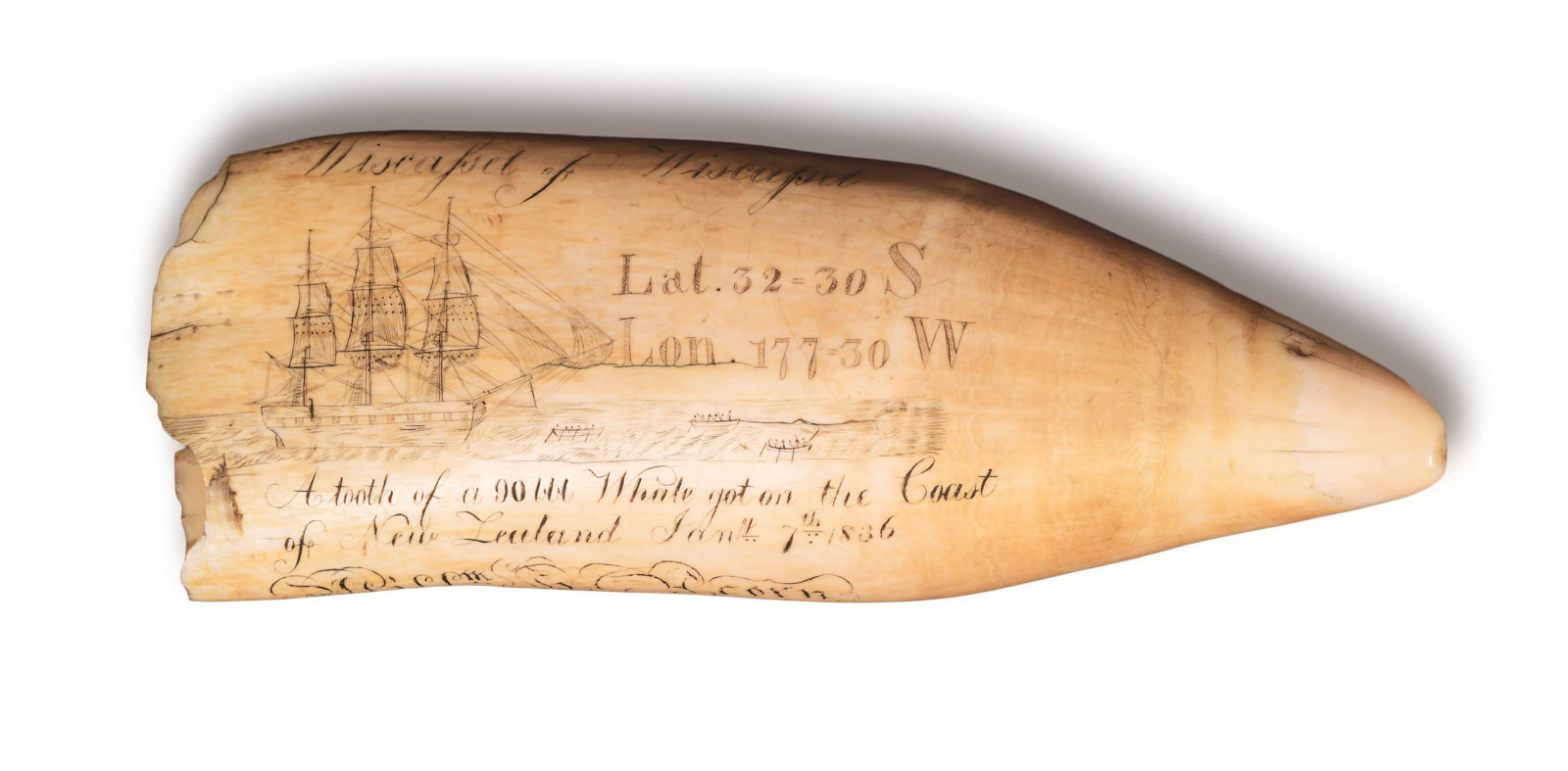 William H. Acorn, Wiscasset of Wiscasset tooth, 1836, sperm whale tooth, 45/8 x 91/16". NBWM 2001.100.1654.
The New Bedford Whaling Museum pairs BREACH: Logbook 24 | Scrimshaw with The Wider World & Scrimshaw, from June 14 to November 11. Together, the exhibitions engage Native cultural heritage and scrimshaw, introducing the rich, global, multicultural legacies of maritime history and whaling from past to present.
Focusing on whaling in the Pacific, The Wider World & Scrimshaw takes a fresh look at how the museum presents scrimshaw and considers how the items relate to Native cultural traditions in the Pacific at the same time by placing them side-by-side.
“The Wider World & Scrimshaw project and the collaboration with Courtney was an opportunity to explore the common misconceptions around these areas of collections and cultural belongings that have been segregated by museums,” Slipp says. “These categories don’t always make sense, and once they get separated, don’t get to talk to each other in interesting or useful ways.”
Museological hierarchy treating one set of objects as a rarified artform, the other as ethnographic. One celebrated, the other warehoused. While the New Bedford Whaling Museum’s world’s largest collection of scrimshaw has been thoroughly exhibited and studied, its holdings of Indigenous cultural heritage from the Pacific world hasn’t.
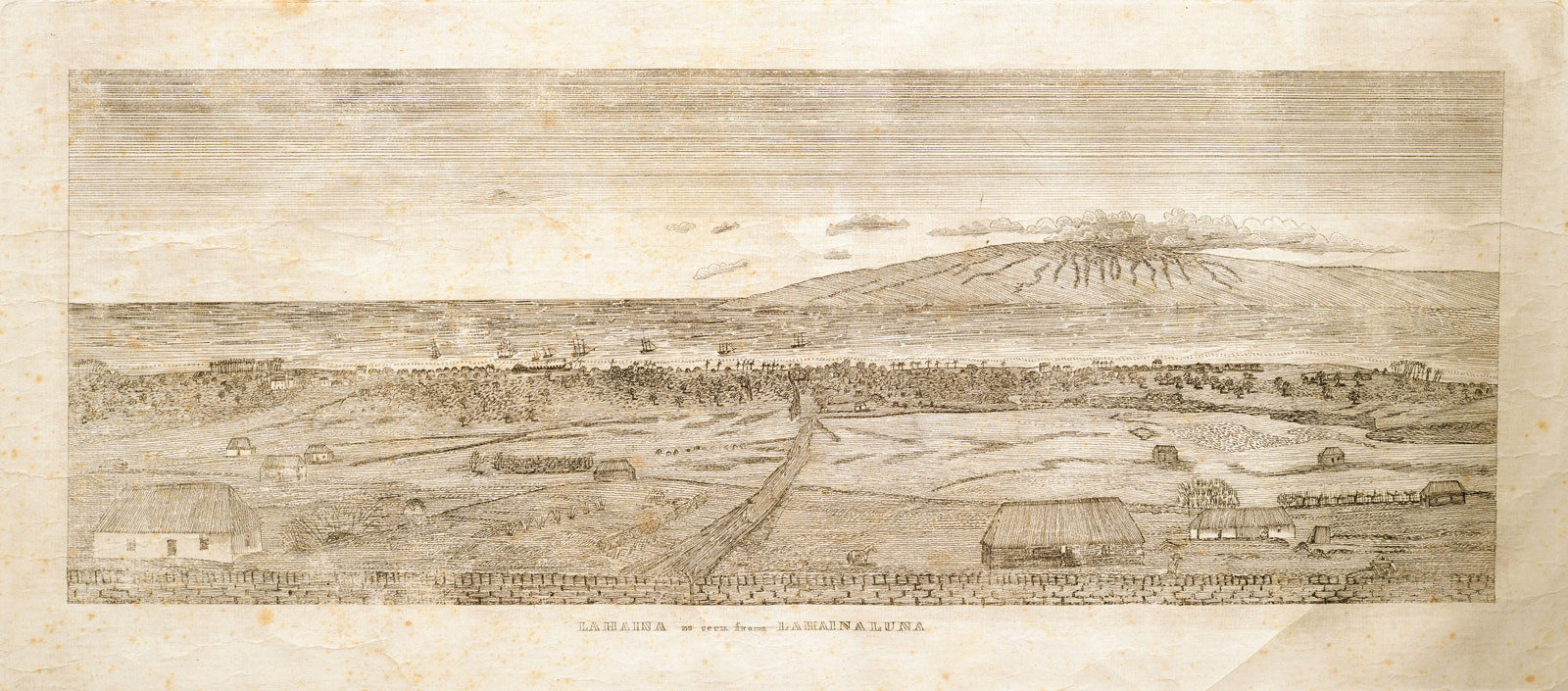 Kepohoni, “Lahaina as seen from Lahainaluna,” ca. 1840. Copperplate engraving from a painting by Persis Goodale Thurston, 16½ x 23½”. NBWM 2001.100.7309.
“The Wider World & Scrimshaw to me is not an end,” Slipp adds. “When we close the exhibition, it is an opening. An opening to forge relationships with individuals, that allow us to share these collections widely, that serves as a beginning to a much richer way of thinking about items and communities.”
June 1-November 3, 2024
BREACH: Logbook 24 | Scrimshaw
June 14-November 11, 2024
The Wider World & Scrimshaw
New Bedford Whaling Museum
18 Johnny Cake Hill, New Bedford, MA 02740
(508) 997-0046, www.whalingmuseum.org
Powered by Froala Editor


